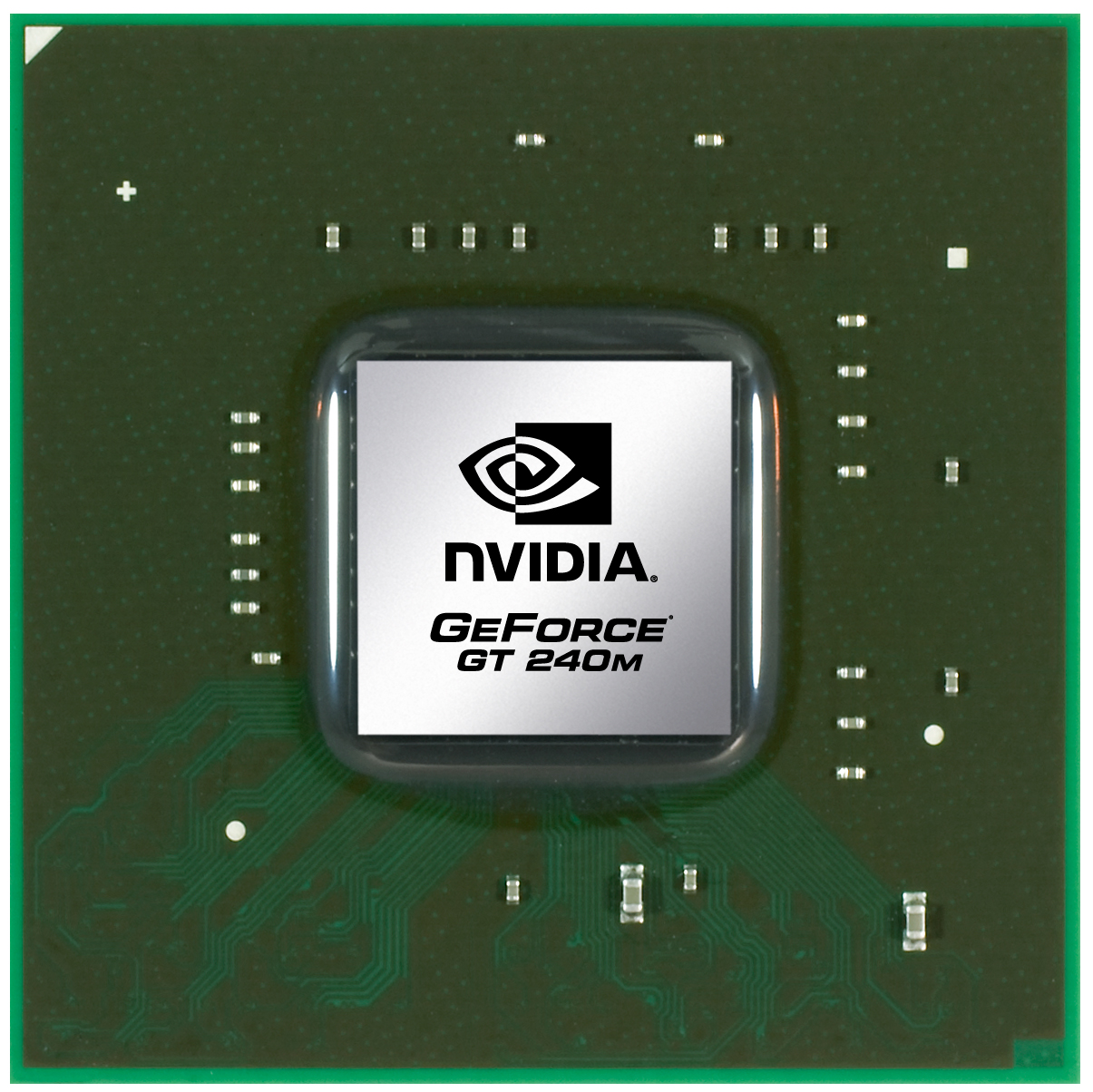
NVIDIA GeForce GT 240M The Nividia GeForce GT 240M is a DirectX 10.1 graphics adapter for notebooks based on the GT216 core. It is the successor of the GT 130M and technically a higher clocked GT 230M . Because of the 48 shader cores, it should perform noticeably better than the GT 130M and due to the 40nm production process the power consumption should stay the same. The GT240M was later succeeded by the very similar GT330M (slightly higher clocked).
The core of the GT230M is internally called GT216 and according to Nvidia based on the current high-end desktop architecture (GTX 200 series). Furthermore, Nvidia has improved the micro-architecture for further power saving and performance increases. Therefore, the performance per shader unit should be slightly improved compared to the previous generation.
As the GeForce 9700M GTS, the GT 240M features 48 stream processors that do the work of the former dedicated pixel- and vertex-shaders. The unified shaders of Nvidia are 1-dimensional (AMD has 5-dimensional shaders which leads to the higher number of shaders).
The GeForce GT240M also supports CUDA , DirectX Compute , OpenCL , and PhysiX to use the shaders for other tasks than rendering images (like encoding videos, calculating the physics of a game or mathematical tasks). For these special tasks, the GPU can be noticeably faster than current CPUs.
The mobile graphics card has a built in video decoder called PureVideo HD with VP4 . The Video Processor 4 (VP4) supports the full decoding of H.264, VC-1, and now also MPEG-4 ASP (e.g. DivX or XviD). MPEG-1 still wont be supported, but the decoding of this codec is quite trivial on a CPU.
In conjunction with a chipset from Nvidia with integrated graphics (e.g. 9400M), the GT 240M supports Hybrid-SLI (HybridPower and GeForceBoost). HybridPower is a technique to choose between the integrated and dedicated graphics core, if performance or battery runtime is needed. This works only in Windows Vista (and possibly Windows 7). Up to now the user has to use a tool to switch between the GPUs. Later Nvidia wants to switch automatically in the drivers. GeForceBoost is not supported by the GT 240M because the SLI combination would not perform better.
The performance of the middle class gpu GT 240M should be somewhere between the GeForce GT130M and the 9700M GTS and above the GT 230. Demanding DirectX 10 games from 2009 like Crysis should run fluently in medium details. Older or less demanding games should run in high detail settings and high resolutions. See below for detailed gaming benchmarks with the GT240M.
Depending on the the used type of graphics memory (GDDR2, GDDR3 or perhaps even DDR2/DDR3) the performance may differ noticeably.
The power consumption of the mobile graphics card is - like the GT 130M and GT 230M - 23 Watt (TDP). Furthermore, according to Nvidia, the new improved core does only need half of the power in Idle mode.
GeForce GT 200M Series Codename N10P-GS Architecture GT2xx Pipelines 48 - unified Core Speed 550 MHz Shader Speed 1210 MHz Memory Speed 800 MHz Memory Bus Width 128 Bit Memory Type DDR3, GDDR2, GDDR3 Max. Amount of Memory 1024 MB Shared Memory no API DirectX 10.1, Shader 4.1 Power Consumption 23 Watt Transistor Count 486 Million Man. Technology 40 nm Features DirectX Compute Support (Windows 7), CUDA, OpenCL, HybridPower, PhysX Notebook Size medium sized Date of Announcement 15.06.2009 Information 174 Gigaflops, 100 mm2 DIE Link to Manufacturer Page www.nvidia.com
Benchmarks 3DMark Vantage + 3DMark Vantage - 3DM Vant. Perf. total
min: 2348 avg: 2429 median: 2371.5 (1%) max: 2624 Points
3DM Vant. Perf. GPU no PhysX + 3DMark Vantage - 3DM Vant. Perf. GPU no PhysX
min: 2066 avg: 2092 median: 2080 (1%) max: 2146 Points
3DMark 2001SE - 3DMark 2001 - Standard
min: 21243 avg: 23708 median: 22708 (24%) max: 28631 Points
3DMark 03 - 3DMark 03 - Standard
min: 18038 avg: 18262 median: 18122 (9%) max: 18657 Points
3DMark 05 - 3DMark 05 - Standard
min: 11275 avg: 11811 median: 11577.5 (13%) max: 13004 Points
3DMark 06 3DMark 06 - Standard 1280x1024 + 3DMark 06
min: 5857 avg: 6077 median: 5952 (8%) max: 6320 Points
3DMark 06 - Standard 1280x800 + 3DMark 06
Model CPU GPU RAM Value 3DMark 06 - Standard 1280x800 Acer Aspire 7738G (3DMark 06 - Standard 1280x800) T6600 GeForce GT 240M 1 GB 4 GB 6567
3DMark 06 - Standard 1280x768 + 3DMark 06
Model CPU GPU RAM Value 3DMark 06 - Standard 1280x768 Acer Aspire 5739G (3DMark 06 - Standard 1280x768) T6600 GeForce GT 240M 550 / 790 MHz 1 GB 4 GB 6676
3DMark 06 - Standard 1280x720 + 3DMark 06
min: 6989 avg: 7136 median: 7052 (9%) max: 7367 Points
Model CPU GPU RAM Value 3DMark 06 - Standard 1280x720 Asus N71Vn (3DMark 06 - Standard 1280x720) P8700 GeForce GT 240M 550 / 790 MHz 1 GB 4 GB 6989 Asus N61Vn (3DMark 06 - Standard 1280x720) P8700 GeForce GT 240M 550 / 790 MHz 1 GB 4 GB 7052 Asus M60J (3DMark 06 - Standard 1280x720) 720QM GeForce GT 240M 1 GB 4 GB 7367
SPECviewperf 10 - SPEC Viewperf 10.0 - 3dsmax
SPECviewperf 10 - SPEC Viewperf 10.0 - Catia
SPECviewperf 10 - SPEC Viewperf 10.0 - EnSight
SPECviewperf 10 - SPEC Viewperf 10.0 - Maya
SPECviewperf 10 - SPEC Viewperf 10.0 - Pro/Engeneer
SPECviewperf 10 - SPEC Viewperf 10.0 - SolidWorks
SPECviewperf 10 - SPEC Viewperf 10.0 - UGS Teamcenter
SPECviewperf 10 - SPEC Viewperf 10.0 - UGS NX
Windows 7 Experience Index - Win7 Gaming graphics
Windows 7 Experience Index - Win7 Graphics
Windows Vista Experience Index - Windows Vista Leistungsindex - Grafik (Spiele)
Windows Vista Experience Index - Windows Vista Leistungsindex - Grafik
Cinebench R10 Cinebench R10 Shading (32bit) + Cinebench R10 - Cinebench R10 Shading (32bit)
min: 2922 avg: 3509 median: 3466.5 (2%) max: 4435 points
Cinebench R11.5 Cinebench R11.5 OpenGL 64 Bit + Cinebench R11.5 - Cinebench R11.5 OpenGL 64 Bit
- Range of benchmark values
- Average benchmark values
* Smaller numbers mean a higher performance
Game Benchmarks The following benchmarks stem from our benchmarks of review laptops. The performance depends on the used graphics memory, clock rate, processor, system settings, drivers, and operating systems. So the results don't have to be representative for all laptops with this GPU. For detailed information on the benchmark results, click on the fps number.
» With all tested laptops playable in detail settings low.
» With all tested laptops playable in detail settings med..
» With all tested laptops playable in detail settings low.
» With all tested laptops playable in detail settings high.
» With all tested laptops playable in detail settings high.
» With all tested laptops playable in detail settings low.
» With all tested laptops playable in detail settings med..
» With all tested laptops playable in detail settings high.
49.6 [X] Asus N71Vn Intel Core 2 Duo P8700 2.5GHz
GeForce GT 240M
50 [X] Acer Aspire 5739G Intel Core 2 Duo T6600 2.2GHz
GeForce GT 240M
50.1 53 [X] Asus N61Vn Intel Core 2 Duo P8700 2.5GHz
GeForce GT 240M
55.8 [X] Asus M60J Intel Core i7-720QM 1.6GHz
GeForce GT 240M
72 [X] Acer Aspire 7738G Intel Core 2 Duo T6600 2.2GHz
GeForce GT 240M
76 ~ 58 fps
+ Compare
- Hide Comparison
32.3 32.3 [X] Asus N71Vn Intel Core 2 Duo P8700 2.5GHz
GeForce GT 240M
32.6 [X] Asus N61Vn Intel Core 2 Duo P8700 2.5GHz
GeForce GT 240M
32.8 [X] Asus M60J Intel Core i7-720QM 1.6GHz
GeForce GT 240M
33 [X] Acer Aspire 5739G Intel Core 2 Duo T6600 2.2GHz
GeForce GT 240M
36 [X] Acer Aspire 7738G Intel Core 2 Duo T6600 2.2GHz
GeForce GT 240M
37 ~ 34 fps
+ Compare
- Hide Comparison
20 [X] Acer Aspire 5739G Intel Core 2 Duo T6600 2.2GHz
GeForce GT 240M
20 [X] Acer Aspire 7738G Intel Core 2 Duo T6600 2.2GHz
GeForce GT 240M
20.4 [X] Asus N61Vn Intel Core 2 Duo P8700 2.5GHz
GeForce GT 240M
20.5 [X] Asus M60J Intel Core i7-720QM 1.6GHz
GeForce GT 240M
20.6 [X] Asus N71Vn Intel Core 2 Duo P8700 2.5GHz
GeForce GT 240M
21 21.3 ~ 21 fps
+ Compare
- Hide Comparison
» With all tested laptops playable in detail settings low.
Additional Benchmarks
High 800x600
24 [X] Acer Aspire 5739G Intel Core 2 Duo T6600 2.2GHz
GeForce GT 240M
25 [X] Acer Aspire 7738G Intel Core 2 Duo T6600 2.2GHz
GeForce GT 240M
26.8 [X] Asus M60J Intel Core i7-720QM 1.6GHz
GeForce GT 240M
26.7 [X] Asus N61Vn Intel Core 2 Duo P8700 2.5GHz
GeForce GT 240M
26.8 [X] Asus N71Vn Intel Core 2 Duo P8700 2.5GHz
GeForce GT 240M
Low 0xAF 0xAA 800x600
52 [X] Acer Aspire 5739G Intel Core 2 Duo T6600 2.2GHz
GeForce GT 240M
72 [X] Acer Aspire 7738G Intel Core 2 Duo T6600 2.2GHz
GeForce GT 240M
60.4 [X] Asus M60J Intel Core i7-720QM 1.6GHz
GeForce GT 240M
57.9 [X] Asus N61Vn Intel Core 2 Duo P8700 2.5GHz
GeForce GT 240M
55.6 [X] Asus N71Vn Intel Core 2 Duo P8700 2.5GHz
GeForce GT 240M
Med 0xAF 0xAA 800x600
35 [X] Acer Aspire 5739G Intel Core 2 Duo T6600 2.2GHz
GeForce GT 240M
39 [X] Acer Aspire 7738G Intel Core 2 Duo T6600 2.2GHz
GeForce GT 240M
40.8 [X] Asus M60J Intel Core i7-720QM 1.6GHz
GeForce GT 240M
39.4 [X] Asus N61Vn Intel Core 2 Duo P8700 2.5GHz
GeForce GT 240M
36.9 [X] Asus N71Vn Intel Core 2 Duo P8700 2.5GHz
GeForce GT 240M
Low 1366x768
45 [X] Acer Aspire 5739G Intel Core 2 Duo T6600 2.2GHz
GeForce GT 240M
45.8 [X] Asus M60J Intel Core i7-720QM 1.6GHz
GeForce GT 240M
44.5 [X] Asus N61Vn Intel Core 2 Duo P8700 2.5GHz
GeForce GT 240M
Medium 1366x768
28 [X] Acer Aspire 5739G Intel Core 2 Duo T6600 2.2GHz
GeForce GT 240M
25.7 [X] Asus M60J Intel Core i7-720QM 1.6GHz
GeForce GT 240M
25.6 [X] Asus N61Vn Intel Core 2 Duo P8700 2.5GHz
GeForce GT 240M
High 1366x768
16 [X] Acer Aspire 5739G Intel Core 2 Duo T6600 2.2GHz
GeForce GT 240M
16 [X] Asus M60J Intel Core i7-720QM 1.6GHz
GeForce GT 240M
16 [X] Asus N61Vn Intel Core 2 Duo P8700 2.5GHz
GeForce GT 240M
Very High 1024x768
11.8 [X] Asus M60J Intel Core i7-720QM 1.6GHz
GeForce GT 240M
High 1600x900
12.8 [X] Asus N71Vn Intel Core 2 Duo P8700 2.5GHz
GeForce GT 240M
Med 1600x900
21 [X] Asus N71Vn Intel Core 2 Duo P8700 2.5GHz
GeForce GT 240M
Low 1600x900
37.4 [X] Asus N71Vn Intel Core 2 Duo P8700 2.5GHz
GeForce GT 240M
38 [X] Acer Aspire 5739G Intel Core 2 Duo T6600 2.2GHz
GeForce GT 240M
39 [X] Acer Aspire 7738G Intel Core 2 Duo T6600 2.2GHz
GeForce GT 240M
51.9 [X] Asus N71Vn Intel Core 2 Duo P8700 2.5GHz
GeForce GT 240M
54.7 [X] Asus N61Vn Intel Core 2 Duo P8700 2.5GHz
GeForce GT 240M
55.7 57.5 [X] Asus M60J Intel Core i7-720QM 1.6GHz
GeForce GT 240M
74 ~ 53 fps
+ Compare
- Hide Comparison
19 [X] Acer Aspire 5739G Intel Core 2 Duo T6600 2.2GHz
GeForce GT 240M
20 [X] Acer Aspire 7738G Intel Core 2 Duo T6600 2.2GHz
GeForce GT 240M
30.5 [X] Asus N71Vn Intel Core 2 Duo P8700 2.5GHz
GeForce GT 240M
30.9 [X] Asus M60J Intel Core i7-720QM 1.6GHz
GeForce GT 240M
32.4 [X] Asus N61Vn Intel Core 2 Duo P8700 2.5GHz
GeForce GT 240M
34 37 ~ 29 fps
+ Compare
- Hide Comparison
15 [X] Acer Aspire 5739G Intel Core 2 Duo T6600 2.2GHz
GeForce GT 240M
16 [X] Acer Aspire 7738G Intel Core 2 Duo T6600 2.2GHz
GeForce GT 240M
17 18.2 [X] Asus N61Vn Intel Core 2 Duo P8700 2.5GHz
GeForce GT 240M
18.4 [X] Asus N71Vn Intel Core 2 Duo P8700 2.5GHz
GeForce GT 240M
18.7 [X] Asus M60J Intel Core i7-720QM 1.6GHz
GeForce GT 240M
20 ~ 18 fps
+ Compare
- Hide Comparison
» With all tested laptops playable in detail settings low.
Additional Benchmarks
Med 0xAF 0xAA 800x600
20 [X] Acer Aspire 5739G Intel Core 2 Duo T6600 2.2GHz
GeForce GT 240M
23 [X] Acer Aspire 7738G Intel Core 2 Duo T6600 2.2GHz
GeForce GT 240M
37.6 [X] Asus M60J Intel Core i7-720QM 1.6GHz
GeForce GT 240M
37.2 [X] Asus N61Vn Intel Core 2 Duo P8700 2.5GHz
GeForce GT 240M
33.1 [X] Asus N71Vn Intel Core 2 Duo P8700 2.5GHz
GeForce GT 240M
Low 0xAF 0xAA 800x600
40 [X] Acer Aspire 5739G Intel Core 2 Duo T6600 2.2GHz
GeForce GT 240M
44 [X] Acer Aspire 7738G Intel Core 2 Duo T6600 2.2GHz
GeForce GT 240M
65.3 [X] Asus M60J Intel Core i7-720QM 1.6GHz
GeForce GT 240M
61.3 [X] Asus N61Vn Intel Core 2 Duo P8700 2.5GHz
GeForce GT 240M
67.6 [X] Asus N71Vn Intel Core 2 Duo P8700 2.5GHz
GeForce GT 240M
High 0xAF 0xAA 800x600
18 [X] Acer Aspire 5739G Intel Core 2 Duo T6600 2.2GHz
GeForce GT 240M
18 [X] Acer Aspire 7738G Intel Core 2 Duo T6600 2.2GHz
GeForce GT 240M
24.1 [X] Asus M60J Intel Core i7-720QM 1.6GHz
GeForce GT 240M
24.1 [X] Asus N61Vn Intel Core 2 Duo P8700 2.5GHz
GeForce GT 240M
24.4 [X] Asus N71Vn Intel Core 2 Duo P8700 2.5GHz
GeForce GT 240M
Low 1366x768
33 [X] Acer Aspire 5739G Intel Core 2 Duo T6600 2.2GHz
GeForce GT 240M
46.3 [X] Asus M60J Intel Core i7-720QM 1.6GHz
GeForce GT 240M
45.7 [X] Asus N61Vn Intel Core 2 Duo P8700 2.5GHz
GeForce GT 240M
Medium 1366x768
17 [X] Acer Aspire 5739G Intel Core 2 Duo T6600 2.2GHz
GeForce GT 240M
25.2 [X] Asus M60J Intel Core i7-720QM 1.6GHz
GeForce GT 240M
25.1 [X] Asus N61Vn Intel Core 2 Duo P8700 2.5GHz
GeForce GT 240M
High 1366x768
13 [X] Acer Aspire 5739G Intel Core 2 Duo T6600 2.2GHz
GeForce GT 240M
15.1 [X] Asus M60J Intel Core i7-720QM 1.6GHz
GeForce GT 240M
15.1 [X] Asus N61Vn Intel Core 2 Duo P8700 2.5GHz
GeForce GT 240M
Very High 1024x768
10.8 [X] Asus M60J Intel Core i7-720QM 1.6GHz
GeForce GT 240M
High 1600x900
12.3 [X] Asus N71Vn Intel Core 2 Duo P8700 2.5GHz
GeForce GT 240M
Med 1600x900
20.9 [X] Asus N71Vn Intel Core 2 Duo P8700 2.5GHz
GeForce GT 240M
Low 1600x900
38.9 [X] Asus N71Vn Intel Core 2 Duo P8700 2.5GHz
GeForce GT 240M
» The benchmarks indicate that the game is not playable in the tested settings.
» With all tested laptops playable in detail settings high.
» With all tested laptops playable in detail settings high.
» With all tested laptops playable in detail settings high.
» With all tested laptops playable in detail settings high.
» With all tested laptops playable in detail settings high.
For more games that might be playable and a list of all games and graphics cards visit our Gaming List
v1.35
log 09. 13:04:13
#0 ran 0s before starting gpusingle class +0s ... 0s
#1 no ids found in url (should be separated by "_") +0s ... 0s
#2 not redirecting to Ajax server +0s ... 0s
#3 did not recreate cache, as it is less than 5 days old! Created at Mon, 07 Sep 2026 05:34:59 +0200 +0.002s ... 0.002s
#4 composed specs +0.016s ... 0.018s
#5 did output specs +0s ... 0.018s
#6 start showIntegratedCPUs +0s ... 0.018s
#7 getting avg benchmarks for device 1296 +0.015s ... 0.033s
#8 got single benchmarks 1296 +0.021s ... 0.053s
#9 got avg benchmarks for devices +0s ... 0.053s
#10 min, max, avg, median took s +0.645s ... 0.698s
#11 before gaming benchmark output +0s ... 0.698s
#12 Got 106 rows for game benchmarks. +0.005s ... 0.703s
#13 composed SQL query for gamebenchmarks +0s ... 0.703s
#14 got data and put it in $dataArray +0.006s ... 0.708s
#15 benchmarks composed for output. +0.111s ... 0.819s
#16 return log +0.556s ... 1.375s






 - Average benchmark values



 Add as a preferred source on Google


