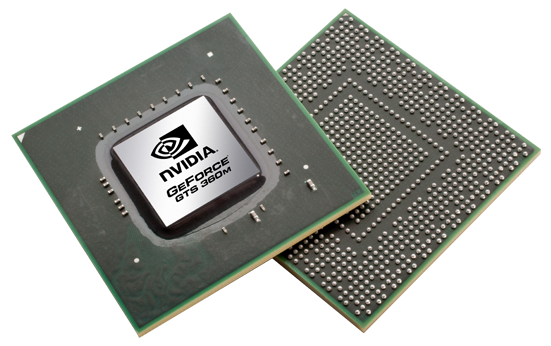
The GT215 architecture supports DirectX 10.1 and OpenGL 2.1 and features 96 shader cores, similar to the 9800M GT. The memory bus of the GTS 360M, however, is only 128 bit wide. To compensate, the GPU supports faster GDDR5 VRAM. Therefore, overall performance is significantly faster compared to models with slower DDR3 VRAM.
Similar to the GeForce 9800M GT, the GTS 360M features 96 stream processors that do the graphics work of the former dedicated pixel- and vertex-shaders. The unified shaders of Nvidia are 1-dimensional (AMD has 5-dimensional shaders which lead to the higher number of shaders). The shaders of the GT215 core are based on the GTX 200 desktop architecture and are therefore improved compared to the G92 based cards (e.g., 9800M GT).
The GeForce GPU also supports CUDA, DirectX Compute, OpenCL, and PhysX to use the shaders for other tasks than rendering images (for example, encoding videos or calculating physics of a game or mathematical tasks). For these special tasks, the GPU can be noticeably faster than current CPUs.
The mobile graphics card has a built in video decoder called PureVideo HD with VP4. The Video Processor 4 (VP4) supports the full decoding of H.264, VC-1, and now also MPEG-4 ASP (e.g. DivX or XviD). MPEG-1 is still not supported, but the decoding of this codec is quite trivial on a CPU.
In conjunction with an Nvidia integrated graphics (e.g. 9400M), the GTS 360M supports Hybrid-SLI in the form of HybridPower. HybridPower is a Windows Vista-only technique for switching between the integrated and dedicated graphics core for power-saving purposes. Up to now, the user had to use a tool to switch between the GPUs. Later, HybridPower was succeeded by Optimus, which can automatically switch between GPUs directly through drivers. GeForceBoost is not supported by the GTS 360M as the SLI combination with the integrated GPU would provide no significant performance boosts.
The performance of the mid- to high-class GeForce GTS 360M should be slightly above the GTS 260M because of the higher clock speed. Demanding DirectX 10 games like Crysis should run fluently in medium to high details and lower resolutions. Older or less demanding games should run in high detail settings and high resolutions fluently. More details about the gaming performance can be found in our benchmarks below.
Depending on the type of graphics memory used (GDDR5 or GDDR3), the performance of the GTS 360M may differ. The maximum clock rate can also differ according to the used graphics RAM. For models equipped with GDDR5 VRAM, the maximum supported clock rate is 2000 MHz.
The power consumption should be similar to the slightly slower clocked GTS 260M, which is rated at 38 Watt TDP. Therefore, the GTS 360M is intended for larger laptops with powerful cooling solutions.
GeForce GTS 300M Series| GeForce GTS 360M | 96 @ 0.58 GHz | 128 Bit @ 1800 MHz | GeForce GTS 350M  | 96 @ 0.5 GHz | 128 Bit @ 1600 MHz |
|
| Codename | N11E-GS1 |
| Architecture | GT2xx |
| Pipelines | 96 - unified |
| Core Speed | 575 MHz |
| Shader Speed | 1325 MHz |
| Memory Speed | 1800 MHz |
| Memory Bus Width | 128 Bit |
| Memory Type | DDR3, GDDR3, GDDR5 |
| Max. Amount of Memory | 1024 MB |
| Shared Memory | no |
| API | DirectX 10.1, Shader 4.1 |
| Transistor Count | 727 Million |
| Man. Technology | 40 nm |
| Features | DirectX Compute Support (Windows 7), CUDA, OpenCL, HybridPower, PhysX, SLI, Powermizer 8.0, MXM 3.0 Type-B |
| Notebook Size | large |
| Date of Announcement | 07.01.2010 |
| Information | 360 GFlops |
| Link to Manufacturer Page | www.nvidia.com |
The following benchmarks stem from our benchmarks of review laptops. The performance depends on the used graphics memory, clock rate, processor, system settings, drivers, and operating systems. So the results don't have to be representative for all laptops with this GPU. For detailed information on the benchmark results, click on the fps number.
| low | med. | high | ultra | QHD | 4K |
|---|
| Metro 2033 | 42.2 | 32.1 | 17.9 | | | |
|---|
| Battlefield: Bad Company 2 | | 52 | 40.2 | 21.6 | | |
|---|
| CoD Modern Warfare 2 | | 61.3 | 53.1 | 34 | | |
|---|
| Risen | | 45.7 | 33.4 | 23.2 | | |
|---|
| Need for Speed Shift | | 63.2 | 53.1 | 32 | | |
|---|
| Colin McRae: DIRT 2 | | 80.9 | 50.2 | 27.8 | | |
|---|
| Anno 1404 | 122.6 | | | 39.1 | | |
|---|
| Crysis - GPU Benchmark | | 62.4 | 38.5 | 9.9 | | |
|---|
| Crysis - CPU Benchmark | | 60.5 | 34.5 | 9.4 | | |
|---|
| low | med. | high | ultra | QHD | 4K |
|---|
< 30 fps
< 60 fps
< 120 fps
≥ 120 fps |
1
1 |
3
5
| 1
7
| 5
3
|
|
|
log 15. 08:04:52
#0 ran 0s before starting gpusingle class +0s ... 0s
#1 no ids found in url (should be separated by "_") +0s ... 0s
#2 not redirecting to Ajax server +0s ... 0s
#3 did not recreate cache, as it is less than 5 days old! Created at Mon, 13 Jul 2026 05:31:40 +0200 +0.002s ... 0.002s
#4 composed specs +0.025s ... 0.027s
#5 did output specs +0s ... 0.027s
#6 start showIntegratedCPUs +0s ... 0.027s
#7 getting avg benchmarks for device 1598 +0.017s ... 0.044s
#8 got single benchmarks 1598 +0.017s ... 0.061s
#9 got avg benchmarks for devices +0s ... 0.061s
#10 min, max, avg, median took s +0.5s ... 0.561s
#11 before gaming benchmark output +0s ... 0.561s
#12 Got 26 rows for game benchmarks. +0.003s ... 0.565s
#13 composed SQL query for gamebenchmarks +0s ... 0.565s
#14 got data and put it in $dataArray +0.004s ... 0.569s
#15 benchmarks composed for output. +0.109s ... 0.678s
#16 return log +0.556s ... 1.234s






 - Average benchmark values



 Add as a preferred source on Google


