
NVIDIA GeForce 9800M GT

NVIDIA GeForce 9800M GT

The Nvidia GeForce 9800M GT is a graphics adapter for laptops and based on the  9800M GTX (G92 core) but features only 96 shaders (instead of the 112 of the GTX). The 9800M GT is produced in 65 nm and is therefore similar to the 8800M GTX (same shader count). The chip is intended for large desktop replacement laptops with a good cooling device. 

As all cards with DirectX 10 capabilities, the GeForce 9800M GT renders the 3D images using "Unified Shaders". There don't exist any more dedicated pixel- and vertex shaders but 96 so called stream processors make the graphic work (which has been done by pixel and vertex shaders in former days). Furthermore, the shader units are higher clocked than the chip.

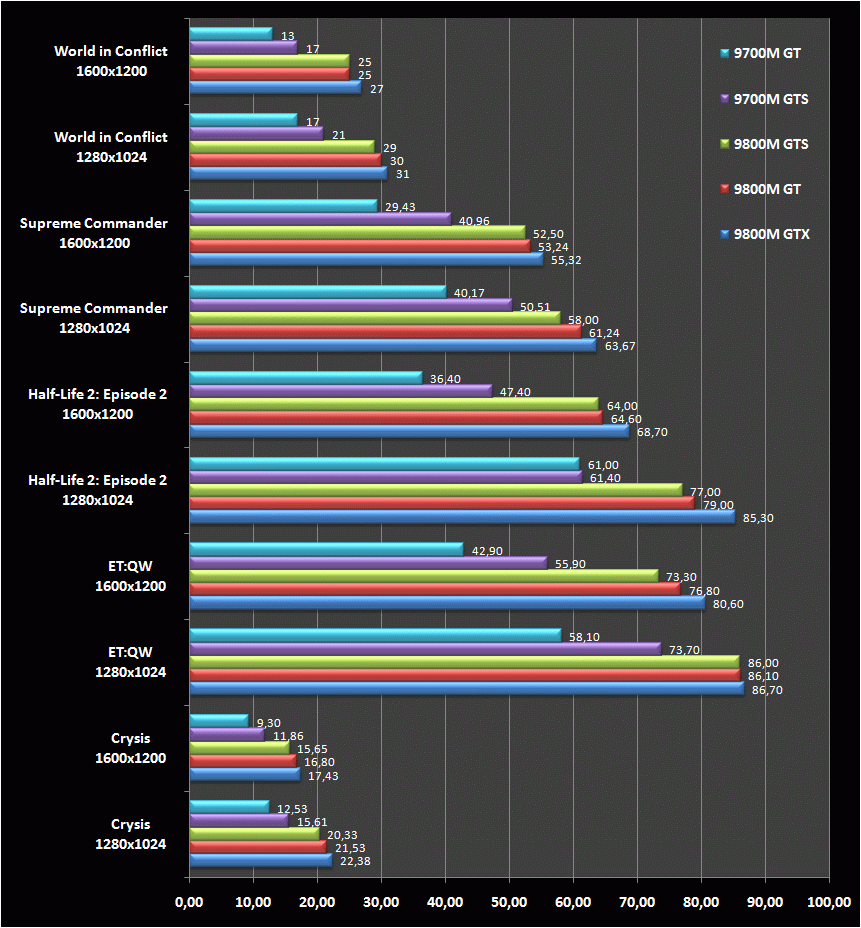
The performance of the 9800M GT is similar to the Geforce 8800M GTX (same spacs). The GTS 360M with GDDR5 and the 9800M GTS (due to the higher clock speed) are also performing on the level of the 9800M GT. Therefore, the performance of the card in 2008 and 2009 was sufficient for most games in high details. A detailed performance analysis of the 9800M GT can be found in our 9800M GT review.

An advantage of the GeForce 9000 series is the integrated PureVideo HD video processor. It is able to help with the decoding of H.264-, VC-1-, MPEG2- and WMV9 video material in HD quality and eases the CPU.

In conjunction with the Nvidia 9100M G integrated graphics, the 9800M GT supports Hybrid-SLI (only HybridPower). HybridPower is a technique to choose between the integrated and dedicated graphics core, if performance or battery runtime is needed. This works only in Windows Vista. Up to now the user has to use a tool to switch between the GPUs. Later Nvidia wants to switch automatically in the drivers. GeForceBoost is not supported with this card, as there would be no performance gain to combine the integrated GPU with the 9800M GT.

Compared to desktop graphic cards, the 9800M GT is similar to the GeForce 8800 GS (which features a higher memory clock rate and is therefore a bit faster).

ManufacturerNVIDIA
GeForce 9800M Series

GeForce 9800M GT SLI 192@500MHz

GeForce 9800M GTS SLI 128@600MHz

GeForce 9800M GTX 112@500MHz

GeForce 9800M GT 96@500MHz

GeForce 9800M GTS 64@600MHz

GeForce 9800M GS 64@530MHz

CodenameNB9E-GT2
Pipelines96 - unified
Core Speed *500 MHz
Shader Speed *1250 MHz
Memory Speed *800 MHz
Memory Bus Width256 Bit
Memory TypeGDDR3
Max. Amount of Memory512 MB
Shared Memoryno
DirectXDirectX 10, Shader 4.0
Current Consumption65 Watt
Transistors754 Million
technology65 nm
FeaturesPureVideo HD, CUDA, PhysX-ready, Hybrid-SLI (HybridPower)
Notebook Sizelarge
Date of Announcement15.07.2008
InformationMXM 3
Link to Manufacturer Pagehttp://www.nvidia.com/object/geforce_980...
* The specified clock rates are only guidelines for the manufacturer and can be altered by them.

Benchmarks

3DMark 2001SE - Standard 1024x768
0% 100%
min: 34871     avg: 35284.5 (58%)     max: 35698 Points
3DMark 03 - Standard 1024x768
0% 100%
min: 30129     avg: 30223.5 (28%)     max: 30318 Points
3DMark 05 - Standard 1024x768
0% 100%
min: 14713     avg: 14869 (46%)     max: 15025 Points
3DMark 06
0% 100%
min: 9228     avg: 9416 (36%)     max: 9762 Points
PCMark Vantage - Gaming Score 1024x768
0% 100%
min: 4086     avg: 4086 (18%)     max: 4086 Points
Cinebench R10 - Shading 32Bit
0% 100%
min: 4460     avg: 4526.5 (42%)     max: 4593 Points
3DMark Vantage - P Result no PhysX 1280x1024
0% 100%
min: 4011     avg: 4011 (13%)     max: 4011 Points
3DMark Vantage - P GPU no PhysX 1280x1024
0% 100%
min: 3725     avg: 3725 (11%)     max: 3725 Points
- Range of benchmark values for this graphics card
- Average benchmark values for this graphics card

Game Benchmarks

The following benchmarks stem from our benchmarks of review laptops. The performance depends on the used graphics memory, clock rate, processor, system settings, drivers, and operating systems. So the results don't have to be representative for all laptops with this GPU. For detailled information on the benchmark results, click on the fps number.

Crysis - GPU Benchmark
Crysis - GPU Benchmark (2007)
low:
67.3 98.4 ~ 83 fps      Compare
med.:
49.8 55.6 ~ 53 fps      Compare
high:
33.1 35.5 ~ 34 fps      Compare
» With all tested laptops playable in detail settings med..
Crysis - CPU Benchmark
Crysis - CPU Benchmark (2007)
low:
75.4 115.9 ~ 96 fps      Compare
med.:
46.1 52.2 ~ 49 fps      Compare
high:
30.9 33.1 ~ 32 fps      Compare
» With all tested laptops playable in detail settings med..
World in Conflict - Benchmark
World in Conflict - Benchmark (2007)
med.:
66  fps      Compare
high:
37  fps      Compare
» With all tested laptops playable in detail settings high.
Command and Conquer III (2007): Not playable with a weaker graphics card. - more...
F.E.A.R.
F.E.A.R. (2005)
low:
551 558 ~ 555 fps      Compare
med.:
273 274 ~ 274 fps      Compare
high:
117 118 ~ 118 fps      Compare
» With all tested laptops playable in detail settings high.
World of Warcraft (2005): Playable with a weaker graphics card in detail settings med.. - more...
Doom 3
Doom 3 (2004)
low:
150.9  fps      Compare
med.:
146.2  fps      Compare
high:
144.9  fps      Compare
ultra:
141.1  fps      Compare
» With all tested laptops playable in detail settings ultra.
Quake 3 Arena - Timedemo
Quake 3 Arena - Timedemo (1999)
high:
624  fps      Compare
» With all tested laptops playable in detail settings high.

For more games that might be playable and a list of all games and graphics cards visit our Gaming List

Gaming Performance

These benchmarks were conducted with high end notebooks (quad-core desktop CPU). Therefore, the performance with slower laptops may decrease.

Crysis: 1280x1024, very high: 21 fps -> not playable (in high playable)
Enemy Territory: Quake Wars: 1600x1200: 76 fps -> fluently playable
Half Life 2 - Episode 2: 1600x1200: 64 fps -> fluently playable 
Supreme Commander: 1600x1200: 53 fps -> fluently playable
World in Conflict: 1280x1024: 30 fps -> playable

GeForce 9M Serie im Vergleich (Daten von Nvidia mit Desktop Q6600 CPU)

Notebook reviews with NVIDIA GeForce 9800M GT graphics card

Clevo M860TU (Intel Core 2 Duo T9400, 15,4")
» Clevo M860TU - External Review

Clevo M860TU (9800M GT) (Intel Core 2 Duo P9500, 15.4")
» Review Deviltech 9000 DTX (Clevo M860TU) Notebook - Review

Cyber System SX15 (Intel Core 2 Duo T9600, 15.4")
» Cyber System SX15 - External Review

Packard Bell iPower GX-Q-030 (Intel Core 2 Quad Q9000, 17.0")
» Packard Bell iPower GX-Q-030 - External Review

Rock Xtreme 620 (Intel Core 2 Duo T9600, 15.4")
» Rock Xtreme 620 - External Review

» Comparison of GPUs
Detailled list of all laptop GPUs with a short description. Classified and sorted by performance.

» Benchmark List
Sortable and restrainable list of all GPUs with benchmarks (e.g. 3DMarks).

» Notebook Gaming List
Which game can be played with my graphics card.

Class 1
GeForce GTX 590
GeForce GTX 580
Radeon HD 6970
GeForce GTX 570
GeForce GTX 480
GeForce GTX 560 Ti
Radeon HD 6870
GeForce GTX 470
Radeon HD 5850
GeForce GTX 460 768MB
Radeon HD 6790
Radeon HD 5770
GeForce GTX 550 Ti
GeForce GTS 450
Radeon HD 4850
Radeon HD 5670
Class 2
GeForce GT 240
GeForce GT 430
7590M *
Radeon HD 5570
Radeon HD 6550D *
GeForce GT 220
Radeon HD 6450 GDDR5
Class 3
Radeon HD 4350
GeForce G 107M *
Chrome9HD *
Class 4
Class 5
Class 6
SGX543MP2 *
Mali-400 MP *
PowerVR SGX540 *
PowerVR SGX535
unknown *

* Approximate position of the graphics adapter

> Notebook / Laptop Reviews and News > FAQ / Tips / Technics > Comparison of Laptop Graphics Cards > NVIDIA GeForce 9800M GT
Author: Klaus Hinum (Update: 2012-01-25)