GF104 architecture
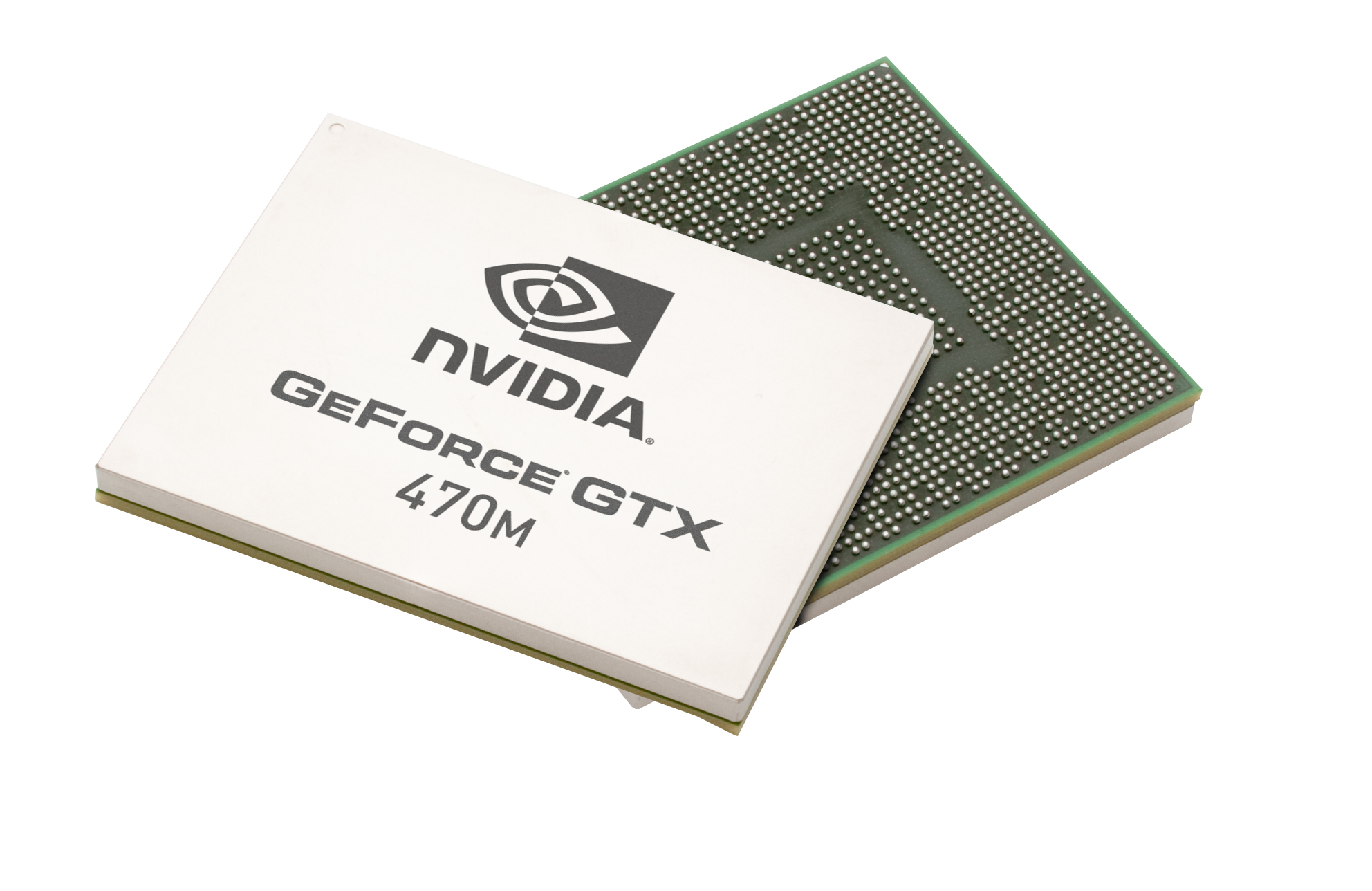
The GF104 core of the GTX 470M is related to the GF100 core of the GeFore GTX 480M that offers 384 shaders and a 256 Bit memory bus for GDDR5. The GTX 470M, however, offers only 288 cores of the 384 and a 192 Bit memory bus. The architecture of the GF104 is not comparable to the old GT215 (e.g., GeForce GTS 350M) or G92b (e.g., GeForce GTX 285M) cores.
Unlike the GF100, the smaller GF104, GF106, and GF108 cores were shortened and considerably modified. In contrast to the GF100, which was designed for professional applications, these chips target the consumer market. They feature more shaders (3x16 instead of 2x16), more texture units (8 instead of 4) and SFUs per streaming multi-processor (SM). As there are still only 2 warp schedulers (versus 3 shader groups), Nvidia now uses superscalar execution to use the higher amount of shaders per SM more efficiently. In theory, the shaders can therefore be utilized more efficiently and the performance per core is improved.
However, in worst case scenarios the performance can also be worse than that of the GF100 (and its predecessors). The ECC memory protection, which is important for professional applications, was completely omitted and the FP64 hardware was shortened (only 1/3 of the shader are FP64-capable and therefore only 1/12 of the performance of the FP32). Because of these cutbacks, the size of the SM grew only by 25% despite the higher number of shaders and larger warp schedulers with superscalar dispatch capabilities. Due to the different shader architectures and the higher clock rate of the shader domain, the core count can not be directly compared to AMD cores of the Radeon 5000 series (e.g. HD 5850).
Detailed information on the GF104 architecture (and by extension also the GF106 and GF108) can be found in the desktop GTX 460 article by Anandtech.
Performance
The performance of the GTX 470M SLI combination should be similar to the GTX 480M SLI due to the high-clocked GTX470M cards. Generally, the SLI gain depends on the used application/game and the driver support. Currently, the SLI driver support from Nvidia is better than the Crossfire support from AMD, leading to higher gains. About 30% more performance is gained on average compared to a single GTX 470M (in high resolutions and with Anti-Aliasing). Therefore, all games from 2010 except Metro 2033 should be playable in the highest detail settings. Metro 2033 only ran with 23 fps in our tests with a GTX 480M SLI system and should therefore score similar on the GTX 470M SLI combination.
Features
A novelty of the GF104/106/108 chips is the support of Bitstream HD Audio (Blu-Ray) output via HDMI. Similar to the Radeon HD 5850, the GTX 470M can transfer Dolby True HD and DTS-HD bitstream without quality loss to a HiFi receiver.
The GTX470M offers the PureVideo HD technology for video decoding. The included Video Processor 4 (VP4) supports feature set C and therefore the GPU is able to fully decode MPEG-1, MPEG-2, MPEG-4 Part 2 (MPEG-4 ASP - e.g., DivX or Xvid), VC-1/WMV9, and H.264 (VLD, IDCT, Motion Compensation, and Deblocking). The X500 tester was able to decode the VC-1 encoded Elephants Dream video with about 3-6% CPU load (according to the task manager). The H.264-encoded Big Buck Bunny video was played back with 1-3% CPU load (both 1080p videos).
Furthermore, the GPU is able to decode two 1080p streams simultaneously (e.g. for Blu-Ray Picture-in-Picture).
Through CUDA, OpenCL and DirectCompute 2.1 support, the GeForce GTX 470M can assist in general calculations. For example, the stream processor can encode videos considerably faster than certain high-end CPUs. Furthermore, physics calculations can be done by the GPU using PhysX (e.g. supported by Mafia 2 or Metro 2033). SLI systems can also dedicate a single card for PhysX calculations.
According to Nvidia, support for 3D Vision on the GTX graphics cards is also new. It enables the laptop to send 3D contents (3D games, 3D Web Streaming, 3D photos, 3D Blu-Rays) to a built-in 3D enabled screen or an external 3D TV (only if supported by the laptop manufacturer).
Unofficially, the power consumption of the GeForce GTX 470M should be about 75 Watt (TDP including the MXM board and memory), which is about the level of the Mobility Radeon HD 5870. Therefore, the SLI system needs 2x75 Watt and therefore a lot less than the GTX 480M SLI with 2x100W. Without load, the chip is clocked at 50/100 MHz (chip/shader) in 2D respectively 200/400 in 3D mode to save power.
Compared to desktop graphics cards, the GTX 470M SLI combination is most similar in performance to a GTS 450 SLI combo, as the desktop GTX 470 is significantly faster.
GeForce GTX 400M Series |
| Codename | N11E-GT |
| Architecture | Fermi |
| Pipelines | 576 - unified |
| Core Speed | 535 MHz |
| Shader Speed | 1070 MHz |
| Memory Speed | 1250 MHz |
| Memory Bus Width | 192 Bit |
| Memory Type | GDDR5 |
| Shared Memory | no |
| API | DirectX 11, Shader 5.0 |
| Man. Technology | 40 nm |
| Notebook Size | large |
| Date of Announcement | 01.11.2010 |
The following benchmarks stem from our benchmarks of review laptops. The performance depends on the used graphics memory, clock rate, processor, system settings, drivers, and operating systems. So the results don't have to be representative for all laptops with this GPU. For detailed information on the benchmark results, click on the fps number.
log 15. 12:23:17
#0 ran 0s before starting gpusingle class +0s ... 0s
#1 no ids found in url (should be separated by "_") +0s ... 0s
#2 not redirecting to Ajax server +0s ... 0s
#3 did not recreate cache, as it is less than 5 days old! Created at Mon, 13 Jul 2026 05:31:40 +0200 +0.006s ... 0.006s
#4 composed specs +0.051s ... 0.056s
#5 did output specs +0s ... 0.056s
#6 start showIntegratedCPUs +0s ... 0.056s
#7 getting avg benchmarks for device 2104 +0.021s ... 0.077s
#8 got single benchmarks 2104 +0.008s ... 0.085s
#9 got avg benchmarks for devices +0s ... 0.085s
#10 min, max, avg, median took s +1.06s ... 1.145s
#11 before gaming benchmark output +0s ... 1.145s
#12 Got 66 rows for game benchmarks. +0.004s ... 1.149s
#13 composed SQL query for gamebenchmarks +0s ... 1.149s
#14 got data and put it in $dataArray +0.011s ... 1.16s
#15 benchmarks composed for output. +0.278s ... 1.438s
#16 return log +0.763s ... 2.201s







 - Average benchmark values



 Add as a preferred source on Google


