
Notebookcheck

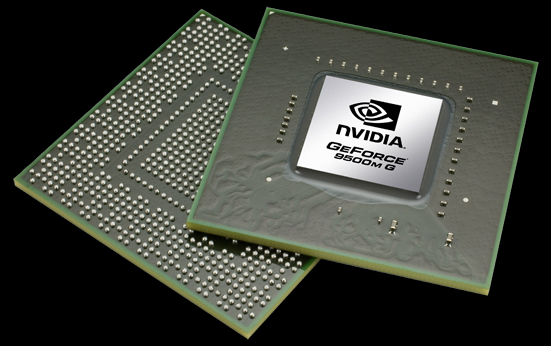
NVIDIA GeForce 9500M G

NVIDIA GeForce 9500M G

The Nvidia GeForce 9500M G is the successor of the 8600M GS as it also featuresonly 16 unified shaders (the 9600M series features 32). Compared to the8600M GS, the 9500M G has an improved PureVideo HD engine (VP3), supports Hybrid-SLI and needs less current (because of the 65nm process).

In conjunction with the Nvidia 9100M G integrated graphics, the 9500M G supports Hybrid-SLI (HybridPower and GeForceBoost). HybridPower is a technique to choose between the integrated and dedicated graphics core, if performance or battery runtime is needed. This works only in Windows Vista. Up to now the user has to use a tool to switch between the GPUs. Later Nvidia wants to switch automatically in the drivers. GeForceBoost uses the integrated graphics core of the 9100M G and the dedicated of the 9500M G in SLI mode to achieve better frame rates.

As the 8600M GS, the 9500M G features 16 stream processors that do the work of the former dedicated pixel- and vertex-shaders. The unified shaders of Nvidia are 1-dimensional (AMD has 5-dimensional shaders which leads to the higher number of shaders).

The desktop GeForce 9500 graphics card is not compareable to the mobile 9500M G, because it has 32 stream processors (compareable to the 9600M series).

ManufacturerNVIDIA
SeriesGeForce 9M
CodenameNB9P
Pipelines16 - unified
Core Speed *500 MHz
Shader Speed *1250 MHz
Memory Speed *800 MHz
Memory Bus Width128 Bit
Memory TypeGDDR2, GDDR3
Max. Amount of Memory1024 MB
Shared Memoryno
DirectXDirectX 10, Shader 4.0
Transistors314 Million
technology65 nm
FeaturesPCI-E 2.0
Notebook Sizemedium sized
Date of Announcement03.06.2008
Link to Manufacturer Pagehttp://www.nvidia.com/object/geforce_950...
* The specified clock rates are only guidelines for the manufacturer and can be altered by them.

benchmarks

3DMark 2001: - Standard 1024x768
0% 100%
      min: 13820, avg: 13926, max: 14032 Points
... More Details

3DMark 03: - Standard 1024x768
0% 100%
      min: 8010, avg: 8034, max: 8057 Points
... More Details

3DMark 05: - Standard 1024x768
0% 100%
      min: 5685, avg: 5766, max: 5846 Points
... More Details

3DMark 06:
0% 100%
      min: 3428, avg: 3435, max: 3442 Points
... More Details

Cinebench R10: - Shading
0% 100%
      min: 2127, avg: 2221, max: 2314 Points
... More Details

- Range of benchmark values for this graphics card
- Average benchmark values for this graphics card
Based on 10 benchmarks

Game Benchmarks

Crysis - GPU Benchmark
Crysis - GPU Benchmark (2007)
low:
38.6  fps
med.:
15.7  fps
» With all tested laptops playable in detail settings low.
Crysis - CPU Benchmark
Crysis - CPU Benchmark (2007)
low:
38.3  fps
med.:
16.2  fps
» With all tested laptops playable in detail settings low.
F.E.A.R.
F.E.A.R. (2005)
low:
28 308 ~ 168 fps
med.:
25 81 ~ 53 fps
high:
18 21 ~ 20 fps
» With most tested laptops playable in detail settings med..
Doom 3
Doom 3 (2004)
low:
88  fps
med.:
87.8  fps
high:
65.2  fps
ultra:
44.1  fps
» With all tested laptops playable in detail settings ultra.
Quake 3 Arena - Timedemo
Quake 3 Arena - Timedemo (1999)
high:
158.4  fps
» With all tested laptops playable in detail settings high.

For more games that might be playable and a list of all games and graphics cards visit our Gaming List

Notebook reviews with NVIDIA GeForce 9500M G graphics card

Dell Studio XPS 13 (Intel Core 2 Duo P9500, 13.3")
» Review Dell Studio XPS 13 Notebook - Review
» Dell Studio XPS 13 - External Review


Author: Klaus Hinum (Update: 2009-11-20)