The Nvidia RTX 2000 Ada Generation Laptop GPU, not to be confused with the A2000, P2000 or T2000, is a mid-range professional graphics card for use in laptops that sports 3,072 CUDA cores and 8 GB of GDDR6 VRAM. It would be fair to say that this is a GeForce RTX 4060 (Laptop) in disguise; consequently, the former is powered by the same AD107 chip as the latter, and is fast enough to handle any triple-A game at 1080p with Ultra quality settings. Brought into existence in 2023, the RTX 2000 leverages TSMC's 5 nm process and Nvidia's Ada Lovelace architecture to achieve very decent performance combined with moderate power consumption. The Nvidia-recommended TGP range for the card is very wide at 35 W to 140 W leading to bizarre performance differences between different systems powered by what is supposed to be the same product.
Quadro series graphics cards ship with much different BIOS and drivers than GeForce cards and are targeted at professional users rather than gamers. Commercial product design, large-scale calculations, simulation, data mining, 24 x 7 operation, certified drivers - if any of this sounds familiar, then a Quadro card will make you happy.
Architecture and Features
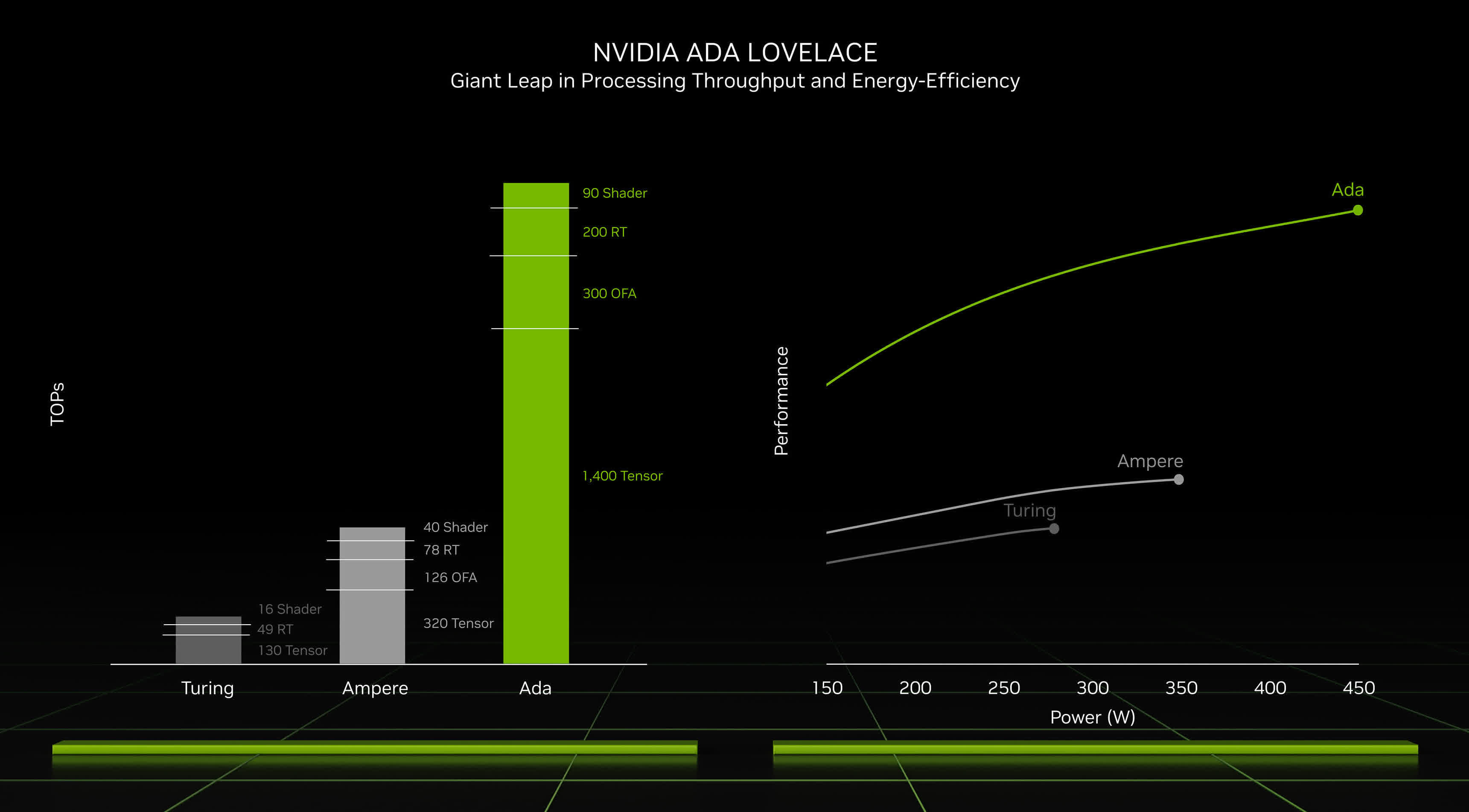
Ada Lovelace brings a range of improvements over older graphics cards utilizing the outgoing Ampere architecture. It's not just a better manufacturing process and a higher number of CUDA cores that we have here (up to 16,384 versus 10,752); under-the-hood refinements are plentiful, including an immensely larger L2 cache, an optimized ray tracing routine (a different way is employed to determine what is transparent and what isn't), and other changes. Naturally, these graphics cards can both encode and decode some of the most widely used video codecs, AVC, HEVC and AV1 included; they also support a host of Nvidia technologies, including Optimus and DLSS 3, and they can certainly be used for various AI applications.
The RTX 2000 features 24 RT cores of the 3rd generation, 96 Tensor cores of the 4th generation and 3,072 CUDA cores. Increase those numbers by 50%, and you get an RTX 3000 Ada Generation - as long as we disregard clock speed differences, of course. Unlike costlier Ada Generation professional laptop graphics cards, the RTX 2000 comes with 8 GB of non-ECC VRAM; the lack of error correction makes this card less suitable for super-important tasks and round-the-clock operation. Much like it is with the RTX 3000 Ada Generation, the VRAM is 128-bit wide and delivers a decent bandwidth of ~256 GB/s.
The RTX 2000 Ada Generation makes use of the PCI-Express 4 protocol, just like Ampere-based cards. 8K SUHD monitors are supported, however, DP 1.4a video outputs can potentially prove to be a bottleneck down the line.
Performance
Most 2024 games are playable at 1440p on High with this GPU. That being said, the average RTX 2000 Ada in our extensive database is much closer to the RTX 4050 Laptop than it is to the RTX 4060 Laptop.
Nvidia's marketing materials mention "up to 14.5 TFLOPS" of performance, a significant downgrade compared to 20 TFLOPS delivered by the RTX 3000 Ada Generation.
Your mileage may vary depending on how competent the cooling solution of your laptop is and how high the TGP power target of the RTX 2000 Ada is.
Power consumption
Nvidia no longer divides its laptop graphics cards into Max-Q and non-max-Q models. Instead, laptop makers are free to set the TGP according to their needs, and the range can sometimes be shockingly wide. This is especially the case for the RTX 2000, as the lowest value recommended for it sits at just 35 W while the highest is 300% higher at 140 W. The slowest system built around an RTX 2000 Ada can easily be half as fast as the fastest one. This is the kind of delta that we've already seen on consumer-grade laptops featuring the latest GeForce RTX cards.
Last but not the least, the improved 5 nm process (TSMC 4N) the Ada graphics card is built with makes for very decent energy efficiency, as of mid 2023.
The Nvidia GeForce RTX 5070 Laptop is a mobile graphics card from the Blackwell family for laptops, which was unveiled at CES 2025. It is based on the GB206 chip with 4,608 shader / CUDA cores clocked at 1425 - 2347 MHz (depending on the model). The graphics memory used is 8 GB GDDR7 with a 128-bit memory bus.
Architecture
The Nvidia GeForce RTX 5070 laptop has new Tensor (5th generation) and RT cores (4th generation) with a performance of 798 AI TOPS. The Blackwell architecture is the first with the new DLSS 4 Multi Frame Generation, which can generate more frames per second thanks to improved AI capabilities, while using less memory and delivering better image quality. Nvidia has also managed to improve the performance and output quality of the DLSS, Frame Generation and Ray Reconstruction features (which were also available on the previous RTX 4000 series). In addition, the new models now support Reflex 2 mode with low latency and Frame Warp.
Performance
The gaming performance of the RTX 5070 Mobile is heavily dependent on the cooling and TDP settings of the laptop. As a result, the maximum clock rate can also vary from 1425 to 2347 MHz. On average, the performance is usually slightly above the old RTX 4070 Laptop GPU but below the RTX 3080 Ti laptop. A new feature of the Blackwell architecture is the support for multi-frame generation (MFG) in DLSS4. This allows significantly higher frame rates to be achieved, but without MFG you should already reach over 50 fps to achieve a playable latency.
The chip is manufactured in the current TSMC 4N process.
Average Benchmarks NVIDIA RTX 2000 Ada Generation Laptop → 100%n=23
Average Benchmarks NVIDIA GeForce RTX 5070 Laptop → 203%n=23
- Range of benchmark values for this graphics card - Average benchmark values for this graphics card * Smaller numbers mean a higher performance 1 This benchmark is not used for the average calculation
Game Benchmarks
The following benchmarks stem from our benchmarks of review laptops. The performance depends on the used graphics memory, clock rate, processor, system settings, drivers, and operating systems. So the results don't have to be representative for all laptops with this GPU. For detailed information on the benchmark results, click on the fps number.







 - Average benchmark values for this graphics card











































 Add as a preferred