Notebookcheck Logo

Qualcomm Snapdragon X Plus X1P-42-100 vs Intel Core Ultra 7 155H

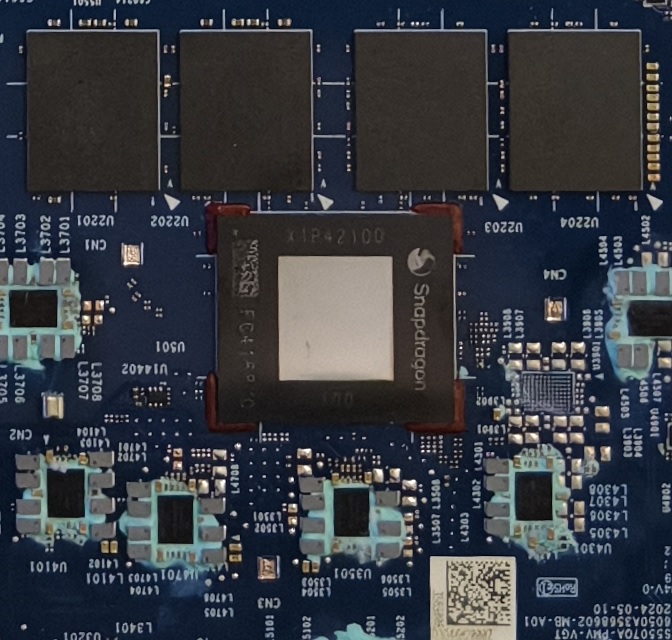
Qualcomm Snapdragon X Plus X1P-42-100

► remove from comparison Qualcomm SD X Plus X1P-42-100

The Snapdragon X Plus 8-core (X1P-42-100) is a relatively affordable ARM architecture processor for use in Windows laptops that was unveiled in Sep 2024. This Qualcomm SoC features 8 Oryon CPU cores running at up to 3.4 GHz, along with the 1.7 TFLOPS X1-45 iGPU and the 45 TOPS Hexagon NPU. The super-fast LPDDR5x-8448 memory controller, USB 4.0 support, TB 4 support and PCIe 4 support are all onboard as well.

Architecture and Features

The Oryon cores (2 clusters of essentially identical cores; 8 threads) are mostly based on Nuvia IP and they reportedly make use of the ARM v8.7 microarchitecture. Much like modern AMD and Intel processors, the Snapdragon chip is compatible with USB 4 and thus with Thunderbolt 4 however it does not appear to support eGPUs as of September 2024.

The X1P-42-100 is based on the smaller die codenamed Purwa, unlike most X Elite and X Plus processors. It is believed to have at least 8 PCIe 4 and 4 PCIe 3 lanes for connecting various kinds of devices. NVMe SSDs are supported with a throughput of up to 7.9 GB/s; furthermore, most laptops built around the chip are expected to have 16 GB of LPDDR5x-8448 RAM. There is also a 45 TOPS NPU present for accelerating AI workloads.

Performance

A lot depends on the power targets of a specific system, just like it is with AMD, Intel and Nvidia products. That being said, the average X1P-42-100 competes with older chips such as the Core i5-1245U when executing multi-threaded x86 code. With apps compiled specifically with Windows on ARM in mind, a Core i7-1360P-like performance level is to be expected which is not bad at all for what is supposed to be a budget CPU.

The 3.4 GHz clock speed is only achievable in single-thread workloads. When under multi-threaded load, the CPU cores will run at no more than 3.2 GHz.

Graphics

The X1-45 used here delivers up to 1.7 TFLOPS of performance. Unlike the much faster 3.8 TFLOPS and 4.6 TFLOPS X1-85 iGPUs, this little guy here has much fewer unified shaders and runs at lower clock speeds, too. Games put it a little behind the GeForce MX350; this kind of performance is sufficient for older games and sub-900p resolutions only.

AVC, HEVC and AV1 video codecs can be both hardware-decoded and hardware-encoded whereas with VP9, only decoding is possible. The highest monitor resolution supported is UHD 2160p.

Power consumption

Expect to see anything between 15 W and 30 W under long-term workloads depending on the system and the power profile chosen. The number includes RAM.

The SoC is built with TSMC's N4P process for better-than-average power efficiency, as of H2 2024.

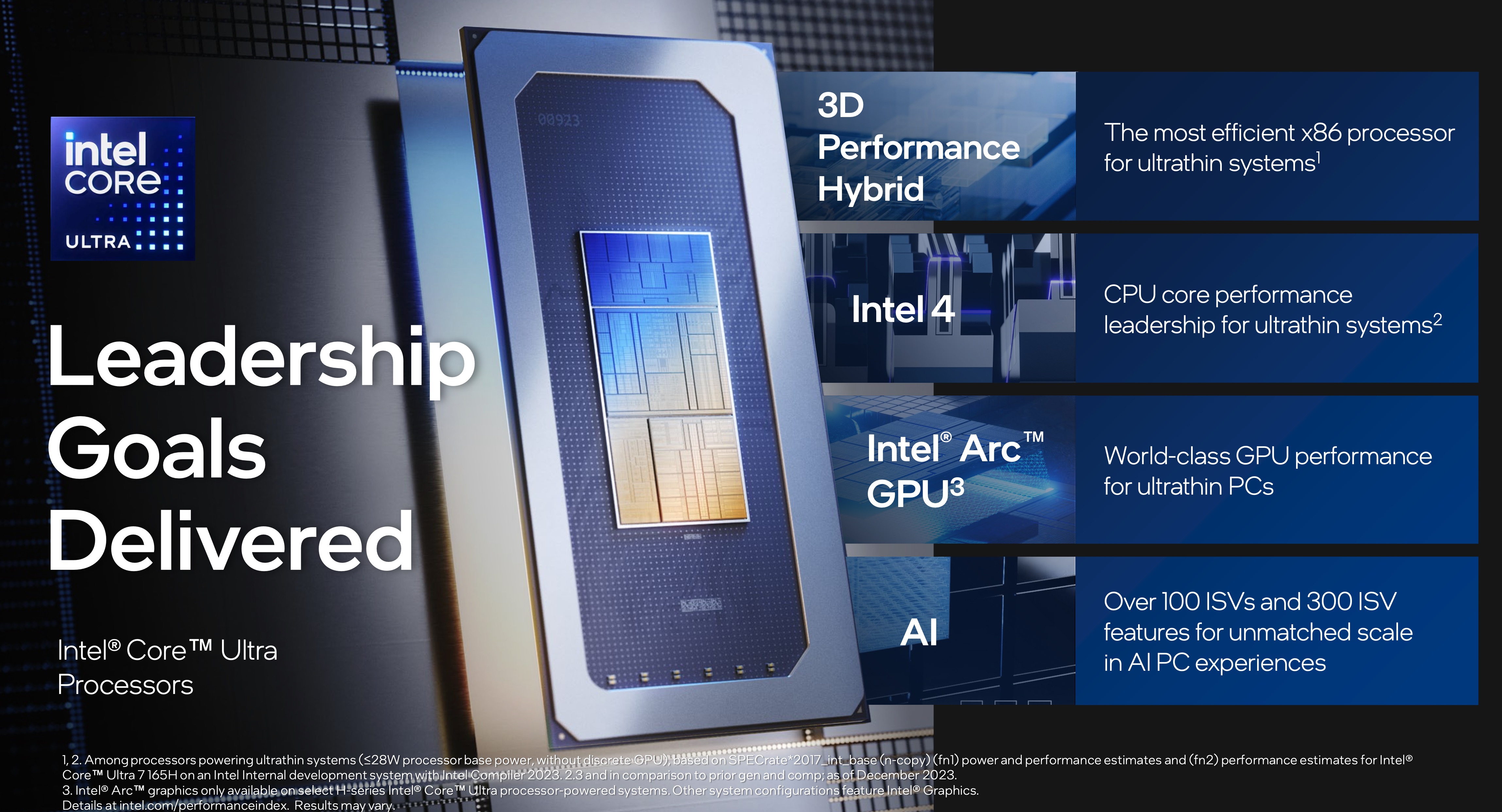
Intel Core Ultra 7 155H

► remove from comparison Intel Ultra 7 155H

The Intel Core Ultra 7 155H is a high-end laptop processor of the Meteor Lake series that has 16 cores (6 + 8 + 2) and 22 threads at its disposal. This 1st Gen Core Ultra chip has come to replace 13th generation Core chips; its 16 cores are comprised of 6 HT-enabled Performance cores running at up to 4.8 GHz and 10 Efficient cores (8 main cores plus 2 extra ones found in the Low Power Island) running at up to 3.8 GHz.

The 8-core Arc GPU, just out of the oven, serves as the integrated graphics adapter - this runs at up to 2.30 GHz - and there is a bevy of other brand-new technologies on offer as well, including the integrated AI Boost NPU with two Gen 3 engines for hardware AI workload acceleration.

Architecture and Features

With Meteor Lake, Intel intends to deliver higher CPU performance, higher GPU performance and at the same time, longer battery life than what Raptor Lake chips were capable of. The company also wants a large piece of the AI cake and is working with Microsoft and other partners to make that happen. As a result, Windows Defender is now AI-enabled, meaning it can use the Intel NPU to take some of the load off the main CPU cores. We also get this new Intel Device Discovery technology that is designed to give us a better hardware-based remote laptop management than ever before; and, to make things even better, Intel now offers a dedicated Arc Pro graphics driver for workstations.

This generation of Intel Core processors features Redwood architecture P-cores and Crestmont architecture E-cores. Both come with slight architectural improvements over Raptor Cove and Gracemont respectively for slightly higher performance-per-clock figures; the interesting thing is that of the 10 E-cores, two are actually a separate cluster located on what Intel calls a "Low Power Island". Essentially, the latter is an SoC within an SoC that can stay active while most other parts of the chip are temporarily switched off to save power. The low-power E-cores run at up to 2.5 GHz. Intel hopes this approach will let it deliver unprecedentedly low power consumption figures when under low load, boosting battery life of laptops and tablets powered by Meteor Lake.

To build its Meteor Lake processors, Intel uses the Foveros technology (stacking several chips on top of each other). This is a cost-cutting measure more than anything else, as manufacturing several small dies on several different processes is so much cheaper than making a huge single die and hoping that there are no defects in it that will require disabling some parts of it.

Elsewhere, the Core Ultra 7 155H comes with 24 MB of L3 cache and a very healthy number of PCIe 5 and PCIe 4 lanes for NVMe SSD speeds up to 15.7 GB/s. It supports RAM running at up to 7467 MHz (DDR5-5600, LPDDR5-7467, LPDDR5x-7467, to be specific - which is about as good as what 8040 series Ryzen chips have). Naturally, the chip features built-in Thunderbolt 4 support and Intel CNVi Wi-Fi support; fascinatingly enough, Intel chose to keep native SATA III support that AMD had removed from its Ryzen processors quite a while ago.

The 155H is compatible with 64-bit Windows 10, 64-bit Windows 11 and with many Linux distros.

Performance

If one chooses to trust the official performance data published by Intel, then the 155H is about as fast as the Ryzen 9 6900HX (Zen 3 Plus, 8 cores, 16 threads, up to 4.9 GHz), as far as multi-thread performance is concerned. This isn't a ground-breaking result but let's just wait for our in-house testing results instead of jumping to conclusions.

Either way, real-world performance of the chip may vary significantly depending on how high the CPU power limits are and how competent the cooling solution of the system is.

Graphics

The 8-core Arc GPU running at up to 2.30 GHz is slated to be a proper alternative to the mighty Radeon 780M. The thing is almost as fast as the GTX 1650 (Laptop) and the RTX 2050 (Laptop) to represent some seriously solid performance gains over aging Xe-series integrated GPUs. If one chooses to take Intel's word for it, that is.

A proper DX12 Ultimate graphics adapter, the Arc is no stranger to ray tracing and other modern technologies including AI frame generation (XeSS). It will let you connect up to four SUHD 4320p monitors and it will both HW-encode and HW-encode the most widely used video codecs including AVC, HEVC and AV1 in a fast and efficient manner.

Your mileage may vary depending on how high the CPU power limits are, how competent the cooling solution of your system is, how fast the RAM of your system is. The latter is really important; Intel stresses that for the Arc to deliver the best results possible, multi-channel RAM configuration is a must.

Power consumption

This mighty Core Ultra 7 series processor has a Base power consumption of 28 W, while its Turbo power consumption is not supposed to exceed 115 W. Its Base power consumption is supposed to be around 64 W, however, most laptop makers will probably go for a higher value to get higher clock speeds and thus better performance. Either way, a powerful cooling solution will be needed to sort out this chip's hot temper.

The 155H is comprised of five small chips ("tiles") that are connected using Intel's Foveros technology. The tile containing main CPU cores is produced on the fairly modern 7 nm Intel process marketed as Intel 4 while most other tiles (the iGPU, the I/O die, ...) are built with TSMC's N5 and N6 processes. The base tile is built with the old Intel 22FFL process.

ModelQualcomm Snapdragon X Plus X1P-42-100Intel Core Ultra 7 155H
CodenameOryonMeteor Lake-H
SeriesQualcomm Snapdragon XIntel Meteor Lake-H
Series: Meteor Lake-H Meteor Lake-H
Qualcomm Snapdragon X Elite X1E-00-1DE compare3.8 - 4.3 GHz12 / 12 cores6 MB L3 Oryon
Qualcomm Snapdragon X Elite X1E-84-100 compare3.8 - 4.2 GHz12 / 12 cores6 MB L3 Oryon
Qualcomm Snapdragon X Elite X1E-80-100 compare - 4 GHz12 / 12 cores6 MB L3 Oryon
Qualcomm Snapdragon X Elite X1E-78-100 compare - 3.4 GHz12 / 12 cores6 MB L3 Oryon
Qualcomm Snapdragon X Plus X1P-64-100 compare - 3.4 GHz10 / 10 cores6 MB L3 Oryon
Qualcomm Snapdragon X Plus X1P-46-100 compare - 4 GHz8 / 8 cores6 MB L3 Oryon
Qualcomm Snapdragon X Plus X1P-42-100 « - 3.4 GHz8 / 8 cores6 MB L3 Oryon
Qualcomm Snapdragon X X1-26-100 compare - 2.98 GHz8 / 8 cores6 MB L3 Oryon
Intel Core Ultra 9 185H compare3.8 - 5.1 GHz16 / 22 cores24 MB L3
Intel Core Ultra 7 165H compare3.8 - 5 GHz16 / 22 cores24 MB L3
Intel Core Ultra 7 155H « 3.8 - 4.8 GHz16 / 22 cores24 MB L3
Intel Core Ultra 5 125H compare3.6 - 4.5 GHz14 / 18 cores18 MB L3
Intel Core Ultra 5 135H compare3.6 - 4.6 GHz14 / 18 cores18 MB L3
Clock <=3400 MHz3800 - 4800 MHz
L1 Cache2.3 MB
L2 Cache12 MB
L3 Cache6 MB24 MB
Cores / Threads8 / 8
8 x 3.4 GHz Qualcomm Oryon
16 / 22
6 x 4.8 GHz Intel Redwood Cove P-Core
8 x 3.8 GHz Intel Crestmont E-Core
2 x 2.5 GHz Intel Crestmont E-Core
TDP30 Watt28 Watt
Technology4 nm7 nm
iGPUQualcomm SD X Adreno X1-45 1.7 TFLOPSIntel Arc 8-Core iGPU ( - 2250 MHz)
NPU / AI45 TOPS INT811 TOPS INT8
ArchitectureARMx86
Announced
Manufacturerwww.qualcomm.comark.intel.com
max. Temp.110 °C
SocketBGA2049
FeaturesDDR5-5600/LPDDR5-7467/LPDDR5x-7467 RAM, PCIe 5, Thr. Director, DL Boost, AI Boost, vPro Ess., MMX, SSE, SSE2, SSE3, SSSE3, SSE4.1, SSE4.2, AES, AVX, AVX2, AVX-VNNI, FMA3, SHA

Benchmarks

Performance Rating - CB R15 + R20 + 7-Zip + X265 + Blender + 3DM11 CPU - SD X Plus X1P-42-100
30.4 pt (51%)
Restrict / Search: Model: Max. age: years
Performance Rating - CB R15 + R20 + 7-Zip + X265 + Blender + 3DM11 CPU - Ultra 7 155H
37.5 pt (62%)
Restrict / Search: Model: Max. age: years
Cinebench 2024 - Cinebench 2024 CPU Single Core
min: 107     avg: 108.2     median: 108 (54%)     max: 109 Points
min: 96     avg: 102.7     median: 102.3 (51%)     max: 108 Points
min: 323     avg: 776     median: 789 (15%)     max: 1024 Points
Cinebench R23 - Cinebench R23 Multi Core
min: 6062     avg: 7465     median: 7746 (7%)     max: 8284 Points
min: 9769     avg: 14965     median: 15028 (14%)     max: 19007 Points
Cinebench R23 - Cinebench R23 Single Core
min: 1065     avg: 1112     median: 1109 (45%)     max: 1134 Points
min: 1496     avg: 1726     median: 1743 (71%)     max: 1815 Points
Cinebench R20 - Cinebench R20 CPU (Single Core)
min: 406     avg: 419.1     median: 420 (46%)     max: 425 Points
min: 601     avg: 665     median: 670.5 (73%)     max: 696 Points
Cinebench R20 - Cinebench R20 CPU (Multi Core)
min: 2361     avg: 2832     median: 2853 (7%)     max: 3125 Points
min: 3798     avg: 5795     median: 5762.5 (14%)     max: 7409 Points
Cinebench R15 - Cinebench R15 CPU Multi 64 Bit
min: 1191     avg: 1447     median: 1477 (9%)     max: 1560 Points
min: 1932     avg: 2449     median: 2450 (15%)     max: 2880 Points
Cinebench R15 - Cinebench R15 CPU Single 64 Bit
min: 206     avg: 209.7     median: 210 (58%)     max: 215 Points
min: 99.6     avg: 249.5     median: 255 (71%)     max: 268 Points
Cinebench R11.5 - Cinebench R11.5 CPU Multi 64 Bit
min: 27.11     avg: 30.5     median: 30.7 (40%)     max: 33.49 Points
Cinebench R11.5 - Cinebench R11.5 CPU Single 64 Bit
min: 2.77     avg: 3     median: 3 (72%)     max: 3.13 Points
Cinebench R10 - Cinebench R10 Rend. Single (32bit)
min: 8808     avg: 9492     median: 9619.5 (58%)     max: 9919 Points
Cinebench R10 - Cinebench R10 Rend. Multi (32bit)
min: 50589     avg: 56540     median: 57550 (42%)     max: 60472 Points
Cinebench R10 - Cinebench R10 Rend. Multi (64bit)
min: 13726     avg: 67393     median: 80420 (51%)     max: 95005 Points
Cinebench R10 - Cinebench R10 Rend. Single (64bit)
min: 12270     avg: 30347     median: 13508.5 (16%)     max: 82102 Points
wPrime 2.10 - wPrime 2.0 1024m *
min: 92.544     avg: 146.2     median: 139.6 (2%)     max: 206.526 s
wPrime 2.10 - wPrime 2.0 32m *
min: 3.523     avg: 3.8     median: 3.7 (1%)     max: 4.041 s
wPrime 1.55 - wPrime 1.55 1024m *
482 s (2%)
wPrime 1.55 - wPrime 1.55 32m *
3.4 s (2%)
WinRAR - WinRAR 4.0
min: 6137     avg: 6921     median: 6911.5 (11%)     max: 7723 Points
7-Zip 18.03 - 7-Zip 18.03 Multi Thread 4 runs
min: 29238     avg: 31381     median: 31010 (18%)     max: 32811 MIPS
min: 41739     avg: 59108     median: 60595 (35%)     max: 70254 MIPS
7-Zip 18.03 - 7-Zip 18.03 Single Thread 4 runs
min: 4087     avg: 4541     median: 4658 (55%)     max: 4675 MIPS
min: 4594     avg: 5330     median: 5398 (64%)     max: 5621 MIPS
X264 HD Benchmark 4.0 - x264 Pass 2
min: 120.65     avg: 136.4     median: 135.4 (3%)     max: 154.15 fps
X264 HD Benchmark 4.0 - x264 Pass 1
min: 282.57     avg: 302.1     median: 300.5 (8%)     max: 325 fps
HWBOT x265 Benchmark v2.2 - HWBOT x265 4k Preset
min: 3.16     avg: 5.1     median: 5.3 (9%)     max: 6.18 fps
min: 9.93     avg: 16.5     median: 16.7 (29%)     max: 21.2 fps
TrueCrypt - TrueCrypt Serpent
min: 0.944     avg: 1     median: 1 (29%)     max: 1.1 GB/s
TrueCrypt - TrueCrypt Twofish
min: 1.6     avg: 1.7     median: 1.7 (29%)     max: 1.7 GB/s
TrueCrypt - TrueCrypt AES
min: 9.3     avg: 10.3     median: 10.4 (27%)     max: 10.9 GB/s
Blender - Blender 3.3 Classroom CPU *
min: 711     avg: 870     median: 828 (11%)     max: 1226 Seconds
min: 296     avg: 413.3     median: 380 (5%)     max: 692 Seconds
Blender - Blender 2.79 BMW27 CPU *
min: 398     avg: 480.2     median: 460 (3%)     max: 683 Seconds
min: 175     avg: 232.5     median: 220 (2%)     max: 381 Seconds
R Benchmark 2.5 - R Benchmark 2.5 *
min: 0.728     avg: 0.7     median: 0.7 (16%)     max: 0.777 sec
min: 0.4457     avg: 0.5     median: 0.5 (10%)     max: 0.53 sec
3DMark 06 - CPU - 3DMark 06 - CPU
min: 12066     avg: 12936     median: 12712.5 (27%)     max: 14729 Points
Super Pi mod 1.5 XS 1M - Super Pi mod 1.5 XS 1M *
min: 7.046     avg: 7.4     median: 7.2 (2%)     max: 8.087 s
Super Pi mod 1.5 XS 2M - Super Pi mod 1.5 XS 2M *
min: 15.701     avg: 16.2     median: 15.9 (1%)     max: 17.277 s
Super Pi Mod 1.5 XS 32M - Super Pi mod 1.5 XS 32M *
min: 394.754     avg: 413.2     median: 400.3 (2%)     max: 444.482 s
3DMark Vantage - 3DM Vant. Perf. CPU no Physx
min: 61131     avg: 65940     median: 63514 (49%)     max: 74620 Points
3DMark 11 - 3DM11 Performance Physics
min: 11743     avg: 12479     median: 12561 (31%)     max: 12757 Points
min: 6531     avg: 18376     median: 19092.5 (47%)     max: 23779 Points
3DMark - 3DMark Ice Storm Physics
min: 53255     avg: 77249     median: 77292.5 (63%)     max: 93608 Points
3DMark - 3DMark Ice Storm Extreme Physics
min: 66925     avg: 75901     median: 72861.5 (59%)     max: 90957 Points
3DMark - 3DMark Ice Storm Unlimited Physics
min: 84880     avg: 88438     median: 88437.5 (71%)     max: 91995 Points
3DMark - 3DMark Cloud Gate Physics
min: 8737     avg: 8949     median: 9010 (23%)     max: 9037 Points
min: 7073     avg: 15332     median: 15194 (38%)     max: 19549 Points
3DMark - 3DMark Fire Strike Standard Physics
min: 13147     avg: 13579     median: 13642 (24%)     max: 13780 Points
min: 5249     avg: 22618     median: 23177 (41%)     max: 28337 Points
3DMark - 3DMark Time Spy CPU
min: 3282     avg: 4645     median: 5552 (23%)     max: 5723 Points
min: 3922     avg: 9000     median: 9454.5 (40%)     max: 12145 Points
Geekbench 6.5 - Geekbench 6.5 Single-Core
min: 2271     avg: 2407     median: 2393.5 (55%)     max: 2675 Points
min: 1901     avg: 2377     median: 2409 (56%)     max: 2473 Points
Geekbench 6.5 - Geekbench 6.5 Multi-Core
min: 7609     avg: 11268     median: 11384 (44%)     max: 14998 Points
min: 7732     avg: 12275     median: 12385 (48%)     max: 13656 Points
Geekbench 6.0 - Geekbench 6.0 Single-Core
min: 2167     avg: 2261     median: 2280.5 (72%)     max: 2314 Points
Geekbench 6.0 - Geekbench 6.0 Multi-Core
min: 10787     avg: 11569     median: 11714 (48%)     max: 12061 Points
Geekbench 5.5 - Geekbench 5.1 - 5.5 64 Bit Single-Core
min: 1486     avg: 1577     median: 1576 (53%)     max: 1669 Points
min: 1462     avg: 1751     median: 1761.5 (59%)     max: 1824 Points
Geekbench 5.5 - Geekbench 5.1 - 5.5 64 Bit Multi-Core
min: 4457     avg: 6440     median: 6244 (11%)     max: 8618 Points
min: 10017     avg: 12016     median: 12183.5 (22%)     max: 13556 Points
Geekbench 5.0 - Geekbench 5.0 64 Bit Single-Core
min: 1556     avg: 1678     median: 1696 (7%)     max: 1745 Points
Geekbench 5.0 - Geekbench 5.0 64 Bit Multi-Core
min: 11112     avg: 11906     median: 12025 (38%)     max: 12530 Points
Geekbench 4.4 - Geekbench 4.1 - 4.4 64 Bit Single-Core
min: 6559     avg: 6879     median: 6927 (69%)     max: 7141 Points
Geekbench 4.4 - Geekbench 4.1 - 4.4 64 Bit Multi-Core
min: 39509     avg: 43123     median: 43897 (43%)     max: 46412 Points
Mozilla Kraken 1.1 - Kraken 1.1 Total Score *
min: 396.1     avg: 587     median: 467.8 (1%)     max: 1145 ms
min: 416.4     avg: 541     median: 535 (1%)     max: 642 ms
Octane V2 - Octane V2 Total Score
min: 78058     avg: 82781     median: 79641 (53%)     max: 88419 Points
min: 77142     avg: 88549     median: 89268 (59%)     max: 97162 Points
WebXPRT 4 - WebXPRT 4 Score
min: 130.3     avg: 258.4     median: 280 (73%)     max: 284 Points
min: 166.4     avg: 251.8     median: 255 (66%)     max: 309 Points
WebXPRT 3 - WebXPRT 3 Score
min: 129.9     avg: 368.3     median: 405 (73%)     max: 426 Points
min: 213     avg: 276.5     median: 278.5 (50%)     max: 299 Points
CrossMark - CrossMark Overall
min: 1061     avg: 1199     median: 1168 (44%)     max: 1463 Points
min: 1366     avg: 1663     median: 1685.5 (63%)     max: 1903 Points
Power Consumption - Prime95 Power Consumption - external Monitor *
min: 31.6     avg: 41.2     median: 39 (7%)     max: 58.5 Watt
min: 37.1     avg: 74.8     median: 72.8 (13%)     max: 168 Watt
Power Consumption - Cinebench R15 Multi Power Consumption - external Monitor *
min: 37.5     avg: 51.5     median: 52.1 (9%)     max: 60.1 Watt
min: 46.9     avg: 89.4     median: 87.9 (16%)     max: 160.1 Watt
Power Consumption - Idle Power Consumption - external Monitor *
min: 1.908     avg: 4.4     median: 3.4 (2%)     max: 9.3 Watt
min: 2.42     avg: 7.2     median: 6.1 (4%)     max: 24.2 Watt
Power Consumption - Idle Power Consumption 150cd 1min *
min: 2.56     avg: 4.4     median: 4.9 (4%)     max: 6.14 Watt
min: 2.83     avg: 8     median: 7.8 (6%)     max: 18.5 Watt
Power Consumption - Power Efficiency - Cinebench R15 Multi external Monitor
min: 25.9     avg: 28     median: 27.5 (20%)     max: 31.8 Points per Watt
min: 17.7     avg: 30.9     median: 28.6 (21%)     max: 64.7 Points per Watt

Average Benchmarks Qualcomm Snapdragon X Plus X1P-42-100 → 100% n=27

Average Benchmarks Intel Core Ultra 7 155H → 152% n=27

- Range of benchmark values for this graphics card
red legend - Average benchmark values for this graphics card
* Smaller numbers mean a higher performance
1 This benchmark is not used for the average calculation

Add one or more devices and compare

In the following list you can select (and also search for) devices that should be added to the comparison. You can select more than one device.

restrict list:
v1.35
log 28. 23:36:21

#0 ran 0s before starting gpusingle class +0s ... 0s

#1 checking url part for id 17591 +0s ... 0s

#2 checking url part for id 16906 +0s ... 0s

#3 redirected to Ajax server, took 1766961381s time from redirect:0 +0s ... 0s

#4 did not recreate cache, as it is less than 5 days old! Created at Sun, 28 Dec 2025 05:18:39 +0100 +0s ... 0s

#5 composed specs +0.008s ... 0.008s

#6 did output specs +0s ... 0.008s

#7 getting avg benchmarks for device 17591 +0.004s ... 0.012s

#8 got single benchmarks 17591 +0.012s ... 0.024s

#9 getting avg benchmarks for device 16906 +0.005s ... 0.028s

#10 got single benchmarks 16906 +0.057s ... 0.086s

#11 got avg benchmarks for devices +0s ... 0.086s

#12 min, max, avg, median took s +0.06s ... 0.146s

#13 return log +0.001s ... 0.147s

Please share our article, every link counts!
Mail Logo
Google Logo Add as a preferred
source on Google
> Expert Reviews and News on Laptops, Smartphones and Tech Innovations > Benchmarks / Tech > Processor Comparison - Head 2 Head
Redaktion, 2017-09- 8 (Update: 2023-07- 1)