




Intel Panther Lake Arc B390 performance and efficiency analysis: Intel's new iGPU trades blows with the Nvidia GeForce RTX 4050
The new Panther Lake mobile processors from Intel are getting new integrated graphics cards that promise a big increase in performance. We have already been able to test the new Intel Core Ultra X9 388H with the Arc B390 graphics in detail, in terms of both performance and efficiency.
We tested the CPU part of the Core Ultra X9 388H separately, and it was convincing in the test.
Intel Arc B390 at a glance
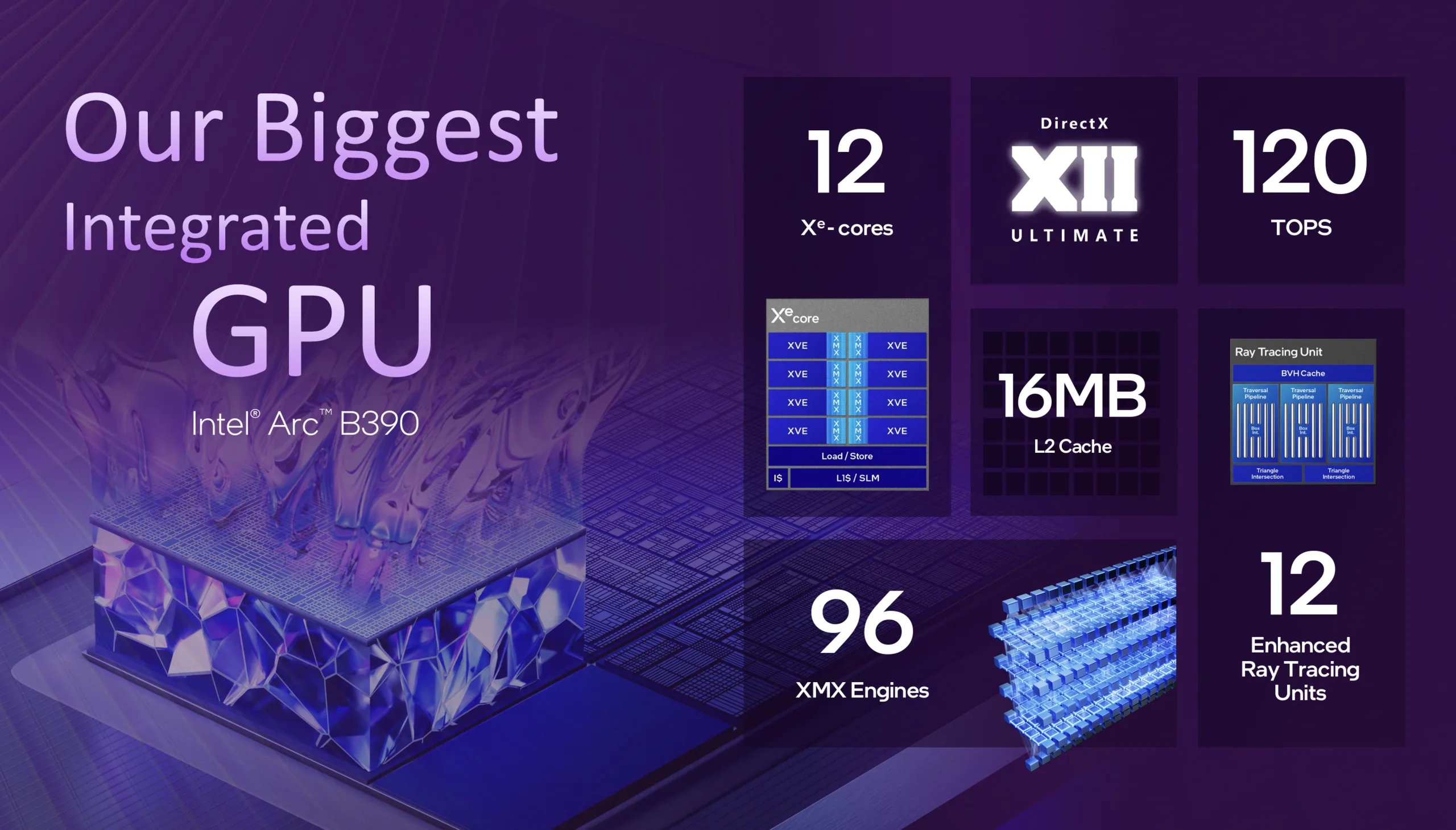
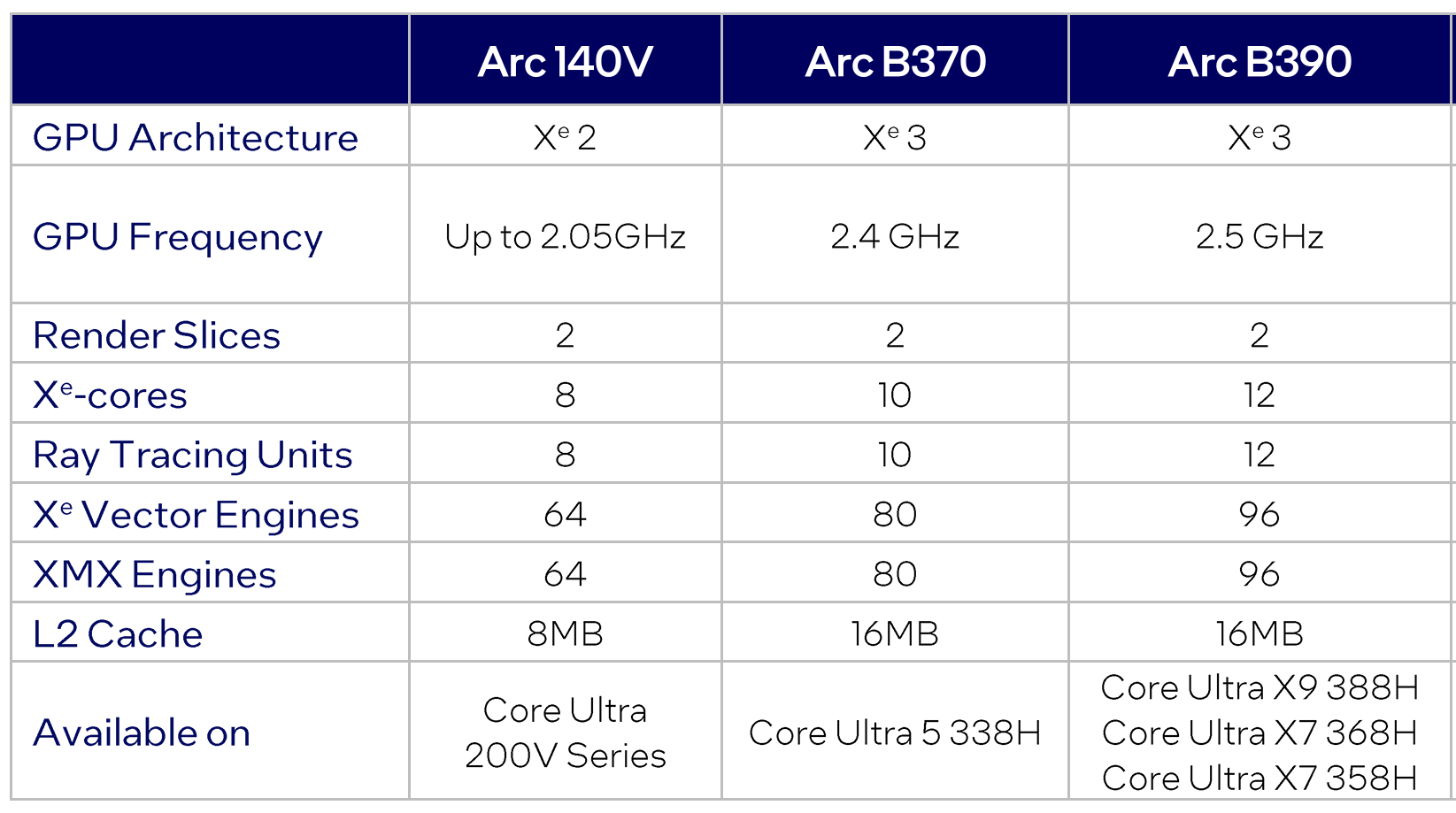
The new Arc B390 is based on the Xe3 architecture and is therefore the successor to the Xe2 models such as the Arc Graphics 140V of the Lunar Lake mobile processors. The Arc Graphics 140T of the Arrow Lake models was based on the even older Xe architecture.
The new GPU tile of the B390 now offers twice as much L2 cache (16 MB) and the two render slices each consist of six Xe cores.
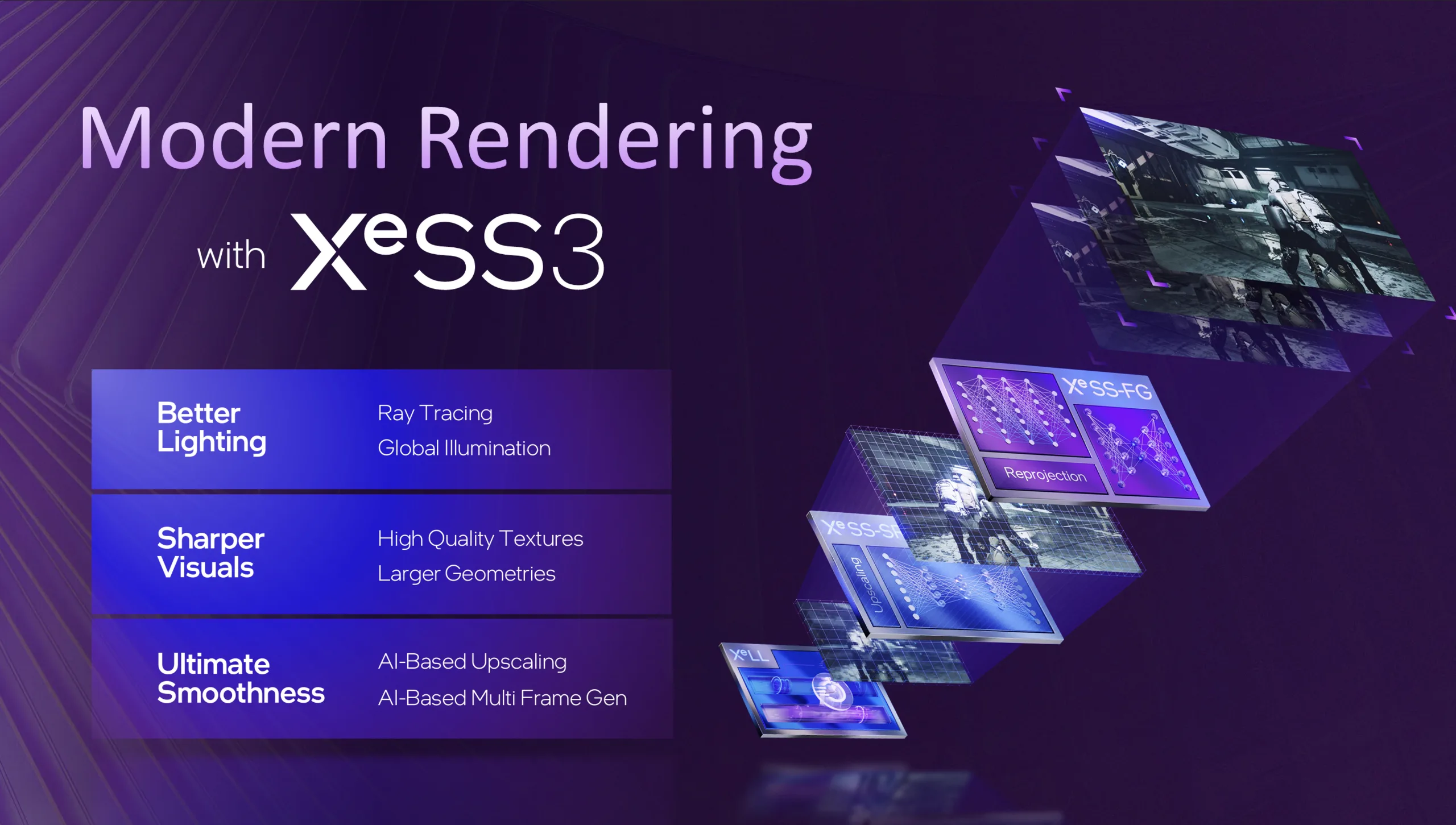
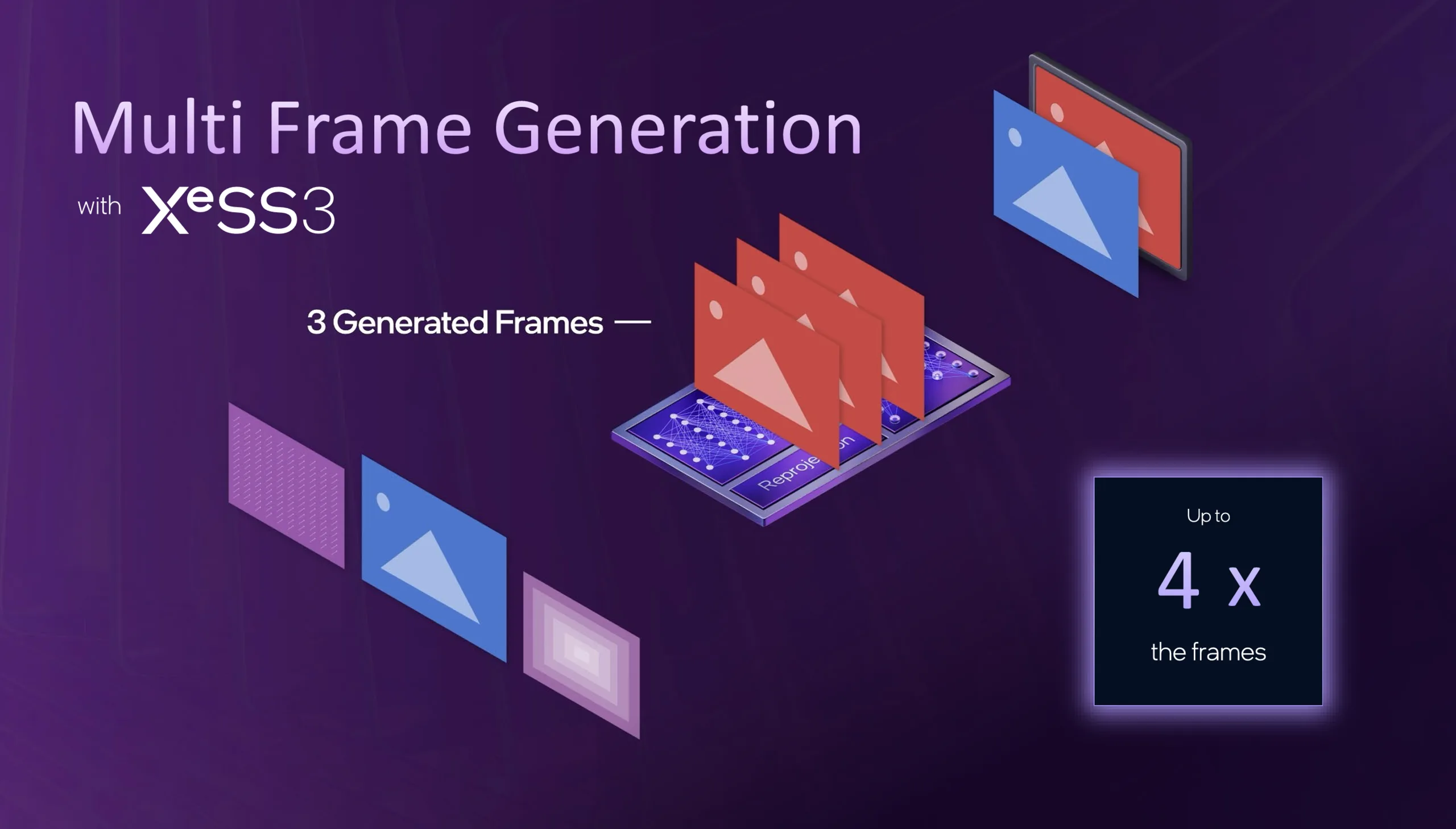
In principle, we are already familiar with XeSS technologies such as Super Sampling, Low Latency, and Frame Generation, but Multi-Frame Generation (MFG) has now been added to XeSS 3.
Similar to its Nvidia counterpart, it is now possible to generate additional intermediate images in order to increase the frame rate.
You can currently make the settings via the driver and choose between 2x (1 generated intermediate frame), 3x (two generated intermediate frames) and 4x (three generated intermediate frames).
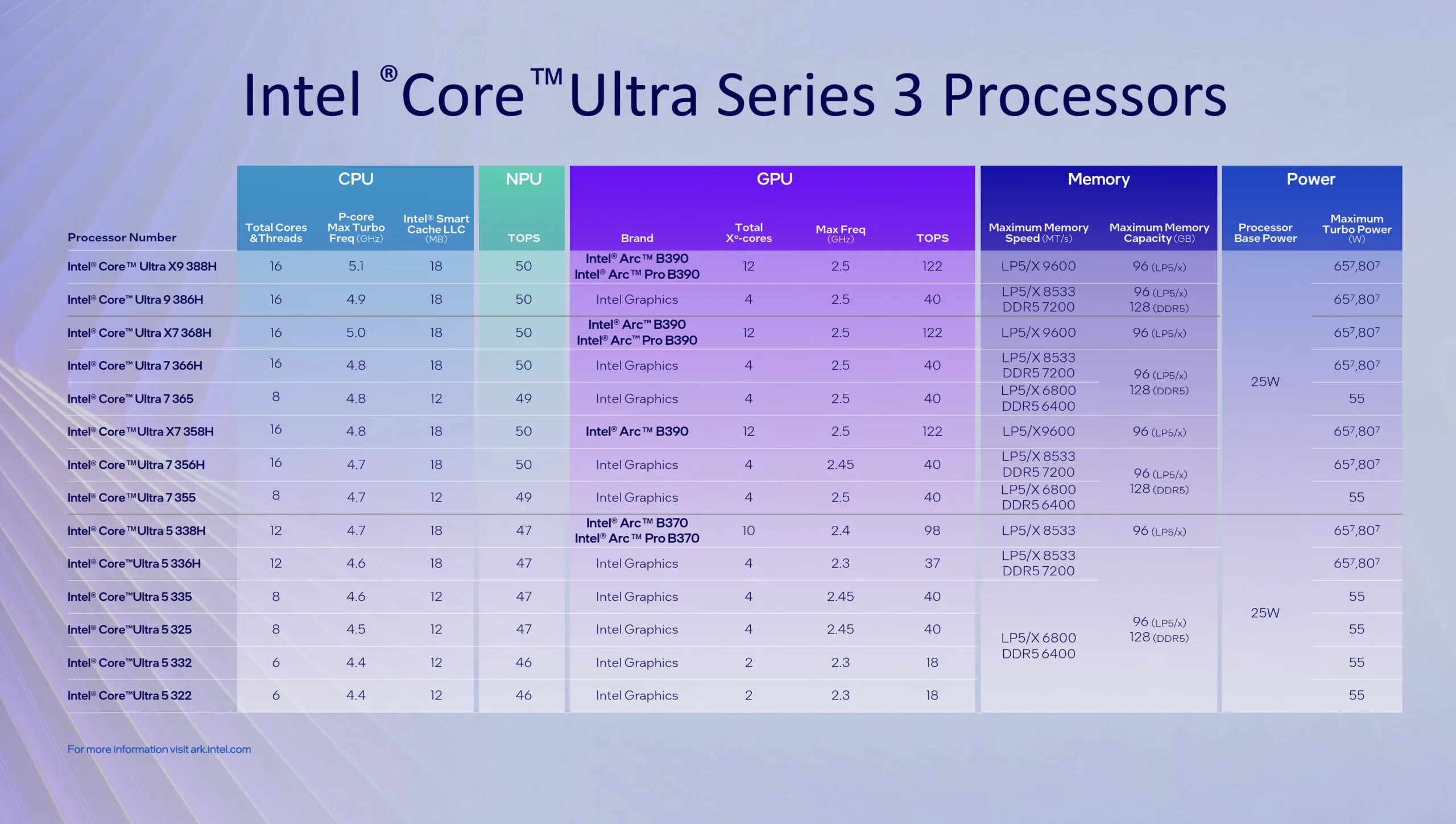
However, not all new Panther Lake processors are equipped with the new B390 — only the Core Ultra X9 388H and the Core Ultra X7 368H and the Core Ultra X7 358H feature this iGPU.
There is also an Arc B370 with 10 Xe cores in the Core Ultra 5 338H. All other processors in the Panther Lake lineup are only equipped with Intel Graphics, which offer 4 or 2 Xe cores and should therefore be significantly slower. As soon as we receive the corresponding specimens, we will add the results here for comparison.
The test system: Asus Zenbook Duo UX8407
We had the Asus Zenbook Duo UX8407 as a test system featuring the Core Ultra X9 388H at our disposal, which we have already tested in detail. Here, the processor is combined with 32 GB of fast LPDDR5x-9600 RAM, and the power limits are 64 W/46 W.
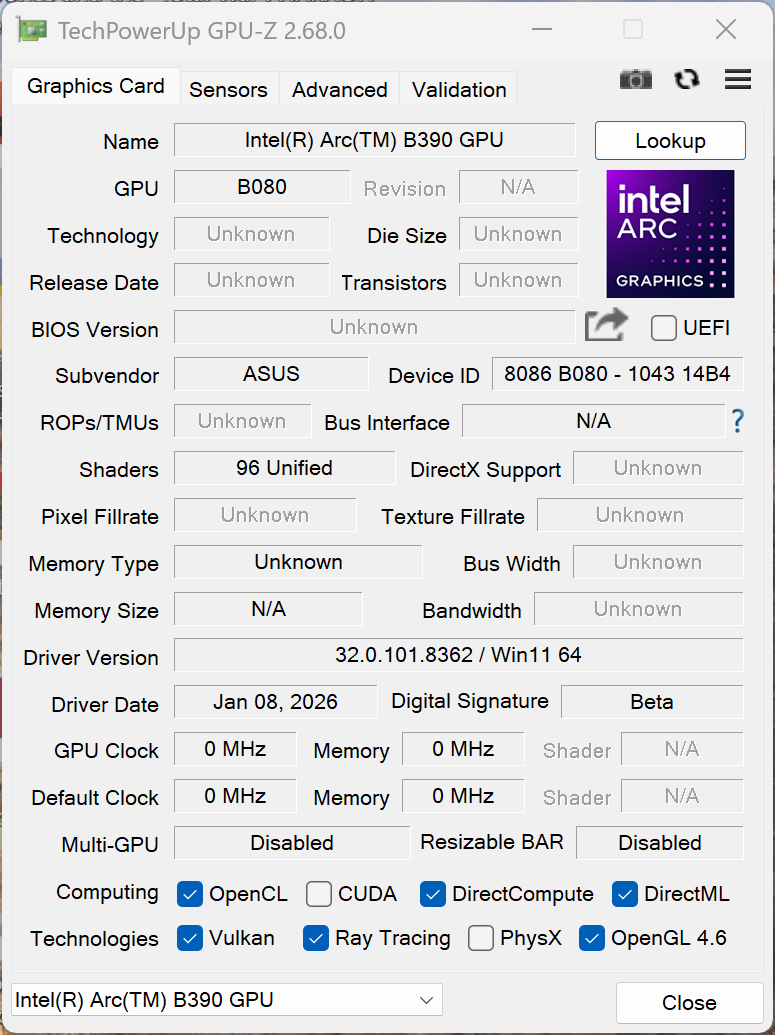
The GPU driver version was 32.0.101.8362 and the maximum GPU clock rate is 2.5 GHz.

Testing conditions
In order to make a meaningful comparison between the different graphics cards, we look at the power consumption in addition to the pure performance in synthetic benchmarks from which we then determine the efficiency.
The consumption measurements are always carried out on an external display so as to eliminate the different internal displays as influencing factors. Nevertheless, we measure the overall consumption of the system here and not just compare the pure TGP values.
GPU performance
We checked the power consumption of the GT cores in the Zenbook Duo, and the new Arc B390 requires around 38-40 W for maximum performance that corresponds to a total package power of around 52 W. We will also take a look at how the new iGPU performs at lower power limits. For perspective, the Arc Graphics 140T consumes a maximum power of around 32 W.
The performance in the synthetic benchmarks is excellent. Compared to the fastest variants of the Arc Graphics 140T/140V, we see an advantage between 60-80% with the Arc B390 depending on the benchmark.
Compared to the current AMD Zen 5 iGPUs such as the Radeon 890M, the B390 offers almost double the performance. AMD's Strix Halo iGPUs such as the Radeon 8050S and Radeon 8060S are noticeably faster but also have a significantly higher power consumption.
Slower versions of the Nvidia GeForce RTX 4050 Laptop GPU up to 60 W are also in the range of the B390 — you need a fast version with a 90 W TGP, for example, as in the Lenovo IdeaPad Pro 5, to have a clear advantage. The Adreno X1-85 iGPUs of the Snapdragon X processors, on the other hand, are far behind.
The comparison with Apple's GPUs is interesting, as the new M5 GPU is clearly beaten. Overall, the Arc B390 is on a par with the smaller M4 Pro GPU with 16 cores, while the faster variant with 20 cores still has a head start.
Gaming performance
The new B390 iGPU is also highly suitable for gaming, and here we again see an advantage of around 70% compared to the old ZenBook Duo with the Arc Graphics 140T.
The two Strix Halo GPUs are still noticeably faster, but comparisons with the RTX 4050 Laptop GPU can differ greatly depending on the title.
In modern titles such as Cyberpunk 2077 and Baldur's Gate 3, for example, the B390 is only barely beaten by the 60 W version of the RTX 4050 Laptop GPU.
We will test more games here as soon as possible.
Multi-frame generation
With the new multi-frame generation of XeSS 3, the performance can be increased even further and the image quality was very good in our initial tests. We feel this feature can be a real advantage and were also able to accelerate demanding titles such as Assassin's Creed Shadows to about 100 fps in 1080p with medium details (in Balanced mode), for example.
We will carry out additional tests with other games in the future, but this is definitely an exciting feature, especially for handhelds.
| Game | Native | MFG x2 | MFG x3 | MFG x4 |
|---|---|---|---|---|
| Cyberpunk 2077 1080p Ultra | 47.7 FPS | 83.5 FPS | 111.3 FPS | 121.5 FPS |
| F1 25 1080p Ultra | 30 FPS | 51 FPS | 74 FPS | 93 FPS |
Graphics performance at lower power limits
As mentioned earlier, the new Arc B390 requires around 38-40 W (which corresponds to a package power of around 52 W) to achieve full performance.
However, many thin laptops or handhelds are unable to achieve this, which is why we also looked at the performance at lower power limits. To do this, we limited the package power to 20 W, 28 W, 35 W, and 45 W using the freeware ThrottleStop tool.
The performance of the Arc B390 remains very good at all tested values and, even at 20 W, the performance is still better than the fastest variants of the Arc Graphics 140T/140V.
The 20-28 W range is particularly exciting for gaming handhelds, and the B390 has a clear advantage over previous models with Intel or AMD chips.
| TDP | 20 W | 28 W | 35 W | 45 W |
|---|---|---|---|---|
| Time Spy Graphics | 4,567 points | 5,600 points | 6,321 points | 6,830 points |
| Cyberpunk 2077 1080p Ultra | 27.2 fps | 33.2 fps | 36.5 fps | 41.2 fps |
| TDP | 20 W | 28 W | 35 W | 45 W |
|---|---|---|---|---|
| Time Spy Graphics | 4334 points | 5330 points | 6296 points | 6709 points |
| Cyberpunk 2077 1080p Ultra | 26.3 fps | 30.1 fps | 37 fps | 44.3 fps |
Update January 31st: We have performed additional benchmarks with the fast AMD Radeon 8060S of the Strix Halo APU. Systems with the powerful AMD chip usually operate at higher power limits, but there are also some handhelds with Strix Halo, so a comparison at lower power limits is also interesting. Contrary to the pure CPU performance, where Strix Halo still has the advantage at 28W, the Radeon 8060S needs more power and only beats the Arc B390 at 45W in the Time Spy benchmark. The gaming performance of Strix Halo, however, is already better at 28W.
| TDP | 20 W | 28 W | 35 W | 45 W |
|---|---|---|---|---|
| Time Spy Graphics | 3040 points | 4554 points | 5642 points | 7286 points |
| Cyberpunk 2077 1080p Ultra | 22.6 fps | 35.5 fps | 42.3 fps | 53.3 fps |
Efficiency
For determining the efficiency, we measured the power consumption of Cyberpunk 2077 on an external monitor. Here you can immediately see that the efficiency has been improved compared to the Arc Graphics 140T, but the two Lunar Lake Arc Graphics 130V and Arc Graphics 140V iGPUs are on a comparable level in this aspect.
In comparison with AMD, the smaller iGPUs such as the Radeon 890M are noticeably weaker, but the two Strix Halo GPUs are on a comparable level.
If we take a look at the Nvidia GPUs, the B390 has to give up some ground. The 60 W RTX 4050 Laptop GPU is comparable in terms of efficiency, but the newer RTX 5050 Laptop and RTX 5070 Laptop models with 60-75 W TGP perform even better.
The efficiency comparison becomes interesting with lower TDP values for the Arc B390. The efficiency is almost at the level of the Apple M5 GPU even at 35 W, and this gets even better at 28 W and 20 W.
| Power Consumption / Cyberpunk 2077 ultra Efficiency | |
| Intel Arc B390 12 Xe3 Panther Lake iGPU | |
| Intel Arc B390 12 Xe3 Panther Lake iGPU | |
| NVIDIA GeForce RTX 5070 Laptop | |
| Apple M5 10-Core GPU | |
| NVIDIA GeForce RTX 5070 Laptop | |
| Apple M4 8-Core GPU | |
| Intel Arc B390 12 Xe3 Panther Lake iGPU | |
| NVIDIA GeForce RTX 5050 Laptop | |
| Intel Arc Graphics 140V | |
| Intel Arc B390 12 Xe3 Panther Lake iGPU | |
| AMD Radeon 8060S | |
| NVIDIA RTX PRO 2000 Blackwell Generation Laptop | |
| Intel Arc Graphics 140V | |
| AMD Radeon 8050S | |
| Intel Arc Graphics 130V | |
| Intel Arc B390 12 Xe3 Panther Lake iGPU | |
| NVIDIA GeForce RTX 4050 Laptop GPU | |
| NVIDIA GeForce RTX 5060 Laptop | |
| Intel Arc 8-Core iGPU | |
| Apple M4 10-core GPU | |
| Apple M4 Pro 20-Core GPU | |
| Intel Arc Graphics 140V | |
| NVIDIA GeForce RTX 5050 Laptop | |
| AMD Radeon 890M | |
| Intel Graphics 4-Core iGPU (Meteor / Arrow Lake) | |
| NVIDIA GeForce RTX 4050 Laptop GPU | |
| AMD Radeon 860M | |
| Intel Arc Graphics 140T | |
| Intel Arc Graphics 140T | |
| AMD Radeon 860M | |
| AMD Radeon 880M | |
| Power Consumption / Cyberpunk 2077 FHD ultra no FSR (external Monitor) | |
| NVIDIA GeForce RTX 5060 Laptop | |
| NVIDIA GeForce RTX 5050 Laptop | |
| NVIDIA GeForce RTX 4050 Laptop GPU | |
| NVIDIA GeForce RTX 5070 Laptop | |
| NVIDIA RTX PRO 2000 Blackwell Generation Laptop | |
| AMD Radeon 8060S | |
| NVIDIA GeForce RTX 5070 Laptop | |
| AMD Radeon 8050S | |
| NVIDIA GeForce RTX 4050 Laptop GPU | |
| NVIDIA GeForce RTX 5050 Laptop | |
| Apple M4 Pro 20-Core GPU | |
| AMD Radeon 880M | |
| Intel Arc B390 12 Xe3 Panther Lake iGPU | |
| Intel Arc B390 12 Xe3 Panther Lake iGPU | |
| Intel Arc Graphics 140T | |
| AMD Radeon 890M | |
| Intel Arc B390 12 Xe3 Panther Lake iGPU | |
| Intel Arc Graphics 140V | |
| Intel Arc Graphics 140V | |
| Intel Arc Graphics 140V | |
| Intel Arc B390 12 Xe3 Panther Lake iGPU | |
| Intel Arc Graphics 140T | |
| Apple M5 10-Core GPU | |
| Intel Arc Graphics 130V | |
| Intel Arc 8-Core iGPU | |
| AMD Radeon 860M | |
| Apple M4 10-core GPU | |
| AMD Radeon 860M | |
| Intel Arc B390 12 Xe3 Panther Lake iGPU | |
| Intel Graphics 4-Core iGPU (Meteor / Arrow Lake) | |
| Apple M4 8-Core GPU | |
* ... smaller is better
Conclusion: Intel Arc B390 is an impressive iGPU

With the new Arc B390, Intel is noticeably raising the performance level of integrated GPUs, and slim devices with power limits in the range of 25-45 W in particular will benefit massively from the new Panther Lake processors.
The performance advantage over the previous Arc Graphics 140T/140V iGPUs is around 70%. The advantage over the smaller Radeon 800 series iGPUs of AMD Zen 5 is also considerably high (between 50-80% depending on the benchmark).
Although the Strix Halo GPUs are even faster (but not more efficient), they operate at higher power limits. There are only a handful of corresponding devices on the market, which then are also quite expensive.
Additionally, the new Arc B390 scales very well even at lower power limits and is therefore very suitable for handhelds, which typically operate in the 20-30 W range. This is where the new Multi Frame Generation feature comes into play, which can significantly increase performance, making even very demanding titles such as Assassin's Creed Shadows playable at low TDP values at over 60 fps. This also comes in handy if you simply want to play in a lower power mode to keep the fan noise to a minimum.
However, the fast Arc B390 is limited to the Core Ultra X9 and Core Ultra X7, which are only available with soldered RAM. The other Panther Lake processors that can also be combined with up to a maximum 128 GB of regular SO-DIMM modules have to contend with significantly slower Intel Graphics (with 2 or 4 Xe cores).
Together with good results in our CPU test, the new Panther Lake chips with the fast iGPUs are probably the best mobile processors for Windows laptops in 2026. Apple's M5 Pro chips will certainly deliver good results and clearly outperform Panther Lake in terms of performance, but these are only available in the MacBooks.
Whether the upcoming Snapdragon X2 processors will be able to keep up with the new Arc B390, especially in terms of graphics performance, is questionable, as GPU performance to date has been a weak point of the first generation of Adreno GPUs anyway.
 Add as a preferred source on Google


