




Intel Panther Lake Core Ultra X9 388H performance analysis - Outpaces Arrow Lake and exceeds Zen 5 in efficiency
Intel presented its new Panther Lake mobile processor series at CES. While last year's Arrow Lake and Lunar Lake were a two-pronged approach, Panther Lake is now intended to offer the best of both worlds, i.e., the best possible performance with high efficiency. AMD has also just unveiled its new Ryzen AI 400 series mobile processors, which we have already tested extensively. Now let's take a look at the CPU performance and efficiency of the new Intel Core Ultra X9 388H. The performance analysis of the new integrated graphics of the Panther Lake generation is available in a separate article:
Intel Panther Lake series overview
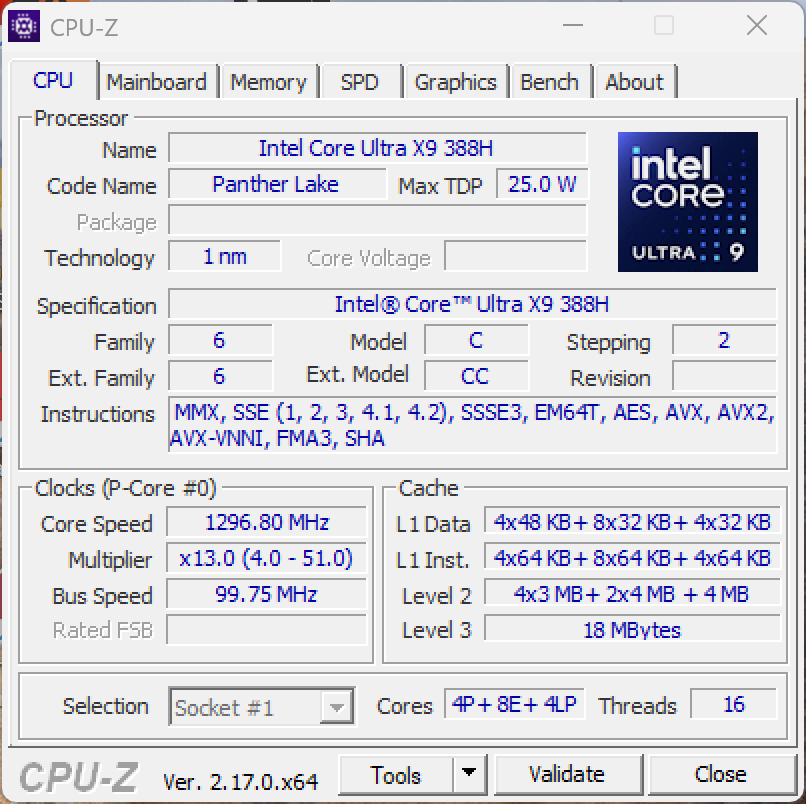
The new Panther Lake mobile processors are once again made up of different tiles, with the compute tile being produced by Intel itself (Intel 18A). Depending on the model, up to 16 cores in total can be used: four fast P-cores (Cougar Cove), eight E-cores (Darkmont), and four additional low-power E-cores (Darkmont). NPUs with 46-50 TOPS are also installed, meaning that all Panther Lake processors meet the minimum requirement for Microsoft's Copilot+ certification. TSMC manufactures the other two tiles (the platform controller and the GPU).
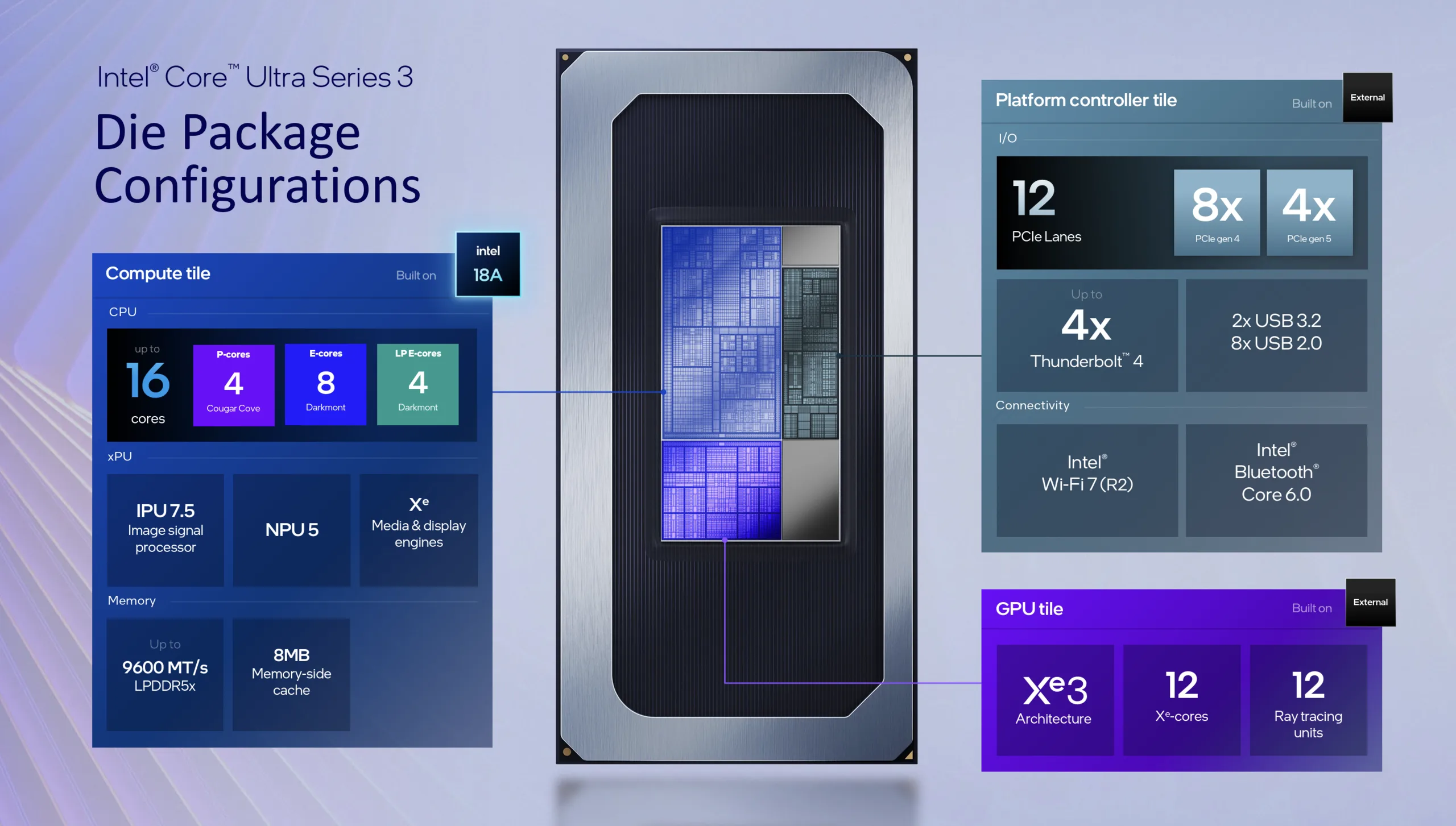
There are differences between the various models when it comes to RAM. The Core Ultra X chips with the fast GPUs are only available with LPDDR5x RAM (8533 or 9600 MT/s) and a maximum of 96 GB. The other models with the small iGPU, on the other hand, can be combined with either LPDDR5x RAM (6800 to 8533 MT/s) or SO-DIMM modules (6400 to 7200 MT/s), and support up to 128 GB of RAM.
The new Panther Lake chips are designed for a TDP range of 25 to a maximum of 80 watts. This is an advantage in our eyes, as the extremely high power limits of the Arrow Lake chips (up to 115 watts) are now a thing of the past.
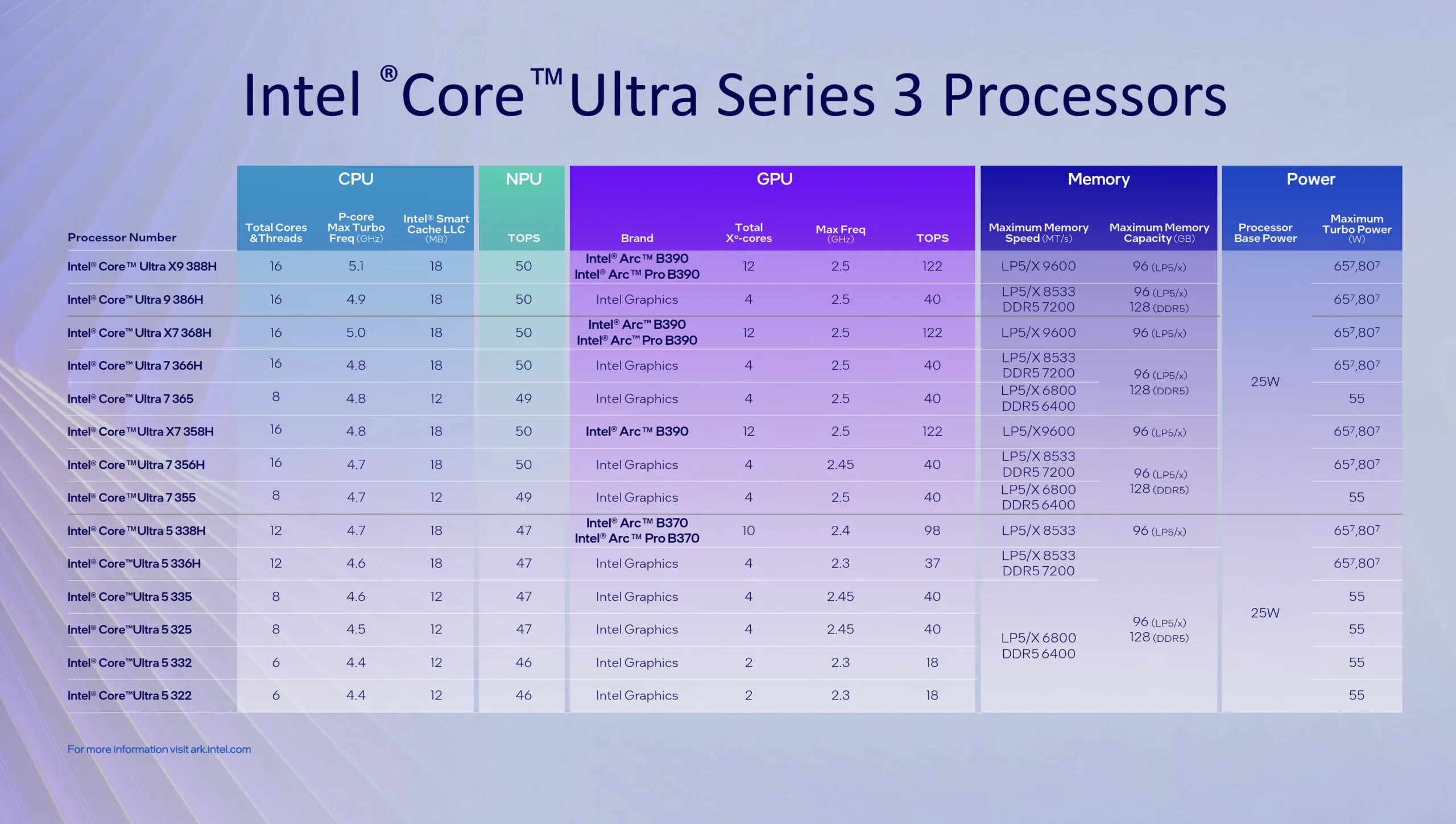
The new CPUs are available with three different integrated graphics cards. The fast models Arc B390 (12 Xe cores) and Arc B370 (10 Xe cores) are limited to a few models; all other CPUs only use a GPU with 4 Xe cores. So you have to be careful when buying a new laptop. A more detailed look at the new iGPUs is available in a separate article.
Test system
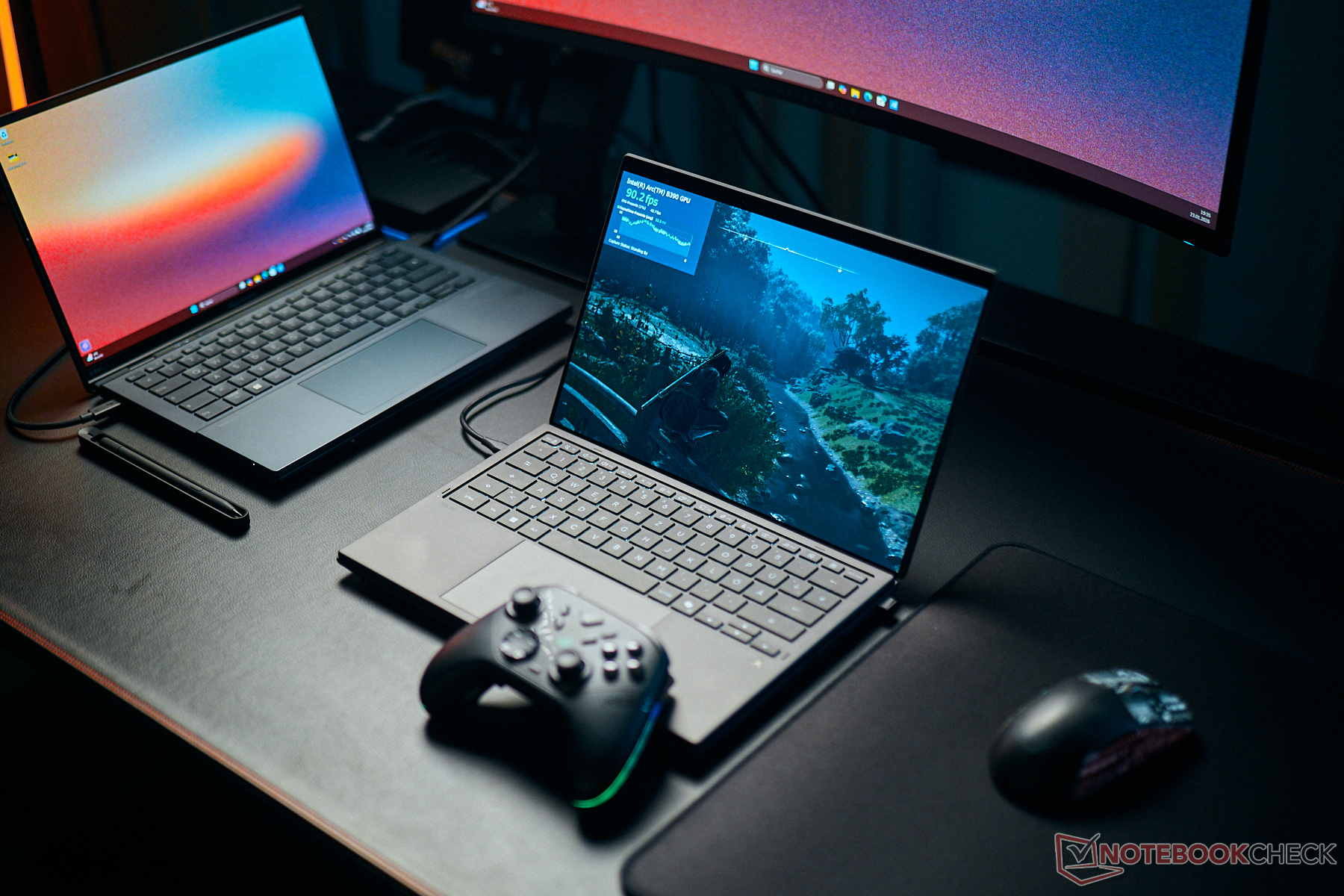
As a test system with the Core Ultra X9 388H, we had the Asus Zenbook Duo UX8407 at our disposal, which we have already extensively tested earlier. Here, the processor is paired with 32 GB of fast LPDDR5x-9600 RAM, and the power limits are set to 64/46 watts. There will therefore be even faster implementations.
Testing conditions
In order to make a meaningful comparison between the different processors, we consider both the power consumption and the actual performance in synthetic benchmarks, from which we then determine the efficiency. Consumption measurements are always carried out on an external display to eliminate differences among internal displays as influencing factors. Nevertheless, we measure the system's overall consumption here and do not just compare the pure TDP values.
Single-core performance & efficiency
We start with the single-core performance, and here the new Panther Lake processor is only just ahead of its predecessors. This makes it currently the fastest mobile processor in this TDP range, apart from Apple's M4 and M5 generation, which are in a different league. The fastest Snapdragon X processor, the X1E-84-100, is also narrowly beaten, and the new AMD Ryzen AI 9 465 is around 8 percent slower.
To achieve such a performance level, the X9 388H requires around 11-12 watts, which corresponds to a package power of 13-15 watts. This means the Panther Lake chip is more efficient in single-core scenarios than its Arrow Lake predecessors and AMD's Zen 5 chips. However, the Lunar Lake CPUs still have a slight advantage, just as the entire ARM competition from Qualcomm and Apple.
* ... smaller is better
Multi-core performance
Performance has also increased in the multi-core tests, and only the very fast Arrow Lake chips and Zen 5 CPUs with high power limits can keep up with the new X9 388H, although the power limits here are significantly lower at 64/46 watts. The Lunar Lake CPUs are completely left behind in terms of pure performance, and the X9 388H is practically twice as fast here. The performance is also on par with the Apple M5 SoC, which, however, operates at significantly lower power limits (max. 30 watts).
When it comes to multi-core efficiency, you have to look at the TDP values as well as the pure performance. For the X9 388H, in addition to the standard power limits, we also conducted measurements with fixed power limits of 20, 28, 35, and 45 watts. We also carried out additional measurements for the new Ryzen AI 9 465 at 20, 28 and 35 watts. Of course, the efficiency increases with lower power limits.
The efficiency of the new X9 388H has improved overall. If you look at the power limits, for example, you can see that the X9 is more efficient at 45 watts than the Ryzen AI 9 465 at 35 watts, and also slightly better at 35 watts than the HX370 at 33/28 watts. At very low power limits, even the Apple M4's efficiency is almost reached.
| Power Consumption / Cinebench 2024 Multi Power Efficiency - external Monitor | |
| Apple M5 10-Core | |
| Apple M4 10-Core | |
| Intel Core Ultra X9 388H | |
| Intel Core Ultra X9 388H | |
| Qualcomm Snapdragon X Elite X1E-84-100 | |
| AMD Ryzen AI 9 465 | |
| Apple M4 Pro 12-Core | |
| Qualcomm Snapdragon X Elite X1E-78-100 | |
| Intel Core Ultra X9 388H | |
| AMD Ryzen AI 9 HX 370 | |
| Intel Core Ultra 9 285H | |
| Qualcomm Snapdragon X Plus X1P-42-100 | |
| AMD Ryzen AI 9 465 | |
| Qualcomm Snapdragon X X1-26-100 | |
| Intel Core Ultra X9 388H | |
| Qualcomm Snapdragon X Elite X1E-80-100 | |
| AMD Ryzen AI 9 465 | |
| AMD Ryzen AI 9 465 | |
| Intel Core Ultra 7 255H | |
| Intel Core Ultra X9 388H | |
| Intel Core Ultra 7 258V | |
| Intel Core Ultra 7 268V | |
| Intel Core Ultra 5 228V | |
| Intel Core Ultra 7 258V | |
| Intel Core Ultra 7 255H | |
| Intel Core Ultra 7 268V | |
| AMD Ryzen AI 9 365 | |
| AMD Ryzen AI 7 350 | |
| AMD Ryzen AI 9 HX 370 | |
| AMD Ryzen AI 7 350 | |
| Power Consumption / Cinebench 2024 Multi Power (external Monitor) | |
| AMD Ryzen AI 9 HX 370 | |
| AMD Ryzen AI 7 350 | |
| AMD Ryzen AI 7 350 | |
| Intel Core Ultra 7 255H | |
| AMD Ryzen AI 9 365 | |
| Intel Core Ultra X9 388H | |
| Intel Core Ultra X9 388H | |
| Apple M4 Pro 12-Core | |
| AMD Ryzen AI 9 465 | |
| AMD Ryzen AI 9 465 | |
| AMD Ryzen AI 9 465 | |
| Qualcomm Snapdragon X Elite X1E-80-100 | |
| Intel Core Ultra X9 388H | |
| Intel Core Ultra 7 255H | |
| Intel Core Ultra 7 268V | |
| AMD Ryzen AI 9 465 | |
| AMD Ryzen AI 9 HX 370 | |
| Intel Core Ultra X9 388H | |
| Apple M5 10-Core | |
| Intel Core Ultra 7 268V | |
| Qualcomm Snapdragon X Elite X1E-78-100 | |
| Intel Core Ultra 7 258V | |
| Qualcomm Snapdragon X Plus X1P-42-100 | |
| Intel Core Ultra 9 285H | |
| Apple M4 10-Core | |
| Qualcomm Snapdragon X Elite X1E-84-100 | |
| Intel Core Ultra 7 258V | |
| Qualcomm Snapdragon X X1-26-100 | |
| AMD Ryzen AI 9 465 | |
| Intel Core Ultra 5 228V | |
| Intel Core Ultra X9 388H | |
* ... smaller is better
Performance with lower power limits
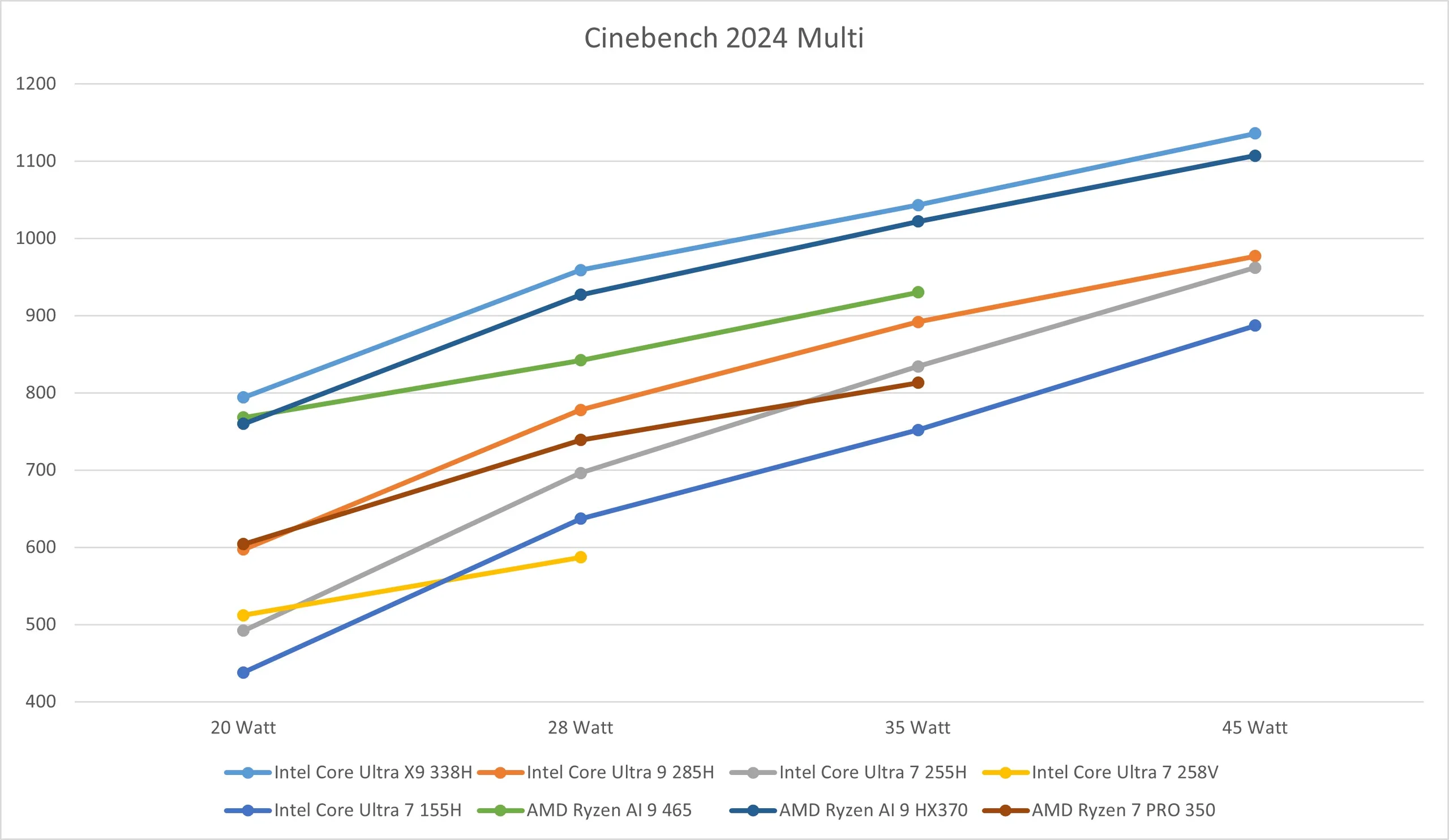
Let's take a closer look at the performance at lower power limits. Here you can clearly see that the new X9 388H has a performance advantage over AMD's Zen 5 models even at low power limits, a trend that was not previously observed. However, the difference to the Ryzen AI 9 HX370 is small, so Intel has only caught up here. Nevertheless, we can clearly say that Panther Lake can replace its two predecessors (Arrow Lake and Lunar Lake) very well and is also a very good choice in slim devices with low power limits. Together with the excellent GPU performance, Panther Lake will clearly be the best platform for handhelds in 2026.
Update 1: We have also tested the smaller Core Ultra X7 358H at lower power limits and the results are still good, but the X7 is beaten by the AMD Ryzen AI 9 HX 370.
Update 2: We performed additional tests with the AMD Ryzen AI Max+ 395 at lower power limits. Systems with Strix Halo usually operate at higher power levels (usually from 65W upwards), but Panther Lake can be operated at up to 80W as well, so a comparison makes sense. Right now, our Panther Lake results are capped at 45W, but we will add performance figures for higher power limits as soon as possible. The results for the Ryzen AI Max+ 395 are very good and still very competitive at lower power limits. AMD's chip still has the advantage at 28W and at higher power, the advantage grows significantly thanks to 16 Zen 5 cores.
| CPU | 20 watts | 28 watts | 35 watts | 45 watts |
|---|---|---|---|---|
| Intel Core Ultra X9 338H | 794 points | 959 points | 1,043 points | 1,136 points |
| Intel Core Ultra X7 358H | 738 points | 900 points | 997 points | 1,100 points |
| Intel Core Ultra 9 285H | 597 points | 778 points | 892 points | 977 points |
| Intel Core Ultra 7 255H | 492 points | 696 points | 834 points | 962 points |
| Intel Core Ultra 7 258V | 512 points | 587 points | ||
| Intel Core Ultra 7 155H | 438 points | 637 points | 752 points | 887 points |
| AMD Ryzen AI Max+ 395 | 717 points | 981 points | 1,108 points | 1,339 points |
| AMD Ryzen AI 9 465 | 768 points | 842 points | 930 points | |
| AMD Ryzen AI 9 HX370 | 760 points | 927 points | 1022 points | 1107 points |
| AMD Ryzen 7 PRO 350 | 604 points | 739 points | 813 points |
Verdict - Intel Core Ultra X9 388H is faster and more efficient
With the new Panther Lake mobile processors, Intel has managed to successfully combine the two previous generations, Arrow Lake and Lunar Lake, as the performance is even better than with Arrow Lake, while efficiency has been improved at the same time. Even with low power limits, the performance is very competitive, and Intel (in conjunction with the new GPUs) is therefore the better choice for slim laptops.
AMD's Zen 5 processors fall slightly behind in single-core performance, but AMD is still competitive in multi-core performance. Apple's current M5 SoC is at the same level in multi-core performance but is more efficient, while single-core performance is in a completely different league. The upcoming M5 Pro SoCs will certainly raise the bar for multi-core and GPU performance.
We will have to wait a little longer for the new Snapdragon processors from ARM, but these will probably have a performance advantage over Panther Lake. However, devices with Panther Lake are already coming onto the market and are currently the best choice when buying a new laptop.
 Add as a preferred source on Google


