



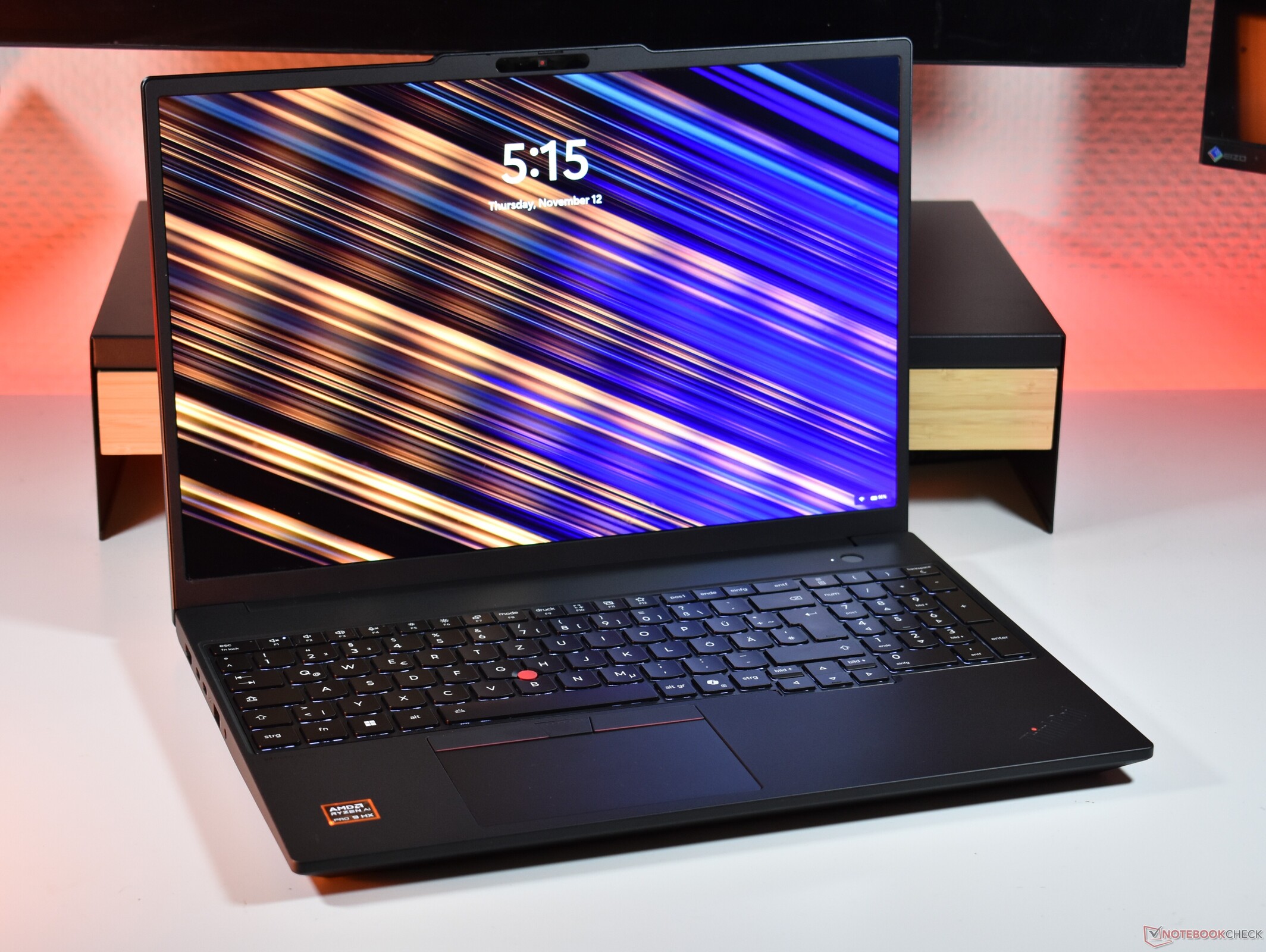
Verdict: 2026 brings a huge upgrade for the ThinkPad P16s AMD
Among the P series ThinkPads, Lenovo's most capable ThinkPad line, the P16s was always one of the weaker models. While that is still overall true with the new Lenovo ThinkPad P16s Gen 5 AMD, this is a far stronger outing than before. The AMD-variant of the P16s finally gains a second fan, as well as the Nvidia RTX Pro GPU option, plus extras like an SD card slot. While the RTX Pro 2000 Blackwell here is limited by a low TGP, the new P16s is still a far more capable device than its predecessors ever were, finishing the transformation of this once limited ultrabook-type workstation variant into a fully fledged mobile workstation laptop.
Among the AMD-based ThinkPads, this one stands out as the only one currently available with an Nvidia GPU. It is also the only AMD ThinkPad with the new LPCAMM2 memory format. Overall, besides the limited GPU performance, this is the most powerful and versatile AMD-based ThinkPad without any real compromises.
Pros
Cons
Price and Availability
As of this review, the Lenovo ThinkPad P16s Gen 5 AMD starts at around $1,873 over at the Lenovo store. The fully equipped top-of-the-line model we reviewed would cost roughly $4,000.

- $2,729.99 price as of 2026-11-26 14:30 UTC.Lenovo ThinkPad P16s Gen 4 with 64GB DDR5, Ryzen AI 9 HX PRO 370, 16" WUXGA | 100%sRGB 500 nits Non-Touch Display, 1TB Performance SSD, Wi-Fi 7, AMD Radeon 890M Graphics, Mobile Workstation - 21RX000MUS
- $1,999.99 price as of 2026-11-26 14:30 UTC.Lenovo ThinkPad P16s Gen 4 Mobile Workstation Laptop, Ultra 7 255H 32GB/1TB | Business AI PC, 16" FHD+ Anti-Glare, 2x Thunderbolt 4, Backlit, Fingerprint, 5MP IR Webcam, Ethernet, Wi-Fi 7, Win 11 Pro
- $2,836.34 price as of 2026-11-26 14:30 UTC.Lenovo ThinkPad P16s Gen 5 21XG0036US 16" Copilot+ PC Notebook - WUXGA - 60 Hz - AMD Ryzen AI 7 PRO Ryzen AI PRO 400 Series 450-32 GB - 1 TB SSD - English Keyboard - Black - AMD Chip - 1920 x 1200 -
In Lenovo's mobile workstation portfolio, the ThinkPad P16 is the absolute best when it comes to performance. The Lenovo ThinkPad P16s, however, was historically one of the least powerful Lenovo workstations, as it was always outfitted with ultra-low-voltage processors. Five generations in, Lenovo has now fundamentally changed things: The new Lenovo ThinkPad P16s Gen 5 has replaced the ThinkPad P16v in the lineup, and it has received a real performance upgrade - especially the AMD variant that we are reviewing here.
Like the P16v it replaces, the new ThinkPad P16s is the entry-level workstation, so if you need to work with CAD applications, this is one of the most affordable Lenovo ThinkPads for you.
Specifications
Case
Historically, the ThinkPad P16s always used the same design as the ThinkPad T series and the ThinkPad T16, but this is no longer true. The newest model has a distinct chassis design from the T series, even though it looks very similar to the new T ThinkPads, with the wide bar hinge and black, boxy design. Unlike the Lenovo ThinkPad T16 Gen 5, this new Lenovo ThinkPad P16s Gen 5 AMD does not have an internal magnesium frame beneath the keyboard, instead opting for a thin aluminum sheet. The bottom cover is made from ABS-plastic, and the display cover consists of black anodized aluminum. The plastic palmrest, like the bottom cover, is painted with a smooth rubbery coating; only the screen bezel is made from rough plastic.
Compared with the T series, the quality is slightly worse, as there is a little bit of a give above the touchpad. That is the only weakness, though, as the device is pretty solid otherwise. The base and the screen certainly can be twisted a bit, but not by a lot. And the hinges, which enable one-handed opening and a 180-degree opening angle, hold the screen firm, with only a very slight amount of wiggle. As all ThinkPads, the chassis can get dirty rather quickly, especially if one has greasy fingers.
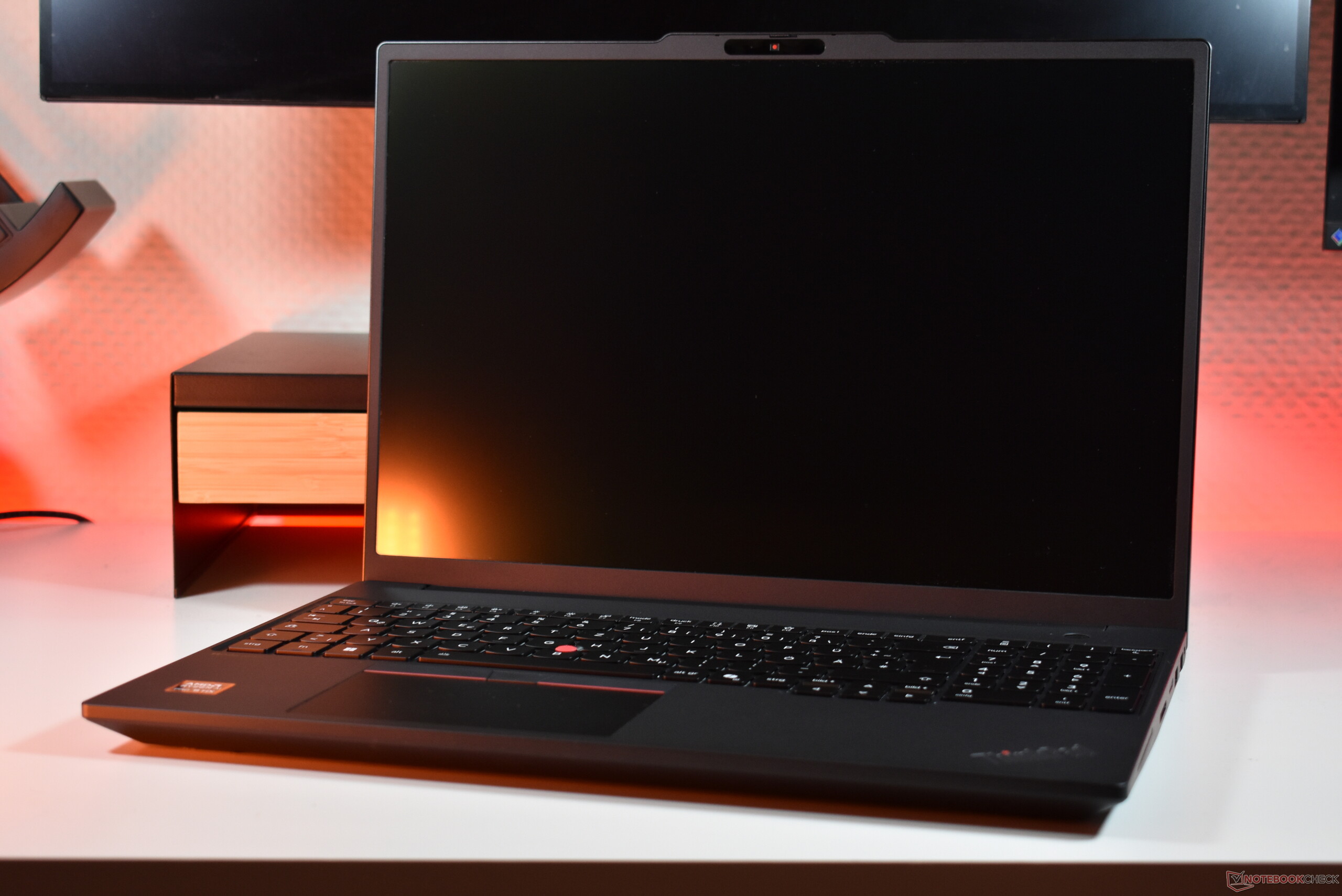
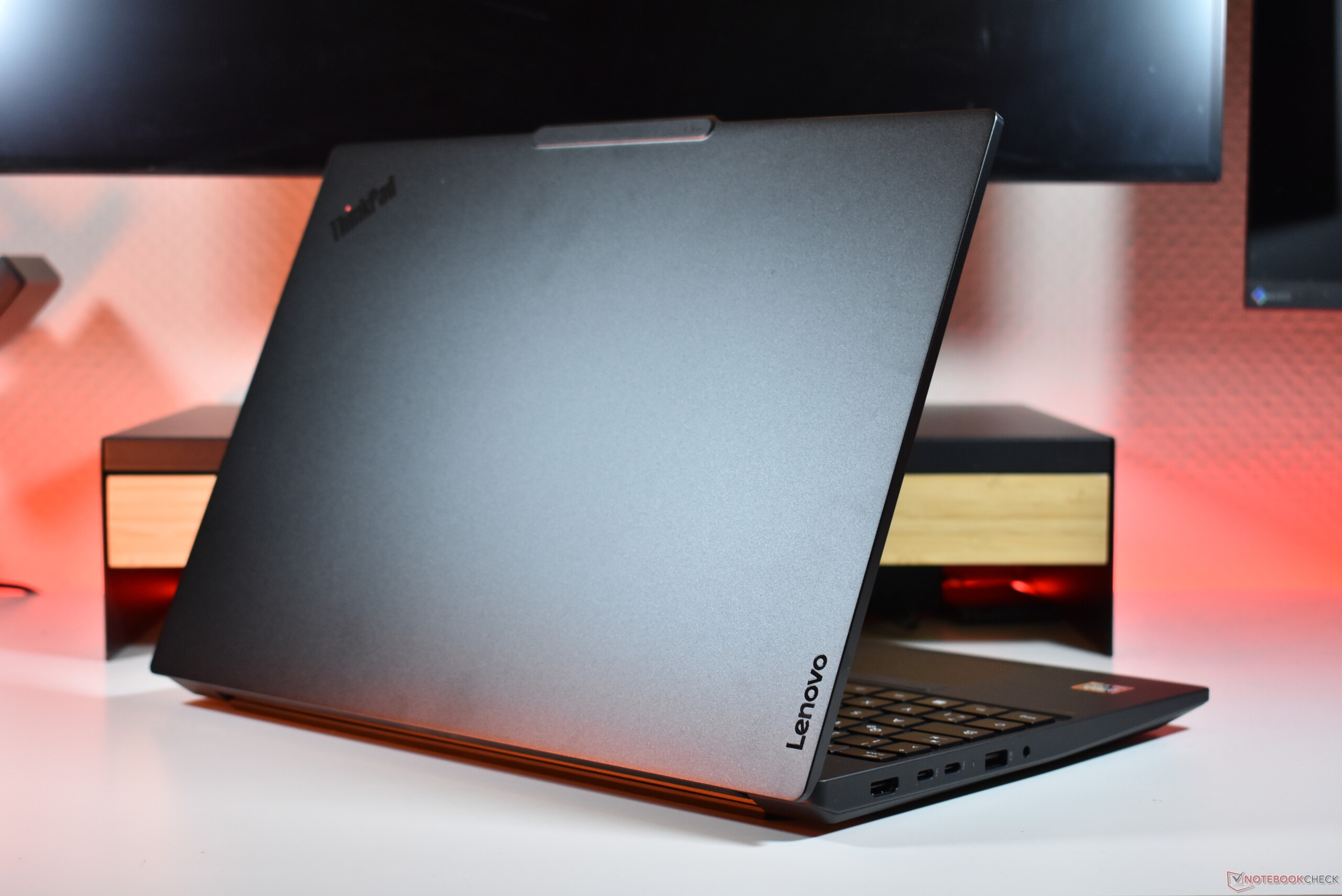
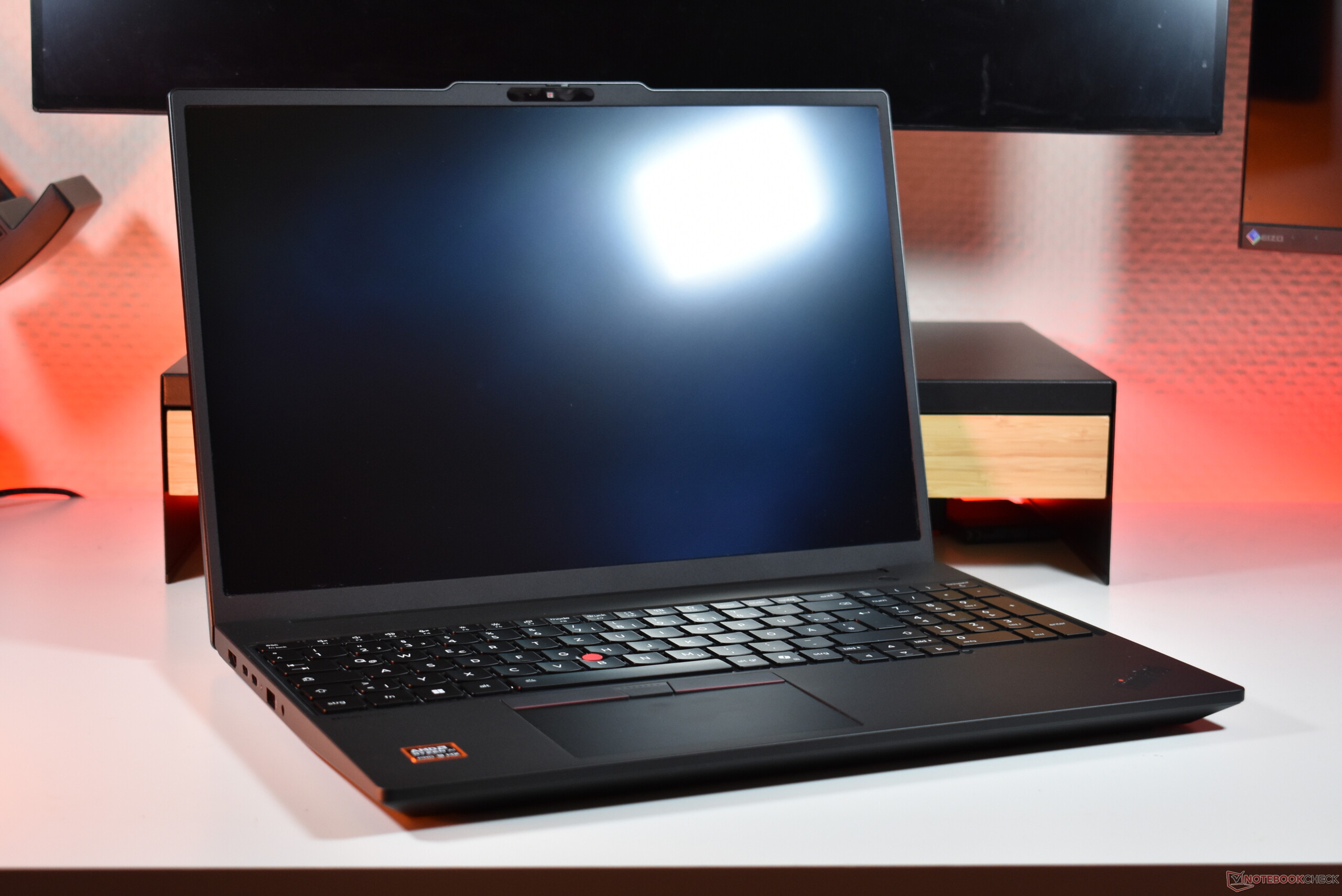
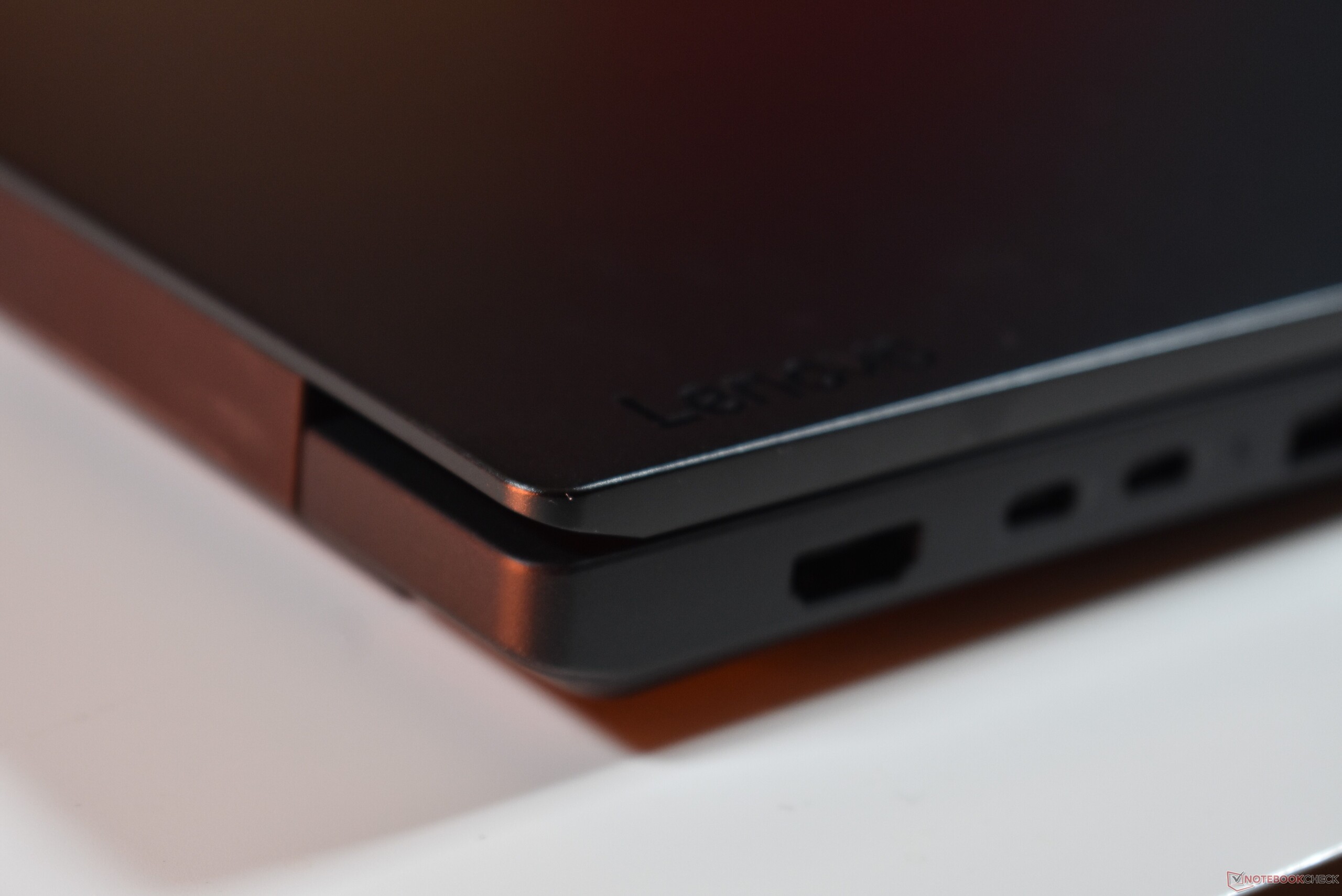
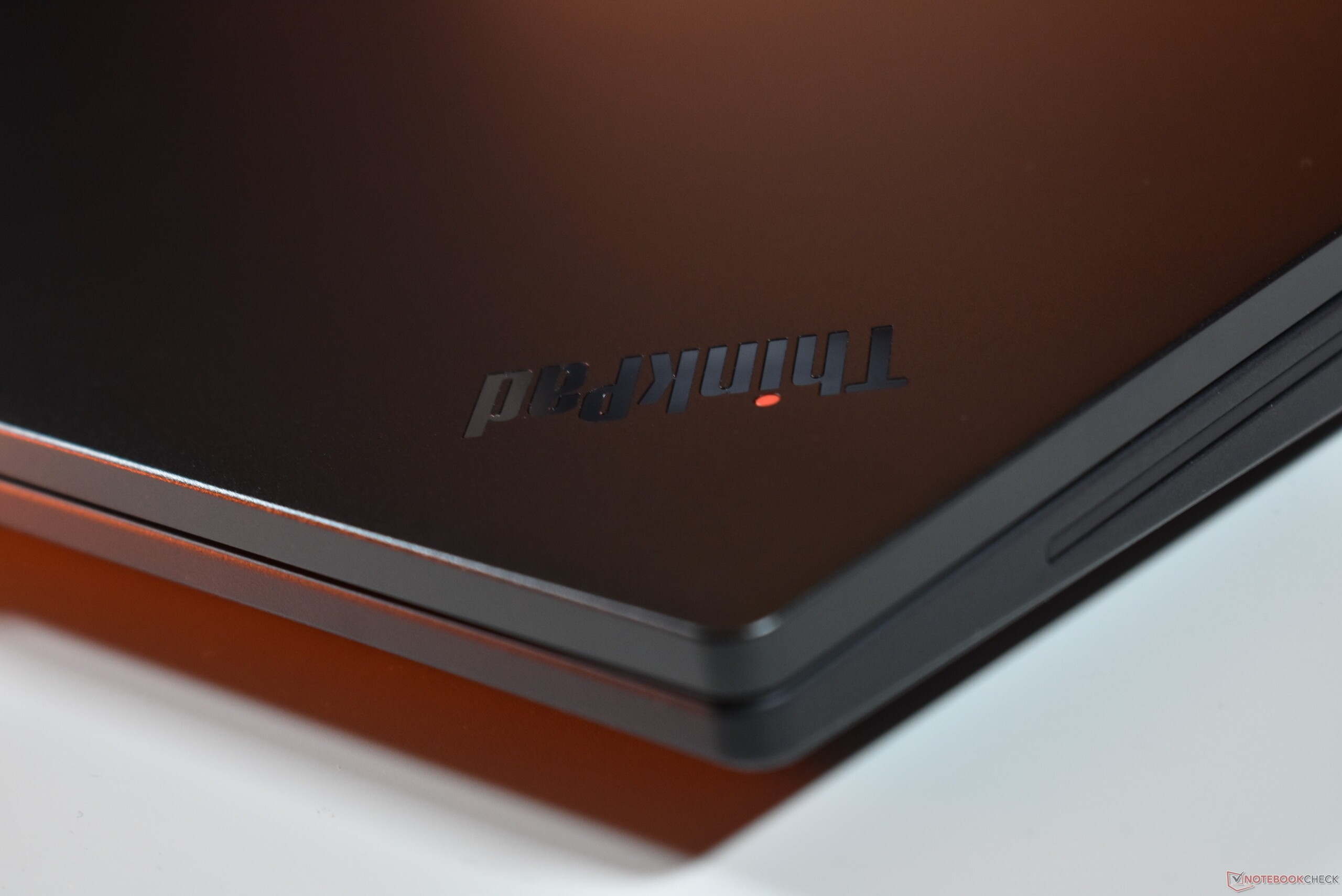
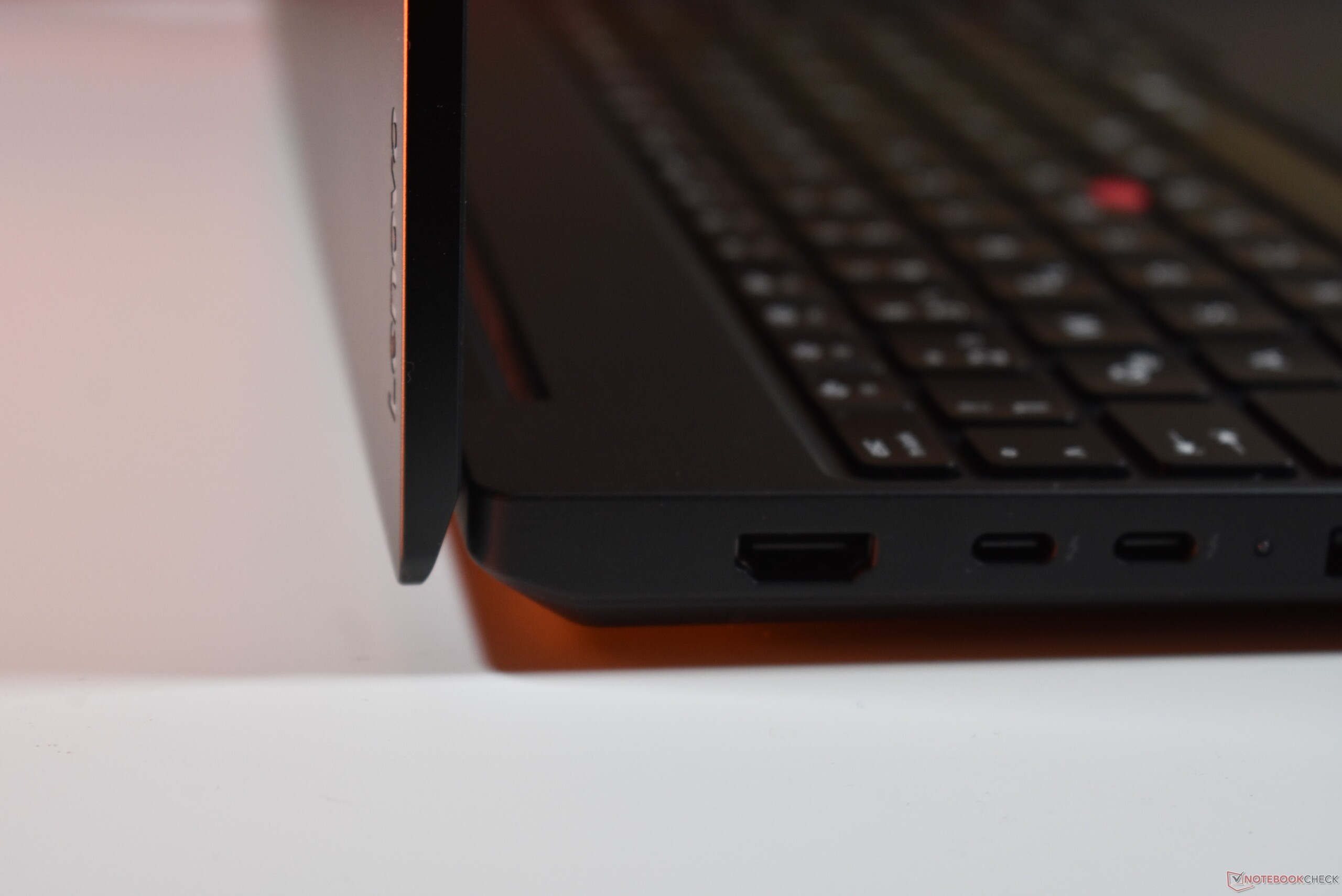
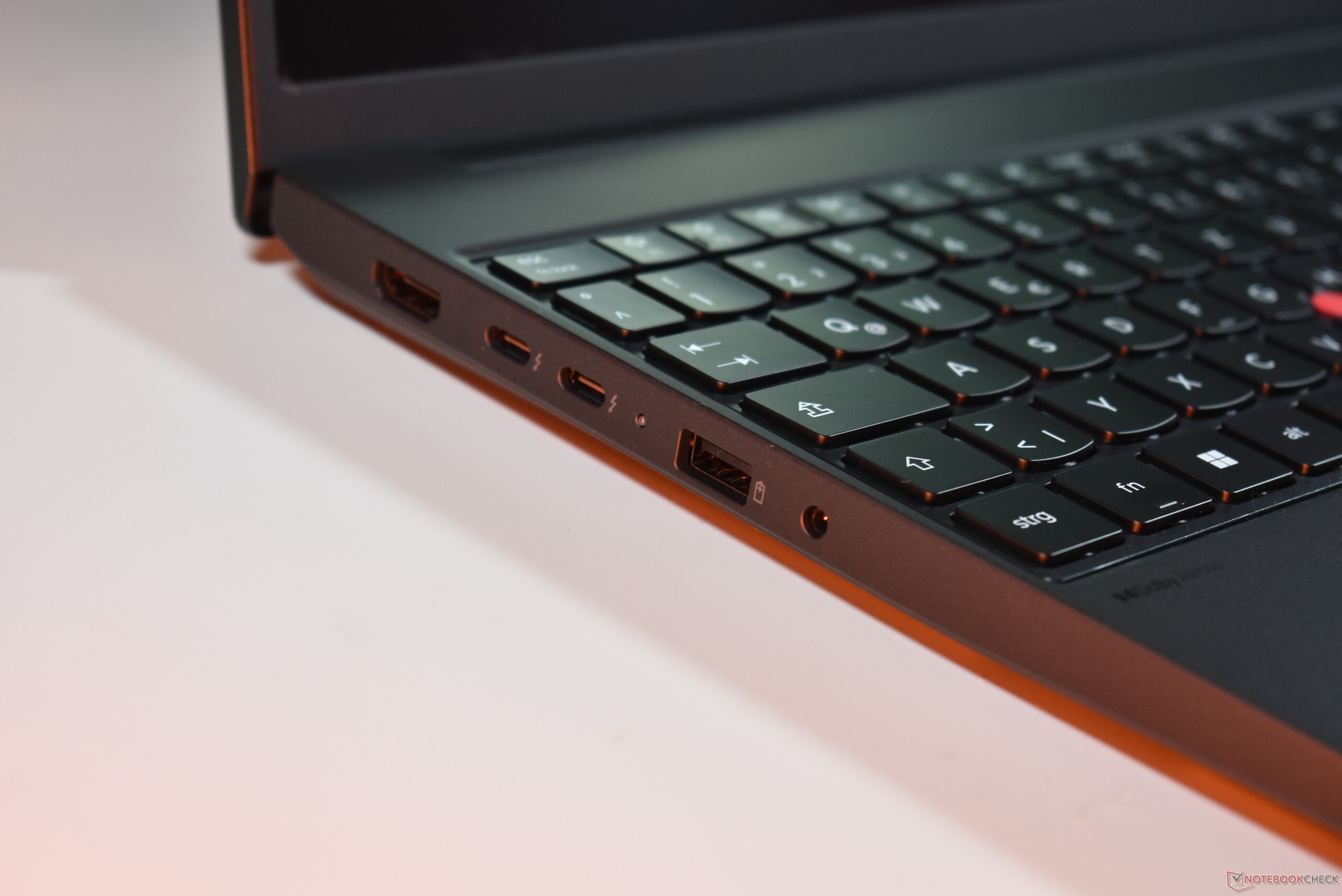
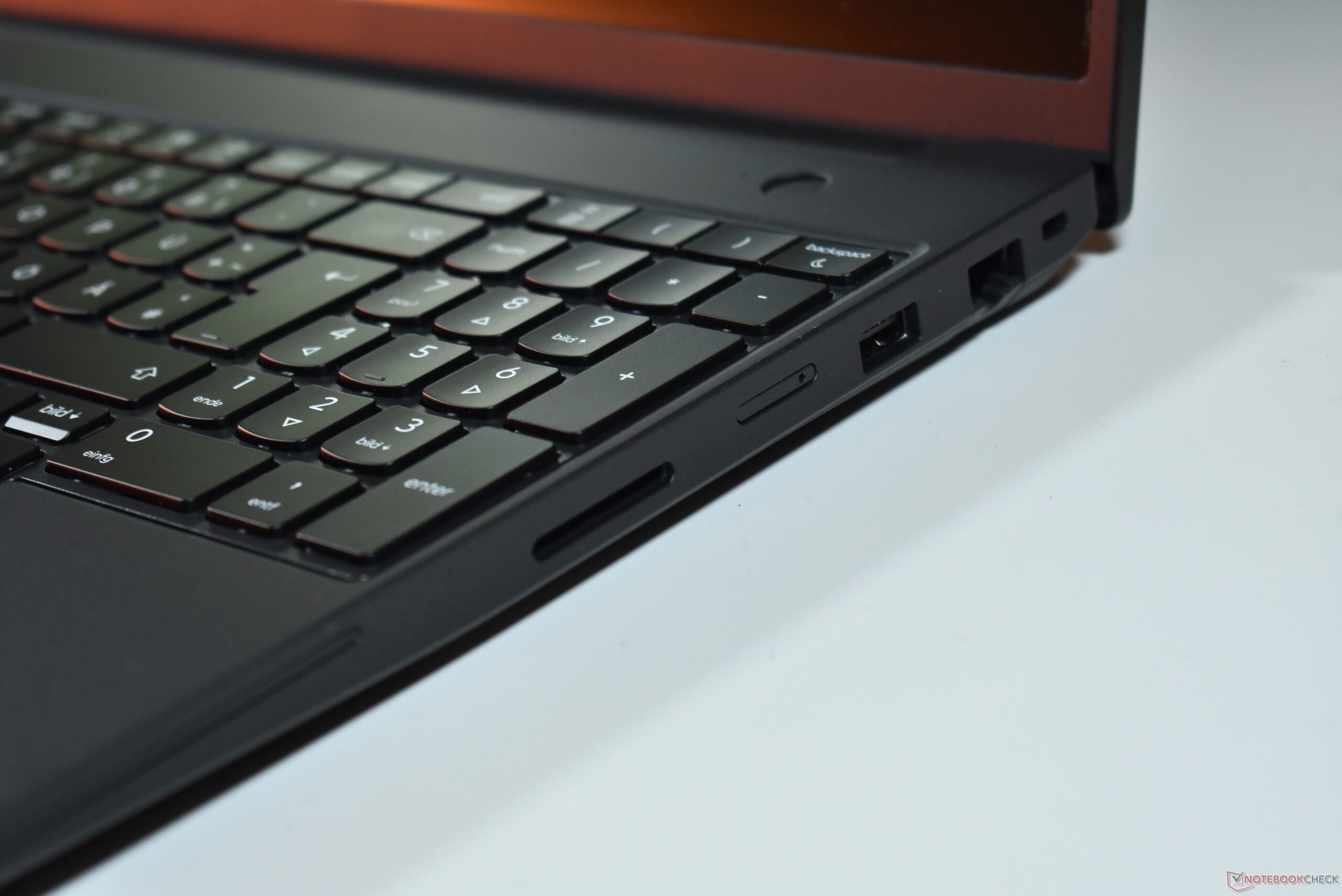
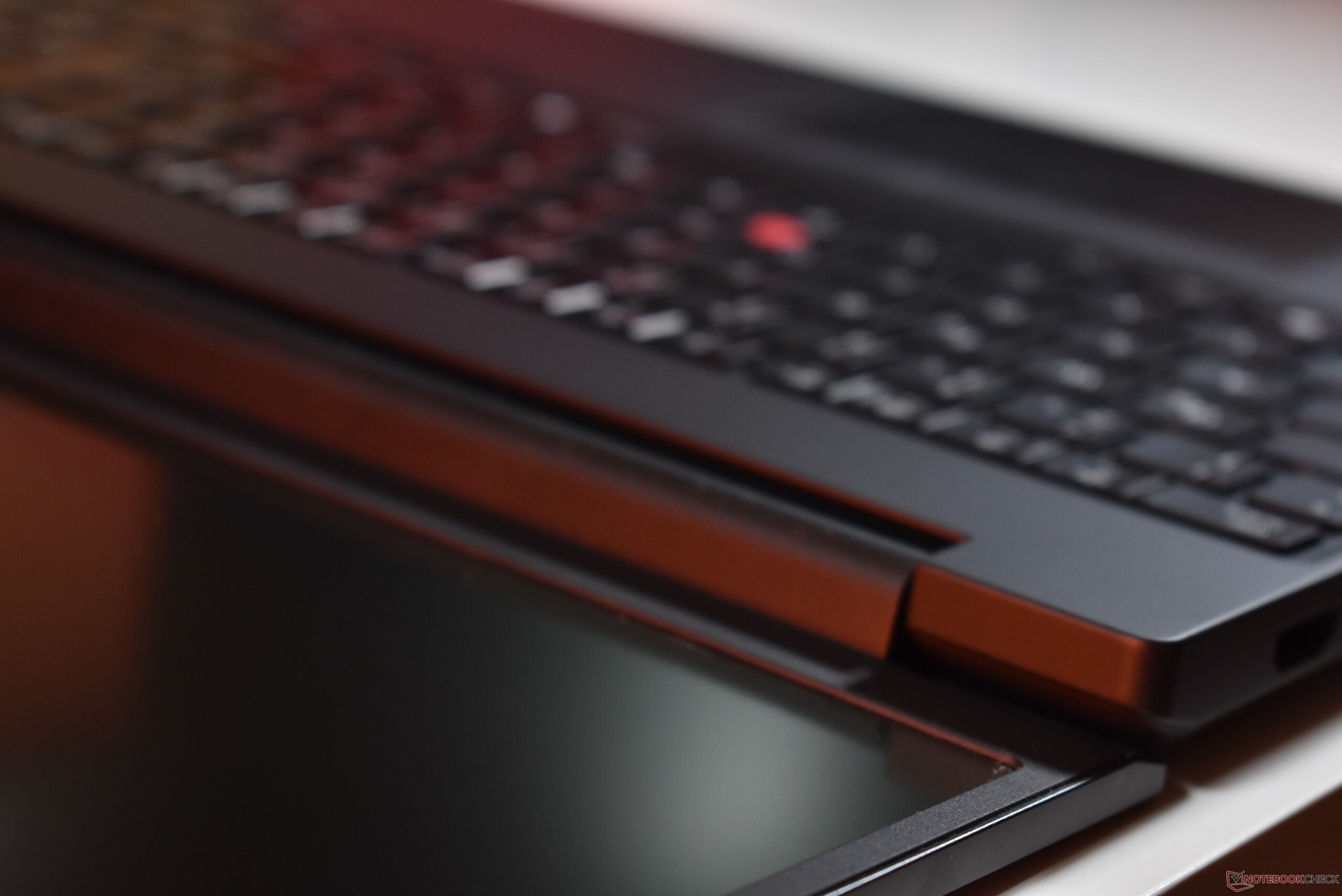
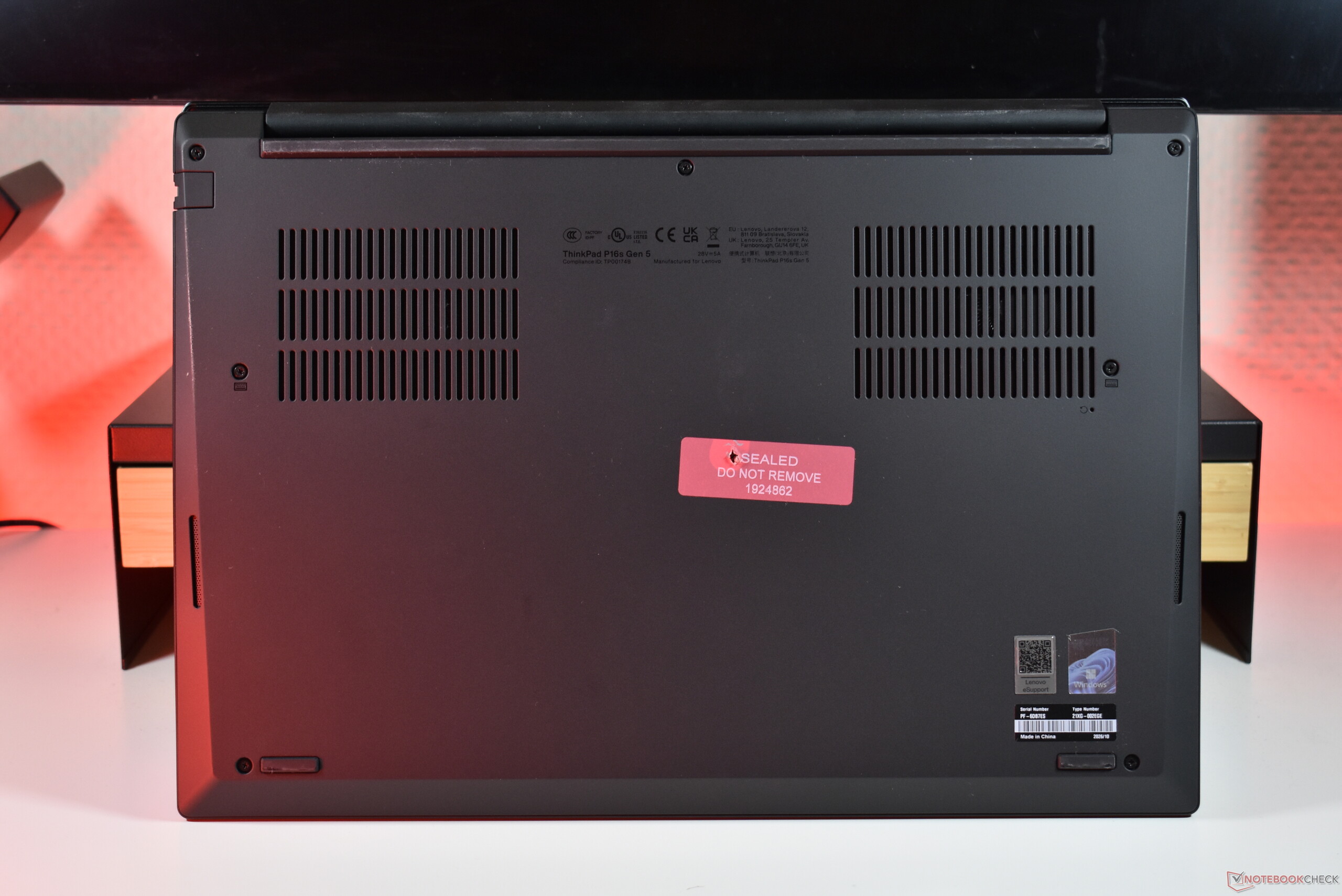
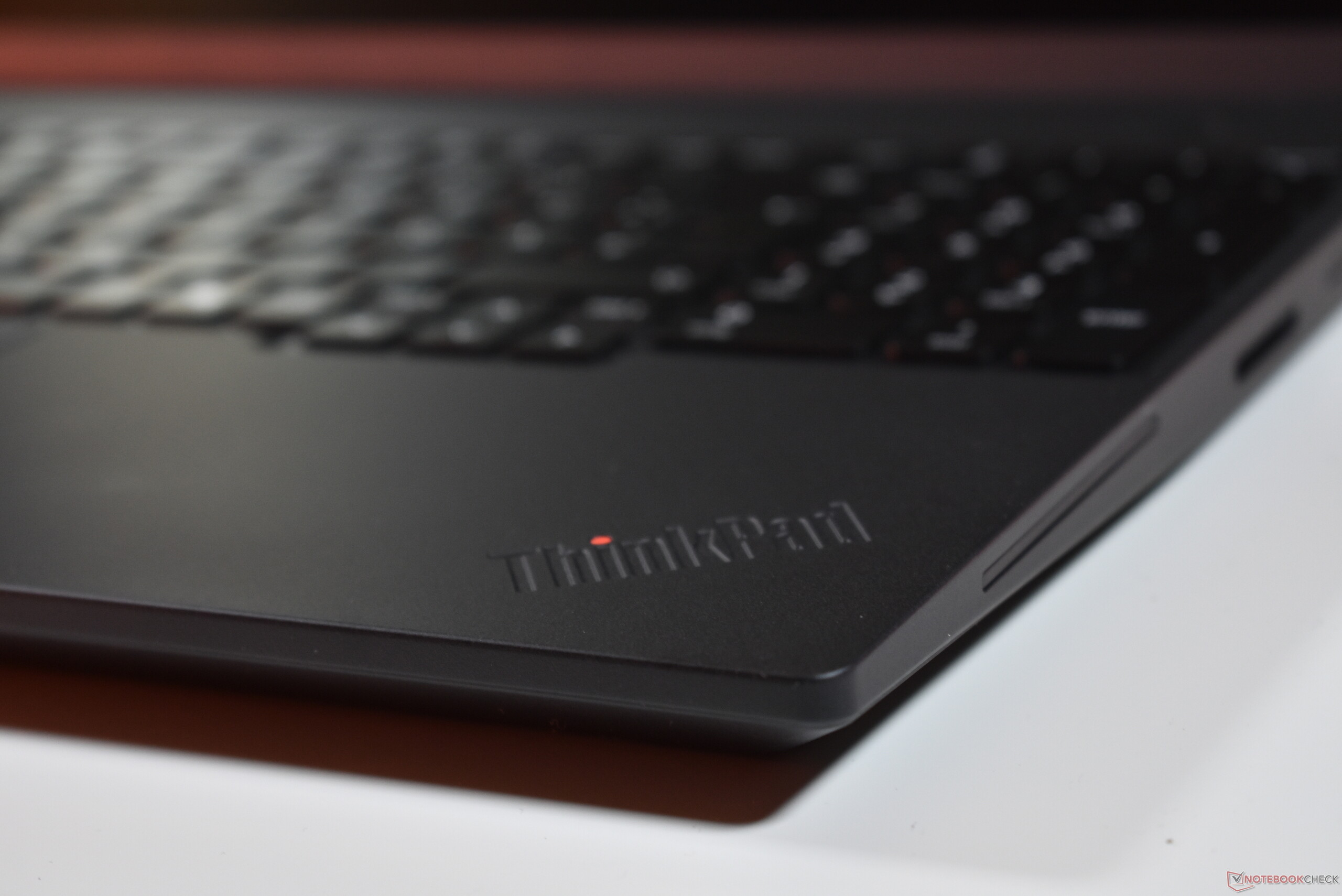
Compared with the ThinkPad P16v it replaces, the new ThinkPad P16s Gen 5 is a bit more lightweight, with a starting weight of 2 kg instead of 2.2 kg. That is still heavier than the premium-model ThinkPad P1 Gen 9, though, which sits at around 1.9 kg.
Connectivity
In contrast to the more expensive ThinkPad workstation laptops, the ThinkPad P16s Gen 5 does not feature Thunderbolt 5 ports. It also only has two Thunderbolt ports; the P1 and P16 have three. At least the P16s provides an Ethernet port, unlike the slimmer ThinkPad P1. It is Gigabit Ethernet, which is worse than the full-fat ThinkPad P16 with 2.5G-Ethernet.


SD Card Reader
New with the 2026 AMD model of the P16s: a full-size SD card reader. Its speed is average, but it takes in the cards completely.
| SD Card Reader | |
| average JPG Copy Test (av. of 3 runs) | |
| HP ZBook X G1i 16 (Toshiba Exceria Pro SDXC 64 GB UHS-II) | |
| Average of class Workstation (32.5 - 681, n=12, last 2 years) | |
| Lenovo ThinkPad P16v G3 21RS000DGE (Angelbird AV Pro V60) | |
| Lenovo ThinkPad P1 Gen 9 21UE000MGE (AV Pro V60) | |
| Lenovo ThinkPad P16s Gen 5 21XG002EGE (AV Pro V60) | |
| maximum AS SSD Seq Read Test (1GB) | |
| Average of class Workstation (82 - 1455, n=12, last 2 years) | |
| HP ZBook X G1i 16 (Toshiba Exceria Pro SDXC 64 GB UHS-II) | |
| Lenovo ThinkPad P16v G3 21RS000DGE (Angelbird AV Pro V60) | |
| Lenovo ThinkPad P16s Gen 5 21XG002EGE (AV Pro V60) | |
| Lenovo ThinkPad P1 Gen 9 21UE000MGE (AV Pro V60) | |
Communication
The ThinkPad laptop contains a modern Wi-Fi 7 card, though the MediaTek card used here is limited to 160 Hz, so it does not provide the maximum Wi-Fi 7 transfer speeds possible.
Optionally, the ThinkPad P16s Gen 5 can be configured with a 5G/LTE module. Our review sample does not contain one, but it has the necessary antennas, an empty M.2 slot and nanoSIM slot.
Webcam
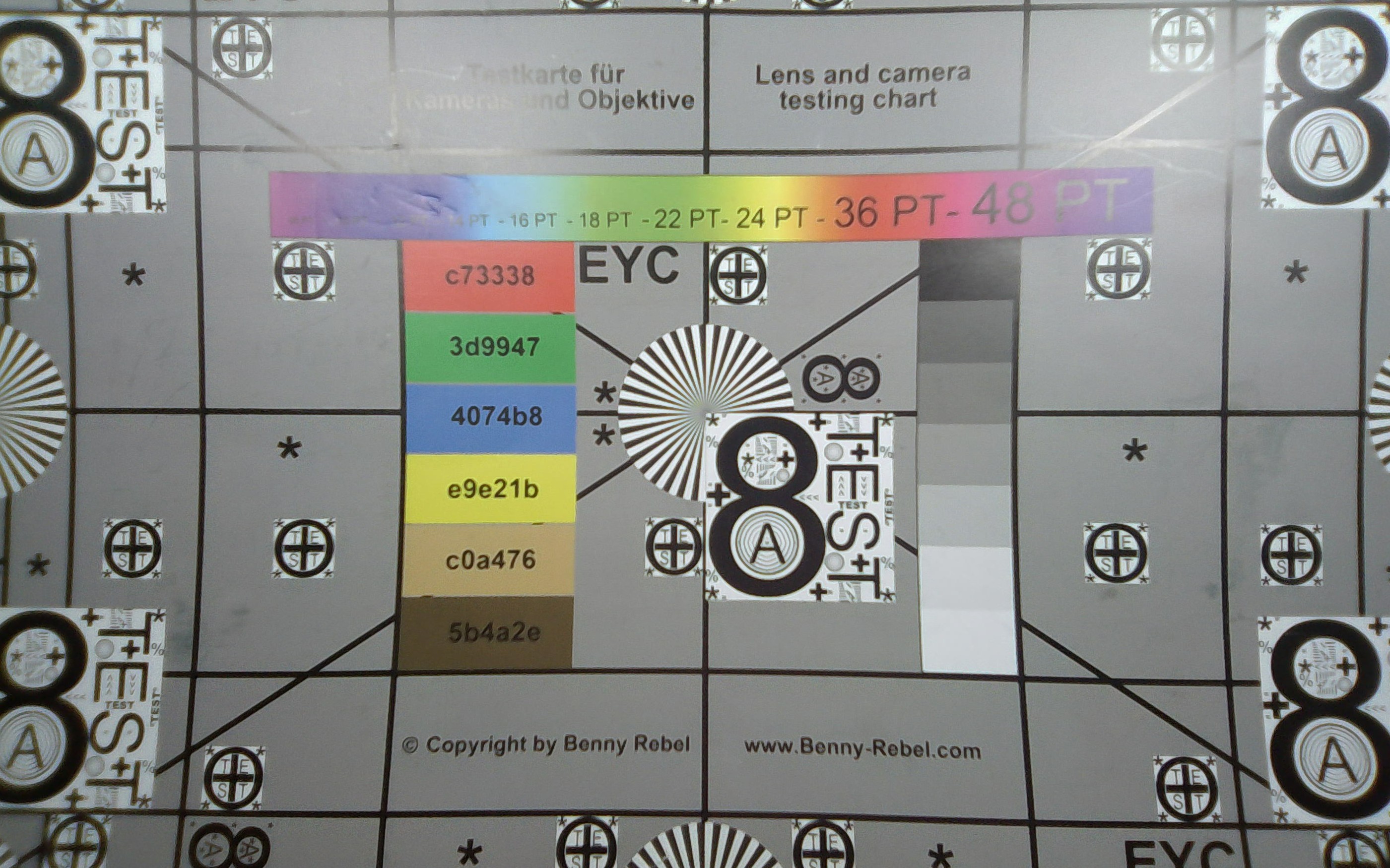
The 5 Mpix webcam of the ThinkPad produces reasonably clear images, if you have a well-lit space. It is certainly not a high-end webcam.


Security
Business devices, like the Lenovo ThinkPad laptop, have plenty of security features that go beyond what consumer-oriented laptops offer. This goes from the fingerprint sensor and IR webcam to the Kensington lock slot for theft protection, a mechanical webcam privacy shutter, and an optional Smartcard reader, which is another feature that the P16s offers over the more expensive ThinkPad P1.
Accessories
Aside from the 140 W GaN USB-C charger, there are no additional accessories included with the ThinkPad P16s Gen 5 AMD.
Maintenance
A total of seven screws hold the bottom cover in place, as well as some clips. Once the cover is removed, there are plenty of modular parts, starting with the M.2 2280 SSD and the LPCAMM2 memory - this is the only AMD ThinkPad with LPCAMM2. There also is a free M.2 2242 slot, enabling 5G upgrades. New as well this year: Modular, replaceable USB-C charging ports and a user-replaceable keyboard, which is a feature that was missing on the older P16s chassis. Plus, the battery is a user-replaceable CRU (customer-replaceable unit) part.


Sustainability
With a CO2-equivalent emission of 154 kg, the P16s Gen 5 is responsible for lower emissions than the more expensive Lenovo ThinkPad P1 Gen 9 (218 kg/CO2e). While the packaging of the ThinkPad is completely plastic-free, only the aluminum top cover and some internal components are made from partially recycled materials. Since this is a ThinkPad for the business market, one can expect driver updates and available replacement parts for many years. And of course, Lenovo releases manuals in both video and written form.
Warranty
The ThinkPad P16s Gen 5 includes a three-year warranty with bring-in service, and limited on-site service for the first year. The bring-in warranty applies worldwide, though the on-site service is limited to the country of origin (Germany). Optional warranty upgrades (five years, premium on-site service, accidental damage protection) are available.
Input Devices
Keyboard
The keyboard is the standard ThinkPad model that you expect from a 16-inch ThinkPad, which means this is a full-size backlit Chiclet keyboard with 1.5 mm key travel and a numpad. It has a sensible layout with grouped F keys and reasonably sized arrow keys, and the typing feel is very good. Overall, this is a keyboard that you can type on for a long time every day without getting tired.

Touchpad and TrackPoint
As a typical ThinkPad, the P16s G5 AMD includes both a touchpad, which is a mechanical plastic clickpad (11.5 x 6.5 cm in size), as well as the red ThinkPad TrackPoint and its three dedicated buttons above the touchpad. Both serve their purpose well, with the TrackPoint being especially good for drag and drop operations, as well as when the laptop is used in a cramped space, like an airplane or train.


Display
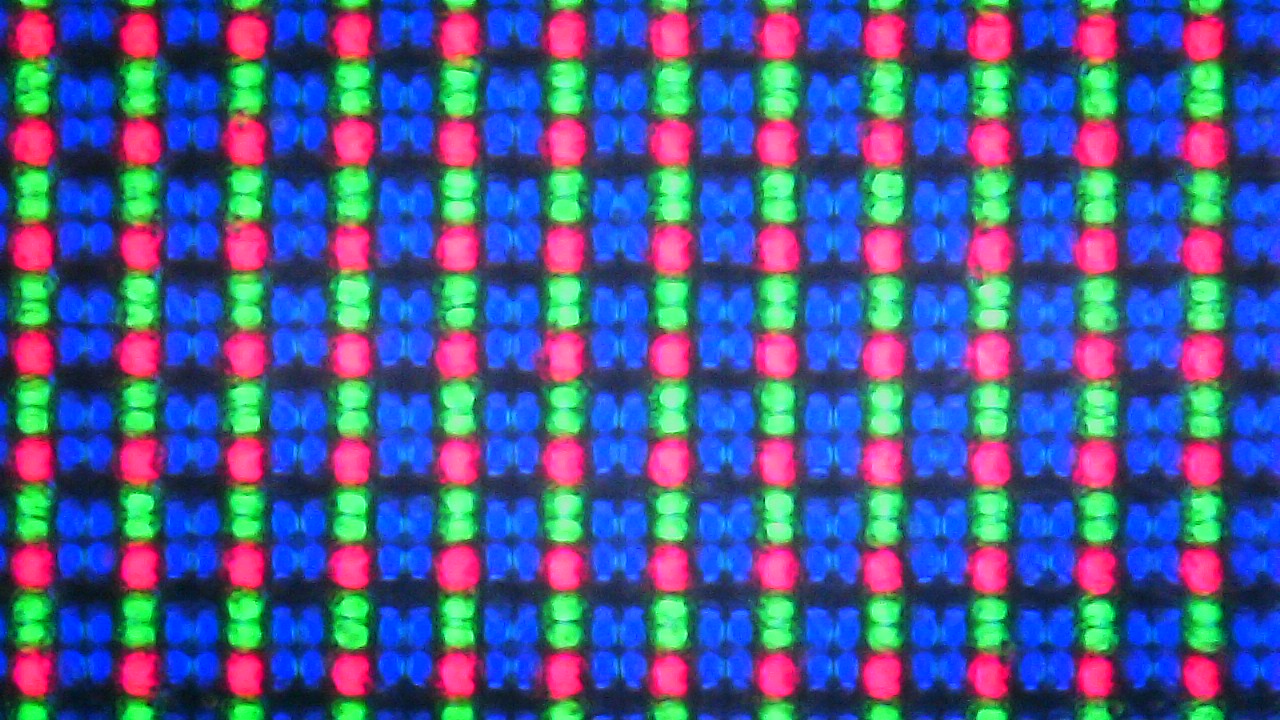
There are a total of three different 16-inch 16:10 screen options, all of which have a matte screen surface. Unlike the more expensive P series ThinkPads, the P16s Gen 5 is not offered with a 4K-WQUXGA (3,840 x 2,400) resolution.
- WUXGA (1,920 x 1,200), IPS, 400 cd/m², 45 % NTSC
- WUXGA (1,920 x 1,200), IPS, 500 cd/m², 100 % sRGB, 30-60 Hz VRR, In-Cell Multitouch
- 2.8K (2,880 x 1,800), OLED, 500 cd/m², 100 % DCI-P3, 30-120 Hz VRR, Dolby Vision HDR
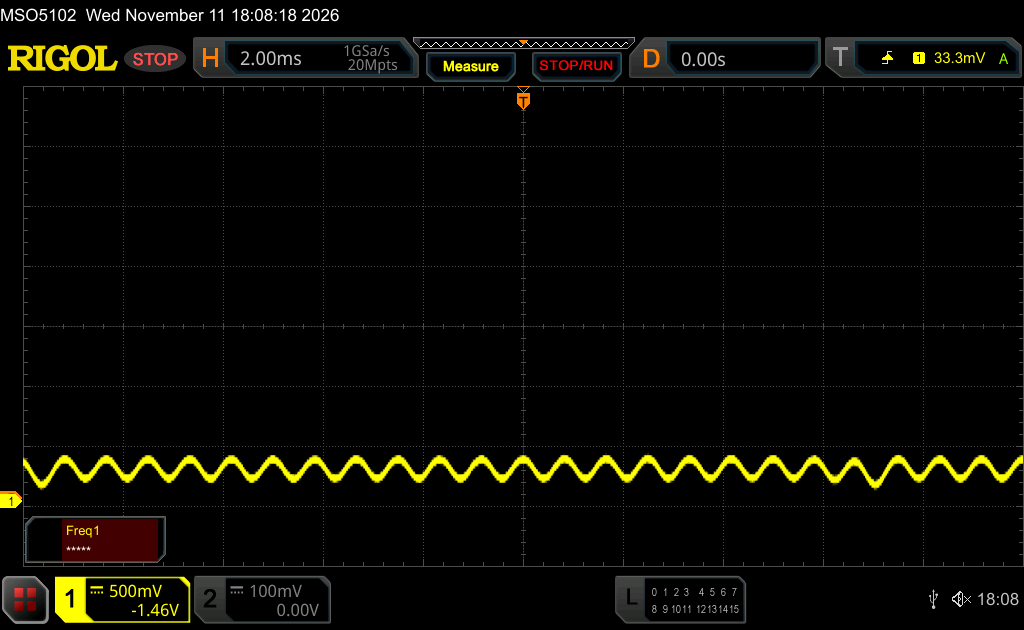
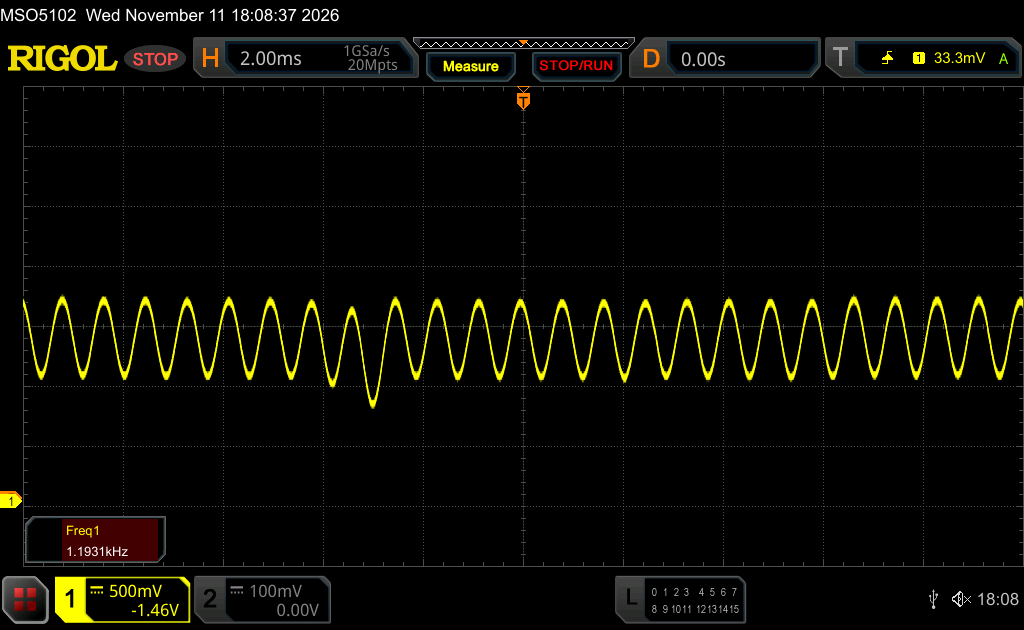
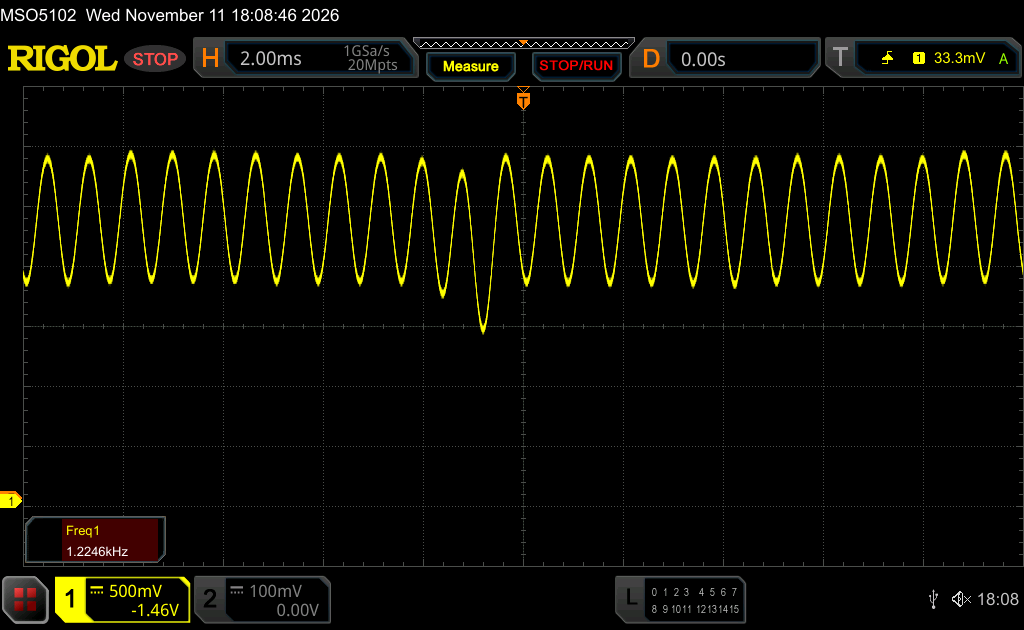
Our review sample was outfitted with the most expensive screen option, which delivers the promised 500 cd/m² of brightness. It's a very nice OLED screen, which also is fast thanks to low reaction times and a high refresh rate. It does use PWM to regulate brightness, but the frequency of more than 1000 Hz is high enough that it should not be problematic for most users.
| |||||||||||||||||||||||||
Brightness Distribution: 99 %
Center on Battery: 499 cd/m²
Contrast: ∞:1 (Black: 0 cd/m²)
ΔE ColorChecker Calman: 4.5 | ∀{0.5-29.43 Ø4.67}
calibrated: 4.9
ΔE Greyscale Calman: 1.5 | ∀{0.09-98 Ø4.92}
90.2% AdobeRGB 1998 (Argyll 3D)
95.9% sRGB (Argyll 3D)
88.5% Display P3 (Argyll 3D)
Gamma: 2.21
CCT: 6445 K
| Lenovo ThinkPad P16s Gen 5 21XG002EGE ATNA60HR09-0, OLED, 2880x1800, 16", 120 Hz | Lenovo ThinkPad P16v G3 21RS000DGE M160NW49 R0, IPS, 1920x1200, 16", 60 Hz | HP ZBook X G1i 16 LG Philips LGD07B3, IPS, 2560x1600, 16", 120 Hz | Lenovo ThinkPad P16s Gen 4 21RX000YGE N160JCA-GT1, IPS LED, 1920x1200, 16", 60 Hz | Lenovo ThinkPad P1 Gen 9 21UE000MGE N160JCA-GT1, IP LED, 1920x1200, 16", 60 Hz | |
|---|---|---|---|---|---|
| Display | -14% | 8% | -17% | -18% | |
| Display P3 Coverage (%) | 88.5 | 68.4 -23% | 97.2 10% | 65.8 -26% | 64.7 -27% |
| sRGB Coverage (%) | 95.9 | 99.7 4% | 100 4% | 96.8 1% | 96.2 0% |
| AdobeRGB 1998 Coverage (%) | 90.2 | 70.6 -22% | 99.9 11% | 67.8 -25% | 66.5 -26% |
| Response Times | -1914% | -1714% | -1804% | -1617% | |
| Response Time Grey 50% / Grey 80% * (ms) | 1.27 ? | 39.2 ? -2987% | 45.5 ? -3483% | 29.4 ? -2215% | 27 ? -2026% |
| Response Time Black / White * (ms) | 1.5 ? | 14.1 ? -840% | 26.1 ? -1640% | 22.4 ? -1393% | 19.6 ? -1207% |
| PWM Frequency (Hz) | 1224.6 | 26536 ? | |||
| PWM Amplitude * (%) | 40 | 47 -18% | |||
| Screen | 17% | -10% | -8% | -4% | |
| Brightness middle (cd/m²) | 499 | 565 13% | 461.8 -7% | 540 8% | 527 6% |
| Brightness (cd/m²) | 500 | 554 11% | 427 -15% | 516 3% | 495 -1% |
| Brightness Distribution (%) | 99 | 90 -9% | 88 -11% | 93 -6% | 89 -10% |
| Black Level * (cd/m²) | 0.33 | 0.46 | 0.37 | 0.36 | |
| Colorchecker dE 2000 * | 4.5 | 1.8 60% | 4.08 9% | 3.4 24% | 3.6 20% |
| Colorchecker dE 2000 max. * | 8.2 | 4.2 49% | 8.1 1% | 5.6 32% | 5.3 35% |
| Colorchecker dE 2000 calibrated * | 4.9 | 0.7 86% | 0.75 85% | 0.9 82% | 1 80% |
| Greyscale dE 2000 * | 1.5 | 2.9 -93% | 3.5 -133% | 4.5 -200% | 3.9 -160% |
| Gamma | 2.21 100% | 2.23 99% | 2.15 102% | 2.51 88% | 2.58 85% |
| CCT | 6445 101% | 6534 99% | 6715 97% | 6294 103% | 6872 95% |
| Contrast (:1) | 1712 | 1004 | 1459 | 1464 | |
| Total Average (Program / Settings) | -637% /
-313% | -572% /
-399% | -610% /
-310% | -546% /
-276% |
* ... smaller is better
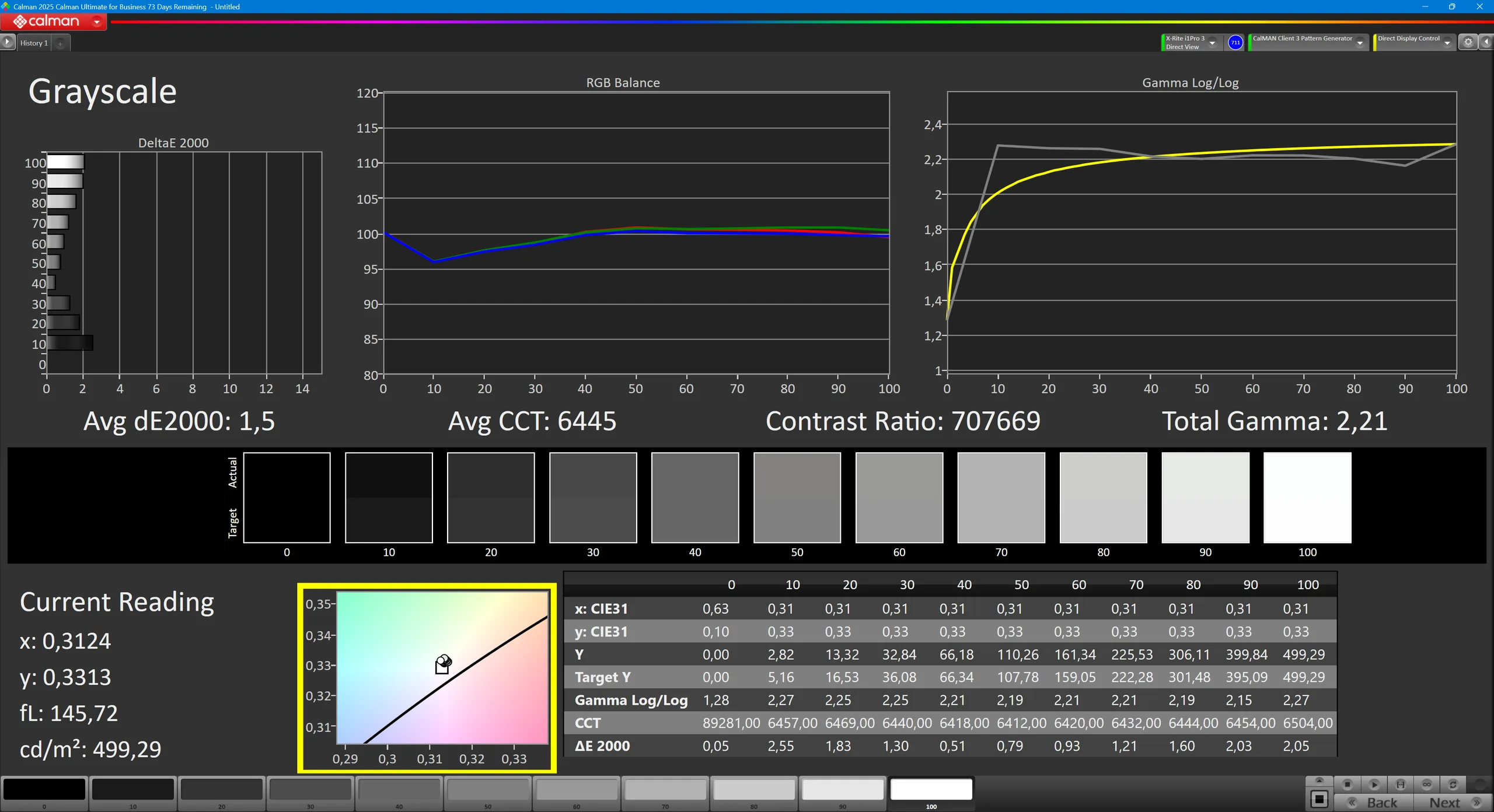
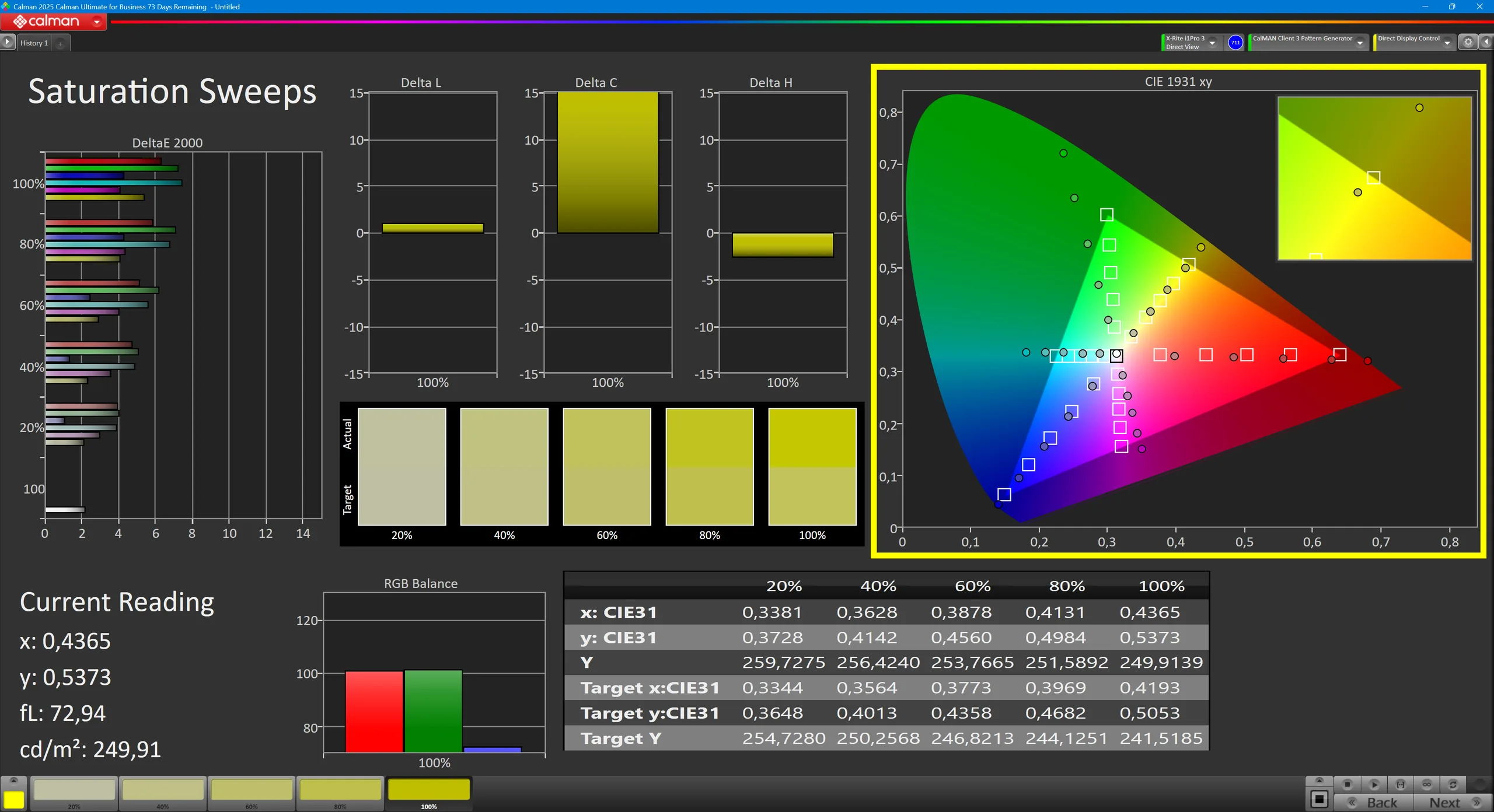

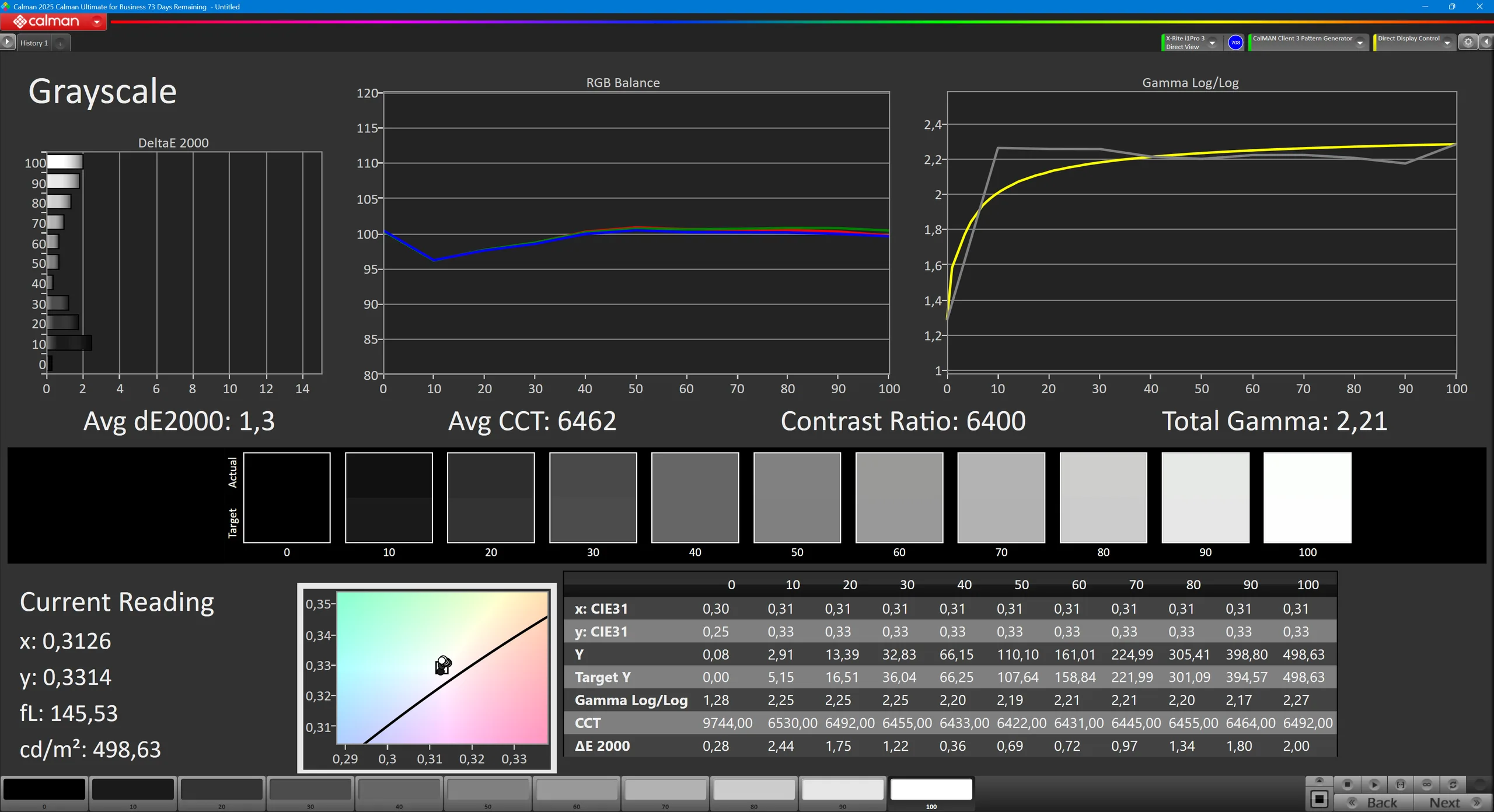
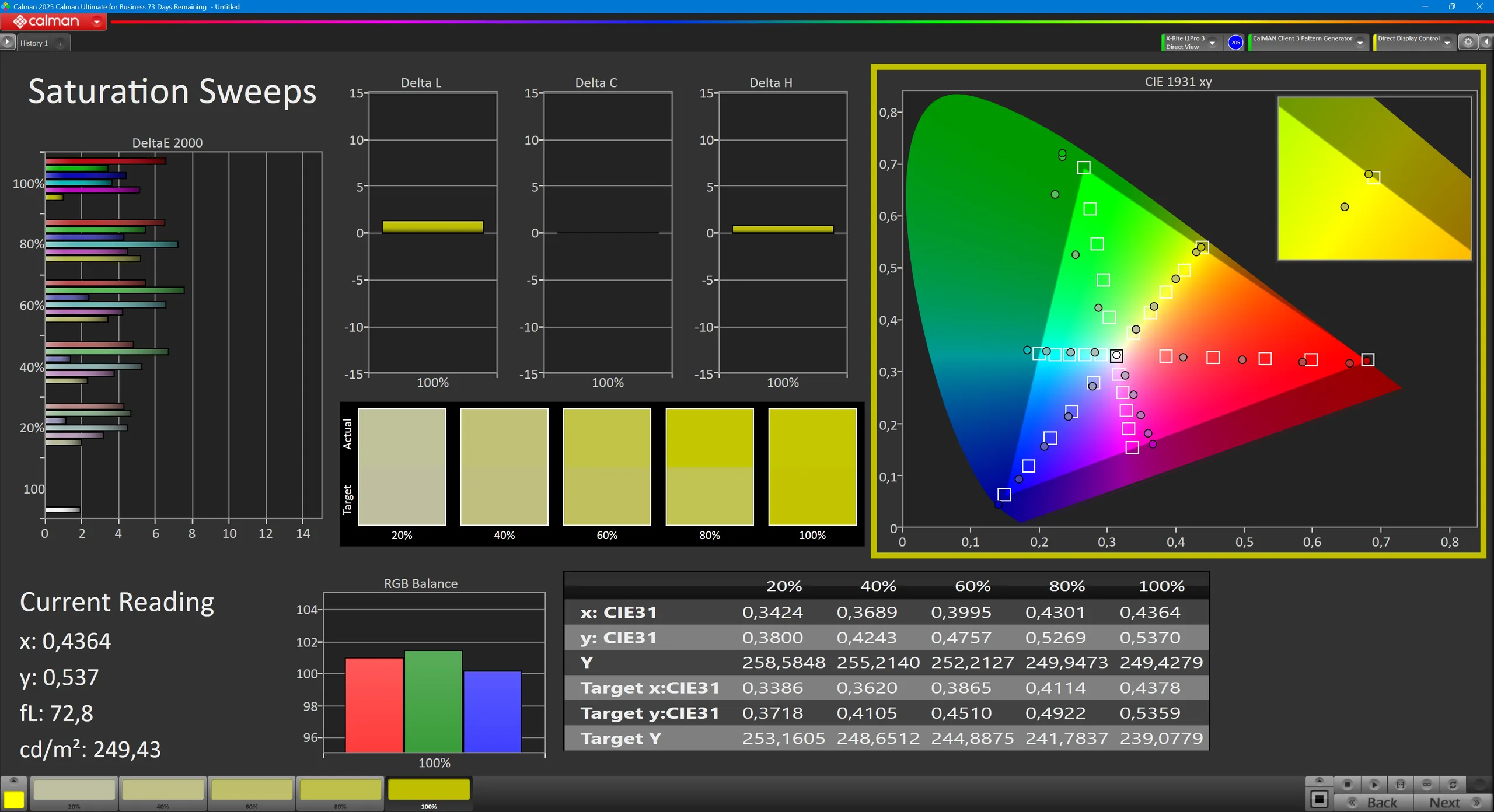

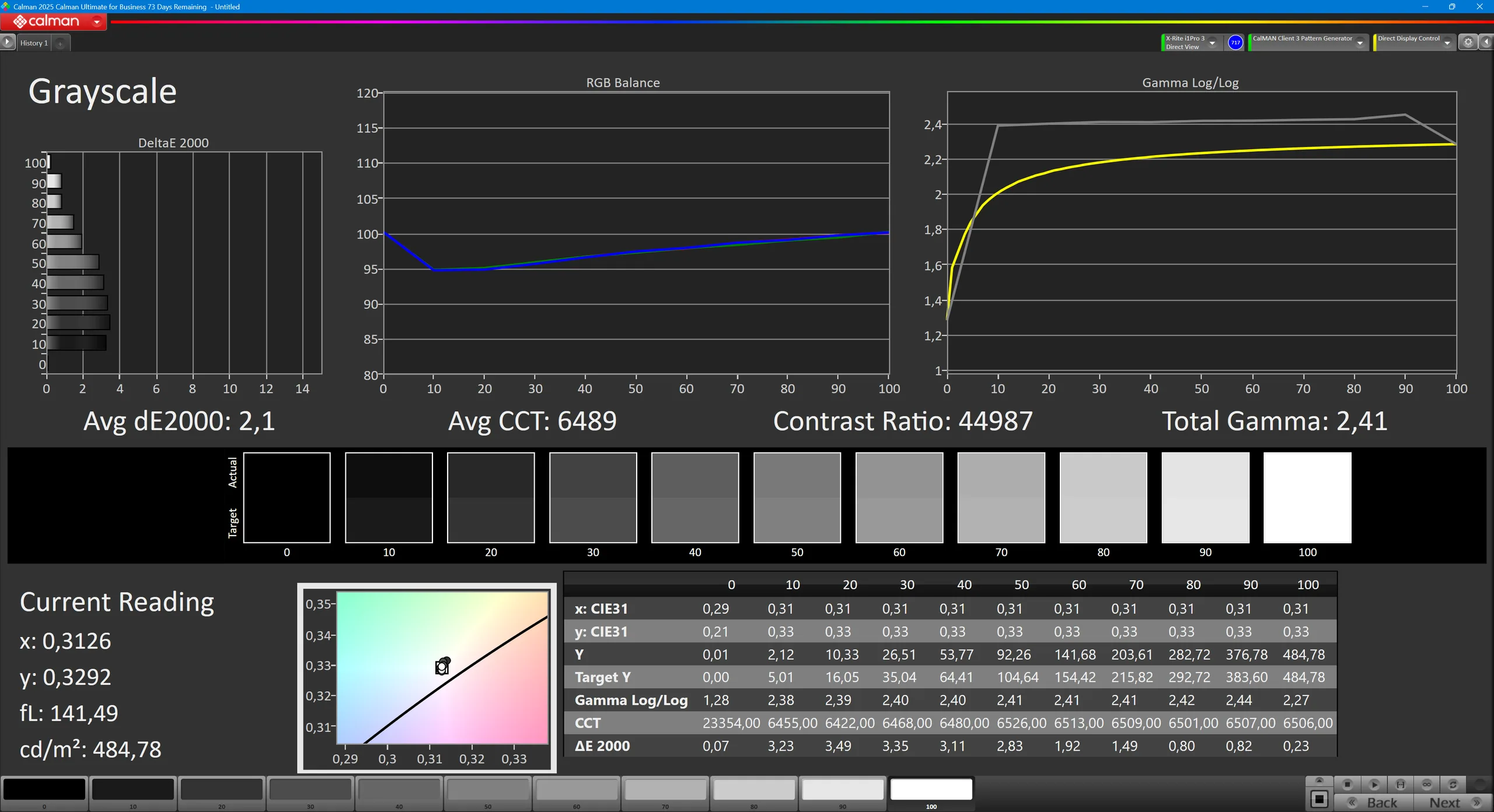
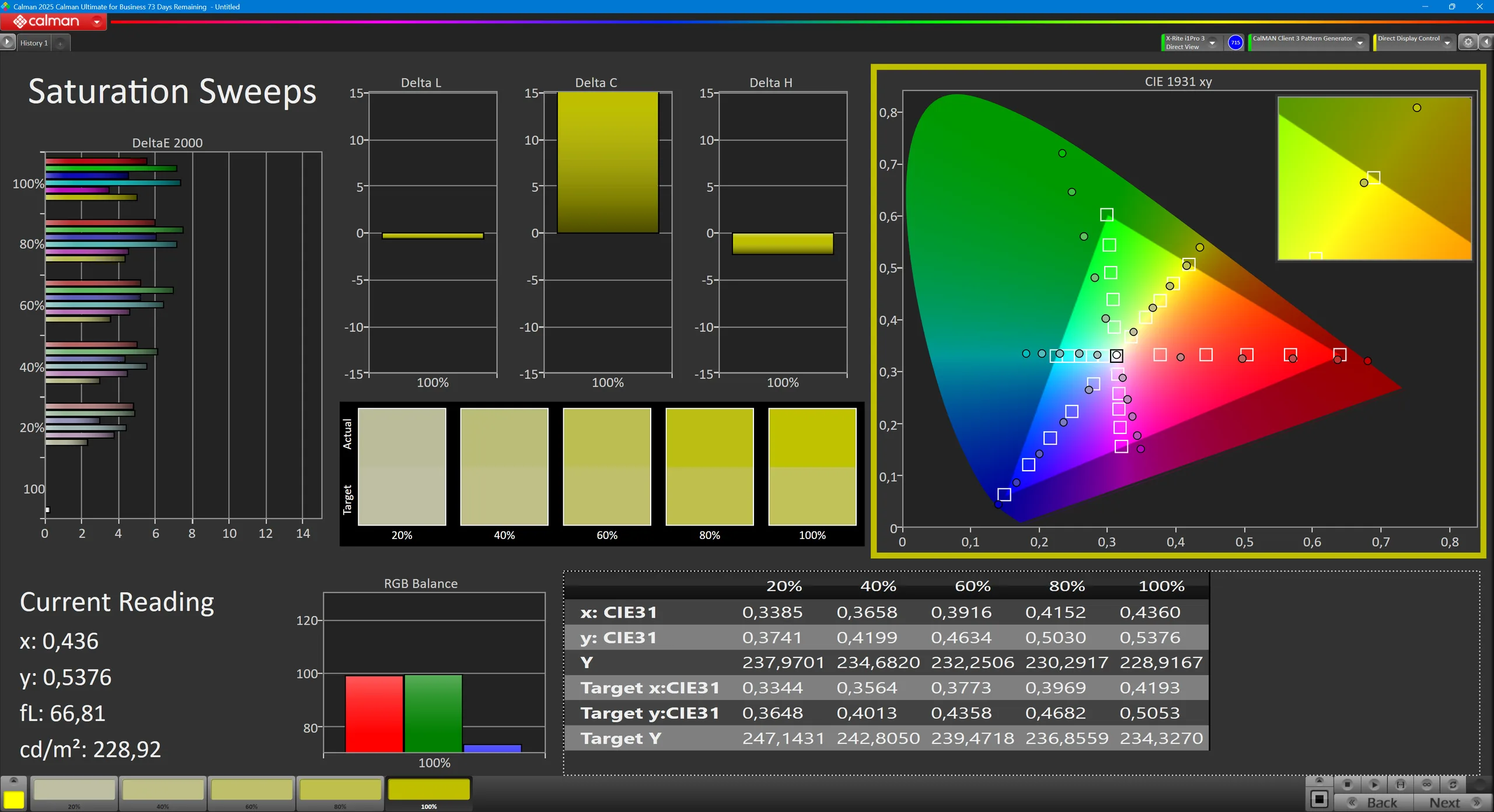

Surprisingly, the panel does not quite deliver the color gamut coverage that Lenovo promises. It falls short quite a bit and does not even cover the smaller sRGB color gamut quite completely. When working with colors, this can lead to some issues.
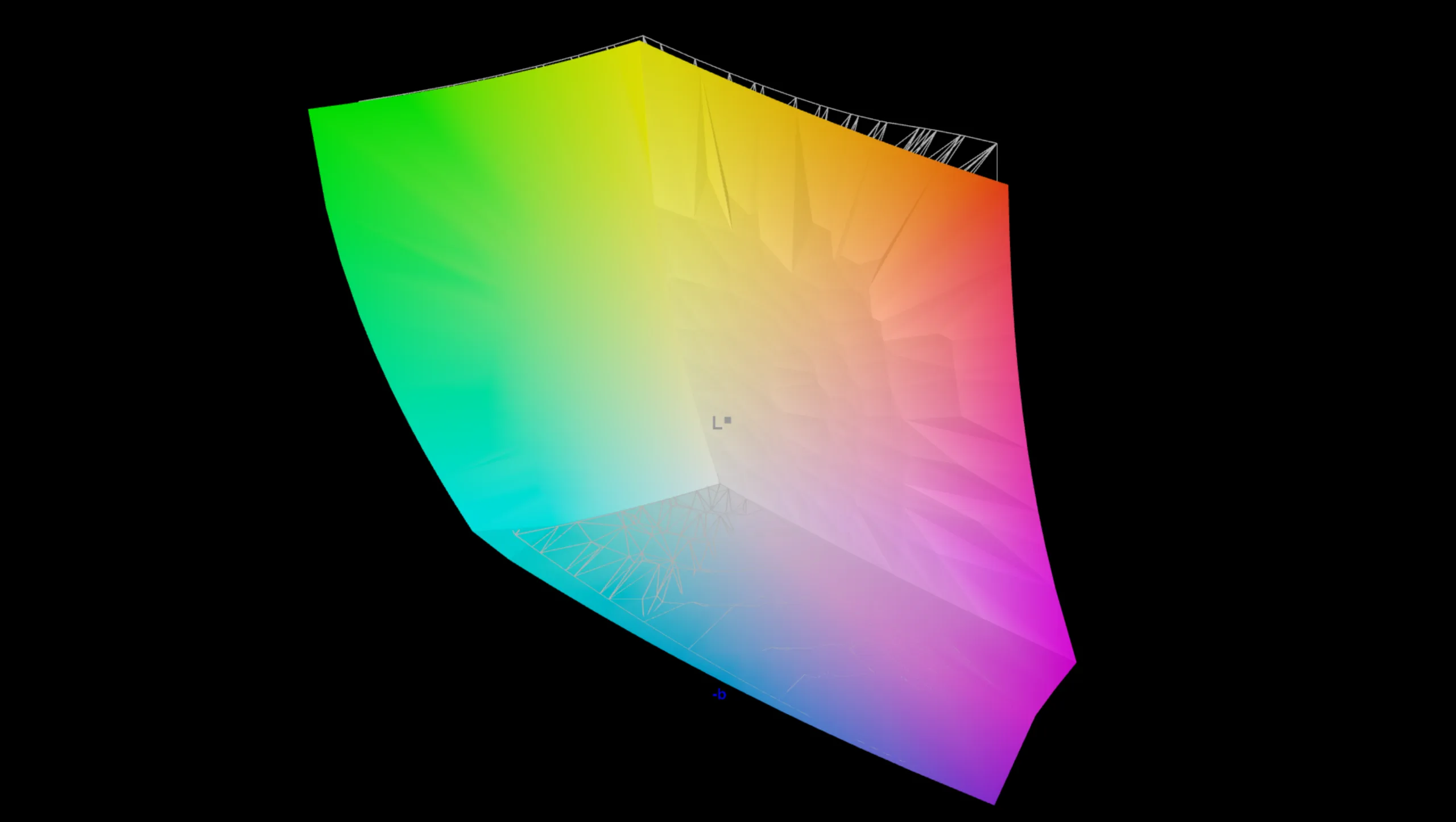
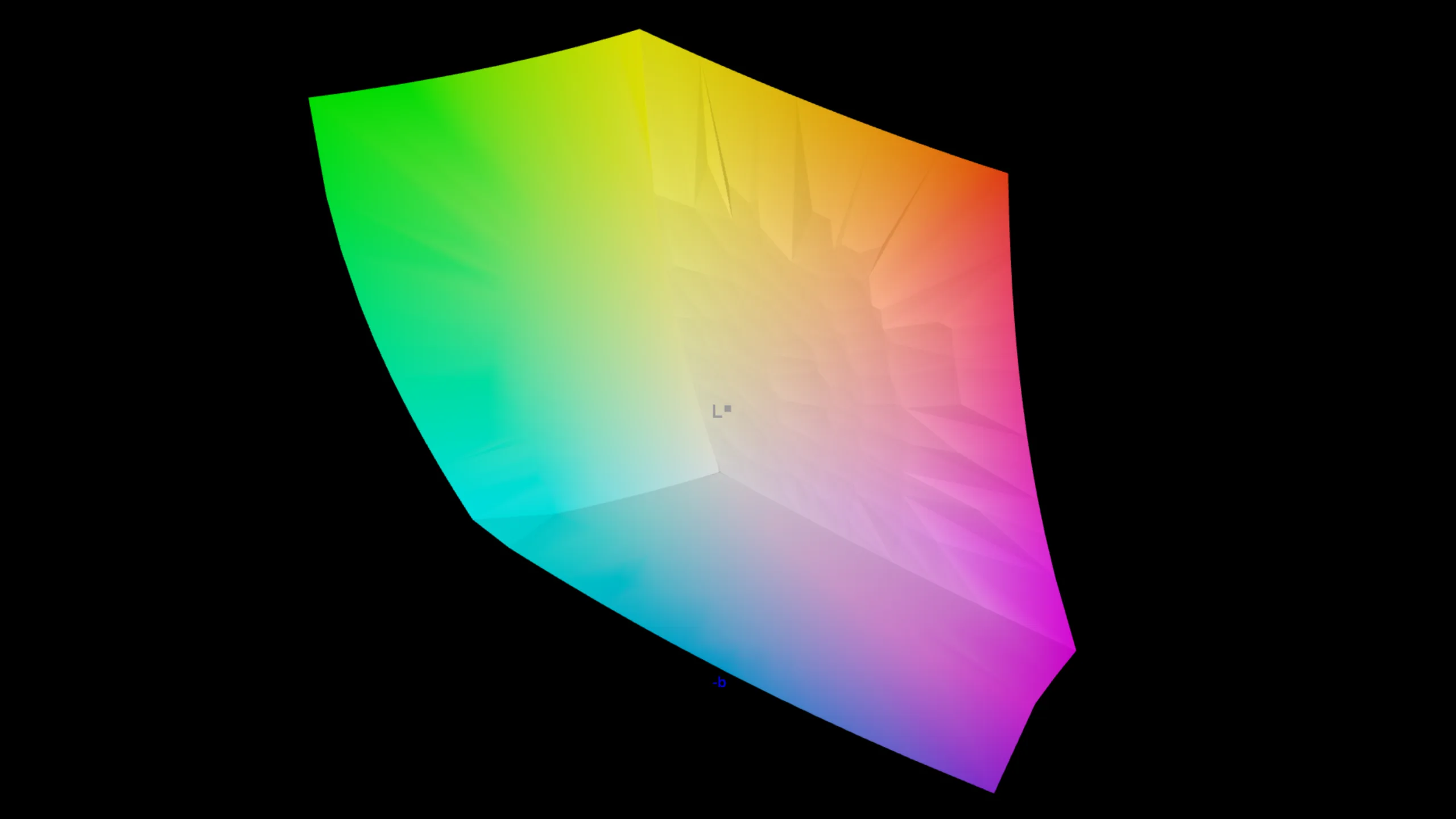
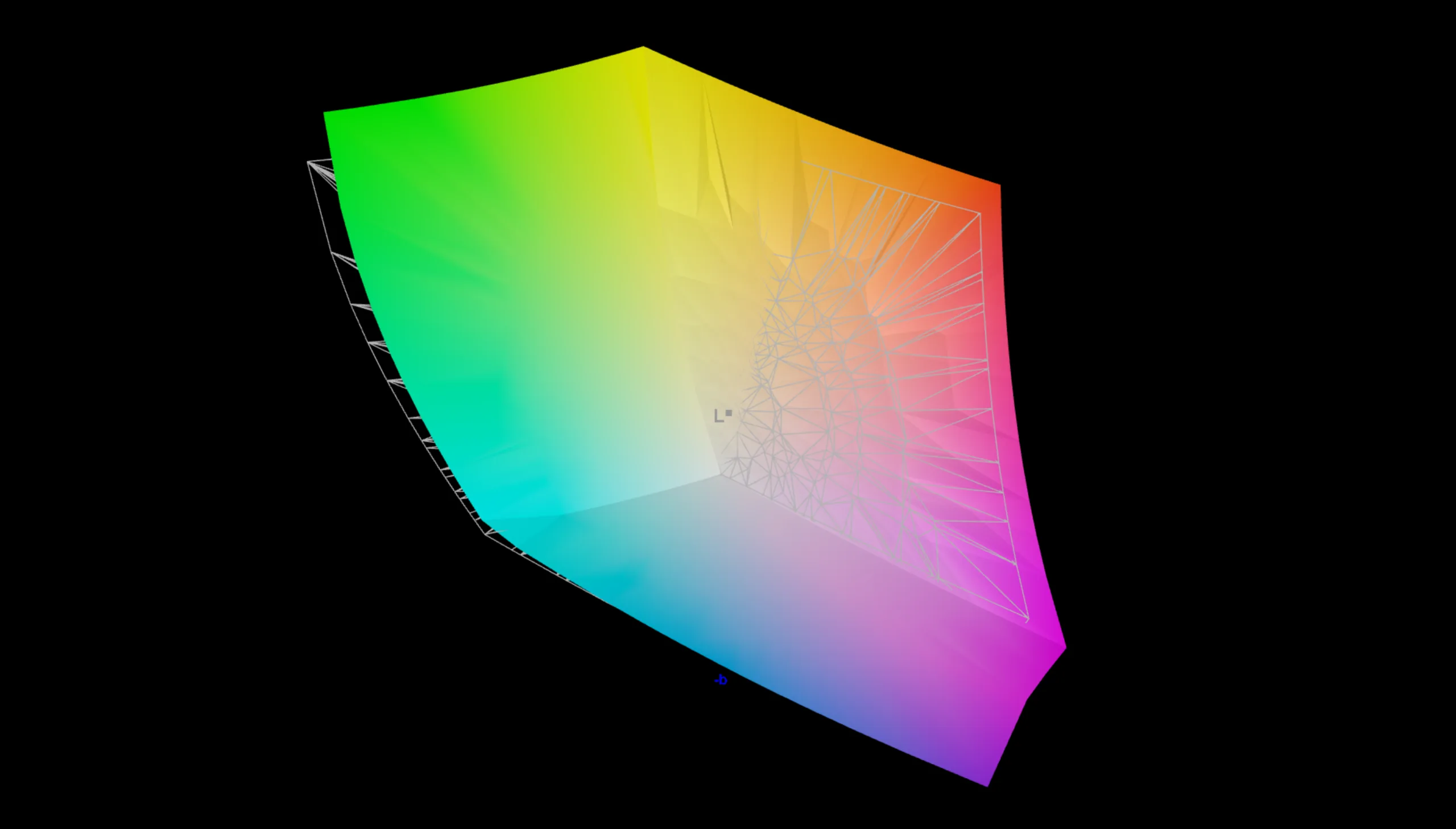

With a matte screen surface and comparably high brightness of 500 cd/m², working outside the office is certainly possible, though it may still be wise to avoid direct sunlight on the screen.
Display Response Times
| ↔ Response Time Black to White | ||
|---|---|---|
| 1.5 ms ... rise ↗ and fall ↘ combined | ↗ 0.78 ms rise | 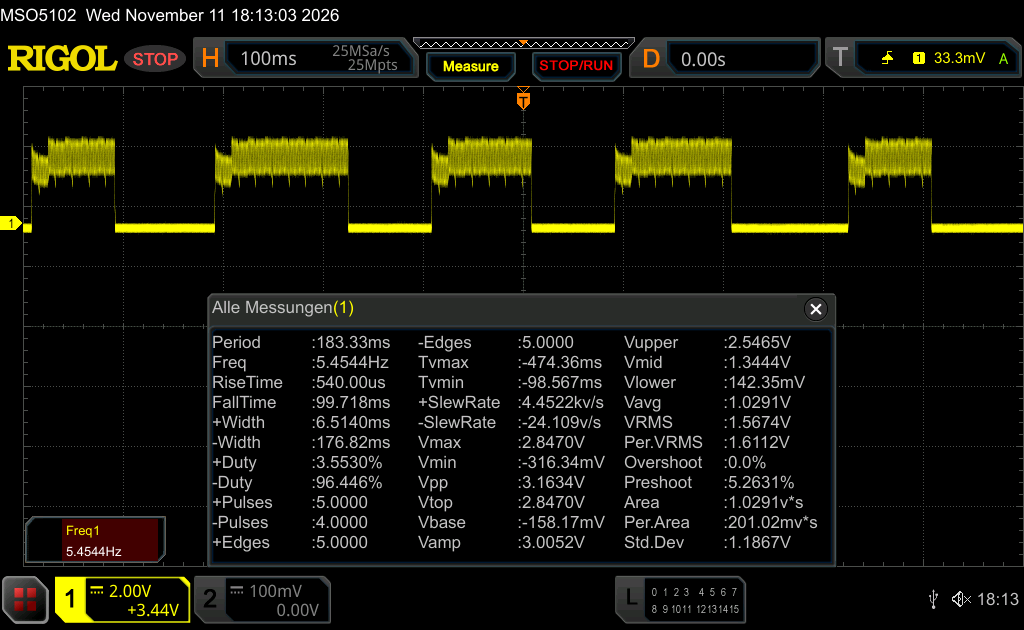 |
| ↘ 0.72 ms fall | ||
| The screen shows very fast response rates in our tests and should be very well suited for fast-paced gaming. In comparison, all tested devices range from 0.1 (minimum) to 240 (maximum) ms. » 10 % of all devices are better. This means that the measured response time is better than the average of all tested devices (19.5 ms). | ||
| ↔ Response Time 50% Grey to 80% Grey | ||
| 1.27 ms ... rise ↗ and fall ↘ combined | ↗ 0.65 ms rise | 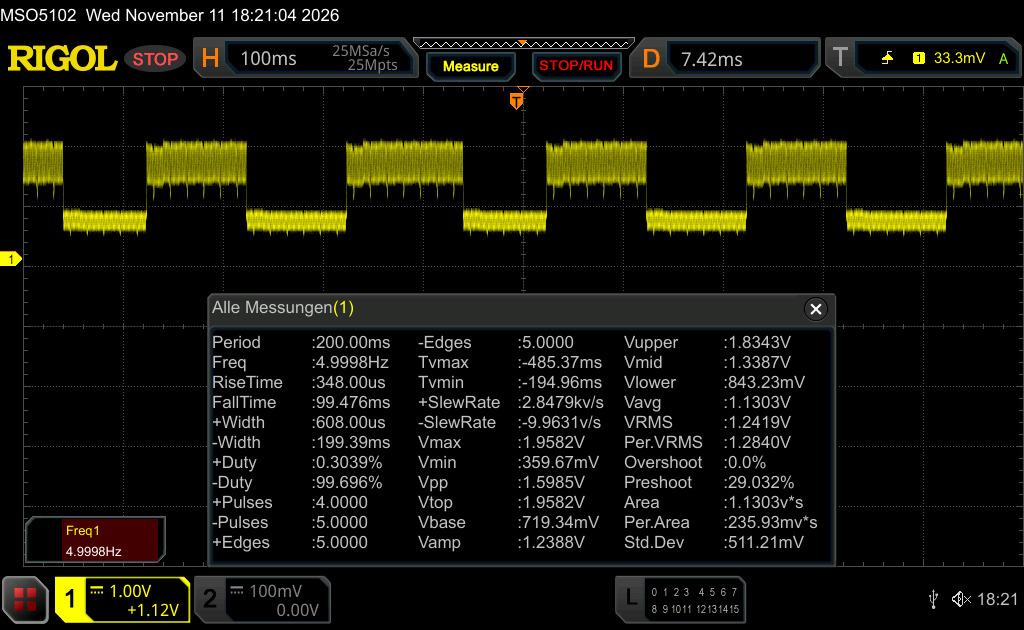 |
| ↘ 0.62 ms fall | ||
| The screen shows very fast response rates in our tests and should be very well suited for fast-paced gaming. In comparison, all tested devices range from 0.13 (minimum) to 636 (maximum) ms. » 7 % of all devices are better. This means that the measured response time is better than the average of all tested devices (30.5 ms). | ||
Screen Flickering / PWM (Pulse-Width Modulation)
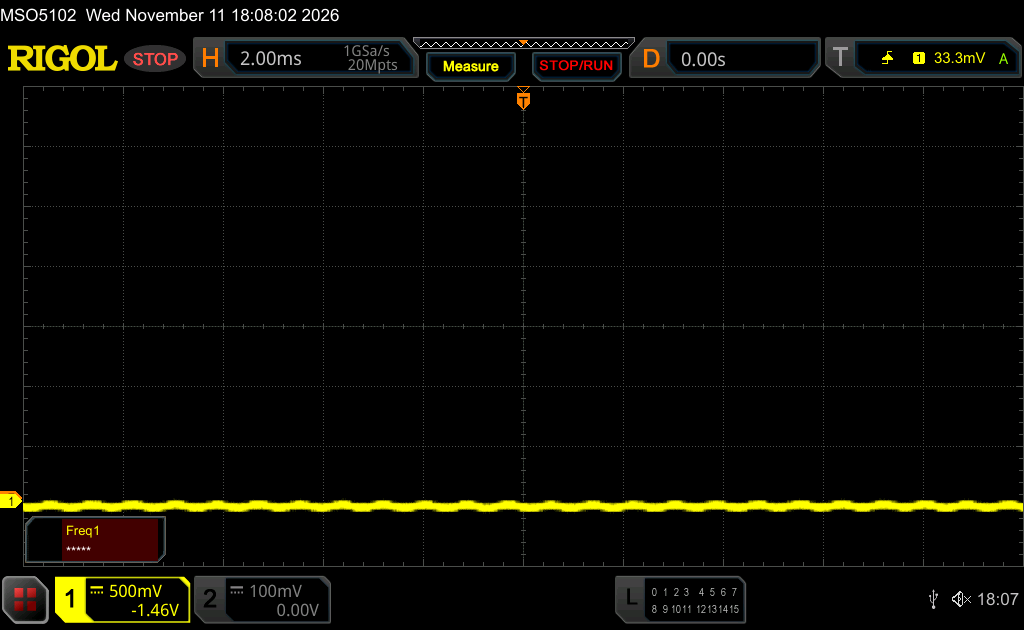
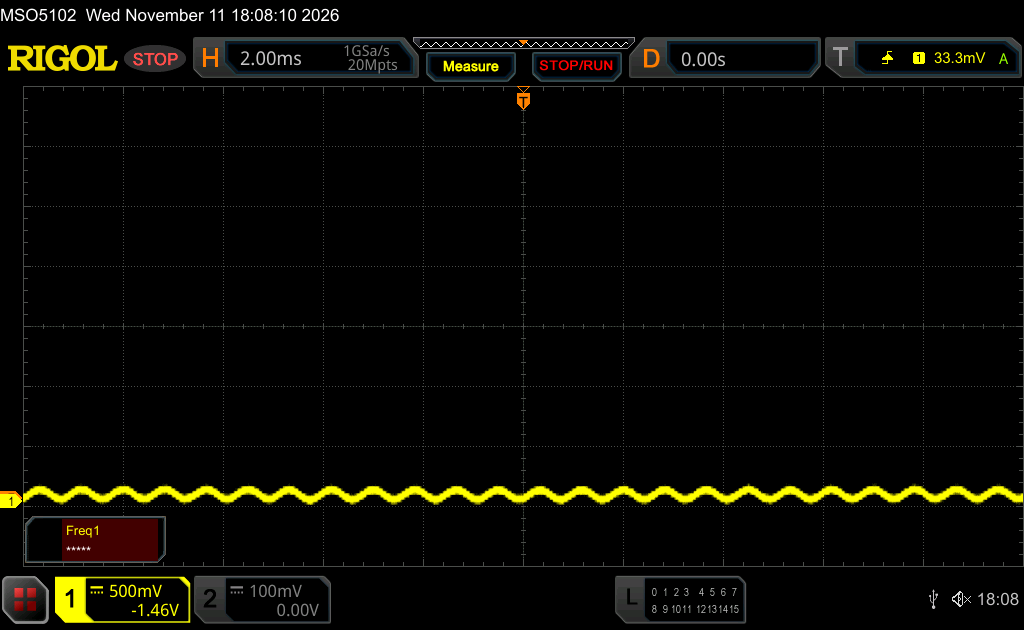
| Screen flickering / PWM detected | 1224.6 Hz Amplitude: 40 % | 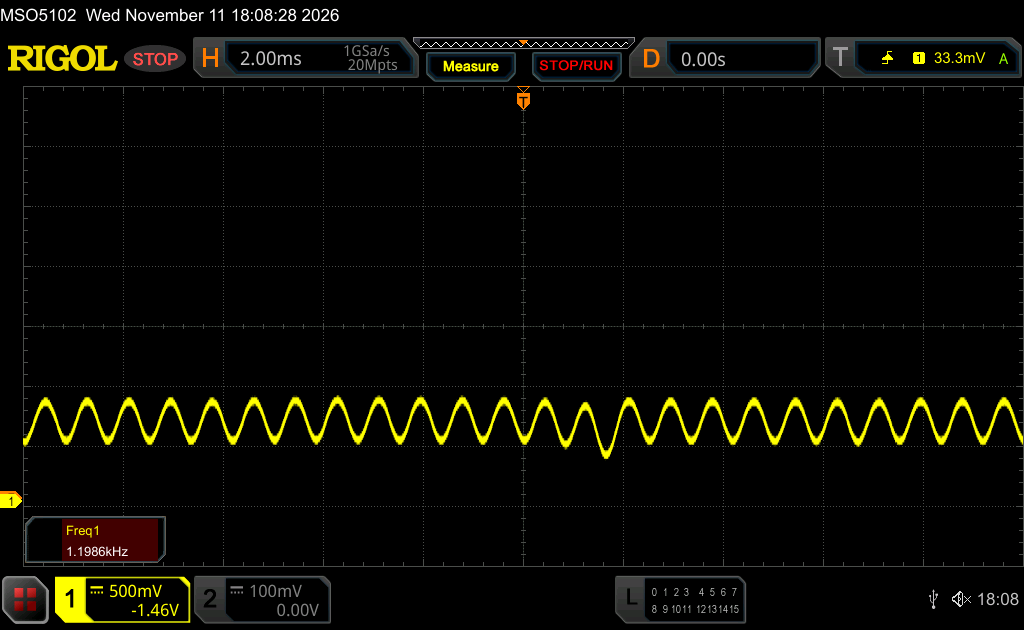 | |
The display backlight flickers at 1224.6 Hz (worst case, e.g., utilizing PWM) . The frequency of 1224.6 Hz is quite high, so most users sensitive to PWM should not notice any flickering. In comparison: 52 % of all tested devices do not use PWM to dim the display. If PWM was detected, an average of 7518 (minimum: 5 - maximum: 343500) Hz was measured. | |||


Performance
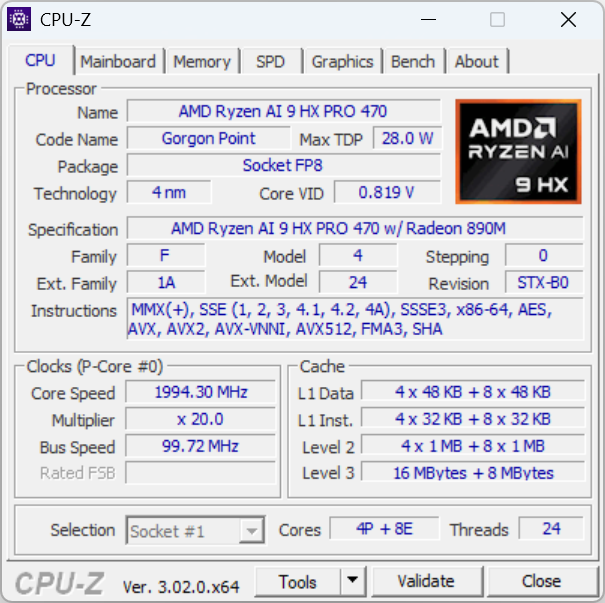
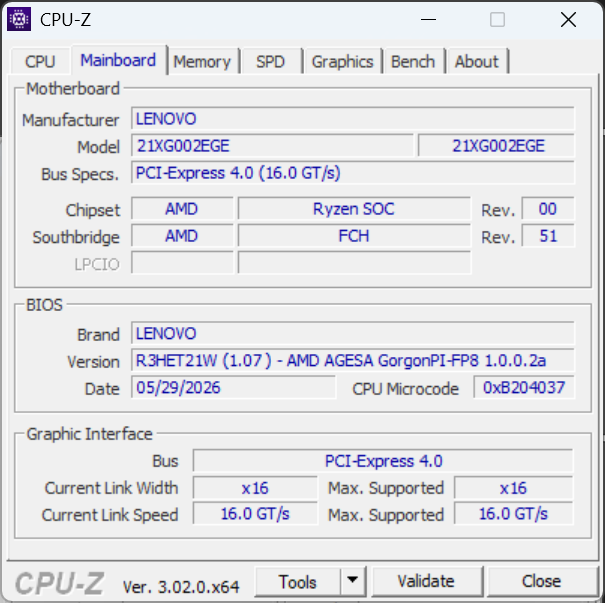
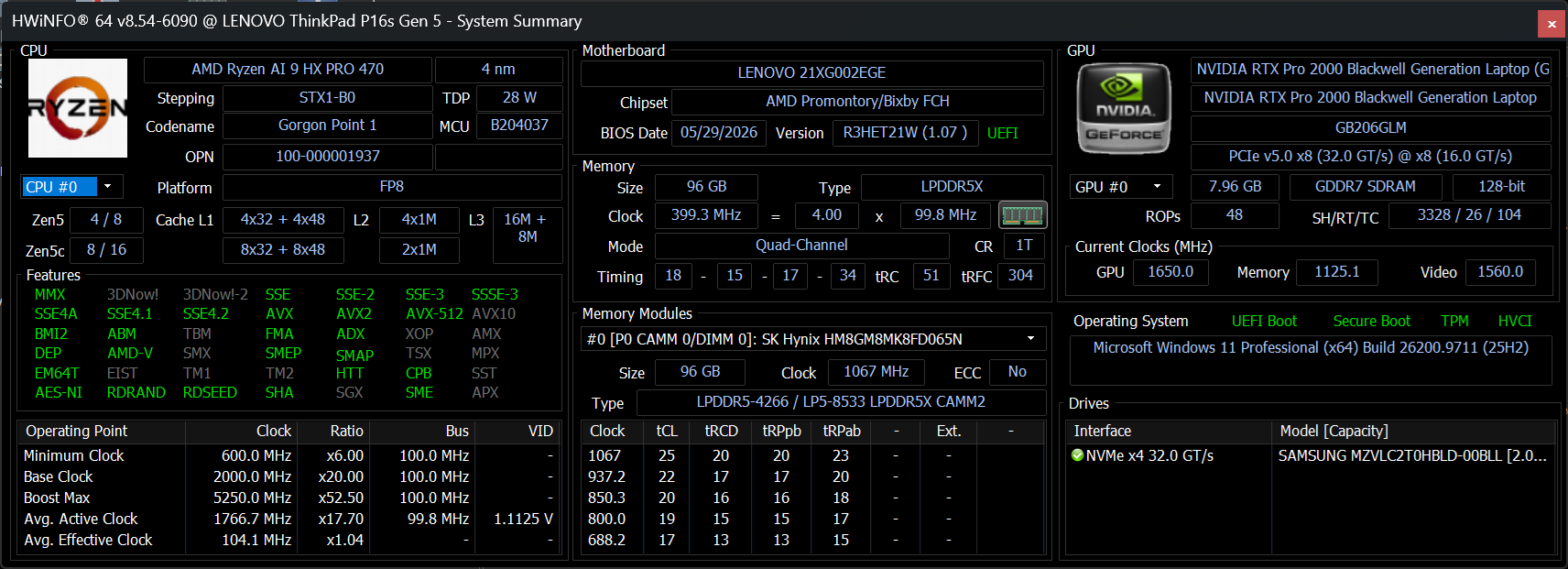
Three different AMD CPUs are offered for the Lenovo ThinkPad P16s Gen 5 (AMD Ryzen AI 5 Pro 440, Ryzen AI 7 Pro 450, Ryzen AI 9 Pro HX 470) and three different Nvidia dGPUs (Nvidia RTX Pro 500 Blackwell, RTX Pro 1000 Blackwell, RTX Pro 2000 Blackwell), though it is also possible to configure the device without the Nvidia GPU. Relying on the AMD iGPU comes with a compromise, as such units only sport a single fan cooling system.
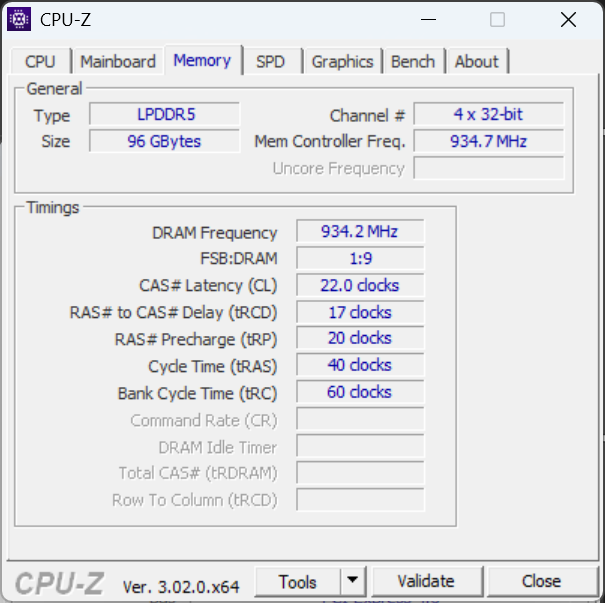
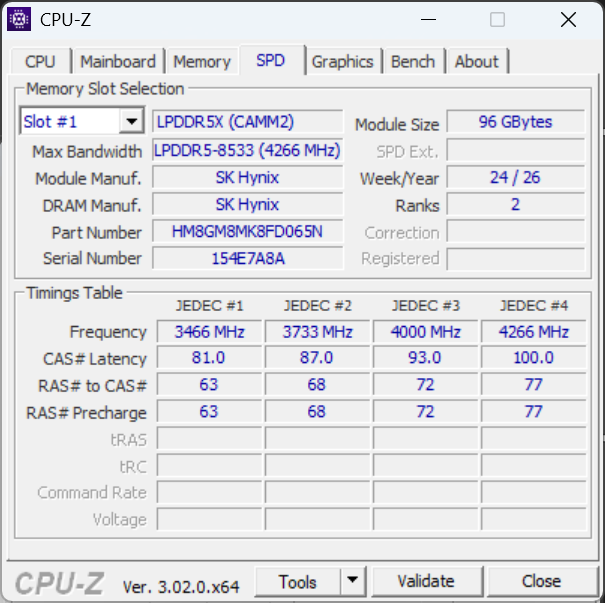
RAM goes up to 96 GB of LPDDR5X-7500, in the form of a single upgradeable LPCAMM2 module. There is only a single M.2 2280 slot, which means the SSD capacity maxes out at 2 TB.
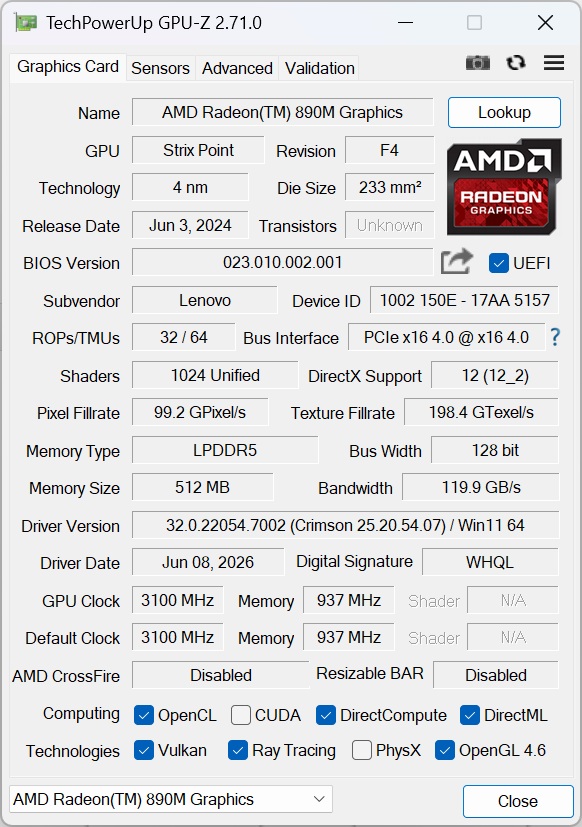
Testing Conditions
The Lenovo ThinkPad offers the following energy profiles, which influence the power consumption of the processor (PL1 = power limit under sustained load, PL2 = maximum consumption).
- Best Power Efficiency: PL1 15 W / PL2 15 W
- Balanced: PL1 45 W / PL2 60 W
- Best Performance: PL1 54 W / PL2 65 W
All benchmarks were performed in "Best Performance" mode.
Processor Performance
The AMD Ryzen AI 9 Pro HX 470 is one of the current AMD CPUs of the "Gorgon Point" generation. It has a total of twelve cores (4x Zen5 up to 5.2 GHz, 8x Zen5c up to 3.3 GHz), which can run up to 24 threads, thanks to SMT. Our CPU comparison list enables comparisons with other CPUs.
Compared to the older Lenovo ThinkPad P16s Gen 4 AMD, CPU performance has increased by around 15 percent, which is thanks to the more powerful cooling system of the 2026 version and its higher power limit - the older model was limited to a PL1 of just 36 W. The P16s Gen 5 AMD even tops the expensive Lenovo ThinkPad P1 G9 when it comes to the CPU performance, though only slightly.
When the device runs on battery mode, performance is throttled by around 39 percent in Cinebench R23 Multicore (16,509 points).
Cinebench R15 Multi Loop
Cinebench R23: Multi Core | Single Core
Cinebench R20: CPU (Multi Core) | CPU (Single Core)
Cinebench R15: CPU Multi 64Bit | CPU Single 64Bit
Blender: v2.79 BMW27 CPU
7-Zip 18.03: 7z b 4 | 7z b 4 -mmt1
Geekbench 7: Multi-Core | Single-Core
Geekbench 6.7: Multi-Core | Single-Core
HWBOT x265 Benchmark v2.2: 4k Preset
LibreOffice : 20 Documents To PDF
R Benchmark 2.5: Overall mean
| CPU Performance rating | |
| Average of class Workstation | |
| Lenovo ThinkPad P16s Gen 5 21XG002EGE | |
| Lenovo ThinkPad P1 Gen 9 21UE000MGE | |
| Average AMD Ryzen AI 9 HX PRO 470 | |
| HP ZBook X G1i 16 -2! | |
| Lenovo ThinkPad P16v G3 21RS000DGE -2! | |
| Lenovo ThinkPad P16s Gen 4 21RX000YGE -2! | |
| Cinebench R23 / Multi Core | |
| Average of class Workstation (14801 - 38520, n=20, last 2 years) | |
| Lenovo ThinkPad P16s Gen 5 21XG002EGE | |
| HP ZBook X G1i 16 | |
| Lenovo ThinkPad P1 Gen 9 21UE000MGE | |
| Lenovo ThinkPad P16v G3 21RS000DGE | |
| Average AMD Ryzen AI 9 HX PRO 470 (18834 - 22921, n=4) | |
| Lenovo ThinkPad P16s Gen 4 21RX000YGE | |
| Cinebench R23 / Single Core | |
| Lenovo ThinkPad P1 Gen 9 21UE000MGE | |
| Average of class Workstation (1935 - 2228, n=20, last 2 years) | |
| Lenovo ThinkPad P16s Gen 5 21XG002EGE | |
| Lenovo ThinkPad P16v G3 21RS000DGE | |
| Average AMD Ryzen AI 9 HX PRO 470 (2042 - 2063, n=4) | |
| HP ZBook X G1i 16 | |
| Lenovo ThinkPad P16s Gen 4 21RX000YGE | |
| Cinebench R20 / CPU (Multi Core) | |
| Average of class Workstation (5721 - 15043, n=20, last 2 years) | |
| Lenovo ThinkPad P16s Gen 5 21XG002EGE | |
| HP ZBook X G1i 16 | |
| Lenovo ThinkPad P1 Gen 9 21UE000MGE | |
| Lenovo ThinkPad P16v G3 21RS000DGE | |
| Average AMD Ryzen AI 9 HX PRO 470 (7355 - 8959, n=4) | |
| Lenovo ThinkPad P16s Gen 4 21RX000YGE | |
| Cinebench R20 / CPU (Single Core) | |
| Lenovo ThinkPad P16s Gen 5 21XG002EGE | |
| Average AMD Ryzen AI 9 HX PRO 470 (804 - 810, n=4) | |
| Average of class Workstation (757 - 857, n=20, last 2 years) | |
| Lenovo ThinkPad P16v G3 21RS000DGE | |
| Lenovo ThinkPad P16s Gen 4 21RX000YGE | |
| Lenovo ThinkPad P1 Gen 9 21UE000MGE | |
| HP ZBook X G1i 16 | |
| Cinebench R15 / CPU Multi 64Bit | |
| Average of class Workstation (2223 - 5810, n=20, last 2 years) | |
| HP ZBook X G1i 16 | |
| Lenovo ThinkPad P16s Gen 5 21XG002EGE | |
| Lenovo ThinkPad P1 Gen 9 21UE000MGE | |
| Lenovo ThinkPad P16v G3 21RS000DGE | |
| Average AMD Ryzen AI 9 HX PRO 470 (2983 - 3418, n=4) | |
| Lenovo ThinkPad P16s Gen 4 21RX000YGE | |
| Cinebench R15 / CPU Single 64Bit | |
| Average AMD Ryzen AI 9 HX PRO 470 (306 - 316, n=4) | |
| Lenovo ThinkPad P16s Gen 4 21RX000YGE | |
| Lenovo ThinkPad P16s Gen 5 21XG002EGE | |
| HP ZBook X G1i 16 | |
| Lenovo ThinkPad P1 Gen 9 21UE000MGE | |
| Average of class Workstation (191.4 - 328, n=20, last 2 years) | |
| Lenovo ThinkPad P16v G3 21RS000DGE | |
| Blender / v2.79 BMW27 CPU | |
| Lenovo ThinkPad P16s Gen 4 21RX000YGE | |
| Lenovo ThinkPad P16v G3 21RS000DGE | |
| HP ZBook X G1i 16 | |
| Lenovo ThinkPad P1 Gen 9 21UE000MGE | |
| Average AMD Ryzen AI 9 HX PRO 470 (144 - 178, n=4) | |
| Lenovo ThinkPad P16s Gen 5 21XG002EGE | |
| Average of class Workstation (91 - 225, n=20, last 2 years) | |
| 7-Zip 18.03 / 7z b 4 | |
| Average of class Workstation (51408 - 116969, n=20, last 2 years) | |
| Lenovo ThinkPad P16s Gen 5 21XG002EGE | |
| Average AMD Ryzen AI 9 HX PRO 470 (71554 - 81031, n=4) | |
| Lenovo ThinkPad P16s Gen 4 21RX000YGE | |
| Lenovo ThinkPad P1 Gen 9 21UE000MGE | |
| HP ZBook X G1i 16 | |
| Lenovo ThinkPad P16v G3 21RS000DGE | |
| 7-Zip 18.03 / 7z b 4 -mmt1 | |
| Lenovo ThinkPad P1 Gen 9 21UE000MGE | |
| Lenovo ThinkPad P16s Gen 4 21RX000YGE | |
| Lenovo ThinkPad P16v G3 21RS000DGE | |
| Average AMD Ryzen AI 9 HX PRO 470 (5948 - 6353, n=4) | |
| HP ZBook X G1i 16 | |
| Average of class Workstation (5126 - 6792, n=20, last 2 years) | |
| Lenovo ThinkPad P16s Gen 5 21XG002EGE | |
| Geekbench 7 / Multi-Core | |
| Lenovo ThinkPad P1 Gen 9 21UE000MGE | |
| Lenovo ThinkPad P16s Gen 5 21XG002EGE | |
| Average AMD Ryzen AI 9 HX PRO 470 (16528 - 17075, n=2) | |
| Average of class Workstation (12761 - 17824, n=3, last 2 years) | |
| Geekbench 7 / Single-Core | |
| Lenovo ThinkPad P16s Gen 5 21XG002EGE | |
| Average AMD Ryzen AI 9 HX PRO 470 (2622 - 2640, n=2) | |
| Lenovo ThinkPad P1 Gen 9 21UE000MGE | |
| Average of class Workstation (2506 - 2640, n=3, last 2 years) | |
| Geekbench 6.7 / Multi-Core | |
| HP ZBook X G1i 16 | |
| Lenovo ThinkPad P1 Gen 9 21UE000MGE | |
| Lenovo ThinkPad P16v G3 21RS000DGE | |
| Average of class Workstation (12139 - 20887, n=20, last 2 years) | |
| Lenovo ThinkPad P16s Gen 5 21XG002EGE | |
| Lenovo ThinkPad P16s Gen 4 21RX000YGE | |
| Average AMD Ryzen AI 9 HX PRO 470 (13878 - 15386, n=4) | |
| Geekbench 6.7 / Single-Core | |
| Lenovo ThinkPad P16s Gen 4 21RX000YGE | |
| Lenovo ThinkPad P16v G3 21RS000DGE | |
| Average AMD Ryzen AI 9 HX PRO 470 (2886 - 2988, n=4) | |
| HP ZBook X G1i 16 | |
| Average of class Workstation (2732 - 3065, n=20, last 2 years) | |
| Lenovo ThinkPad P16s Gen 5 21XG002EGE | |
| Lenovo ThinkPad P1 Gen 9 21UE000MGE | |
| HWBOT x265 Benchmark v2.2 / 4k Preset | |
| Average of class Workstation (18.1 - 40.5, n=20, last 2 years) | |
| Lenovo ThinkPad P16s Gen 5 21XG002EGE | |
| HP ZBook X G1i 16 | |
| Lenovo ThinkPad P16v G3 21RS000DGE | |
| Lenovo ThinkPad P1 Gen 9 21UE000MGE | |
| Average AMD Ryzen AI 9 HX PRO 470 (21.9 - 27.3, n=4) | |
| Lenovo ThinkPad P16s Gen 4 21RX000YGE | |
| LibreOffice / 20 Documents To PDF | |
| Lenovo ThinkPad P16s Gen 4 21RX000YGE | |
| Lenovo ThinkPad P16s Gen 5 21XG002EGE | |
| Average AMD Ryzen AI 9 HX PRO 470 (54.7 - 71.8, n=4) | |
| Lenovo ThinkPad P1 Gen 9 21UE000MGE | |
| Average of class Workstation (37.1 - 74.7, n=20, last 2 years) | |
| HP ZBook X G1i 16 | |
| Lenovo ThinkPad P16v G3 21RS000DGE | |
| R Benchmark 2.5 / Overall mean | |
| Lenovo ThinkPad P16s Gen 4 21RX000YGE | |
| Lenovo ThinkPad P1 Gen 9 21UE000MGE | |
| Lenovo ThinkPad P16v G3 21RS000DGE | |
| Average of class Workstation (0.3974 - 0.603, n=20, last 2 years) | |
| HP ZBook X G1i 16 | |
| Lenovo ThinkPad P16s Gen 5 21XG002EGE | |
| Average AMD Ryzen AI 9 HX PRO 470 (0.393 - 0.4065, n=4) | |
* ... smaller is better
AIDA64: FP32 Ray-Trace | FPU Julia | CPU SHA3 | CPU Queen | FPU SinJulia | FPU Mandel | CPU AES | CPU ZLib | FP64 Ray-Trace | CPU PhotoWorxx
| Performance rating | |
| Lenovo ThinkPad P16s Gen 5 21XG002EGE -1! | |
| Average of class Workstation | |
| Average AMD Ryzen AI 9 HX PRO 470 -1! | |
| Lenovo ThinkPad P16s Gen 4 21RX000YGE | |
| Lenovo ThinkPad P1 Gen 9 21UE000MGE -1! | |
| Lenovo ThinkPad P16v G3 21RS000DGE | |
| AIDA64 / FP32 Ray-Trace | |
| Lenovo ThinkPad P16s Gen 5 21XG002EGE (v8.20.8100) | |
| Average AMD Ryzen AI 9 HX PRO 470 (28416 - 36644, n=4) | |
| Average of class Workstation (20583 - 61611, n=20, last 2 years) | |
| Lenovo ThinkPad P16s Gen 4 21RX000YGE (v6.92.6600) | |
| Lenovo ThinkPad P16v G3 21RS000DGE (v6.92.6600) | |
| Lenovo ThinkPad P1 Gen 9 21UE000MGE (v8.20.8100) | |
| AIDA64 / FPU Julia | |
| Lenovo ThinkPad P16s Gen 5 21XG002EGE (v8.20.8100) | |
| Average of class Workstation (104730 - 186971, n=20, last 2 years) | |
| Average AMD Ryzen AI 9 HX PRO 470 (117109 - 149404, n=4) | |
| Lenovo ThinkPad P16s Gen 4 21RX000YGE (v6.92.6600) | |
| Lenovo ThinkPad P16v G3 21RS000DGE (v6.92.6600) | |
| Lenovo ThinkPad P1 Gen 9 21UE000MGE (v8.20.8100) | |
| AIDA64 / CPU SHA3 | |
| Average of class Workstation (3590 - 8975, n=20, last 2 years) | |
| Lenovo ThinkPad P16s Gen 5 21XG002EGE (v8.20.8100) | |
| Average AMD Ryzen AI 9 HX PRO 470 (4824 - 5661, n=4) | |
| Lenovo ThinkPad P1 Gen 9 21UE000MGE (v8.20.8100) | |
| Lenovo ThinkPad P16s Gen 4 21RX000YGE (v6.92.6600) | |
| Lenovo ThinkPad P16v G3 21RS000DGE (v6.92.6600) | |
| AIDA64 / CPU Queen | |
| Average of class Workstation (60778 - 137783, n=16, last 2 years) | |
| Lenovo ThinkPad P16s Gen 4 21RX000YGE (v6.92.6600) | |
| Lenovo ThinkPad P16v G3 21RS000DGE (v6.92.6600) | |
| AIDA64 / FPU SinJulia | |
| Lenovo ThinkPad P16s Gen 5 21XG002EGE (v8.20.8100) | |
| Average AMD Ryzen AI 9 HX PRO 470 (17621 - 19228, n=4) | |
| Lenovo ThinkPad P16s Gen 4 21RX000YGE (v6.92.6600) | |
| Average of class Workstation (7136 - 29343, n=20, last 2 years) | |
| Lenovo ThinkPad P16v G3 21RS000DGE (v6.92.6600) | |
| Lenovo ThinkPad P1 Gen 9 21UE000MGE (v8.20.8100) | |
| AIDA64 / FPU Mandel | |
| Lenovo ThinkPad P16s Gen 5 21XG002EGE (v8.20.8100) | |
| Average of class Workstation (54684 - 98153, n=20, last 2 years) | |
| Average AMD Ryzen AI 9 HX PRO 470 (62125 - 75695, n=4) | |
| Lenovo ThinkPad P16s Gen 4 21RX000YGE (v6.92.6600) | |
| Lenovo ThinkPad P16v G3 21RS000DGE (v6.92.6600) | |
| Lenovo ThinkPad P1 Gen 9 21UE000MGE (v8.20.8100) | |
| AIDA64 / CPU AES | |
| Lenovo ThinkPad P16s Gen 5 21XG002EGE (v8.20.8100) | |
| Average of class Workstation (68072 - 187841, n=20, last 2 years) | |
| Average AMD Ryzen AI 9 HX PRO 470 (98035 - 116649, n=4) | |
| Lenovo ThinkPad P16s Gen 4 21RX000YGE (v6.92.6600) | |
| Lenovo ThinkPad P16v G3 21RS000DGE (v6.92.6600) | |
| Lenovo ThinkPad P1 Gen 9 21UE000MGE (v8.20.8100) | |
| AIDA64 / CPU ZLib | |
| Average of class Workstation (917 - 2148, n=20, last 2 years) | |
| Lenovo ThinkPad P16s Gen 5 21XG002EGE (v8.20.8100) | |
| Average AMD Ryzen AI 9 HX PRO 470 (1174 - 1507, n=4) | |
| Lenovo ThinkPad P16s Gen 4 21RX000YGE (v6.92.6600) | |
| Lenovo ThinkPad P1 Gen 9 21UE000MGE (v8.20.8100) | |
| Lenovo ThinkPad P16v G3 21RS000DGE (v6.92.6600) | |
| AIDA64 / FP64 Ray-Trace | |
| Lenovo ThinkPad P16s Gen 5 21XG002EGE (v8.20.8100) | |
| Average of class Workstation (11027 - 32891, n=20, last 2 years) | |
| Average AMD Ryzen AI 9 HX PRO 470 (14799 - 19216, n=4) | |
| Lenovo ThinkPad P16s Gen 4 21RX000YGE (v6.92.6600) | |
| Lenovo ThinkPad P16v G3 21RS000DGE (v6.92.6600) | |
| Lenovo ThinkPad P1 Gen 9 21UE000MGE (v8.20.8100) | |
| AIDA64 / CPU PhotoWorxx | |
| Lenovo ThinkPad P1 Gen 9 21UE000MGE (v8.20.8100) | |
| Average of class Workstation (37482 - 93684, n=20, last 2 years) | |
| Lenovo ThinkPad P16s Gen 4 21RX000YGE (v6.92.6600) | |
| Average AMD Ryzen AI 9 HX PRO 470 (48728 - 52444, n=4) | |
| Lenovo ThinkPad P16s Gen 5 21XG002EGE (v8.20.8100) | |
| Lenovo ThinkPad P16v G3 21RS000DGE (v6.92.6600) | |
System Performance
While the P16s Gen 5 AMD never feels slow during everyday use, the Intel-based ThinkPad P1 Gen 9 has the edge in the system performance benchmarks.
PCMark 10: Score | Essentials | Productivity | Digital Content Creation
CrossMark: Overall | Productivity | Creativity | Responsiveness
WebXPRT 3: Overall
WebXPRT 4: Overall
Mozilla Kraken 1.1: Total
| Performance rating | |
| Lenovo ThinkPad P1 Gen 9 21UE000MGE | |
| Lenovo ThinkPad P16v G3 21RS000DGE | |
| Average of class Workstation | |
| HP ZBook X G1i 16 -4! | |
| Lenovo ThinkPad P16s Gen 5 21XG002EGE | |
| Average AMD Ryzen AI 9 HX PRO 470, NVIDIA RTX PRO 2000 Blackwell Generation Laptop | |
| Lenovo ThinkPad P16s Gen 4 21RX000YGE | |
| PCMark 10 / Score | |
| Lenovo ThinkPad P16v G3 21RS000DGE | |
| Lenovo ThinkPad P1 Gen 9 21UE000MGE | |
| Average of class Workstation (6940 - 10409, n=16, last 2 years) | |
| Lenovo ThinkPad P16s Gen 5 21XG002EGE | |
| Average AMD Ryzen AI 9 HX PRO 470, NVIDIA RTX PRO 2000 Blackwell Generation Laptop (n=1) | |
| Lenovo ThinkPad P16s Gen 4 21RX000YGE | |
| PCMark 10 / Essentials | |
| Lenovo ThinkPad P16v G3 21RS000DGE | |
| Lenovo ThinkPad P16s Gen 4 21RX000YGE | |
| Lenovo ThinkPad P16s Gen 5 21XG002EGE | |
| Average AMD Ryzen AI 9 HX PRO 470, NVIDIA RTX PRO 2000 Blackwell Generation Laptop (n=1) | |
| Average of class Workstation (9622 - 11087, n=16, last 2 years) | |
| Lenovo ThinkPad P1 Gen 9 21UE000MGE | |
| PCMark 10 / Productivity | |
| Lenovo ThinkPad P1 Gen 9 21UE000MGE | |
| Lenovo ThinkPad P16v G3 21RS000DGE | |
| Average of class Workstation (8789 - 20616, n=16, last 2 years) | |
| Lenovo ThinkPad P16s Gen 5 21XG002EGE | |
| Average AMD Ryzen AI 9 HX PRO 470, NVIDIA RTX PRO 2000 Blackwell Generation Laptop (n=1) | |
| Lenovo ThinkPad P16s Gen 4 21RX000YGE | |
| PCMark 10 / Digital Content Creation | |
| Lenovo ThinkPad P16v G3 21RS000DGE | |
| Average of class Workstation (9948 - 15631, n=16, last 2 years) | |
| Lenovo ThinkPad P1 Gen 9 21UE000MGE | |
| Lenovo ThinkPad P16s Gen 5 21XG002EGE | |
| Average AMD Ryzen AI 9 HX PRO 470, NVIDIA RTX PRO 2000 Blackwell Generation Laptop (n=1) | |
| Lenovo ThinkPad P16s Gen 4 21RX000YGE | |
| CrossMark / Overall | |
| Lenovo ThinkPad P1 Gen 9 21UE000MGE | |
| HP ZBook X G1i 16 | |
| Lenovo ThinkPad P16v G3 21RS000DGE | |
| Average of class Workstation (1307 - 2267, n=20, last 2 years) | |
| Lenovo ThinkPad P16s Gen 5 21XG002EGE | |
| Average AMD Ryzen AI 9 HX PRO 470, NVIDIA RTX PRO 2000 Blackwell Generation Laptop (n=1) | |
| Lenovo ThinkPad P16s Gen 4 21RX000YGE | |
| CrossMark / Productivity | |
| Lenovo ThinkPad P1 Gen 9 21UE000MGE | |
| HP ZBook X G1i 16 | |
| Lenovo ThinkPad P16v G3 21RS000DGE | |
| Average of class Workstation (1130 - 2122, n=20, last 2 years) | |
| Lenovo ThinkPad P16s Gen 5 21XG002EGE | |
| Average AMD Ryzen AI 9 HX PRO 470, NVIDIA RTX PRO 2000 Blackwell Generation Laptop (n=1) | |
| Lenovo ThinkPad P16s Gen 4 21RX000YGE | |
| CrossMark / Creativity | |
| Lenovo ThinkPad P1 Gen 9 21UE000MGE | |
| HP ZBook X G1i 16 | |
| Lenovo ThinkPad P16v G3 21RS000DGE | |
| Average of class Workstation (1554 - 2725, n=20, last 2 years) | |
| Lenovo ThinkPad P16s Gen 4 21RX000YGE | |
| Lenovo ThinkPad P16s Gen 5 21XG002EGE | |
| Average AMD Ryzen AI 9 HX PRO 470, NVIDIA RTX PRO 2000 Blackwell Generation Laptop (n=1) | |
| CrossMark / Responsiveness | |
| Lenovo ThinkPad P1 Gen 9 21UE000MGE | |
| Average of class Workstation (993 - 2096, n=20, last 2 years) | |
| HP ZBook X G1i 16 | |
| Lenovo ThinkPad P16v G3 21RS000DGE | |
| Lenovo ThinkPad P16s Gen 5 21XG002EGE | |
| Average AMD Ryzen AI 9 HX PRO 470, NVIDIA RTX PRO 2000 Blackwell Generation Laptop (n=1) | |
| Lenovo ThinkPad P16s Gen 4 21RX000YGE | |
| WebXPRT 3 / Overall | |
| Lenovo ThinkPad P16v G3 21RS000DGE | |
| HP ZBook X G1i 16 | |
| Lenovo ThinkPad P16s Gen 4 21RX000YGE | |
| Average of class Workstation (197 - 360, n=20, last 2 years) | |
| Lenovo ThinkPad P1 Gen 9 21UE000MGE | |
| Lenovo ThinkPad P16s Gen 5 21XG002EGE | |
| Average AMD Ryzen AI 9 HX PRO 470, NVIDIA RTX PRO 2000 Blackwell Generation Laptop (n=1) | |
| WebXPRT 4 / Overall | |
| Lenovo ThinkPad P16v G3 21RS000DGE | |
| HP ZBook X G1i 16 | |
| Lenovo ThinkPad P1 Gen 9 21UE000MGE | |
| Average of class Workstation (156 - 326, n=20, last 2 years) | |
| Lenovo ThinkPad P16s Gen 4 21RX000YGE | |
| Lenovo ThinkPad P16s Gen 5 21XG002EGE | |
| Average AMD Ryzen AI 9 HX PRO 470, NVIDIA RTX PRO 2000 Blackwell Generation Laptop (n=1) | |
| Mozilla Kraken 1.1 / Total | |
| Lenovo ThinkPad P16s Gen 4 21RX000YGE | |
| HP ZBook X G1i 16 | |
| Lenovo ThinkPad P1 Gen 9 21UE000MGE | |
| Lenovo ThinkPad P16v G3 21RS000DGE | |
| Average of class Workstation (411 - 466, n=20, last 2 years) | |
| Lenovo ThinkPad P16s Gen 5 21XG002EGE | |
| Average AMD Ryzen AI 9 HX PRO 470, NVIDIA RTX PRO 2000 Blackwell Generation Laptop (n=1) | |
* ... smaller is better
| PCMark 10 Score | 8129 points | |
Help | ||
| AIDA64 / Memory Copy | |
| Lenovo ThinkPad P1 Gen 9 21UE000MGE | |
| Average of class Workstation (56003 - 164795, n=20, last 2 years) | |
| Lenovo ThinkPad P16s Gen 5 21XG002EGE | |
| Average AMD Ryzen AI 9 HX PRO 470 (70163 - 82931, n=4) | |
| Lenovo ThinkPad P16v G3 21RS000DGE | |
| Lenovo ThinkPad P16s Gen 4 21RX000YGE | |
| AIDA64 / Memory Read | |
| Lenovo ThinkPad P1 Gen 9 21UE000MGE | |
| Lenovo ThinkPad P16s Gen 5 21XG002EGE | |
| Lenovo ThinkPad P16s Gen 4 21RX000YGE | |
| Average of class Workstation (55795 - 121563, n=20, last 2 years) | |
| Average AMD Ryzen AI 9 HX PRO 470 (80270 - 86838, n=4) | |
| Lenovo ThinkPad P16v G3 21RS000DGE | |
| AIDA64 / Memory Write | |
| Lenovo ThinkPad P1 Gen 9 21UE000MGE | |
| Lenovo ThinkPad P16s Gen 5 21XG002EGE | |
| Average AMD Ryzen AI 9 HX PRO 470 (85093 - 109384, n=4) | |
| Average of class Workstation (55663 - 214520, n=20, last 2 years) | |
| Lenovo ThinkPad P16s Gen 4 21RX000YGE | |
| Lenovo ThinkPad P16v G3 21RS000DGE | |
| AIDA64 / Memory Latency | |
| Average of class Workstation (93 - 165.2, n=20, last 2 years) | |
| Lenovo ThinkPad P16s Gen 5 21XG002EGE | |
| Average AMD Ryzen AI 9 HX PRO 470 (100.1 - 125.1, n=4) | |
| Lenovo ThinkPad P16v G3 21RS000DGE | |
| Lenovo ThinkPad P16s Gen 4 21RX000YGE | |
| Lenovo ThinkPad P1 Gen 9 21UE000MGE | |
* ... smaller is better
DPC Latency
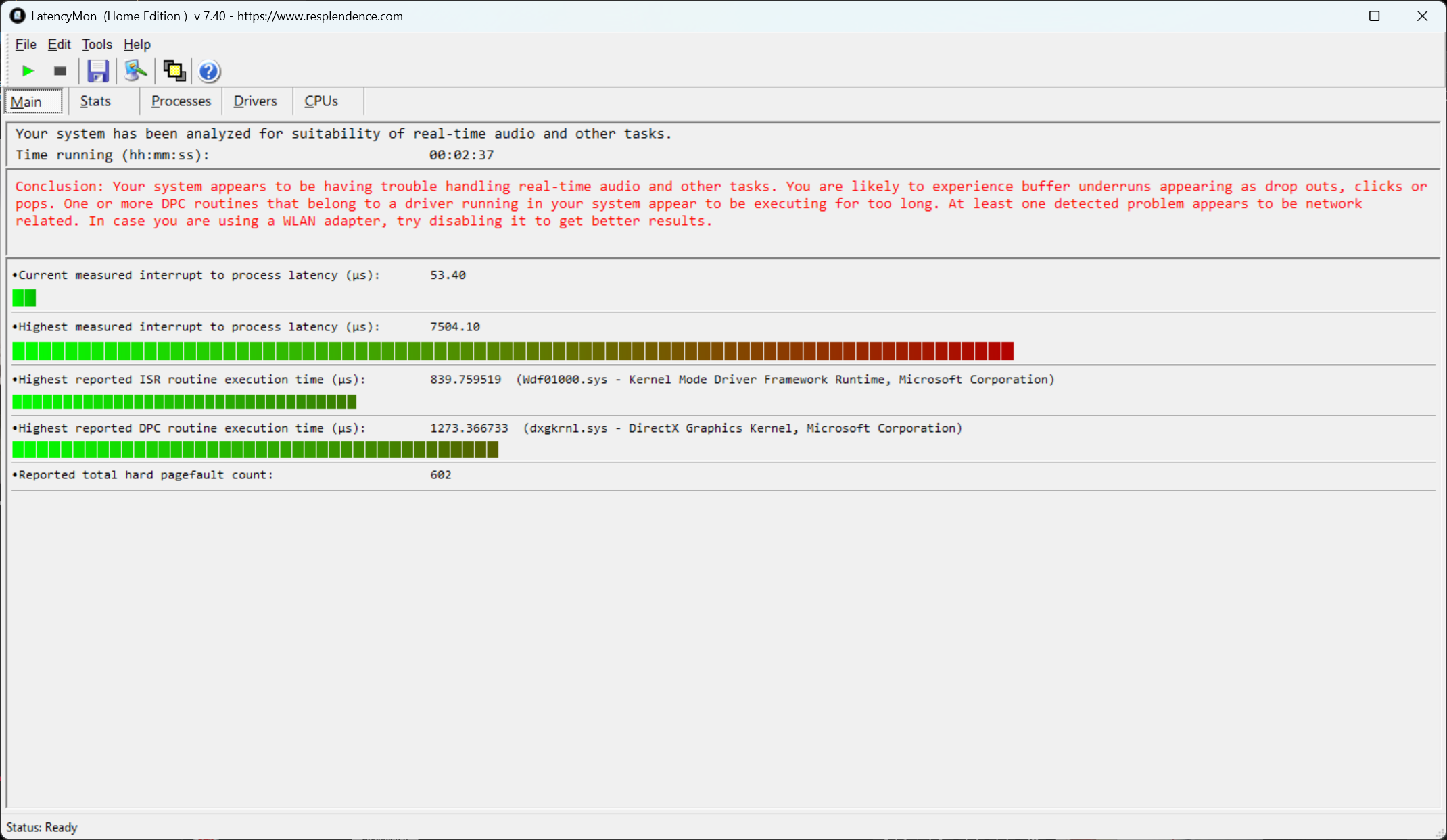
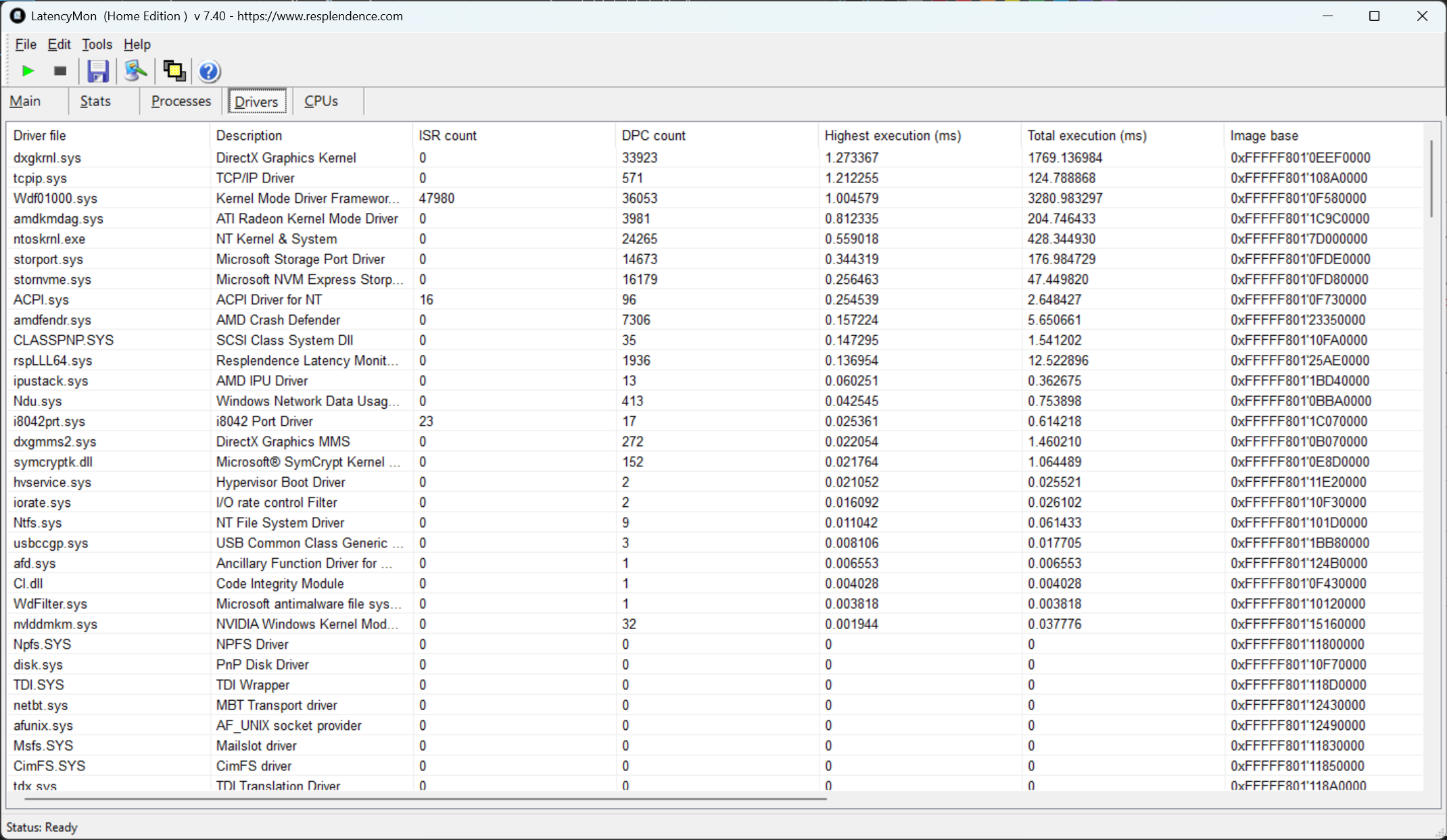
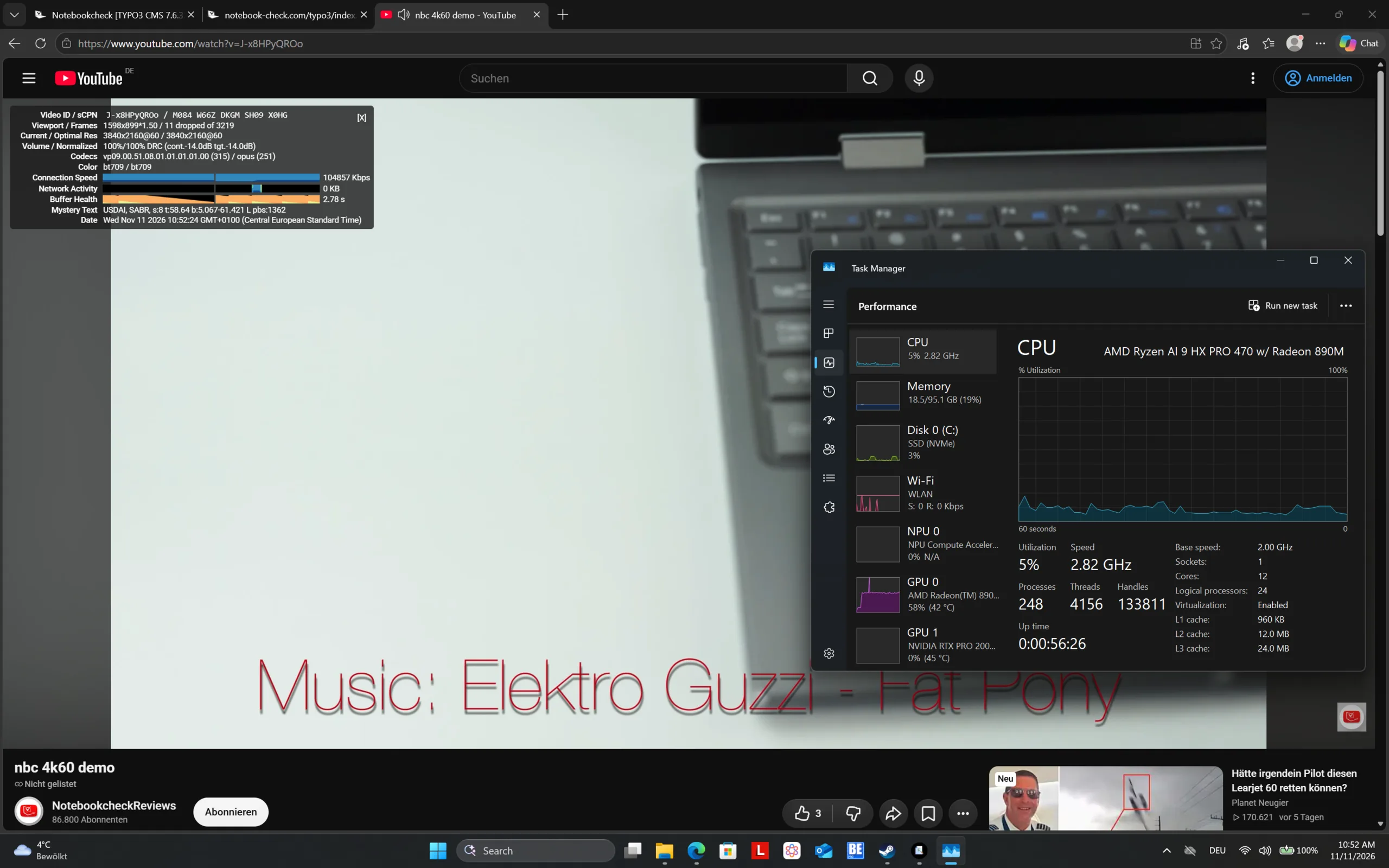
| DPC Latencies / LatencyMon - interrupt to process latency (max), Web, Youtube, Prime95 | |
| Lenovo ThinkPad P16s Gen 5 21XG002EGE | |
| Average of class Workstation (439 - 7504, n=18, last 2 years) | |
| Lenovo ThinkPad P16s Gen 4 21RX000YGE | |
| HP ZBook X G1i 16 | |
| Lenovo ThinkPad P1 Gen 9 21UE000MGE | |
| Lenovo ThinkPad P16v G3 21RS000DGE | |
* ... smaller is better
Storage Devices
While the Lenovo ThinkPad P16s Gen 5 AMD ships with a very fast PCIe 5.0 SSD from Samsung with a capacity of 2 TB, the system limits it to PCIe 4.0 speed. On the flip side, performance is not throttled under sustained load.

* ... smaller is better
Disk Throttling: DiskSpd Read Loop, Queue Depth 8
GPU Performance
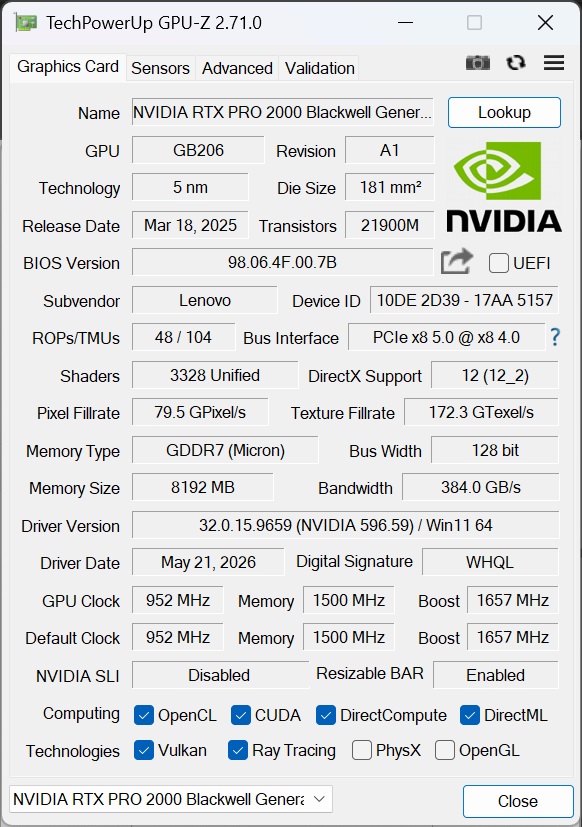
As a first for the ThinkPad P16s line, the ThinkPad P16s Gen 5 AMD features an RTX 2000 class GPU, the Nvidia RTX Pro 2000 Blackwell (roughly the equivalent of a GeForce RTX 5060 Laptop, but with ISV-certified drivers); previous Intel-based iterations were limited to the RTX Pro 1000 Blackwell, and the previous AMD versions of the P16s featured no Nvidia GPUs at all. The gains over the older P16s Gen 4 AMD are huge; the old model with its integrated AMD GPU delivered 59 percent less GPU performance. Still, the RTX Pro 2000 here is limited, as Lenovo only gives it a TGP of 55 W (35 W if the CPU is under load). With the same GPU, the older ThinkPad P16v Gen 3 is around eight percent faster, and the more expensive ThinkPad P1 Gen 9 is around 19 percent faster in the workstation-centric SPECviewperf benchmark.
While gaming is certainly not one of the core jobs of the ThinkPad P16s Gen 5 AMD, it is capable of playing even some newer games - though mostly limited to a Full-HD (1,920 x 1,080) resolution, as the frame rates drop a bit low in QHD (2,560 x 1,440) resolution even with DLSS enabled.
| 3DMark 11 Performance | 26496 points | |
| 3DMark Ice Storm Standard Score | 134834 points | |
| 3DMark Cloud Gate Standard Score | 55589 points | |
| 3DMark Fire Strike Score | 20978 points | |
| 3DMark Time Spy Score | 8600 points | |
Help | ||
* ... smaller is better
| Final Fantasy XV Benchmark - 1920x1080 High Quality | |
| Lenovo ThinkPad P1 Gen 9 21UE000MGE | |
| Average of class Workstation (26.4 - 197.6, n=19, last 2 years) | |
| HP ZBook X G1i 16 | |
| Lenovo ThinkPad P16v G3 21RS000DGE | |
| Lenovo ThinkPad P16s Gen 5 21XG002EGE | |
| Lenovo ThinkPad P16s Gen 4 21RX000YGE | |
| Strange Brigade - 1920x1080 ultra AA:ultra AF:16 | |
| Average of class Workstation (93.2 - 418, n=13, last 2 years) | |
| HP ZBook X G1i 16 | |
| Lenovo ThinkPad P16v G3 21RS000DGE | |
| Lenovo ThinkPad P16s Gen 5 21XG002EGE | |
Cyberpunk 2077 ultra FPS Chart
| low | med. | high | ultra | QHD DLSS | QHD | |
|---|---|---|---|---|---|---|
| GTA V (2015) | 167.6 | 100.6 | 71.5 | |||
| Dota 2 Reborn (2015) | 171.8 | 148.4 | 142.7 | 131.4 | ||
| Final Fantasy XV Benchmark (2018) | 174.1 | 101.4 | 75.2 | 56.8 | ||
| X-Plane 11.11 (2018) | 92.1 | 76.5 | 59.2 | |||
| Strange Brigade (2018) | 407 | 227 | 180.4 | 154.2 | 111.2 | |
| Baldur's Gate 3 (2023) | 92.7 | 72.9 | 62.2 | 61.8 | 43.8 | |
| Cyberpunk 2077 (2023) | 94.7 | 73.5 | 62.3 | 54.7 | 32.8 | |
| Kingdom Come Deliverance 2 (2025) | 86.6 | 67.5 | 55.6 | 40.9 | 37.3 | 31.9 |
| Doom: The Dark Ages (2025) | 48.7 | 39.8 | 36.3 | 35.1 | 33.3 | 23.8 |
| F1 25 (2025) | 161.8 | 140.4 | 110.5 | 20 | 12.1 | |
| ARC Raiders (2025) | 93.4 | 84.8 | 66.9 | 48.9 | 49.4 | 33.8 |
| Call of Duty Black Ops 7 (2025) | 125 | 115 | 88 | 35 | 29 | 23 |
| Resident Evil Requiem (2026) | 96.7 | 64.7 | 60.7 | 33 | 21.3 | |
| Death Stranding 2 (2026) | 54 | 45.9 | 41.4 | 31.3 | 34.2 | 23.1 |
| Crimson Desert (2026) | 58.6 | 39 | 38 | 31.3 | 31.8 | 22.4 |
| Pragmata (2026) | 95.3 | 71.2 | 54.9 | 54.4 | 42 | |
| Forza Horizon 6 (2026) | 129 | 80 | 47 | 21 | 14 | |
| 007 First Light (2026) | 49.3 | 45.3 | 41.3 | 41.1 | 43.8 | 28.5 |
Emissions
System Noise
The two fans of the Lenovo ThinkPad laptop stay quiet when the device is idling or just surfing the web, especially in the lower power modes. Under load, we measured a maximum of 46.9 dB(a) - loud, but not yet disturbing, and less than most other mobile workstation laptops.
There is no coil whine with this ThinkPad P16s Gen 5 AMD.
Noise level
| Idle |
| 25.1 / 25.1 / 25.1 dB(A) |
| Load |
| 40.6 / 46.9 dB(A) |
 | ||
30 dB silent 40 dB(A) audible 50 dB(A) loud |
||
min:  , med:  , max:  Earthworks M23R, Arta (15 cm distance) environment noise: 25.1 dB(A) | ||
| Lenovo ThinkPad P16s Gen 5 21XG002EGE Ryzen AI 9 HX PRO 470, RTX PRO 2000 Blackwell Generation Laptop | Lenovo ThinkPad P16v G3 21RS000DGE Ultra 7 255H, RTX PRO 2000 Blackwell Generation Laptop | HP ZBook X G1i 16 Ultra 7 265H, RTX PRO 2000 Blackwell Generation Laptop | Lenovo ThinkPad P16s Gen 4 21RX000YGE Ryzen AI 9 HX PRO 370, Radeon 890M | Lenovo ThinkPad P1 Gen 9 21UE000MGE Ultra 7 366H, RTX PRO 2000 Blackwell Generation Laptop | |
|---|---|---|---|---|---|
| Noise | -3% | 5% | -5% | -2% | |
| off / environment * (dB) | 25.1 | 25.9 -3% | 23.7 6% | 25.9 -3% | 25.6 -2% |
| Idle Minimum * (dB) | 25.1 | 25.9 -3% | 23.7 6% | 25.9 -3% | 25.6 -2% |
| Idle Average * (dB) | 25.1 | 25.9 -3% | 23.7 6% | 25.9 -3% | 25.6 -2% |
| Idle Maximum * (dB) | 25.1 | 29.2 -16% | 23.7 6% | 28.5 -14% | 25.6 -2% |
| Load Average * (dB) | 40.6 | 37.5 8% | 32.7 19% | 42.9 -6% | 41.5 -2% |
| Cyberpunk 2077 ultra * (dB) | 46.6 | 47.1 -1% | 50.9 -9% | 48.7 -5% | 47.8 -3% |
| Load Maximum * (dB) | 46.9 | 47.1 -0% | 48 -2% | 48.5 -3% | 47.9 -2% |
* ... smaller is better
Temperature
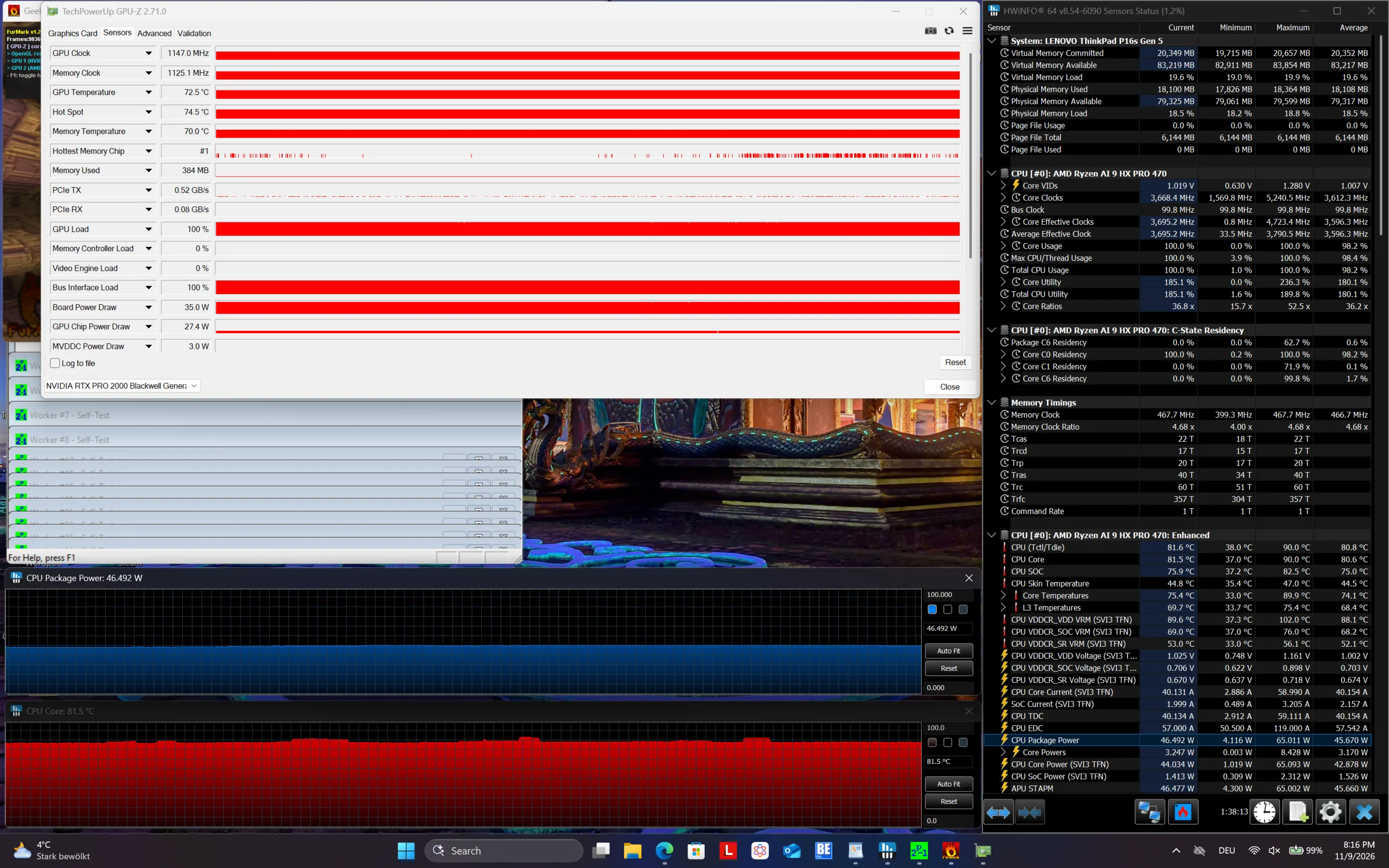
Despite the Nvidia GPU, the ThinkPad P16s Gen 5 AMD runs cooler than the older ThinkPad P16s Gen 4 AMD, probably thanks to the second fan. An overall maximum temperature of 46.8 degrees Celsius or 116 F is hot, but luckily, the machine only reaches this point at a single hot-spot above the keyboard, as well as in the middle of the bottom cover.
During the combined CPU/GPU stress test, the CPU consumes 45 W and the GPU 35 W, so the device can cool up to 80 W under load. We did not detect any throttling.
(-) The maximum temperature on the upper side is 46.8 °C / 116 F, compared to the average of 38.3 °C / 101 F, ranging from 22.2 to 69.8 °C for the class Workstation.
(-) The bottom heats up to a maximum of 46.3 °C / 115 F, compared to the average of 41.1 °C / 106 F
(+) In idle usage, the average temperature for the upper side is 27.8 °C / 82 F, compared to the device average of 32 °C / 90 F.
(+) 3: The average temperature for the upper side is 30.5 °C / 87 F, compared to the average of 32 °C / 90 F for the class Workstation.
(+) The palmrests and touchpad are cooler than skin temperature with a maximum of 28 °C / 82.4 F and are therefore cool to the touch.
(±) The average temperature of the palmrest area of similar devices was 27.8 °C / 82 F (-0.2 °C / -0.4 F).
| Lenovo ThinkPad P16s Gen 5 21XG002EGE Ryzen AI 9 HX PRO 470, RTX PRO 2000 Blackwell Generation Laptop | Lenovo ThinkPad P16v G3 21RS000DGE Ultra 7 255H, RTX PRO 2000 Blackwell Generation Laptop | HP ZBook X G1i 16 Ultra 7 265H, RTX PRO 2000 Blackwell Generation Laptop | Lenovo ThinkPad P16s Gen 4 21RX000YGE Ryzen AI 9 HX PRO 370, Radeon 890M | Lenovo ThinkPad P1 Gen 9 21UE000MGE Ultra 7 366H, RTX PRO 2000 Blackwell Generation Laptop | |
|---|---|---|---|---|---|
| Heat | 15% | 10% | -16% | 3% | |
| Maximum Upper Side * (°C) | 46.8 | 39.9 15% | 36 23% | 50.6 -8% | 51 -9% |
| Maximum Bottom * (°C) | 46.3 | 44.8 3% | 39.4 15% | 54.3 -17% | 43.9 5% |
| Idle Upper Side * (°C) | 30.9 | 24 22% | 30.4 2% | 35.3 -14% | 28.3 8% |
| Idle Bottom * (°C) | 31.4 | 25 20% | 31.8 -1% | 38.5 -23% | 28.6 9% |
* ... smaller is better
Speakers
The two bottom-firing speakers are limited in their total volume, but well balanced, as they do deliver more bass than the speakers of the comparable HP ZBook X.
Lenovo ThinkPad P16s Gen 5 21XG002EGE audio analysis
(±) | speaker loudness is average but good (79.6 dB)
Bass 100 - 315 Hz
(±) | reduced bass - on average 10.6% lower than median
(±) | linearity of bass is average (12.7% delta to prev. frequency)
Mids 400 - 2000 Hz
(±) | higher mids - on average 5.2% higher than median
(+) | mids are linear (6% delta to prev. frequency)
Highs 2 - 16 kHz
(+) | balanced highs - only 2.4% away from median
(+) | highs are linear (6.7% delta to prev. frequency)
Overall 100 - 16.000 Hz
(±) | linearity of overall sound is average (16.6% difference to median)
Compared to same class
» 47% of all tested devices in this class were better, 8% similar, 45% worse
» The best had a delta of 7%, average was 17%, worst was 35%
Compared to all devices tested
» 30% of all tested devices were better, 6% similar, 65% worse
» The best had a delta of 4%, average was 23%, worst was 136%
HP ZBook X G1i 16 audio analysis
(+) | speakers can play relatively loud (84 dB)
Bass 100 - 315 Hz
(-) | nearly no bass - on average 28% lower than median
(±) | linearity of bass is average (8.8% delta to prev. frequency)
Mids 400 - 2000 Hz
(+) | balanced mids - only 1.9% away from median
(+) | mids are linear (6.1% delta to prev. frequency)
Highs 2 - 16 kHz
(+) | balanced highs - only 2.9% away from median
(+) | highs are linear (5.1% delta to prev. frequency)
Overall 100 - 16.000 Hz
(±) | linearity of overall sound is average (15.6% difference to median)
Compared to same class
» 37% of all tested devices in this class were better, 10% similar, 53% worse
» The best had a delta of 7%, average was 17%, worst was 35%
Compared to all devices tested
» 24% of all tested devices were better, 5% similar, 71% worse
» The best had a delta of 4%, average was 23%, worst was 136%
Energy Management
Power Consumption
Despite the OLED screen and Nvidia GPU, the ThinkPad P16s Gen 5 AMD does not run much more inefficiently than its older counterpart without those features, though the minimum idle consumption is increased from 3.9 to 5.5 W. The difference mostly comes out during load testing. The maximum power consumption of 141.8 W is slightly above the capacity of the 140 W USB-C charger, but since consumption quickly drops, there is no danger of discharging during use.
| Off / Standby | 0.2 / 0.9 Watt |
| Idle | 5.5 / 6.9 / 7.3 Watt |
| Load |
86.1 / 141.8 Watt |
   
| |
Key:
min: ,
med: ,
max: Metrahit Energy | |
| Lenovo ThinkPad P16s Gen 5 21XG002EGE Ryzen AI 9 HX PRO 470, RTX PRO 2000 Blackwell Generation Laptop, Samsung PM9E1 MZVLC2T0HBLD, OLED, 2880x1800, 16" | Lenovo ThinkPad P16v G3 21RS000DGE Ultra 7 255H, RTX PRO 2000 Blackwell Generation Laptop, Samsung PM9E1 1 TB MZVLC1T0HFLU, IPS, 1920x1200, 16" | HP ZBook X G1i 16 Ultra 7 265H, RTX PRO 2000 Blackwell Generation Laptop, Samsung PM9A1 MZVL22T0HBLB, IPS, 2560x1600, 16" | Lenovo ThinkPad P16s Gen 4 21RX000YGE Ryzen AI 9 HX PRO 370, Radeon 890M, Micron 3500 1TB MTFDKBA1T0TGD, IPS LED, 1920x1200, 16" | Lenovo ThinkPad P1 Gen 9 21UE000MGE Ultra 7 366H, RTX PRO 2000 Blackwell Generation Laptop, Samsung PM9E1 1 TB MZVLC1T0HFLU, IP LED, 1920x1200, 16" | Average NVIDIA RTX PRO 2000 Blackwell Generation Laptop | Average of class Workstation | |
|---|---|---|---|---|---|---|---|
| Power Consumption | -24% | -7% | 25% | -6% | -29% | -58% | |
| Idle Minimum * (Watt) | 5.5 | 4.8 13% | 4.1 25% | 3.9 29% | 2.2 60% | 6.4 ? -16% | 8.41 ? -53% |
| Idle Average * (Watt) | 6.9 | 12.3 -78% | 9 -30% | 8.3 -20% | 7.8 -13% | 10.5 ? -52% | 12.7 ? -84% |
| Idle Maximum * (Watt) | 7.3 | 12.7 -74% | 9.4 -29% | 8.7 -19% | 8.7 -19% | 12.2 ? -67% | 16.3 ? -123% |
| Load Average * (Watt) | 86.1 | 89.6 -4% | 86.7 -1% | 51.6 40% | 112.1 -30% | 92.2 ? -7% | 95.3 ? -11% |
| Cyberpunk 2077 ultra * (Watt) | 103.4 | 115.1 -11% | 106.1 -3% | 55.4 46% | 121.6 -18% | ||
| Cyberpunk 2077 ultra external monitor * (Watt) | 101.7 | 115.8 -14% | 102 -0% | 54.6 46% | 126.5 -24% | ||
| Load Maximum * (Watt) | 141.8 | 139.5 2% | 152.9 -8% | 63.7 55% | 142.9 -1% | 144.1 ? -2% | 167 ? -18% |
* ... smaller is better
Power Consumption Cyberpunk / Stress Test
Power Consumption external Monitor
Battery Life
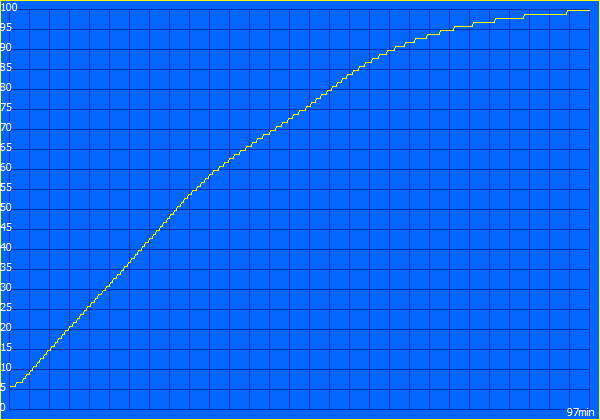
Battery capacity is increased from 86 to 90 Wh. Still, with the OLED screen and Nvidia GPU, the battery life of the ThinkPad P16s Gen 5 AMD is limited. 11.6 hrs during our Wi-Fi/websurfing test are certainly an OK score, but also nothing special. If one buys the ThinkPad P16s G5 with an IPS screen, battery life should be better.
| Lenovo ThinkPad P16s Gen 5 21XG002EGE Ryzen AI 9 HX PRO 470, RTX PRO 2000 Blackwell Generation Laptop, 90 Wh | Lenovo ThinkPad P16s Gen 4 21RX000YGE Ryzen AI 9 HX PRO 370, Radeon 890M, 86 Wh | HP ZBook X G1i 16 Ultra 7 265H, RTX PRO 2000 Blackwell Generation Laptop, 83 Wh | Lenovo ThinkPad P16v G3 21RS000DGE Ultra 7 255H, RTX PRO 2000 Blackwell Generation Laptop, 90 Wh | Lenovo ThinkPad P1 Gen 9 21UE000MGE Ultra 7 366H, RTX PRO 2000 Blackwell Generation Laptop, 90 Wh | Average of class Workstation | |
|---|---|---|---|---|---|---|
| Battery runtime | -15% | 8% | 22% | 43% | -20% | |
| WiFi v1.3 (h) | 11.6 | 13.9 20% | 12.5 8% | 14.2 22% | 22.6 95% | 10.6 ? -9% |
| Load (h) | 2.2 | 1.1 -50% | 2 -9% | 1.518 ? -31% |
Notebookcheck Rating
!CHANGE!
very short conclusion, max 400 characters
Lenovo ThinkPad P16s Gen 5 21XG002EGE
- 11/26/2026 v8
Benjamin Herzig
 Total Sustainability Score:
Potential Competitors in Comparison
Image | Model / Review | Price | Weight | Height | Display |
|---|---|---|---|---|---|
1. 89.1%  | Lenovo ThinkPad P16s Gen 5 21XG002EGE AMD Ryzen AI 9 HX PRO 470 ⎘ NVIDIA RTX PRO 2000 Blackwell Generation Laptop ⎘ 96 GB Memory, 2048 GB SSD | List Price: 6224 Euro | 2 kg | 24 mm | 16.00" 2880x1800 212 PPI OLED |
2. 87.3%  | Lenovo ThinkPad P16v G3 21RS000DGE Intel Core Ultra 7 255H ⎘ NVIDIA RTX PRO 2000 Blackwell Generation Laptop ⎘ 32 GB Memory, 1024 GB SSD | List Price: 2825€ | 2.2 kg | 19.6 mm | 16.00" 1920x1200 IPS |
3. 87.4%  | HP ZBook X G1i 16 Intel Core Ultra 7 265H ⎘ NVIDIA RTX PRO 2000 Blackwell Generation Laptop ⎘ 64 GB Memory, 2048 GB SSD | List Price: 2700 USD | 2.2 kg | 23 mm | 16.00" 2560x1600 189 PPI IPS |
4. 82%  | Lenovo ThinkPad P16s Gen 4 21RX000YGE AMD Ryzen AI 9 HX PRO 370 ⎘ AMD Radeon 890M ⎘ 64 GB Memory, 1024 GB SSD | List Price: 2440 Euro | 2 kg | 23 mm | 16.00" 1920x1200 142 PPI IPS LED |
5. 90.8%  | Lenovo ThinkPad P1 Gen 9 21UE000MGE Intel Core Ultra 7 366H ⎘ NVIDIA RTX PRO 2000 Blackwell Generation Laptop ⎘ 64 GB Memory, 1024 GB SSD | List Price: 5300 Euro | 1.9 kg | 21 mm | 16.00" 1920x1200 142 PPI IP LED |
Transparency
The selection of devices to be reviewed is made by our editorial team. The test sample was provided to the author as a loan by the manufacturer or retailer for the purpose of this review. The lender had no influence on this review, nor did the manufacturer receive a copy of this review before publication. There was no obligation to publish this review. As an independent media company, Notebookcheck is not subjected to the authority of manufacturers, retailers or publishers.
This is how Notebookcheck is testing
Every year, Notebookcheck independently reviews hundreds of laptops and smartphones using standardized procedures to ensure that all results are comparable. We have continuously developed our test methods for around 20 years and set industry standards in the process. In our test labs, high-quality measuring equipment is utilized by experienced technicians and editors. These tests involve a multi-stage validation process. Our complex rating system is based on hundreds of well-founded measurements and benchmarks, which maintains objectivity. Further information on our test methods can be found here.
 Add as a preferred source on Google


