




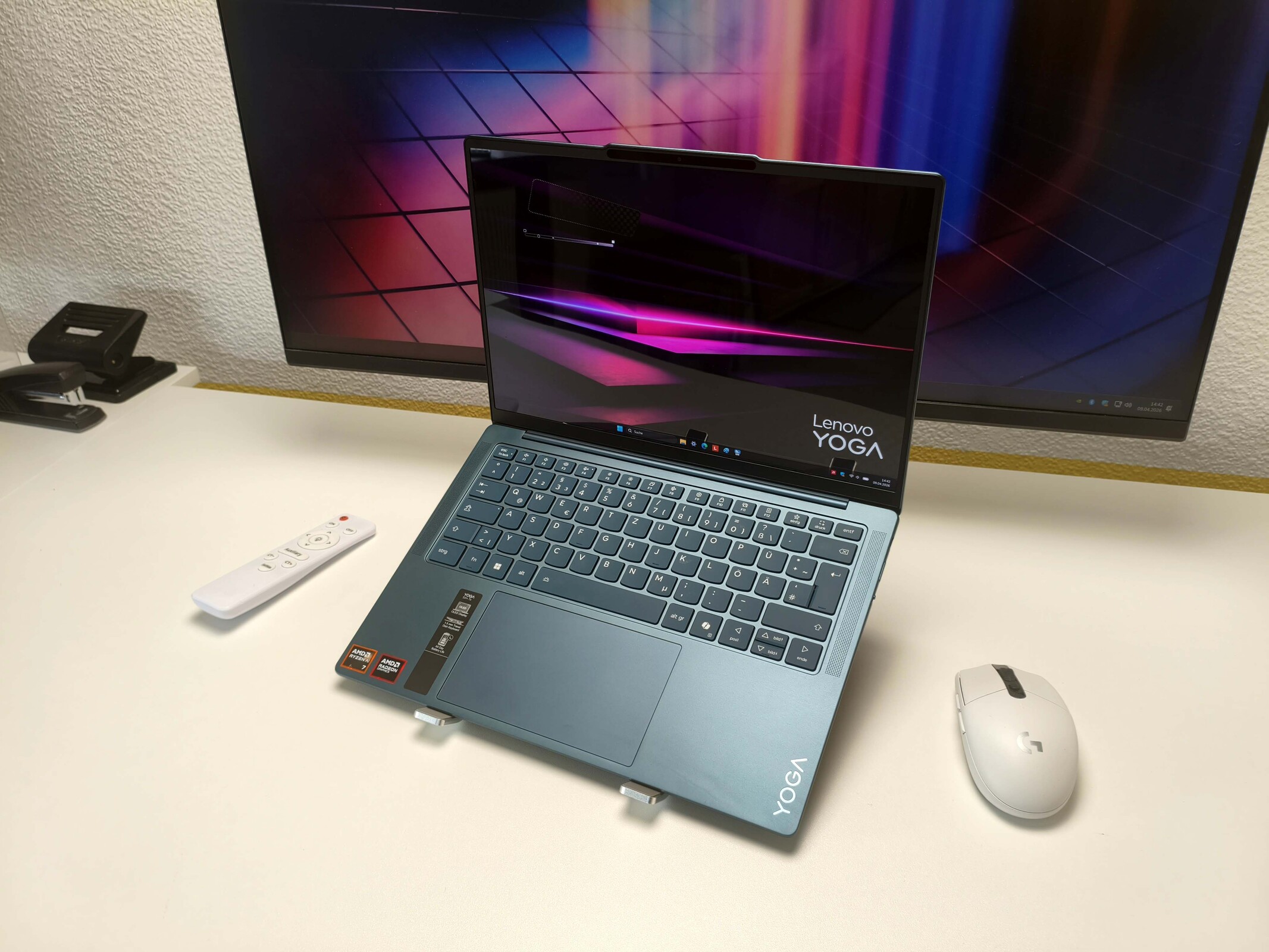
Verdict
Similar to its predecessors, the current Yoga Slim 7a 14 impresses with a high-quality metal chassis, which makes a good impression in combination with the elegant design.
However, the slim design of the 14-inch Yoga is both a blessing and a curse. While on the one hand the low weight and compact dimensions are a pleasure, the device is weaker in terms of connectivity and performance on the other.
The Ryzen AI 7 445 APU installed in the test device delivers a solid speed, but it would have been possible to achieve better scores with a more powerful cooling system. Especially considering that there are already devices in this price range with a faster iGPU like the Radeon 860M or Arc Graphics 130V instead of the Radeon 840M.
The Yoga SLim 7a 14's low power requirement should be mentioned on the positive side, which results in good battery life. The OLED display also shines with vibrant colors and excellent contrast.
Meanwhile, Lenovo could be criticized for poor sustainability in terms of components. For instance, the RAM comes soldered and there is only a small M.2 2242 slot.
Nevertheless, the Lenovo Yoga Slim 7a 14 is a recommendable companion for those constantly on the move.
Pros
Cons
Price and availability

- $1,088.95Lenovo Yoga 7a 2-in-1 Touchscreen Laptop, Ryzen 5 430, 16GB 512GB, 50 Tops
- $9.13KEANBOLL 3-Pack Anti-Glare (Matte) Screen Protector Designed for Lenovo Yoga 7i 2-in-1 Aura Edition 14" / Yoga 7a 2-in-1 14" (14IPH11/83TC,14AGP11/83TD) Touchscreen Laptop, (2026 Model Exclusive)
- $989.99Lenovo Yoga 7a 16" 2-in-1 Touch Laptop, Ryzen AI 5 430, WUXGA IPS
The Lenovo Yoga Slim 7a 14's competitors include laptops based on the AMD Ryzen AI 7 350, such as the old Yoga Slim 7 and the IdeaPad Pro 5.
Intel Core Ultra 5 226V-based offerings including the Asus VivoBook S 14 and Acer Swift 14 AI also sport a 14-inch chassis and cost less than €1,500.
Specifications
Build
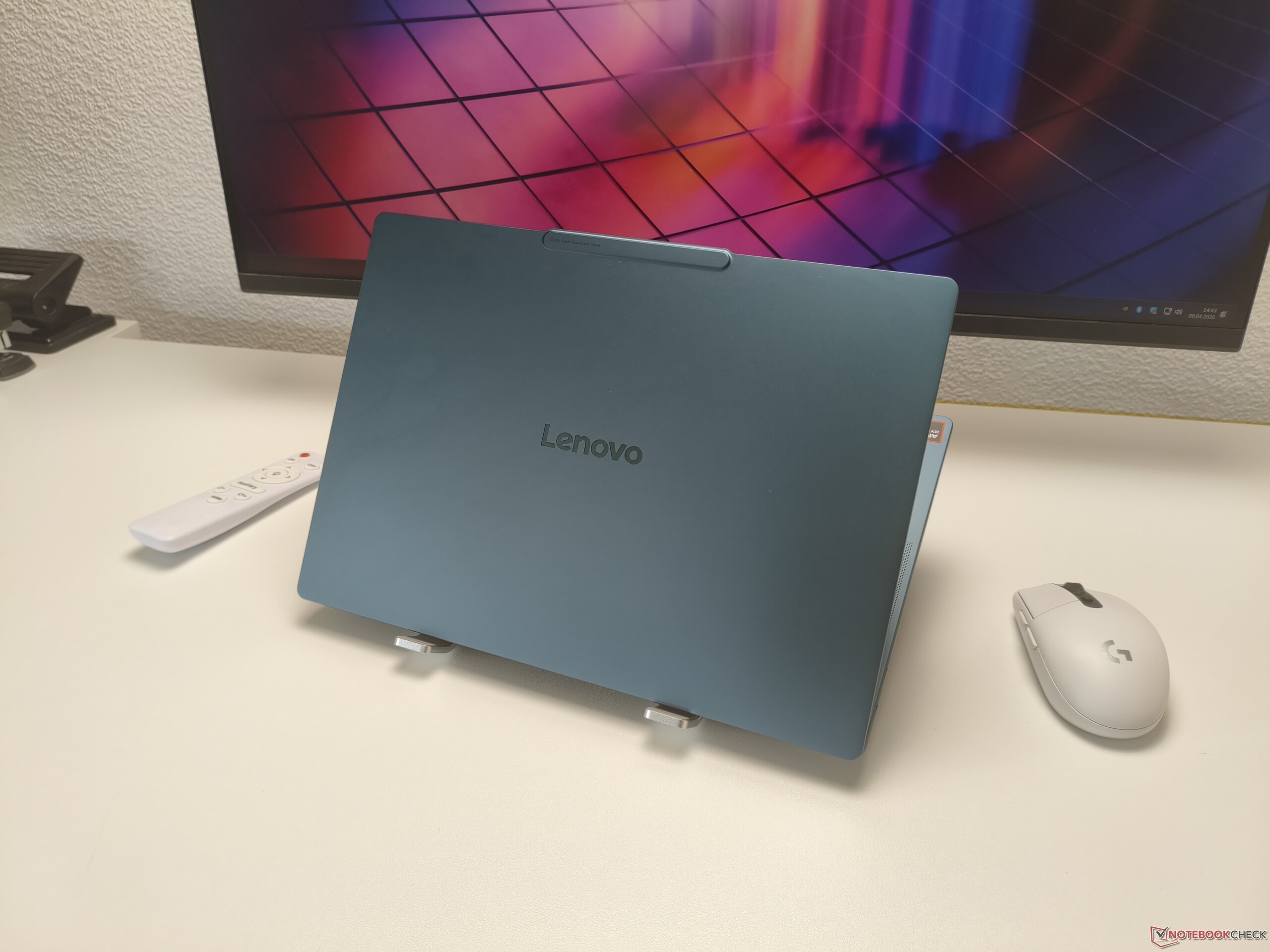
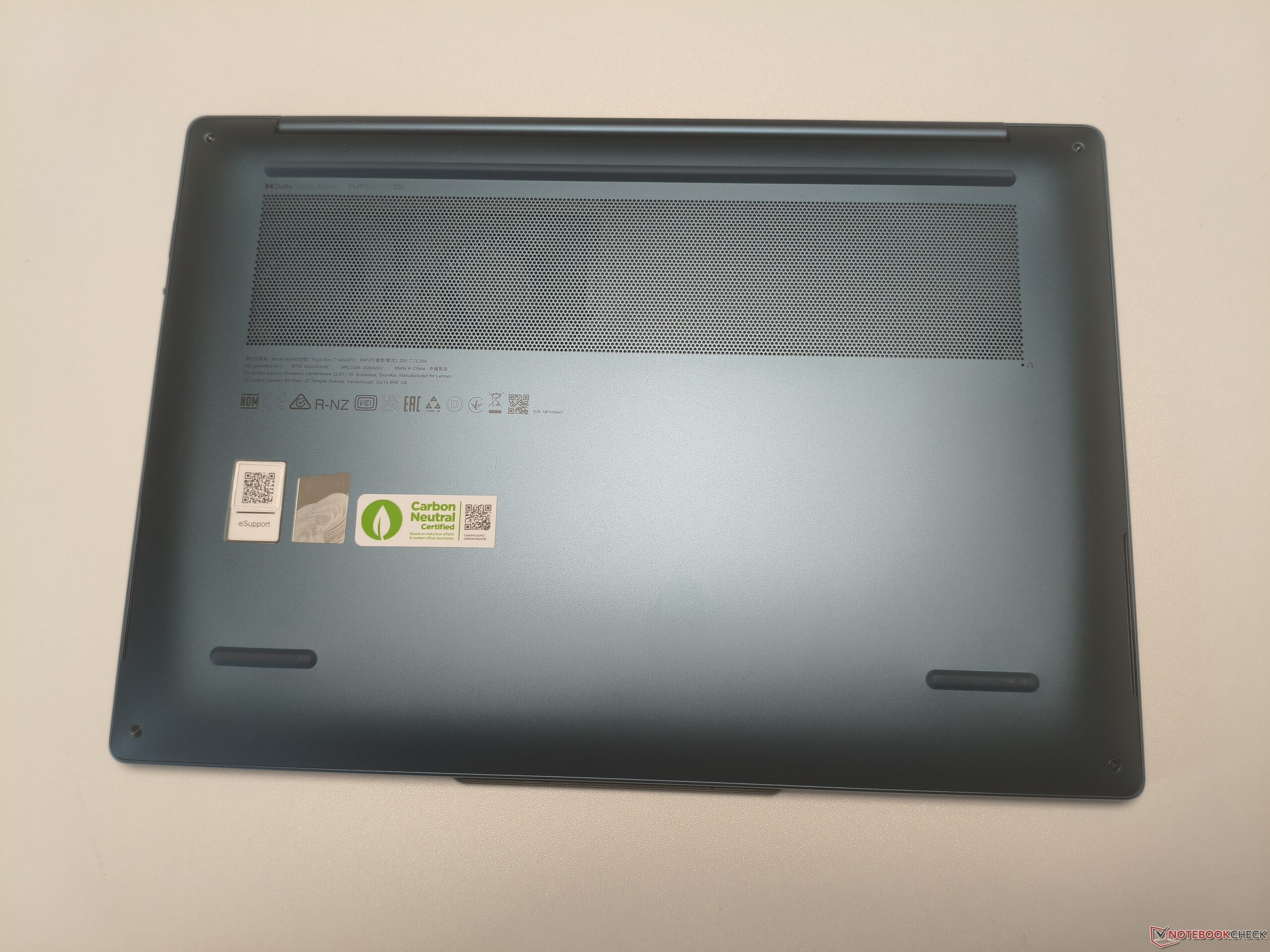
The Lenovo Yoga Slim 7a 14's build quality is excellent. We particularly liked the generous opening angle of almost 170°.
The workmanship, on the other hand, could be a little better. For instance, the sides and the base plate of our test device did not merge completely cleanly or evenly.
The highlight of the Yoga Slim 7a 14 is of course its low weight. At just about 1.15 kg, it is very comfortable to carry. A height of 14 mm is also comparatively low.
Equipment
One of the biggest weaknesses of this 14-inch Yoga turns out to be the lack of connectivity. Buyers not only have to do without a LAN port, but also a card reader, an audio socket, and an HDMI port.
A USB Type-A port is also missing. Nevertheless, the subnotebook offers three USB-C ports, each of which supports Power Delivery and DisplayPort. Two of them also support the modern USB 4 standard, which means not too many points need to be cut on the connectivity side.
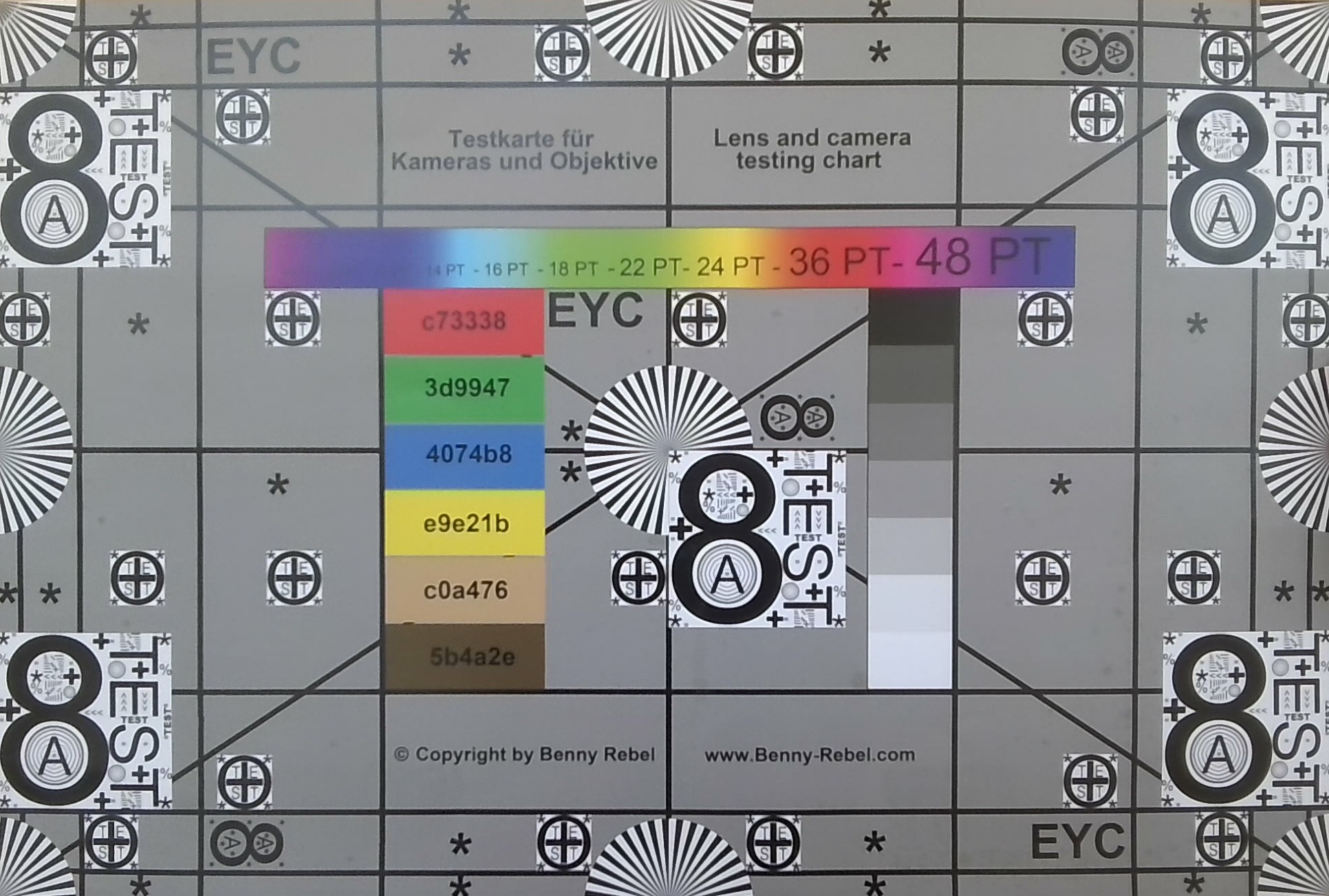
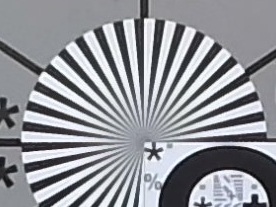
There is praise for the webcam shutter, especially as the image quality of the webcam is above average. The Wi-Fi 7 module from MediaTek also performed well in our testing with our reference Asus RT-BE96U Wi-Fi 7 router.
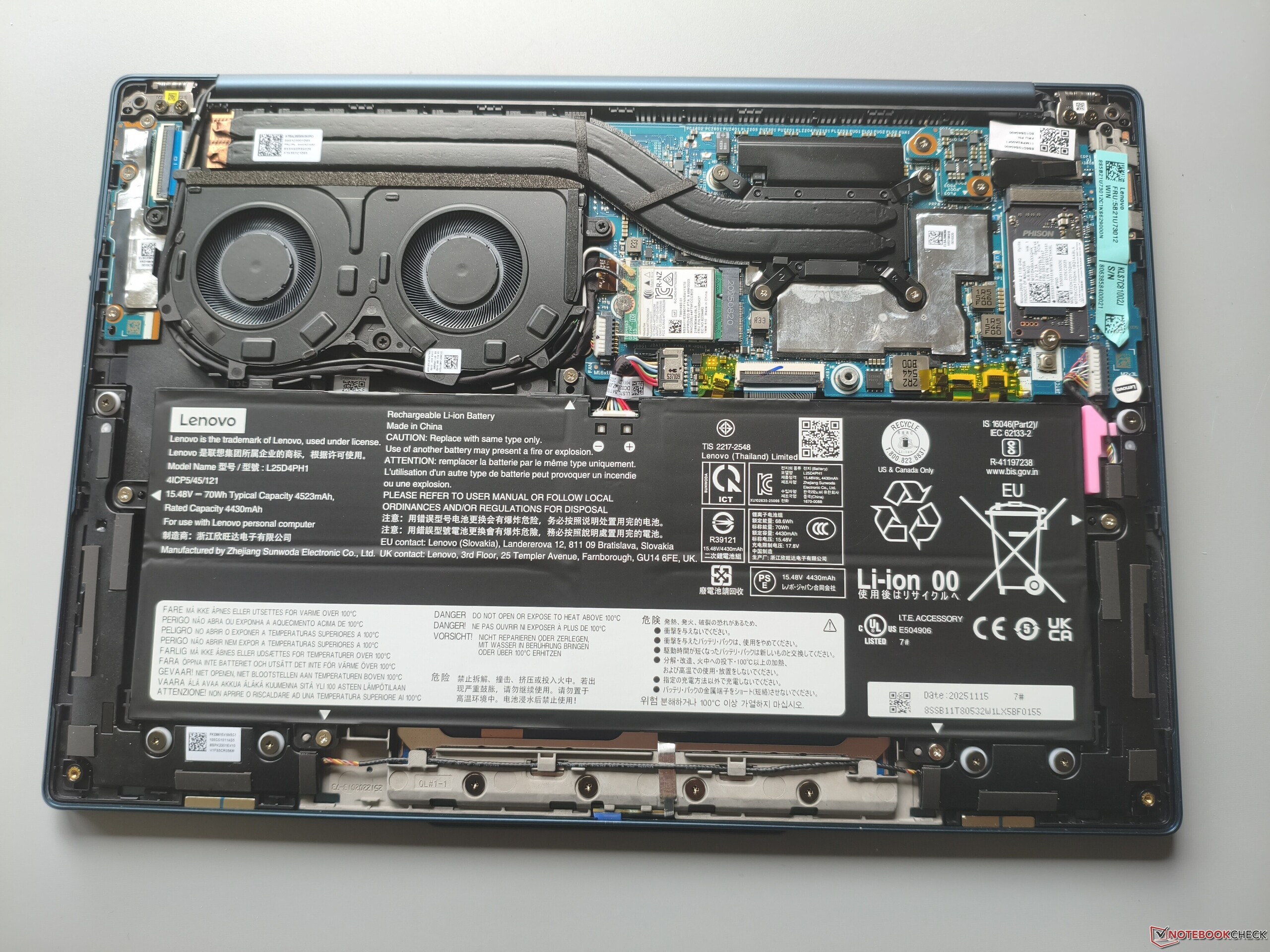
The chassis can be serviced after loosening just four Torx screws. Under the hood is a cooling solution with two fans and two heat pipes.


Communication
Webcam

Maintenance
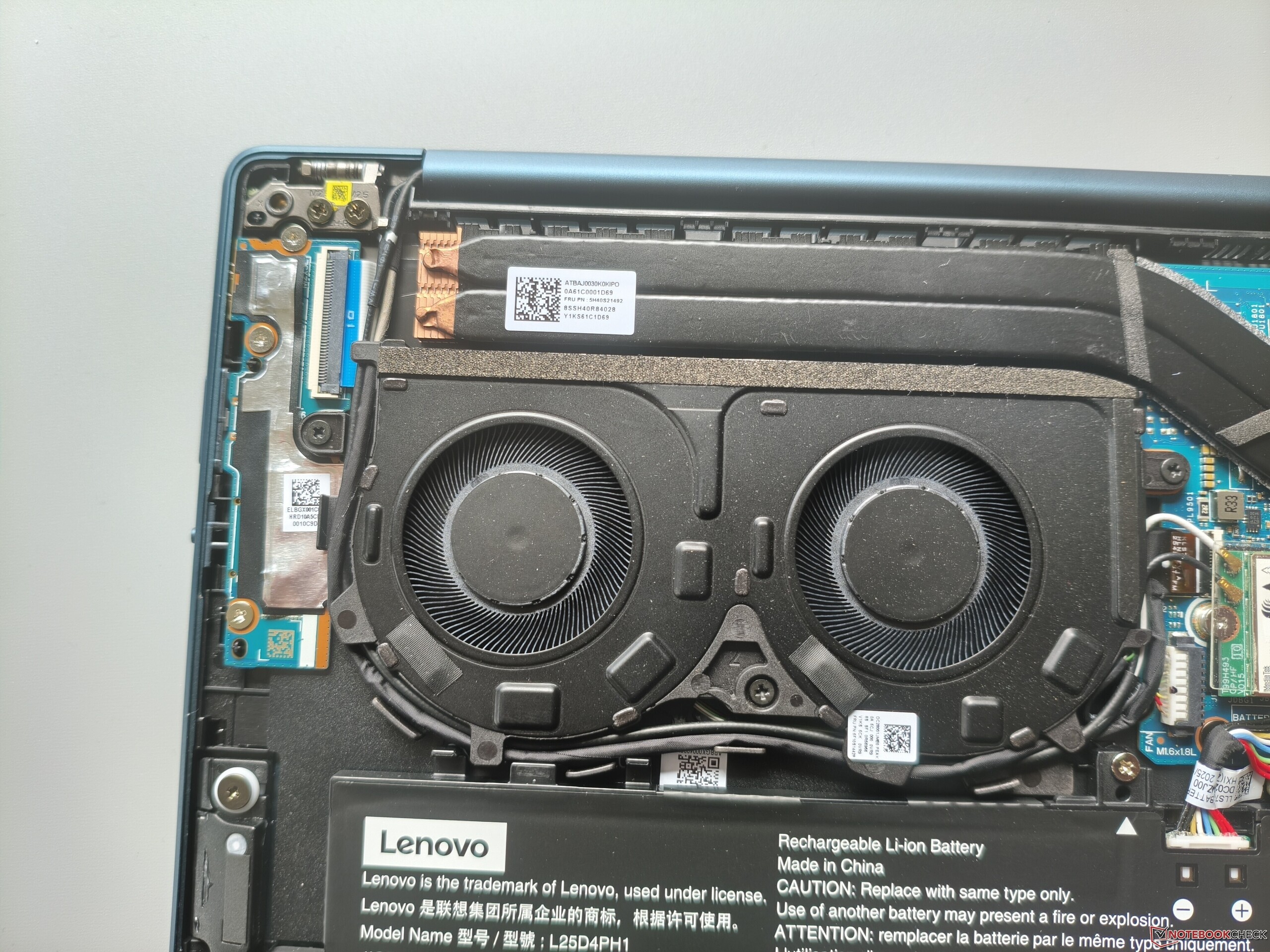
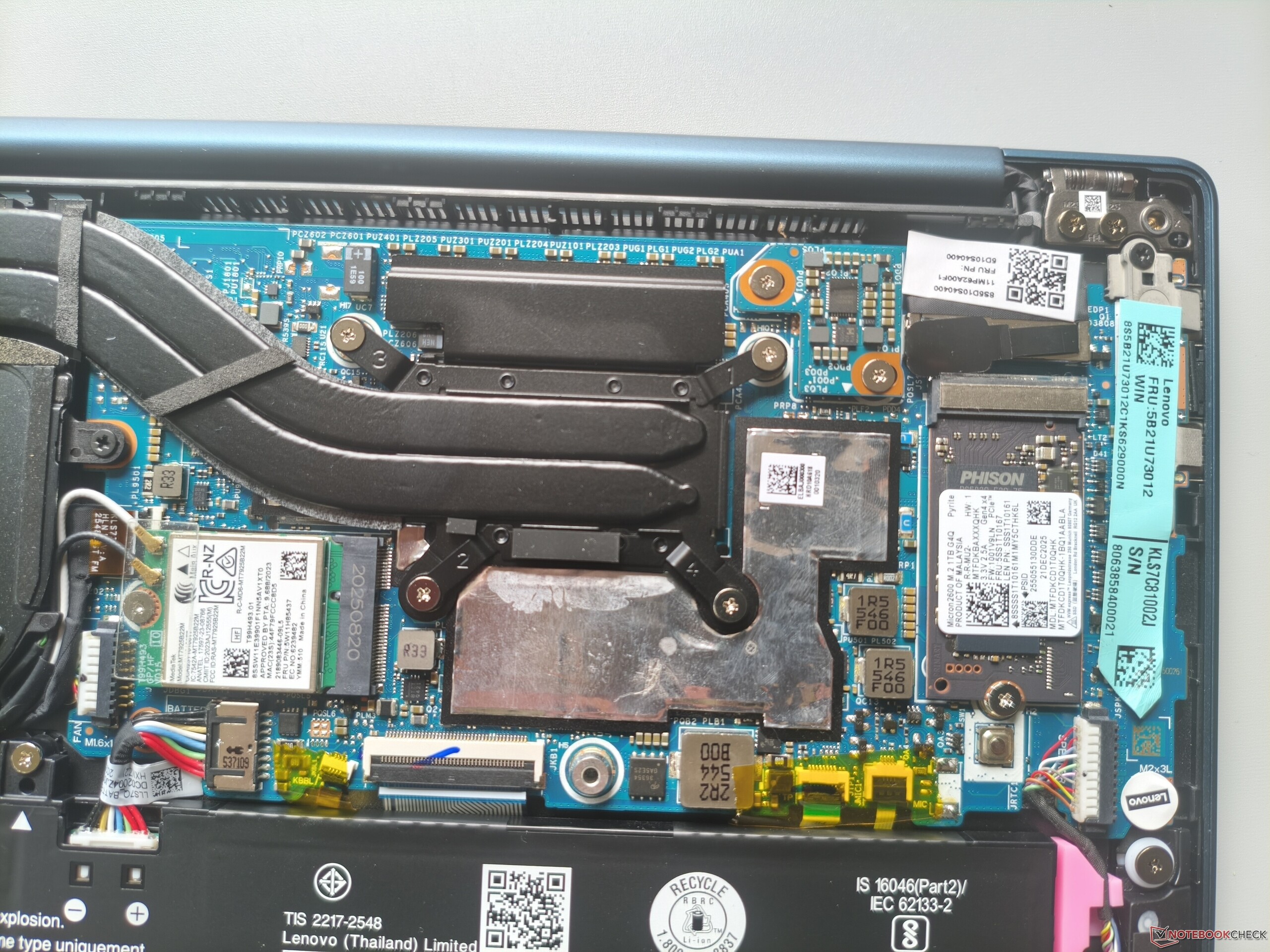
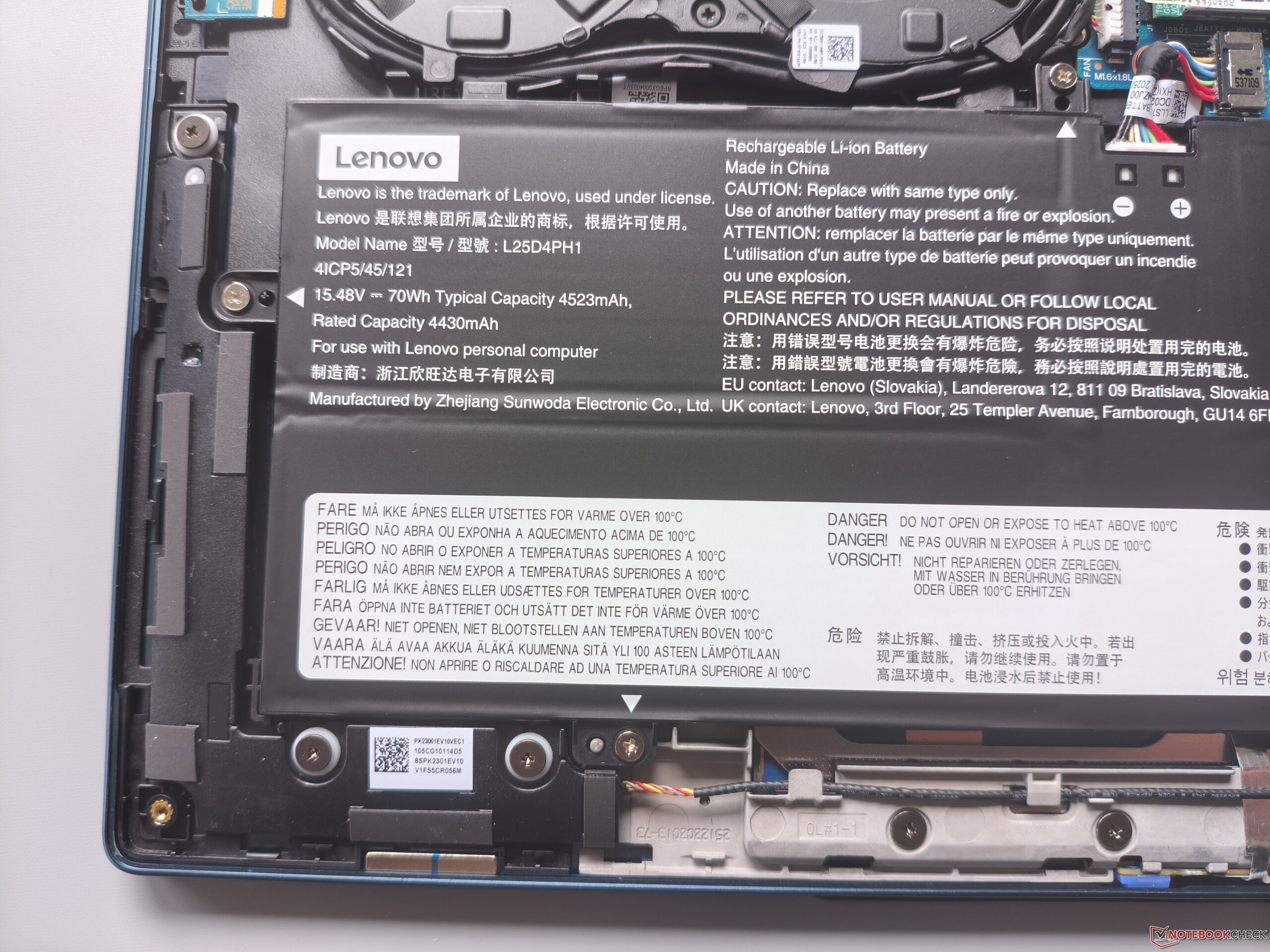
Input devices
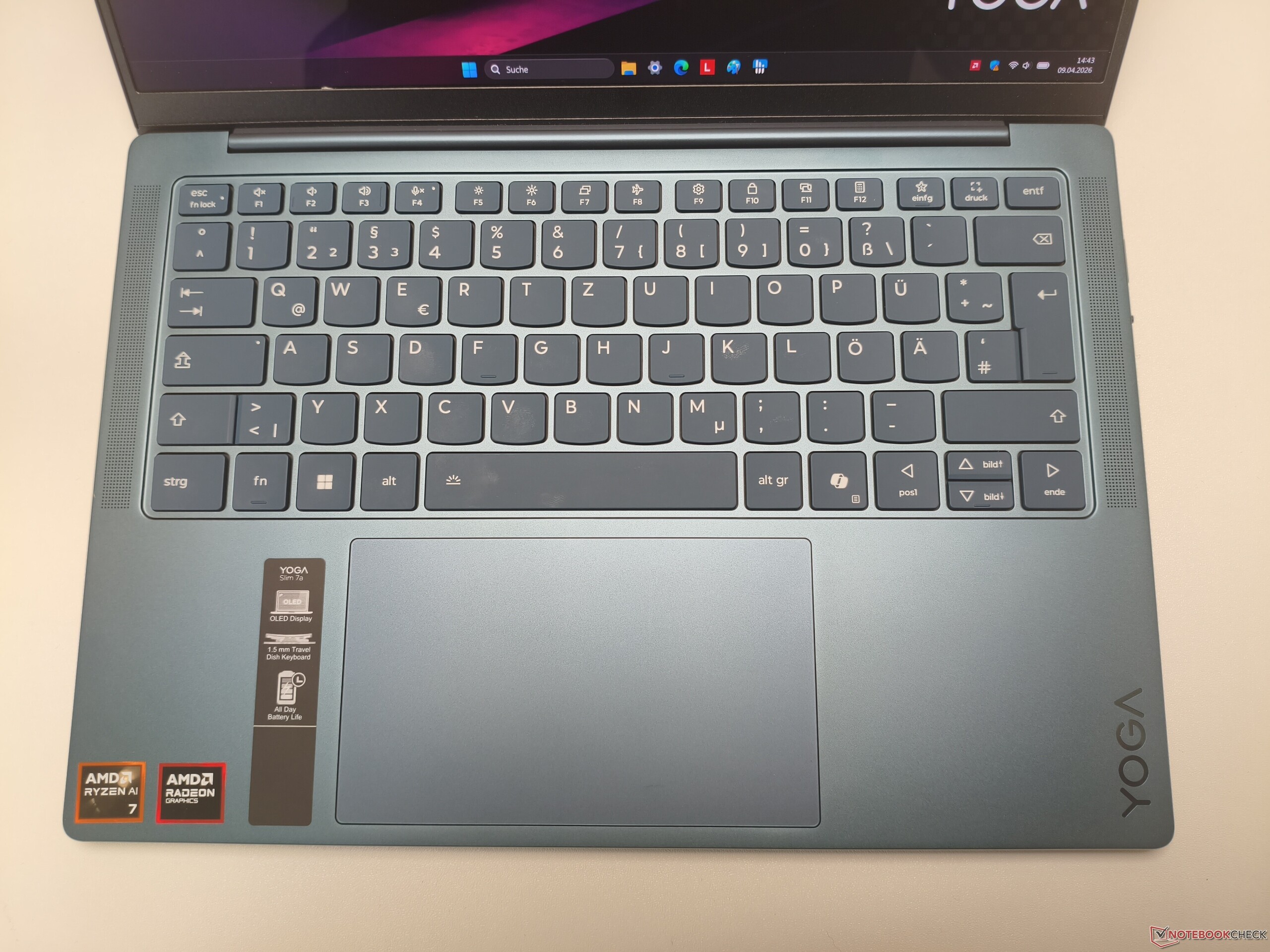
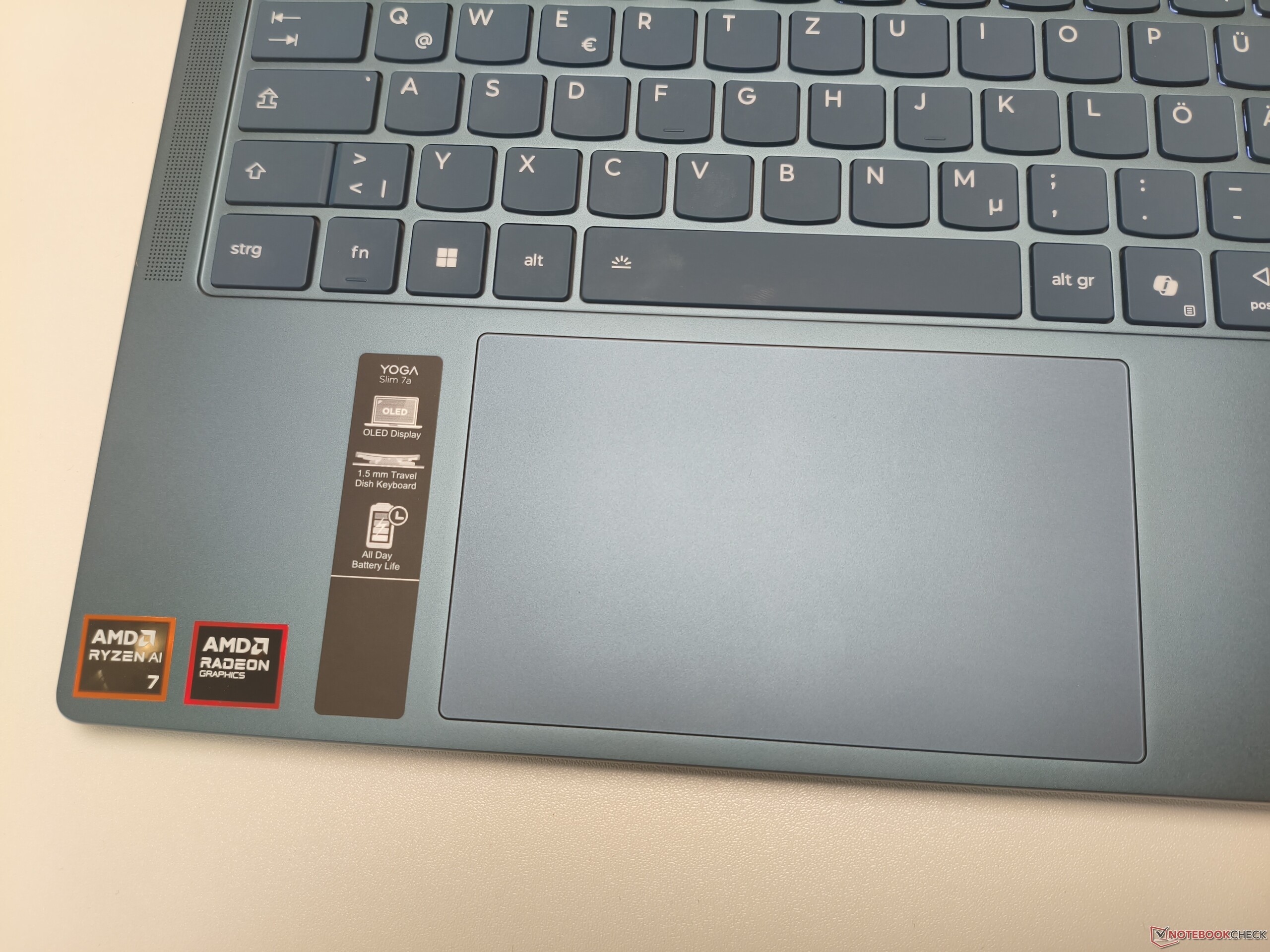
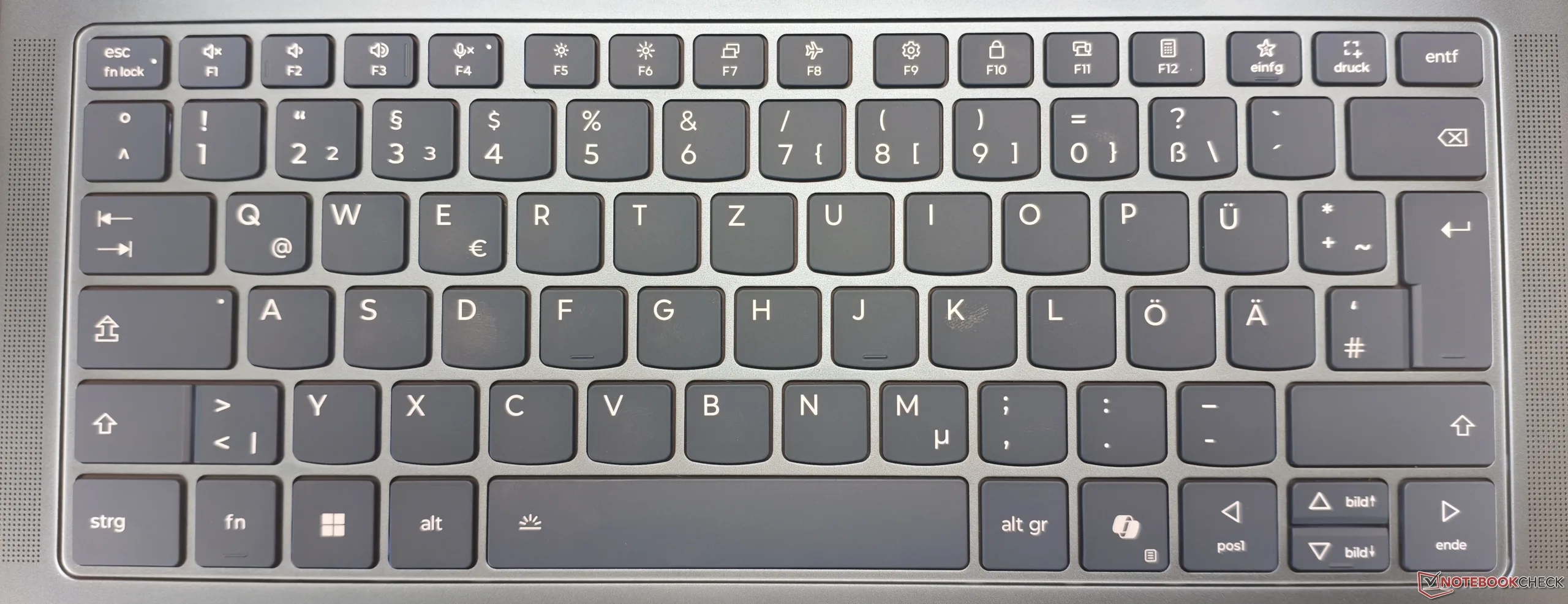
The input devices are typically good for a Lenovo laptop. In addition to the layout, the keyboard's key shape and the two-stage white illumination are also impressive.
The pleasantly smooth touchpad measures a respectable 13.5 cm x 8 cm.
Display
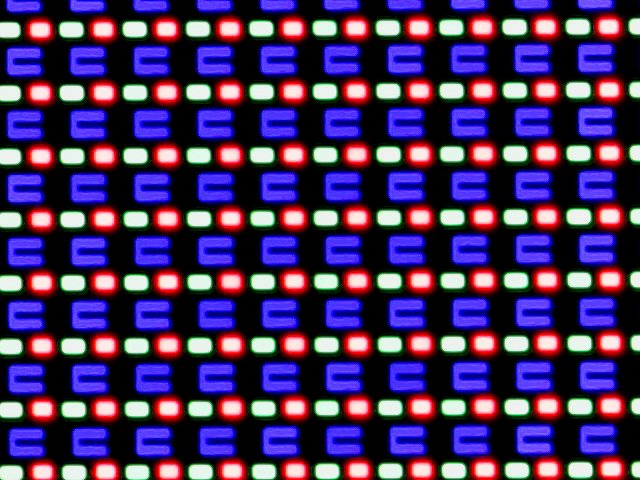
The OLED display offers a generous resolution of 2,880 x 1,800 pixels in the 16:10 format, which ensures a very sharp picture. Thanks to the excellent black level, the contrast is miles ahead of classic IPS panels.
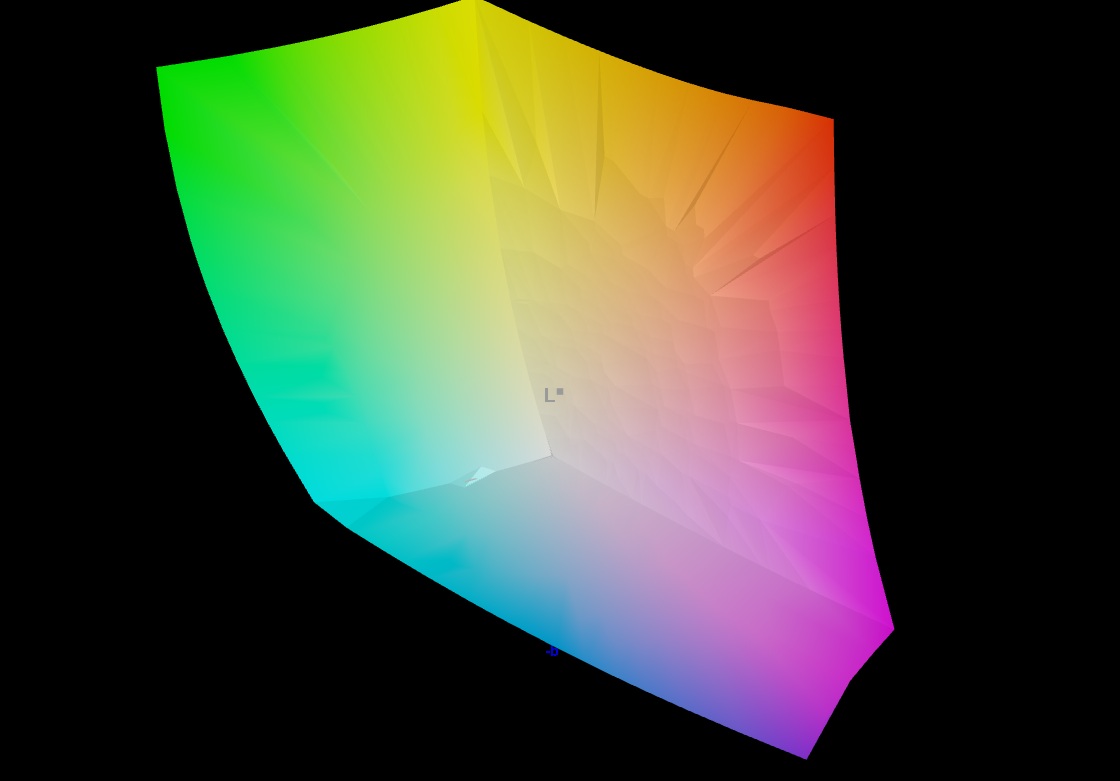
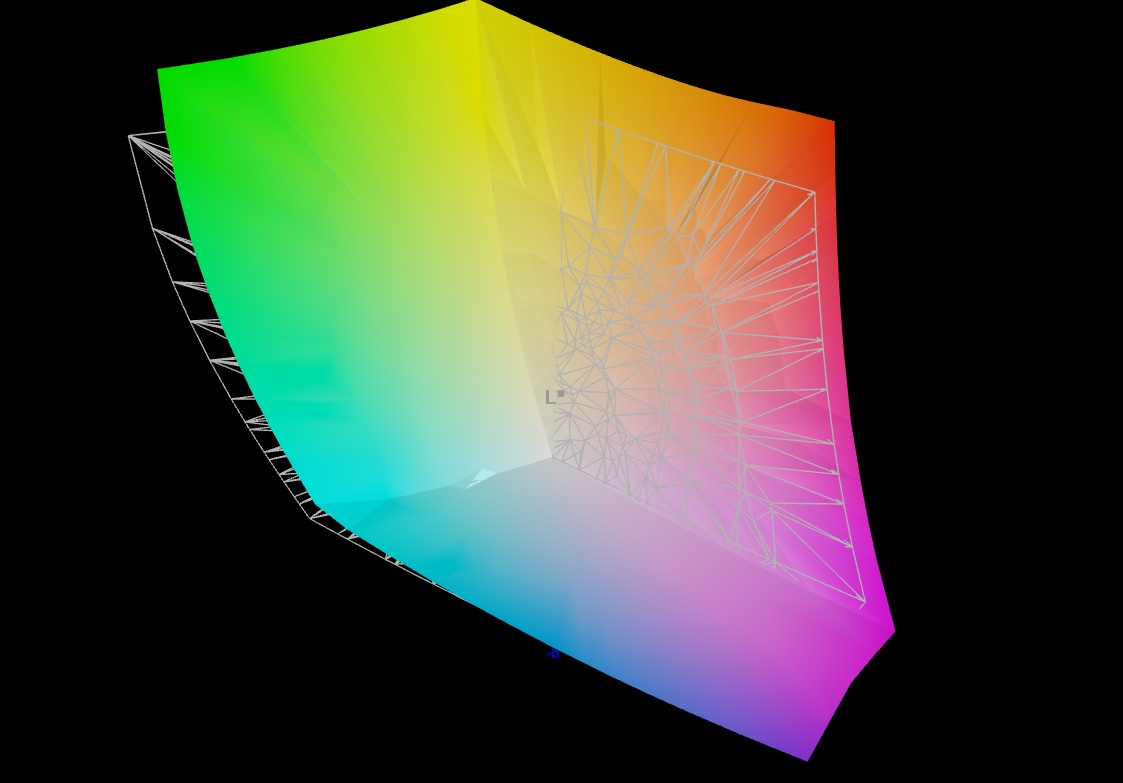
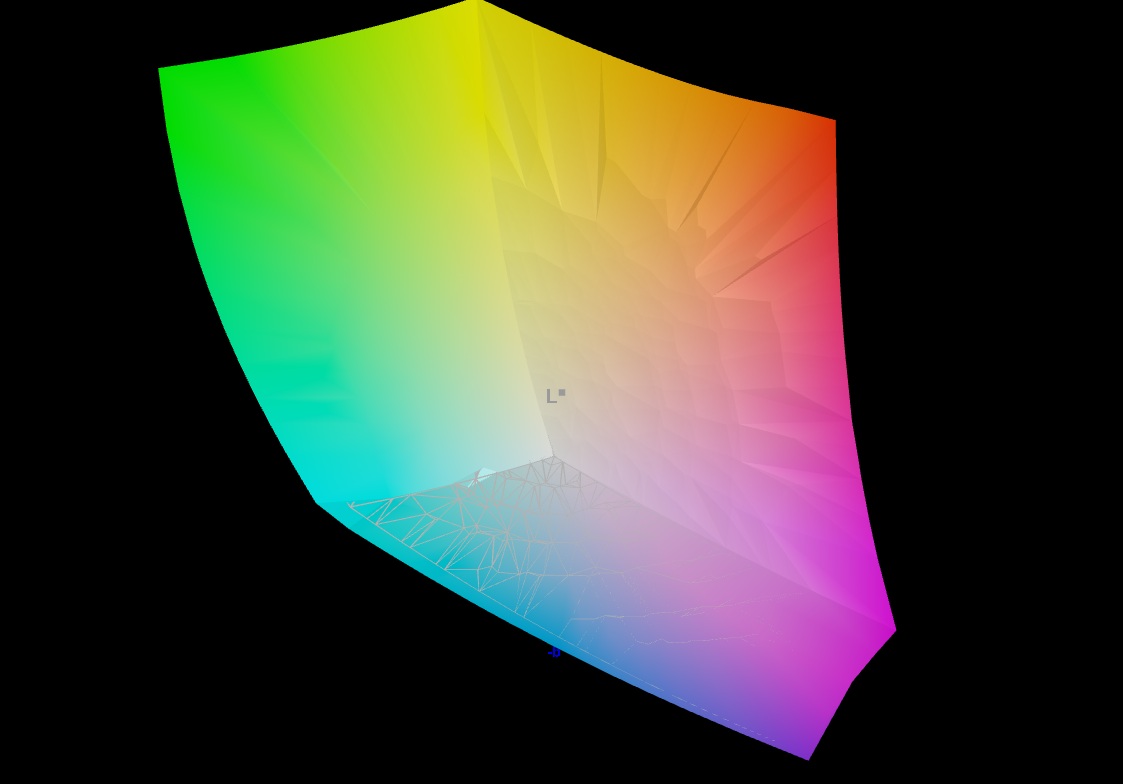
The color space is also impressive. Even AdobeRGB is almost completely covered.
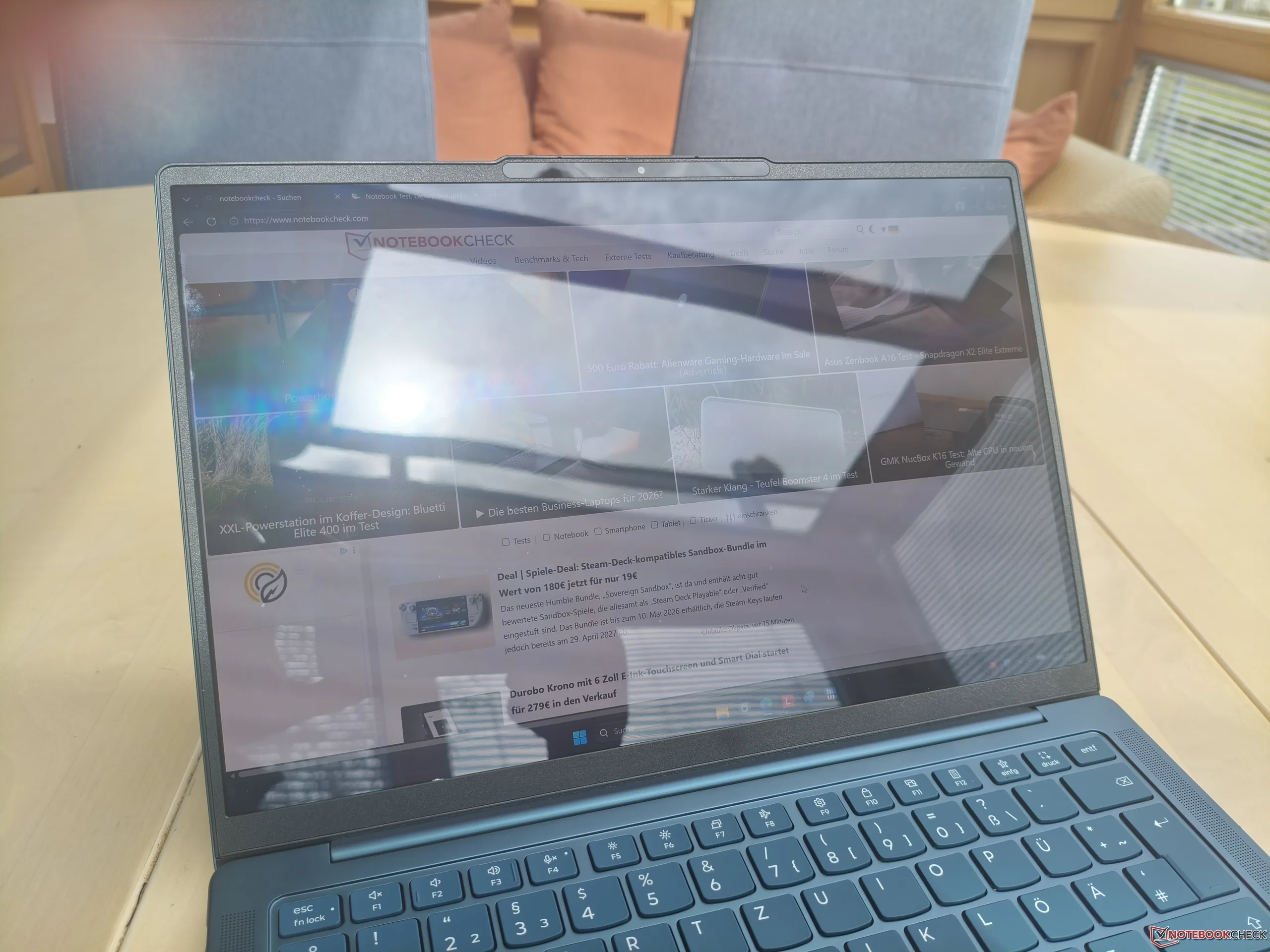
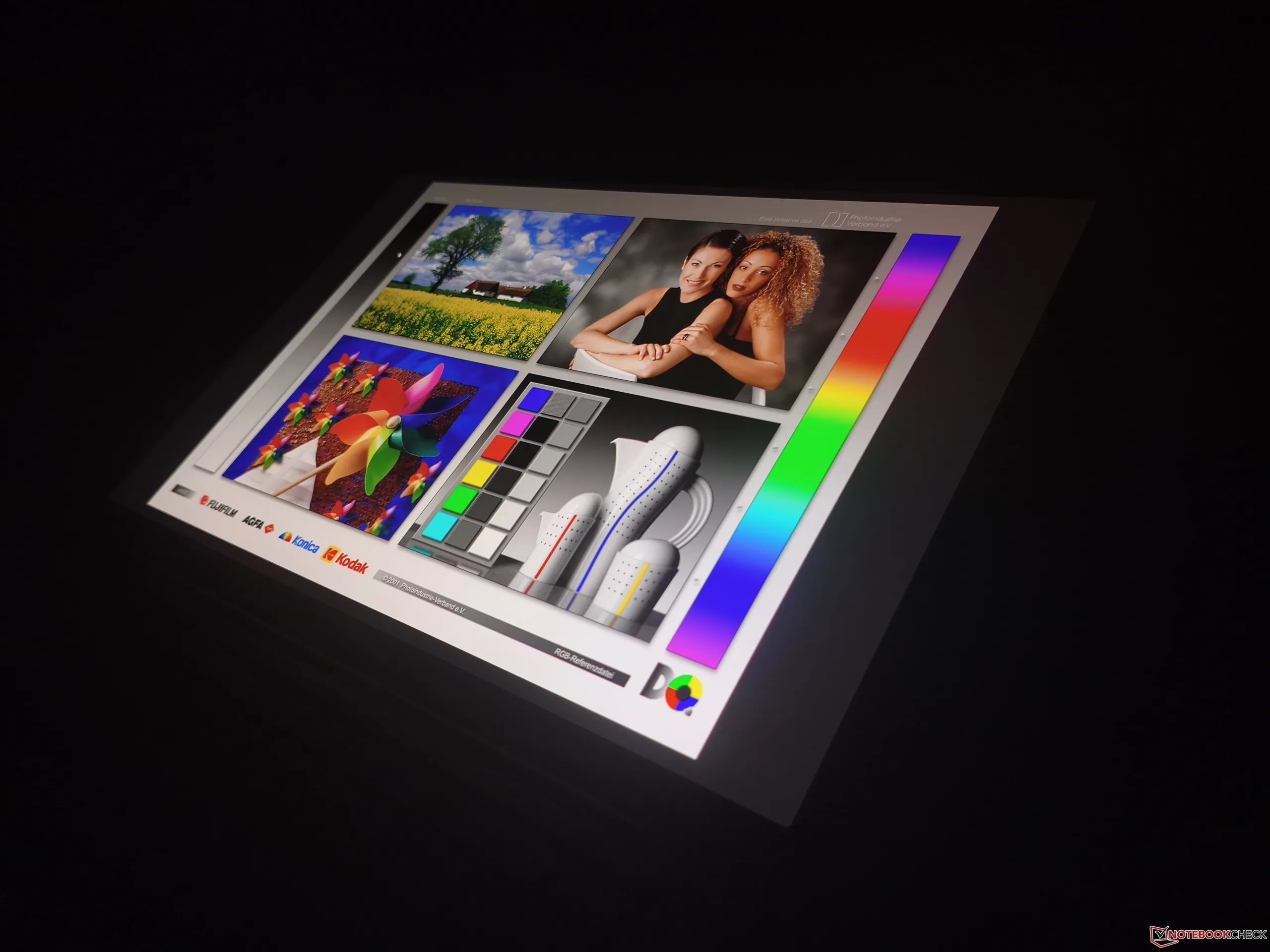
The response time and viewing angles are also beyond criticism. Meanwhile, the at times-strong reflections caused by the glossy surface are problematic.
| |||||||||||||||||||||||||
Brightness Distribution: 98 %
Center on Battery: 485 cd/m²
Contrast: ∞:1 (Black: 0 cd/m²)
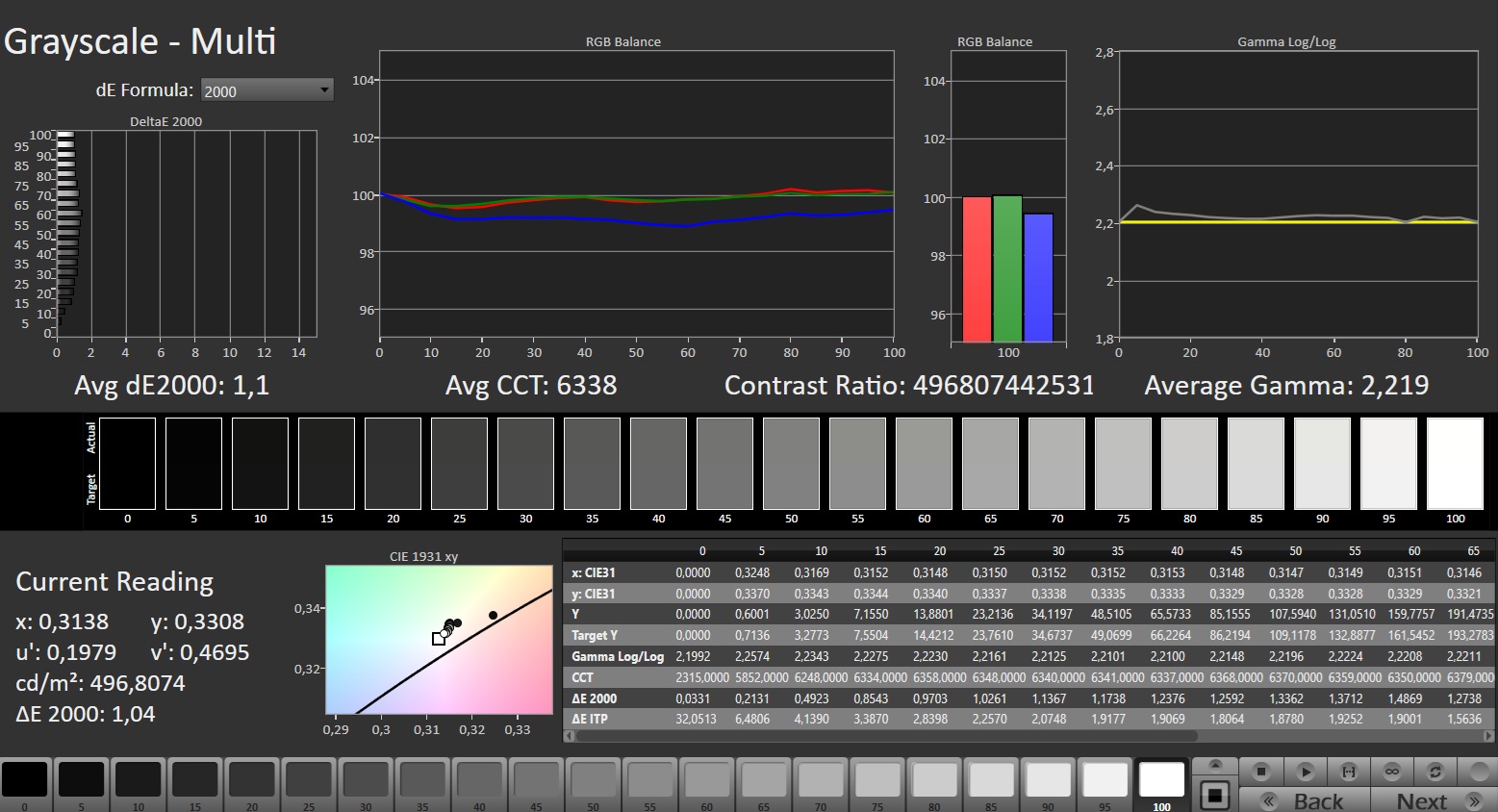
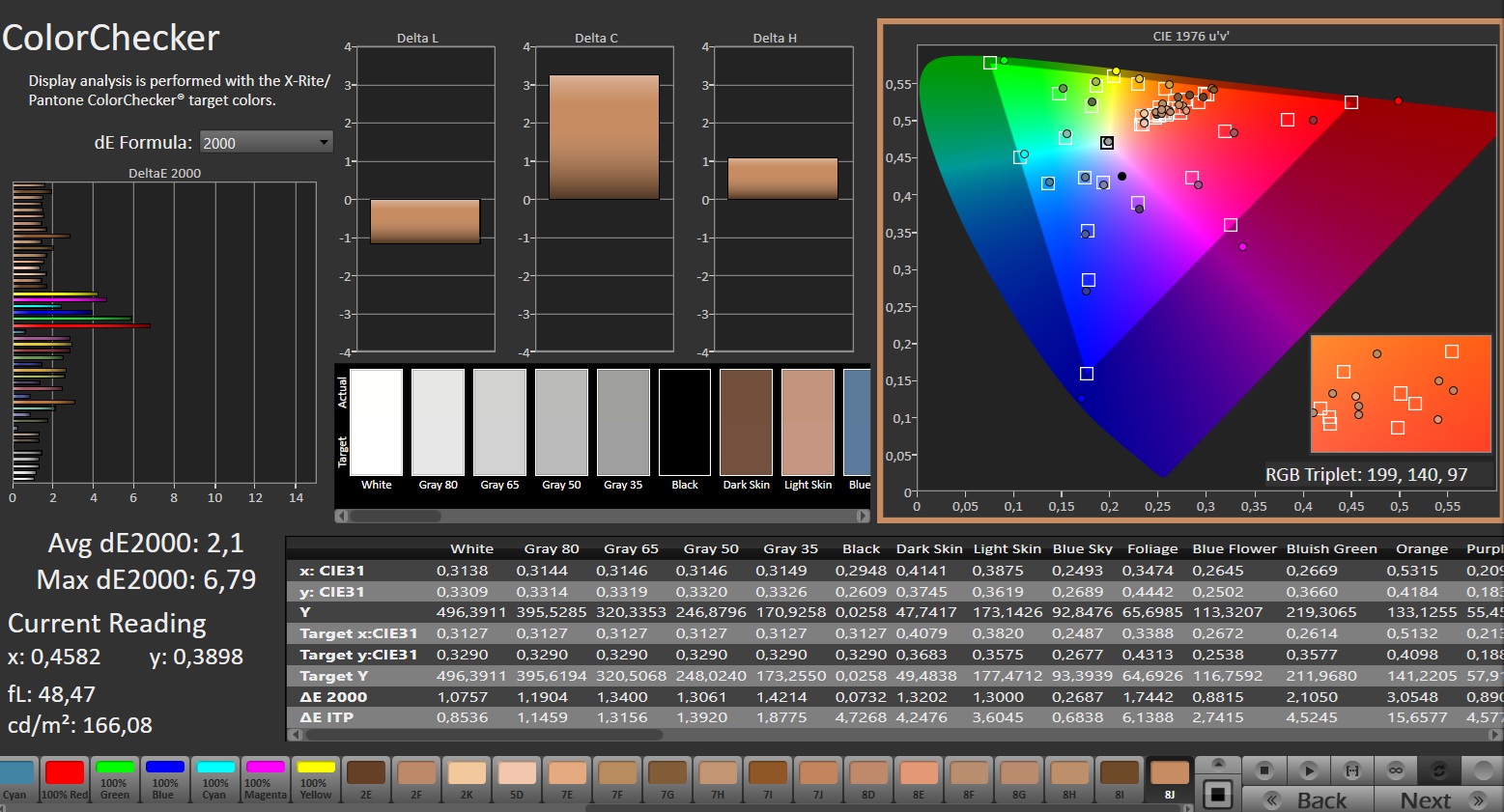
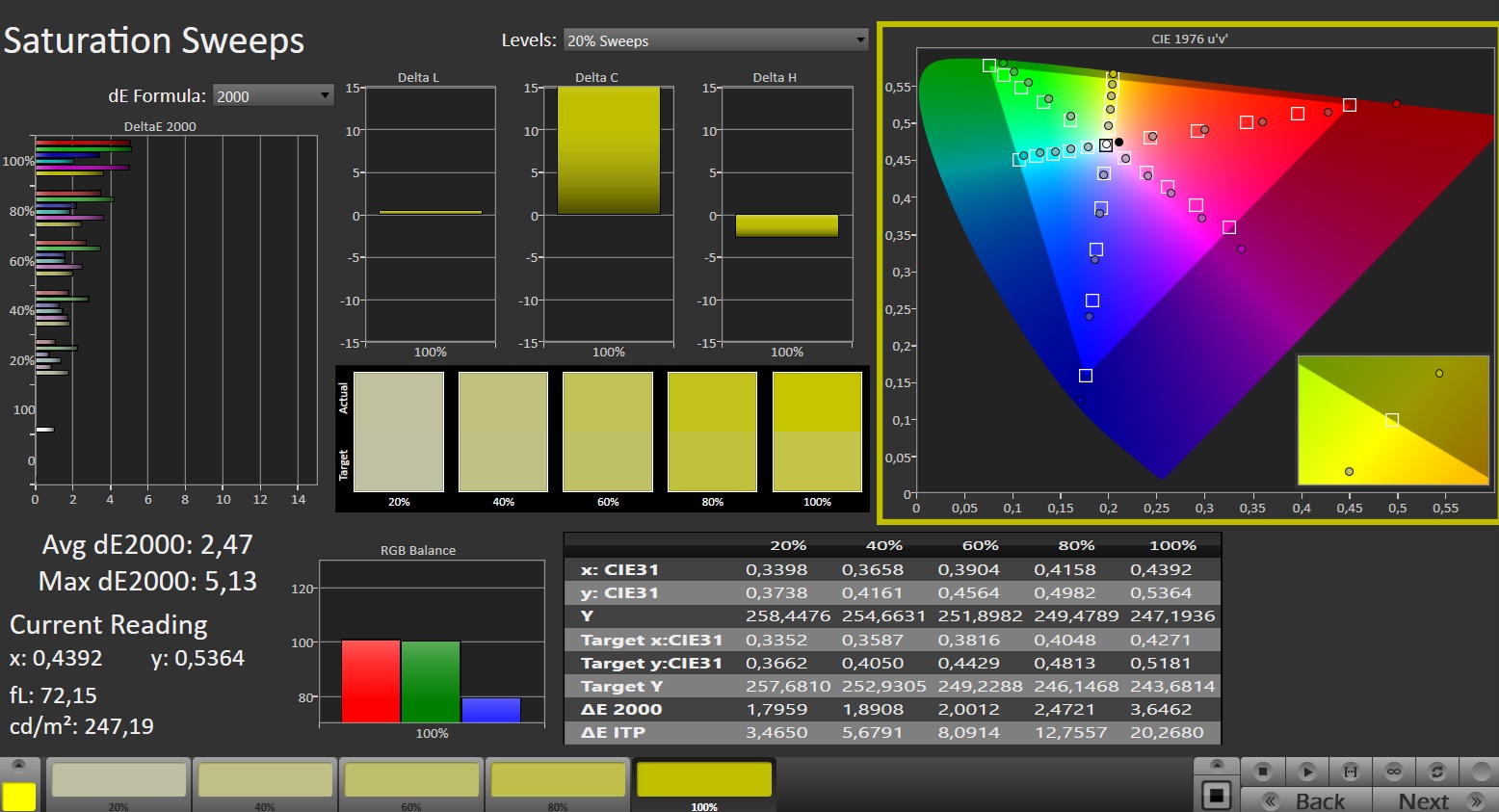
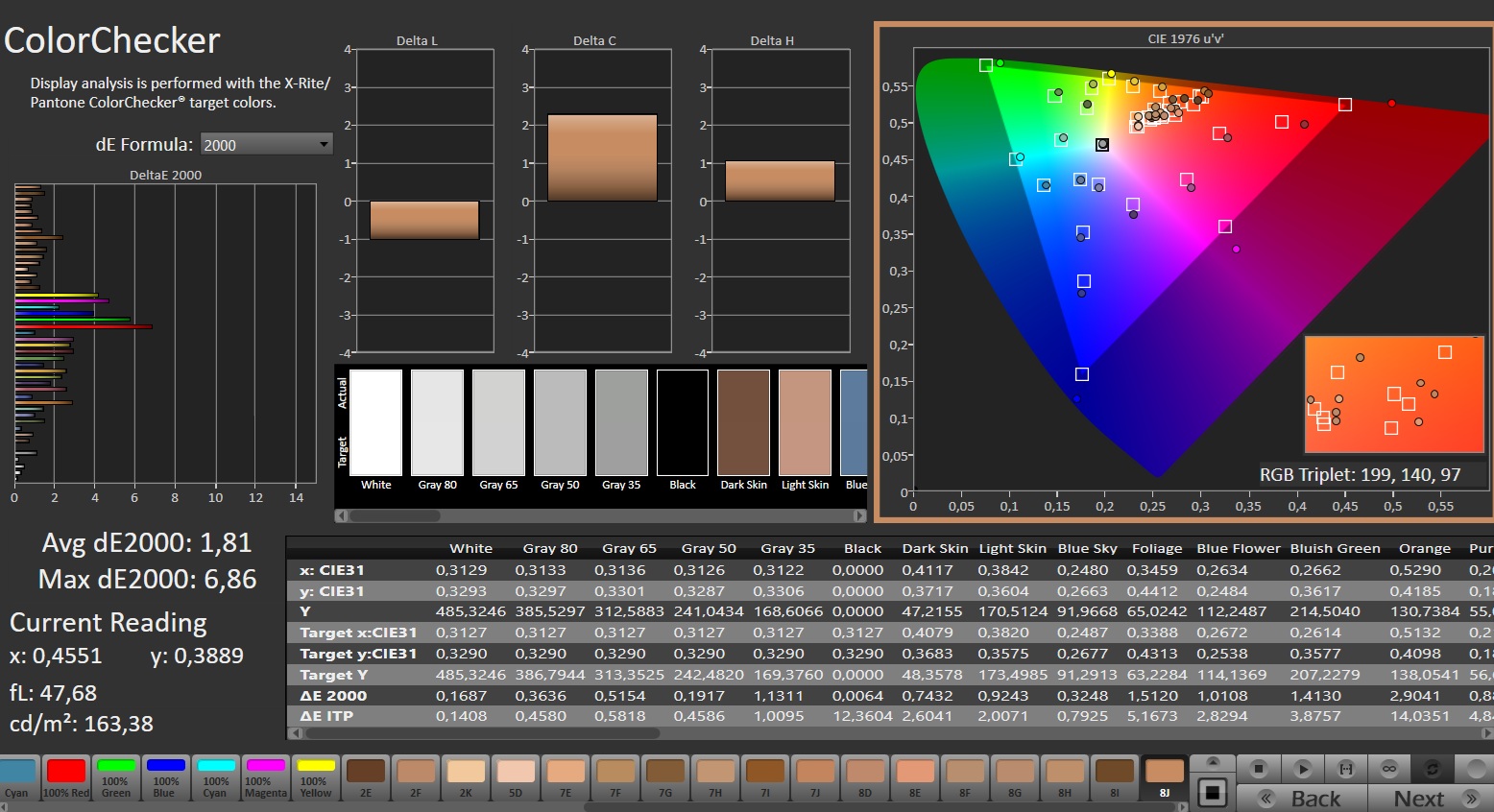
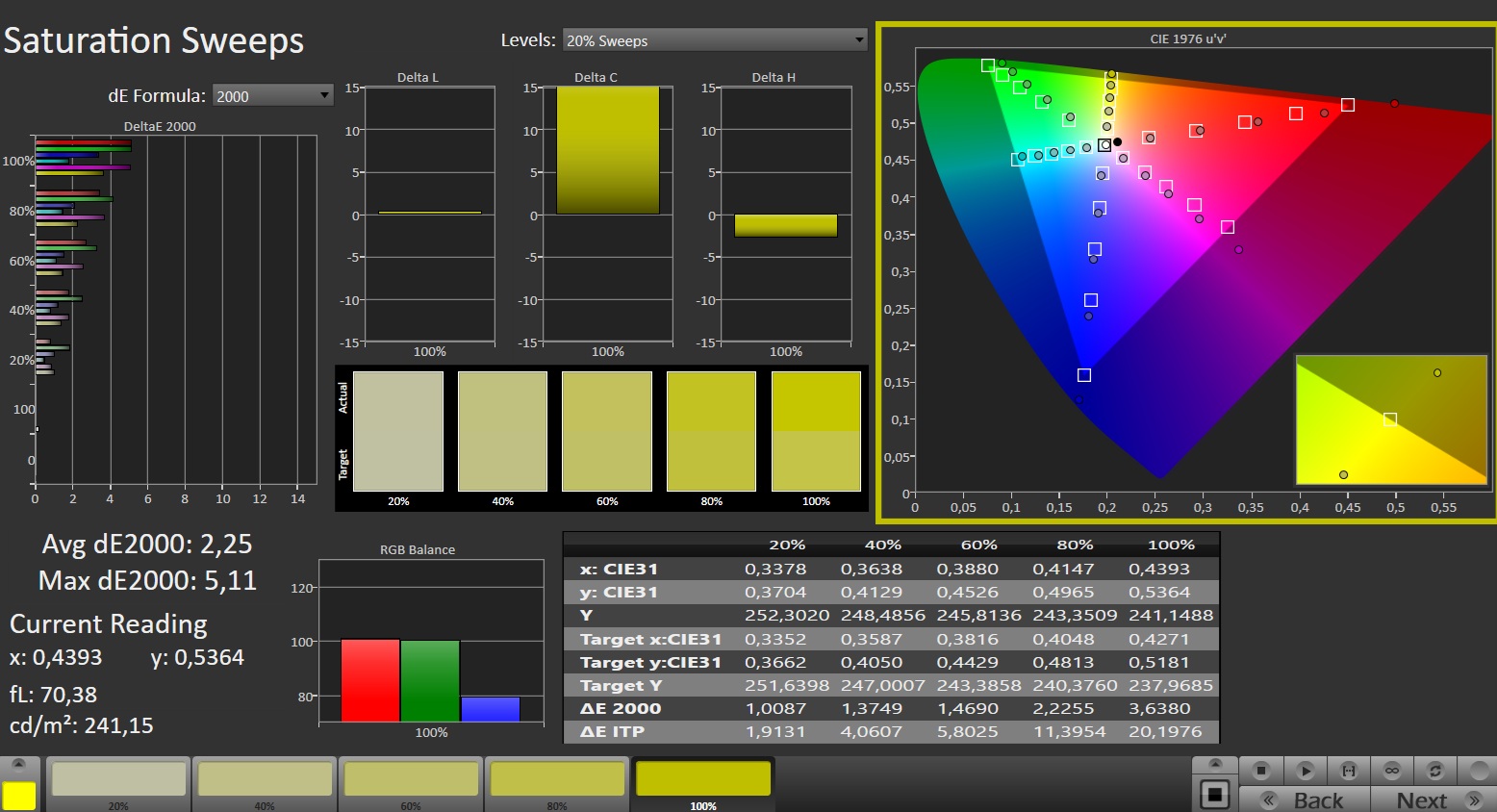
ΔE ColorChecker Calman: 2.1 | ∀{0.5-29.43 Ø4.69}
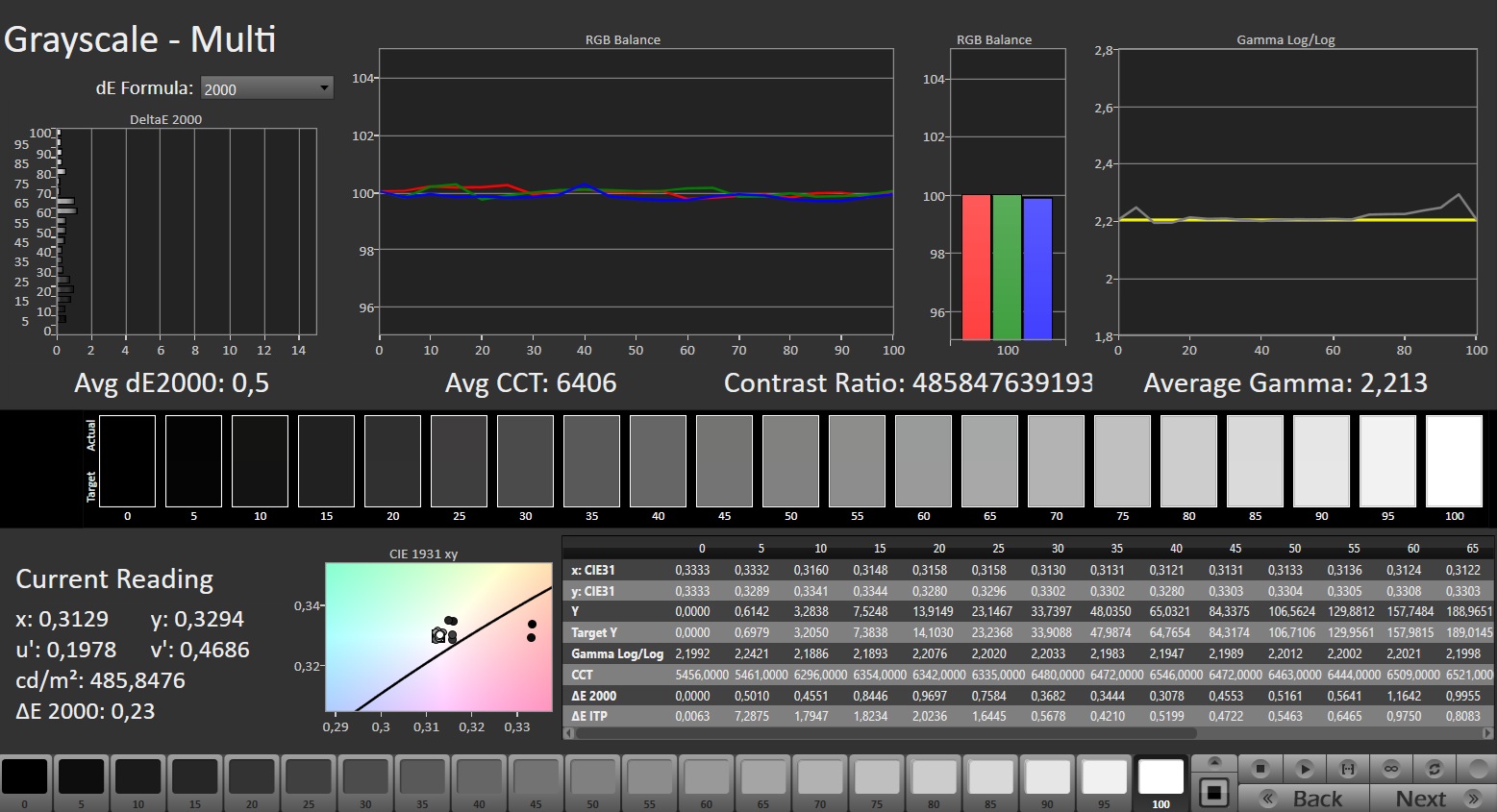
calibrated: 1.81
ΔE Greyscale Calman: 1.1 | ∀{0.09-98 Ø4.94}
94.2% AdobeRGB 1998 (Argyll 3D)
100% sRGB (Argyll 3D)
99.9% Display P3 (Argyll 3D)
Gamma: 2.219
CCT: 6338 K
| Lenovo Yoga Slim 7a 14AGP11 LEN140WQ+, OLED, 2880x1800, 14", 120 Hz | Lenovo Yoga Slim 7 14AKP G10 LEN140WQ+, OLED, 2880x1800, 14", 120 Hz | Lenovo IdeaPad Pro 5 14AKP G10 LEN140WQ+, OLED, 2880x1800, 14", 120 Hz | Acer Swift 14 AI SF14-51-58TU Samsung ATNA40YK11-0 (SDC4181), OLED, 2880x1800, 14", 90 Hz | |
|---|---|---|---|---|
| Display | -3% | 0% | 1% | |
| Display P3 Coverage (%) | 99.9 | 98.4 -2% | 99.9 0% | 99.9 0% |
| sRGB Coverage (%) | 100 | 100 0% | 100 0% | 100 0% |
| AdobeRGB 1998 Coverage (%) | 94.2 | 87.8 -7% | 94.5 0% | 97.6 4% |
| Response Times | -3% | -2% | -80% | |
| Response Time Grey 50% / Grey 80% * (ms) | 0.4 ? | 0.4 ? -0% | 0.39 ? 2% | 0.8 ? -100% |
| Response Time Black / White * (ms) | 0.5 ? | 0.49 ? 2% | 0.49 ? 2% | 0.8 ? -60% |
| PWM Frequency (Hz) | 600 ? | 1200 ? | 1200 ? | 60 ? |
| PWM Amplitude * (%) | 20 | 22 -10% | 22 -10% | |
| Screen | 15% | 8% | -29% | |
| Brightness middle (cd/m²) | 485 | 478 -1% | 473 -2% | 500 3% |
| Brightness (cd/m²) | 488 | 484 -1% | 474 -3% | 499 2% |
| Brightness Distribution (%) | 98 | 97 -1% | 99 1% | 97 -1% |
| Black Level * (cd/m²) | 0.01 | |||
| Colorchecker dE 2000 * | 2.1 | 1 52% | 1.2 43% | 3.55 -69% |
| Colorchecker dE 2000 max. * | 6.79 | 2.3 66% | 3.8 44% | 6.38 6% |
| Colorchecker dE 2000 calibrated * | 1.81 | 2.55 -41% | ||
| Greyscale dE 2000 * | 1.1 | 1.4 -27% | 1.5 -36% | 2.2 -100% |
| Gamma | 2.219 99% | 2.25 98% | 2.27 97% | 1.94 113% |
| CCT | 6338 103% | 6521 100% | 6214 105% | 6405 101% |
| Contrast (:1) | 50000 | |||
| Total Average (Program / Settings) | 3% /
6% | 2% /
3% | -36% /
-30% |
* ... smaller is better
Display Response Times
| ↔ Response Time Black to White | ||
|---|---|---|
| 0.5 ms ... rise ↗ and fall ↘ combined | ↗ 0.3 ms rise | 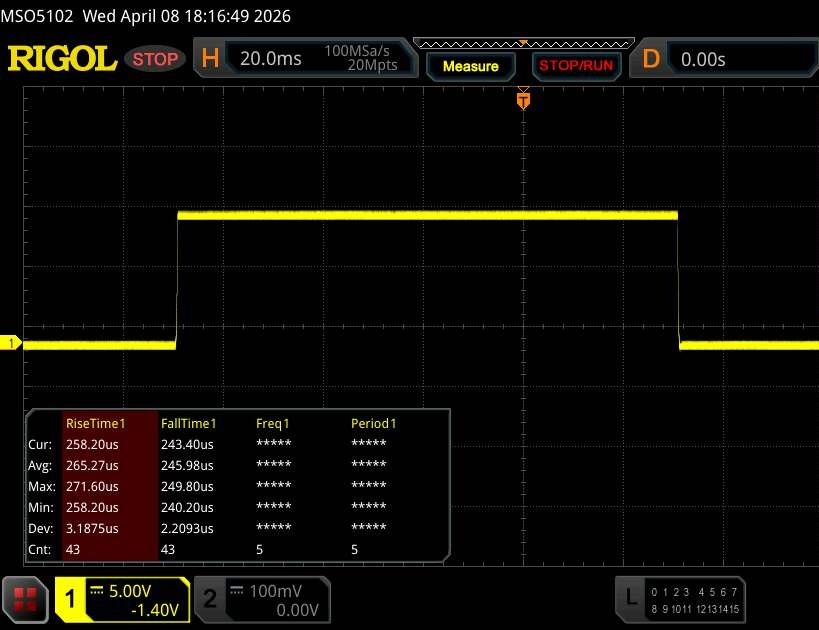 |
| ↘ 0.2 ms fall | ||
| The screen shows very fast response rates in our tests and should be very well suited for fast-paced gaming. In comparison, all tested devices range from 0.1 (minimum) to 240 (maximum) ms. » 1 % of all devices are better. This means that the measured response time is better than the average of all tested devices (19.7 ms). | ||
| ↔ Response Time 50% Grey to 80% Grey | ||
| 0.4 ms ... rise ↗ and fall ↘ combined | ↗ 0.2 ms rise | 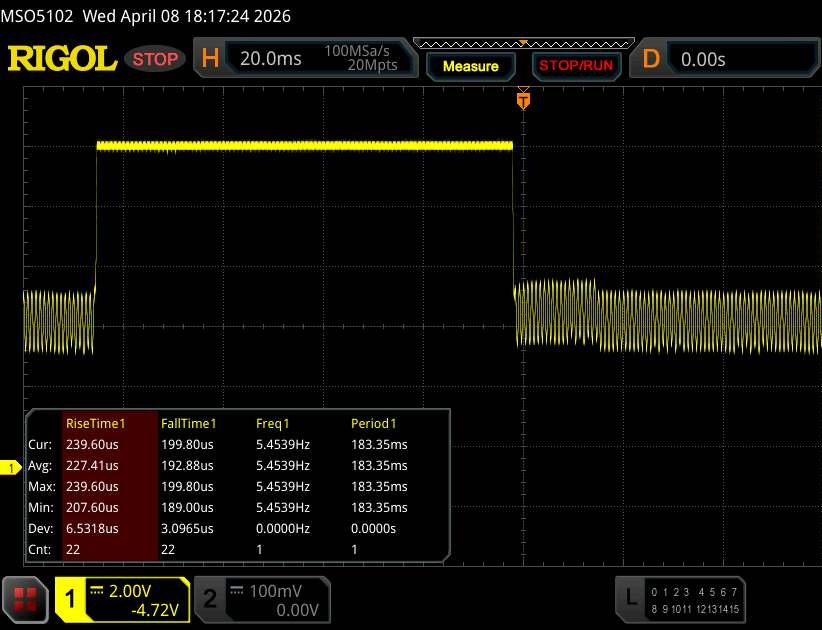 |
| ↘ 0.2 ms fall | ||
| The screen shows very fast response rates in our tests and should be very well suited for fast-paced gaming. In comparison, all tested devices range from 0.13 (minimum) to 636 (maximum) ms. » 1 % of all devices are better. This means that the measured response time is better than the average of all tested devices (30.7 ms). | ||
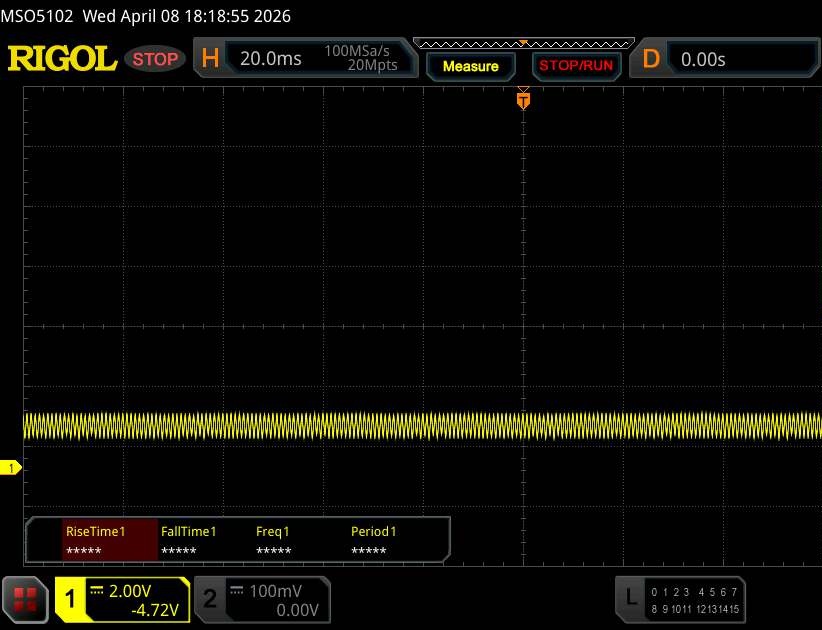
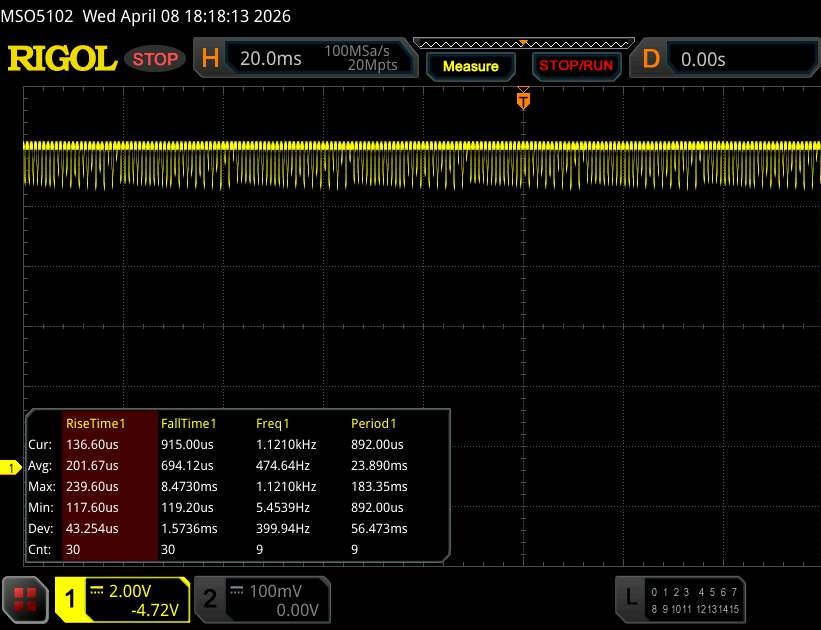
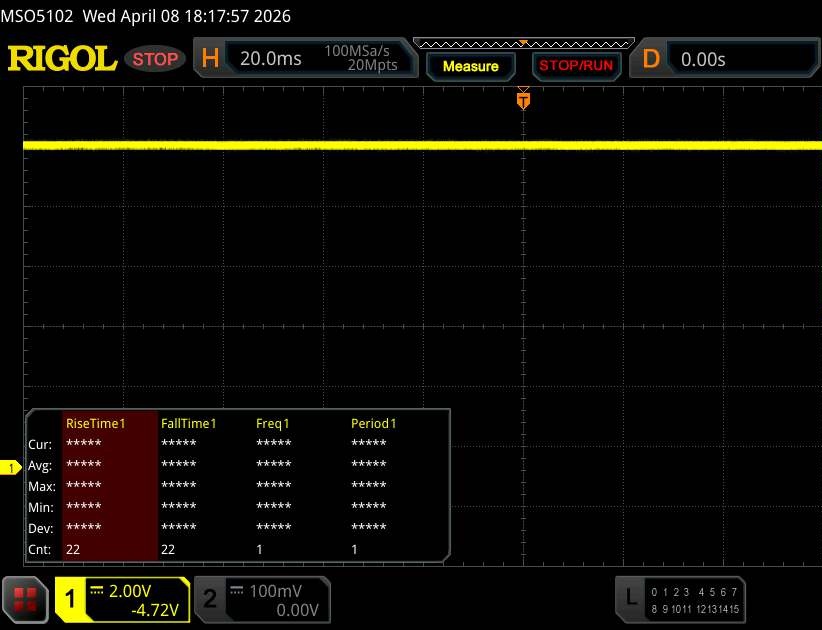
Screen Flickering / PWM (Pulse-Width Modulation)
| Screen flickering / PWM detected | 600 Hz Amplitude: 20 % | 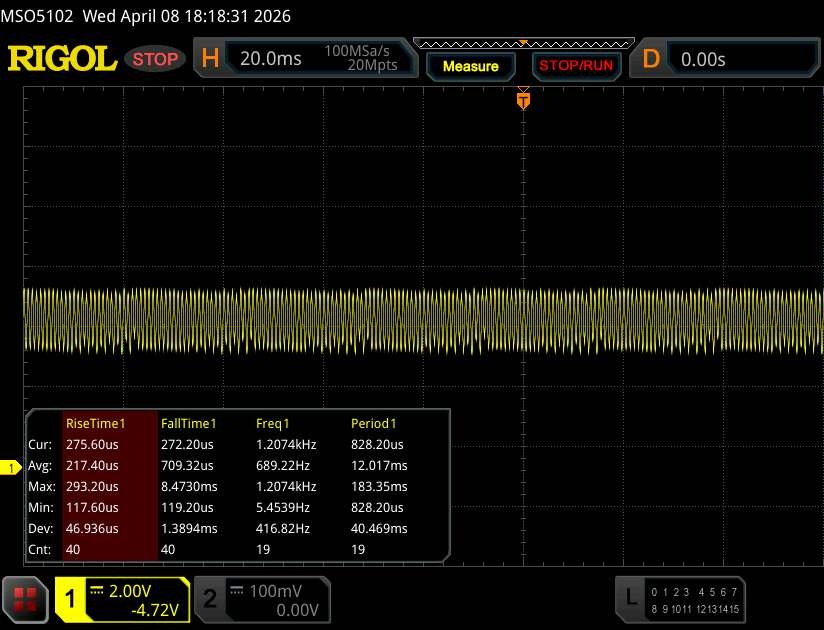 | |
| ≤ 80 cd/m² brightness | |||
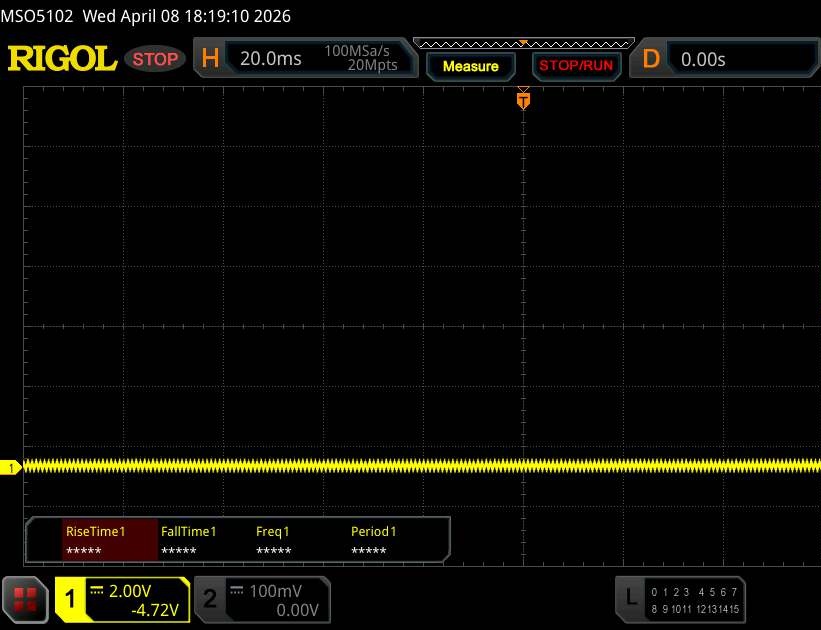
The display backlight flickers at 600 Hz (worst case, e.g., utilizing PWM) Flickering detected at a brightness setting of 80 cd/m² and below. There should be no flickering or PWM above this brightness setting. The frequency of 600 Hz is quite high, so most users sensitive to PWM should not notice any flickering. Flickering occurs at relatively low brightness settings, so extended use at this brightness setting or lower can cause eyestrain. In comparison: 52 % of all tested devices do not use PWM to dim the display. If PWM was detected, an average of 7611 (minimum: 5 - maximum: 343500) Hz was measured. | |||
Performance
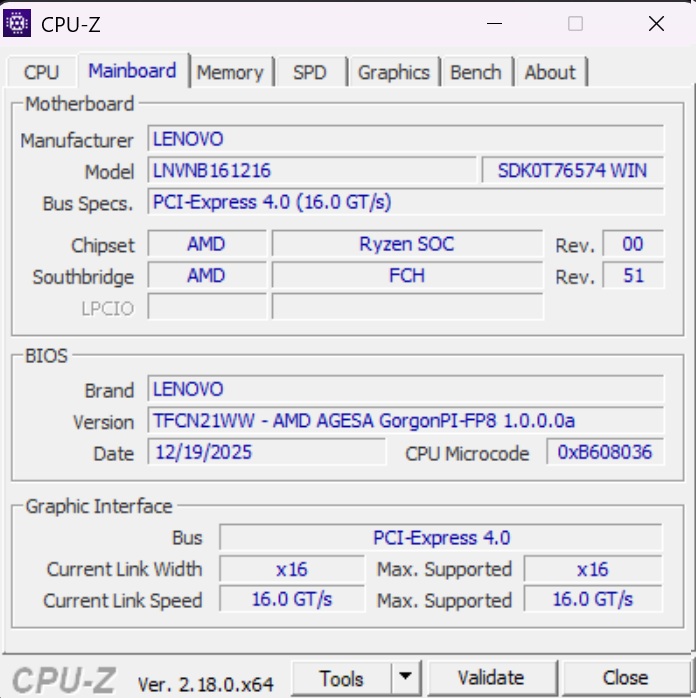
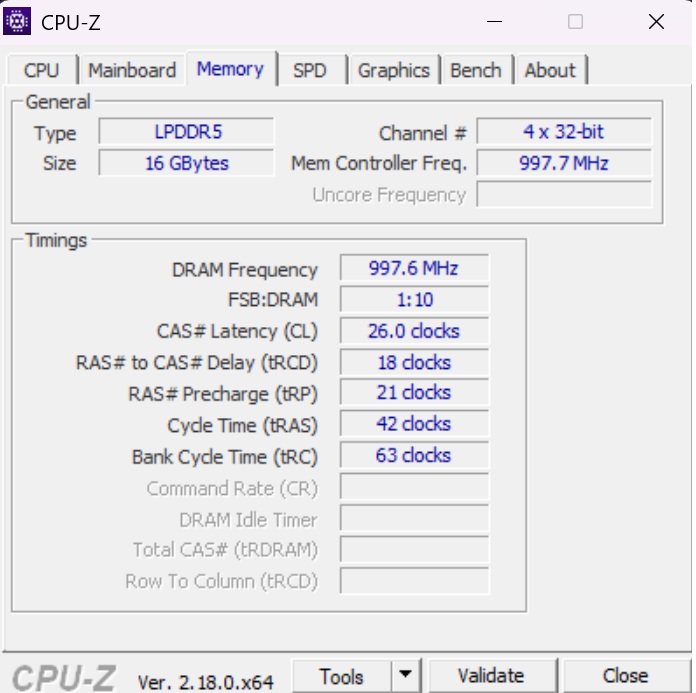
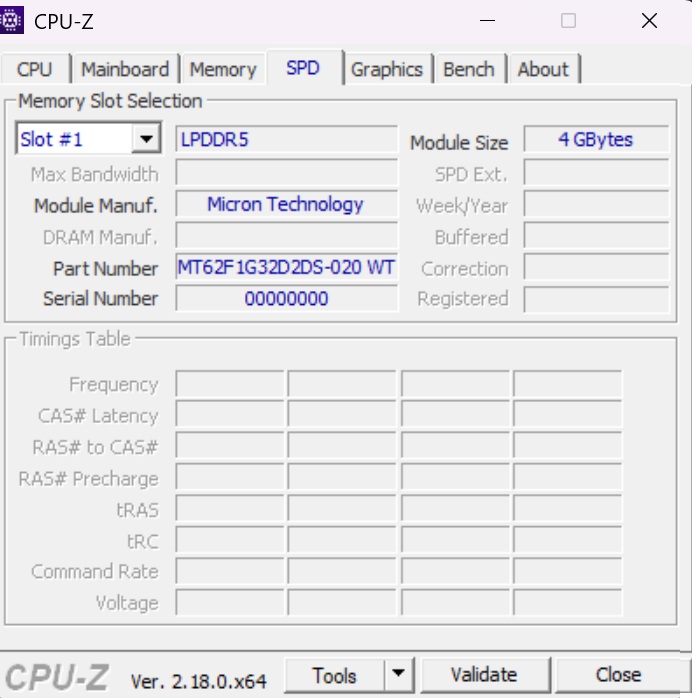
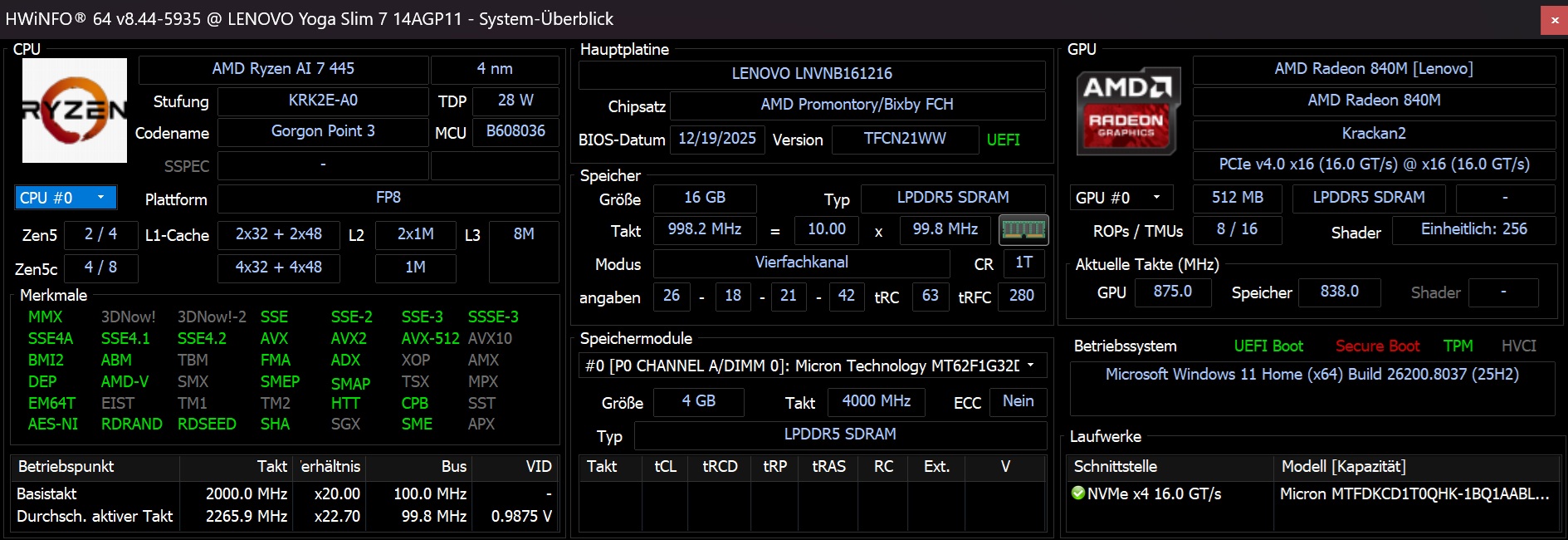
As the RAM cannot be expanded, buyers of the test version will have to make do with 16 GB LPDDR5X RAM in the long term. The 1 TB SSD can be replaced if desired.
Test conditions
The Fn+Q key combination can be used to switch between the three operating modes of the Lenovo Yoga Slim 7a. Since the performance profile hardly brings any improvements in terms of performance, our measurements were taken with the adaptive profile.
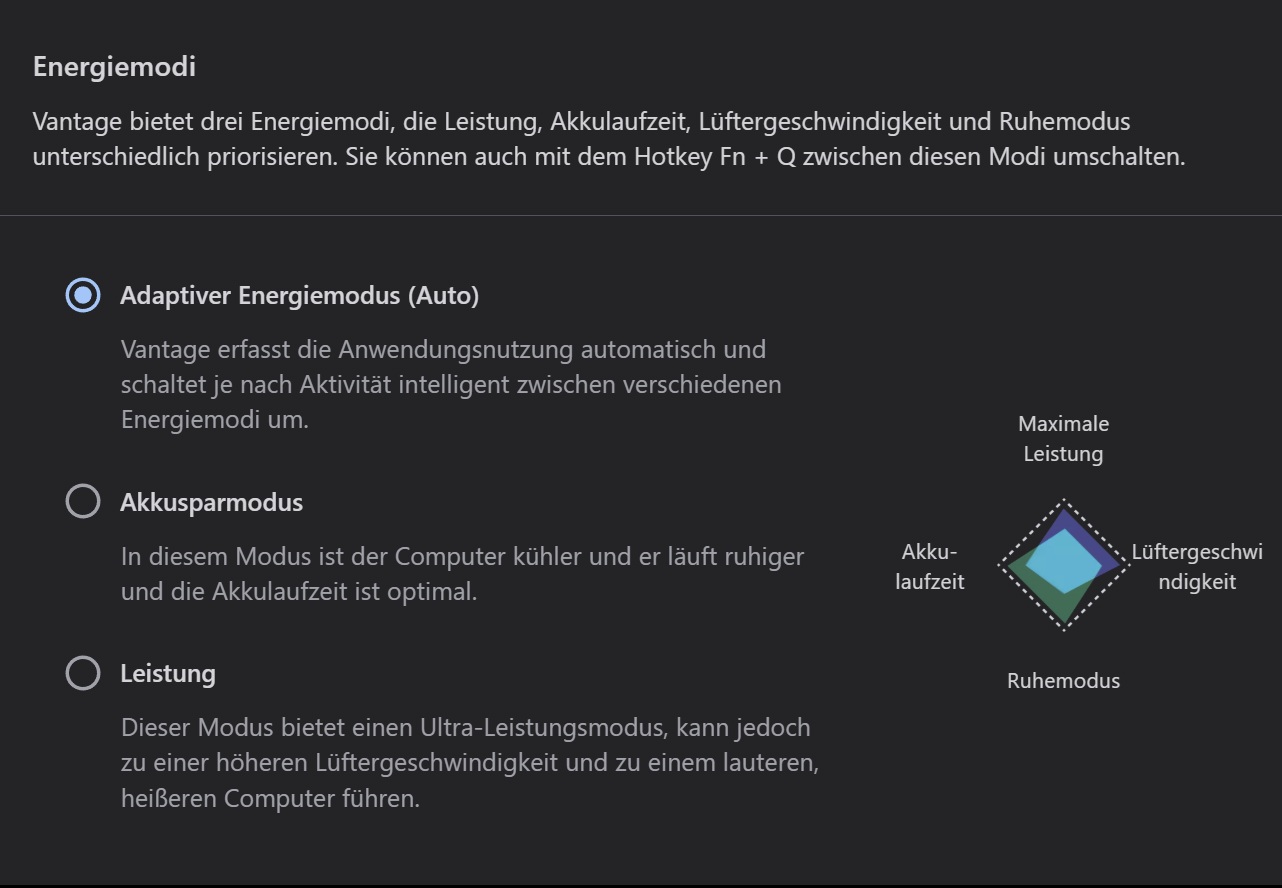
| Mode | Battery | Adaptive | Performance |
| Cyberpunk 2077 Noise | 33 dB(A) | 37 dB(A) | 41 dB(A) |
| Cyberpunk 2077 frame rate (FHD/Ultra) | 9.7 fps | 11 fps | 11.7 fps |
| GPU Power Draw | ~15 W | ~23 W | ~28 W |
| CPU PL1 | 20 W | 38 W | 41 W |
| CPU PL2 | 40 W | 51 W | 51 W |
| Cinebench R15 Multi Score | 1429 Points | 1717 Points | 1722 Points |
Processor
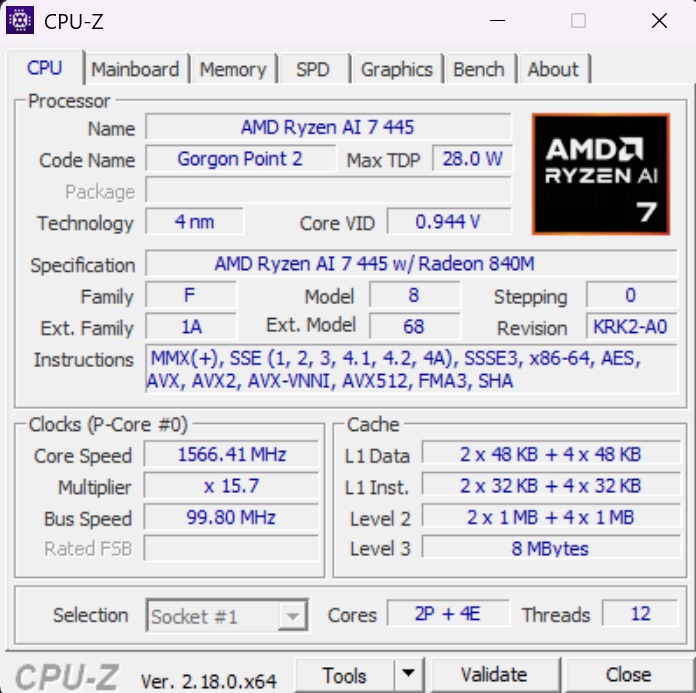
The Ryzen AI 7 445 is based on AMD's Zen 5 architecture (4 nm) and comes with 6 cores that can handle up to 12 threads in parallel via SMT. The performance on the CPU course is somewhat sobering.
The values hover around the level of the Core Ultra 5 226V. The old Ryzen AI 7 350, which offers 8 cores and 16 threads, was quite a bit faster, at least in the comparison devices.
Cinebench R15 multi-core loop
* ... smaller is better
AIDA64: FP32 Ray-Trace | FPU Julia | CPU SHA3 | FPU SinJulia | FPU Mandel | CPU AES | CPU ZLib | FP64 Ray-Trace | CPU PhotoWorxx
| Performance rating | |
| Lenovo IdeaPad Pro 5 14AKP G10 | |
| Lenovo Yoga Slim 7 14AKP G10 | |
| Average AMD Ryzen AI 7 445 | |
| Lenovo Yoga Slim 7a 14AGP11 | |
| Average of class Subnotebook | |
| Asus Vivobook S 14 OLED S5406SA | |
| Acer Swift 14 AI SF14-51-58TU | |
| AIDA64 / FP32 Ray-Trace | |
| Lenovo IdeaPad Pro 5 14AKP G10 (v6.92.6600) | |
| Lenovo Yoga Slim 7 14AKP G10 (v6.92.6600) | |
| Average AMD Ryzen AI 7 445 (17966 - 18237, n=2) | |
| Lenovo Yoga Slim 7a 14AGP11 (v8.20.8100) | |
| Average of class Subnotebook (2069 - 28231, n=55, last 2 years) | |
| Asus Vivobook S 14 OLED S5406SA (v6.92.6600) | |
| Acer Swift 14 AI SF14-51-58TU (v6.92.6600) | |
| AIDA64 / FPU Julia | |
| Lenovo IdeaPad Pro 5 14AKP G10 (v6.92.6600) | |
| Lenovo Yoga Slim 7 14AKP G10 (v6.92.6600) | |
| Average AMD Ryzen AI 7 445 (74431 - 74977, n=2) | |
| Lenovo Yoga Slim 7a 14AGP11 (v8.20.8100) | |
| Average of class Subnotebook (11041 - 114866, n=55, last 2 years) | |
| Acer Swift 14 AI SF14-51-58TU (v6.92.6600) | |
| Asus Vivobook S 14 OLED S5406SA (v6.92.6600) | |
| AIDA64 / CPU SHA3 | |
| Lenovo IdeaPad Pro 5 14AKP G10 (v6.92.6600) | |
| Lenovo Yoga Slim 7 14AKP G10 (v6.92.6600) | |
| Average of class Subnotebook (561 - 4973, n=55, last 2 years) | |
| Average AMD Ryzen AI 7 445 (2798 - 2812, n=2) | |
| Lenovo Yoga Slim 7a 14AGP11 (v8.20.8100) | |
| Acer Swift 14 AI SF14-51-58TU (v6.92.6600) | |
| Asus Vivobook S 14 OLED S5406SA (v6.92.6600) | |
| AIDA64 / FPU SinJulia | |
| Lenovo IdeaPad Pro 5 14AKP G10 (v6.92.6600) | |
| Lenovo Yoga Slim 7 14AKP G10 (v6.92.6600) | |
| Lenovo Yoga Slim 7a 14AGP11 (v8.20.8100) | |
| Average AMD Ryzen AI 7 445 (9270 - 9280, n=2) | |
| Average of class Subnotebook (692 - 14208, n=55, last 2 years) | |
| Asus Vivobook S 14 OLED S5406SA (v6.92.6600) | |
| Acer Swift 14 AI SF14-51-58TU (v6.92.6600) | |
| AIDA64 / FPU Mandel | |
| Lenovo IdeaPad Pro 5 14AKP G10 (v6.92.6600) | |
| Lenovo Yoga Slim 7 14AKP G10 (v6.92.6600) | |
| Average AMD Ryzen AI 7 445 (37793 - 37941, n=2) | |
| Lenovo Yoga Slim 7a 14AGP11 (v8.20.8100) | |
| Average of class Subnotebook (5978 - 57729, n=55, last 2 years) | |
| Asus Vivobook S 14 OLED S5406SA (v6.92.6600) | |
| Acer Swift 14 AI SF14-51-58TU (v6.92.6600) | |
| AIDA64 / CPU AES | |
| Lenovo Yoga Slim 7 14AKP G10 (v6.92.6600) | |
| Lenovo Yoga Slim 7a 14AGP11 (v8.20.8100) | |
| Lenovo IdeaPad Pro 5 14AKP G10 (v6.92.6600) | |
| Average AMD Ryzen AI 7 445 (56825 - 56960, n=2) | |
| Average of class Subnotebook (6815 - 96917, n=55, last 2 years) | |
| Acer Swift 14 AI SF14-51-58TU (v6.92.6600) | |
| Asus Vivobook S 14 OLED S5406SA (v6.92.6600) | |
| AIDA64 / CPU ZLib | |
| Lenovo IdeaPad Pro 5 14AKP G10 (v6.92.6600) | |
| Lenovo Yoga Slim 7 14AKP G10 (v6.92.6600) | |
| Lenovo Yoga Slim 7a 14AGP11 (v8.20.8100) | |
| Average AMD Ryzen AI 7 445 (751 - 751, n=2) | |
| Average of class Subnotebook (127.2 - 1217, n=55, last 2 years) | |
| Asus Vivobook S 14 OLED S5406SA (v6.92.6600) | |
| Acer Swift 14 AI SF14-51-58TU (v6.92.6600) | |
| AIDA64 / FP64 Ray-Trace | |
| Lenovo IdeaPad Pro 5 14AKP G10 (v6.92.6600) | |
| Lenovo Yoga Slim 7 14AKP G10 (v6.92.6600) | |
| Average AMD Ryzen AI 7 445 (9668 - 9943, n=2) | |
| Lenovo Yoga Slim 7a 14AGP11 (v8.20.8100) | |
| Average of class Subnotebook (953 - 15342, n=55, last 2 years) | |
| Asus Vivobook S 14 OLED S5406SA (v6.92.6600) | |
| Acer Swift 14 AI SF14-51-58TU (v6.92.6600) | |
| AIDA64 / CPU PhotoWorxx | |
| Acer Swift 14 AI SF14-51-58TU (v6.92.6600) | |
| Asus Vivobook S 14 OLED S5406SA (v6.92.6600) | |
| Average of class Subnotebook (10193 - 85600, n=55, last 2 years) | |
| Lenovo IdeaPad Pro 5 14AKP G10 (v6.92.6600) | |
| Lenovo Yoga Slim 7 14AKP G10 (v6.92.6600) | |
| Average AMD Ryzen AI 7 445 (38654 - 46615, n=2) | |
| Lenovo Yoga Slim 7a 14AGP11 (v8.20.8100) | |
System performance
The system performance proves to be unspectacular. The Yoga Slim 7a ranks in the middle of the comparison field.
PCMark 10: Score | Essentials | Productivity | Digital Content Creation
CrossMark: Overall | Productivity | Creativity | Responsiveness
WebXPRT 3: Overall
WebXPRT 4: Overall
Mozilla Kraken 1.1: Total
| Performance rating | |
| Lenovo IdeaPad Pro 5 14AKP G10 | |
| Lenovo Yoga Slim 7 14AKP G10 | |
| Average of class Subnotebook | |
| Average AMD Ryzen AI 7 445, AMD Radeon 840M | |
| Lenovo Yoga Slim 7a 14AGP11 | |
| Asus Vivobook S 14 OLED S5406SA | |
| Acer Swift 14 AI SF14-51-58TU -5! | |
| PCMark 10 / Score | |
| Lenovo Yoga Slim 7 14AKP G10 | |
| Lenovo IdeaPad Pro 5 14AKP G10 | |
| Average AMD Ryzen AI 7 445, AMD Radeon 840M (6801 - 7458, n=2) | |
| Average of class Subnotebook (4920 - 9939, n=46, last 2 years) | |
| Lenovo Yoga Slim 7a 14AGP11 | |
| Asus Vivobook S 14 OLED S5406SA | |
| Acer Swift 14 AI SF14-51-58TU | |
| PCMark 10 / Essentials | |
| Lenovo Yoga Slim 7 14AKP G10 | |
| Lenovo IdeaPad Pro 5 14AKP G10 | |
| Average of class Subnotebook (8368 - 11646, n=46, last 2 years) | |
| Average AMD Ryzen AI 7 445, AMD Radeon 840M (9889 - 10346, n=2) | |
| Lenovo Yoga Slim 7a 14AGP11 | |
| Acer Swift 14 AI SF14-51-58TU | |
| Asus Vivobook S 14 OLED S5406SA | |
| PCMark 10 / Productivity | |
| Average AMD Ryzen AI 7 445, AMD Radeon 840M (12393 - 14337, n=2) | |
| Lenovo Yoga Slim 7a 14AGP11 | |
| Average of class Subnotebook (5435 - 16606, n=46, last 2 years) | |
| Lenovo IdeaPad Pro 5 14AKP G10 | |
| Lenovo Yoga Slim 7 14AKP G10 | |
| Asus Vivobook S 14 OLED S5406SA | |
| Acer Swift 14 AI SF14-51-58TU | |
| PCMark 10 / Digital Content Creation | |
| Lenovo Yoga Slim 7 14AKP G10 | |
| Lenovo IdeaPad Pro 5 14AKP G10 | |
| Average of class Subnotebook (5181 - 13779, n=46, last 2 years) | |
| Asus Vivobook S 14 OLED S5406SA | |
| Acer Swift 14 AI SF14-51-58TU | |
| Average AMD Ryzen AI 7 445, AMD Radeon 840M (6966 - 7588, n=2) | |
| Lenovo Yoga Slim 7a 14AGP11 | |
| CrossMark / Overall | |
| Lenovo IdeaPad Pro 5 14AKP G10 | |
| Lenovo Yoga Slim 7 14AKP G10 | |
| Average of class Subnotebook (1061 - 2356, n=57, last 2 years) | |
| Average AMD Ryzen AI 7 445, AMD Radeon 840M (1592 - 1597, n=2) | |
| Lenovo Yoga Slim 7a 14AGP11 | |
| Asus Vivobook S 14 OLED S5406SA | |
| CrossMark / Productivity | |
| Lenovo IdeaPad Pro 5 14AKP G10 | |
| Lenovo Yoga Slim 7 14AKP G10 | |
| Average of class Subnotebook (1022 - 2277, n=57, last 2 years) | |
| Lenovo Yoga Slim 7a 14AGP11 | |
| Average AMD Ryzen AI 7 445, AMD Radeon 840M (1516 - 1564, n=2) | |
| Asus Vivobook S 14 OLED S5406SA | |
| CrossMark / Creativity | |
| Lenovo IdeaPad Pro 5 14AKP G10 | |
| Lenovo Yoga Slim 7 14AKP G10 | |
| Average of class Subnotebook (1070 - 2743, n=57, last 2 years) | |
| Asus Vivobook S 14 OLED S5406SA | |
| Average AMD Ryzen AI 7 445, AMD Radeon 840M (1630 - 1750, n=2) | |
| Lenovo Yoga Slim 7a 14AGP11 | |
| CrossMark / Responsiveness | |
| Lenovo IdeaPad Pro 5 14AKP G10 | |
| Lenovo Yoga Slim 7a 14AGP11 | |
| Average AMD Ryzen AI 7 445, AMD Radeon 840M (1416 - 1570, n=2) | |
| Lenovo Yoga Slim 7 14AKP G10 | |
| Average of class Subnotebook (1010 - 1873, n=57, last 2 years) | |
| Asus Vivobook S 14 OLED S5406SA | |
| WebXPRT 3 / Overall | |
| Average of class Subnotebook (203 - 530, n=55, last 2 years) | |
| Lenovo IdeaPad Pro 5 14AKP G10 | |
| Lenovo Yoga Slim 7 14AKP G10 | |
| Average AMD Ryzen AI 7 445, AMD Radeon 840M (288 - 309, n=2) | |
| Lenovo Yoga Slim 7a 14AGP11 | |
| Asus Vivobook S 14 OLED S5406SA | |
| WebXPRT 4 / Overall | |
| Average of class Subnotebook (167.3 - 378, n=59, last 2 years) | |
| Lenovo Yoga Slim 7 14AKP G10 | |
| Lenovo IdeaPad Pro 5 14AKP G10 | |
| Asus Vivobook S 14 OLED S5406SA | |
| Average AMD Ryzen AI 7 445, AMD Radeon 840M (242 - 260, n=2) | |
| Acer Swift 14 AI SF14-51-58TU | |
| Acer Swift 14 AI SF14-51-58TU | |
| Lenovo Yoga Slim 7a 14AGP11 | |
| Mozilla Kraken 1.1 / Total | |
| Acer Swift 14 AI SF14-51-58TU | |
| Acer Swift 14 AI SF14-51-58TU | |
| Asus Vivobook S 14 OLED S5406SA | |
| Lenovo Yoga Slim 7a 14AGP11 | |
| Average AMD Ryzen AI 7 445, AMD Radeon 840M (479 - 480, n=2) | |
| Average of class Subnotebook (234 - 709, n=60, last 2 years) | |
| Lenovo IdeaPad Pro 5 14AKP G10 | |
| Lenovo Yoga Slim 7 14AKP G10 | |
* ... smaller is better
| PCMark 10 Score | 6801 points | |
Help | ||
| AIDA64 / Memory Copy | |
| Asus Vivobook S 14 OLED S5406SA | |
| Acer Swift 14 AI SF14-51-58TU | |
| Average of class Subnotebook (15233 - 131023, n=55, last 2 years) | |
| Lenovo IdeaPad Pro 5 14AKP G10 | |
| Lenovo Yoga Slim 7 14AKP G10 | |
| Lenovo Yoga Slim 7a 14AGP11 | |
| Average AMD Ryzen AI 7 445 (84523 - 85004, n=2) | |
| AIDA64 / Memory Read | |
| Asus Vivobook S 14 OLED S5406SA | |
| Acer Swift 14 AI SF14-51-58TU | |
| Average of class Subnotebook (13982 - 127174, n=55, last 2 years) | |
| Lenovo Yoga Slim 7 14AKP G10 | |
| Lenovo IdeaPad Pro 5 14AKP G10 | |
| Lenovo Yoga Slim 7a 14AGP11 | |
| Average AMD Ryzen AI 7 445 (62676 - 62823, n=2) | |
| AIDA64 / Memory Write | |
| Lenovo Yoga Slim 7a 14AGP11 | |
| Asus Vivobook S 14 OLED S5406SA | |
| Average AMD Ryzen AI 7 445 (109818 - 112844, n=2) | |
| Acer Swift 14 AI SF14-51-58TU | |
| Lenovo IdeaPad Pro 5 14AKP G10 | |
| Lenovo Yoga Slim 7 14AKP G10 | |
| Average of class Subnotebook (17404 - 135141, n=55, last 2 years) | |
| AIDA64 / Memory Latency | |
| Average AMD Ryzen AI 7 445 (109 - 113.6, n=2) | |
| Lenovo Yoga Slim 7a 14AGP11 | |
| Lenovo IdeaPad Pro 5 14AKP G10 | |
| Average of class Subnotebook (6.1 - 317, n=53, last 2 years) | |
| Lenovo Yoga Slim 7 14AKP G10 | |
| Asus Vivobook S 14 OLED S5406SA | |
| Acer Swift 14 AI SF14-51-58TU | |
* ... smaller is better
DPC latency
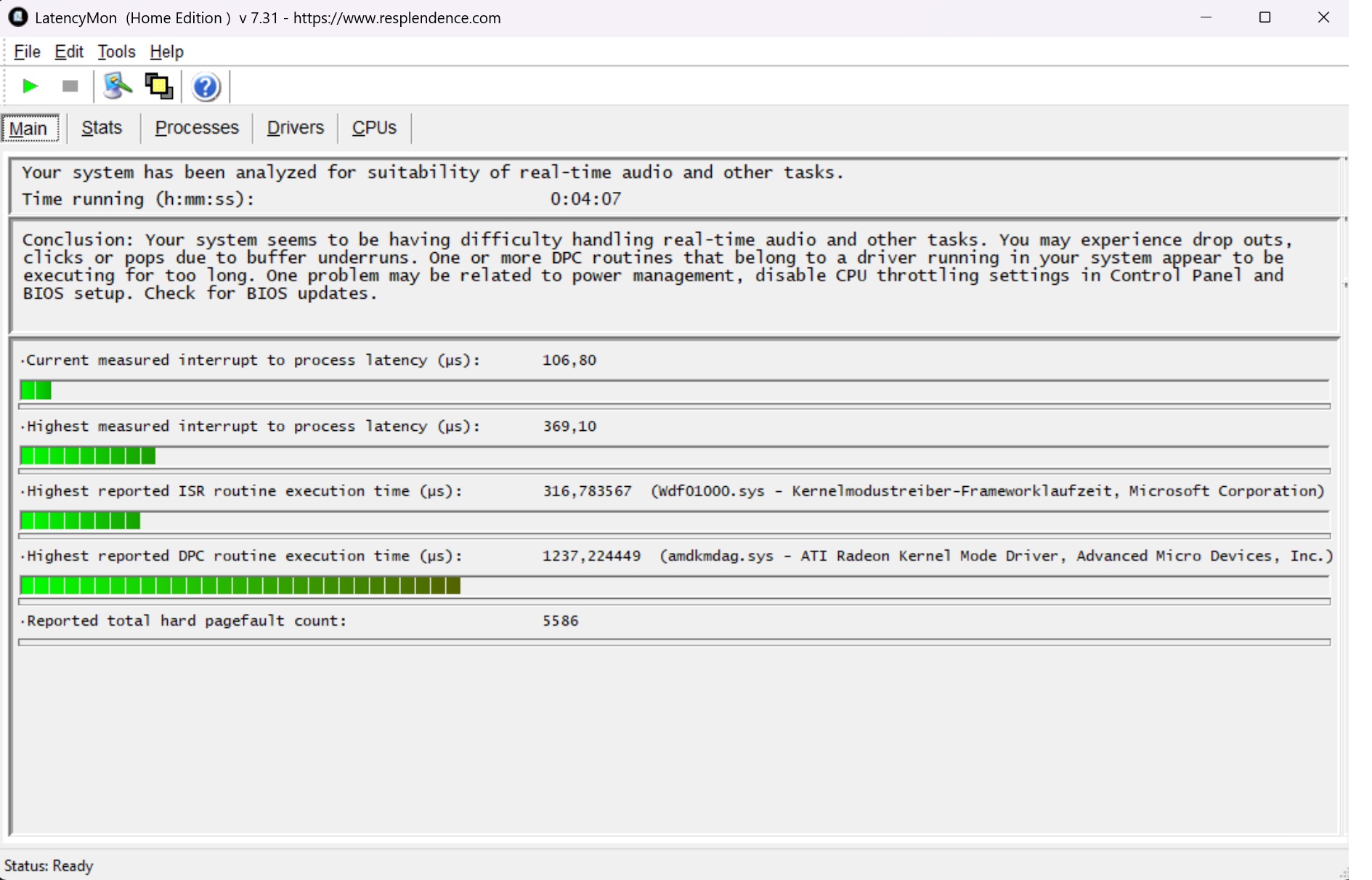
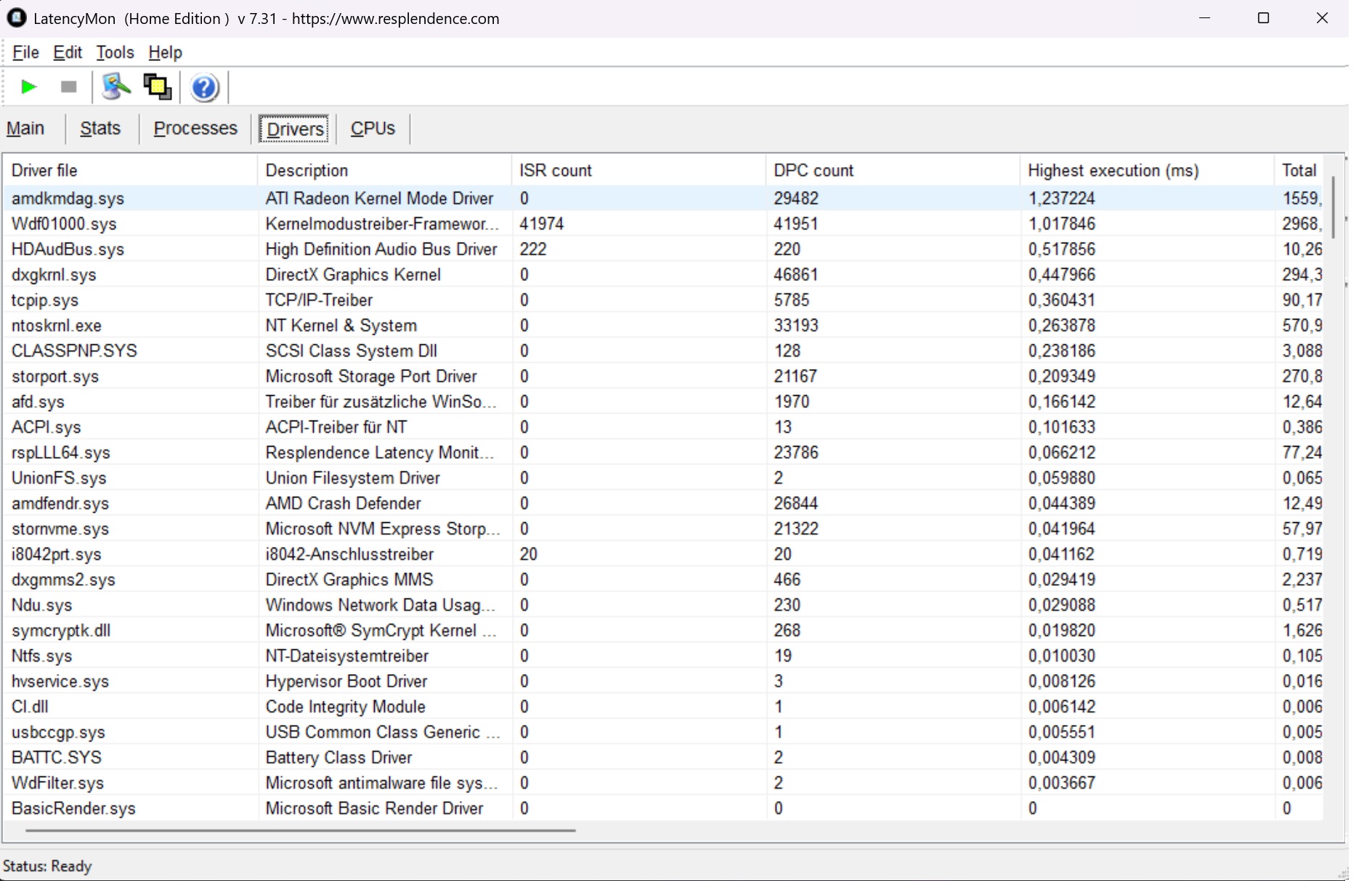
The latencies are relatively good, although the LatencyMon tool does mention possible problems in certain applications.
| DPC Latencies / LatencyMon - interrupt to process latency (max), Web, Youtube, Prime95 | |
| Lenovo Yoga Slim 7 14AKP G10 | |
| Acer Swift 14 AI SF14-51-58TU | |
| Asus Vivobook S 14 OLED S5406SA | |
| Lenovo Yoga Slim 7a 14AGP11 | |
| Lenovo IdeaPad Pro 5 14AKP G10 | |
* ... smaller is better
Storage devices
At first glance, the NVMe drive from Micron cuts a very good figure, both when reading and writing. However, in our loop test, there were significant performance fluctuations after a while.

* ... smaller is better
Disk throttling: DiskSpd Read Loop, Queue Depth 8
GPU performance
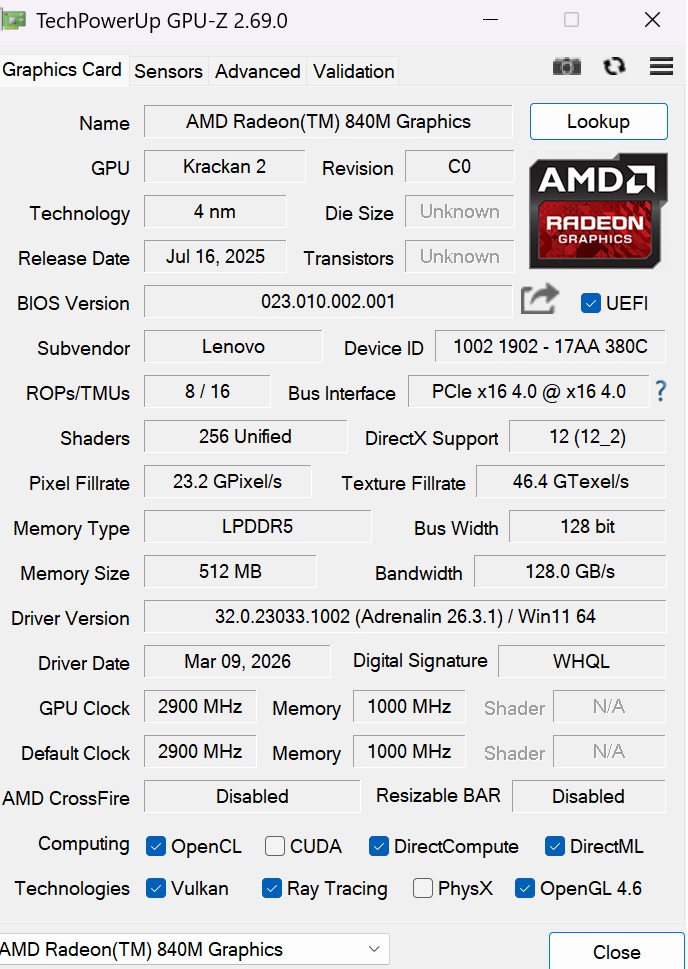
The Ryzen AI 7 445's integrated Radeon 840M cannot compete with the better Radeon 860M, which is sometimes found in similarly priced devices.
According to 3DMark tests, the Radeon 840M falls behind by more than 40% on average. A similar situation is seen when compared against the faster Arc Graphics 130V of corresponding Intel CPUs.
| 3DMark Performance rating - Percent | |
| Lenovo IdeaPad Pro 5 14AKP G10 -1! | |
| Acer Swift 14 AI SF14-51-58TU | |
| Average of class Subnotebook | |
| Lenovo Yoga Slim 7 14AKP G10 -1! | |
| Asus Vivobook S 14 OLED S5406SA -1! | |
| Average AMD Radeon 840M | |
| Lenovo Yoga Slim 7a 14AGP11 | |
| 3DMark 11 Performance | 6985 points | |
| 3DMark Cloud Gate Standard Score | 21576 points | |
| 3DMark Fire Strike Score | 3598 points | |
| 3DMark Time Spy Score | 1590 points | |
Help | ||
Gaming performance
The Radeon 840M is only suitable for older or undemanding games. Current games often don't even run smoothly with minimum settings at 1,920 x 1,080 resolution if you don't use FSR.
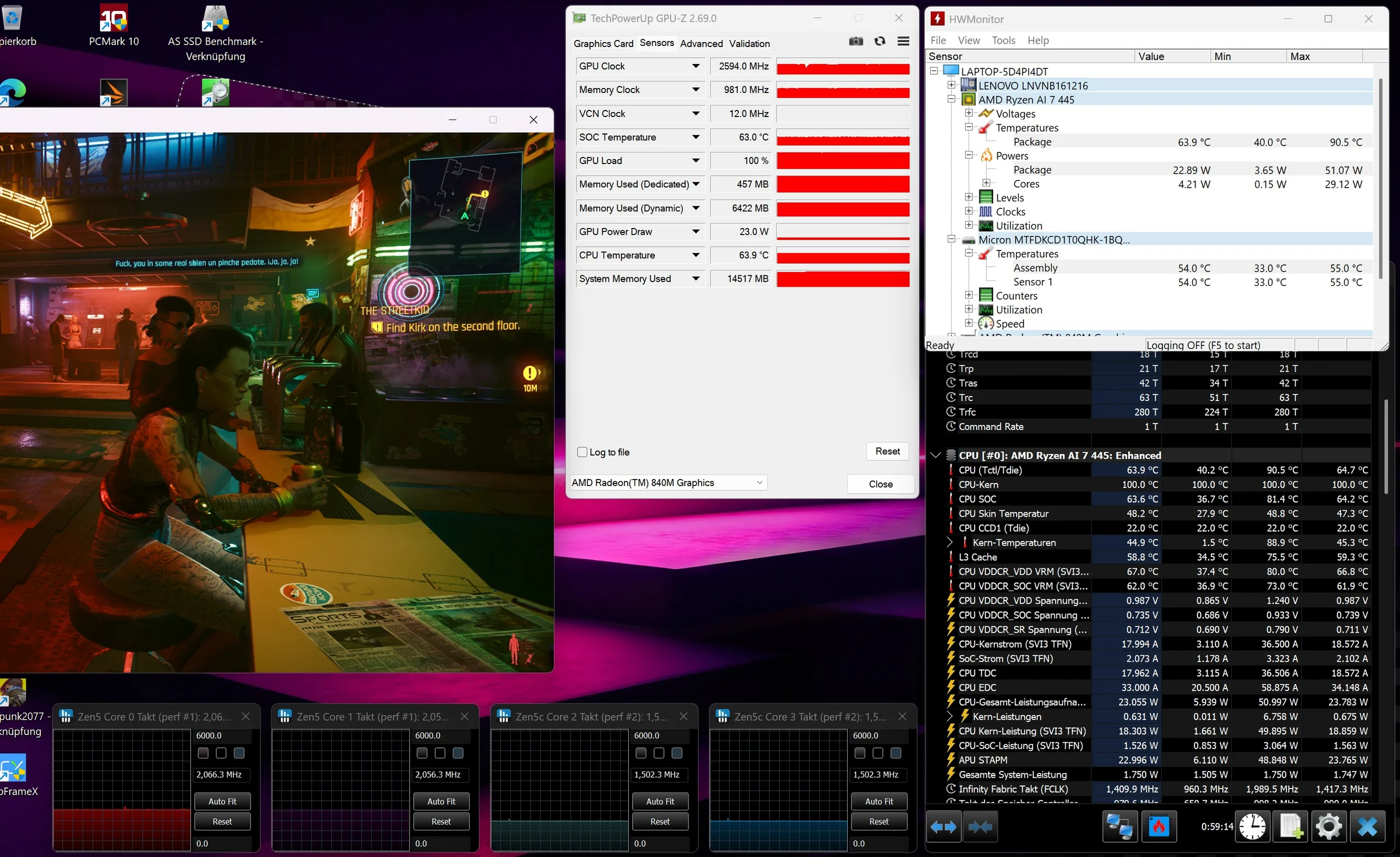
Nevertheless, the GPU performance in our Cyberpunk 2077 test was fairly stable over a longer period of time.
| low | med. | high | ultra | |
|---|---|---|---|---|
| GTA V (2015) | 148.8 | 130 | 46.1 | 19.3 |
| Dota 2 Reborn (2015) | 136.8 | 103.2 | 63.7 | 56.5 |
| X-Plane 11.11 (2018) | 47.7 | 37.7 | 31.2 | |
| Baldur's Gate 3 (2023) | 20.6 | 17.6 | 13.4 | 12.5 |
| Cyberpunk 2077 (2023) | 23.5 | 17.1 | 13.6 | 11 |
| The Outer Worlds 2 (2025) | 13.4 | 9.91 | 7.61 | |
| ARC Raiders (2025) | 32.8 | 27.4 | 18.5 | |
| Anno 117: Pax Romana (2025) | 14.4 | 9.5 | 7 | |
| Resident Evil Requiem (2026) | 20.3 | 13.3 | 9.21 | |
| Death Stranding 2 (2026) | 10.6 | 8.73 | 8.16 | |
| Crimson Desert (2026) | 14 | 7.38 | 6.76 |
| ARC Raiders - 1920x1080 Low Preset | |
| Average of class Subnotebook (32.8 - 67.9, n=2, last 2 years) | |
| Acer Nitro V14 AI | |
| Average AMD Radeon 840M (32.8 - 39.8, n=2) | |
| Lenovo Yoga Slim 7a 14AGP11 | |
| Anno 117: Pax Romana - 1920x1080 Low AA:T | |
| Average of class Subnotebook (14.4 - 28.7, n=2, last 2 years) | |
| Acer Nitro V14 AI | |
| Average AMD Radeon 840M (14.4 - 17.2, n=2) | |
| Lenovo Yoga Slim 7a 14AGP11 | |
| The Outer Worlds 2 - 1920x1080 Low Preset | |
| Average of class Subnotebook (13.4 - 23.9, n=2, last 2 years) | |
| Acer Nitro V14 AI | |
| Average AMD Radeon 840M (13.4 - 16.4, n=2) | |
| Lenovo Yoga Slim 7a 14AGP11 | |
Cyberpunk 2077 1080p Ultra FPS chart
Emissions
Noise emissions
The noise emissions are largely inconspicuous. In idle mode, the fans usually remain off or only rotate at a very discreet level.
Under load, the Adaptive mode produces an audible but not disturbingly loud 37 dB(A) to 43 dB(A) noise level.
Noise level
| Idle |
| 24 / 25 / 26 dB(A) |
| Load |
| 40 / 43 dB(A) |
 | ||
30 dB silent 40 dB(A) audible 50 dB(A) loud |
||
min:  , med: , med:  , max: , max:  Earthworks M23R, Arta (15 cm distance) environment noise: 24 dB(A) Earthworks M23R, Arta (15 cm distance) environment noise: 24 dB(A) | ||
| Lenovo Yoga Slim 7a 14AGP11 Ryzen AI 7 445, Radeon 840M | Lenovo Yoga Slim 7 14AKP G10 Ryzen AI 7 350, Radeon 860M | Lenovo IdeaPad Pro 5 14AKP G10 Ryzen AI 7 350, Radeon 860M | Asus Vivobook S 14 OLED S5406SA Core Ultra 5 226V, Arc 130V | Acer Swift 14 AI SF14-51-58TU Core Ultra 5 226V, Arc 130V | |
|---|---|---|---|---|---|
| Noise | -5% | -6% | 4% | -4% | |
| off / environment * (dB) | 24 | 24 -0% | 23.6 2% | 24.2 -1% | 25 -4% |
| Idle Minimum * (dB) | 24 | 24 -0% | 23.6 2% | 24.2 -1% | 25 -4% |
| Idle Average * (dB) | 25 | 24 4% | 23.6 6% | 24.2 3% | 26 -4% |
| Idle Maximum * (dB) | 26 | 27.2 -5% | 23.6 9% | 24.2 7% | 29 -12% |
| Load Average * (dB) | 40 | 44.1 -10% | 46.5 -16% | 28.8 28% | 40 -0% |
| Cyberpunk 2077 ultra * (dB) | 37 | 44.1 -19% | 48.9 -32% | 37.6 -2% | 40 -8% |
| Load Maximum * (dB) | 43 | 44.1 -3% | 48.9 -14% | 45.6 -6% | 41 5% |
* ... smaller is better
Temperature
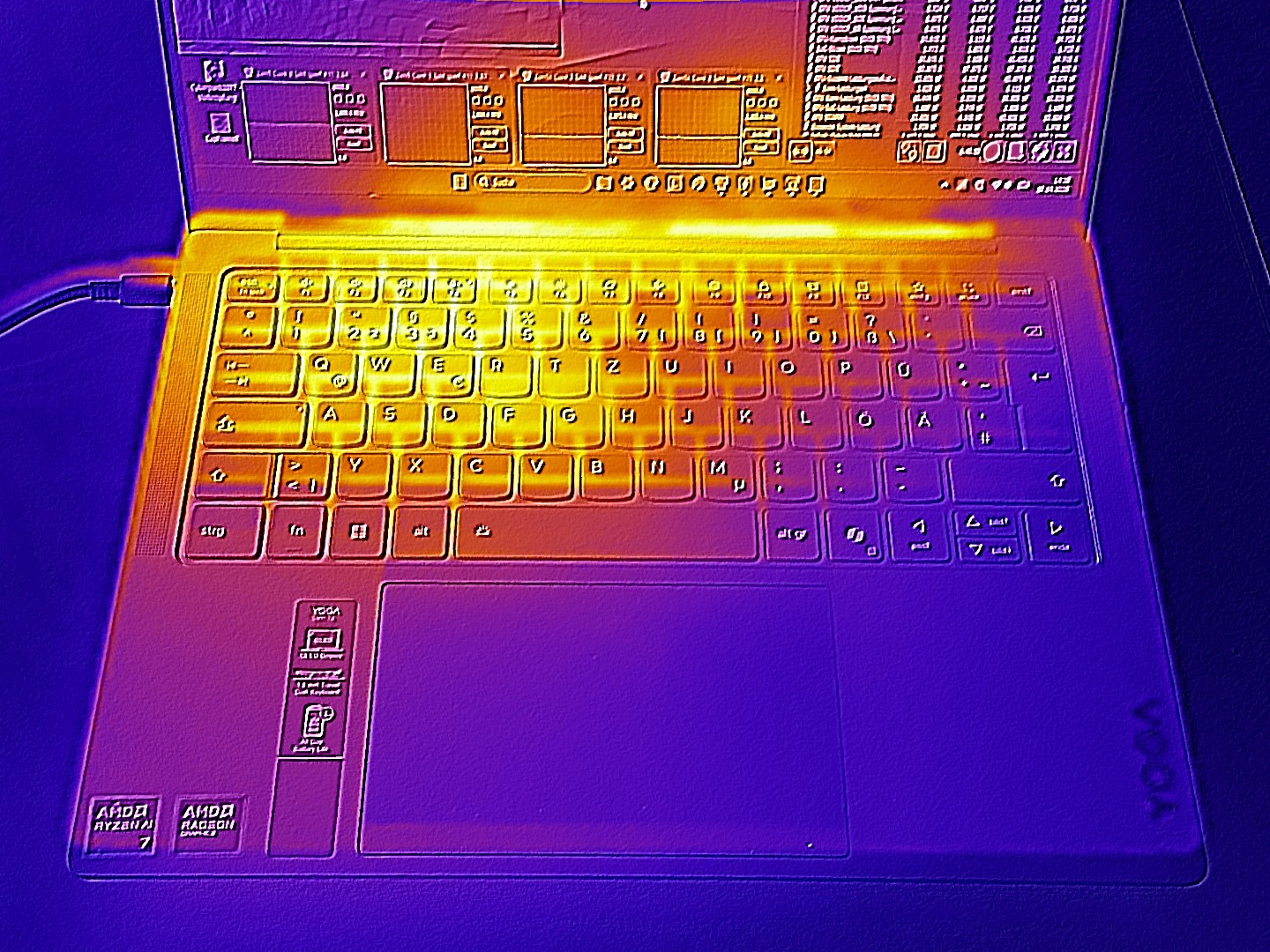
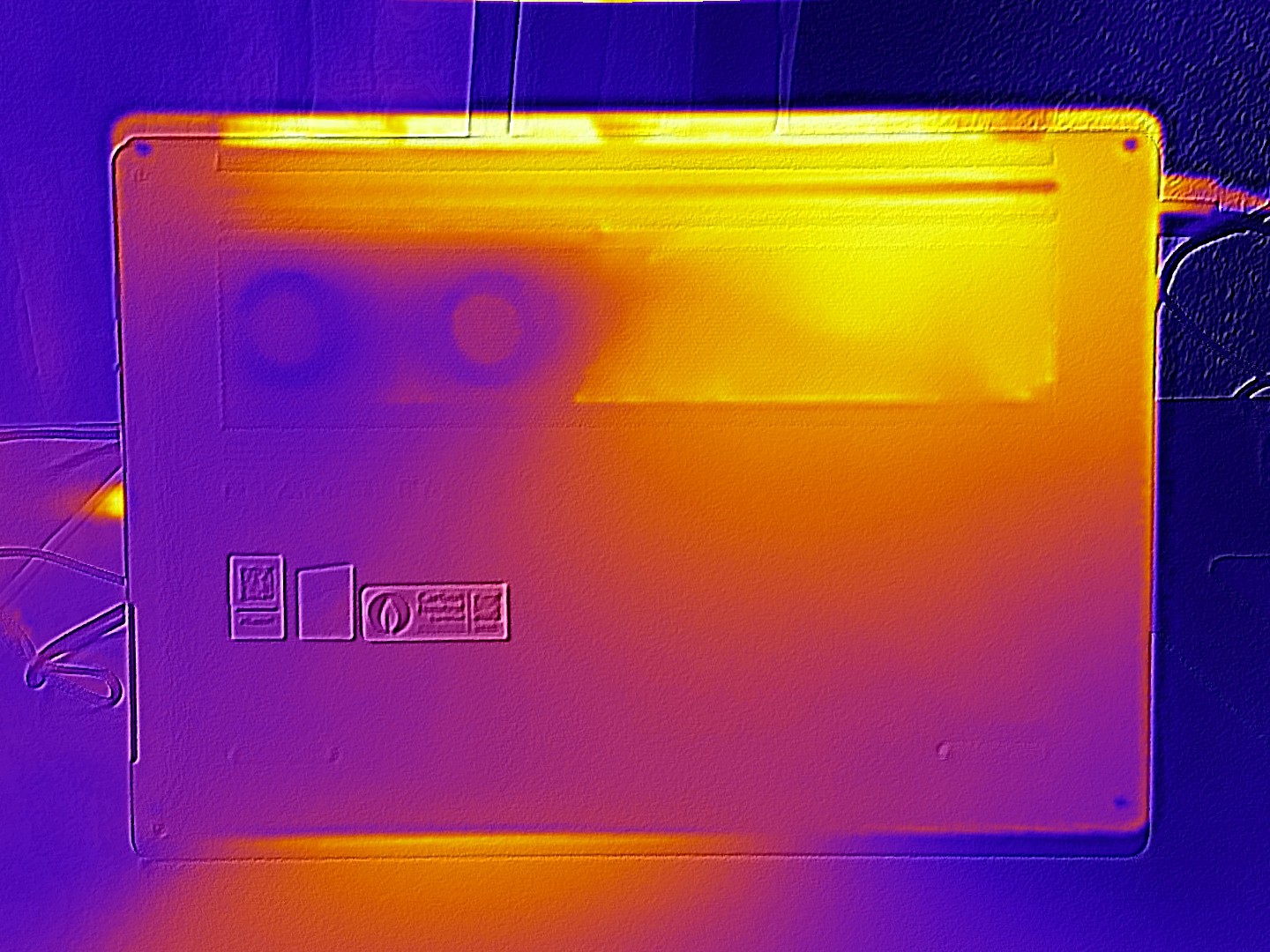
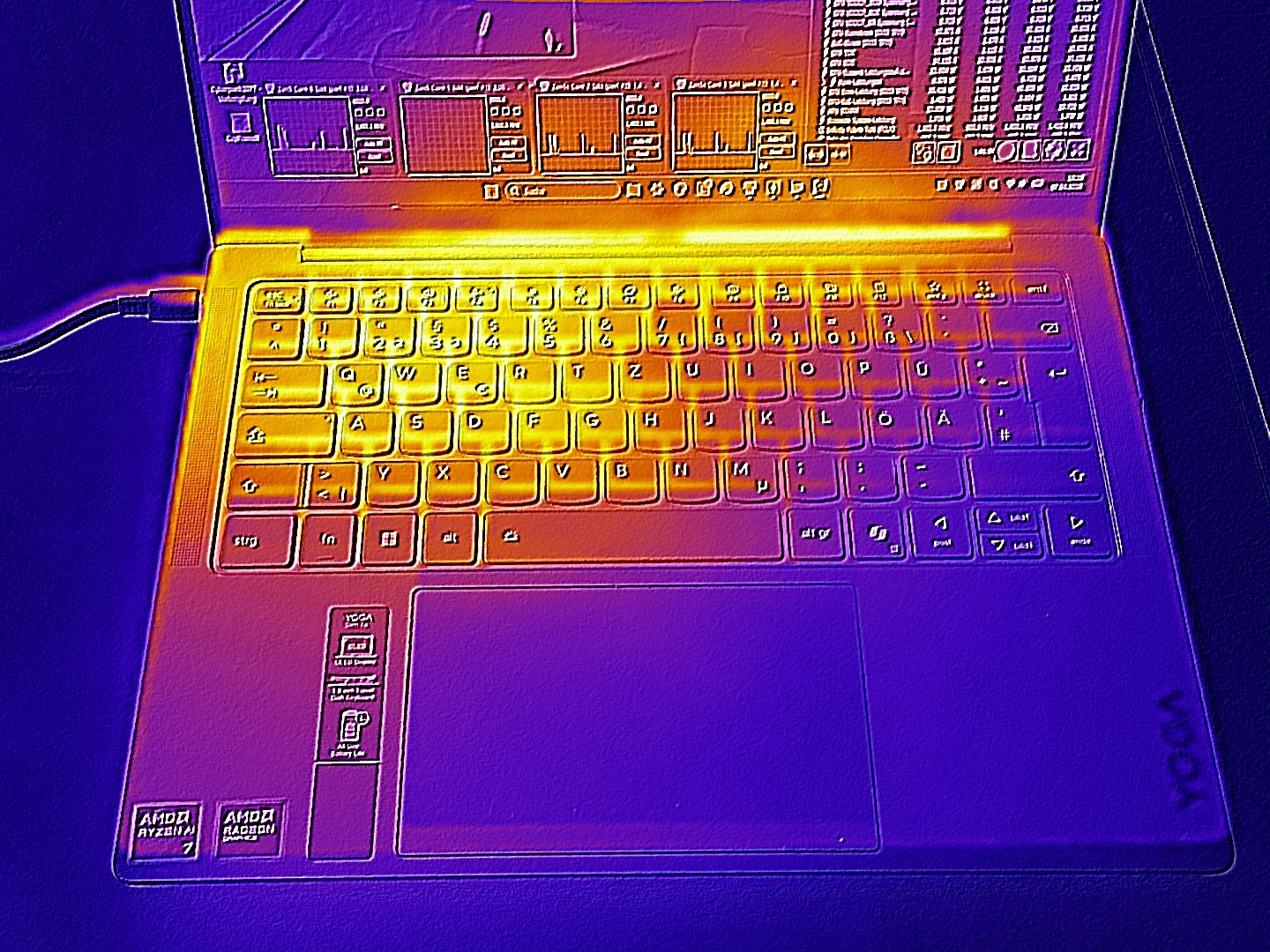
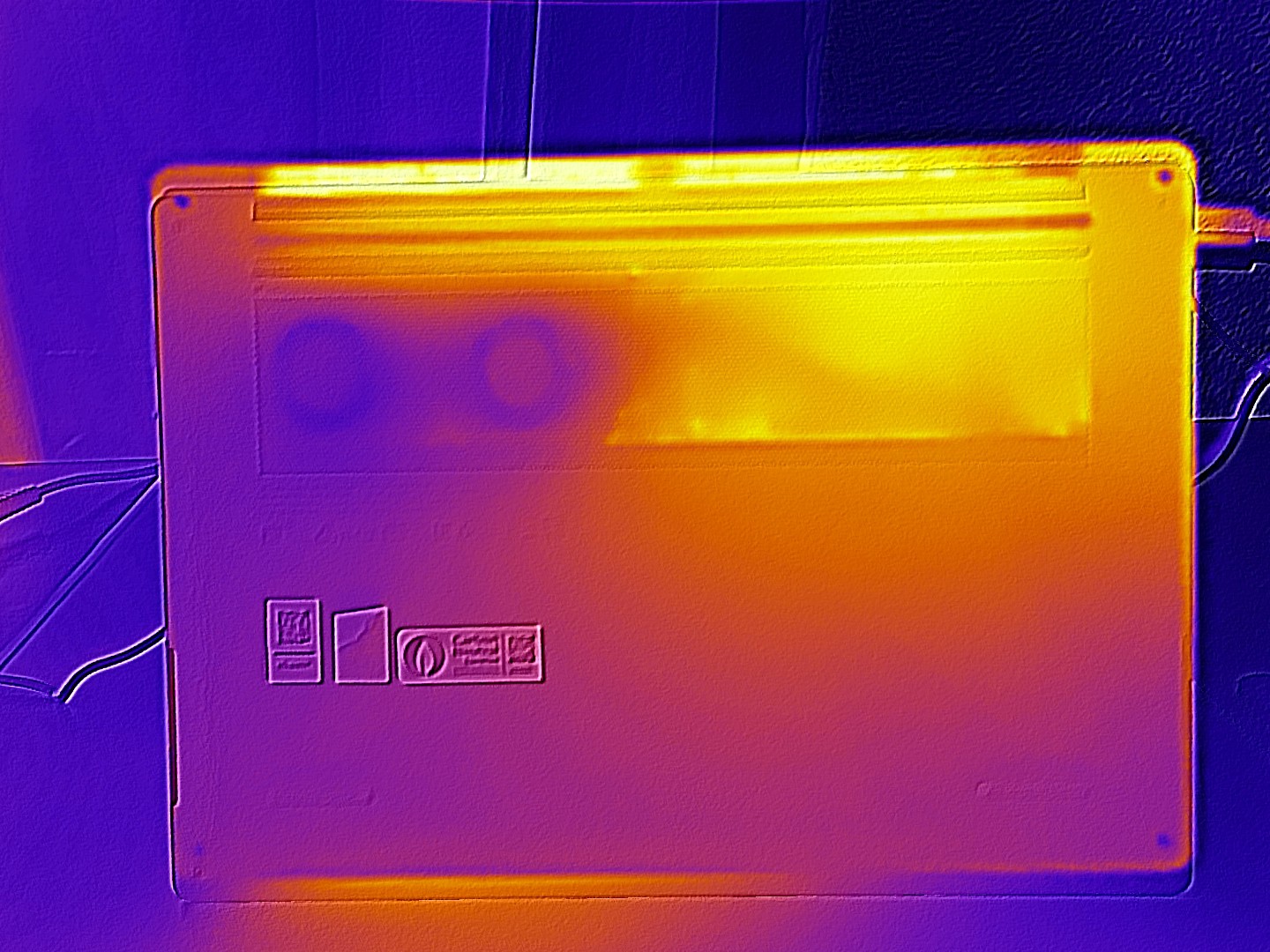
The temperature situation is similar. While the chassis remains below the 30 °C mark in idle mode, individual areas heat up to 45 °C (top) and 46 °C (bottom) while gaming.
The results are roughly in line with the competition.
(±) The maximum temperature on the upper side is 45 °C / 113 F, compared to the average of 35.9 °C / 97 F, ranging from 21.4 to 59 °C for the class Subnotebook.
(-) The bottom heats up to a maximum of 46 °C / 115 F, compared to the average of 39.2 °C / 103 F
(+) In idle usage, the average temperature for the upper side is 25.8 °C / 78 F, compared to the device average of 30.8 °C / 87 F.
(±) 3: The average temperature for the upper side is 37.7 °C / 100 F, compared to the average of 30.8 °C / 87 F for the class Subnotebook.
(+) The palmrests and touchpad are reaching skin temperature as a maximum (34 °C / 93.2 F) and are therefore not hot.
(-) The average temperature of the palmrest area of similar devices was 28.2 °C / 82.8 F (-5.8 °C / -10.4 F).
| Lenovo Yoga Slim 7a 14AGP11 Ryzen AI 7 445, Radeon 840M | Lenovo Yoga Slim 7 14AKP G10 Ryzen AI 7 350, Radeon 860M | Lenovo IdeaPad Pro 5 14AKP G10 Ryzen AI 7 350, Radeon 860M | Asus Vivobook S 14 OLED S5406SA Core Ultra 5 226V, Arc 130V | Acer Swift 14 AI SF14-51-58TU Core Ultra 5 226V, Arc 130V | |
|---|---|---|---|---|---|
| Heat | 5% | 8% | 6% | 5% | |
| Maximum Upper Side * (°C) | 45 | 44 2% | 42.2 6% | 38.4 15% | 41 9% |
| Maximum Bottom * (°C) | 46 | 42.9 7% | 42.4 8% | 49.7 -8% | 45 2% |
| Idle Upper Side * (°C) | 27 | 26.5 2% | 25.4 6% | 25.1 7% | 26 4% |
| Idle Bottom * (°C) | 29 | 26.7 8% | 25.7 11% | 25.8 11% | 28 3% |
* ... smaller is better
Stress test
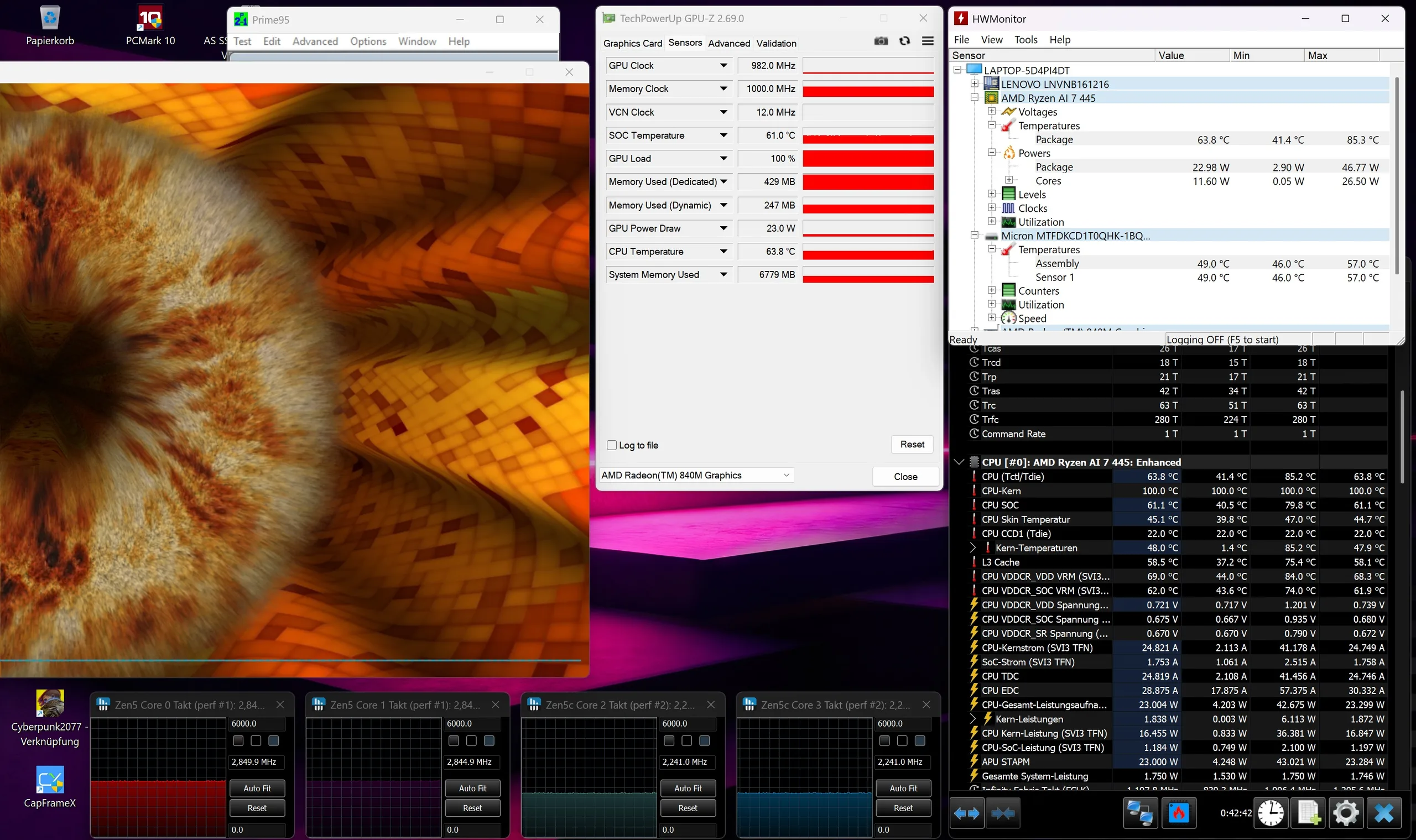
The CPU finished the stress test with the Furmark and Prime95 tools at just over 60 °C — a very moderate value.
Loudspeaker
The sound quality is solid but nothing to write home about. As is so often the case, the bass in particular could be better.
Lenovo Yoga Slim 7a 14AGP11 audio analysis
(±) | speaker loudness is average but good (78 dB)
Bass 100 - 315 Hz
(-) | nearly no bass - on average 16.6% lower than median
(±) | linearity of bass is average (10.6% delta to prev. frequency)
Mids 400 - 2000 Hz
(+) | balanced mids - only 3.7% away from median
(+) | mids are linear (4.1% delta to prev. frequency)
Highs 2 - 16 kHz
(+) | balanced highs - only 4.4% away from median
(+) | highs are linear (5.4% delta to prev. frequency)
Overall 100 - 16.000 Hz
(±) | linearity of overall sound is average (16.6% difference to median)
Compared to same class
» 43% of all tested devices in this class were better, 6% similar, 51% worse
» The best had a delta of 5%, average was 18%, worst was 53%
Compared to all devices tested
» 29% of all tested devices were better, 6% similar, 65% worse
» The best had a delta of 4%, average was 23%, worst was 136%
Lenovo Yoga Slim 7 14AKP G10 audio analysis
(±) | speaker loudness is average but good (76.1 dB)
Bass 100 - 315 Hz
(±) | reduced bass - on average 14.2% lower than median
(±) | linearity of bass is average (10.2% delta to prev. frequency)
Mids 400 - 2000 Hz
(+) | balanced mids - only 2.2% away from median
(+) | mids are linear (5.2% delta to prev. frequency)
Highs 2 - 16 kHz
(+) | balanced highs - only 3.2% away from median
(+) | highs are linear (5.4% delta to prev. frequency)
Overall 100 - 16.000 Hz
(+) | overall sound is linear (14.2% difference to median)
Compared to same class
» 28% of all tested devices in this class were better, 6% similar, 66% worse
» The best had a delta of 5%, average was 18%, worst was 53%
Compared to all devices tested
» 17% of all tested devices were better, 4% similar, 79% worse
» The best had a delta of 4%, average was 23%, worst was 136%
Energy management
Power consumption
Power consumption remains within manageable limits. Around 5 W in idle and approx. 60 W under load are reasonable in view of the speed, although Intel's Core Ultra 5 226V is even more economical.
A pitiable and annoying aspect is that our test sample did not come with a power supply unit. USB-C power delivery up to 65 W is supported.
| Off / Standby | 0.1 / 0.3 Watt |
| Idle | 5.1 / 5.3 / 6.2 Watt |
| Load |
58 / 72 Watt |
   
| |
Key:
min: ,
med: ,
max: Metrahit Energy | |
| Lenovo Yoga Slim 7a 14AGP11 Ryzen AI 7 445, Radeon 840M | Lenovo Yoga Slim 7 14AKP G10 Ryzen AI 7 350, Radeon 860M | Lenovo IdeaPad Pro 5 14AKP G10 Ryzen AI 7 350, Radeon 860M | Asus Vivobook S 14 OLED S5406SA Core Ultra 5 226V, Arc 130V | Acer Swift 14 AI SF14-51-58TU Core Ultra 5 226V, Arc 130V | Average of class Subnotebook | |
|---|---|---|---|---|---|---|
| Power Consumption | -17% | -30% | 16% | 6% | 5% | |
| Idle Minimum * (Watt) | 5.1 | 5.2 -2% | 5.1 -0% | 2.7 47% | 5 2% | 3.53 ? 31% |
| Idle Average * (Watt) | 5.3 | 7.8 -47% | 6.8 -28% | 6.7 -26% | 6 -13% | 6.46 ? -22% |
| Idle Maximum * (Watt) | 6.2 | 8.1 -31% | 6.9 -11% | 6.9 -11% | 10 -61% | 7.82 ? -26% |
| Load Average * (Watt) | 58 | 64.3 -11% | 71.7 -24% | 34.5 41% | 36 38% | 39.1 ? 33% |
| Cyberpunk 2077 ultra * (Watt) | 57.3 | 65.4 -14% | 84.8 -48% | 43 25% | 41.6 27% | |
| Cyberpunk 2077 ultra external monitor * (Watt) | 54.8 | 64 -17% | 83.5 -52% | 41.9 24% | 38.2 30% | |
| Load Maximum * (Watt) | 72 | 68.5 5% | 104.8 -46% | 62.7 13% | 60 17% | 63.8 ? 11% |
* ... smaller is better
Power consumption: Cyberpunk 2077 / Stress test
Power consumption: External monitor
Battery life
The Yoga Slim 7a 14 managed our Wi-Fi browsing test with the brightness reduced to 150 cd/m² for nearly 9 hours, which is a good result in itself but not quite on a par with the competition.
Perhaps there are still a few problems with the power-saving mechanisms in battery mode.
| Lenovo Yoga Slim 7a 14AGP11 Ryzen AI 7 445, Radeon 840M, 70 Wh | Lenovo Yoga Slim 7 14AKP G10 Ryzen AI 7 350, Radeon 860M, 70 Wh | Lenovo IdeaPad Pro 5 14AKP G10 Ryzen AI 7 350, Radeon 860M, 84 Wh | Asus Vivobook S 14 OLED S5406SA Core Ultra 5 226V, Arc 130V, 75 Wh | Acer Swift 14 AI SF14-51-58TU Core Ultra 5 226V, Arc 130V, 65 Wh | Average of class Subnotebook | |
|---|---|---|---|---|---|---|
| Battery runtime | 12% | 54% | 91% | 40% | 61% | |
| WiFi v1.3 (h) | 9 | 10.1 12% | 13.9 54% | 17.2 91% | 12.6 40% | 14.5 ? 61% |
| H.264 (h) | 15.9 | 19.6 | 20 | 15.7 ? | ||
| Load (h) | 1 | 0.9 | 2.9 | 2.03 ? |
Notebookcheck's overall impressions of the Lenovo Yoga Slim 7a 14
The Lenovo Yoga Slim 7a 14AGP11 is a classy subnotebook that shines with a high mobility factor.
However, if you value 3D performance, you should rather get a device with a fast Radeon 860M iGPU and above.
Lenovo Yoga Slim 7a 14AGP11
- 04/10/2026 v8
Florian Glaser
 Total Sustainability Score:
 Potential competitors in comparison
Image | Model / Review | Price | Weight | Height | Display |
|---|---|---|---|---|---|
1. 84.1%  | Lenovo Yoga Slim 7a 14AGP11 AMD Ryzen AI 7 445 ⎘ AMD Radeon 840M ⎘ 16 GB Memory, 1024 GB SSD | List Price: 1299 EUR | 1.2 kg | 14 mm | 14.00" 2880x1800 243 PPI OLED |
2. 85.3%  | Lenovo Yoga Slim 7 14AKP G10 AMD Ryzen AI 7 350 ⎘ AMD Radeon 860M ⎘ 32 GB Memory, 512 GB SSD | Amazon: 1. $859.00 Lenovo Yoga Slim 7X: Snapdra... 2. $749.99 Lenovo Yoga Slim 7X Laptop 1... 3. $675.99 Lenovo Yoga Slim 7 14Q8X9 14... List Price: 1299€ | 1.2 kg | 13.9 mm | 14.00" 2880x1800 243 PPI OLED |
3. 87.4%  | Lenovo IdeaPad Pro 5 14AKP G10 AMD Ryzen AI 7 350 ⎘ AMD Radeon 860M ⎘ 32 GB Memory, 1024 GB SSD | List Price: 989€ | 1.4 kg | 15.5 mm | 14.00" 2880x1800 243 PPI OLED |
4. 85.9%  | Asus Vivobook S 14 OLED S5406SA Intel Core Ultra 5 226V ⎘ Intel Arc Graphics 130V ⎘ 16 GB Memory, 512 GB SSD | List Price: 1099€ | 1.3 kg | 15.9 mm | 14.00" 1920x1200 162 PPI OLED |
5. 83.5%  | Acer Swift 14 AI SF14-51-58TU Intel Core Ultra 5 226V ⎘ Intel Arc Graphics 130V ⎘ 16 GB Memory, 512 GB SSD | List Price: 1200 EUR | 1.3 kg | 16 mm | 14.00" 2880x1800 243 PPI OLED |
Transparency
The selection of devices to be reviewed is made by our editorial team. The test sample was provided to the author as a loan by the manufacturer or retailer for the purpose of this review. The lender had no influence on this review, nor did the manufacturer receive a copy of this review before publication. There was no obligation to publish this review. As an independent media company, Notebookcheck is not subjected to the authority of manufacturers, retailers or publishers.
This is how Notebookcheck is testing
Every year, Notebookcheck independently reviews hundreds of laptops and smartphones using standardized procedures to ensure that all results are comparable. We have continuously developed our test methods for around 20 years and set industry standards in the process. In our test labs, high-quality measuring equipment is utilized by experienced technicians and editors. These tests involve a multi-stage validation process. Our complex rating system is based on hundreds of well-founded measurements and benchmarks, which maintains objectivity. Further information on our test methods can be found here.
 Add as a preferred source on Google


