




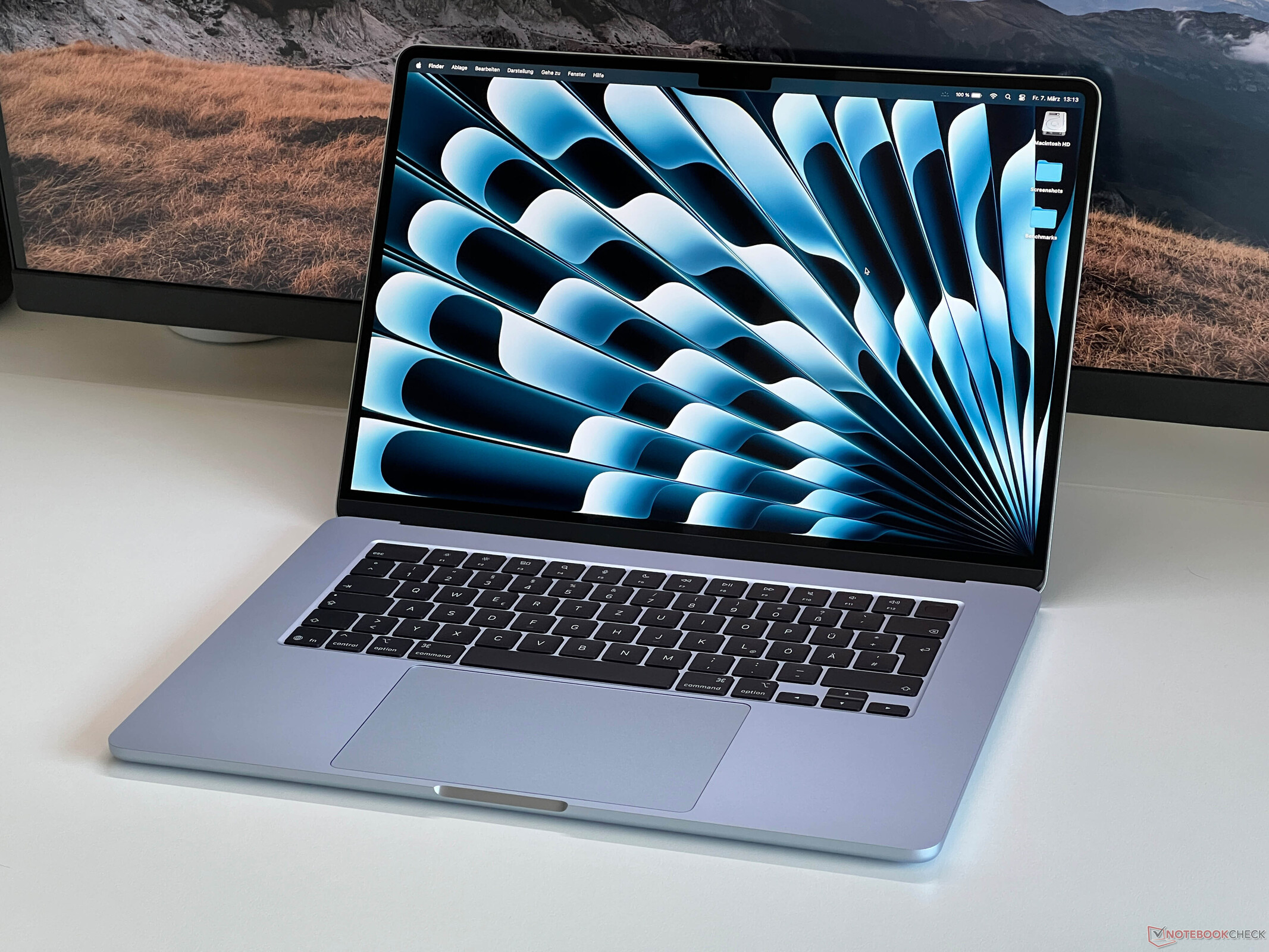
Verdict - MacBook Air 15 gets even better with M5 and Wi-Fi 7
The new Apple M5 SoC is very powerful and also very efficient - a perfect match for the passive cooling system of the MacBook Air 15. There is just nothing comparable in the Windows world, neither with x86 chips, nor with ARM CPUs from Qualcomm. The performance is nothing short of spectacular and the M5 is also very efficient while gaming, where we did not experience any throttling. This means the slim and silent MacBook Air can play even demanding titles like Cyberpunk 2077 or Baldur's Gate 3 smoothly with reduced details.
Other improvements include Wi-Fi as well as faster PCIe 4.0 SSDs, and this is also the case for the base model starting at $1299. Our review unit is quite expensive due to the RAM and storage upgrades, but you will get pretty much the same performance from the base model, which is our recommendation for most users.
The deficits are still the same on the MacBook Air like soldered RAM and storage, the lack of Face-ID and the limited number of ports, which is even more annoying on the larger 15-inch model. We don't mind the IPS screen on the Air since it has no issues with PWM and offers good image quality, but the refresh rate of 60 Hz is pretty outdated in 2026. Considering the more expensive entry-level level of the MacBook Pro 14, however, we do not think Apple really wants to offer a better screen for the Air and would like you to switch to the Pro for a better screen instead.
Pros
Cons
Apple refreshes the MacBook Air and the 15-inch version is equipped with the faster M5 SoC with 10 GPU cores. The manufacturer also upgraded the Wi-Fi module as well as SSD speeds and you can get the base model with 16 GB RAM and 512 GB SSD storage for $1299 while our review unit has some upgrades (32 GB RAM and 2 TB storage), which increases the price tag to $2299.
Specifications
Case and Connectivity
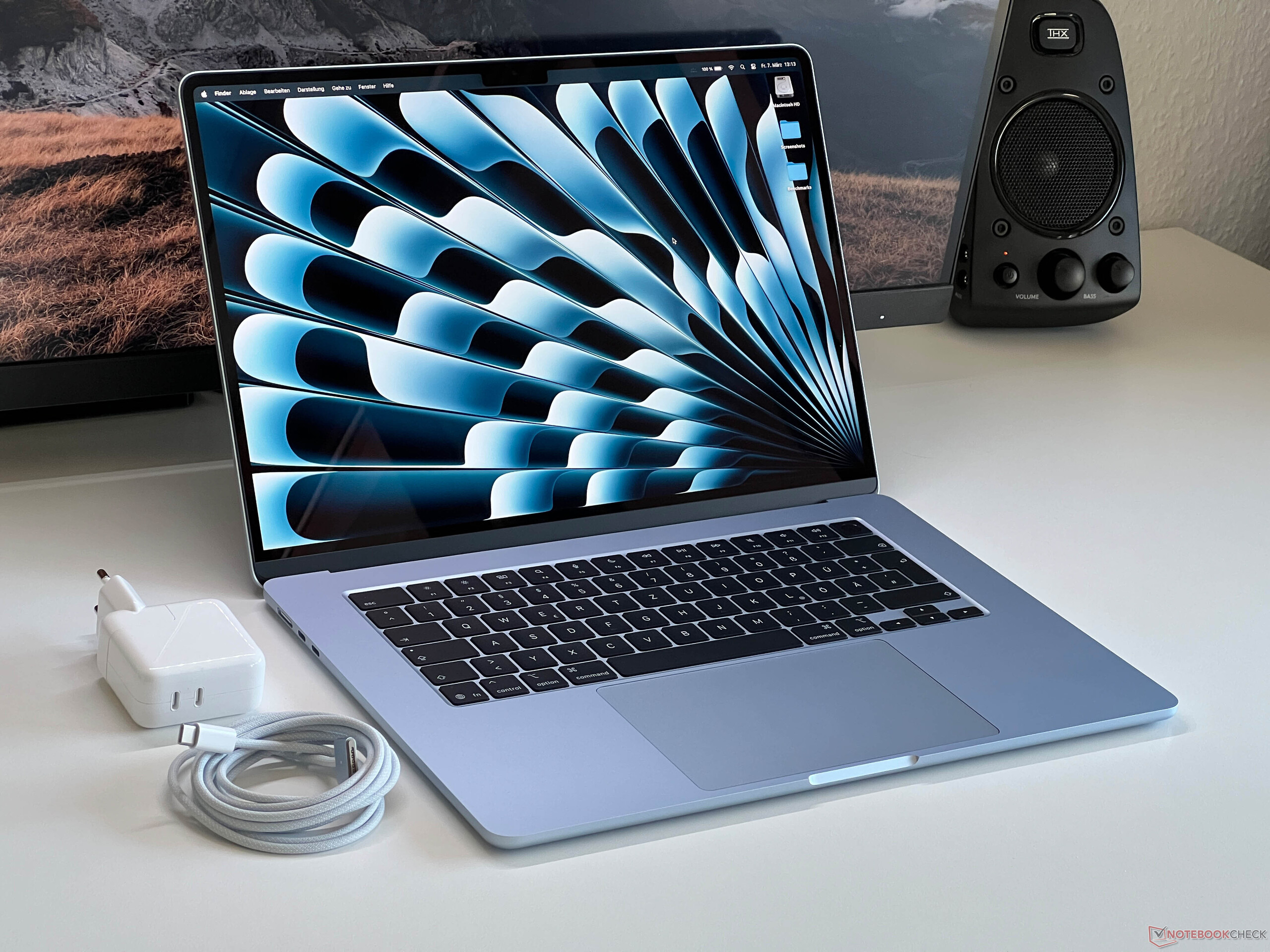
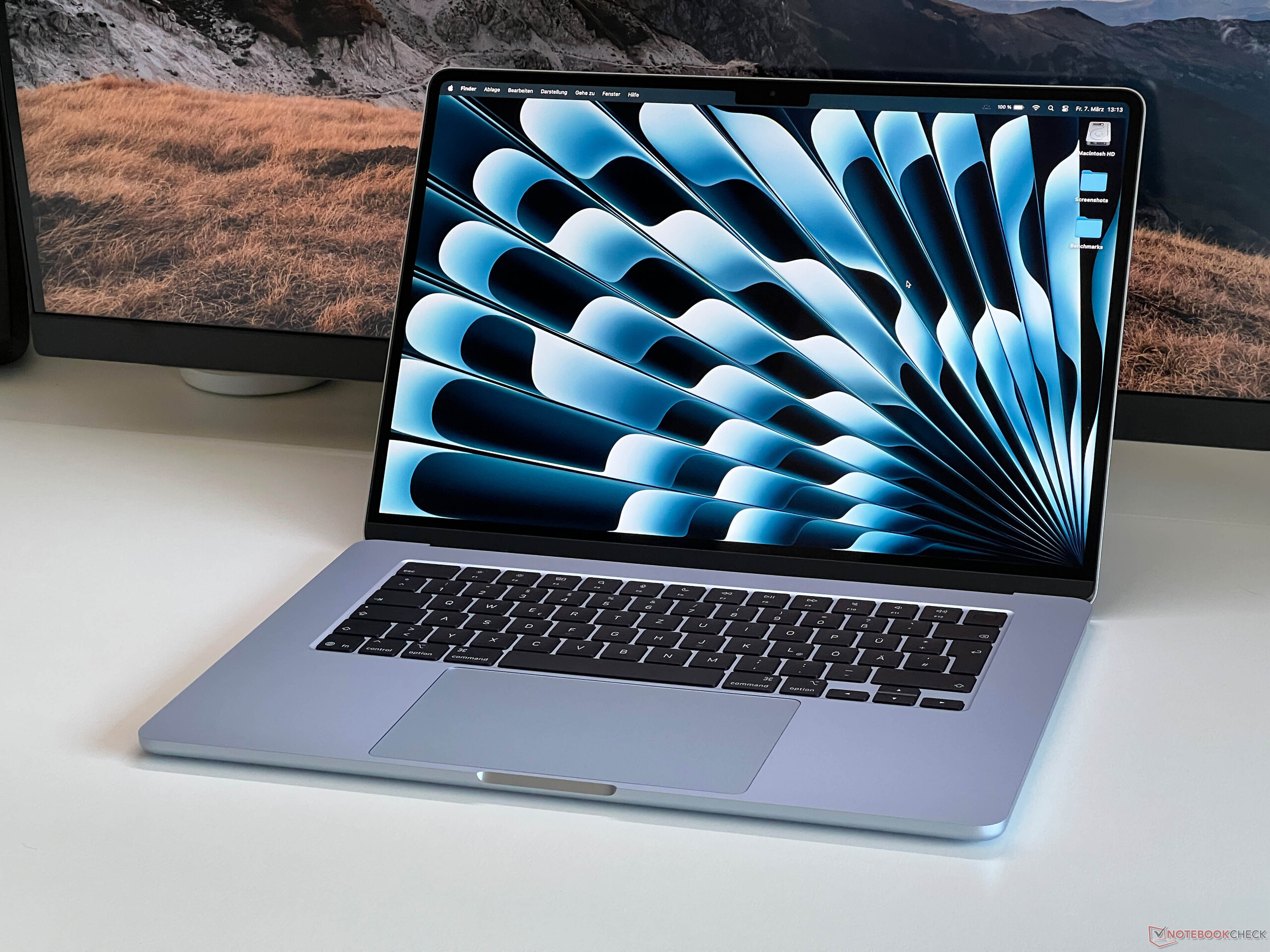
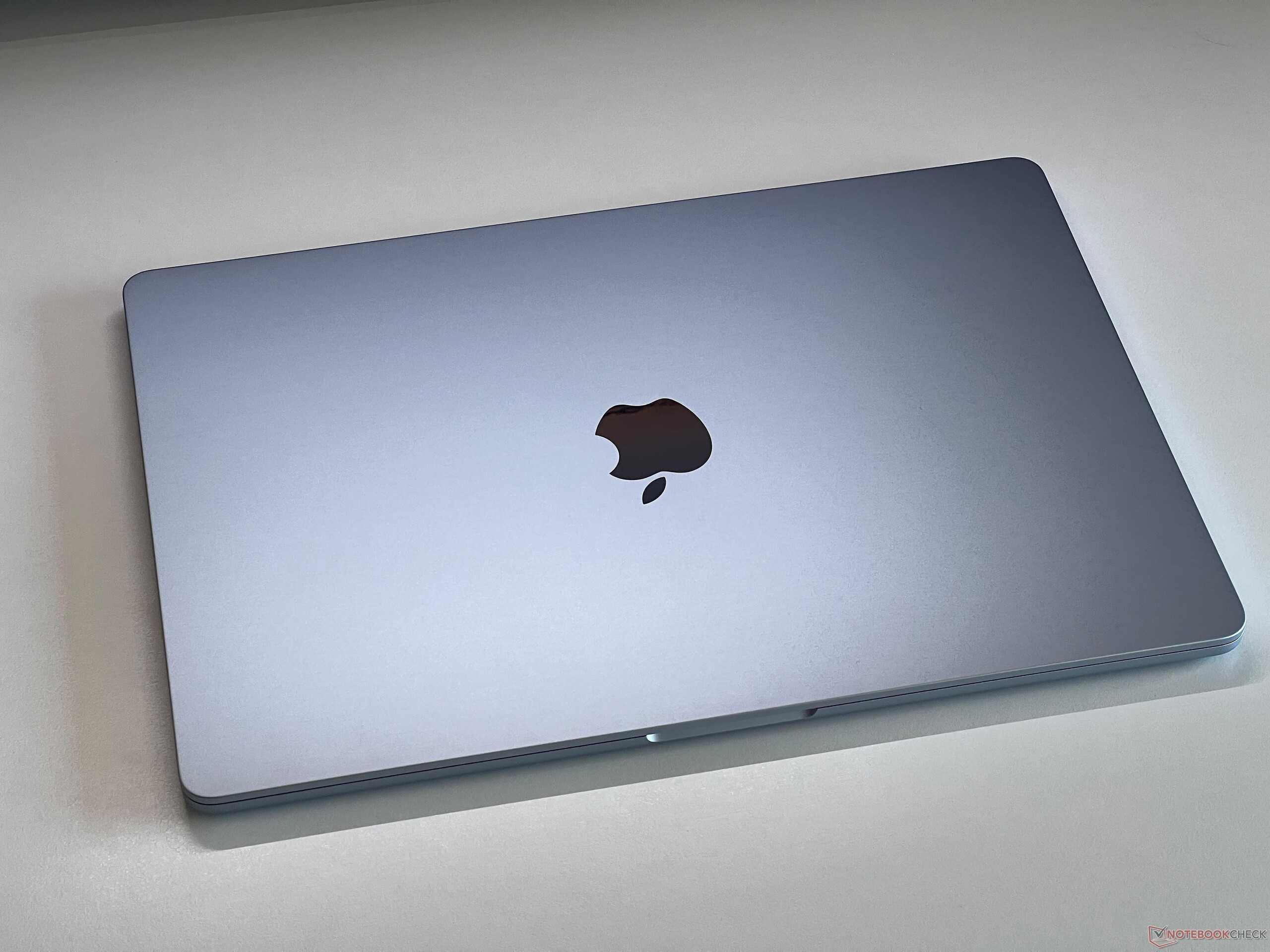
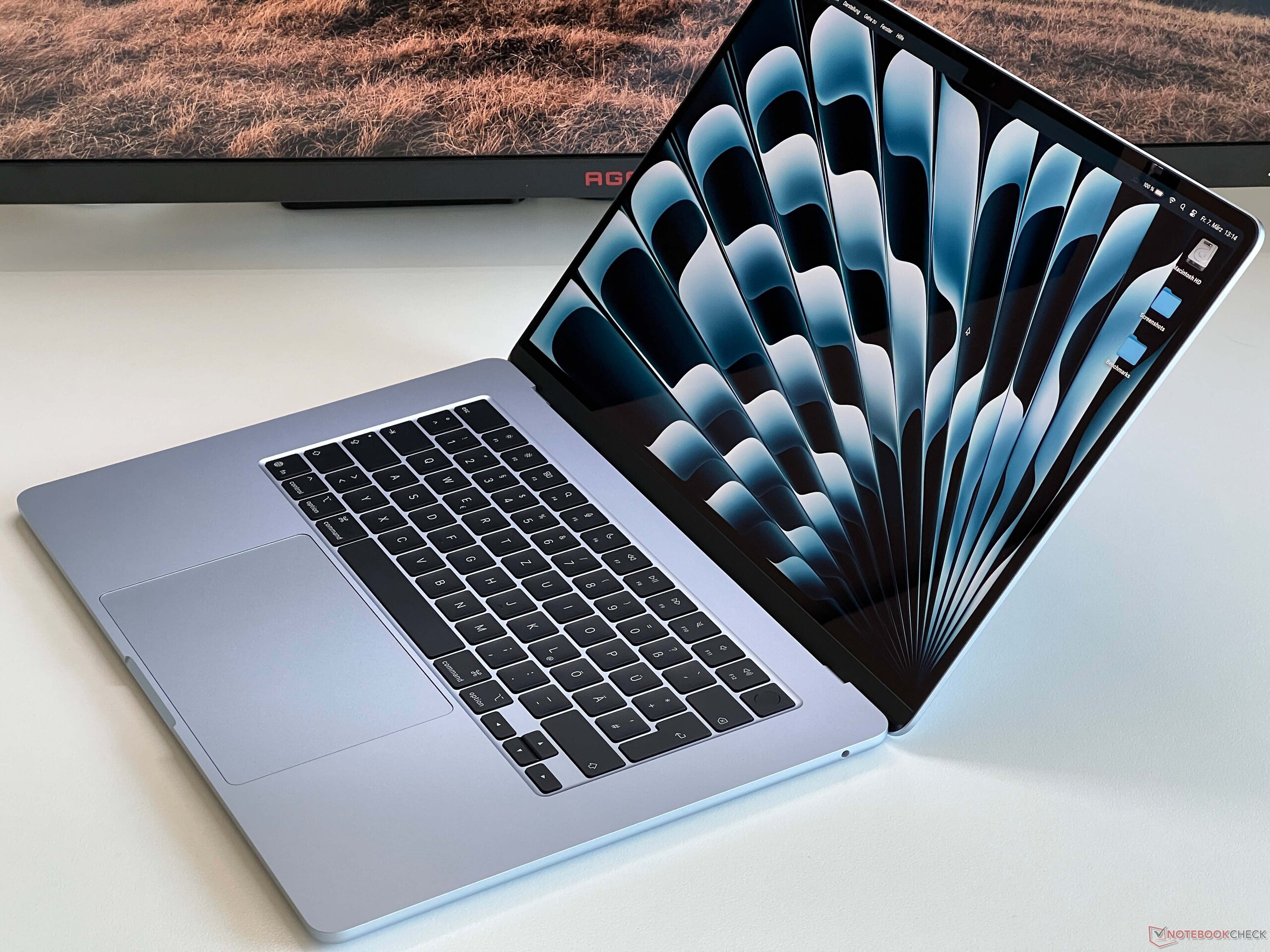
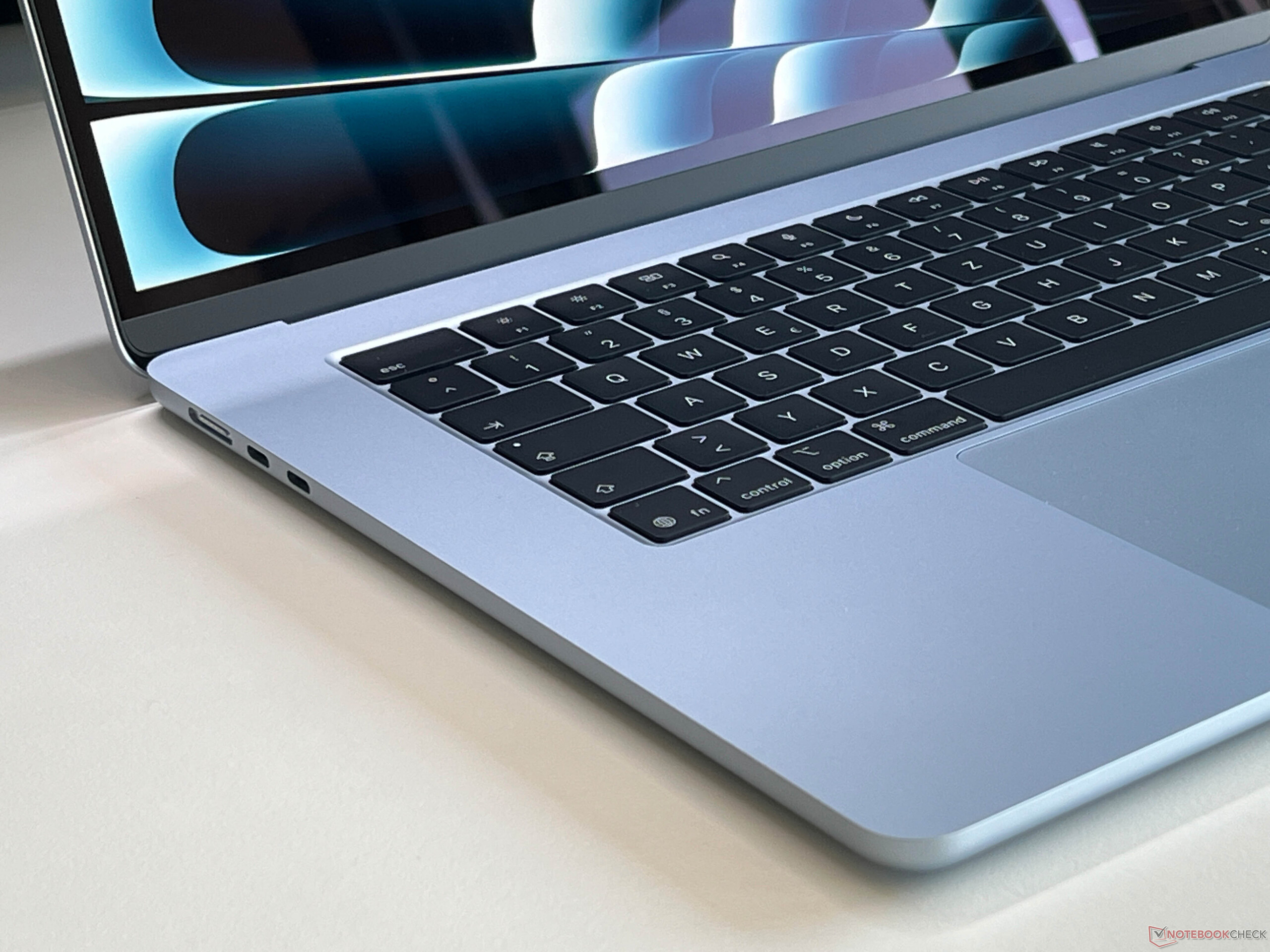
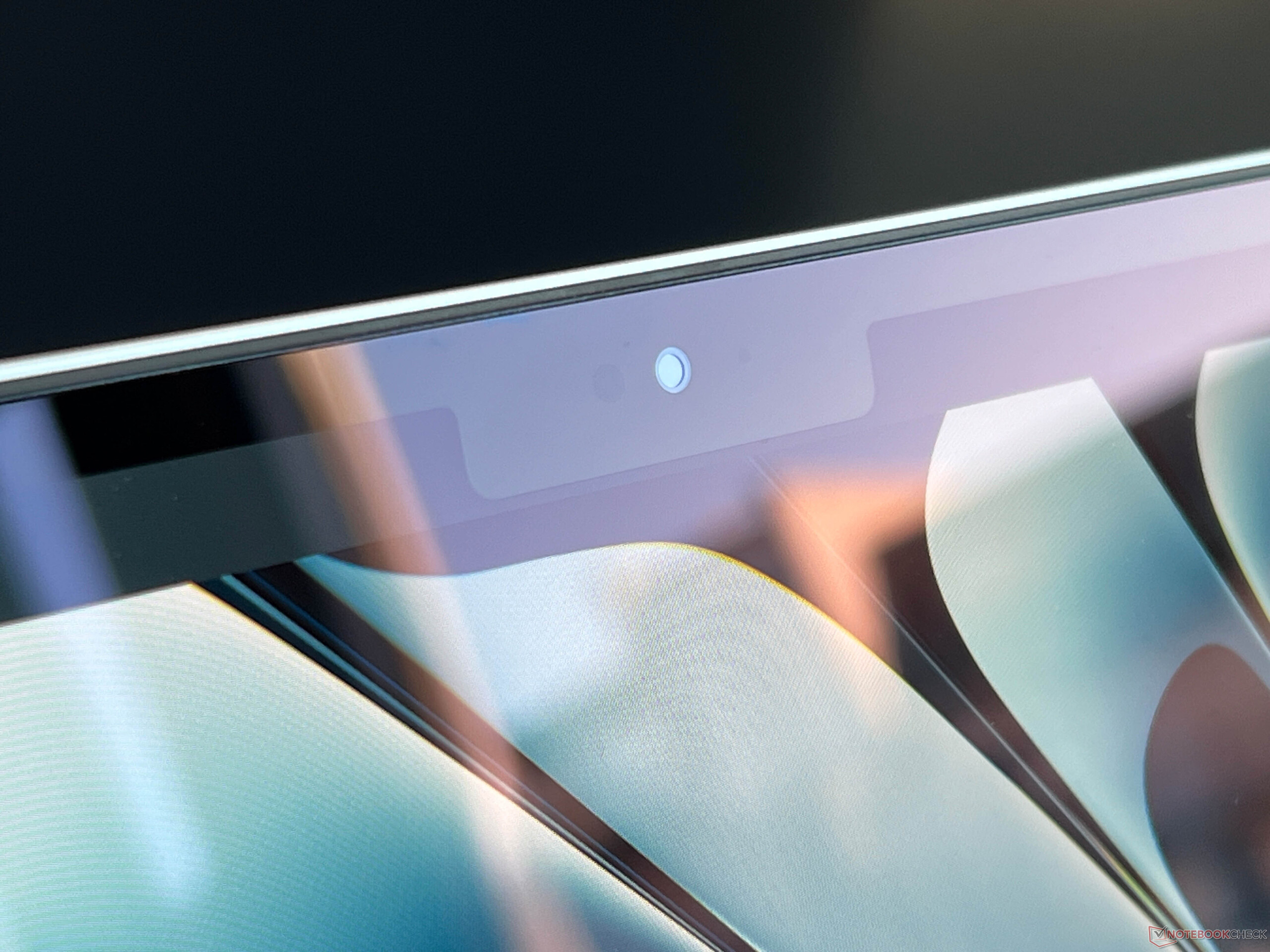
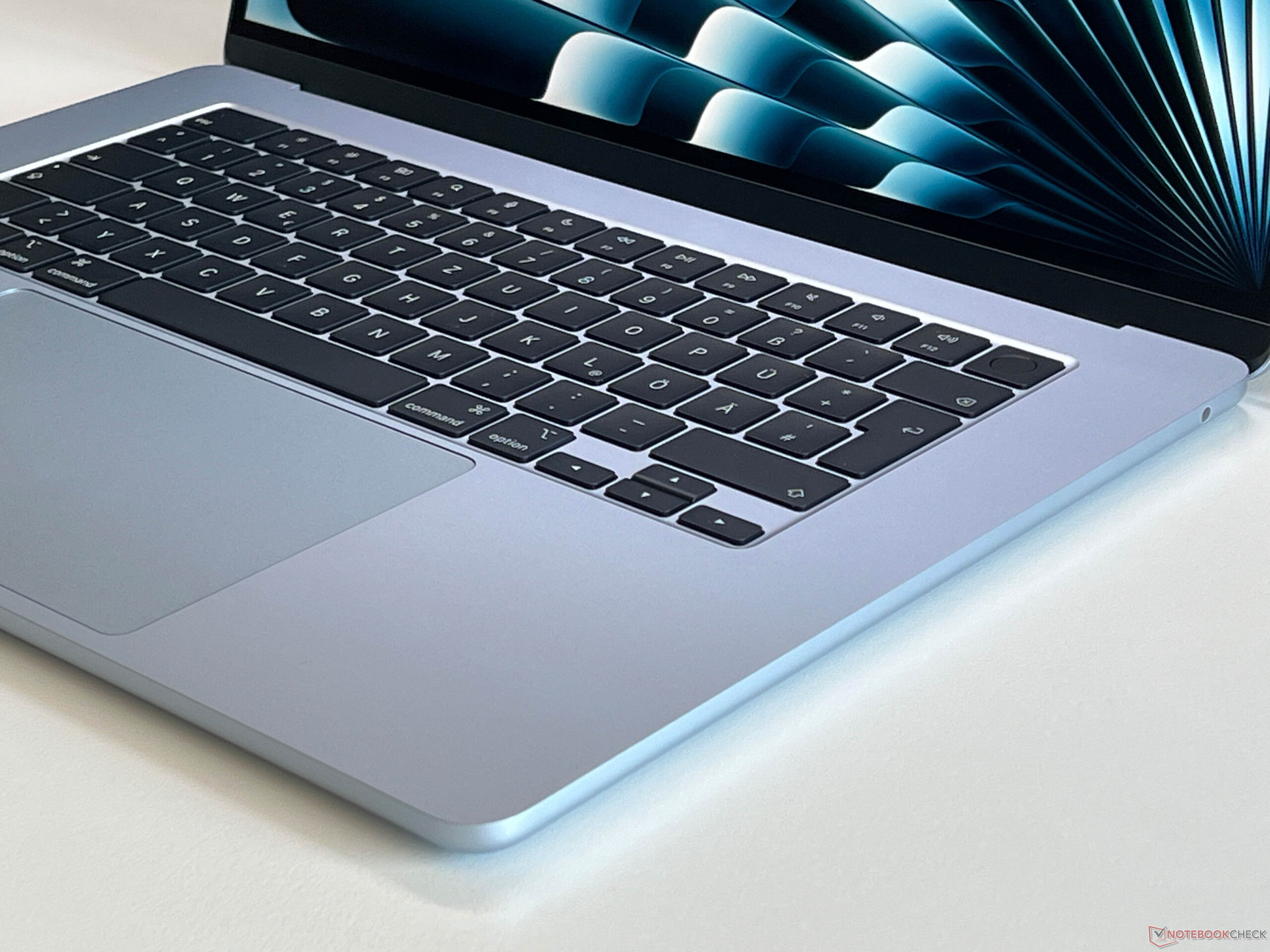
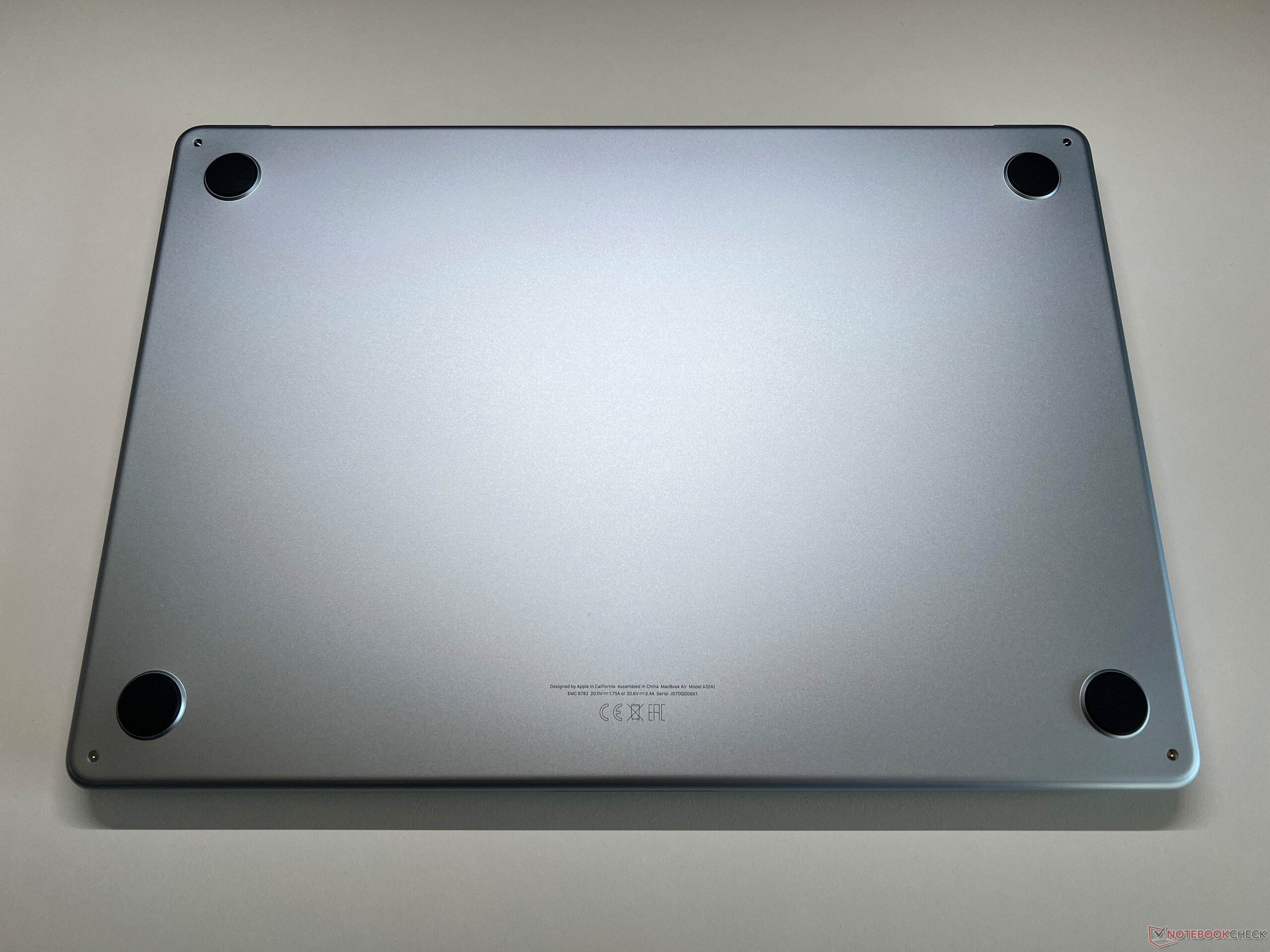
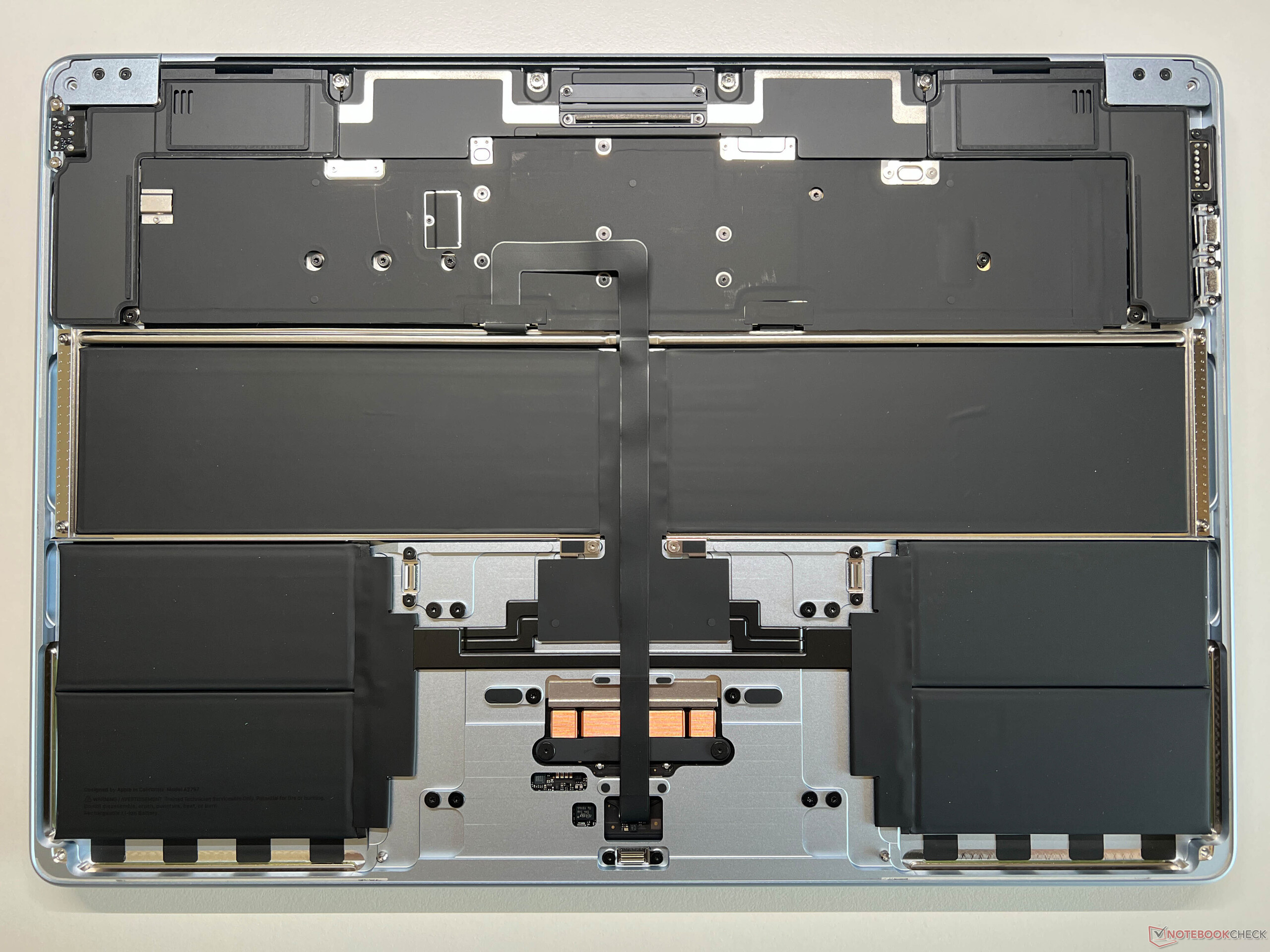
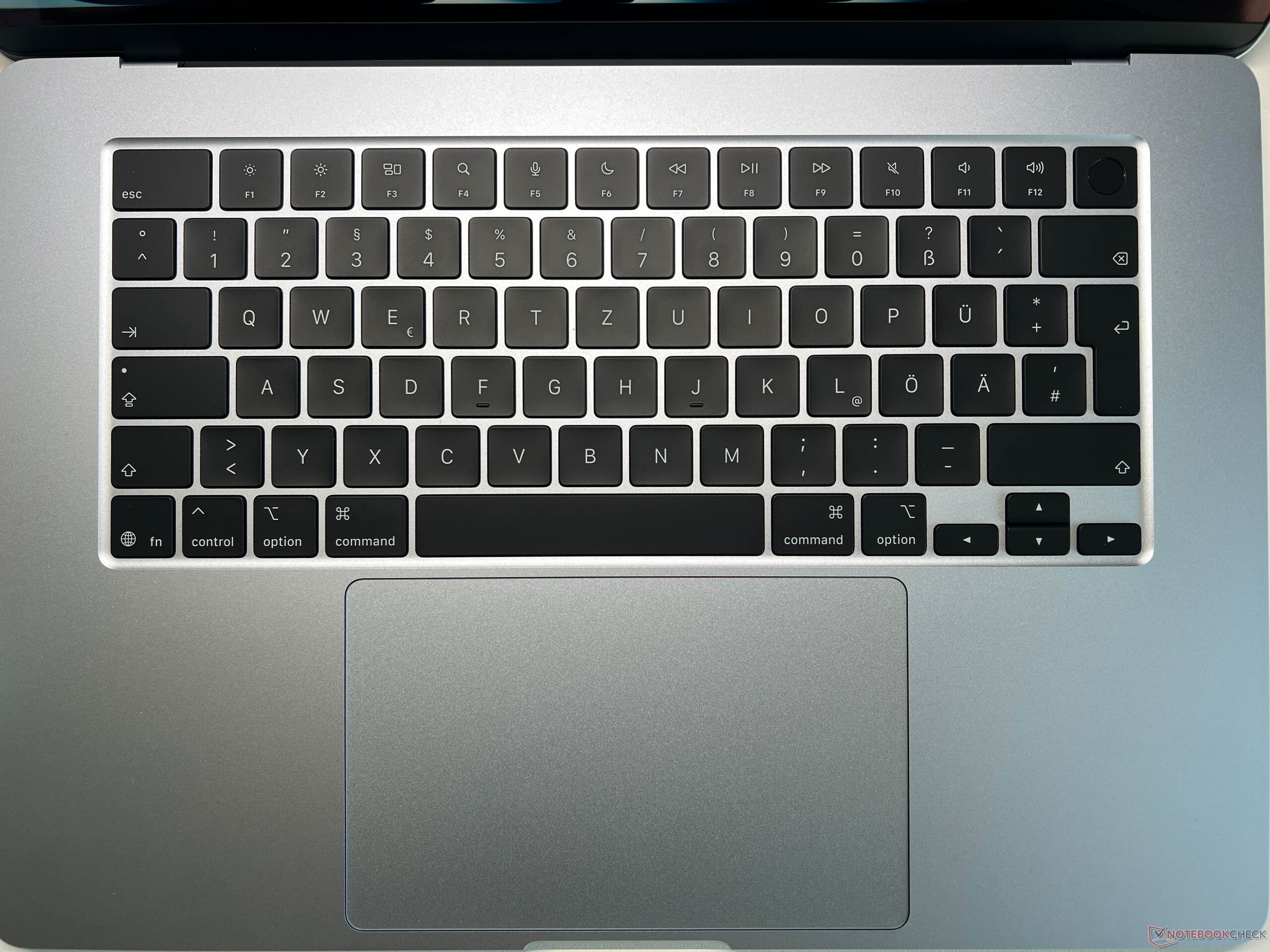
The case design including ports, webcam and the input devices did not change compared to the previous M4 model, so you still get a very slim but not particularly lightweight laptop at 1.512 kg. The quality is excellent, both in terms of stability as well as build quality. Apple upgraded the Wi-Fi module and it now supports the latest Wi-Fi 7 standard including Bluetooth 6.0. The transfer rates in our test were good as well as stable and also better compared to the smaller MacBook Air 13 M5. The following images are from the previous M4 generation.



| Networking | |
| Apple MacBook Air 15 M5 | |
| iperf3 transmit AXE11000 | |
| iperf3 receive AXE11000 | |
| Apple MacBook Air 15 M4 | |
| iperf3 transmit AXE11000 | |
| iperf3 receive AXE11000 | |
| Microsoft Surface Laptop 7 15 Lunar Lake | |
| iperf3 transmit AXE11000 | |
| iperf3 receive AXE11000 | |
| Lenovo ThinkPad X9-15 Aura Edition | |
| iperf3 transmit AXE11000 | |
| iperf3 receive AXE11000 | |
| Microsoft Surface Laptop 15 Snapdragon X Elite | |
| iperf3 transmit AXE11000 | |
| iperf3 receive AXE11000 | |
| iperf3 transmit AXE11000 6GHz | |
| iperf3 receive AXE11000 6GHz | |
| Samsung Galaxy Book4 Edge 16 | |
| iperf3 transmit AXE11000 | |
| iperf3 receive AXE11000 | |
| iperf3 transmit AXE11000 6GHz | |
| iperf3 receive AXE11000 6GHz | |


Sustainability
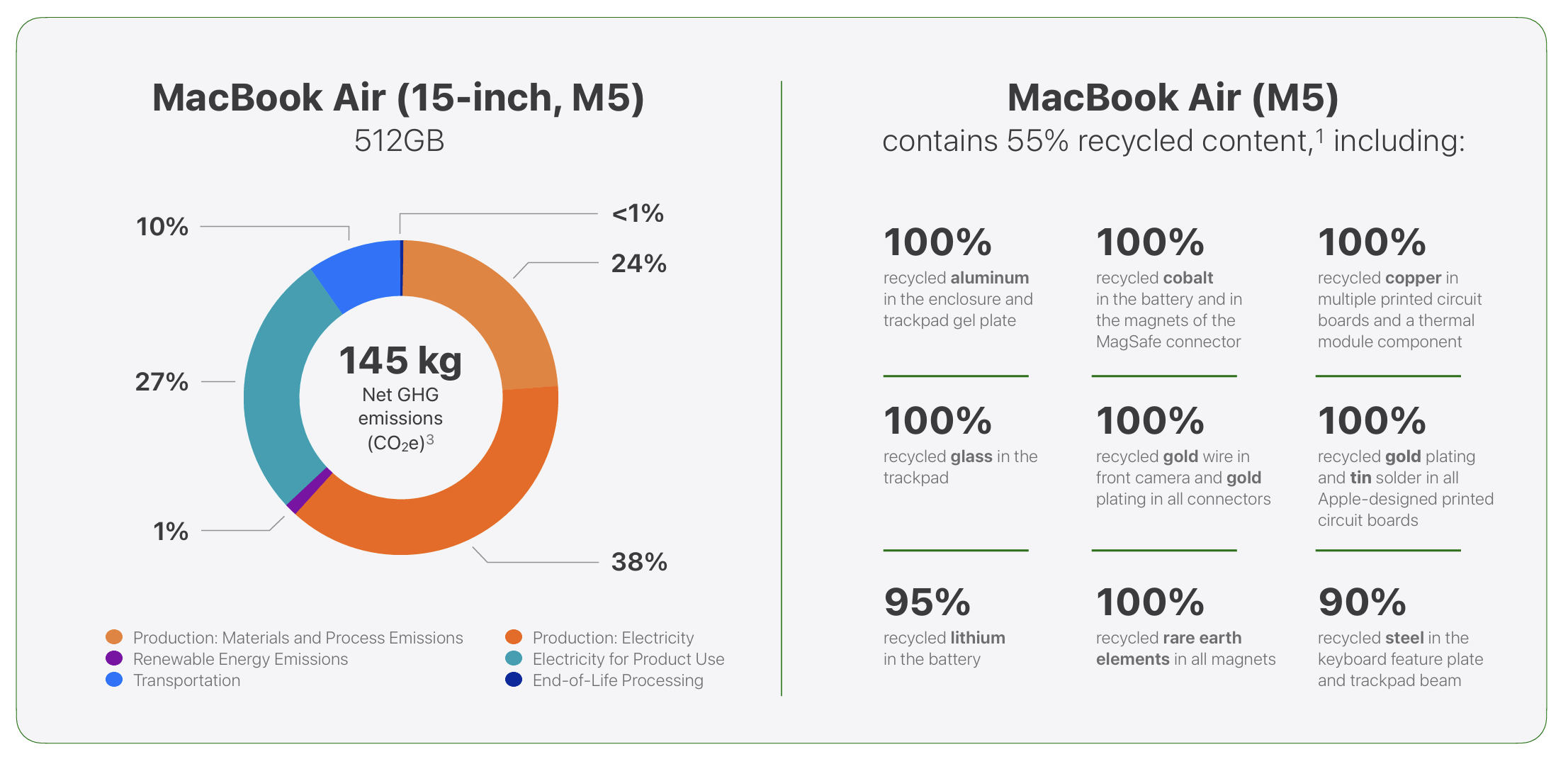
Apple offers a comprehensive environmental report including data about the CO2 emissions as well as recycled contents. The following image shows exemplary data for the MacBook Air 15 and the highest shown SKU with 24 GB RAM and 1 TB SSD storage has a carbon footprint of 167 kg CO2e.
Display - 60 Hz IPS without PWM


Apple did not change the display, so we still get a 60 Hz IPS screen (2560 x 1664 pixels, 16:10) and offers good image quality, but the low frequency is an issue. The surface is anti-reflective and there is a visible advantage compared to most other glossy screens, which is also noticeable in our outdoor shots below. There is hardly any backlight bleeding and there is no PWM flickering, either, while the response times are inconspicuous. Both the brightness as well as the color temperature can be adjusted automatically.
The brightness is still north of 500 nits, but the black value is a bit high at 0.44, which still results in a good maximum contrast ratio of ~1300:1. Our analysis with the professional CalMAN software shows that the factory calibration is not that great and there is a distinct blue cast in combination with a cool color temperature. This boosts the maximum brightness and is not noticeable when you use True Tone, but it is not ideal for picture editing. We calibrated the panel and managed to improve the accuracy noticeably (the corresponding profile can be downloaded for free in the box below), so picture editing is no problem (P3 & sRGB).
| |||||||||||||||||||||||||
Brightness Distribution: 90 %
Center on Battery: 538 cd/m²
Contrast: 1223:1 (Black: 0.44 cd/m²)
ΔE ColorChecker Calman: 2.1 | ∀{0.5-29.43 Ø4.69}
calibrated: 0.7
ΔE Greyscale Calman: 3.1 | ∀{0.09-98 Ø4.94}
86.3% AdobeRGB 1998 (Argyll 3D)
98.3% sRGB (Argyll 3D)
97.5% Display P3 (Argyll 3D)
Gamma: 2.19
CCT: 7075 K
| Apple MacBook Air 15 M5 IPS, 2880x1864, 15.3", 60 Hz | Apple MacBook Air 15 M4 IPS, 2880x1864, 15.3", 60 Hz | Microsoft Surface Laptop 7 15 Lunar Lake LQ150P1JX61, IPS, 2496x1664, 15", 120 Hz | Lenovo ThinkPad X9-15 Aura Edition ATNA53JB01-0, OLED, 2880x1800, 15.3", 120 Hz | Microsoft Surface Laptop 15 Snapdragon X Elite Sharp LQ150P1JX61, IPS, 2496x1664, 15", 120 Hz | Samsung Galaxy Book4 Edge 16 ATNA60CL07-0, OLED, 2880x1800, 16", 120 Hz | |
|---|---|---|---|---|---|---|
| Display | 2% | 1% | 5% | 6% | ||
| Display P3 Coverage (%) | 97.5 | 98.7 1% | 98.1 1% | 100 3% | 99.5 2% | |
| sRGB Coverage (%) | 98.3 | 100 2% | 100 2% | 100 2% | 100 2% | |
| AdobeRGB 1998 Coverage (%) | 86.3 | 88.3 2% | 87.2 1% | 94.6 10% | 97.5 13% | |
| Response Times | 11% | -8% | 96% | -78% | 97% | |
| Response Time Grey 50% / Grey 80% * (ms) | 26.9 ? | 23.2 ? 14% | 33.4 ? -24% | 1.46 ? 95% | 44.4 ? -65% | 0.64 ? 98% |
| Response Time Black / White * (ms) | 15.9 ? | 14.7 ? 8% | 14.7 ? 8% | 0.44 ? 97% | 30.3 ? -91% | 0.68 ? 96% |
| PWM Frequency (Hz) | 1200 ? | 240 ? | ||||
| PWM Amplitude * (%) | 22 | 50 | ||||
| Screen | 11% | 37% | 538% | 29% | 19% | |
| Brightness middle (cd/m²) | 538 | 525 -2% | 599 11% | 509 -5% | 579.9 8% | 385 -28% |
| Brightness (cd/m²) | 521 | 513 -2% | 590 13% | 508 -2% | 576 11% | 391 -25% |
| Brightness Distribution (%) | 90 | 87 -3% | 93 3% | 97 8% | 92 2% | 97 8% |
| Black Level * (cd/m²) | 0.44 | 0.32 27% | 0.4 9% | 0.01 98% | 0.34 23% | |
| Contrast (:1) | 1223 | 1641 34% | 1498 22% | 50900 4062% | 1706 39% | |
| Colorchecker dE 2000 * | 2.1 | 1.7 19% | 0.5 76% | 1.1 48% | 0.96 54% | 1.1 48% |
| Colorchecker dE 2000 max. * | 4.1 | 4 2% | 0.9 78% | 2.5 39% | 2.39 42% | 1.8 56% |
| Colorchecker dE 2000 calibrated * | 0.7 | |||||
| Greyscale dE 2000 * | 3.1 | 2.7 13% | 0.6 81% | 1.5 52% | 1.4 55% | 1.4 55% |
| Gamma | 2.19 100% | 2.2 100% | 2.16 102% | 2.28 96% | 2.13 103% | 2.24 98% |
| CCT | 7075 92% | 7010 93% | 6543 99% | 6294 103% | 6407 101% | 6444 101% |
| Total Average (Program / Settings) | 8% /
9% | 10% /
22% | 213% /
347% | -25% /
8% | 41% /
30% |
* ... smaller is better


Display Response Times
| ↔ Response Time Black to White | ||
|---|---|---|
| 15.9 ms ... rise ↗ and fall ↘ combined | ↗ 4.9 ms rise | 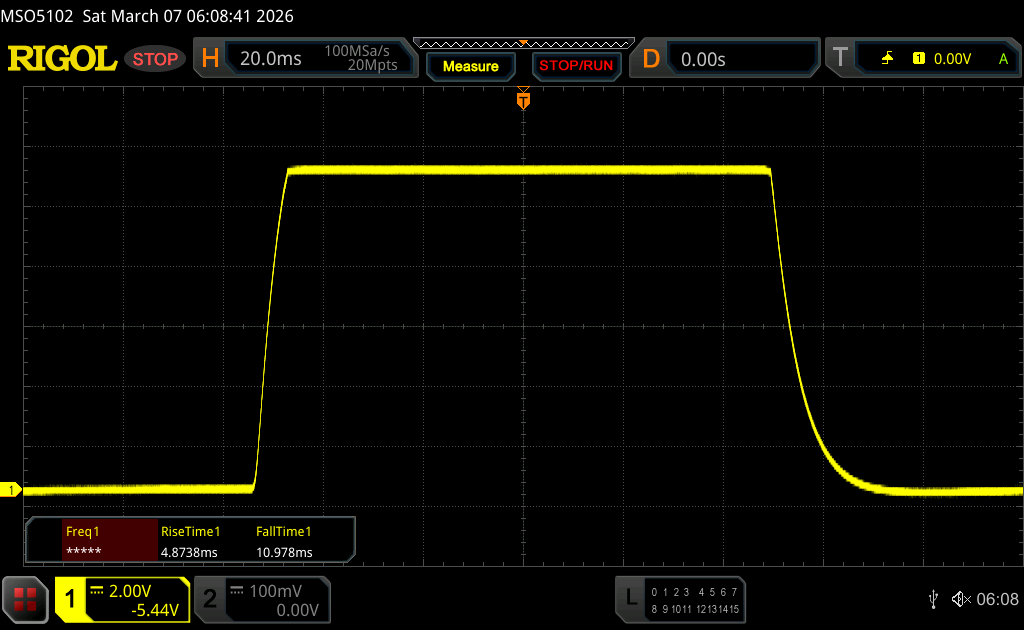 |
| ↘ 11 ms fall | ||
| The screen shows good response rates in our tests, but may be too slow for competitive gamers. In comparison, all tested devices range from 0.1 (minimum) to 240 (maximum) ms. » 38 % of all devices are better. This means that the measured response time is better than the average of all tested devices (19.6 ms). | ||
| ↔ Response Time 50% Grey to 80% Grey | ||
| 26.9 ms ... rise ↗ and fall ↘ combined | ↗ 13.4 ms rise | 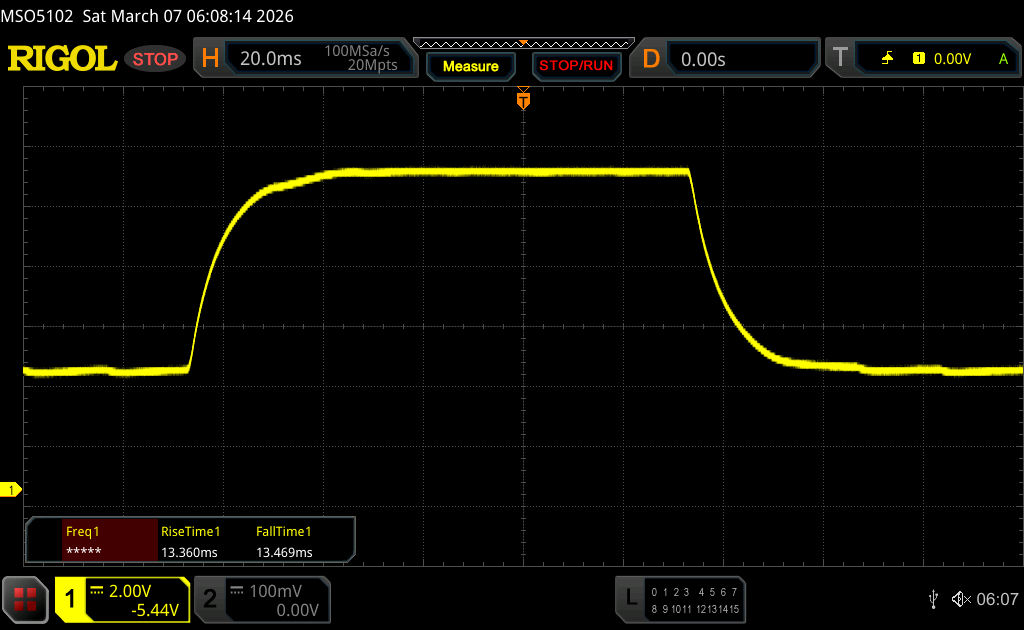 |
| ↘ 13.5 ms fall | ||
| The screen shows relatively slow response rates in our tests and may be too slow for gamers. In comparison, all tested devices range from 0.13 (minimum) to 636 (maximum) ms. » 37 % of all devices are better. This means that the measured response time is better than the average of all tested devices (30.7 ms). | ||
Screen Flickering / PWM (Pulse-Width Modulation)
| Screen flickering / PWM not detected | 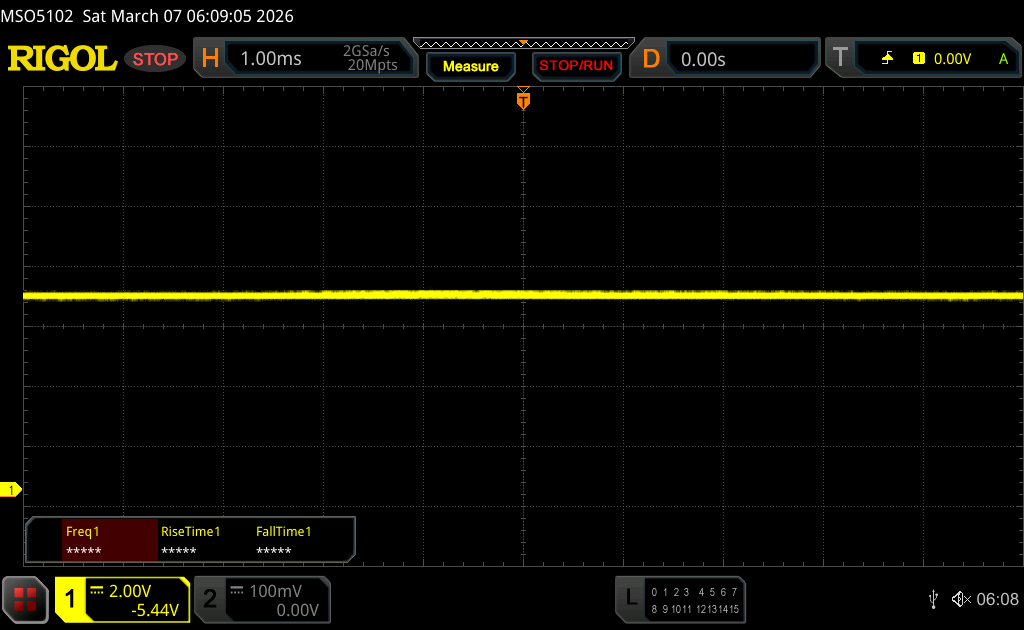 | ||
In comparison: 52 % of all tested devices do not use PWM to dim the display. If PWM was detected, an average of 7597 (minimum: 5 - maximum: 343500) Hz was measured. | |||


Performance - Apple M5 with 10-core GPU
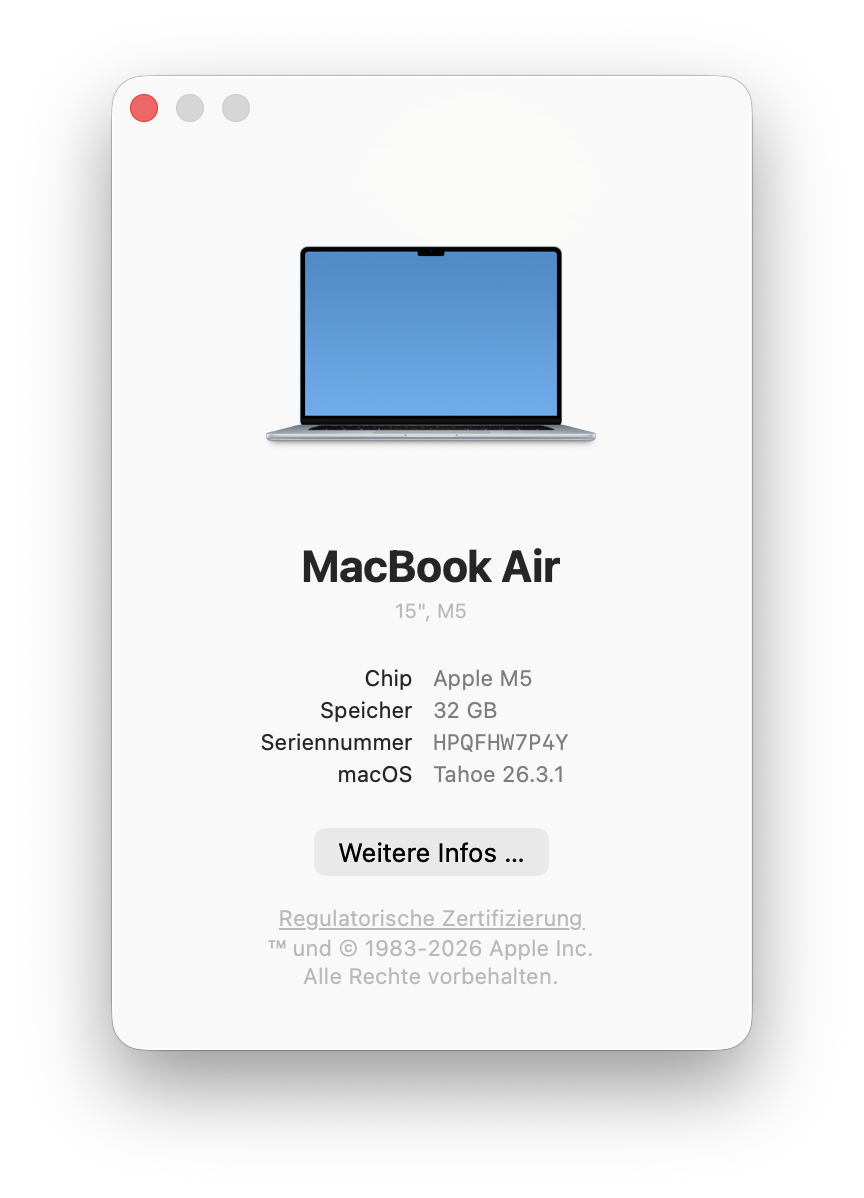
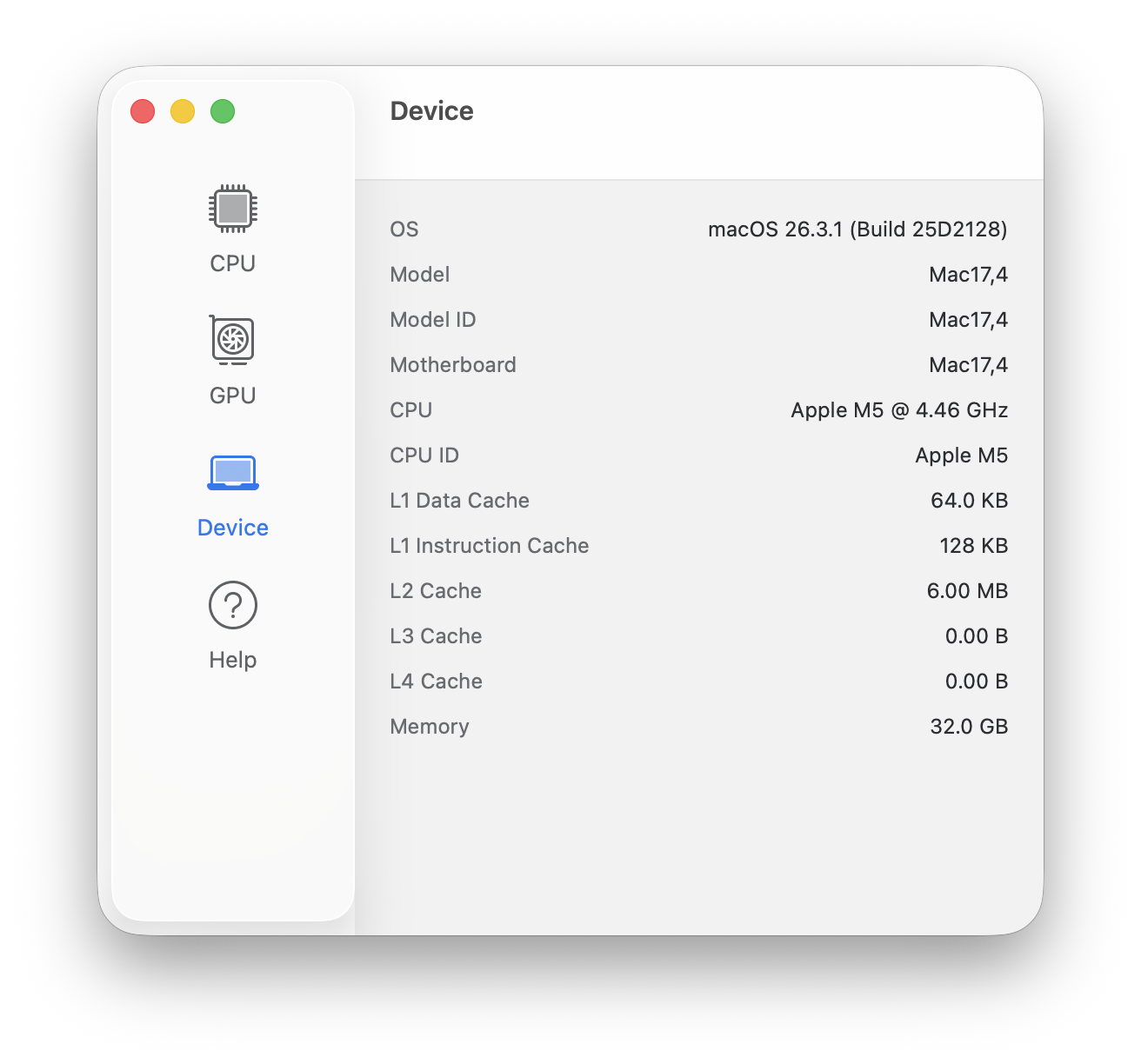
Processor
The CPU performance of the new Apple M5 (4 super cores, 6 efficiency cores) is very impressive and it is the fastest single-core processor you can buy with quite a margin. The multi-core performance is also very good, even though the system has to reduce the power limit quite quickly. The deficit compared to the MacBook Pro 14 M5 with active cooling is still only 18 % during the Cinebench 2024 Multi test, which takes a couple of minutes. After the stress test of CB24 Multi (30 minutes), the result is still just ~10 % lower.
Across our CPU benchmarks, the new M5 model is 14 % faster compared to the MacBook Air 15 M4 and 43 % faster compared to the MacBook Air 15 M3. The CPU performance is not reduced on battery power.
Cinebench 2024: CPU Multi Core | CPU Single Core
Geekbench 6.7: Multi-Core | Single-Core
| CPU Performance rating | |
| Apple MacBook Pro 14 2025 M5 | |
| Average Apple M5 10-Core | |
| Apple MacBook Air 15 M5 | |
| Apple MacBook Air 15 M4 | |
| Samsung Galaxy Book4 Edge 16 | |
| Apple MacBook Air 15 M3 | |
| Average of class Subnotebook | |
| Microsoft Surface Laptop 15 Snapdragon X Elite | |
| Microsoft Surface Laptop 7 15 Lunar Lake | |
| Lenovo ThinkPad X9-15 Aura Edition | |
| Apple MacBook Air 15 2023 M2 16 GB | |
| Cinebench 2024 / CPU Multi Core | |
| Apple MacBook Pro 14 2025 M5 | |
| Average Apple M5 10-Core (957 - 1172, n=3) | |
| Apple MacBook Air 15 M5 | |
| Microsoft Surface Laptop 15 Snapdragon X Elite | |
| Apple MacBook Air 15 M4 | |
| Samsung Galaxy Book4 Edge 16 | |
| Average of class Subnotebook (416 - 1471, n=52, last 2 years) | |
| Microsoft Surface Laptop 7 15 Lunar Lake | |
| Apple MacBook Air 15 M3 | |
| Lenovo ThinkPad X9-15 Aura Edition | |
| Apple MacBook Air 15 2023 M2 16 GB | |
| Cinebench 2024 / CPU Single Core | |
| Apple MacBook Pro 14 2025 M5 | |
| Average Apple M5 10-Core (199 - 200, n=3) | |
| Apple MacBook Air 15 M5 | |
| Apple MacBook Air 15 M4 | |
| Apple MacBook Air 15 M3 | |
| Microsoft Surface Laptop 7 15 Lunar Lake | |
| Samsung Galaxy Book4 Edge 16 | |
| Microsoft Surface Laptop 15 Snapdragon X Elite | |
| Average of class Subnotebook (83 - 200, n=50, last 2 years) | |
| Apple MacBook Air 15 2023 M2 16 GB | |
| Lenovo ThinkPad X9-15 Aura Edition | |
System Performance
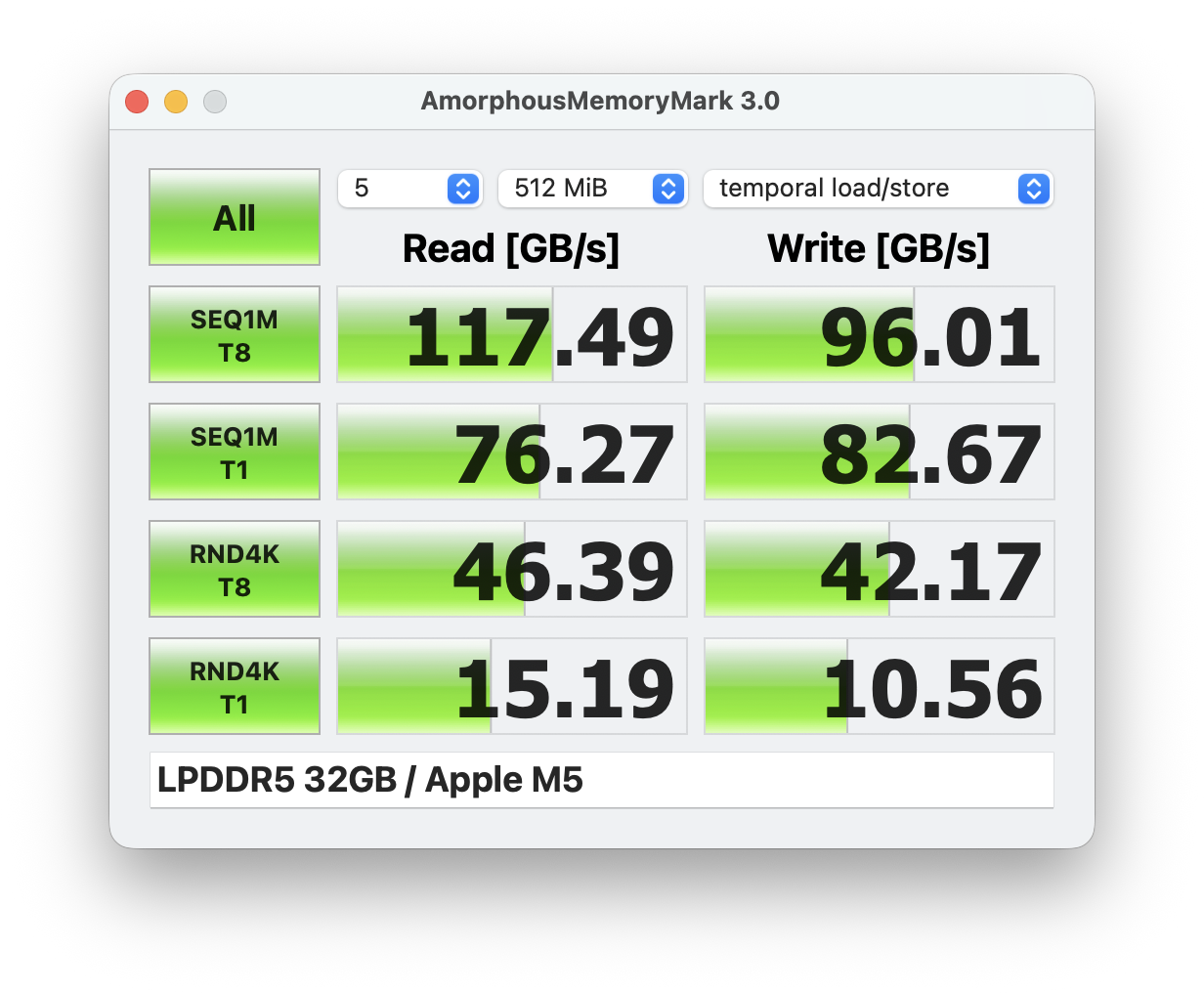
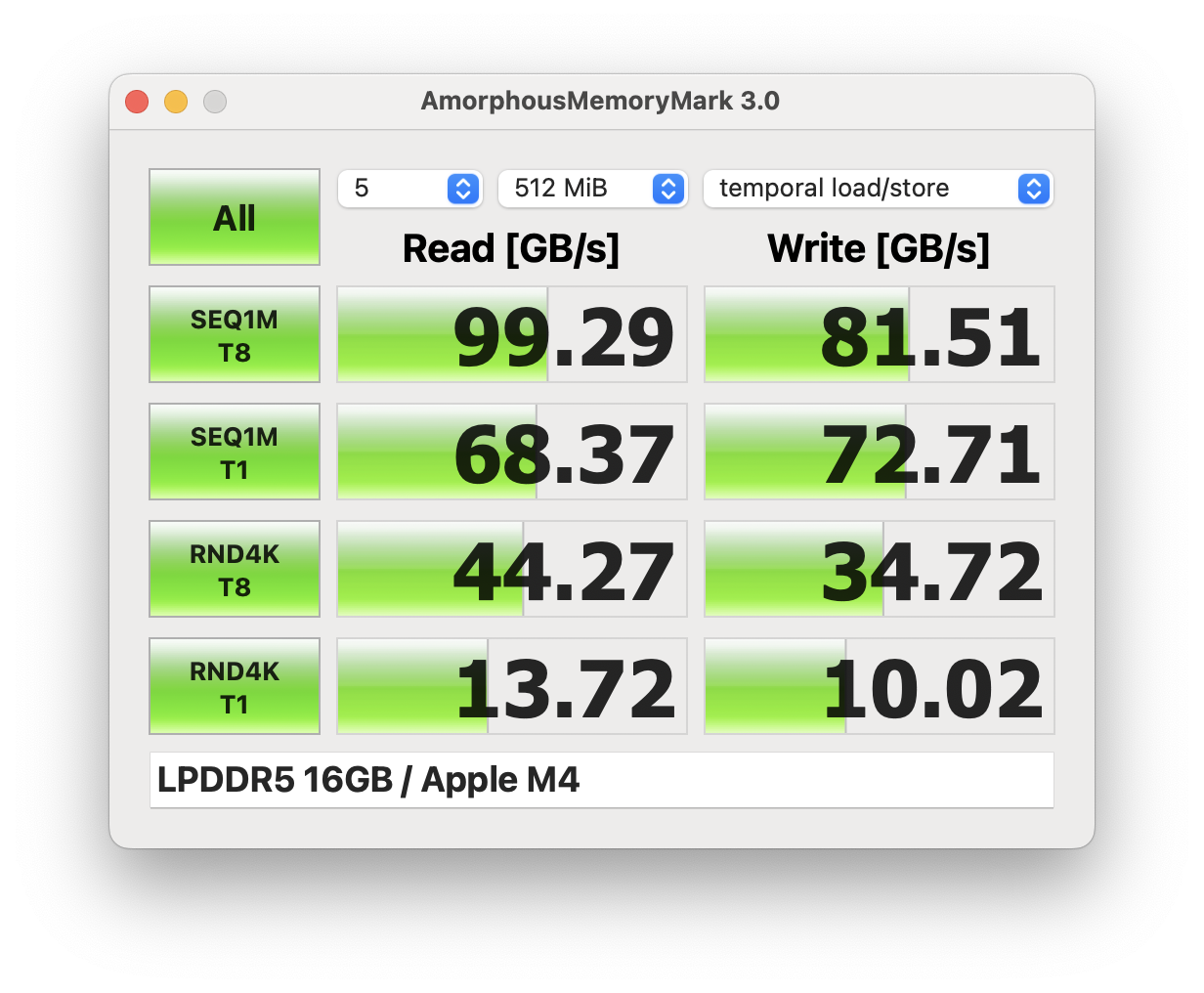
The subjective system performance is excellent and the benchmark results support this impression. Apple also increased the memory bandwidth compared to the M4. Overall, you will not notice a difference compared to the more expensive MacBook Pro models or the much more affordable base model of the MacBook Air 15 M5 in everyday scenarios.
CrossMark: Overall | Productivity | Creativity | Responsiveness
WebXPRT 3: Overall
WebXPRT 4: Overall
Mozilla Kraken 1.1: Total
| Performance rating | |
| Apple MacBook Pro 14 2025 M5 | |
| Apple MacBook Air 15 M5 | |
| Average Apple M5 10-Core, Apple M5 10-Core GPU | |
| Apple MacBook Air 15 M4 | |
| Average of class Subnotebook | |
| Microsoft Surface Laptop 15 Snapdragon X Elite | |
| Microsoft Surface Laptop 7 15 Lunar Lake | |
| Lenovo ThinkPad X9-15 Aura Edition | |
| Samsung Galaxy Book4 Edge 16 | |
| CrossMark / Overall | |
| Apple MacBook Pro 14 2025 M5 | |
| Apple MacBook Air 15 M5 | |
| Average Apple M5 10-Core, Apple M5 10-Core GPU (2129 - 2426, n=3) | |
| Apple MacBook Air 15 M4 | |
| Lenovo ThinkPad X9-15 Aura Edition | |
| Microsoft Surface Laptop 7 15 Lunar Lake | |
| Average of class Subnotebook (1061 - 2356, n=57, last 2 years) | |
| Microsoft Surface Laptop 15 Snapdragon X Elite | |
| Samsung Galaxy Book4 Edge 16 | |
| CrossMark / Productivity | |
| Apple MacBook Pro 14 2025 M5 | |
| Apple MacBook Air 15 M5 | |
| Average Apple M5 10-Core, Apple M5 10-Core GPU (2036 - 2344, n=3) | |
| Apple MacBook Air 15 M4 | |
| Lenovo ThinkPad X9-15 Aura Edition | |
| Microsoft Surface Laptop 7 15 Lunar Lake | |
| Average of class Subnotebook (1022 - 2277, n=57, last 2 years) | |
| Microsoft Surface Laptop 15 Snapdragon X Elite | |
| Samsung Galaxy Book4 Edge 16 | |
| CrossMark / Creativity | |
| Apple MacBook Pro 14 2025 M5 | |
| Apple MacBook Air 15 M5 | |
| Average Apple M5 10-Core, Apple M5 10-Core GPU (2620 - 2820, n=3) | |
| Apple MacBook Air 15 M4 | |
| Lenovo ThinkPad X9-15 Aura Edition | |
| Microsoft Surface Laptop 7 15 Lunar Lake | |
| Average of class Subnotebook (1070 - 2743, n=57, last 2 years) | |
| Samsung Galaxy Book4 Edge 16 | |
| Microsoft Surface Laptop 15 Snapdragon X Elite | |
| CrossMark / Responsiveness | |
| Apple MacBook Pro 14 2025 M5 | |
| Apple MacBook Air 15 M5 | |
| Average Apple M5 10-Core, Apple M5 10-Core GPU (1307 - 1712, n=3) | |
| Apple MacBook Air 15 M4 | |
| Average of class Subnotebook (1010 - 1873, n=57, last 2 years) | |
| Lenovo ThinkPad X9-15 Aura Edition | |
| Microsoft Surface Laptop 15 Snapdragon X Elite | |
| Microsoft Surface Laptop 7 15 Lunar Lake | |
| Samsung Galaxy Book4 Edge 16 | |
| WebXPRT 3 / Overall | |
| Apple MacBook Pro 14 2025 M5 | |
| Apple MacBook Air 15 M5 | |
| Average Apple M5 10-Core, Apple M5 10-Core GPU (480 - 540, n=3) | |
| Apple MacBook Air 15 M4 | |
| Samsung Galaxy Book4 Edge 16 | |
| Microsoft Surface Laptop 15 Snapdragon X Elite | |
| Average of class Subnotebook (203 - 530, n=55, last 2 years) | |
| Microsoft Surface Laptop 7 15 Lunar Lake | |
| Lenovo ThinkPad X9-15 Aura Edition | |
| WebXPRT 4 / Overall | |
| Apple MacBook Pro 14 2025 M5 | |
| Average Apple M5 10-Core, Apple M5 10-Core GPU (376 - 384, n=3) | |
| Apple MacBook Air 15 M5 | |
| Apple MacBook Air 15 M4 | |
| Microsoft Surface Laptop 15 Snapdragon X Elite | |
| Samsung Galaxy Book4 Edge 16 | |
| Microsoft Surface Laptop 7 15 Lunar Lake | |
| Lenovo ThinkPad X9-15 Aura Edition | |
| Average of class Subnotebook (167.3 - 378, n=59, last 2 years) | |
| Mozilla Kraken 1.1 / Total | |
| Microsoft Surface Laptop 7 15 Lunar Lake | |
| Lenovo ThinkPad X9-15 Aura Edition | |
| Average of class Subnotebook (234 - 709, n=60, last 2 years) | |
| Samsung Galaxy Book4 Edge 16 | |
| Microsoft Surface Laptop 15 Snapdragon X Elite | |
| Apple MacBook Air 15 M4 | |
| Apple MacBook Air 15 M5 | |
| Average Apple M5 10-Core, Apple M5 10-Core GPU (228 - 243, n=3) | |
| Apple MacBook Pro 14 2025 M5 | |
* ... smaller is better
Storage Devices
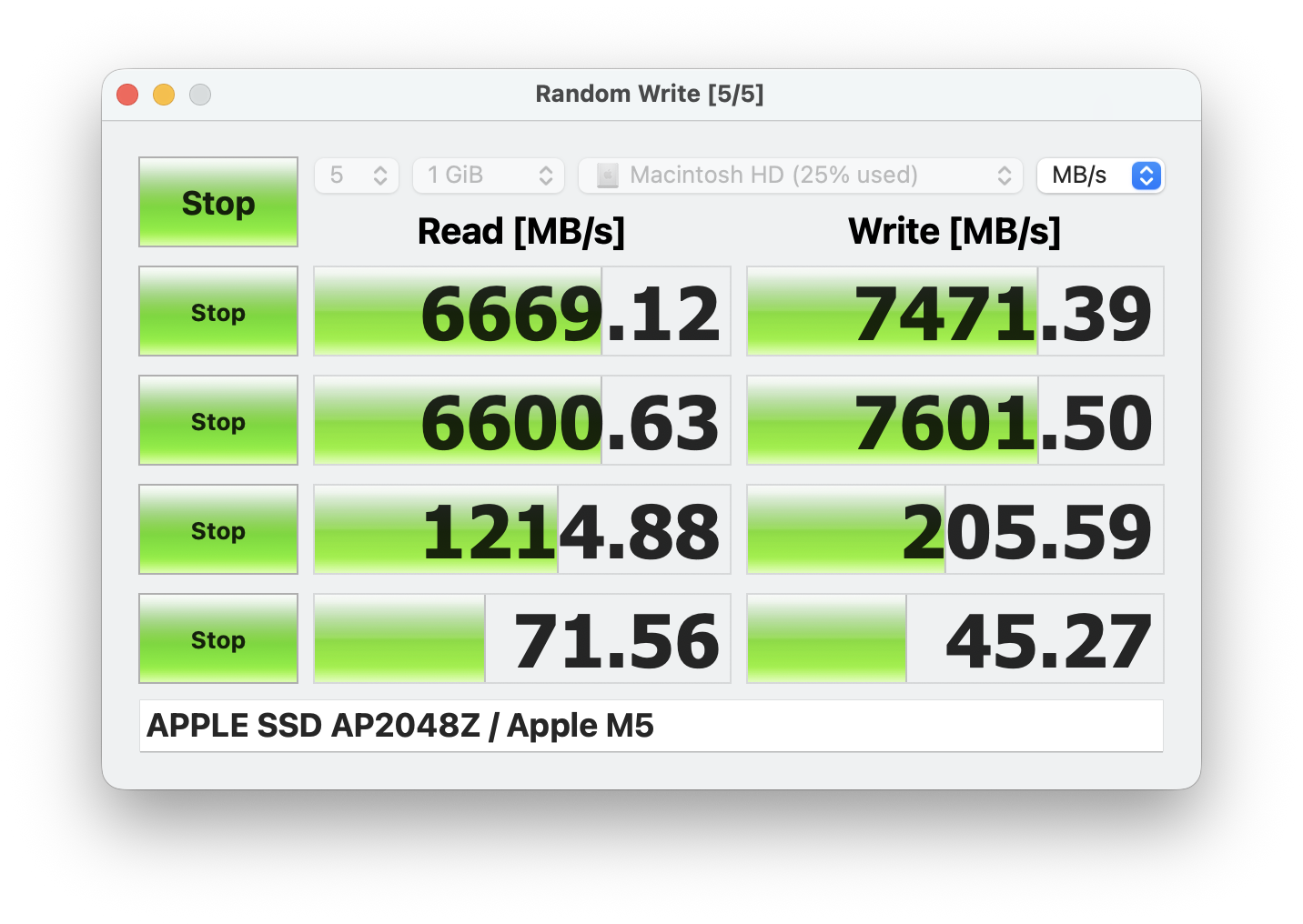
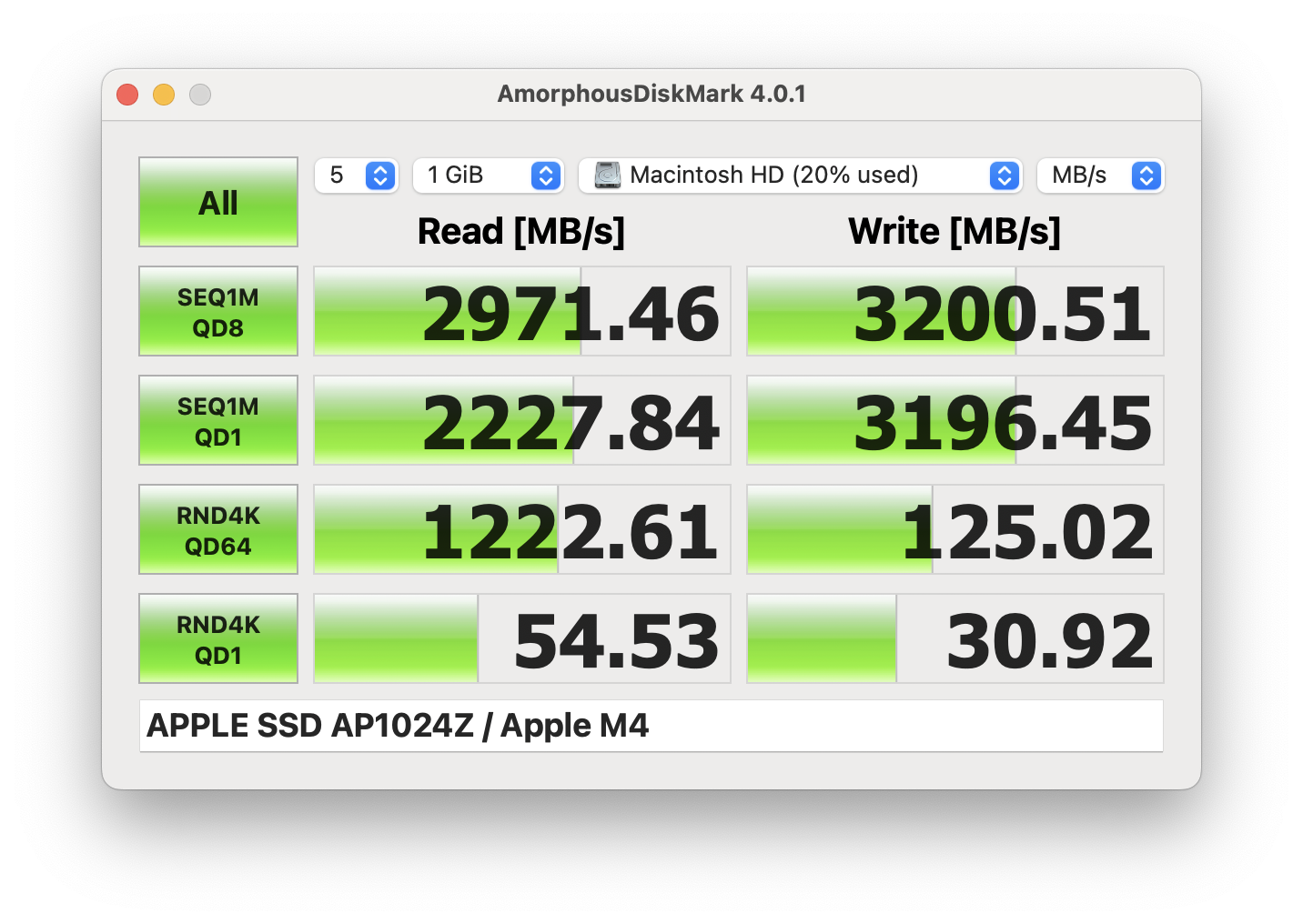
The base model now gets 512 GB SSD storage by default, and the speed was improved to PCIe 4.0, so the transfer rates are on par with the MacBook Pro models at around 7 GB/s. Our review unit is equipped with the 2 TB drive, which is a pricey upgrade ($600). The SSD-chips are once again soldered, but the maximum capacity was increased from 2 to 4 TB for the M5 generation.
GPU Performance
The MacBook Air 15 gets the faster M5 SoC with the 10-core GPU like the MacBook Pro 14 M5. The performance in short benchmarks is very good and we only see a deficit of up to 5 %, while the advantage over the previous MacBook Air 15 M4 is at least 30 %. However, the performance is not stable and it will drop by around 23 % in the 3DMark stress test (Steel Nomad Light).
The gaming performance on the other hand is completely stable since the SoC simply does not consume so much power to begin with (~8 Watt in games like Cyberpunk 2077, Assassin's Creed Shadows or Baldur's Gate 3). We already saw this behavior on the smaller MacBook Air 13 M5 and the result is that the gaming performance is completely stable, even during longer gaming sessions. If you reduce the details, the Air M5 can even handle these demanding games without throttling and while being completely silent.
| 3DMark Steel Nomad Score | 1070 points | |
| 3DMark Steel Nomad Light Score | 5084 points | |
Help | ||
| Blender / v3.3 Classroom METAL | |
| Apple MacBook Air 15 2023 M2 16 GB | |
| Apple MacBook Air 15 M3 | |
| Average of class Subnotebook (76.3 - 227, n=5, last 2 years) | |
| Apple MacBook Air 15 M4 | |
| Apple MacBook Air 15 M5 | |
| Average Apple M5 10-Core GPU (68 - 76.3, n=2) | |
| Apple MacBook Pro 14 2025 M5 | |
| Blender / v3.3 Classroom CPU | |
| Apple MacBook Air 15 2023 M2 16 GB | |
| Microsoft Surface Laptop 15 Snapdragon X Elite | |
| Lenovo ThinkPad X9-15 Aura Edition | |
| Microsoft Surface Laptop 7 15 Lunar Lake | |
| Average of class Subnotebook (280 - 1117, n=60, last 2 years) | |
| Apple MacBook Air 15 M3 | |
| Apple MacBook Pro 14 2025 M5 | |
| Apple MacBook Air 15 M4 | |
| Average Apple M5 10-Core GPU (344 - 429, n=2) | |
| Apple MacBook Air 15 M5 | |
* ... smaller is better
| Assassin's Creed Shadows - 1920x1080 Low | |
| Apple MacBook Pro 14 2025 M5 | |
| Apple MacBook Air 15 M5 | |
| Average of class Subnotebook (17 - 26, n=4, last 2 years) | |
| Lenovo ThinkPad X9-15 Aura Edition | |
| Total War Pharaoh - 1920x1080 Ultra Preset | |
| Apple MacBook Pro 14 2025 M5 | |
| Apple MacBook Air 15 M5 | |
| Apple MacBook Air 15 M4 | |
| Apple MacBook Air 15 M3 | |
| Average of class Subnotebook (14.9 - 71.1, n=8, last 2 years) | |
| Shadow of the Tomb Raider - 1920x1080 Highest Preset AA:T | |
| Apple MacBook Pro 14 2025 M5 | |
| Apple MacBook Air 15 M5 | |
| Lenovo ThinkPad X9-15 Aura Edition | |
| Apple MacBook Air 15 M4 | |
| Average of class Subnotebook (17 - 42, n=6, last 2 years) | |
| Apple MacBook Air 15 M3 | |
| Apple MacBook Air 15 2023 M2 16 GB | |
| low | med. | high | ultra | |
|---|---|---|---|---|
| Shadow of the Tomb Raider (2018) | 99 | 54 | 48 | 42 |
| Baldur's Gate 3 (2023) | 60.3 | 49.8 | 41 | 39.4 |
| Cyberpunk 2077 (2023) | 42.6 | 32.5 | 27.1 | 23.3 |
| Total War Pharaoh (2023) | 50.9 | 47.5 | ||
| Assassin's Creed Shadows (2025) | 26 | 23 | 20 | 13 |
Emissions & Power Consumption
System Noise
The MacBook Air still uses a fanless cooling unit, so the laptop is always silent and we did not experience any other electronic noises, either. This is a huge advantage over Windows competitors.
| Apple MacBook Air 15 M5 M5 10-Core, M5 10-Core GPU | Microsoft Surface Laptop 7 15 Lunar Lake Core Ultra 7 268V, Arc 140V | Lenovo ThinkPad X9-15 Aura Edition Core Ultra 7 258V, Arc 140V | Microsoft Surface Laptop 15 Snapdragon X Elite SD X Elite X1E-80-100, Adreno X1-85 3.8 TFLOPS | Samsung Galaxy Book4 Edge 16 SD X Elite X1E-80-100, Adreno X1-85 3.8 TFLOPS | |
|---|---|---|---|---|---|
| Noise | |||||
| off / environment * (dB) | 23.9 | 24.4 | 23.3 | 24.6 | |
| Idle Minimum * (dB) | 23.9 | 24.4 | 23.3 | 24.6 | |
| Idle Average * (dB) | 23.9 | 24.4 | 23.3 | 24.6 | |
| Idle Maximum * (dB) | 23.9 | 24.4 | 23.3 | 24.6 | |
| Load Average * (dB) | 31.8 | 35.8 | 25.7 | 28.1 | |
| Cyberpunk 2077 ultra * (dB) | 38 | 39.4 | 31.1 | 32.4 | |
| Load Maximum * (dB) | 41.9 | 45 | 33.2 | 32.4 |
* ... smaller is better
Temperature
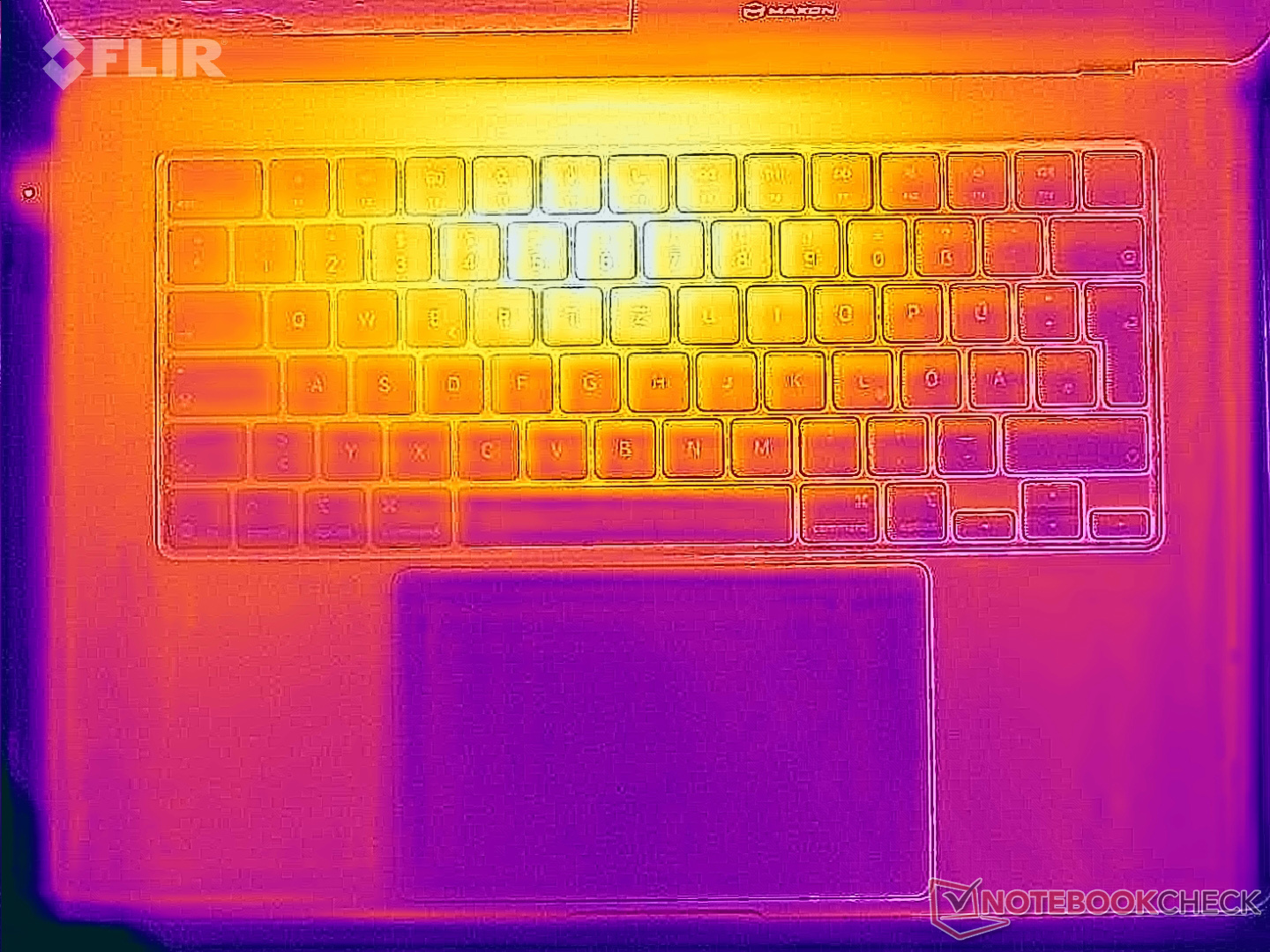
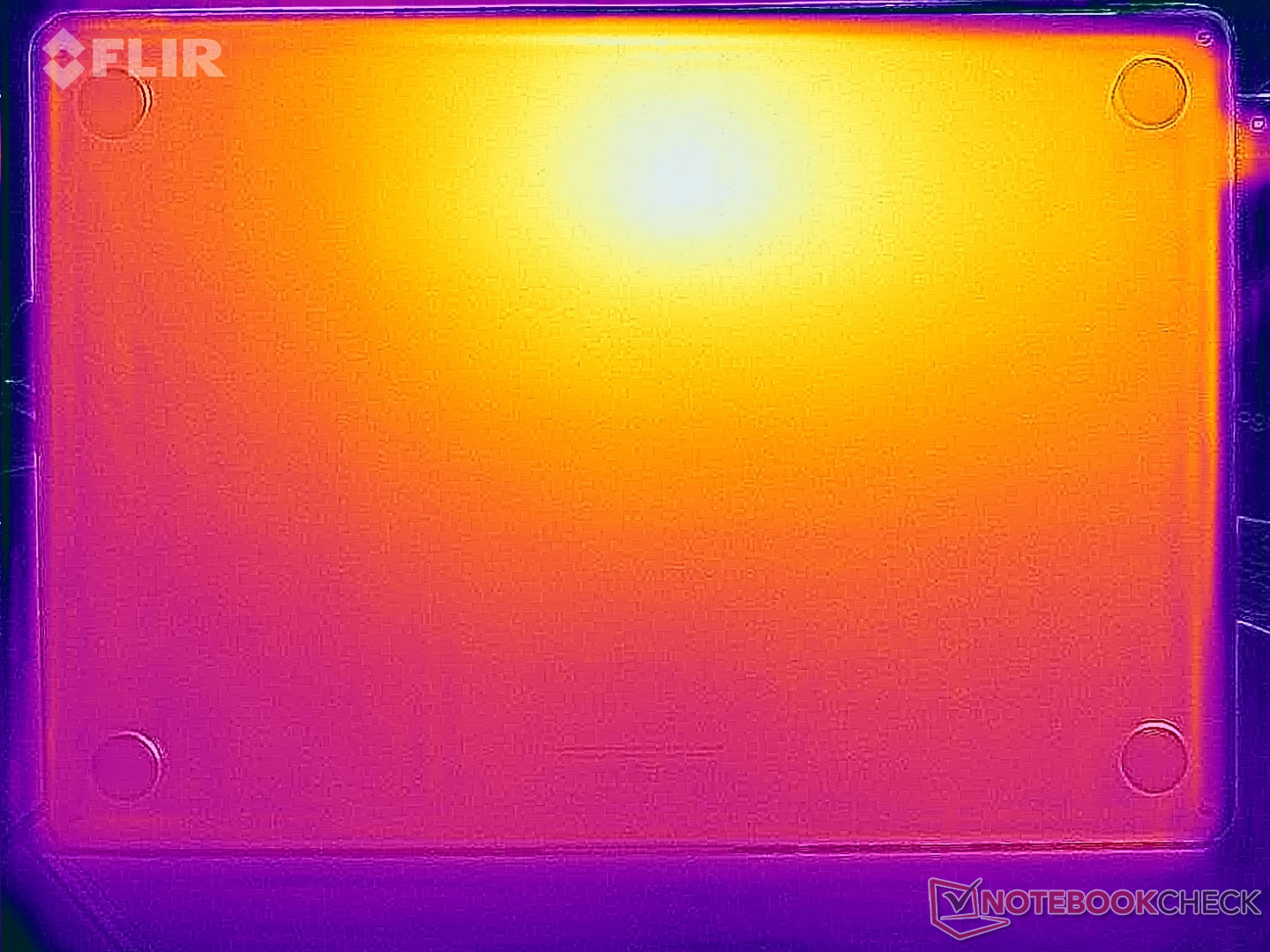
Surface temperatures are absolutely no problem and the MacBook Air usually stays very cool. If you really stress it, it will warm up to slightly more than 40 °C, but that is no problem. During our stress test with combined CPU/GPU load, the M5 SoC consumes up to 28 Watts and then quickly levels off at around 9 Watts after around 20 minutes.
(±) The maximum temperature on the upper side is 44.1 °C / 111 F, compared to the average of 35.9 °C / 97 F, ranging from 21.4 to 59 °C for the class Subnotebook.
(±) The bottom heats up to a maximum of 43.1 °C / 110 F, compared to the average of 39.2 °C / 103 F
(+) In idle usage, the average temperature for the upper side is 23.7 °C / 75 F, compared to the device average of 30.8 °C / 87 F.
(±) 3: The average temperature for the upper side is 36.6 °C / 98 F, compared to the average of 30.8 °C / 87 F for the class Subnotebook.
(+) The palmrests and touchpad are reaching skin temperature as a maximum (33.3 °C / 91.9 F) and are therefore not hot.
(-) The average temperature of the palmrest area of similar devices was 28.2 °C / 82.8 F (-5.1 °C / -9.1 F).
| Apple MacBook Air 15 M5 M5 10-Core, M5 10-Core GPU | Apple MacBook Air 15 M4 M4 10-Core, M4 10-Core GPU | Microsoft Surface Laptop 7 15 Lunar Lake Core Ultra 7 268V, Arc 140V | Lenovo ThinkPad X9-15 Aura Edition Core Ultra 7 258V, Arc 140V | Microsoft Surface Laptop 15 Snapdragon X Elite SD X Elite X1E-80-100, Adreno X1-85 3.8 TFLOPS | Samsung Galaxy Book4 Edge 16 SD X Elite X1E-80-100, Adreno X1-85 3.8 TFLOPS | |
|---|---|---|---|---|---|---|
| Heat | 0% | 0% | 2% | 7% | -8% | |
| Maximum Upper Side * (°C) | 44.1 | 44.9 -2% | 45.7 -4% | 42.1 5% | 45.4 -3% | 44.3 -0% |
| Maximum Bottom * (°C) | 43.1 | 43.9 -2% | 42.9 -0% | 39.5 8% | 37.2 14% | 51.6 -20% |
| Idle Upper Side * (°C) | 24 | 23.4 2% | 23.6 2% | 24.5 -2% | 22.4 7% | 25.1 -5% |
| Idle Bottom * (°C) | 23.9 | 23.5 2% | 23.1 3% | 24.4 -2% | 22 8% | 25.8 -8% |
* ... smaller is better
Speakers
The speaker system of the MacBook Air 15 is once again excellent and also a bit better compared to the smaller MacBook Air 13.
Apple MacBook Air 15 M5 audio analysis
(+) | speakers can play relatively loud (84.8 dB)
Bass 100 - 315 Hz
(±) | reduced bass - on average 6.8% lower than median
(+) | bass is linear (6.6% delta to prev. frequency)
Mids 400 - 2000 Hz
(+) | balanced mids - only 2% away from median
(+) | mids are linear (3.3% delta to prev. frequency)
Highs 2 - 16 kHz
(+) | balanced highs - only 3.6% away from median
(+) | highs are linear (3.2% delta to prev. frequency)
Overall 100 - 16.000 Hz
(+) | overall sound is linear (7.7% difference to median)
Compared to same class
» 2% of all tested devices in this class were better, 0% similar, 98% worse
» The best had a delta of 5%, average was 18%, worst was 53%
Compared to all devices tested
» 1% of all tested devices were better, 0% similar, 98% worse
» The best had a delta of 4%, average was 23%, worst was 136%
Apple MacBook Air 15 M4 audio analysis
(+) | speakers can play relatively loud (85.8 dB)
Bass 100 - 315 Hz
(±) | reduced bass - on average 8.2% lower than median
(±) | linearity of bass is average (9.4% delta to prev. frequency)
Mids 400 - 2000 Hz
(+) | balanced mids - only 1.6% away from median
(+) | mids are linear (2.4% delta to prev. frequency)
Highs 2 - 16 kHz
(+) | balanced highs - only 4.2% away from median
(+) | highs are linear (4.3% delta to prev. frequency)
Overall 100 - 16.000 Hz
(+) | overall sound is linear (8% difference to median)
Compared to same class
» 2% of all tested devices in this class were better, 1% similar, 97% worse
» The best had a delta of 5%, average was 18%, worst was 53%
Compared to all devices tested
» 2% of all tested devices were better, 1% similar, 98% worse
» The best had a delta of 4%, average was 23%, worst was 136%
Microsoft Surface Laptop 7 15 Lunar Lake audio analysis
(±) | speaker loudness is average but good (78.8 dB)
Bass 100 - 315 Hz
(±) | reduced bass - on average 9.3% lower than median
(±) | linearity of bass is average (8.4% delta to prev. frequency)
Mids 400 - 2000 Hz
(+) | balanced mids - only 4.4% away from median
(+) | mids are linear (3% delta to prev. frequency)
Highs 2 - 16 kHz
(+) | balanced highs - only 2.4% away from median
(+) | highs are linear (4.1% delta to prev. frequency)
Overall 100 - 16.000 Hz
(+) | overall sound is linear (11.4% difference to median)
Compared to same class
» 4% of all tested devices in this class were better, 2% similar, 94% worse
» The best had a delta of 7%, average was 21%, worst was 53%
Compared to all devices tested
» 8% of all tested devices were better, 2% similar, 90% worse
» The best had a delta of 4%, average was 23%, worst was 136%
Lenovo ThinkPad X9-15 Aura Edition audio analysis
(+) | speakers can play relatively loud (87.5 dB)
Bass 100 - 315 Hz
(±) | reduced bass - on average 12.5% lower than median
(+) | bass is linear (6.8% delta to prev. frequency)
Mids 400 - 2000 Hz
(+) | balanced mids - only 3.1% away from median
(+) | mids are linear (5.3% delta to prev. frequency)
Highs 2 - 16 kHz
(+) | balanced highs - only 2.4% away from median
(+) | highs are linear (3.3% delta to prev. frequency)
Overall 100 - 16.000 Hz
(+) | overall sound is linear (9.5% difference to median)
Compared to same class
» 1% of all tested devices in this class were better, 0% similar, 99% worse
» The best had a delta of 7%, average was 21%, worst was 53%
Compared to all devices tested
» 4% of all tested devices were better, 1% similar, 95% worse
» The best had a delta of 4%, average was 23%, worst was 136%
Microsoft Surface Laptop 15 Snapdragon X Elite audio analysis
(±) | speaker loudness is average but good (81 dB)
Bass 100 - 315 Hz
(±) | reduced bass - on average 11.7% lower than median
(±) | linearity of bass is average (9.1% delta to prev. frequency)
Mids 400 - 2000 Hz
(+) | balanced mids - only 3.3% away from median
(+) | mids are linear (3.2% delta to prev. frequency)
Highs 2 - 16 kHz
(+) | balanced highs - only 3.1% away from median
(+) | highs are linear (6.3% delta to prev. frequency)
Overall 100 - 16.000 Hz
(+) | overall sound is linear (11.4% difference to median)
Compared to same class
» 4% of all tested devices in this class were better, 2% similar, 94% worse
» The best had a delta of 7%, average was 21%, worst was 53%
Compared to all devices tested
» 8% of all tested devices were better, 2% similar, 90% worse
» The best had a delta of 4%, average was 23%, worst was 136%
Samsung Galaxy Book4 Edge 16 audio analysis
(±) | speaker loudness is average but good (81.8 dB)
Bass 100 - 315 Hz
(±) | reduced bass - on average 10.6% lower than median
(±) | linearity of bass is average (11% delta to prev. frequency)
Mids 400 - 2000 Hz
(+) | balanced mids - only 4% away from median
(+) | mids are linear (3.9% delta to prev. frequency)
Highs 2 - 16 kHz
(+) | balanced highs - only 3.1% away from median
(±) | linearity of highs is average (7.2% delta to prev. frequency)
Overall 100 - 16.000 Hz
(+) | overall sound is linear (11.5% difference to median)
Compared to same class
» 18% of all tested devices in this class were better, 4% similar, 78% worse
» The best had a delta of 5%, average was 17%, worst was 45%
Compared to all devices tested
» 8% of all tested devices were better, 2% similar, 90% worse
» The best had a delta of 4%, average was 23%, worst was 136%
Power Consumption
The power consumption figures did not really change compared to the previous model and there are no surprises here. The 35W PSU is a limiting factor for a couple of seconds during our stress test, but the consumption quickly levels off at around 30.5 Watts.
| Off / Standby |   0.17 / 0.31 Watt 0.17 / 0.31 Watt |
| Idle |  2.2 / 11.7 / 11.8 Watt 2.2 / 11.7 / 11.8 Watt |
| Load |
36.2 / 37.4 Watt |
    
| |
Key:
min: ,
med: ,
max: Metrahit Energy | |
| Apple MacBook Air 15 M5 M5 10-Core, M5 10-Core GPU, Apple SSD AP2048Z, IPS, 2880x1864, 15.3" | Apple MacBook Air 15 M4 M4 10-Core, M4 10-Core GPU, Apple SSD AP1024Z, IPS, 2880x1864, 15.3" | Microsoft Surface Laptop 7 15 Lunar Lake Core Ultra 7 268V, Arc 140V, Samsung PM9C1a MZ9L81T0HDLB, IPS, 2496x1664, 15" | Lenovo ThinkPad X9-15 Aura Edition Core Ultra 7 258V, Arc 140V, WD PC SN740 SDDQMQD-1T00, OLED, 2880x1800, 15.3" | Microsoft Surface Laptop 15 Snapdragon X Elite SD X Elite X1E-80-100, Adreno X1-85 3.8 TFLOPS, Samsung PM9B1 256GB MZ9L4256HCJQ, IPS, 2496x1664, 15" | Samsung Galaxy Book4 Edge 16 SD X Elite X1E-80-100, Adreno X1-85 3.8 TFLOPS, Kioxia THGJFJT2T85BAT01, OLED, 2880x1800, 16" | Average Apple M5 10-Core GPU | Average of class Subnotebook | |
|---|---|---|---|---|---|---|---|---|
| Power Consumption | -2% | -48% | -21% | -33% | -27% | 11% | -12% | |
| Idle Minimum * (Watt) | 2.2 | 2.2 -0% | 3.2 -45% | 2.4 -9% | 3 -36% | 4.2 -91% | 2.09 ? 5% | 3.53 ? -60% |
| Idle Average * (Watt) | 11.7 | 11.5 2% | 8.7 26% | 3.9 67% | 8.3 29% | 5.6 52% | 8.77 ? 25% | 6.46 ? 45% |
| Idle Maximum * (Watt) | 11.8 | 11.6 2% | 9 24% | 5.1 57% | 8.4 29% | 7.8 34% | 8.85 ? 25% | 7.82 ? 34% |
| Load Average * (Watt) | 36.2 | 34.5 5% | 44.7 -23% | 42.5 -17% | 34.3 5% | 28.3 22% | 31.1 ? 14% | 39.1 ? -8% |
| Cyberpunk 2077 ultra * (Watt) | 23.5 | 24.4 -4% | 51.1 -117% | 43.5 -85% | 45.8 -95% | 38.8 -65% | ||
| Cyberpunk 2077 ultra external monitor * (Watt) | 21.7 | 26.2 -21% | 49.3 -127% | 40.2 -85% | 41 -89% | 38.2 -76% | ||
| Load Maximum * (Watt) | 37.4 | 37.5 -0% | 64.6 -73% | 64.4 -72% | 65.2 -74% | 61.9 -66% | 43.5 ? -16% | 63.8 ? -71% |
* ... smaller is better
Power Consumption Cyberpunk / Stress Test
Power Consumption external Monitor
Battery Life
The battery runtime in our Wi-Fi test at 150 nits is slightly better than before at 17.2 vs. 16.5 hours on the M4 model. The runtime at maximum brightness, however, is pretty much identical at 6.7 hours.
Notebookcheck Rating
Apple MacBook Air 15 M5
- 03/08/2026 v8
Andreas Osthoff
 Total Sustainability Score:
 Potential Competitors in Comparison
Image | Model / Review | Price | Weight | Height | Display |
|---|---|---|---|---|---|
1. 91.6%  | Apple MacBook Air 15 M5 Apple M5 10-Core ⎘ Apple M5 10-Core GPU ⎘ 32 GB Memory, 2048 GB SSD | 1.5 kg | 11.5 mm | 15.30" 2880x1864 224 PPI IPS | |
2. 91.2%  | Apple MacBook Air 15 M4 Apple M4 10-Core ⎘ Apple M4 10-core GPU ⎘ 16 GB Memory, 1024 GB SSD | List Price: 1999€ | 1.5 kg | 11.5 mm | 15.30" 2880x1864 224 PPI IPS |
3. 87.4%  | Microsoft Surface Laptop 7 15 Lunar Lake Intel Core Ultra 7 268V ⎘ Intel Arc Graphics 140V ⎘ 32 GB Memory, 1024 GB SSD | List Price: 2760€ | 1.7 kg | 18.3 mm | 15.00" 2496x1664 200 PPI IPS |
4. 90.1%  | Lenovo ThinkPad X9-15 Aura Edition Intel Core Ultra 7 258V ⎘ Intel Arc Graphics 140V ⎘ 32 GB Memory, 1024 GB SSD | Amazon: List Price: 1989€ | 1.4 kg | 17.7 mm | 15.30" 2880x1800 222 PPI OLED |
5. 84.3%  | Microsoft Surface Laptop 15 Snapdragon X Elite Qualcomm Snapdragon X Elite X1E-80-100 ⎘ Qualcomm SD X Adreno X1-85 3.8 TFLOPS ⎘ 16 GB Memory, 256 GB SSD | List Price: 1100 USD | 1.7 kg | 18.29 mm | 15.00" 2496x1664 200 PPI IPS |
6. 80.2%  | Samsung Galaxy Book4 Edge 16 Qualcomm Snapdragon X Elite X1E-80-100 ⎘ Qualcomm SD X Adreno X1-85 3.8 TFLOPS ⎘ 16 GB Memory, 512 GB UFS 4.x | Amazon: 1. $899.00 Samsung - Galaxy Book4 Edge-... 2. $1,199.40 Samsung Galaxy Book4 Edge La... 3. $879.90 Samsung - Galaxy Book4 Edge-... List Price: 1799€ | 1.5 kg | 12.3 mm | 16.00" 2880x1800 212 PPI OLED |
Transparency
The selection of devices to be reviewed is made by our editorial team. The test sample was provided to the author as a loan by the manufacturer or retailer for the purpose of this review. The lender had no influence on this review, nor did the manufacturer receive a copy of this review before publication. There was no obligation to publish this review. As an independent media company, Notebookcheck is not subjected to the authority of manufacturers, retailers or publishers.
This is how Notebookcheck is testing
Every year, Notebookcheck independently reviews hundreds of laptops and smartphones using standardized procedures to ensure that all results are comparable. We have continuously developed our test methods for around 20 years and set industry standards in the process. In our test labs, high-quality measuring equipment is utilized by experienced technicians and editors. These tests involve a multi-stage validation process. Our complex rating system is based on hundreds of well-founded measurements and benchmarks, which maintains objectivity. Further information on our test methods can be found here.
 Add as a preferred source on Google


