




Major weakness: Apple MacBook Neo battery life suffers from excessive cost cutting

Initial reviews of the Apple MacBook Neo are out. The consensus is that Apple has crafted a compelling package for students and professionals who don’t need a lot of power. However, in bringing the MacBook Neo price down to $599 ($499 for students), Apple has had to make a bunch of sacrifices. One of the biggest is the battery life.
In Dave2D’s review, the MacBook Neo only lasted 7 hours and 48 minutes under a light load and just under 4 hours during a heavy load. Under the same conditions, the MacBook Air M4 endured for 11.5 hours (light load) and 4 hours and 41 minutes (heavy load). Even the MacBook Pro 14 with the much more power-hungry M4 Max lasted 9 hours and 15 minutes under a light load. This is especially concerning when we consider that Apple advertises up to 11 hours of wireless web browsing and up to 16 hours of video streaming.
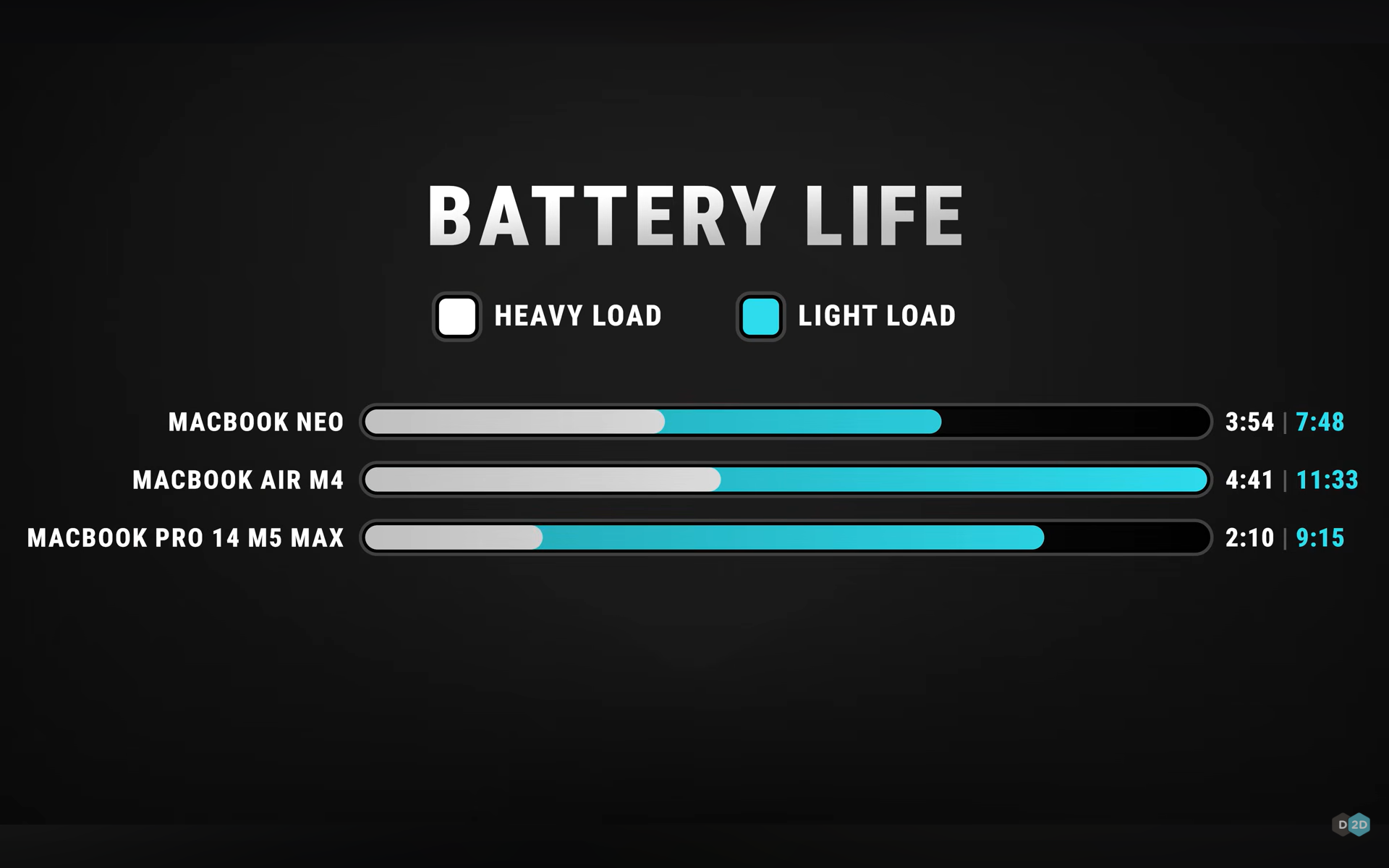
So, what’s happening here? The MacBook Neo is being held back by the 36.5 Wh battery. By comparison, the MacBook Air M4, like the latest MacBook Air 13 M5, packs a 53.8 Wh battery while the MacBook Pro 14 M4 Max features a 72.4 Wh cell.
Furthermore, the 36.5 Wh cell of the MacBook Neo is even smaller than many Windows laptops of similar size and weight. For example, the latest Dell XPS 14 packs a much bigger 70 Wh cell, while the 2025 Acer Aspire 14 AI runs a 65 Wh battery pack. As a consequence, the latest Dell XPS 14 lasted over 16.5 hours in our Wi-Fi websurfing test, despite a much more powerful Panther Lake chip and a 120 Hz display.
As a side note, we mention the Dell XPS 14 here from a purely battery capacity standpoint. The MacBook Neo is nowhere near the price of the Dell XPS 14 (2026). So, this isn’t an apples-to-apples comparison.
In the end, it is quite clear that the MacBook Neo’s small battery is a purely cost-cutting measure. We find it hard to believe that Apple couldn’t have done better by packing, let’s say, a 30% larger cell, especially when we know that Apple will produce a ton of MacBook Neo units. At such a high volume, the economies of scale kick in and decrease the per-unit cost of components like the battery, chassis, etc.
Source(s)
 Add as a preferred source on Google


