




Apple M5 Pro & M5 Max CPU Analysis - M5 Max is not much faster than the M4 Max

A couple of months after Apple introduced their new M5-SoC in the iPad Pro and the entry-level MacBook Pro 14, we now get the more powerful chips M5 Pro as well as M5 Max in the more expensive MacBook Pro models. In this article, we take a closer look at the new CPU performance and while some users will be very happy, others will probably be disappointed. We will talk about the new M5 Pro & M5 Max GPUs in a separate GPU analysis, and you can obviously read our reviews of the new MacBook Pro models:
- Apple MacBook Pro 16 review (M5 Pro, 20-core GPU, 64 GB RAM)
- Apple MacBook Pro 14 review (M5 Max, 40-core GPU, 128 GB RAM)
- Apple M5 Pro & M5 Max GPU analysis (soon)
Update: We added the benchmark results for the M5 Max in the larger MacBook Pro 16 and the Cinebench 2024 performance in particular is much better. We have also repeated the test with the other two models and got a better score for the M5 Pro in the 16-inch MBP, but the result for the smaller MBP 14 stayed the same. We have also updated the efficiency figures.
Overview - M5 Pro & M5 Max use the same CPU
The new M5 Pro and M5 Max chips are still manufactured in a 3 nm process (third generation), but Apple's approach now follows another approach. Instead of a monolithic design, Apple now uses two tiles (basically CPU and GPU) and combines them. This means the CPU part with 18 cores is identical for both the M5 Pro (or the slower 15-core version) and the M5 Max, while the GPU tile is different. There are once again different models: The base M5 Pro gets 15 CPU cores (5/6 super cores, 10/12 performance cores) as well as the full 18-core version, while the M5 Max always gets all 18 cores.
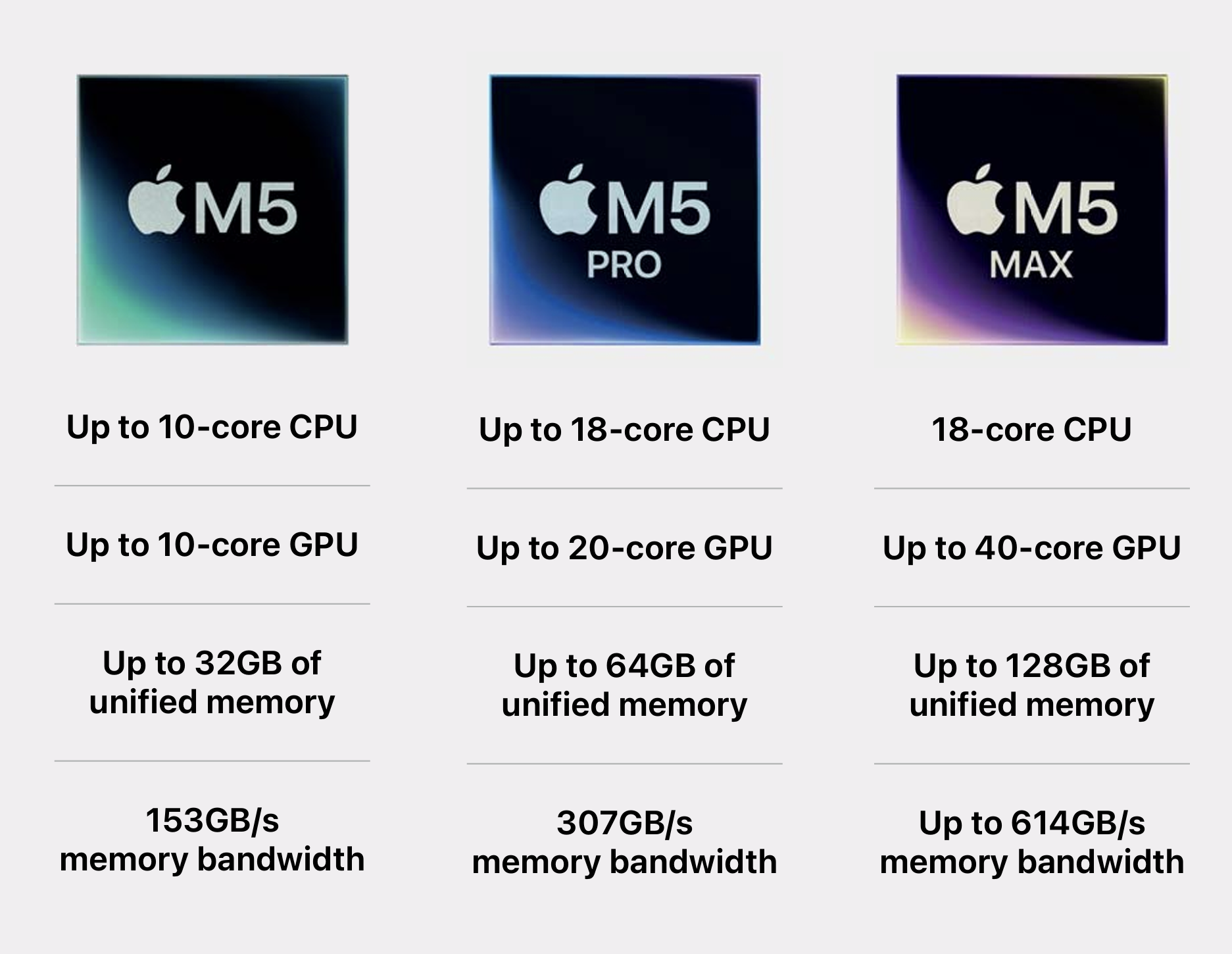
This brings us to the next new feature, the cores themselves. Apple includes 6 super cores clocked at up to 4.608 GHz, which are already familiar from the regular M5-SoC, where they were still called Performance cores. They are optimized for the highest single-core performance, while the new Performance cores are clocked at up to 4.38 GHz and they are optimized for multi-threaded performance. The system itself calls them M-cores and from a performance standpoint, they are sitting between the new super cores (formerly performance cores) and the efficiency cores of the M5 SoC.
During our tests, we saw a maximum consumption of 75 Watts for the CPU, but neither the MacBook Pro 14, nor the MacBook Pro 16 were able to maintain this value. The smaller 14-inch model had issues to maintain 50 Watts, while the 16-inch MacBook Pro maintained 62 Watts in High Power mode.
Test Systems - MacBook Pro 14 & 16
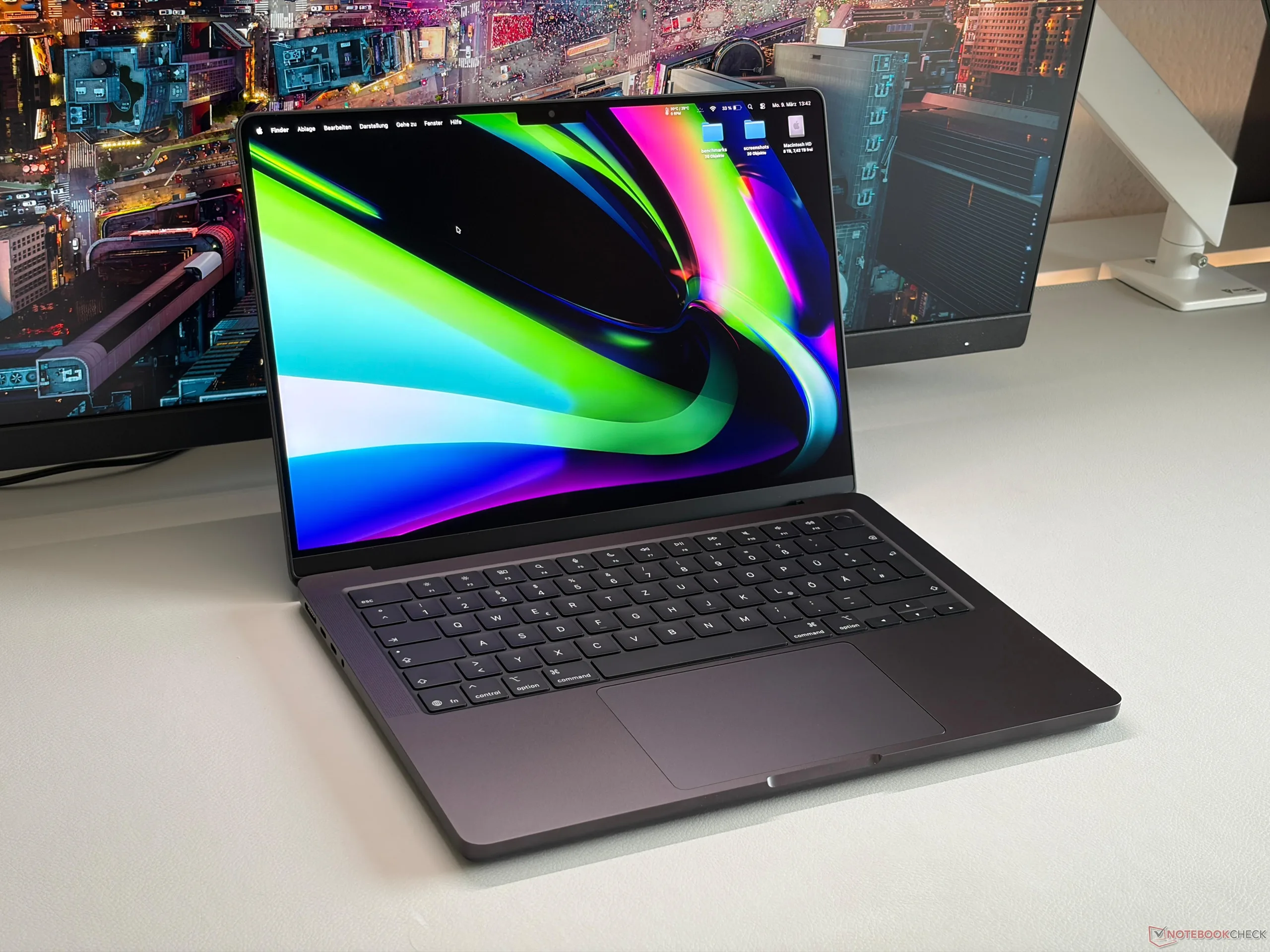
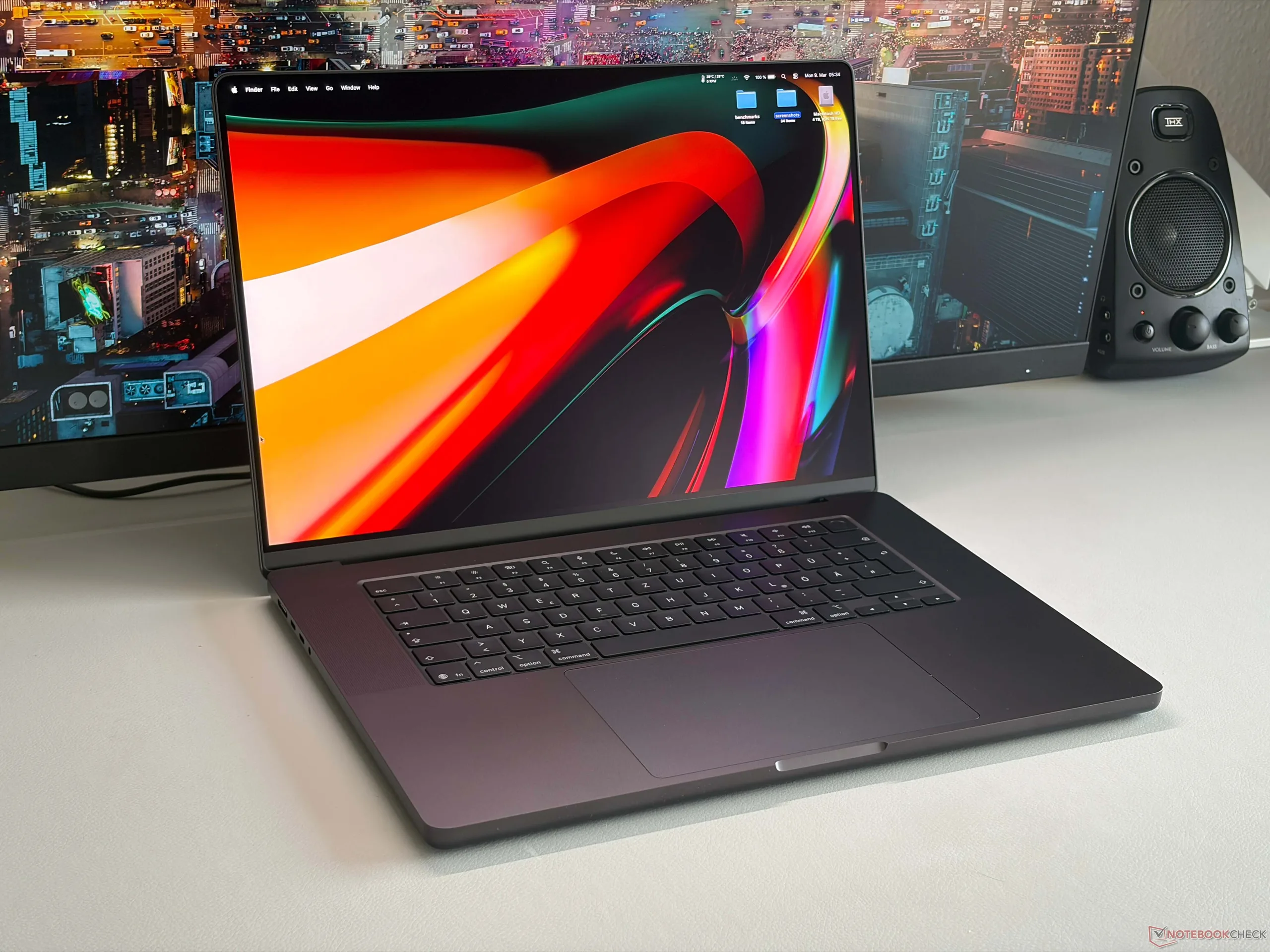
We used two new MacBook Pro models for our tests, even though the situation is not ideal. Our MacBook Pro 16 was equipped with the 18-core version of the M5 Pro (64 GB LPDDR5x-9600 RAM), while the smaller 14-inch version was equipped with the M5 Max (128 GB LPDDR5x-9600 RAM). While the testing was pretty straightforward on the MBP 16, the smaller 14-inch model was pretty overwhelmed by the M5 Max and we struggled to get consistent benchmark scores. Please see our review for more information (will be available soon). We will try to get our hands on the MacBook Pro 16 with the M5 Max as soon as possible and add the results.
Test Procedure
In order to make a meaningful comparison between the different processors, we look at the power consumption in addition to the pure performance in synthetic benchmarks from which we then determine the efficiency.
The consumption measurements are always carried out on an external display so as to eliminate the different internal displays as influencing factors. Nevertheless, we measure the overall consumption of the system here and not just compare the pure TDP values.
Single-Core Performance & Efficiency
As expected, the new M5 Pro and M5 Max CPUs offer the same single core performance we already know from the base M5-SoC in the MacBook Pro 14 and also the new MacBook Air models. They offer the best single-core performance you can currently get and even the new Snapdragon X2 will be quite far behind in Cinebench 2024 (and even slower than the M4 generation), but closer in Geekbench if the reference scores turn out to be true. The advantage of the new M5 chips compared to the M4 generation is 11-12 %.
If we look at the efficiency during the Cinebench 2024 run, we have to take into account that the M5 Pro and M5 Max are bigger chips with more cores and also much more RAM compared to the entry-level Macbook Pro 14 or the MacBook Air. Therefore, the efficiency is worse, but still far ahead of every other chip manufacturer. The efficiency is roughly on par with the old M4 Pro 14-core. We are already eager to see the efficiency results of the new Snapdragon X2 series, while Intel and AMD are pretty far behind.
* ... smaller is better
Multi-Core Performance & Efficiency
Both the new M5 Pro and M5 Max also offer good multi-core performance, but they are not faster than the previous M4 Max CPU in Cinebench 2024, which stresses the CPU for a couple of minutes. While this is a major improvement for the M5 Pro model (almost 20 % faster than the M4 Pro), it is very disappointing for the M5 Max.
Geekbench on the other hand shows an advantage of 10-14 % over the old M4 Max, but keep in mind that Geekbench only stresses the CPU for very brief moment and it says nothing about the sustained performance. The new Snapdragon X2 Elite is once again pretty close to Apple's new chips.
Our efficiency measurements do not show a massive improvement over the M4 generation, either. Interestingly, the M5 Max in the smaller MacBook Pro 14 is a bit more efficient than the M5 Pro in the MacBook Pro 16 in our initial testing. The M5 Pro is as efficient as the old M4 Pro, but offers much more overall performance.
* ... smaller is better
Cinebench 2026
Cinebench 2026 is Maxon's latest CPU benchmark, but we do not have an extensive number of benchmark results yet. The performance of the new chips is once again very good, but the multi-core test once again illustrates the problems we had the thermal throttling on the MacBook Pro 14 M5 Max.
System Performance
The new M5 Pro and M5 Max chips offer excellent general system performance and are at the top of the cross-platform CrossMark as well as the browser benchmarks.
Memory Performance
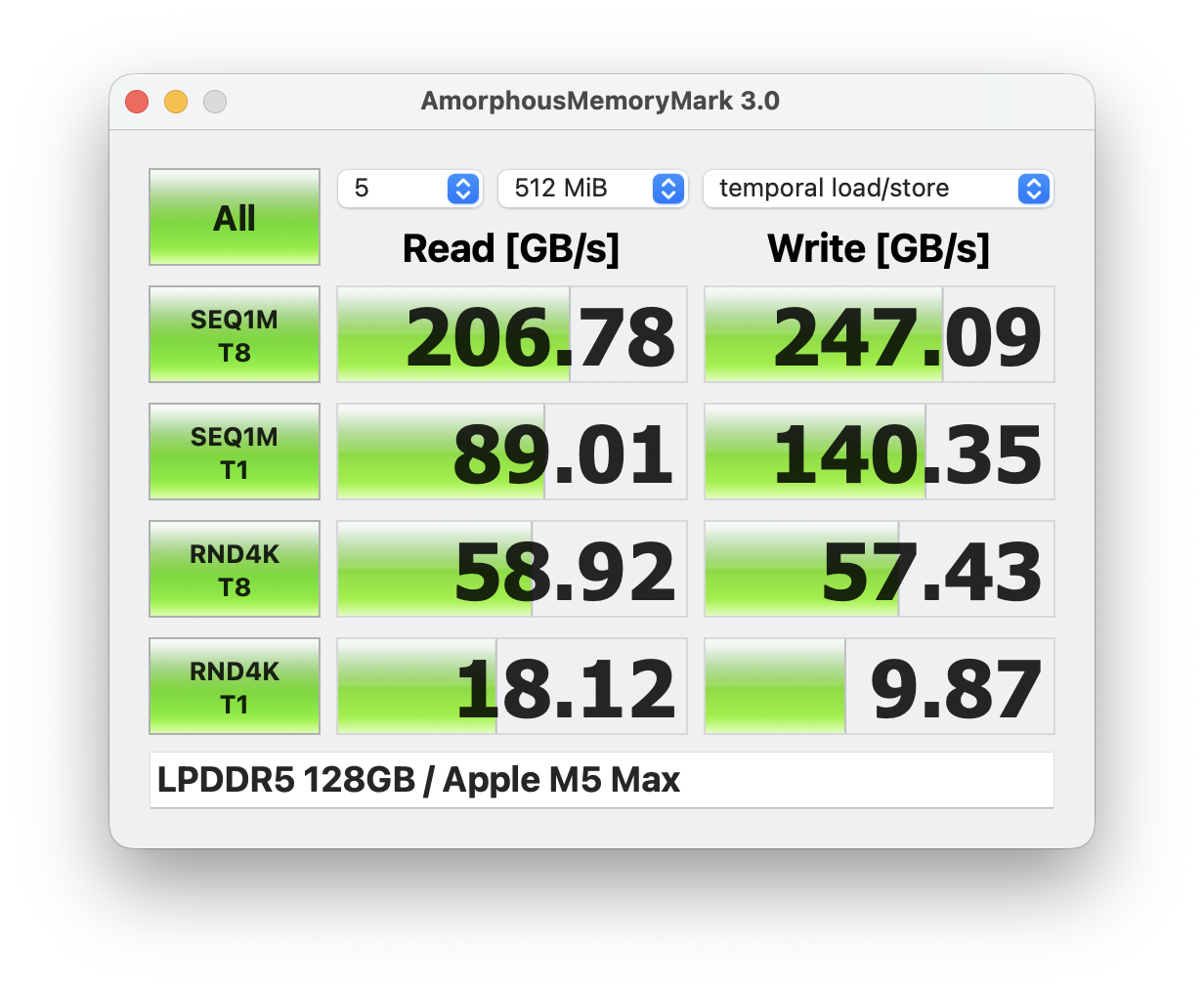
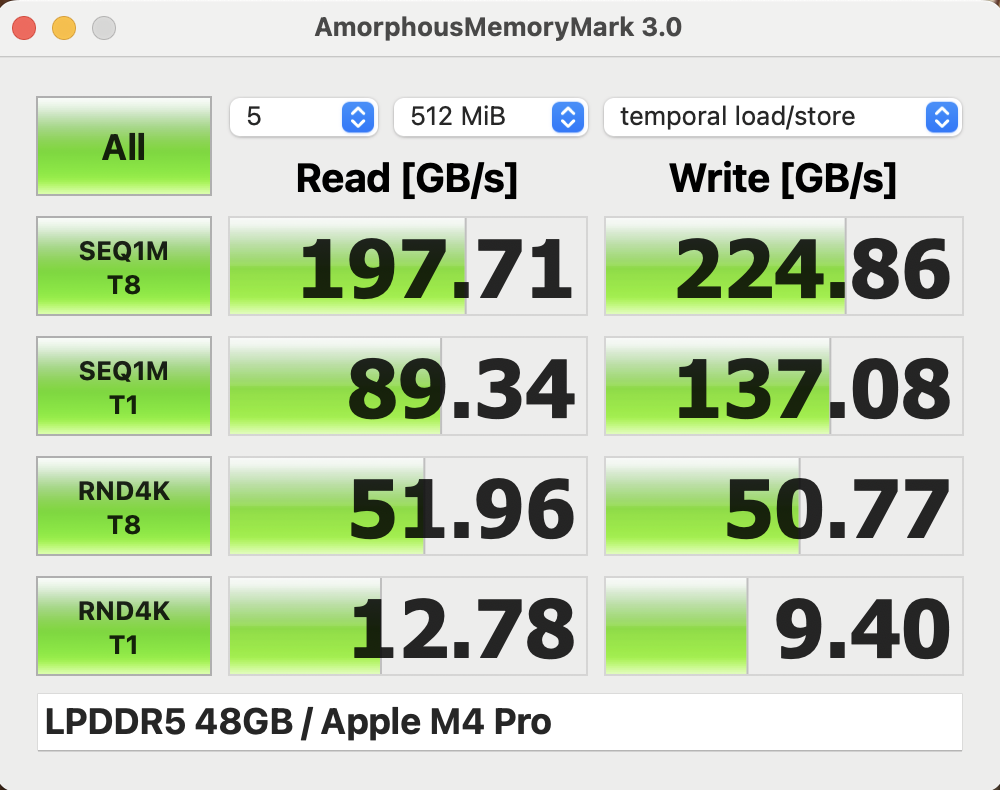
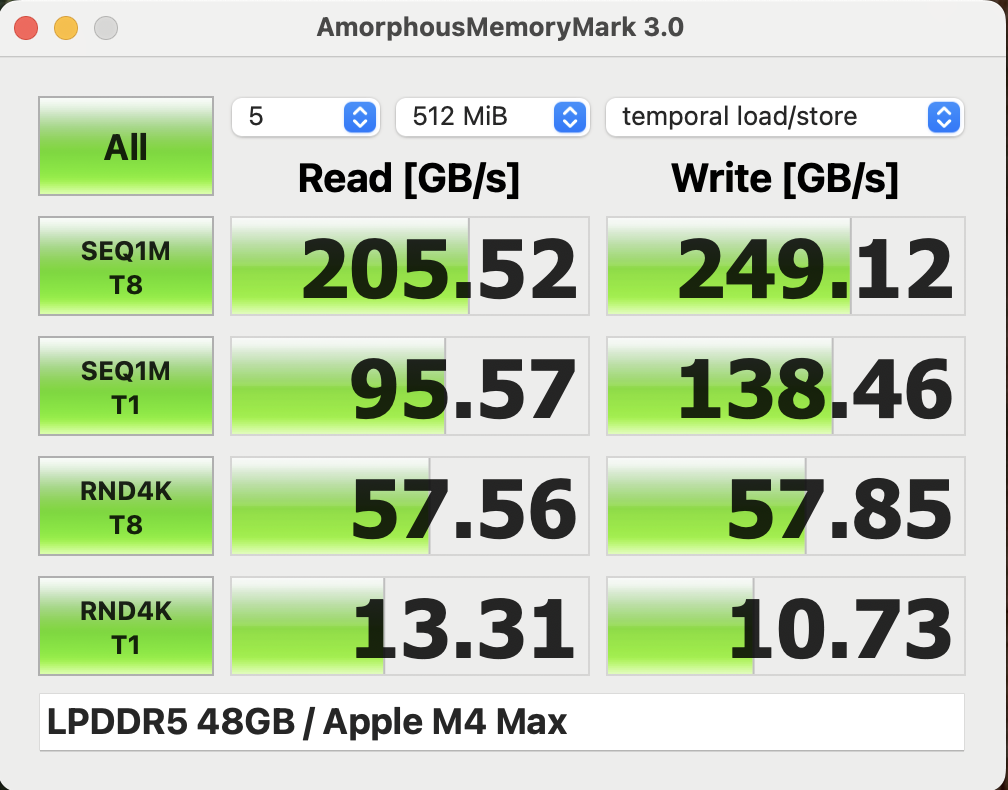
According to Apple, the memory performance was increased as well and claims up to 307 GB/s for the M5 Pro and up to 614 GB/s for the M5 Max. We performed the AmorphousMemoryMark 3.0 on both systems and the results are shown in the screenshots below. The results for the M5 Pro are better compared to the M4 generation, but we do not see an improvement for the M5 Max compared to the M4 max.

Verdict - The M5 Pro gets a big performance increase, but the M5 Max is not much faster than the old M4 Max
Our initial tests for the new M5 Pro and M5 Max CPUs are mixed. Apple's decision to use the same CPUs for both models is great news for users of the M5 Pro, since they will get a nice performance increase and the same CPU performance as on the flagship M5 Max model. For potential customers of the M5 Max, however, the situation is different, because the new M5 Max CPU is not really much faster than the old M4 Max. Yes, the single-core performance is better (as expected), but you can get the same single-core performance in a MacBook Air for $1099.
As it looks right now, Qualcomm might be able to catch up quite nicely with their new Snapdragon X2 Elite series, at least in terms of CPU performance according to our reference scores. We will obviously have to wait for review units to verify them and also take a closer look at the performance.
We will update this article soon with additional benchmarks. Please leave a comment if you have any wishes for benchmarks.
 Add as a preferred source on Google


