




Honor MagicBook Pro 14 vs. Apple MacBook Pro 14 M5 - Who offers the best multimedia laptop?

Honor's new MagicBook Pro 14 2026 is a really good overall package without major drawbacks. This also means it is a rival for Apple's entry-level MacBook Pro 14, which is already available since last autumn with the M5 SoC. We compare the two 14-inch models in the most important sections.
Case, Connectivity & Input Devices
Both models use aluminum cases with a very high quality, but Apple still has the edge with its unibody design. However, Honor offers better maintenance options (SSD can be upgraded) and also a wider opening angle of the display. Both devices feature Thunderbolt 4 and HDMI, but USB-A is only available on the Honor, whereas the MacBook can be charged from both sides. Both models are also limited to Wi-Fi 6E.
The keyboard and the haptic trackpad are pretty equal. Apple has a larger touchpad, while Honor offers more key travel. However, Honor also offers a touchscreen, which is not available in the MacBook Pro.

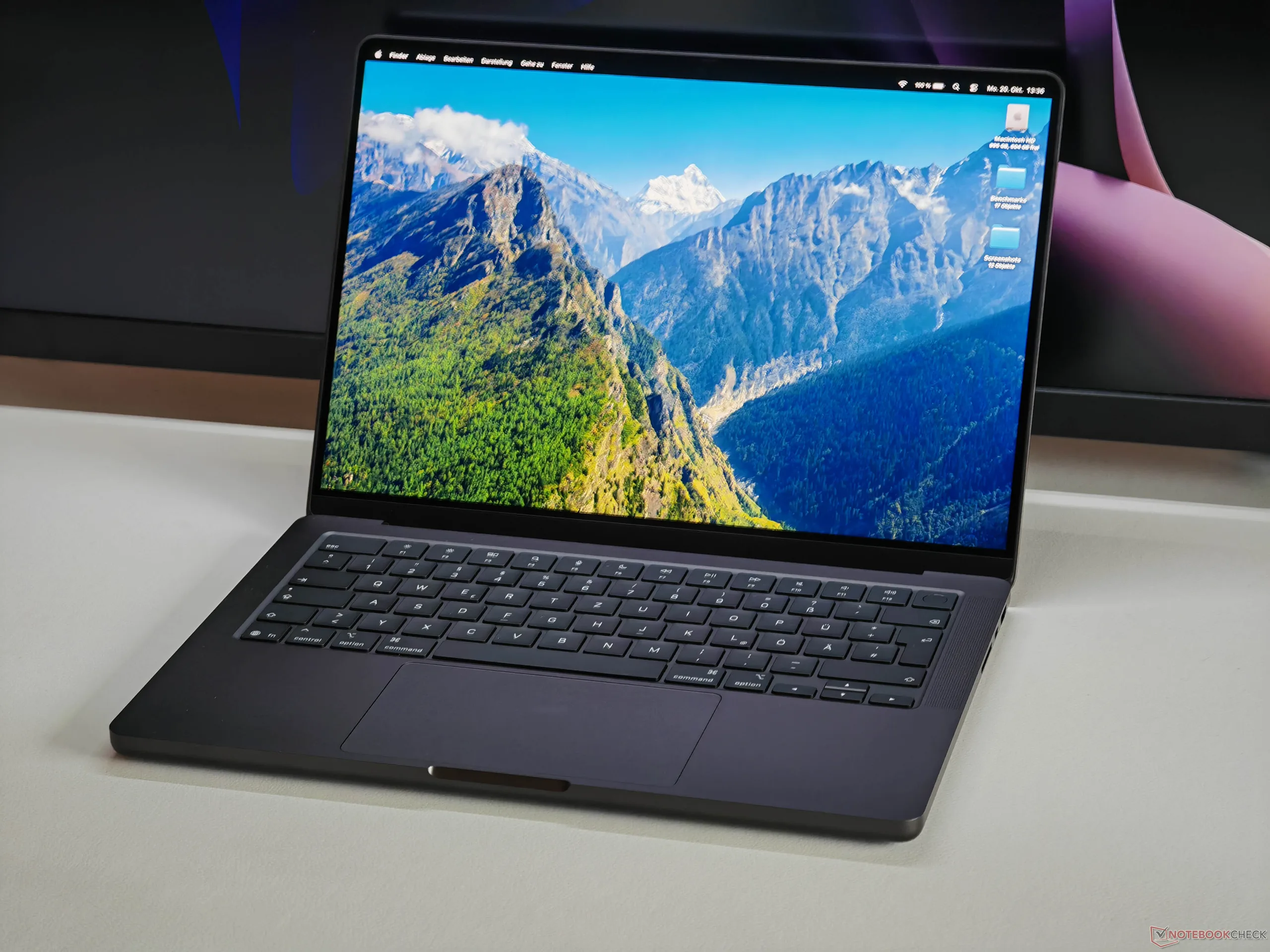
Display - OLED vs. Mini-LED
The two manufacturers use different display technologies - OLED in the Honor MagicBook and Mini-LED in the Macbook Pro. First of all, both devices offer great subjective image quality with full P3 color gamut, accurate color profiles for P3 as well as sRGB and 120 Hz. Honor offers a touchscreen, while Apple also offers a matte version.
In terms of brightness, the easy winner is Apple. It can reach up to 1,000 nits in SDR mode with activated brightness sensor, while the Honor is limited to 500 nits. Apple's panel is also superior with HDR contents, where it reaches up to 1,600 nits (Honor ~770 nits) and we just have to say that Apple's HDR handling is still so much better compared to Windows. Advantages of the OLED screen are faster response times (the Mini-LED screen is just a regular IPS panel after all) and there is also no blooming.
| Honor MagicBook Pro 14 2026 EDO14.55, OLED, 3120x2080, 14.6", 120 Hz | Apple MacBook Pro 14 2025 M5 Mini-LED, 3024x1964, 14.2", 120 Hz | |
|---|---|---|
| Display | 2% | |
| Display P3 Coverage (%) | 96.3 | 99.5 3% |
| sRGB Coverage (%) | 99.9 | 100 0% |
| AdobeRGB 1998 Coverage (%) | 85 | 88.8 4% |
| Response Times | -6239% | |
| Response Time Grey 50% / Grey 80% * (ms) | 0.55 ? | 49.4 ? -8882% |
| Response Time Black / White * (ms) | 0.51 ? | 47 ? -9116% |
| PWM Frequency (Hz) | 120 ? | 14900 |
| PWM Amplitude * (%) | 11 | 90 -718% |
| Screen | 13% | |
| Brightness middle (cd/m²) | 519 | 633 22% |
| Brightness (cd/m²) | 526 | 619 18% |
| Brightness Distribution (%) | 89 | 92 3% |
| Black Level * (cd/m²) | 0.01 | |
| Contrast (:1) | 51900 | |
| Colorchecker dE 2000 * | 1.1 | 1 9% |
| Colorchecker dE 2000 max. * | 2.2 | 2.2 -0% |
| Colorchecker dE 2000 calibrated * | 0.7 | |
| Greyscale dE 2000 * | 1.8 | 1.3 28% |
| Gamma | 2.23 99% | 2.2 100% |
| CCT | 6496 100% | 6549 99% |
| Total Average (Program / Settings) | -2075% /
-1552% |
* ... smaller is better
Performance - Intel Panther Lake vs. Apple M5
The performance is an interesting point, because the difference between the M5 and the Core Ultra 5 338H with the fast Arc B370 GPU is not huge, even though Apple's chip is much more efficient, as we have clearly seen in our Panther Lake analysis. Both systems are very fast in everyday situations and the M5 is clearly superior in terms of CPU performance. Especially the single-core performance of the M5 is currently the fastest processor you can get in a laptop (it does not matter which size or performance class). The Arc B370 is a bit more powerful than the M5 GPU and the optional Arc B390 would be even faster. In native games, the MacBook also performs well and both models are pretty much on par, but the MagicBook Pro 14 is not limited to a handful of games. Both models are limited to PCIe 4.0 SSDs.
Cinebench 2024: CPU Multi Core | CPU Single Core
Geekbench 6.7: Multi-Core | Single-Core
CrossMark: Overall
WebXPRT 4: Overall
3DMark: Steel Nomad Score | Steel Nomad Light Score
Cyberpunk 2077: 1920x1080 Ultra Preset (FSR off)
Baldur's Gate 3: 1920x1080 Ultra Preset AA:T
Assassin's Creed Shadows: 1920x1080 Low
| Performance Performance rating | |
| Apple MacBook Pro 14 2025 M5 | |
| Honor MagicBook Pro 14 2026 | |
| Cinebench 2024 / CPU Multi Core | |
| Apple MacBook Pro 14 2025 M5 | |
| Honor MagicBook Pro 14 2026 | |
| Cinebench 2024 / CPU Single Core | |
| Apple MacBook Pro 14 2025 M5 | |
| Honor MagicBook Pro 14 2026 | |
| Geekbench 6.7 / Multi-Core | |
| Apple MacBook Pro 14 2025 M5 | |
| Honor MagicBook Pro 14 2026 | |
| Geekbench 6.7 / Single-Core | |
| Apple MacBook Pro 14 2025 M5 | |
| Honor MagicBook Pro 14 2026 | |
| CrossMark / Overall | |
| Apple MacBook Pro 14 2025 M5 | |
| Honor MagicBook Pro 14 2026 | |
| WebXPRT 4 / Overall | |
| Apple MacBook Pro 14 2025 M5 | |
| Honor MagicBook Pro 14 2026 | |
| 3DMark / Steel Nomad Score | |
| Honor MagicBook Pro 14 2026 | |
| Apple MacBook Pro 14 2025 M5 | |
| 3DMark / Steel Nomad Light Score | |
| Honor MagicBook Pro 14 2026 | |
| Apple MacBook Pro 14 2025 M5 | |
| Cyberpunk 2077 / Ultra Preset (FSR off) | |
| Honor MagicBook Pro 14 2026 | |
| Apple MacBook Pro 14 2025 M5 | |
| Baldur's Gate 3 / Ultra Preset | |
| Apple MacBook Pro 14 2025 M5 | |
| Honor MagicBook Pro 14 2026 | |
| Assassin's Creed Shadows / Low | |
| Apple MacBook Pro 14 2025 M5 | |
| Honor MagicBook Pro 14 2026 | |
Fans, Speakers and Battery Runtime
Apple always uses very defensive fan curves, so the devices are always very quiet in everyday scenarios and even short peak load is usually covered without the use of the fans. However, the MacBook Pro 14 M5 only gets a reduced cooling unit with just one fan, so the MacBook Pro 14 actually gets much louder (up to 48 dB(A)) under high loads compared to the Honor (up to 43 dB(A)). The Honor also convinces with a quiet cooling solution in everyday scenarios. In terms of speakers, the MagicBook Pro 14 is not bad, but the MacBook is superior and sounds better. The situation is not clear in terms of battery runtime, even though the Honor also uses a larger battery. Apple manages 16.7 hours in our Wi-Fi test at 150 nits compared to 14.9 hours for Honor, but the latter is better at full SDR brightness with 8.8 hours compared to just 5.6 hours on the MacBook Pro (to be fair though, the SDR brightness on the Honor is a bit lower at 500 vs. 640 nits).
| Honor MagicBook Pro 14 2026 Ultra 5 338H, Arc B370 Panther Lake iGPU | Apple MacBook Pro 14 2025 M5 M5 10-Core, M5 10-Core GPU | |
|---|---|---|
| Noise | 7% | |
| off / environment * (dB) | 25.7 | 24.5 5% |
| Idle Minimum * (dB) | 25.7 | 24.5 5% |
| Idle Average * (dB) | 25.7 | 24.5 5% |
| Idle Maximum * (dB) | 25.7 | 24.5 5% |
| Load Average * (dB) | 30.2 | 25.2 17% |
| Cyberpunk 2077 ultra * (dB) | 39.4 | 30 24% |
| Load Maximum * (dB) | 42.9 | 48 -12% |
* ... smaller is better
Honor MagicBook Pro 14 2026 audio analysis
(±) | speaker loudness is average but good (81.2 dB)
Bass 100 - 315 Hz
(±) | reduced bass - on average 12.8% lower than median
(±) | linearity of bass is average (8.9% delta to prev. frequency)
Mids 400 - 2000 Hz
(+) | balanced mids - only 4.5% away from median
(+) | mids are linear (5.2% delta to prev. frequency)
Highs 2 - 16 kHz
(+) | balanced highs - only 1.1% away from median
(+) | highs are linear (3.9% delta to prev. frequency)
Overall 100 - 16.000 Hz
(+) | overall sound is linear (12.1% difference to median)
Compared to same class
» 22% of all tested devices in this class were better, 3% similar, 75% worse
» The best had a delta of 5%, average was 17%, worst was 45%
Compared to all devices tested
» 10% of all tested devices were better, 2% similar, 88% worse
» The best had a delta of 4%, average was 23%, worst was 136%
Apple MacBook Pro 14 2025 M5 audio analysis
(+) | speakers can play relatively loud (84.8 dB)
Bass 100 - 315 Hz
(+) | good bass - only 4.2% away from median
(+) | bass is linear (6.5% delta to prev. frequency)
Mids 400 - 2000 Hz
(+) | balanced mids - only 2% away from median
(+) | mids are linear (3.2% delta to prev. frequency)
Highs 2 - 16 kHz
(+) | balanced highs - only 3.3% away from median
(+) | highs are linear (3.7% delta to prev. frequency)
Overall 100 - 16.000 Hz
(+) | overall sound is linear (6.4% difference to median)
Compared to same class
» 4% of all tested devices in this class were better, 1% similar, 95% worse
» The best had a delta of 5%, average was 17%, worst was 45%
Compared to all devices tested
» 1% of all tested devices were better, 0% similar, 99% worse
» The best had a delta of 4%, average was 23%, worst was 136%
| Battery Runtime | |
| WiFi Websurfing | |
| Apple MacBook Pro 14 2025 M5 | |
| Honor MagicBook Pro 14 2026 | |
| WiFi Websurfing max. Brightness | |
| Honor MagicBook Pro 14 2026 | |
| Apple MacBook Pro 14 2025 M5 | |
Verdict - Small things make the difference
It is not an easy decision and small aspects and personal preferences will probably make the difference. Both devices are very good overall, which is why the price will play an important role as well. We are still waiting for official prices of the MagicBook Pro 14 2026, but we expect lower prices compared to Apple if you take the 1 TB version (currently starting at $1599 on Amazon). The cheapest MacBook Pro 14 M5 with a 512 GB SSD currently starts at $1549, while the SKU with 24 GB RAM will set you back at least $1845.
Please see our comprehensive review for more information on the new Honor MagicBook Pro 14 2026.
 Add as a preferred source on Google


