




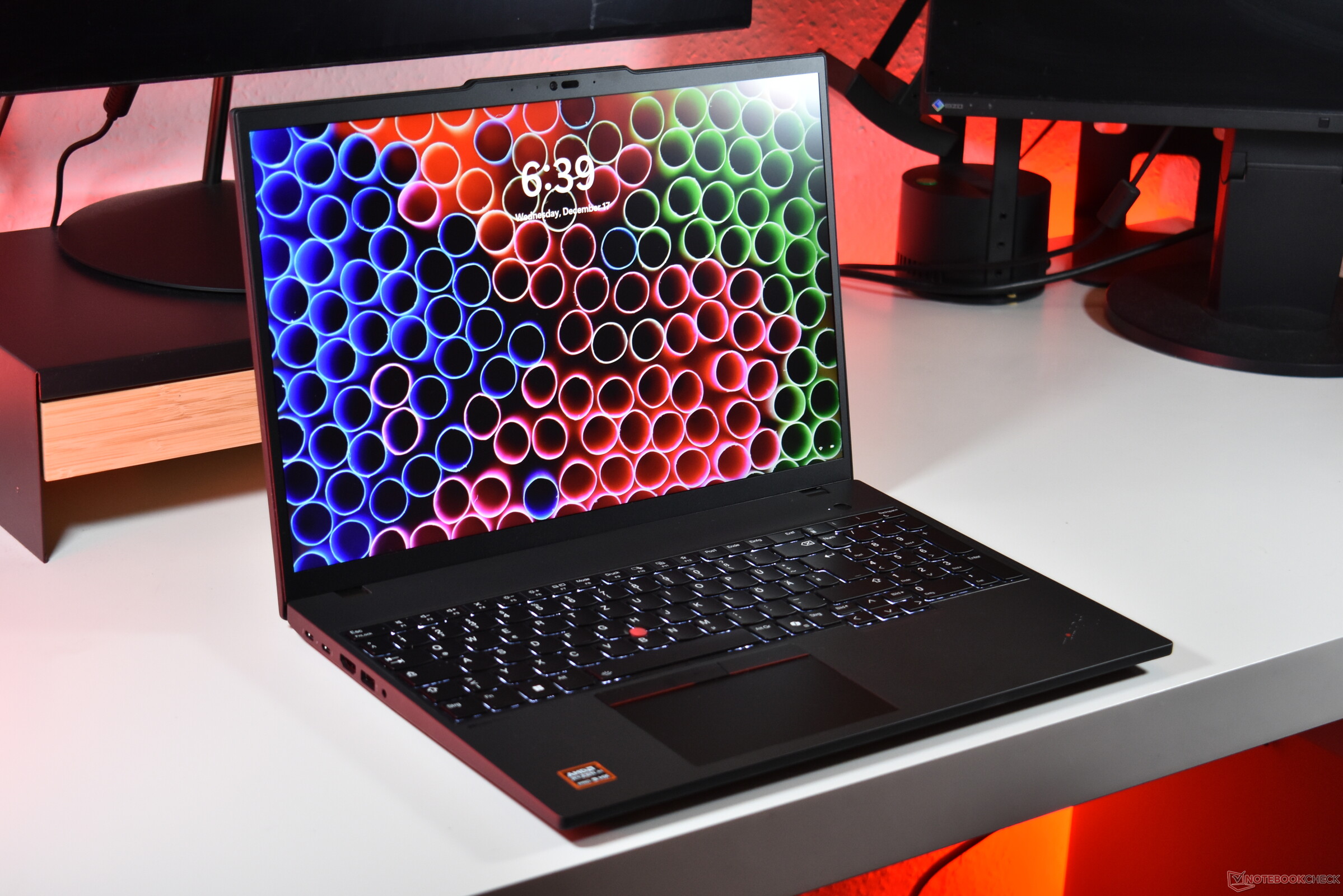
Verdict: Powerful Lenovo ThinkPad workhorse with some weaknesses
The Lenovo ThinkPad P16s Gen 4 AMD is the most powerful Lenovo laptop with a 16-inch screen, as it is the only one with the AMD Ryzen AI 9 HX CPUs. That alone makes it interesting for anyone who is looking for a big workhorse based on team red's CPUs. It is many strengths, such as the great keyboard, upgradeability, bright screen and powerful CPU, as well as the good battery life and optional 5G LTE. On the base of those features alone, the Lenovo laptop can be already a good recommendation.
Of course, it is not perfect, and there are some noticeable weaknesses. For one, the device does get rather loud, and it runs pretty hot. Additionally, the GPU performance is weak for a workstation, which means this device is mostly only useful for CPU or RAM heavy tasks. Lastly, the speakers are not the best. Plus, the OLED screen is limited to the Ryzen 5 and Ryzen 7 configurations, and there is no higher resolution IPS panel. If you are ready to accept these compromises, the ThinkPad P16s G4 AMD can still be an excellent work laptop.
Pros
Cons
Price and Availability
The Lenovo ThinkPad P16s Gen 4 AMD starts at roughly $1,250 as of this review. The version with the AMD Ryzen AI 9 Pro HX 370 costs $1,800 over at Lenovo.com.

Table of Contents
- Verdict: Powerful Lenovo ThinkPad workhorse with some weaknesses
- Specifications: Ryzen AI 9 Pro HX 370 in a 16-inch ThinkPad
- Case: ThinkPad P16s Gen 4 AMD brings the classic ThinkPad vibe
- Connectivity: AMD ThinkPad now with Thunderbolt 4
- Input Devices: Strong ThinkPad legacy continues
- Display: Bright, but low resolution screen
- Performance: AMD Ryzen laptop delivers great CPU performance
- Emissions: Lenovo ThinkPad P16s Gen 4 AMD is a hot-head
- Energy Management: Battery life much improved on new AMD model
- Notebookcheck Rating
- Potential Competitors in Comparison
When it launched in 2015, the Lenovo ThinkPad W550s would create a lasting legacy, as the first ultrabook-type workstation in Lenovo's lineup. Ten years later, the W series has become the P series and the most recent successor of the W550s is the Lenovo ThinkPad P16s Gen 4. We are reviewing the AMD variant here, which is identical in design to the ThinkPad T16 Gen 4 - the Intel variant of the P16s uses a different platform, so despite the same name, they are not comparable.
The Lenovo ThinkPad P16s G4 is one of the few Lenovo laptops available with AMD's Ryzen 9 HX CPUs, which certainly helps this model stand out.
Specifications: Ryzen AI 9 Pro HX 370 in a 16-inch ThinkPad
Case: ThinkPad P16s Gen 4 AMD brings the classic ThinkPad vibe
Whereas the P16s G4 Intel mainly uses aluminum for its build, the Lenovo ThinkPad P16s G4 AMD bets on the classic ThinkPad materials: Plastic and magnesium and a black soft-touch coating all around. It is a robust build that does not have any huge weaknesses, with stable hinges that open 180 degrees and allow one-handed opening. There is not a lot of visual flair, with the red design elements as well as the silver Lenovo logo and black-glossy ThinkPad logo on the lid being the only stand-outs in the sea of black. Overall, it is a device that will not turn heads, but one the exudes the aura of seriousness.
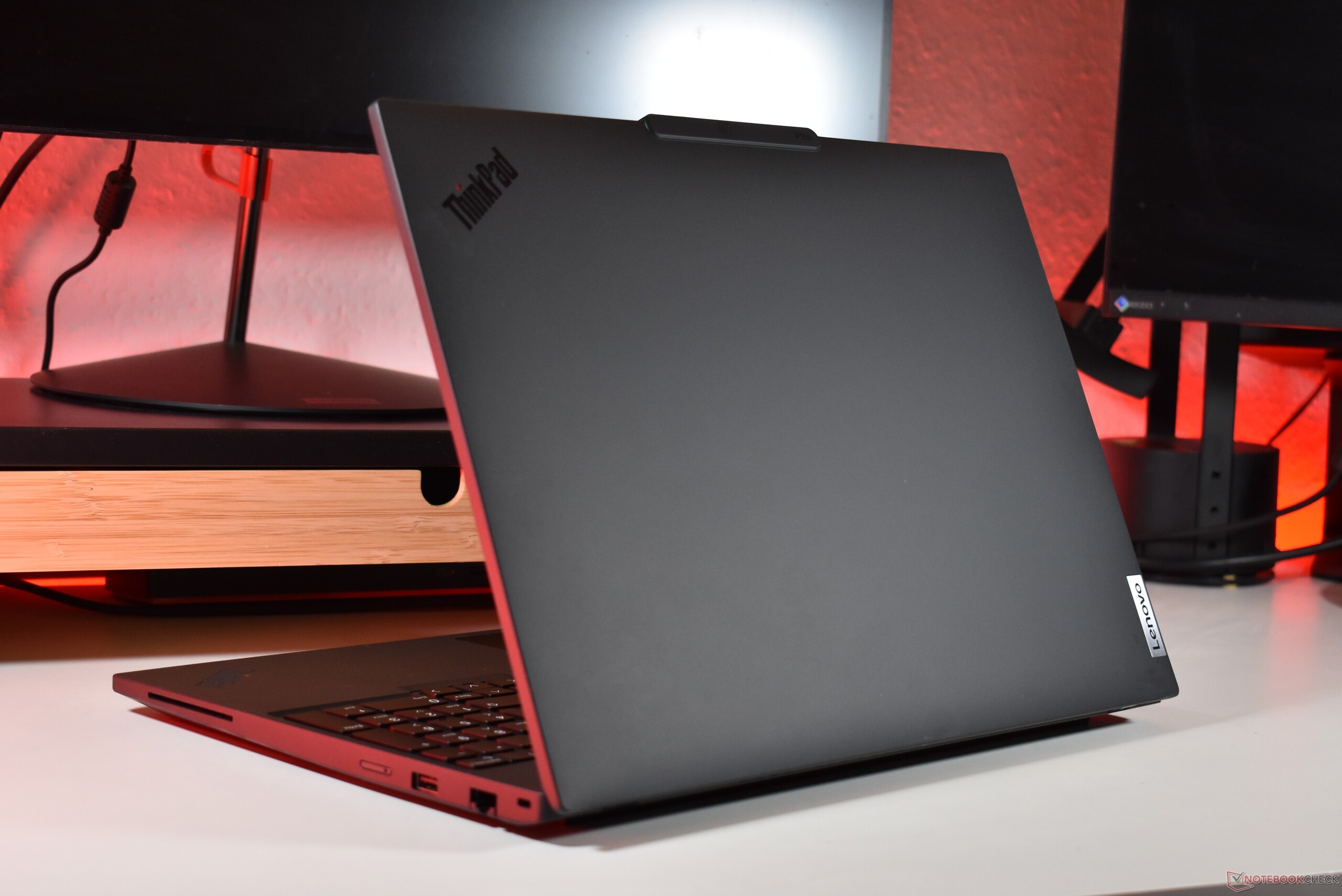
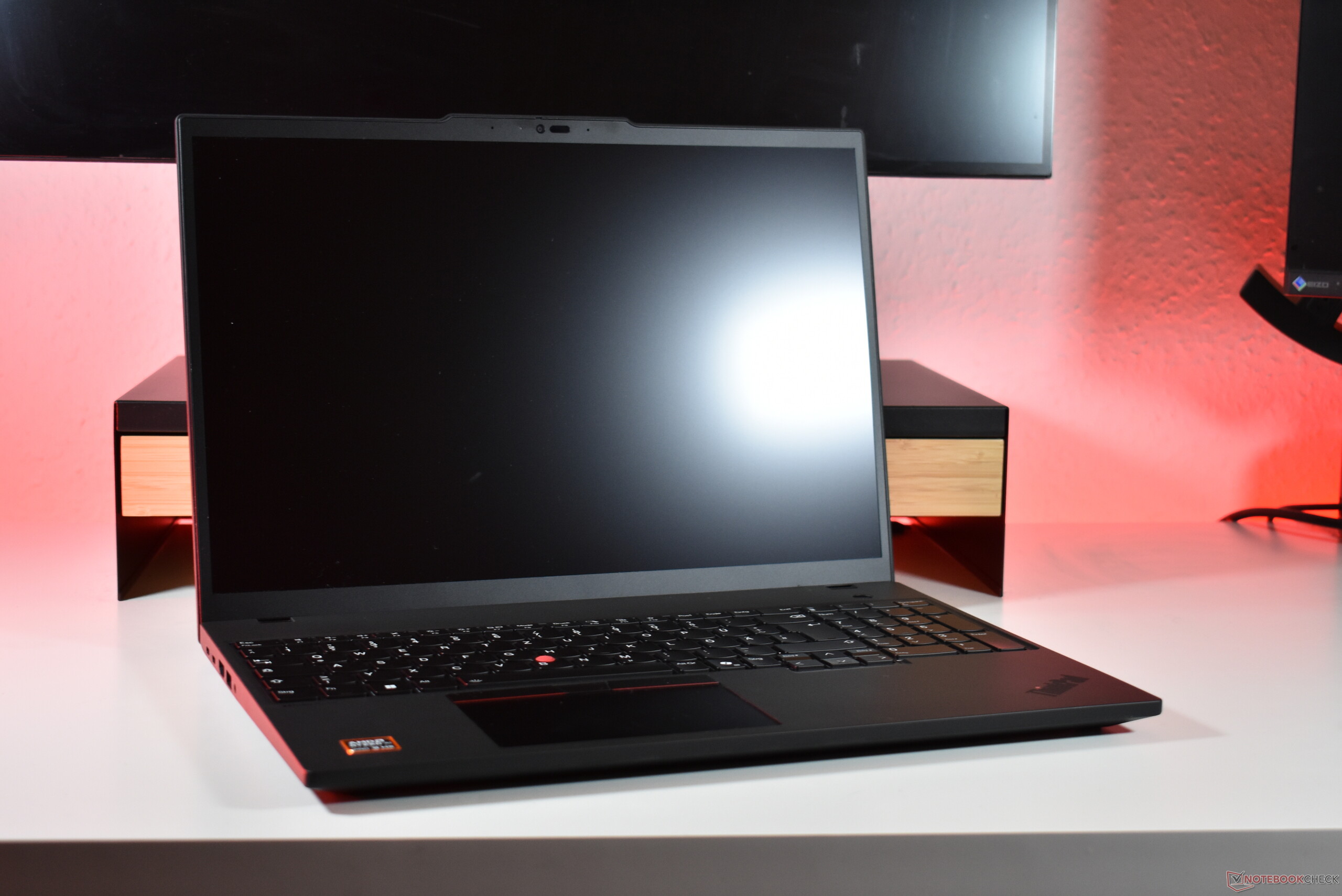
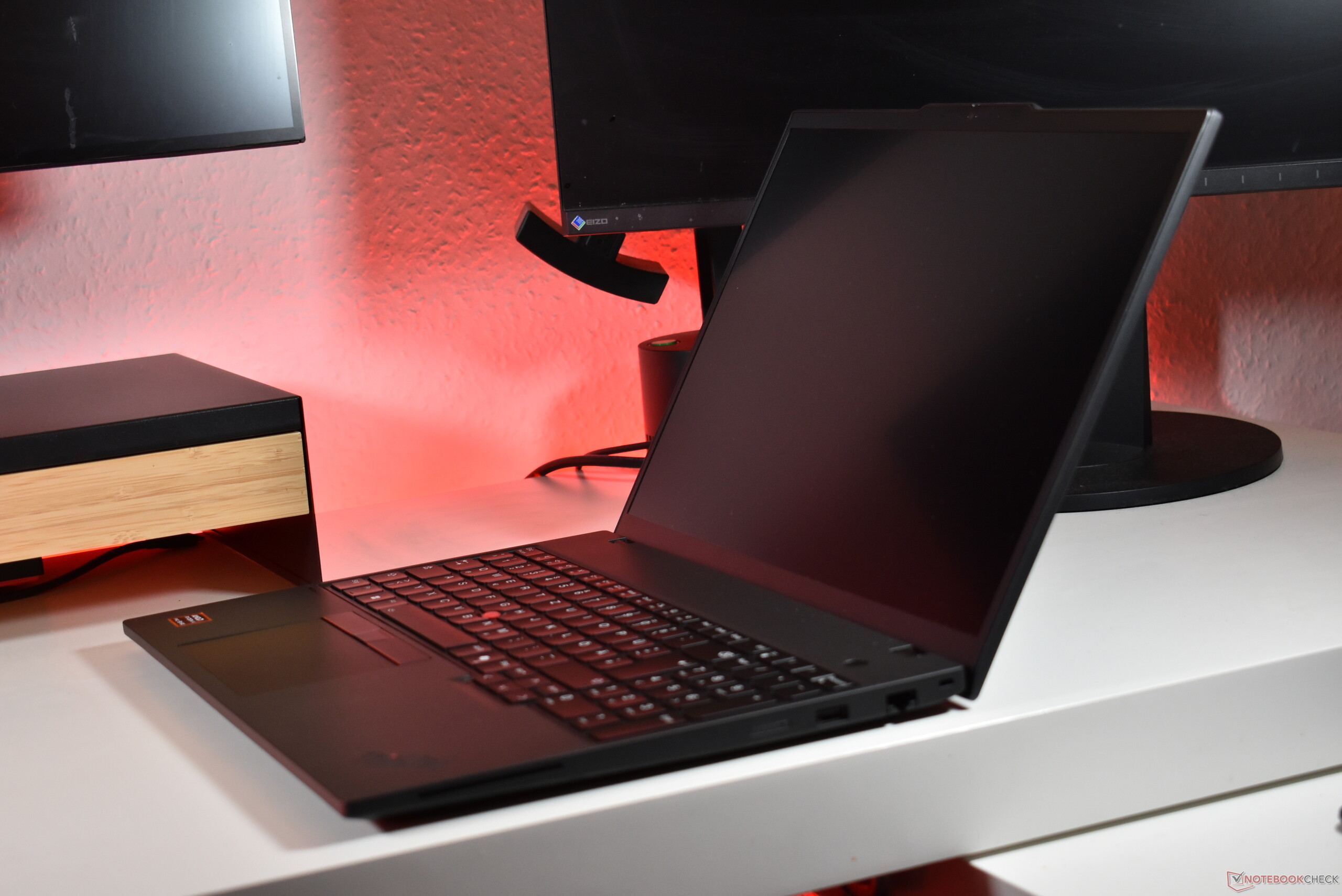
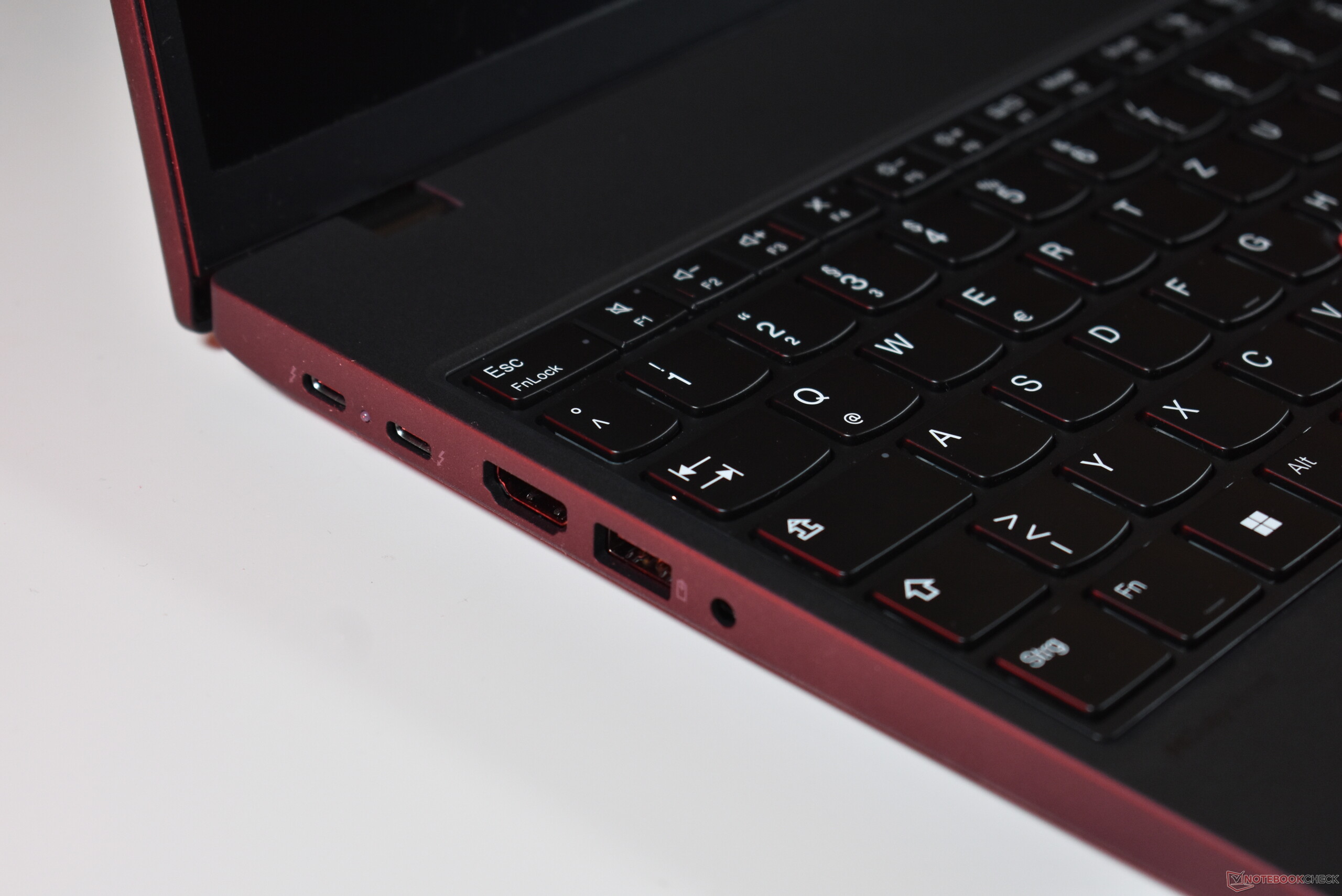
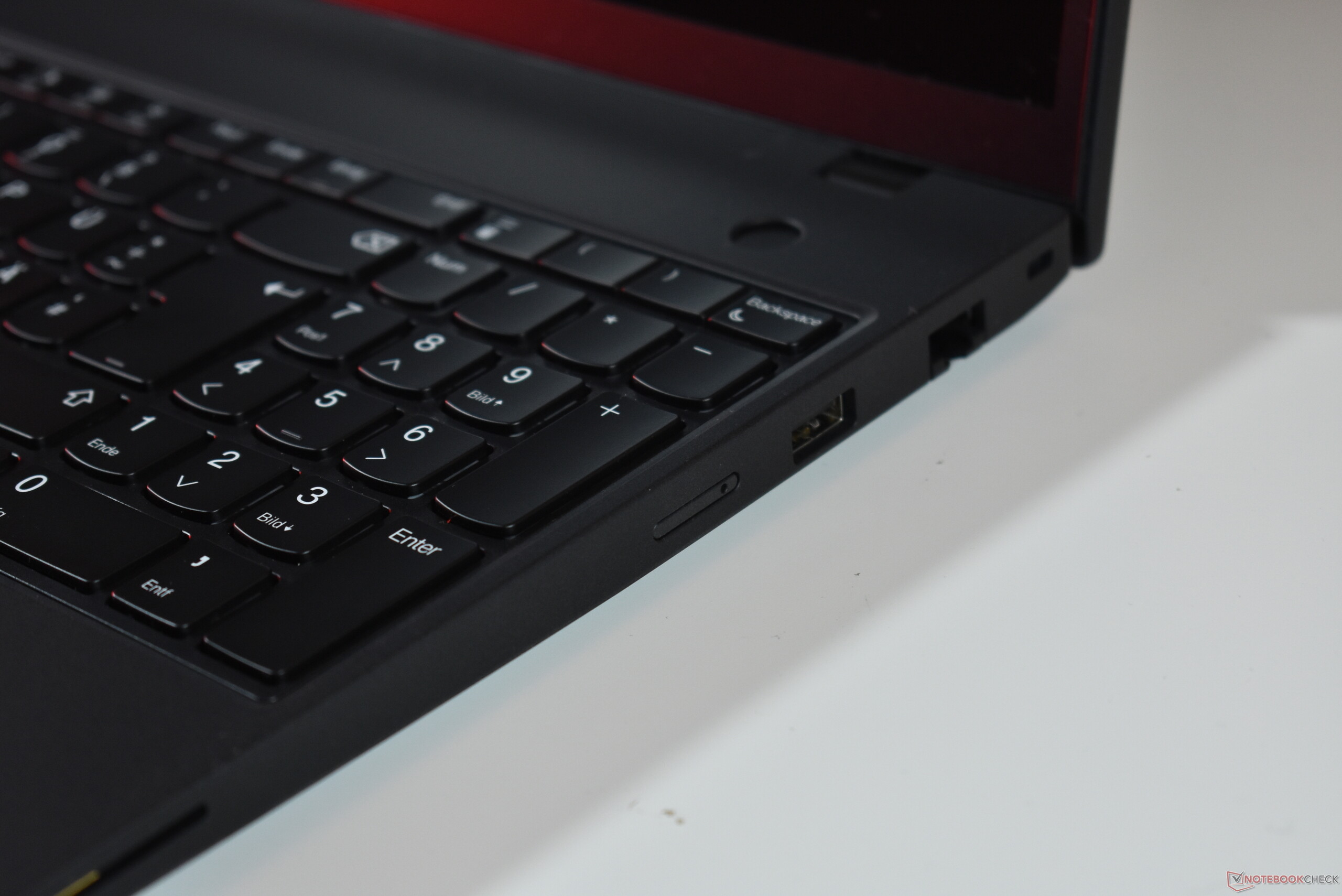
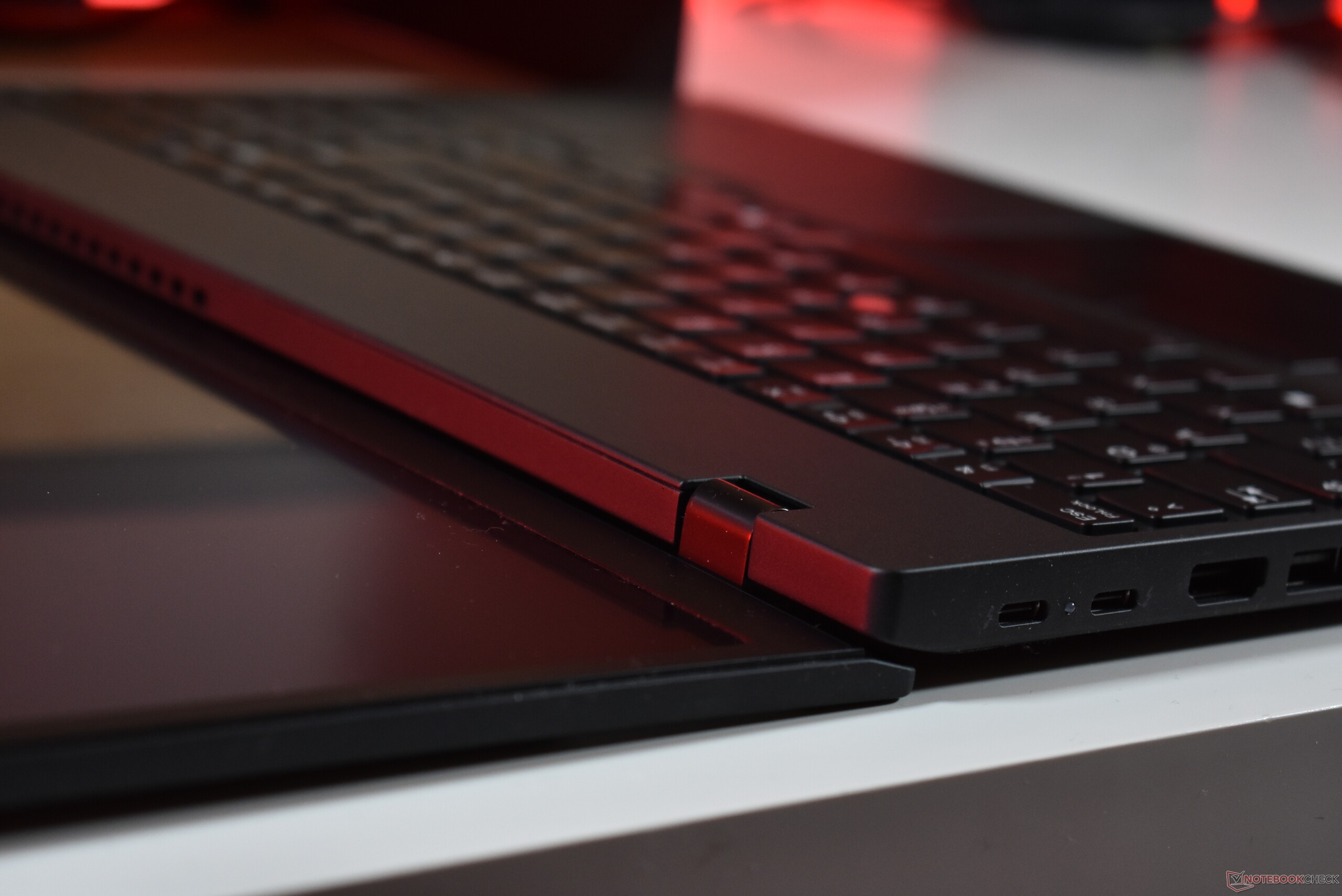
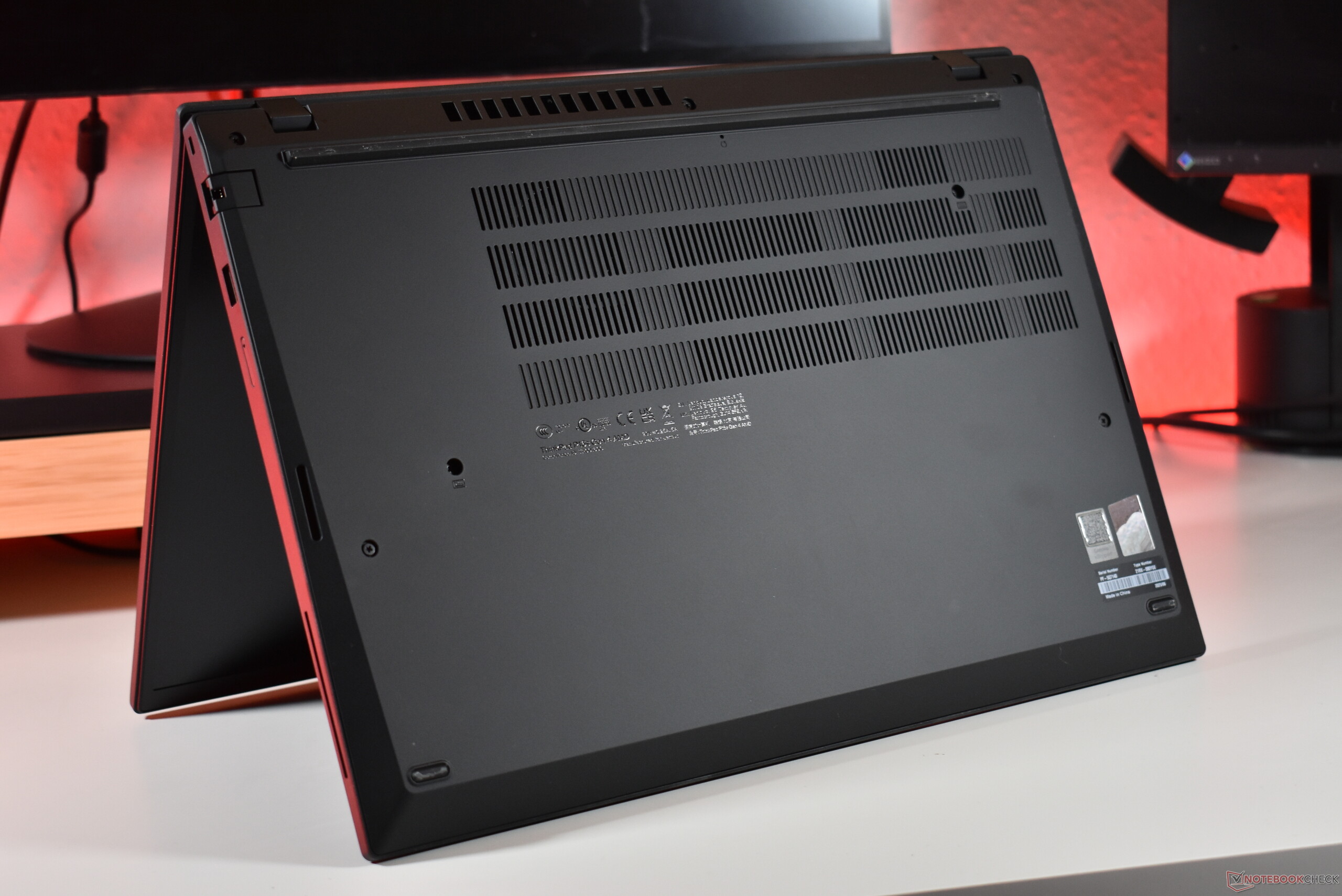
The 16-inch workstations we chose for our comparison are all similar in size and weight. Notably, the P16s Gen 4 AMD is roughly 200 g heavier than the ThinkPad P16s Gen 2 AMD.
Connectivity: AMD ThinkPad now with Thunderbolt 4
The port selection remains almost unchanged compared with the P16s G2, except that the newer P16s now has two Thunderbolt 4 ports (instead of one USB4 and one regular USB-C), and the RJ45 port now has a hinge. Missing for such a big workstation is an SD card slot. Also, it would be nice if there was another USB-C on the right side, so you could charge the device from either side.


Communication
Lenovo uses a fast Wi-Fi 7 solution made by Mediatek, which also offers Bluetooth 5.4. In terms of transfer rates, it does well achieving high networking speeds all around.
Since this is based on the enterprise-line of the ThinkPad T series, Lenovo offers optional WWAN - in this case, 5G/LTE. Our review model has the necessary antennas, M.2 slot and nanoSIM slot. The 5G Quectel RM520N-GL card can be added by the user optionally. Note that only an official part from Lenovo with an FRU number will work.
Webcam
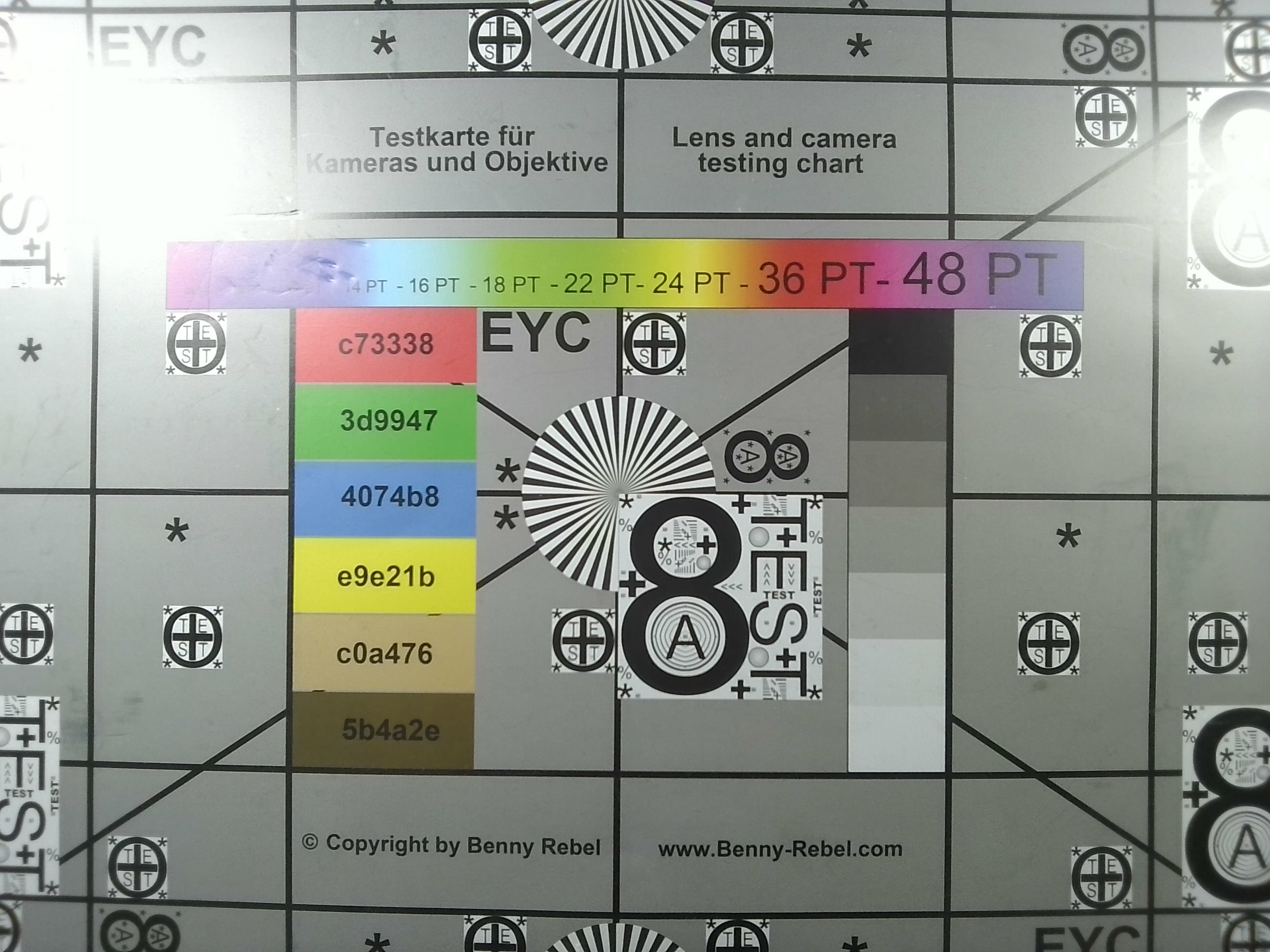
The 5 Mpix webcam is good enough for video calls, as images are reasonably sharp.


Security
As a business model, the Lenovo ThinkPad P16s Gen 4 AMD offers features that are more exotic to consumers, like a Kensington lock slot or a Smartcard reader. More familiar are things like a fingerprint sensor and the infrared webcam for quick log-in with Windows Hello, as well as a mechanical camera shutter for increased privacy.
Accessories
There are no additional accessories, besides the obligatory 65 W USB-C charger.
Maintenance
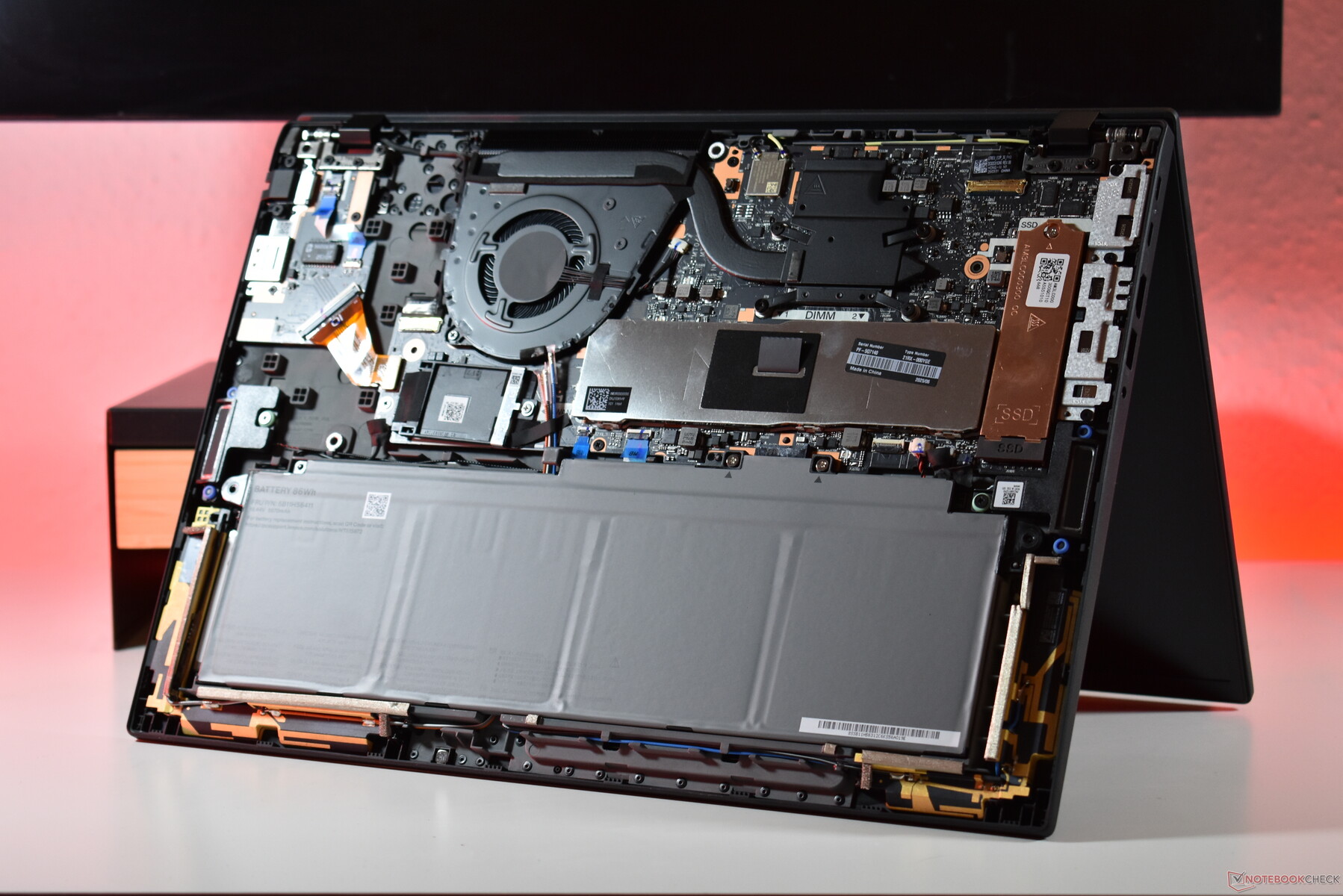
Compared with the older Lenovo ThinkPad P16s Gen 2, this P16s Gen 4 is more upgradeable. After the seven Philips head screws on the bottom are loosened, the bottom cover can be easily removed, as the clips come apart quite nicely. On the inside, there are two SO-DIMM RAM slots and a single M.2 2280 SSD bay. In addition, there is an open M.2 2242 slot for the 5G module. Soldered are the CPU and the Wi-Fi chip. The fan is easily accessible, as is the battery, which is also easier to replace than on previous models.
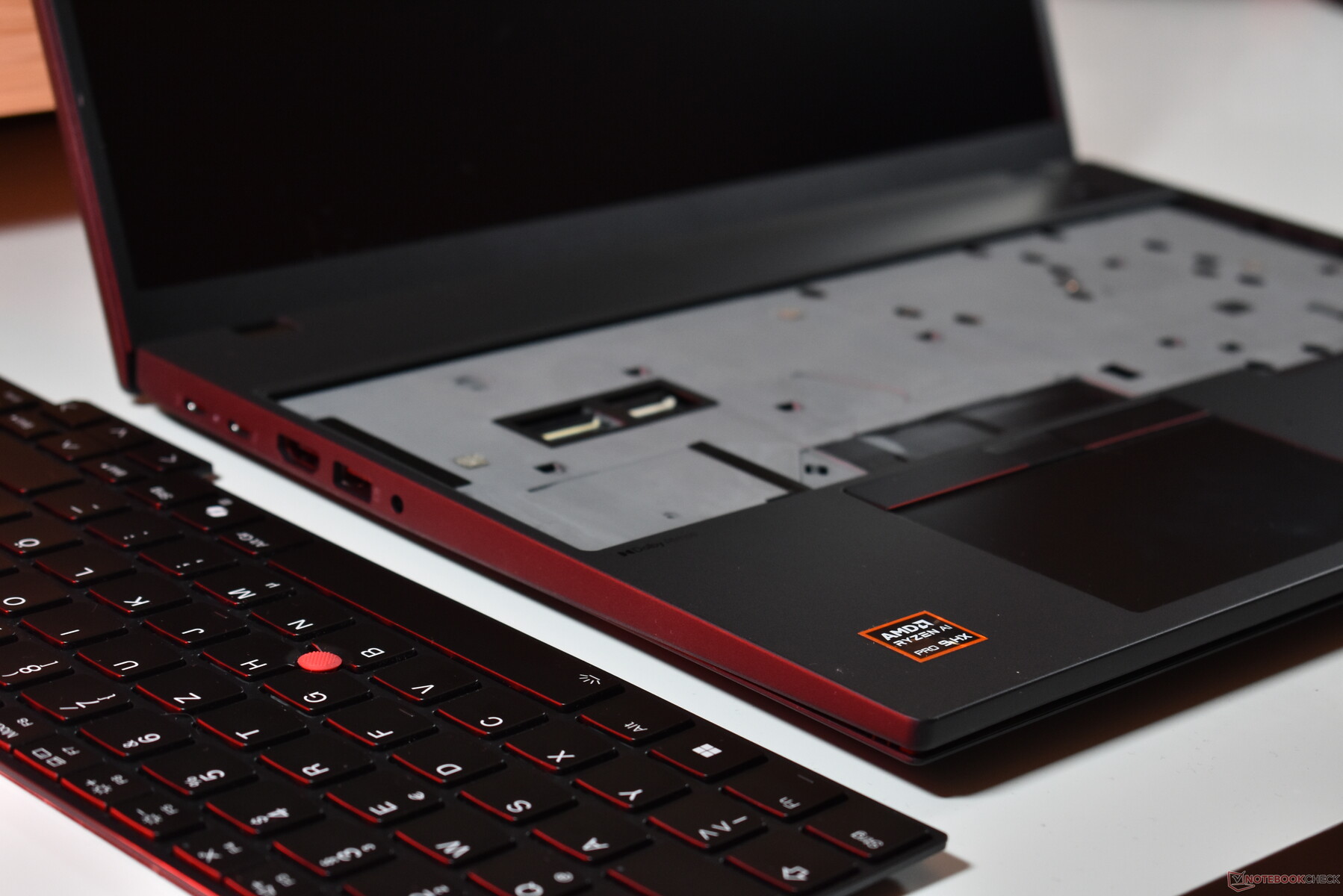
One special feature of the P16s Gen 4 AMD: The keyboard is user-replaceable. It is just held by two screws on the bottom. Once they are loosened, it can be slid back and just removed from the chassis - a great repairability feature.
Sustainability
While the packaging is 100 % recyclable, the device itself is a bit less sustainable, as the chassis materials themselves are not made from recycled stuff. Lenovo estimates the lifecycle CO2-emissions of the ThinkPad P16s Gen 4 AMD to be around 192 kg CO2 equivalent, a bit more than comparable 14-inch systems. As a ThinkPad, Lenovo provides software updates and parts support for up to seven years, and there also are maintenance manuals, both in written and video form.
Warranty
This device is sold with a three-year warranty, which also applies internationally, and covers a basic bring-in service. Should the battery fail, Lenovo only replaces it during the first year of the warranty - warranty extensions for the battery are optional.
Input Devices: Strong ThinkPad legacy continues
Keyboard
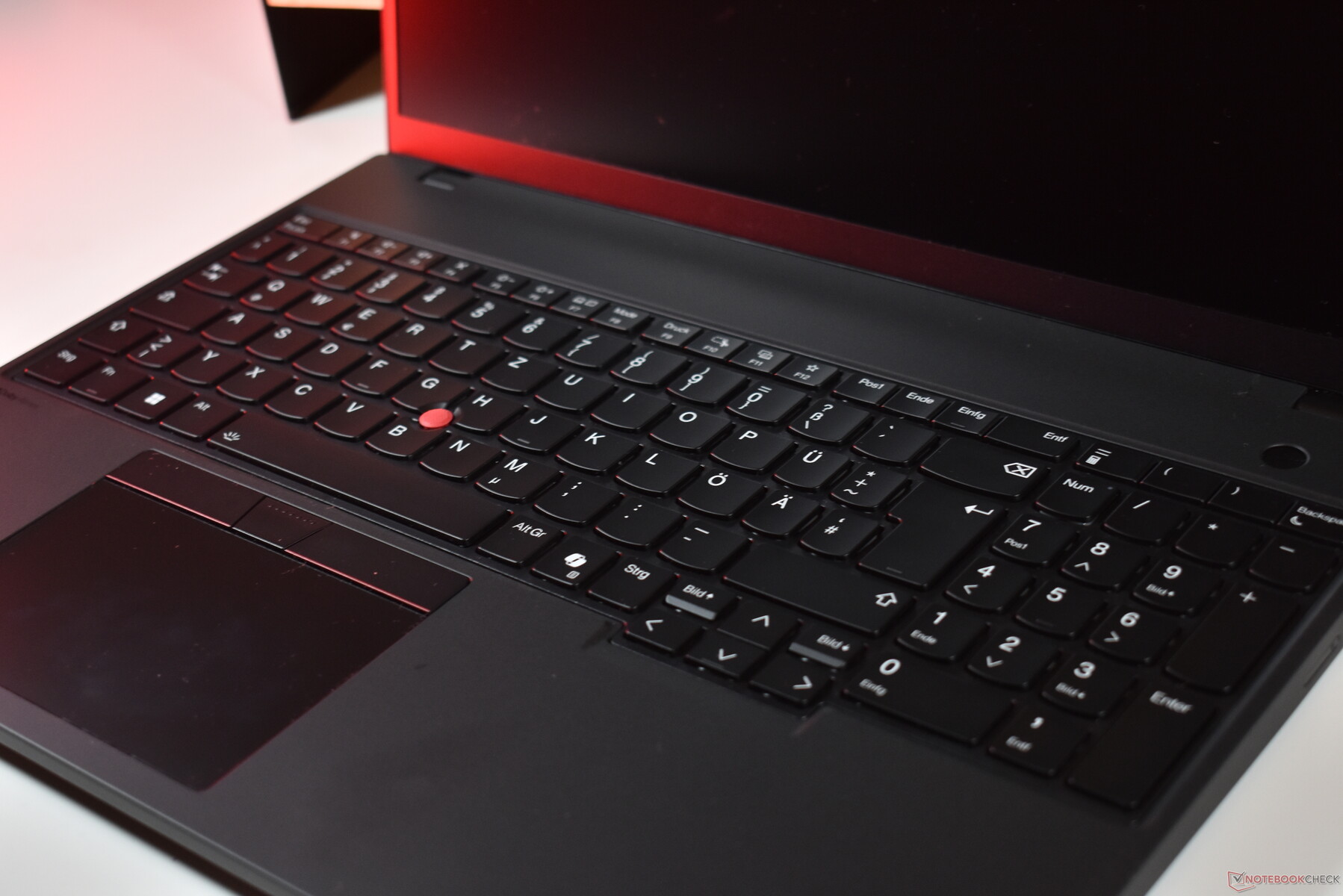
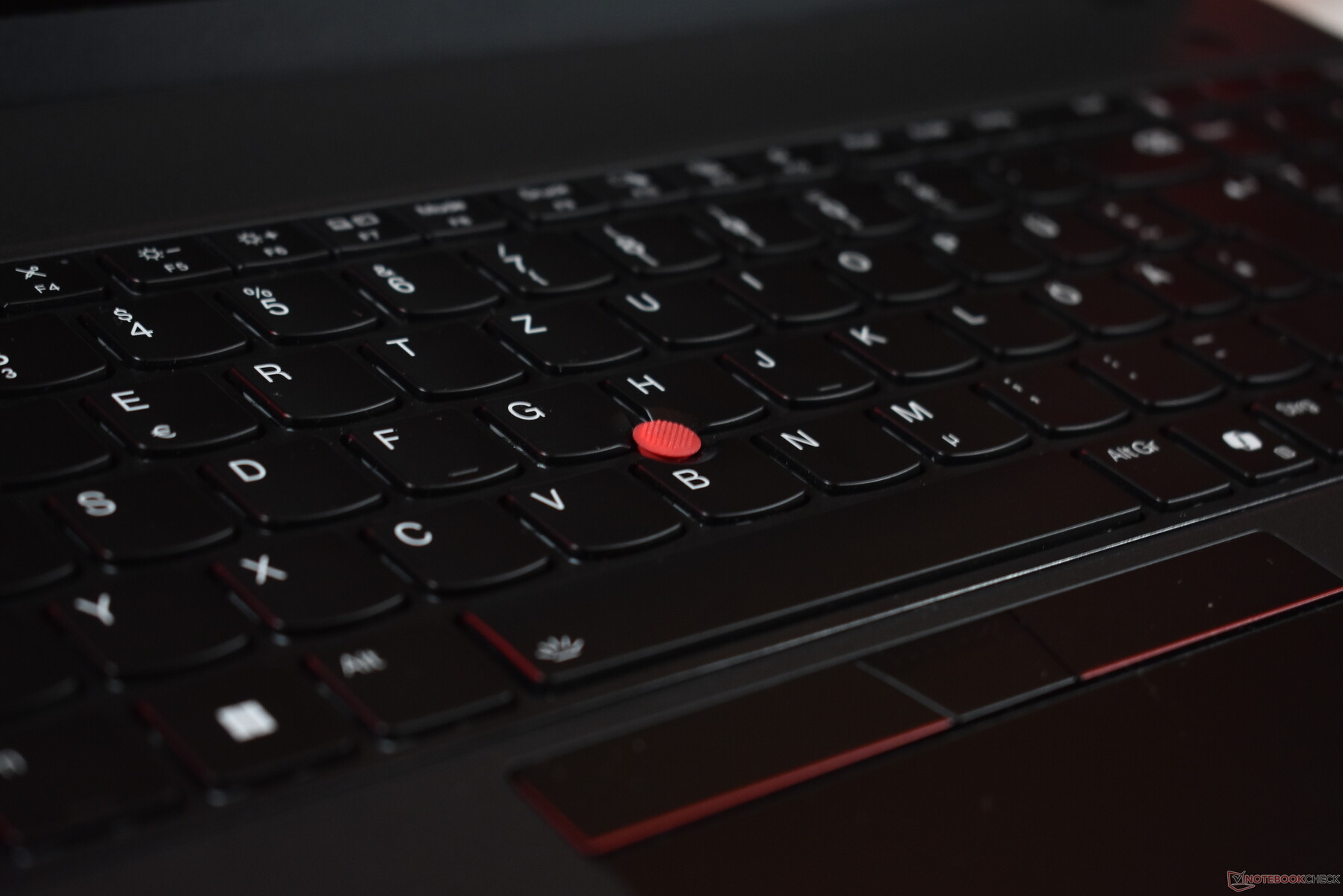
The keyboard that Lenovo uses in the ThinkPad P16s Gen 4 AMD is not too different from the ThinkPad P16s Gen 2 AMD. The basic stuff, like the slightly concave Chiclet keys with 1.5 mm travel and two stage backlight plus full-size layout with numpad. The changes are small, but not meaningless: Lenovo added the obligatory Copilot key, and the Ctrl and FN keys have been switched. There are also some minor changes to the F key functions.
Overall, the keyboard is excellent. Typing on this ThinkPad laptop is a joy, and writing longer text is very easy, thanks to the very comfortable typing feel.
Touchpad and TrackPoint
Lenovo offers two mouse inputs on the ThinkPad line: A touchpad with integrated buttons, a so called clickpad, and a pointing stick, also known as TrackPoint. The touchpad has a medium size (11.5 x 6.5 cm) and it is made out of plastic. While it does not feel as luxurious as a glass touchpad, it provides a quite satisfying user experience. The same can be said for the TrackPoint and its dedicated mouse keys. The pointing stick, which works via pressure, not movement, is better in certain situations, like in an airplane, and especially useful on a workstation, thanks to the third mouse button.

Display: Bright, but low resolution screen
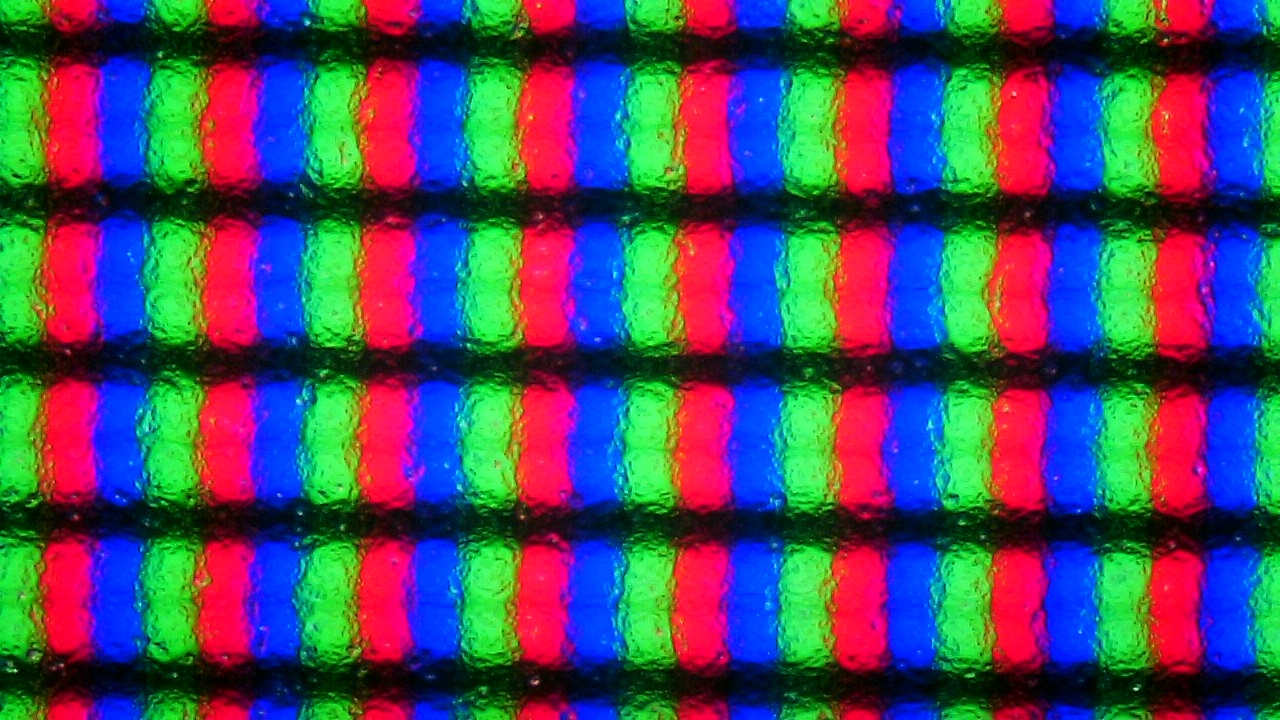
Four different 16-inch 16:10 screens are available in the Lenovo ThinkPad P16s Gen 4 AMD:
- WUXGA (1,920 x 1,200), IPS, 400 cd/m², 45 % NTSC, matte
- WUXGA (1,920 x 1,200), IPS, 400 cd/m², 45 % NTSC, matte, multitouch
- WUXGA (1,920 x 1,200), IPS, 500 cd/m², 100 % sRGB, matte, low power
- 4K-WQUXGA (3,840 x 2,400), OLED, 400 cd/m², 100 % DCI-P3, semi-glossy, multitouch
As with the smaller ThinkPad P14s Gen 6 AMD, the highest-end panel, the OLED screen, can not be configured with the Ryzen AI 9 HX CPU and is only available with Ryzen 5 and Ryzen 7 CPUs.
The low power panel in our review sample is made by Innolux. It delivers the promised brightness and is one of the brighter panel in our comparison. WUXGA resolution is the bare minimum for a 16-inch workstation, though, and the lack of a higher resolution IPS option does hurt.
| |||||||||||||||||||||||||
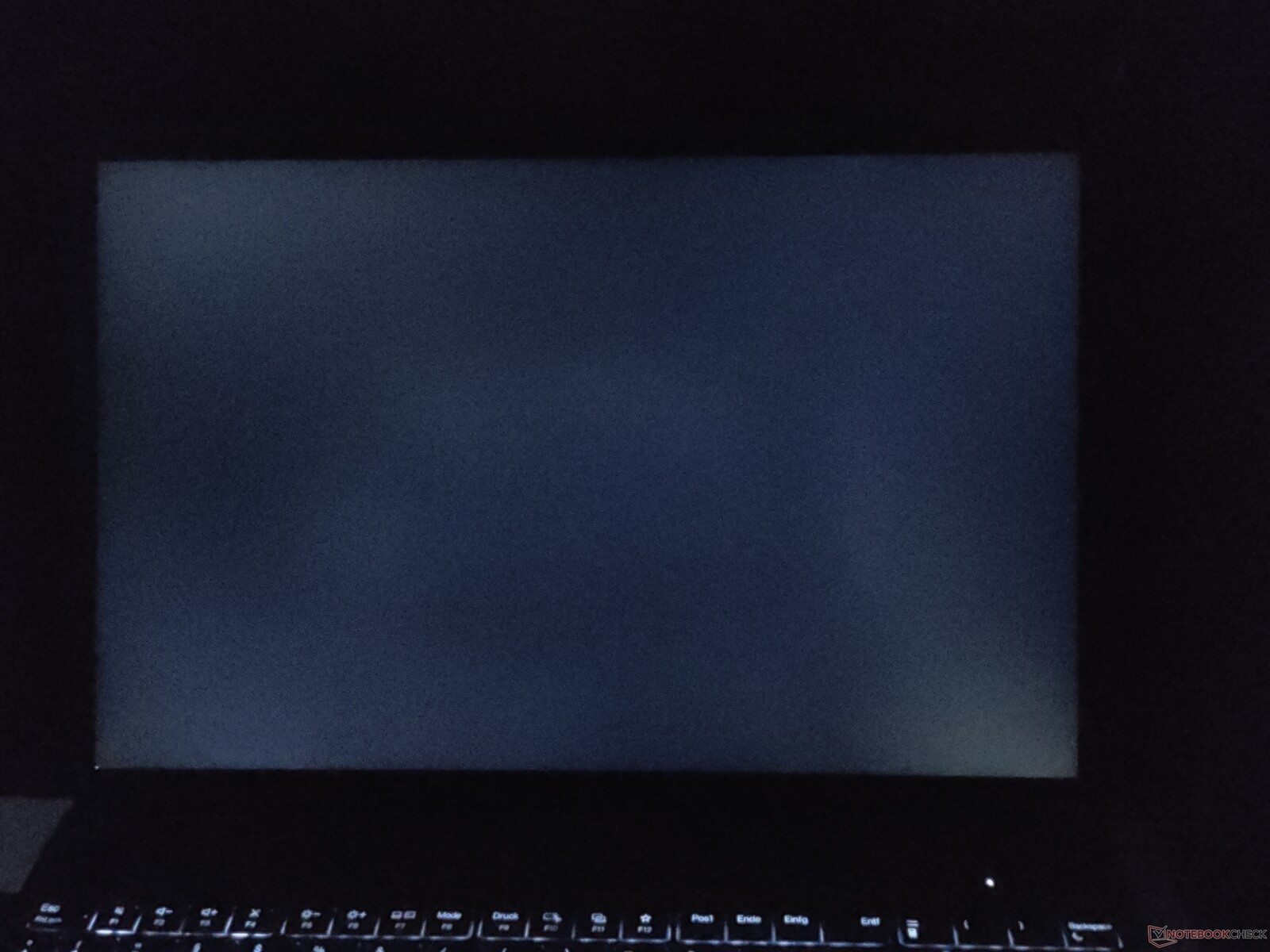
Brightness Distribution: 93 %
Center on Battery: 540 cd/m²
Contrast: 1459:1 (Black: 0.37 cd/m²)
ΔE ColorChecker Calman: 3.4 | ∀{0.5-29.43 Ø4.7}
calibrated: 0.9
ΔE Greyscale Calman: 4.5 | ∀{0.09-98 Ø4.95}
67.8% AdobeRGB 1998 (Argyll 3D)
96.8% sRGB (Argyll 3D)
65.8% Display P3 (Argyll 3D)
Gamma: 2.51
CCT: 6294 K
| Lenovo ThinkPad P16s Gen 4 21RX000YGE N160JCA-GT1, IPS LED, 1920x1200, 16", 60 Hz | Lenovo ThinkPad P16s G2 21K9000CGE ATNA60YV04-0, OLED, 3840x2400, 16", 60 Hz | HP ZBook X G1i 16 LG Philips LGD07B3, IPS, 2560x1600, 16", 120 Hz | Lenovo ThinkPad P1 Gen 8 Samsung ATNA60KA02-0, Tandem OLED, 3200x2000, 16", 120 Hz | Dell Precision 5690 Samsung 160YV03, OLED, 3840x2400, 16", 60 Hz | |
|---|---|---|---|---|---|
| Display | 33% | 33% | 32% | 32% | |
| Display P3 Coverage (%) | 65.8 | 99.9 52% | 97.2 48% | 98.8 50% | 99.8 52% |
| sRGB Coverage (%) | 96.8 | 100 3% | 100 3% | 100 3% | 100 3% |
| AdobeRGB 1998 Coverage (%) | 67.8 | 96.9 43% | 99.9 47% | 97.5 44% | 96.6 42% |
| Response Times | 95% | -36% | 98% | 93% | |
| Response Time Grey 50% / Grey 80% * (ms) | 29.4 ? | 1.5 ? 95% | 45.5 ? -55% | 0.57 ? 98% | 1.7 ? 94% |
| Response Time Black / White * (ms) | 22.4 ? | 1.3 ? 94% | 26.1 ? -17% | 0.73 ? 97% | 1.7 ? 92% |
| PWM Frequency (Hz) | 60 | 26536 ? | 1199 | 60 ? | |
| PWM Amplitude * (%) | 47 | 18 | |||
| Screen | -12% | -13% | 30% | -7% | |
| Brightness middle (cd/m²) | 540 | 416 -23% | 461.8 -14% | 561.8 4% | 348.1 -36% |
| Brightness (cd/m²) | 516 | 421 -18% | 427 -17% | 566 10% | 351 -32% |
| Brightness Distribution (%) | 93 | 98 5% | 88 -5% | 99 6% | 97 4% |
| Black Level * (cd/m²) | 0.37 | 0.46 -24% | |||
| Contrast (:1) | 1459 | 1004 -31% | |||
| Colorchecker dE 2000 * | 3.4 | 1.3 62% | 4.08 -20% | 1.29 62% | 4.18 -23% |
| Colorchecker dE 2000 max. * | 5.6 | 2.8 50% | 8.1 -45% | 2.96 47% | 6.68 -19% |
| Colorchecker dE 2000 calibrated * | 0.9 | 2.9 -222% | 0.75 17% | 0.81 10% | 0.97 -8% |
| Greyscale dE 2000 * | 4.5 | 1.8 60% | 3.5 22% | 1.4 69% | 1.7 62% |
| Gamma | 2.51 88% | 2.25 98% | 2.15 102% | 2.23 99% | 2.2 100% |
| CCT | 6294 103% | 6574 99% | 6715 97% | 6319 103% | 6198 105% |
| Total Average (Program / Settings) | 39% /
17% | -5% /
-7% | 53% /
42% | 39% /
19% |
* ... smaller is better
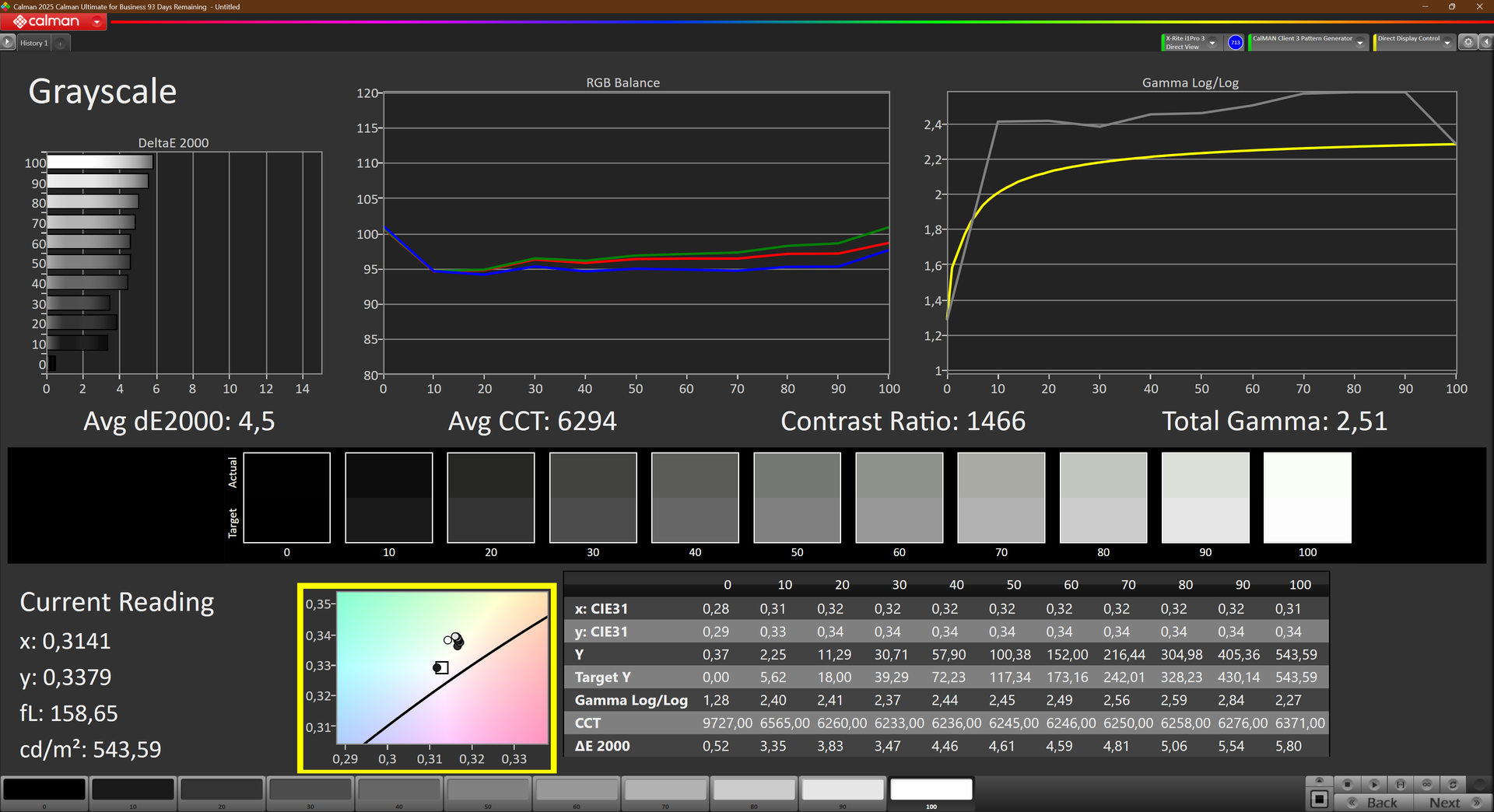
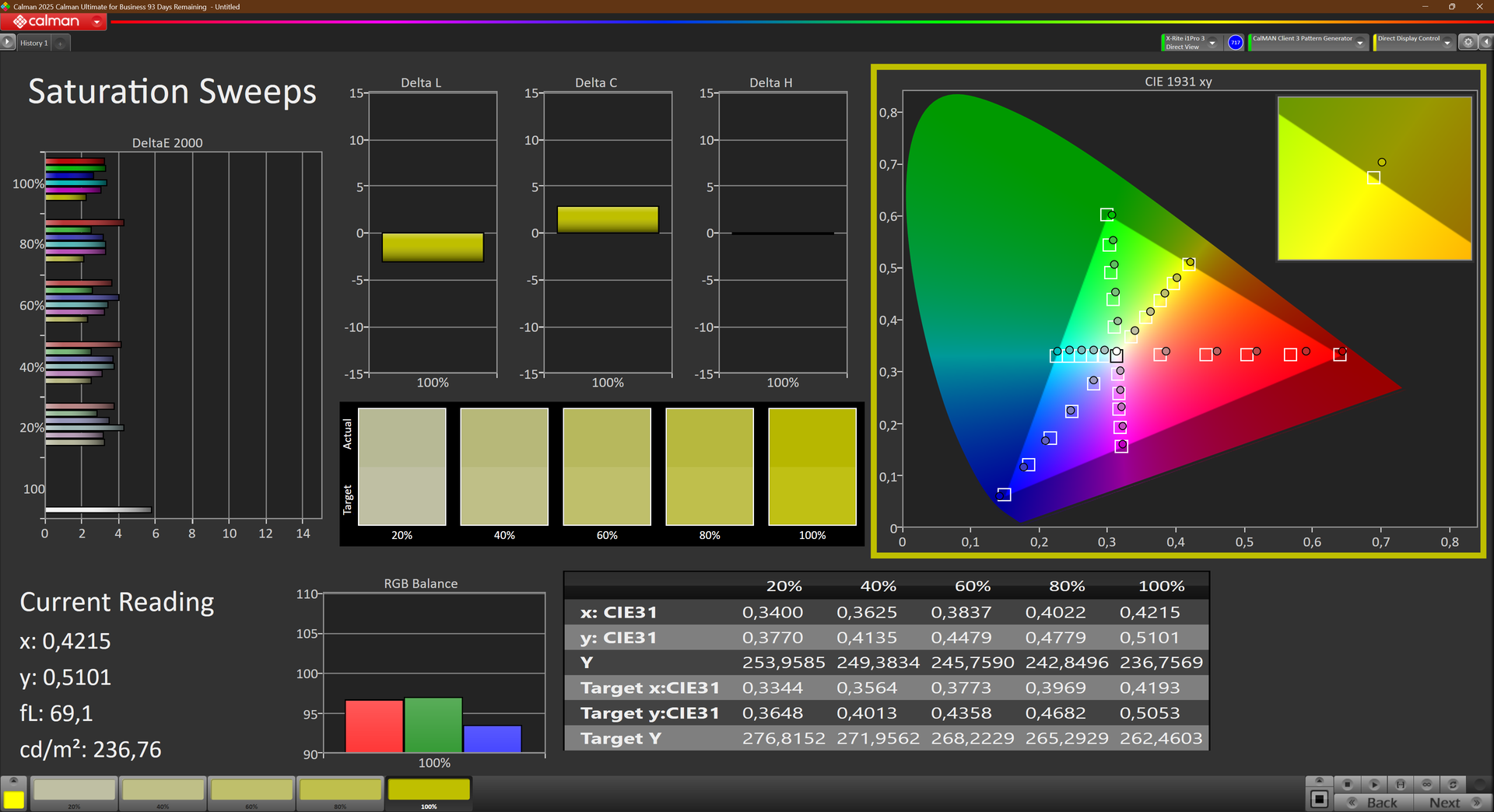
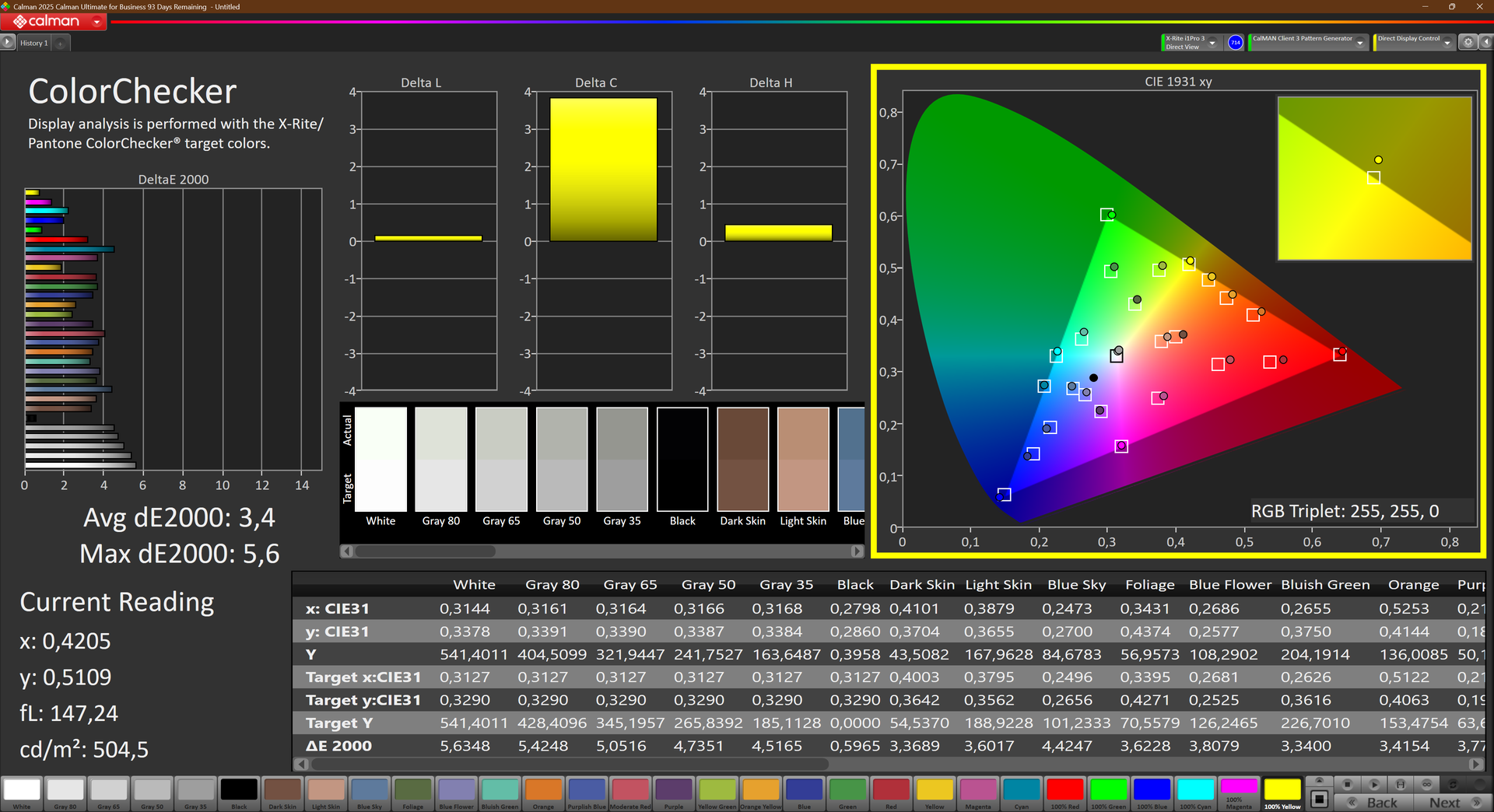
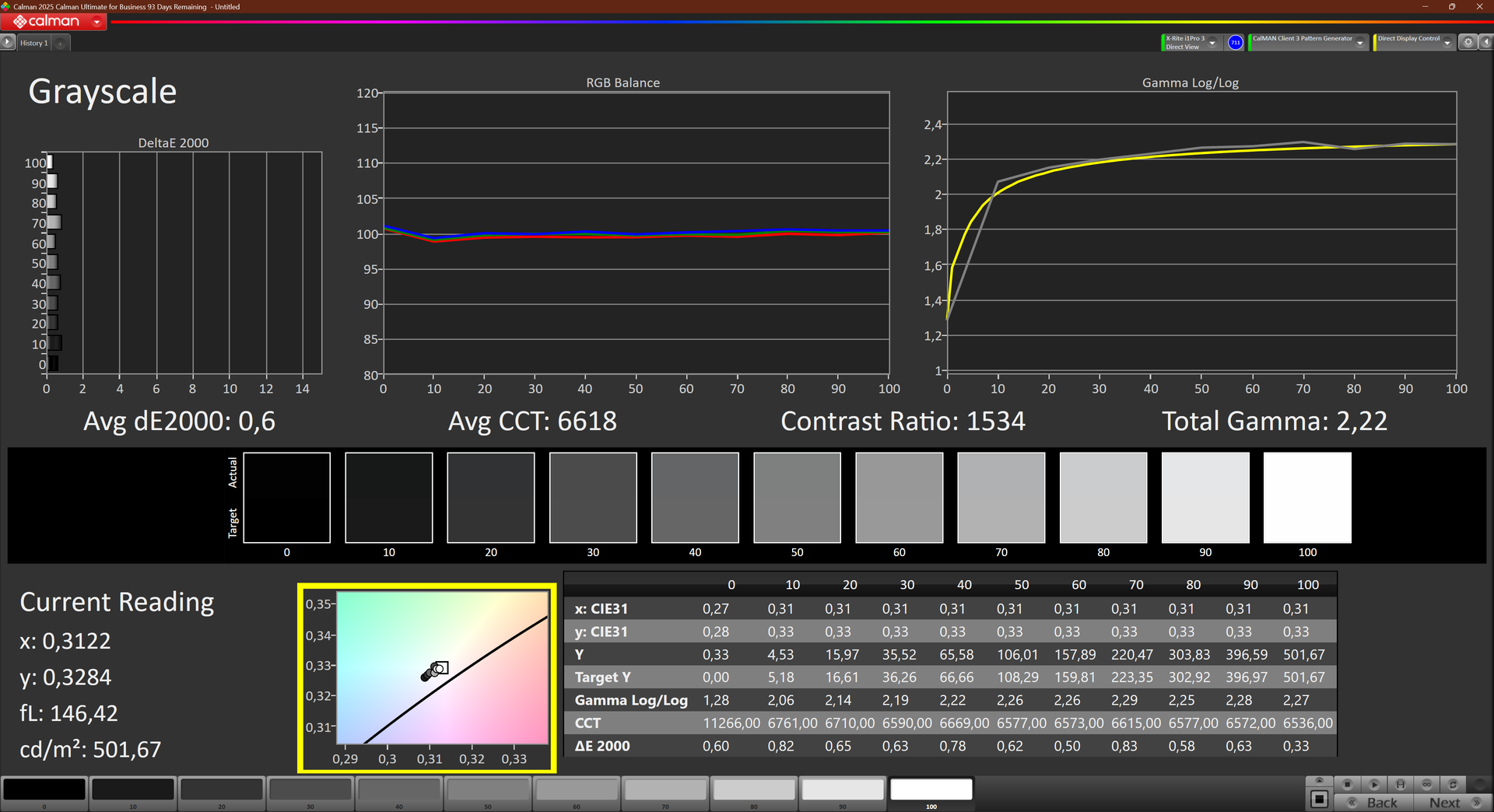


After a calibration with the X-Rite i1 Pro 3 and the i1Profiler software, the colors of the Lenovo ThinkPad P16s Gen 4 AMD were mostly accurate (Calman Colorchecker deltaE: 0,9). The profile created by us is available for download for free, as always.
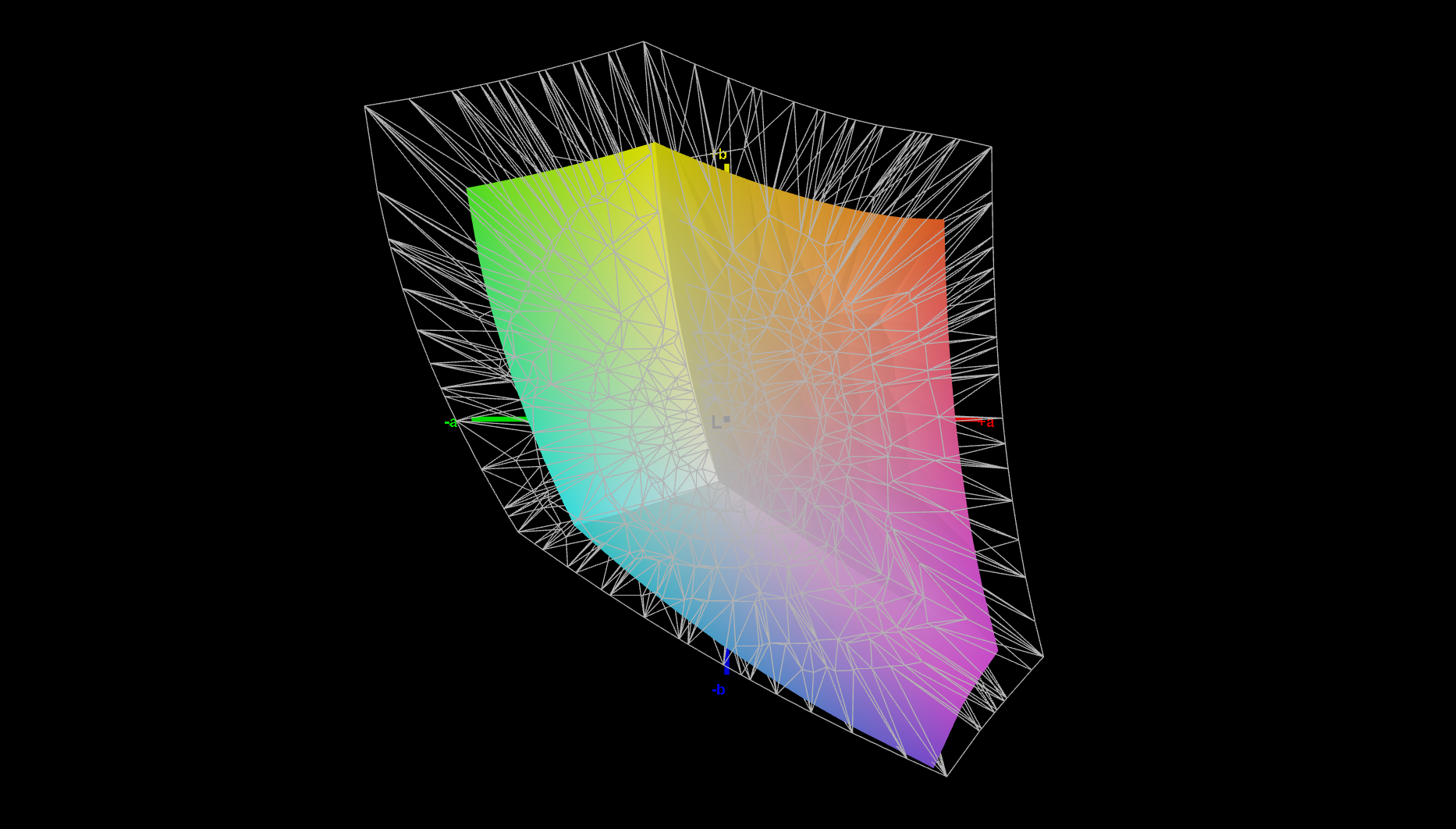
The panel misses the 100 % sRGB target slightly, as we measure 96.8 % sRGB coverage. The panel is usable for simple photo editing.
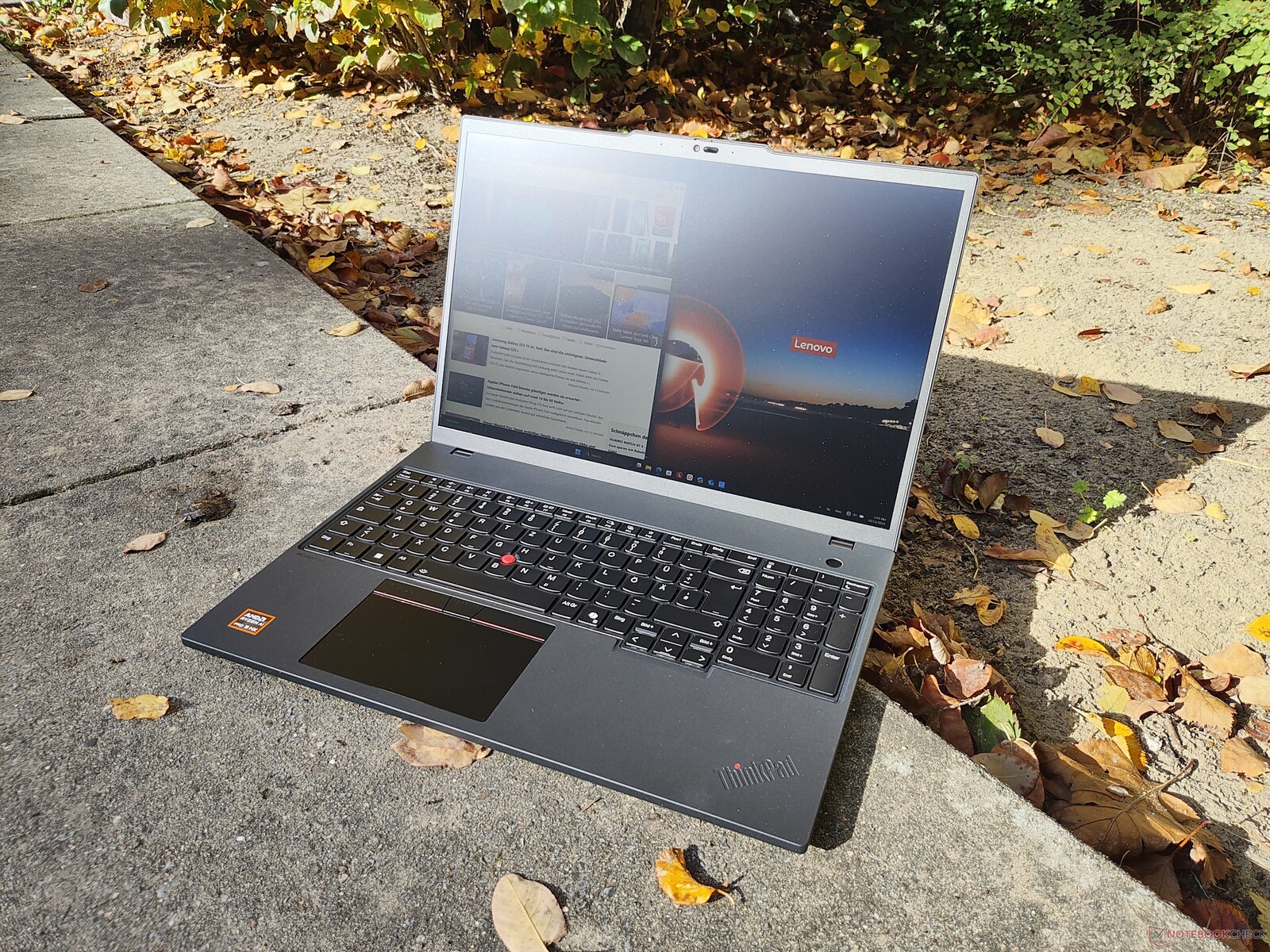
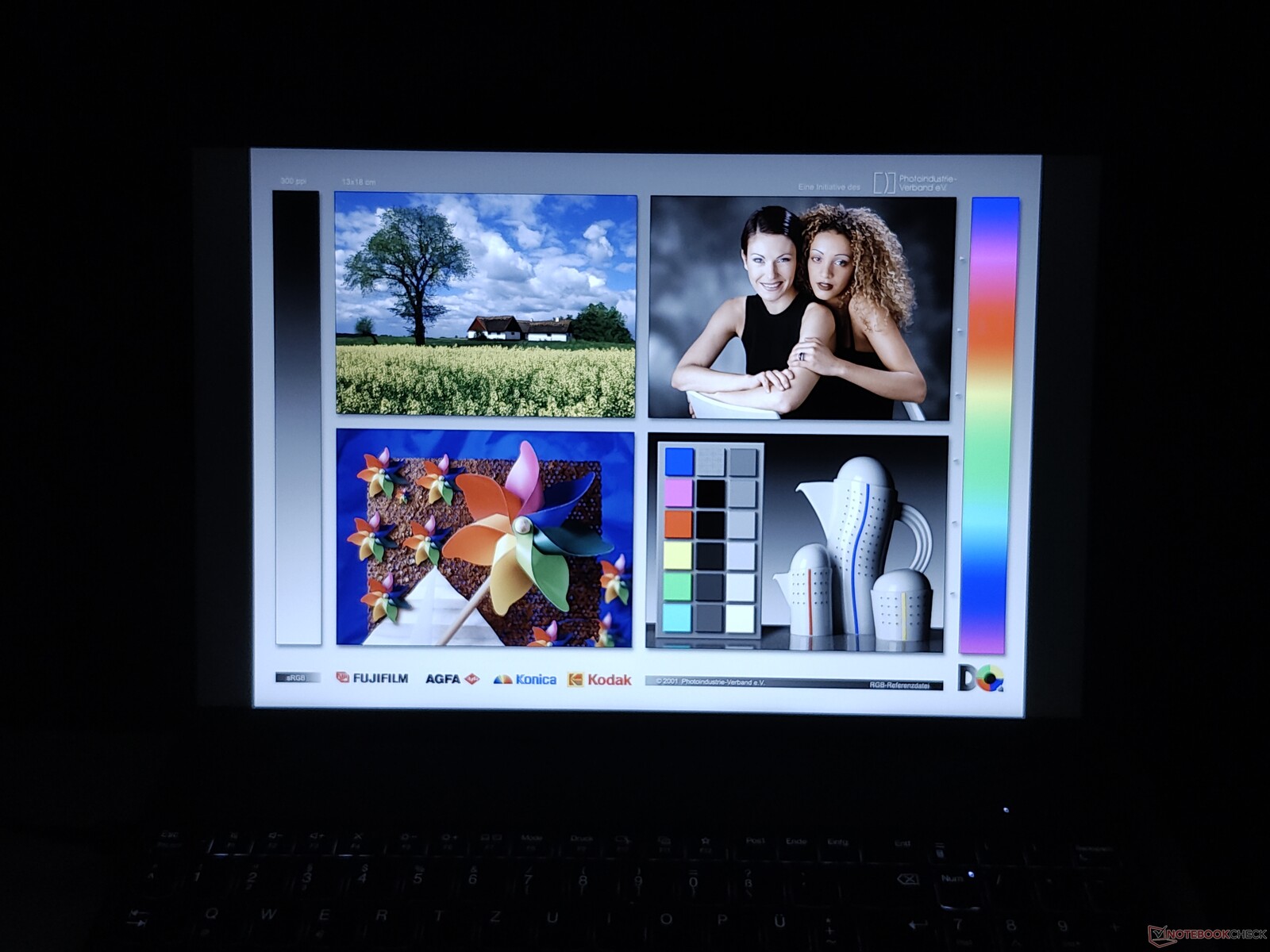
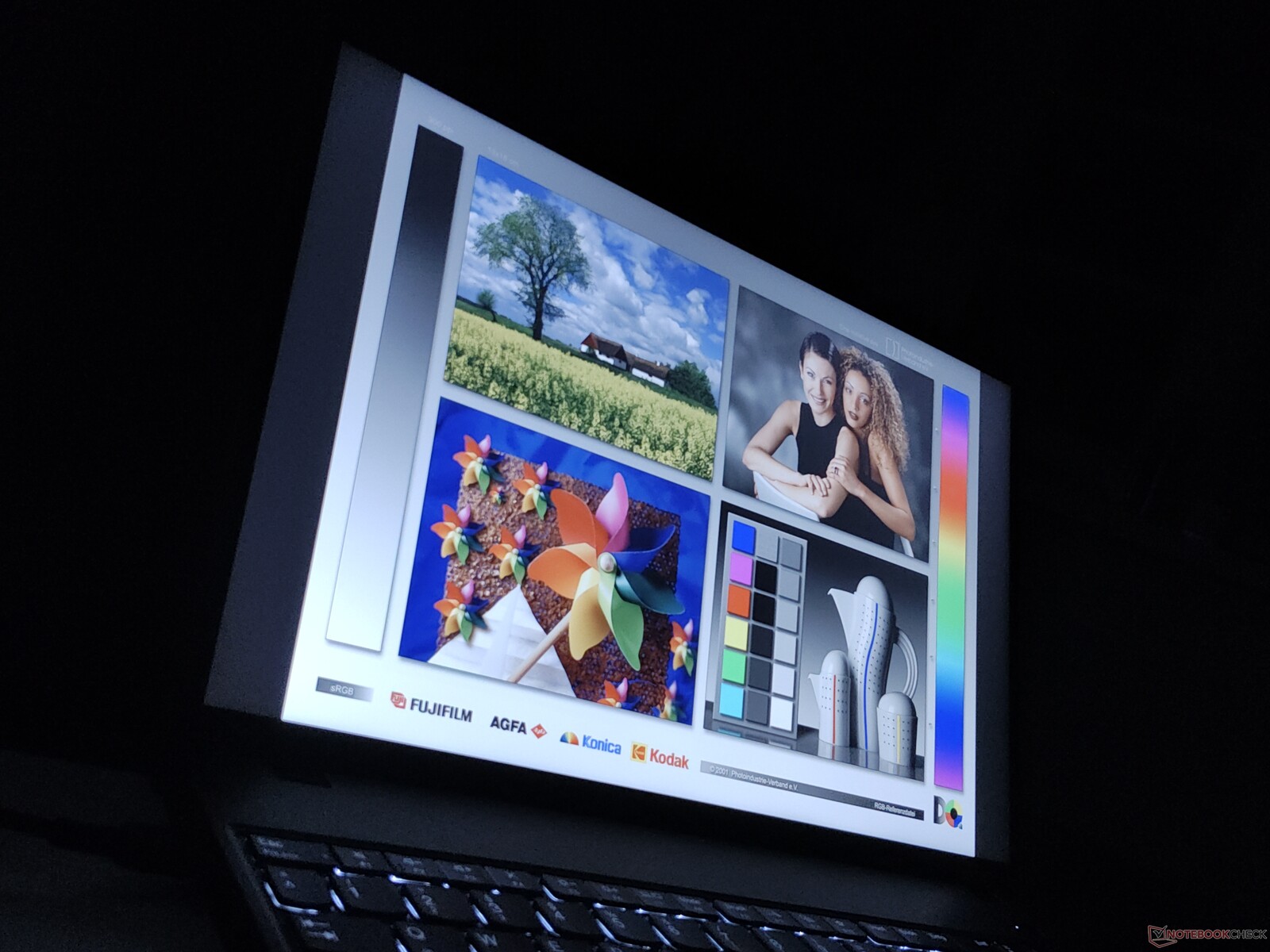
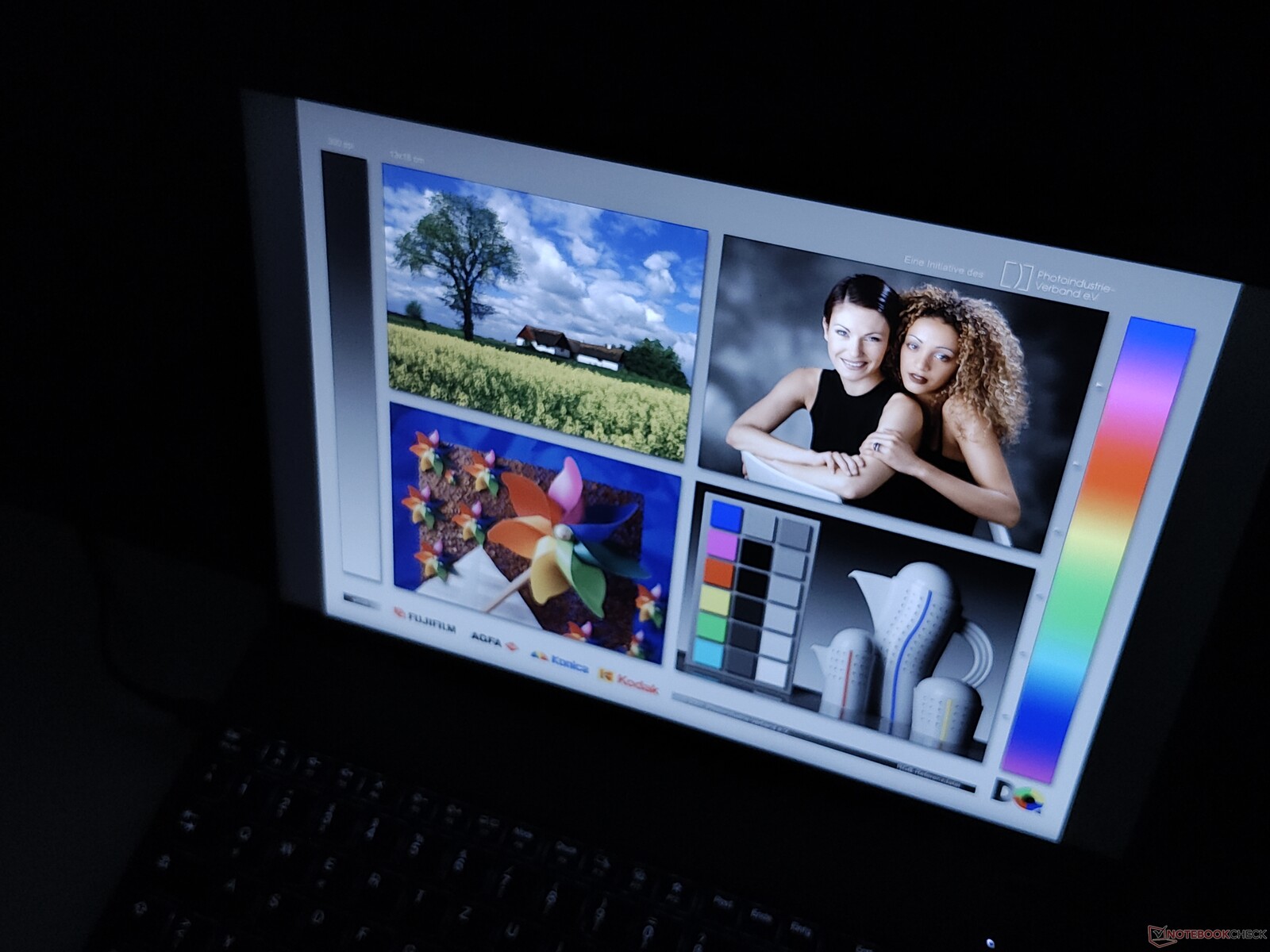
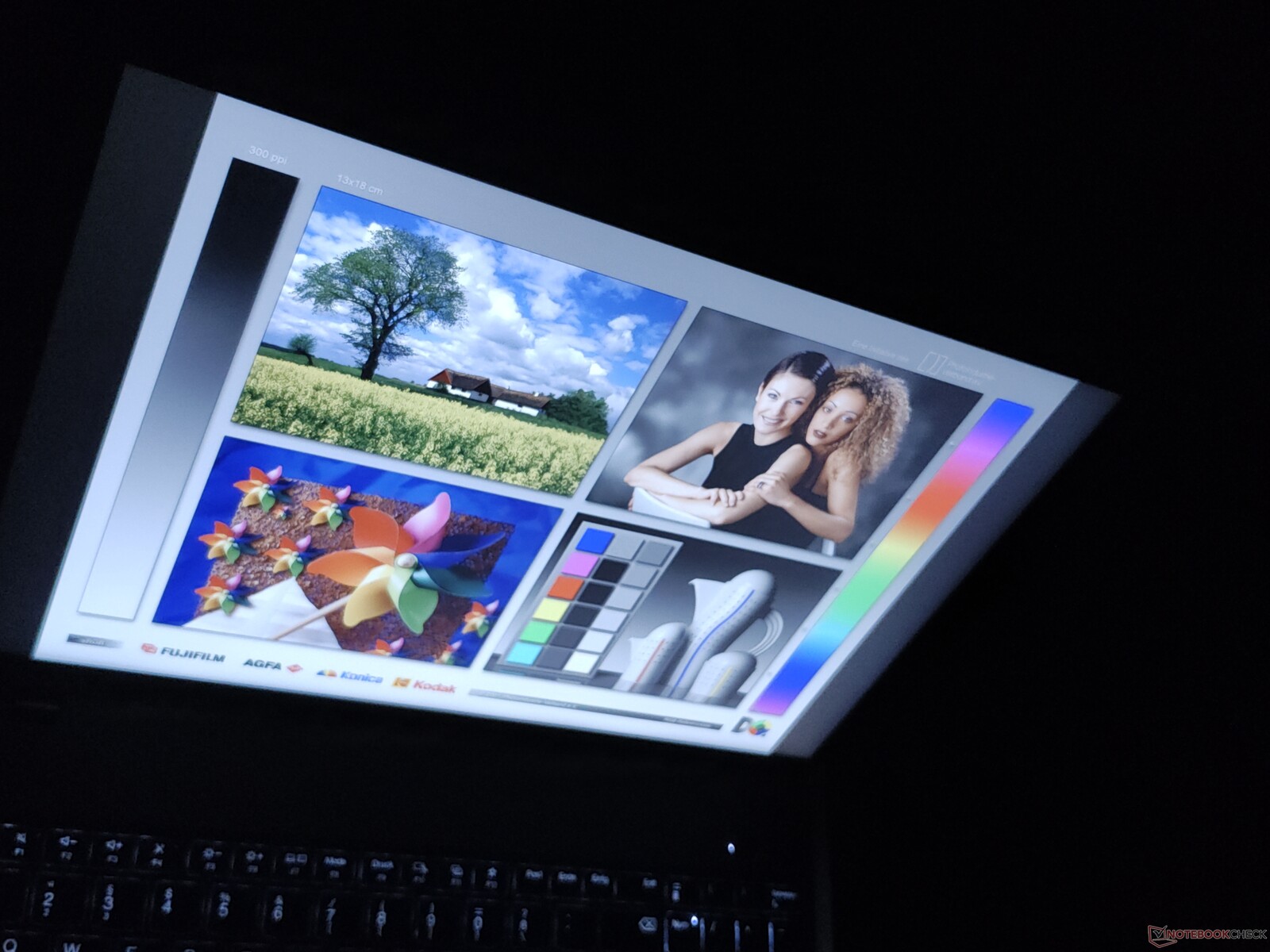
Thanks to the high brightness and matte surface, using the Lenovo ThinkPad P16s Gen 4 outside the office is possible. Even some indirect sunlight can be overcome by the panel.
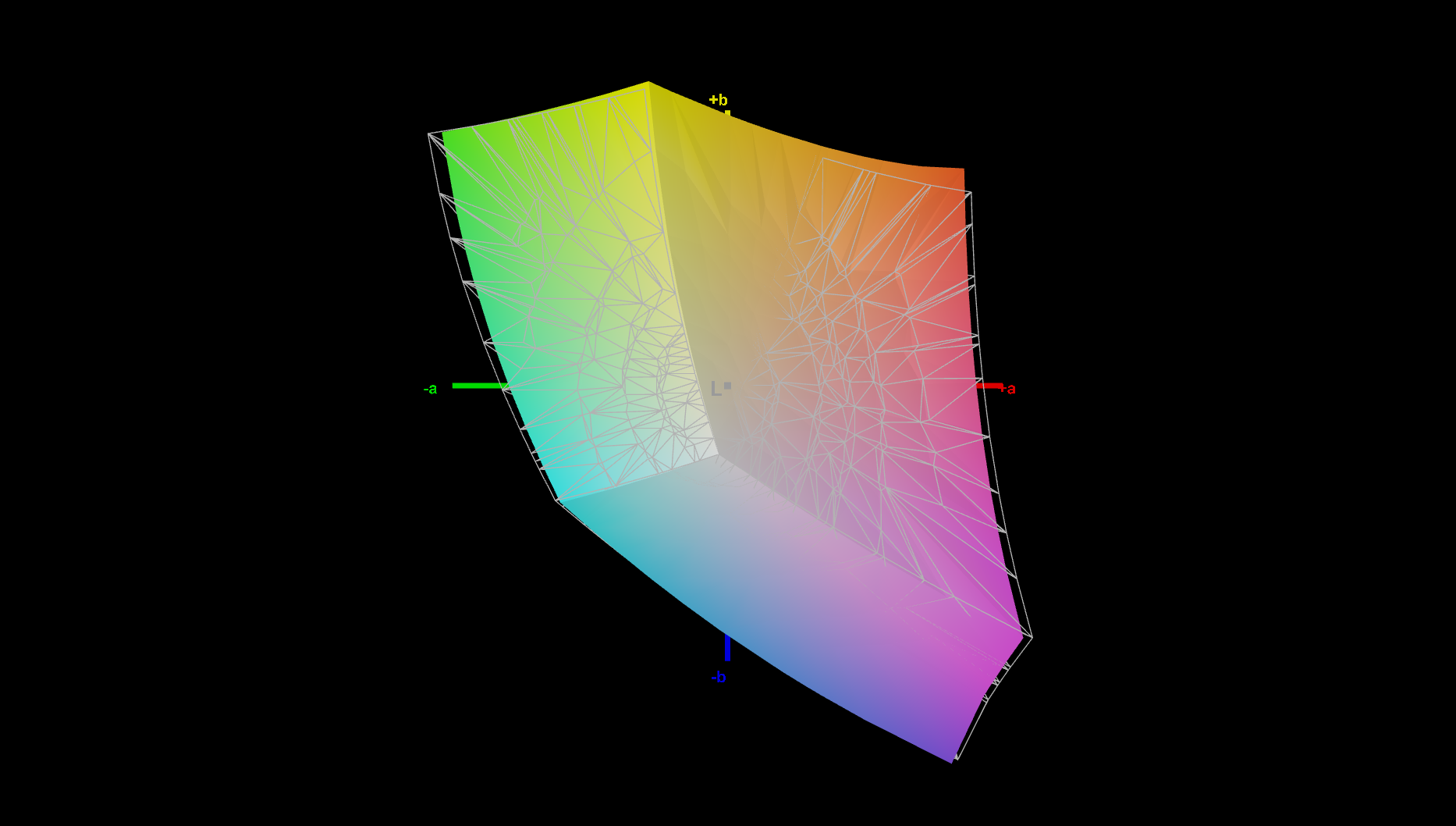

Display Response Times
| ↔ Response Time Black to White | ||
|---|---|---|
| 22.4 ms ... rise ↗ and fall ↘ combined | ↗ 12.8 ms rise | 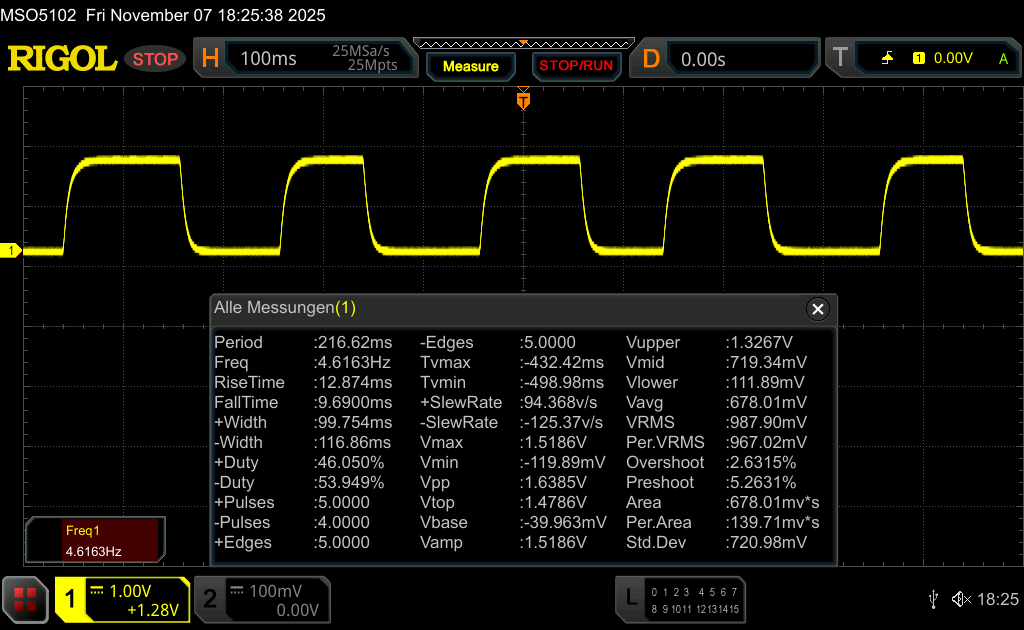 |
| ↘ 9.6 ms fall | ||
| The screen shows good response rates in our tests, but may be too slow for competitive gamers. In comparison, all tested devices range from 0.1 (minimum) to 240 (maximum) ms. » 51 % of all devices are better. This means that the measured response time is worse than the average of all tested devices (19.7 ms). | ||
| ↔ Response Time 50% Grey to 80% Grey | ||
| 29.4 ms ... rise ↗ and fall ↘ combined | ↗ 14.5 ms rise | 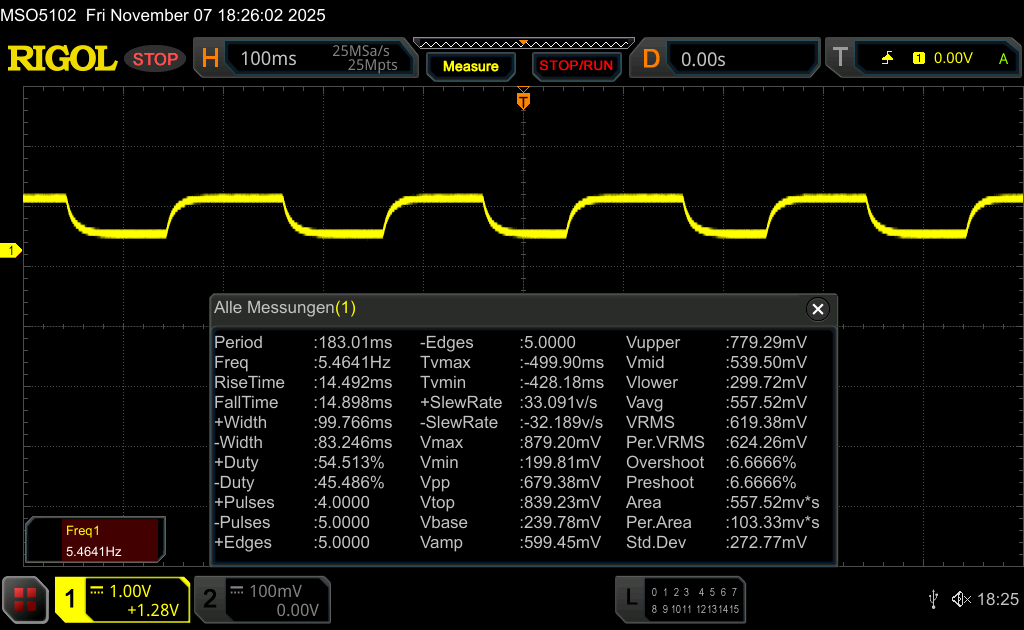 |
| ↘ 14.9 ms fall | ||
| The screen shows relatively slow response rates in our tests and may be too slow for gamers. In comparison, all tested devices range from 0.13 (minimum) to 636 (maximum) ms. » 40 % of all devices are better. This means that the measured response time is similar to the average of all tested devices (30.8 ms). | ||
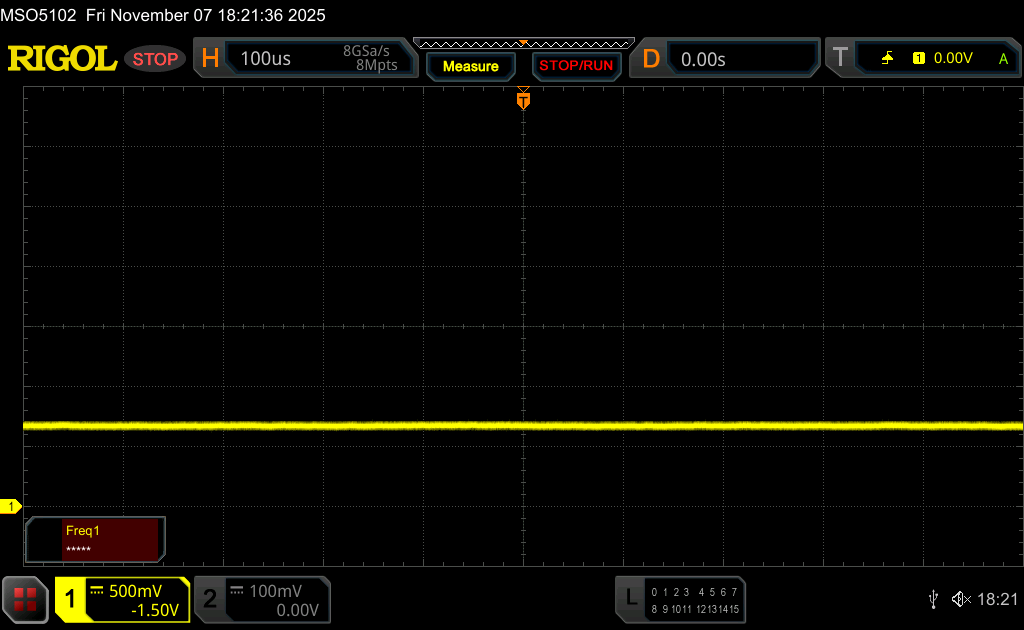
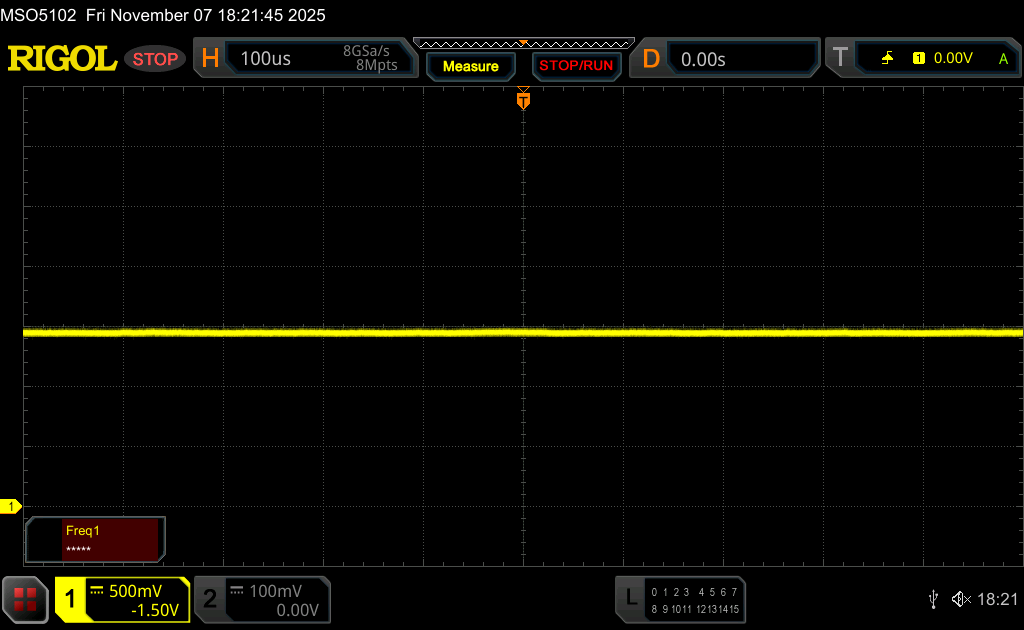
Screen Flickering / PWM (Pulse-Width Modulation)
| Screen flickering / PWM not detected | 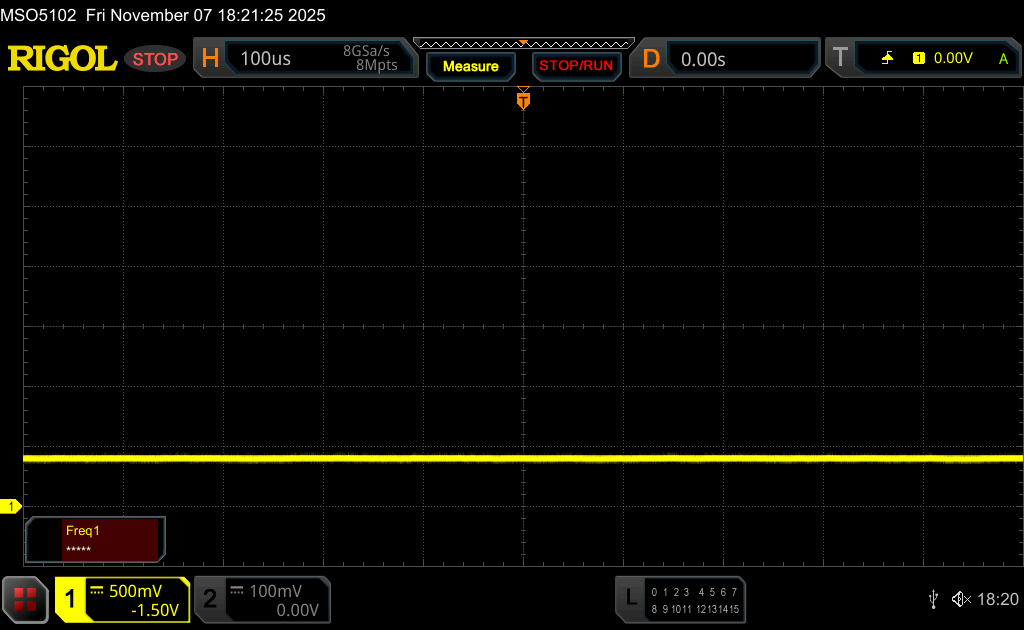 | ||
In comparison: 52 % of all tested devices do not use PWM to dim the display. If PWM was detected, an average of 7659 (minimum: 5 - maximum: 343500) Hz was measured. | |||
Performance: AMD Ryzen laptop delivers great CPU performance
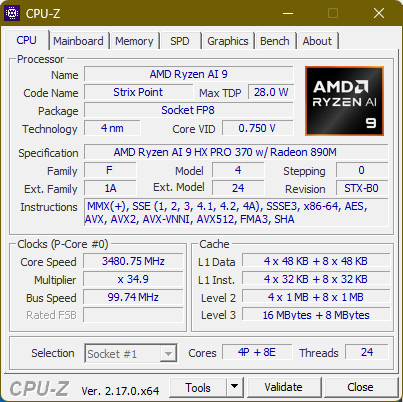
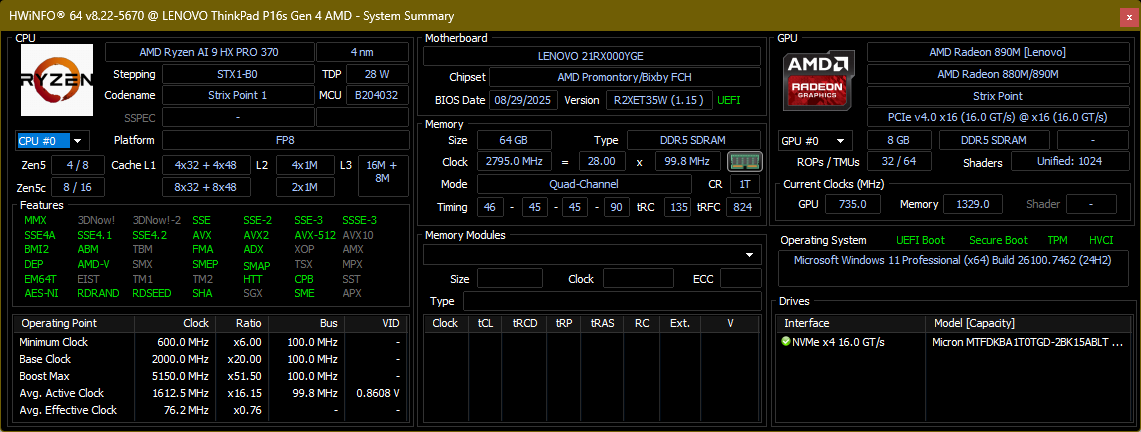
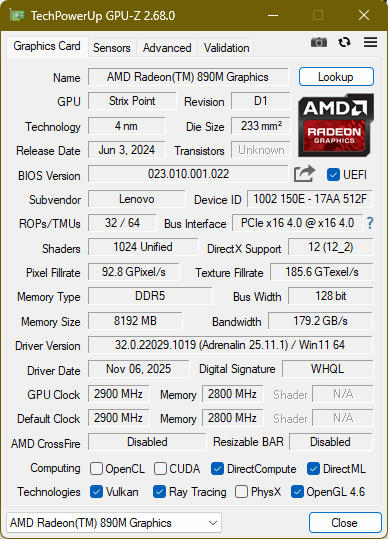
There are a total of three different processors (AMD Ryzen AI 5 Pro 340, AMD Ryzen AI 7 Pro 350, AMD Ryzen AI 9 Pro HX 370) and integrated GPUs (AMD Radeon 840M, Radeon 860M, Radeon 890M).
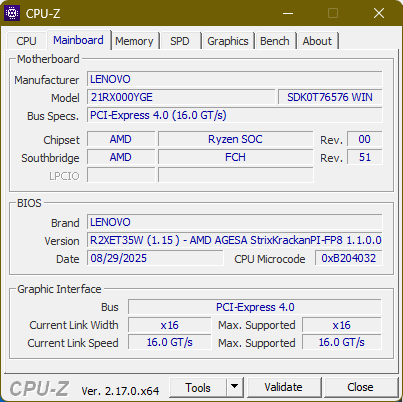
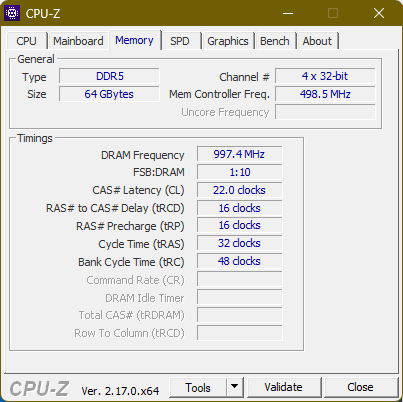
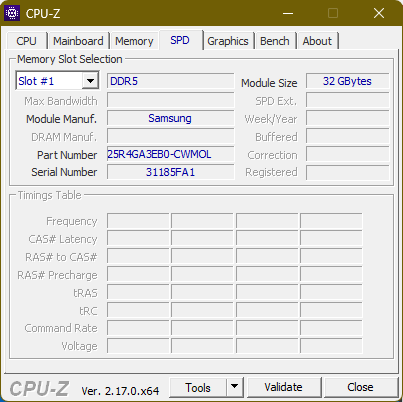
Different from the older P16s Gen 2 AMD, the RAM is not soldered. Instead, the Lenovo ThinkPad P16s G6 has two SO-DIMMs for up to 96 GB DDR5-5600 memory. A single M.2 2280 NVMe PCIe 4.0 SSD serves as storage with a capacity of up to 2 TB ex factory.
Testing Conditions
As always with ThinkPads, Lenovo relies on the Windows settings power modes to regulate the performance of the ThinkPad P16s Gen 4 AMD. The power profiles do this by changing the power limits of the processor (PL1 = sustained power consumption, PL2 = peak power consumption):
- Best Battery Life: PL1 26 W / PL2 30 W
- Balanced: PL1 32 W / PL2 35 W
- Best Performance: PL1 36 W / PL2 51 W
All benchmarks were done using the "Best Performance" profile.
Processor
The AMD Ryzen AI 9 Pro HX 370 is a high-end processor from AMD with 12 cores and a typical power consumption of 28 W. It has four big Zen5 (up to 5.1 GHz) and eight Zen5c cores (up to 3.3 GHz) and 24 threads, thanks to simultaneous multithreading (SMT). Comparisons with other CPUs are possible with our CPU list.
With the AMD CPU, the Lenovo ThinkPad P16s Gen 4 AMD punches way above its weight class in terms of CPU performance. It outdoes its own predecessor, the Lenovo ThinkPad P14s Gen 2 AMD, easily (plus 17 percent) and is not far behind the far more expensive Lenovo ThinkPad P1 Gen 8 with Intel's Arrow Lake H processor.
There is no CPU throttling when the device runs on battery power.
Cinebench R15 Multi Loop
Cinebench R23: Multi Core | Single Core
Cinebench R20: CPU (Multi Core) | CPU (Single Core)
Cinebench R15: CPU Multi 64Bit | CPU Single 64Bit
Blender: v2.79 BMW27 CPU
7-Zip 18.03: 7z b 4 | 7z b 4 -mmt1
Geekbench 6.7: Multi-Core | Single-Core
Geekbench 5.5: Multi-Core | Single-Core
HWBOT x265 Benchmark v2.2: 4k Preset
LibreOffice : 20 Documents To PDF
R Benchmark 2.5: Overall mean
| CPU Performance rating | |
| Average of class Workstation | |
| HP ZBook X G1i 16 | |
| Lenovo ThinkPad P1 Gen 8 | |
| Average AMD Ryzen AI 9 HX PRO 370 | |
| Lenovo ThinkPad P16s Gen 4 21RX000YGE | |
| Dell Precision 5690 | |
| Lenovo ThinkPad P16s G2 21K9000CGE | |
| Cinebench R23 / Multi Core | |
| Average of class Workstation (14621 - 38520, n=23, last 2 years) | |
| Lenovo ThinkPad P1 Gen 8 | |
| HP ZBook X G1i 16 | |
| Average AMD Ryzen AI 9 HX PRO 370 (18504 - 21474, n=3) | |
| Dell Precision 5690 | |
| Lenovo ThinkPad P16s Gen 4 21RX000YGE | |
| Lenovo ThinkPad P16s G2 21K9000CGE | |
| Cinebench R23 / Single Core | |
| Average of class Workstation (1712 - 2228, n=23, last 2 years) | |
| HP ZBook X G1i 16 | |
| Lenovo ThinkPad P1 Gen 8 | |
| Lenovo ThinkPad P16s Gen 4 21RX000YGE | |
| Average AMD Ryzen AI 9 HX PRO 370 (1939 - 2044, n=3) | |
| Dell Precision 5690 | |
| Lenovo ThinkPad P16s G2 21K9000CGE | |
| Cinebench R20 / CPU (Multi Core) | |
| Average of class Workstation (5721 - 15043, n=23, last 2 years) | |
| Lenovo ThinkPad P1 Gen 8 | |
| HP ZBook X G1i 16 | |
| Dell Precision 5690 | |
| Average AMD Ryzen AI 9 HX PRO 370 (6518 - 8414, n=3) | |
| Lenovo ThinkPad P16s Gen 4 21RX000YGE | |
| Lenovo ThinkPad P16s G2 21K9000CGE | |
| Cinebench R20 / CPU (Single Core) | |
| Lenovo ThinkPad P16s Gen 4 21RX000YGE | |
| Average of class Workstation (671 - 857, n=23, last 2 years) | |
| Average AMD Ryzen AI 9 HX PRO 370 (757 - 796, n=3) | |
| HP ZBook X G1i 16 | |
| Lenovo ThinkPad P1 Gen 8 | |
| Dell Precision 5690 | |
| Lenovo ThinkPad P16s G2 21K9000CGE | |
| Cinebench R15 / CPU Multi 64Bit | |
| Average of class Workstation (2223 - 5810, n=23, last 2 years) | |
| HP ZBook X G1i 16 | |
| Lenovo ThinkPad P1 Gen 8 | |
| Lenovo ThinkPad P16s Gen 4 21RX000YGE | |
| Average AMD Ryzen AI 9 HX PRO 370 (3082 - 3248, n=3) | |
| Dell Precision 5690 | |
| Lenovo ThinkPad P16s G2 21K9000CGE | |
| Cinebench R15 / CPU Single 64Bit | |
| Lenovo ThinkPad P16s Gen 4 21RX000YGE | |
| HP ZBook X G1i 16 | |
| Lenovo ThinkPad P1 Gen 8 | |
| Average of class Workstation (191.4 - 328, n=23, last 2 years) | |
| Average AMD Ryzen AI 9 HX PRO 370 (191.4 - 312, n=3) | |
| Dell Precision 5690 | |
| Lenovo ThinkPad P16s G2 21K9000CGE | |
| Blender / v2.79 BMW27 CPU | |
| Lenovo ThinkPad P16s G2 21K9000CGE | |
| Dell Precision 5690 | |
| Lenovo ThinkPad P16s Gen 4 21RX000YGE | |
| Lenovo ThinkPad P1 Gen 8 | |
| HP ZBook X G1i 16 | |
| Average AMD Ryzen AI 9 HX PRO 370 (152 - 171, n=3) | |
| Average of class Workstation (91 - 225, n=23, last 2 years) | |
| 7-Zip 18.03 / 7z b 4 | |
| Average of class Workstation (51408 - 116969, n=23, last 2 years) | |
| Average AMD Ryzen AI 9 HX PRO 370 (73642 - 79217, n=3) | |
| Dell Precision 5690 | |
| Lenovo ThinkPad P16s Gen 4 21RX000YGE | |
| HP ZBook X G1i 16 | |
| Lenovo ThinkPad P1 Gen 8 | |
| Lenovo ThinkPad P16s G2 21K9000CGE | |
| 7-Zip 18.03 / 7z b 4 -mmt1 | |
| Lenovo ThinkPad P16s Gen 4 21RX000YGE | |
| Average AMD Ryzen AI 9 HX PRO 370 (6054 - 6344, n=3) | |
| Average of class Workstation (5126 - 6895, n=23, last 2 years) | |
| HP ZBook X G1i 16 | |
| Lenovo ThinkPad P16s G2 21K9000CGE | |
| Lenovo ThinkPad P1 Gen 8 | |
| Dell Precision 5690 | |
| Geekbench 6.7 / Multi-Core | |
| HP ZBook X G1i 16 | |
| Lenovo ThinkPad P1 Gen 8 | |
| Average of class Workstation (12139 - 20887, n=23, last 2 years) | |
| Lenovo ThinkPad P16s Gen 4 21RX000YGE | |
| Average AMD Ryzen AI 9 HX PRO 370 (14066 - 15197, n=4) | |
| Dell Precision 5690 | |
| Lenovo ThinkPad P16s G2 21K9000CGE | |
| Geekbench 6.7 / Single-Core | |
| Lenovo ThinkPad P16s Gen 4 21RX000YGE | |
| HP ZBook X G1i 16 | |
| Average AMD Ryzen AI 9 HX PRO 370 (2864 - 2939, n=4) | |
| Average of class Workstation (2495 - 3065, n=23, last 2 years) | |
| Lenovo ThinkPad P1 Gen 8 | |
| Dell Precision 5690 | |
| Lenovo ThinkPad P16s G2 21K9000CGE | |
| Geekbench 5.5 / Multi-Core | |
| Average of class Workstation (11542 - 25554, n=22, last 2 years) | |
| Lenovo ThinkPad P1 Gen 8 | |
| HP ZBook X G1i 16 | |
| Lenovo ThinkPad P16s Gen 4 21RX000YGE | |
| Average AMD Ryzen AI 9 HX PRO 370 (14518 - 14791, n=3) | |
| Dell Precision 5690 | |
| Lenovo ThinkPad P16s G2 21K9000CGE | |
| Geekbench 5.5 / Single-Core | |
| Lenovo ThinkPad P16s Gen 4 21RX000YGE | |
| Average AMD Ryzen AI 9 HX PRO 370 (2097 - 2130, n=3) | |
| HP ZBook X G1i 16 | |
| Average of class Workstation (1848 - 2183, n=22, last 2 years) | |
| Lenovo ThinkPad P1 Gen 8 | |
| Dell Precision 5690 | |
| Lenovo ThinkPad P16s G2 21K9000CGE | |
| HWBOT x265 Benchmark v2.2 / 4k Preset | |
| Average of class Workstation (17.8 - 40.5, n=23, last 2 years) | |
| Lenovo ThinkPad P1 Gen 8 | |
| HP ZBook X G1i 16 | |
| Average AMD Ryzen AI 9 HX PRO 370 (23 - 25.1, n=3) | |
| Lenovo ThinkPad P16s Gen 4 21RX000YGE | |
| Dell Precision 5690 | |
| Lenovo ThinkPad P16s G2 21K9000CGE | |
| LibreOffice / 20 Documents To PDF | |
| Lenovo ThinkPad P16s Gen 4 21RX000YGE | |
| Average AMD Ryzen AI 9 HX PRO 370 (51.5 - 72.6, n=3) | |
| Lenovo ThinkPad P16s G2 21K9000CGE | |
| Average of class Workstation (37.1 - 74.7, n=23, last 2 years) | |
| HP ZBook X G1i 16 | |
| Dell Precision 5690 | |
| Lenovo ThinkPad P1 Gen 8 | |
| R Benchmark 2.5 / Overall mean | |
| Lenovo ThinkPad P16s Gen 4 21RX000YGE | |
| Average AMD Ryzen AI 9 HX PRO 370 (0.413 - 0.603, n=3) | |
| Lenovo ThinkPad P16s G2 21K9000CGE | |
| Dell Precision 5690 | |
| Lenovo ThinkPad P1 Gen 8 | |
| Average of class Workstation (0.395 - 0.603, n=23, last 2 years) | |
| HP ZBook X G1i 16 | |
* ... smaller is better
AIDA64: FP32 Ray-Trace | FPU Julia | CPU SHA3 | CPU Queen | FPU SinJulia | FPU Mandel | CPU AES | CPU ZLib | FP64 Ray-Trace | CPU PhotoWorxx
| Performance rating | |
| Average of class Workstation | |
| Average AMD Ryzen AI 9 HX PRO 370 | |
| Lenovo ThinkPad P16s Gen 4 21RX000YGE | |
| Lenovo ThinkPad P1 Gen 8 | |
| Lenovo ThinkPad P16s G2 21K9000CGE | |
| Dell Precision 5690 | |
| AIDA64 / FP32 Ray-Trace | |
| Average AMD Ryzen AI 9 HX PRO 370 (29194 - 33973, n=3) | |
| Average of class Workstation (16730 - 61611, n=23, last 2 years) | |
| Lenovo ThinkPad P16s Gen 4 21RX000YGE | |
| Lenovo ThinkPad P1 Gen 8 | |
| Lenovo ThinkPad P16s G2 21K9000CGE | |
| Dell Precision 5690 | |
| AIDA64 / FPU Julia | |
| Average of class Workstation (89740 - 186971, n=23, last 2 years) | |
| Lenovo ThinkPad P1 Gen 8 | |
| Average AMD Ryzen AI 9 HX PRO 370 (109627 - 128877, n=3) | |
| Lenovo ThinkPad P16s Gen 4 21RX000YGE | |
| Lenovo ThinkPad P16s G2 21K9000CGE | |
| Dell Precision 5690 | |
| AIDA64 / CPU SHA3 | |
| Average of class Workstation (3590 - 8975, n=23, last 2 years) | |
| Lenovo ThinkPad P1 Gen 8 | |
| Average AMD Ryzen AI 9 HX PRO 370 (5088 - 5560, n=3) | |
| Lenovo ThinkPad P16s Gen 4 21RX000YGE | |
| Lenovo ThinkPad P16s G2 21K9000CGE | |
| Dell Precision 5690 | |
| AIDA64 / CPU Queen | |
| Average of class Workstation (60778 - 144411, n=21, last 2 years) | |
| Lenovo ThinkPad P16s G2 21K9000CGE | |
| Dell Precision 5690 | |
| Lenovo ThinkPad P16s Gen 4 21RX000YGE | |
| Average AMD Ryzen AI 9 HX PRO 370 (88754 - 92656, n=3) | |
| Lenovo ThinkPad P1 Gen 8 | |
| AIDA64 / FPU SinJulia | |
| Average AMD Ryzen AI 9 HX PRO 370 (17800 - 18684, n=3) | |
| Lenovo ThinkPad P16s Gen 4 21RX000YGE | |
| Lenovo ThinkPad P16s G2 21K9000CGE | |
| Average of class Workstation (8165 - 29343, n=23, last 2 years) | |
| Dell Precision 5690 | |
| Lenovo ThinkPad P1 Gen 8 | |
| AIDA64 / FPU Mandel | |
| Average of class Workstation (44497 - 98153, n=23, last 2 years) | |
| Average AMD Ryzen AI 9 HX PRO 370 (59117 - 68633, n=3) | |
| Lenovo ThinkPad P1 Gen 8 | |
| Lenovo ThinkPad P16s Gen 4 21RX000YGE | |
| Lenovo ThinkPad P16s G2 21K9000CGE | |
| Dell Precision 5690 | |
| AIDA64 / CPU AES | |
| Average of class Workstation (72108 - 187841, n=23, last 2 years) | |
| Lenovo ThinkPad P16s Gen 4 21RX000YGE | |
| Average AMD Ryzen AI 9 HX PRO 370 (79496 - 104163, n=3) | |
| Dell Precision 5690 | |
| Lenovo ThinkPad P1 Gen 8 | |
| Lenovo ThinkPad P16s G2 21K9000CGE | |
| AIDA64 / CPU ZLib | |
| Average of class Workstation (917 - 2148, n=23, last 2 years) | |
| Dell Precision 5690 | |
| Lenovo ThinkPad P1 Gen 8 | |
| Average AMD Ryzen AI 9 HX PRO 370 (1222 - 1416, n=3) | |
| Lenovo ThinkPad P16s Gen 4 21RX000YGE | |
| Lenovo ThinkPad P16s G2 21K9000CGE | |
| AIDA64 / FP64 Ray-Trace | |
| Average AMD Ryzen AI 9 HX PRO 370 (15751 - 18241, n=3) | |
| Average of class Workstation (8545 - 32891, n=23, last 2 years) | |
| Lenovo ThinkPad P16s Gen 4 21RX000YGE | |
| Lenovo ThinkPad P1 Gen 8 | |
| Lenovo ThinkPad P16s G2 21K9000CGE | |
| Dell Precision 5690 | |
| AIDA64 / CPU PhotoWorxx | |
| Lenovo ThinkPad P1 Gen 8 | |
| Average of class Workstation (37482 - 93684, n=23, last 2 years) | |
| Dell Precision 5690 | |
| Lenovo ThinkPad P16s Gen 4 21RX000YGE | |
| Average AMD Ryzen AI 9 HX PRO 370 (47197 - 50943, n=3) | |
| Lenovo ThinkPad P16s G2 21K9000CGE | |
System Performance
The Lenovo ThinkPad P16s Gen 4 AMD does not struggle with the performance during everyday use, and does well enough in our benchmarks too. Of course, thicker, bigger workstations with stronger cooling systems and processors take the lead here.
PCMark 10: Score | Essentials | Productivity | Digital Content Creation
CrossMark: Overall | Productivity | Creativity | Responsiveness
WebXPRT 3: Overall
WebXPRT 4: Overall
Mozilla Kraken 1.1: Total
| Performance rating | |
| Lenovo ThinkPad P1 Gen 8 | |
| HP ZBook X G1i 16 -4! | |
| Average of class Workstation | |
| Dell Precision 5690 | |
| Average AMD Ryzen AI 9 HX PRO 370, AMD Radeon 890M | |
| Lenovo ThinkPad P16s Gen 4 21RX000YGE | |
| Lenovo ThinkPad P16s G2 21K9000CGE -1! | |
| PCMark 10 / Score | |
| Lenovo ThinkPad P1 Gen 8 | |
| Average of class Workstation (6563 - 10409, n=19, last 2 years) | |
| Dell Precision 5690 | |
| Lenovo ThinkPad P16s Gen 4 21RX000YGE | |
| Average AMD Ryzen AI 9 HX PRO 370, AMD Radeon 890M (7368 - 7478, n=3) | |
| Lenovo ThinkPad P16s G2 21K9000CGE | |
| PCMark 10 / Essentials | |
| Dell Precision 5690 | |
| Lenovo ThinkPad P16s Gen 4 21RX000YGE | |
| Average AMD Ryzen AI 9 HX PRO 370, AMD Radeon 890M (10509 - 10950, n=3) | |
| Lenovo ThinkPad P1 Gen 8 | |
| Average of class Workstation (9622 - 11157, n=19, last 2 years) | |
| Lenovo ThinkPad P16s G2 21K9000CGE | |
| PCMark 10 / Productivity | |
| Lenovo ThinkPad P1 Gen 8 | |
| Average of class Workstation (8789 - 20616, n=19, last 2 years) | |
| Dell Precision 5690 | |
| Lenovo ThinkPad P16s Gen 4 21RX000YGE | |
| Average AMD Ryzen AI 9 HX PRO 370, AMD Radeon 890M (9733 - 10069, n=3) | |
| Lenovo ThinkPad P16s G2 21K9000CGE | |
| PCMark 10 / Digital Content Creation | |
| Lenovo ThinkPad P1 Gen 8 | |
| Average of class Workstation (8108 - 15631, n=19, last 2 years) | |
| Dell Precision 5690 | |
| Lenovo ThinkPad P16s Gen 4 21RX000YGE | |
| Average AMD Ryzen AI 9 HX PRO 370, AMD Radeon 890M (10226 - 10614, n=3) | |
| Lenovo ThinkPad P16s G2 21K9000CGE | |
| CrossMark / Overall | |
| HP ZBook X G1i 16 | |
| Lenovo ThinkPad P1 Gen 8 | |
| Average of class Workstation (1307 - 2267, n=22, last 2 years) | |
| Dell Precision 5690 | |
| Average AMD Ryzen AI 9 HX PRO 370, AMD Radeon 890M (1307 - 1835, n=3) | |
| Lenovo ThinkPad P16s G2 21K9000CGE | |
| Lenovo ThinkPad P16s Gen 4 21RX000YGE | |
| CrossMark / Productivity | |
| HP ZBook X G1i 16 | |
| Lenovo ThinkPad P1 Gen 8 | |
| Average of class Workstation (1130 - 2122, n=22, last 2 years) | |
| Dell Precision 5690 | |
| Lenovo ThinkPad P16s G2 21K9000CGE | |
| Average AMD Ryzen AI 9 HX PRO 370, AMD Radeon 890M (1130 - 1720, n=3) | |
| Lenovo ThinkPad P16s Gen 4 21RX000YGE | |
| CrossMark / Creativity | |
| HP ZBook X G1i 16 | |
| Lenovo ThinkPad P1 Gen 8 | |
| Average of class Workstation (1657 - 2725, n=22, last 2 years) | |
| Dell Precision 5690 | |
| Average AMD Ryzen AI 9 HX PRO 370, AMD Radeon 890M (1657 - 2139, n=3) | |
| Lenovo ThinkPad P16s G2 21K9000CGE | |
| Lenovo ThinkPad P16s Gen 4 21RX000YGE | |
| CrossMark / Responsiveness | |
| Lenovo ThinkPad P1 Gen 8 | |
| Average of class Workstation (993 - 2096, n=22, last 2 years) | |
| Dell Precision 5690 | |
| HP ZBook X G1i 16 | |
| Average AMD Ryzen AI 9 HX PRO 370, AMD Radeon 890M (993 - 1650, n=3) | |
| Lenovo ThinkPad P16s G2 21K9000CGE | |
| Lenovo ThinkPad P16s Gen 4 21RX000YGE | |
| WebXPRT 3 / Overall | |
| Lenovo ThinkPad P1 Gen 8 | |
| HP ZBook X G1i 16 | |
| Average of class Workstation (260 - 360, n=23, last 2 years) | |
| Lenovo ThinkPad P16s Gen 4 21RX000YGE | |
| Average AMD Ryzen AI 9 HX PRO 370, AMD Radeon 890M (285 - 331, n=3) | |
| Dell Precision 5690 | |
| Lenovo ThinkPad P16s G2 21K9000CGE | |
| WebXPRT 4 / Overall | |
| HP ZBook X G1i 16 | |
| Lenovo ThinkPad P1 Gen 8 | |
| Average of class Workstation (189.2 - 326, n=23, last 2 years) | |
| Dell Precision 5690 | |
| Average AMD Ryzen AI 9 HX PRO 370, AMD Radeon 890M (189.2 - 280, n=3) | |
| Lenovo ThinkPad P16s Gen 4 21RX000YGE | |
| Mozilla Kraken 1.1 / Total | |
| Lenovo ThinkPad P16s G2 21K9000CGE | |
| Dell Precision 5690 | |
| Lenovo ThinkPad P16s Gen 4 21RX000YGE | |
| Lenovo ThinkPad P1 Gen 8 | |
| Average AMD Ryzen AI 9 HX PRO 370, AMD Radeon 890M (443 - 473, n=3) | |
| HP ZBook X G1i 16 | |
| Average of class Workstation (411 - 538, n=23, last 2 years) | |
* ... smaller is better
| PCMark 10 Score | 7478 points | |
Help | ||
| AIDA64 / Memory Copy | |
| Lenovo ThinkPad P1 Gen 8 | |
| Dell Precision 5690 | |
| Average of class Workstation (56003 - 164795, n=23, last 2 years) | |
| Lenovo ThinkPad P16s Gen 4 21RX000YGE | |
| Average AMD Ryzen AI 9 HX PRO 370 (72322 - 73385, n=3) | |
| Lenovo ThinkPad P16s G2 21K9000CGE | |
| AIDA64 / Memory Read | |
| Dell Precision 5690 | |
| Average AMD Ryzen AI 9 HX PRO 370 (83486 - 86229, n=3) | |
| Lenovo ThinkPad P16s Gen 4 21RX000YGE | |
| Average of class Workstation (55795 - 121563, n=23, last 2 years) | |
| Lenovo ThinkPad P1 Gen 8 | |
| Lenovo ThinkPad P16s G2 21K9000CGE | |
| AIDA64 / Memory Write | |
| Lenovo ThinkPad P16s G2 21K9000CGE | |
| Average of class Workstation (55663 - 214520, n=23, last 2 years) | |
| Average AMD Ryzen AI 9 HX PRO 370 (80783 - 85195, n=3) | |
| Lenovo ThinkPad P16s Gen 4 21RX000YGE | |
| Dell Precision 5690 | |
| Lenovo ThinkPad P1 Gen 8 | |
| AIDA64 / Memory Latency | |
| Dell Precision 5690 | |
| Lenovo ThinkPad P1 Gen 8 | |
| Lenovo ThinkPad P16s G2 21K9000CGE | |
| Average of class Workstation (84.5 - 165.2, n=23, last 2 years) | |
| Average AMD Ryzen AI 9 HX PRO 370 (100.1 - 103.4, n=3) | |
| Lenovo ThinkPad P16s Gen 4 21RX000YGE | |
* ... smaller is better
DPC Latency
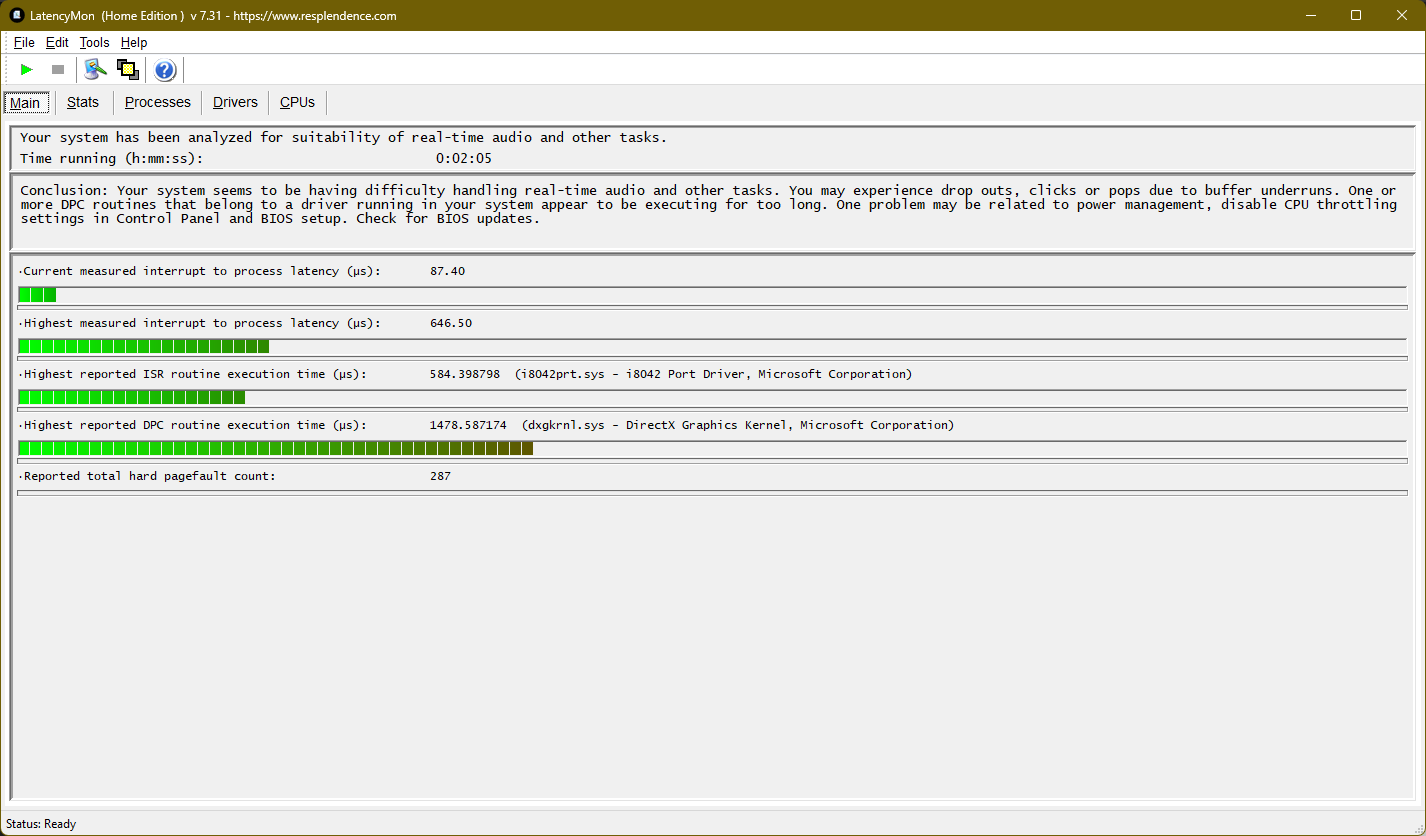
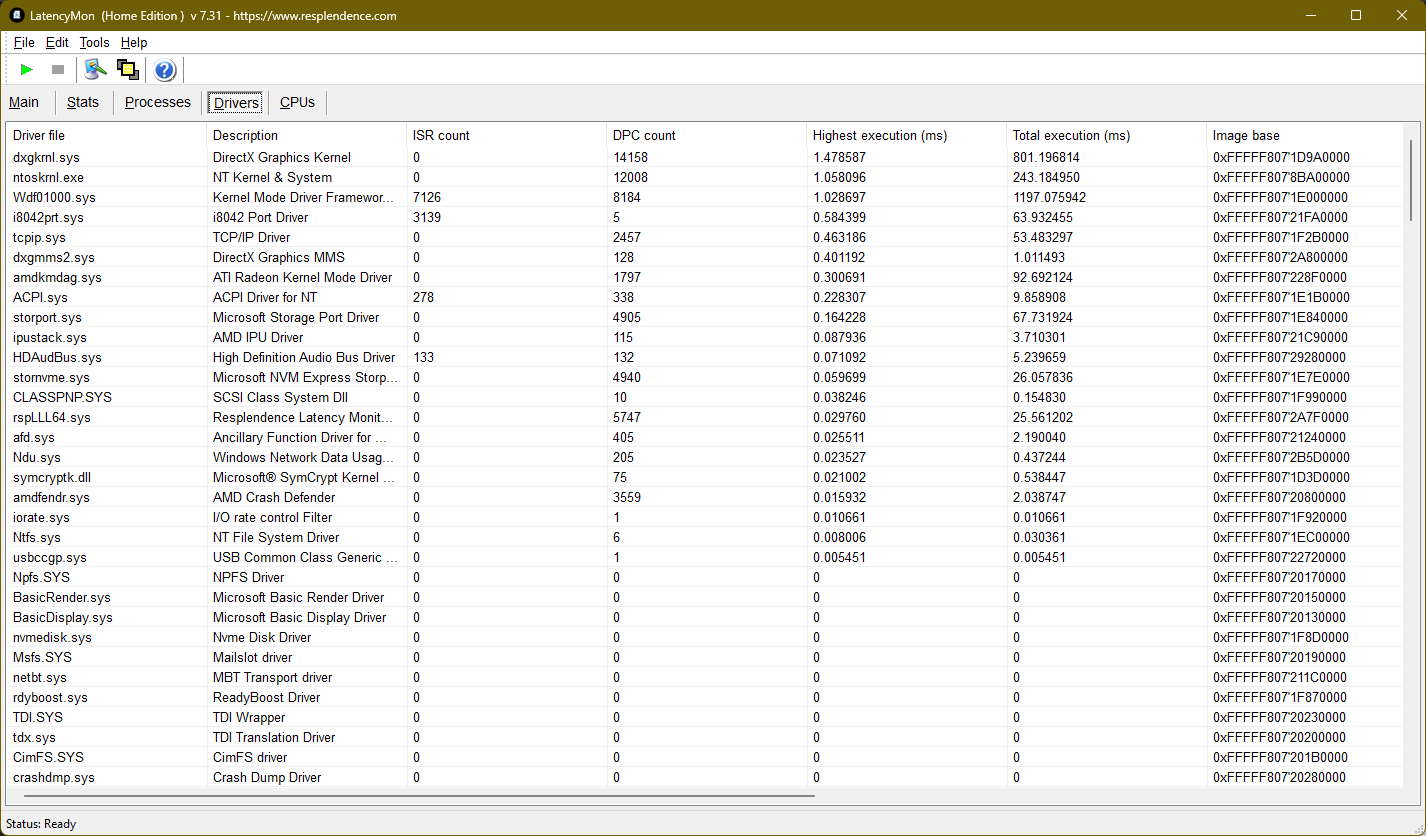
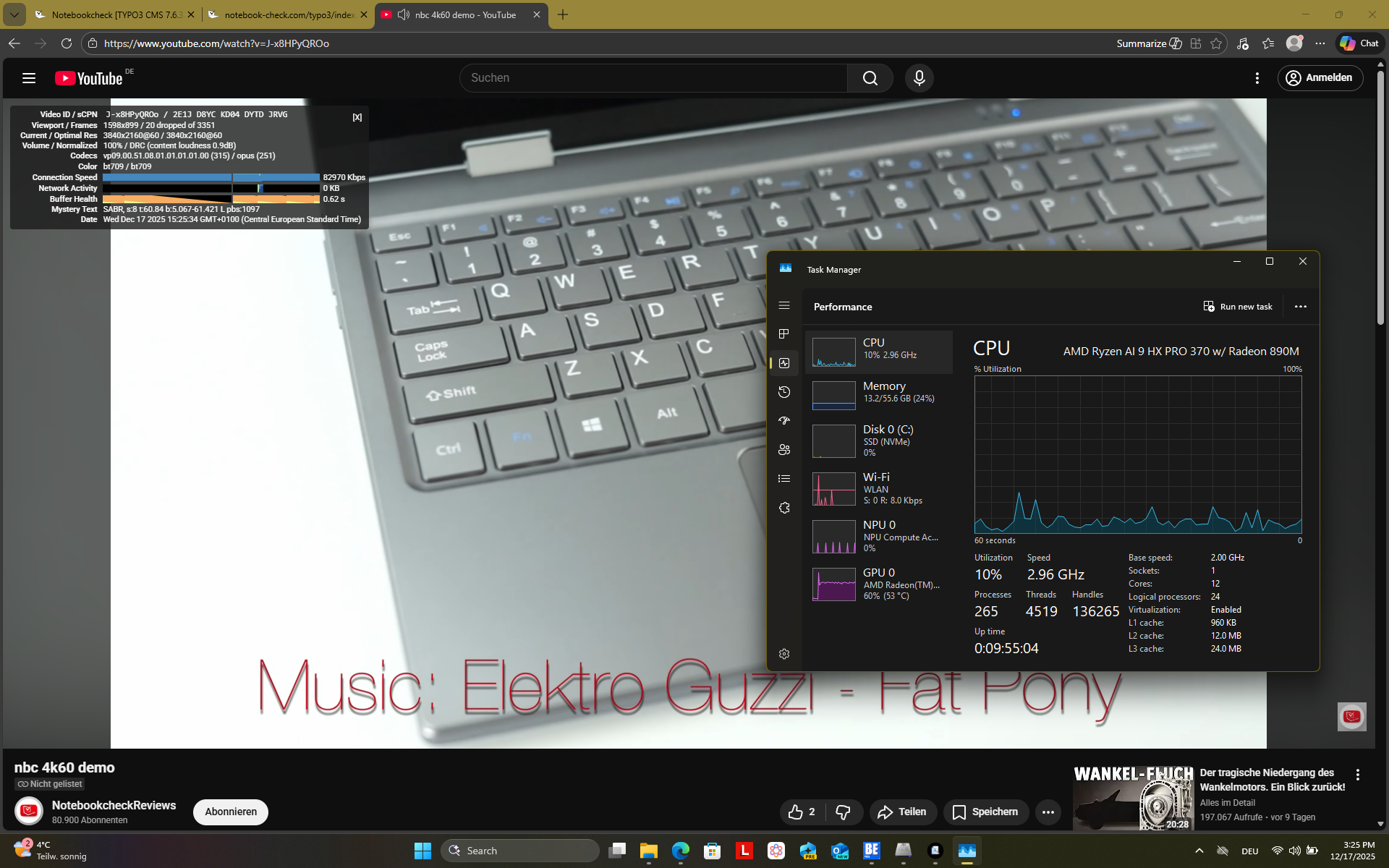
| DPC Latencies / LatencyMon - interrupt to process latency (max), Web, Youtube, Prime95 | |
| Lenovo ThinkPad P1 Gen 8 | |
| Lenovo ThinkPad P16s G2 21K9000CGE | |
| Lenovo ThinkPad P16s Gen 4 21RX000YGE | |
| HP ZBook X G1i 16 | |
| Dell Precision 5690 | |
* ... smaller is better
Storage Devices
Lenovo uses an M.2 2280 SSD with average speed for an NVMe PCIe 4.0 drive. The Micron SSD with a capacity of 1 TB is still plenty fast for everyday use, though, and there is no throttling under sustained load.

* ... smaller is better
Disk Throttling: DiskSpd Read Loop, Queue Depth 8
GPU Performance
Graphics performance remains a weak point of the Lenovo ThinkPad P16s Gen 4 AMD. Without a dedicated graphics chip, it simply can not compete. At least there is still an uptick of GPU performance compared with the older Lenovo ThinkPad P16s Gen 2 AMD, thanks to the AMD Radeon 890M, which is roughly 10 to 15 percent, depending on the application. For very simple CAD work, the P16s Gen 4 should be fine.
| 3DMark 11 Performance | 13499 points | |
| 3DMark Fire Strike Score | 8001 points | |
| 3DMark Time Spy Score | 3583 points | |
Help | ||
* ... smaller is better
| Performance rating - Percent | |
| Dell Precision 5690 -1! | |
| Lenovo ThinkPad P1 Gen 8 | |
| HP ZBook X G1i 16 | |
| Average of class Workstation | |
| Lenovo ThinkPad P16s Gen 4 21RX000YGE | |
| Lenovo ThinkPad P16s G2 21K9000CGE -2! | |
| Cyberpunk 2077 - 1920x1080 Ultra Preset (FSR off) | |
| Dell Precision 5690 | |
| Lenovo ThinkPad P1 Gen 8 | |
| Average of class Workstation (21.5 - 152.4, n=23, last 2 years) | |
| HP ZBook X G1i 16 | |
| Lenovo ThinkPad P16s Gen 4 21RX000YGE | |
| Baldur's Gate 3 - 1920x1080 Ultra Preset AA:T | |
| Dell Precision 5690 | |
| Lenovo ThinkPad P1 Gen 8 | |
| Average of class Workstation (23.7 - 205, n=24, last 2 years) | |
| HP ZBook X G1i 16 | |
| Lenovo ThinkPad P16s Gen 4 21RX000YGE | |
| GTA V - 1920x1080 Highest AA:4xMSAA + FX AF:16x | |
| Lenovo ThinkPad P1 Gen 8 | |
| HP ZBook X G1i 16 | |
| Average of class Workstation (18.1 - 156.1, n=22, last 2 years) | |
| Lenovo ThinkPad P16s Gen 4 21RX000YGE | |
| Lenovo ThinkPad P16s G2 21K9000CGE | |
| Final Fantasy XV Benchmark - 1920x1080 High Quality | |
| Dell Precision 5690 | |
| Lenovo ThinkPad P1 Gen 8 | |
| Average of class Workstation (26.4 - 197.6, n=22, last 2 years) | |
| HP ZBook X G1i 16 | |
| Lenovo ThinkPad P16s Gen 4 21RX000YGE | |
| Lenovo ThinkPad P16s G2 21K9000CGE | |
| Dota 2 Reborn - 1920x1080 ultra (3/3) best looking | |
| HP ZBook X G1i 16 | |
| Dell Precision 5690 | |
| Average of class Workstation (50.7 - 178.4, n=23, last 2 years) | |
| Lenovo ThinkPad P1 Gen 8 | |
| Lenovo ThinkPad P16s Gen 4 21RX000YGE | |
| Lenovo ThinkPad P16s G2 21K9000CGE | |
Cyberpunk 2077 ultra FPS Chart
| low | med. | high | ultra | |
|---|---|---|---|---|
| GTA V (2015) | 168.7 | 158.7 | 71.7 | 30.6 |
| Dota 2 Reborn (2015) | 143.7 | 111.6 | 85.7 | 77.6 |
| Final Fantasy XV Benchmark (2018) | 82.1 | 41.5 | 30.2 | |
| X-Plane 11.11 (2018) | 78.2 | 61.7 | 49.9 | |
| Baldur's Gate 3 (2023) | 48.6 | 38.2 | 32.1 | 31.3 |
| Cyberpunk 2077 (2023) | 46.8 | 38 | 30.1 | 26.2 |
| F1 25 (2025) | 88.7 | 70 | 52.9 |
Emissions: Lenovo ThinkPad P16s Gen 4 AMD is a hot-head
System Noise
With only a single fan and 36 W of sustained CPU performance to cool, the ThinkPad P16s Gen 4 struggles. Accordingly, we recorded the highest fan noise among the 16-inch workstations of our comparison on this Lenovo laptop.
There was no coil whine, but the fan does run at a pretty high frequency when the overall fan-noise is low.
Noise level
| Idle |
| 25.9 / 25.9 / 28.5 dB(A) |
| Load |
| 42.9 / 48.5 dB(A) |
 | ||
30 dB silent 40 dB(A) audible 50 dB(A) loud |
||
min:  , med: , med:  , max: , max:  Earthworks M23R, Arta (15 cm distance) environment noise: 25.9 dB(A) Earthworks M23R, Arta (15 cm distance) environment noise: 25.9 dB(A) | ||
| Lenovo ThinkPad P16s Gen 4 21RX000YGE Radeon 890M, Ryzen AI 9 HX PRO 370, Micron 3500 1TB MTFDKBA1T0TGD | Lenovo ThinkPad P16s G2 21K9000CGE Radeon 780M, R7 PRO 7840U, SK hynix PC801 HFS001TEJ9X162N | HP ZBook X G1i 16 RTX PRO 2000 Blackwell Generation Laptop, Ultra 7 265H, Samsung PM9A1 MZVL22T0HBLB | Lenovo ThinkPad P1 Gen 8 RTX PRO 2000 Blackwell Generation Laptop, Ultra 7 255H, Samsung PM9E1 1 TB MZVLC1T0HFLU | Dell Precision 5690 RTX 5000 Ada Generation Laptop, Ultra 9 185H, 2x Samsung PM9A1 1TB (RAID 0) | |
|---|---|---|---|---|---|
| Noise | 15% | 9% | 15% | 2% | |
| off / environment * (dB) | 25.9 | 22.6 13% | 23.7 8% | 23.1 11% | 23.4 10% |
| Idle Minimum * (dB) | 25.9 | 22.6 13% | 23.7 8% | 23.1 11% | 23.6 9% |
| Idle Average * (dB) | 25.9 | 22.6 13% | 23.7 8% | 23.1 11% | 24.9 4% |
| Idle Maximum * (dB) | 28.5 | 22.6 21% | 23.7 17% | 23.1 19% | 30.9 -8% |
| Load Average * (dB) | 42.9 | 37.8 12% | 32.7 24% | 27.3 36% | 40.4 6% |
| Cyberpunk 2077 ultra * (dB) | 48.7 | 50.9 -5% | |||
| Load Maximum * (dB) | 48.5 | 40.5 16% | 48 1% | 47.9 1% | 51.9 -7% |
| Witcher 3 ultra * (dB) | 40.3 | 48.3 |
* ... smaller is better
Temperature
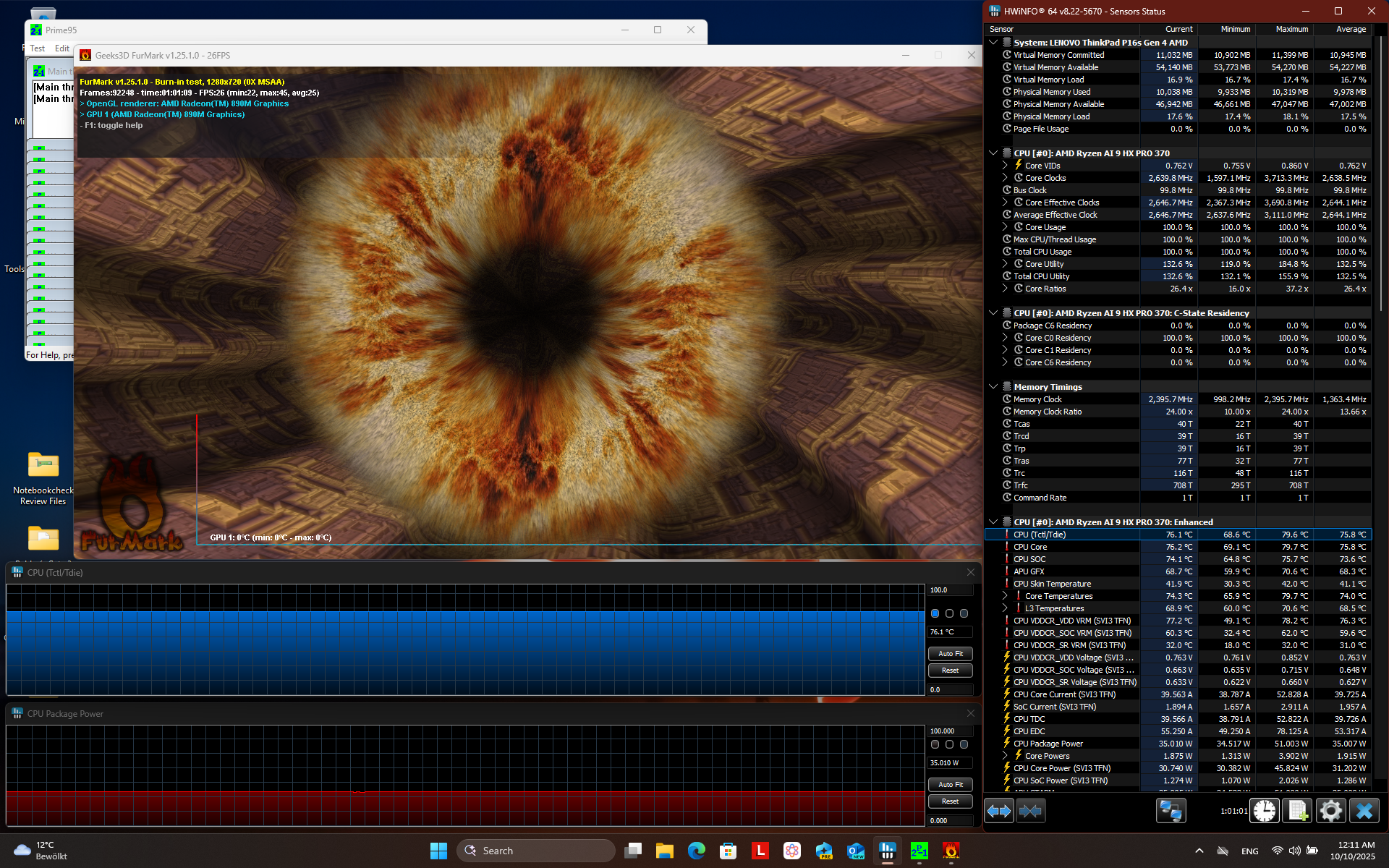
Despite the lower performance than most other workstations, the ThinkPad P16s G4 AMD does get pretty hot on the outside, with a maximum of 54.3 degrees Celsius or 130 F. Overall this is not surprising though, as with a single cooling fan, the cooling capabilities of this machine are just not as good as they are for the other 16-inch workstations.
There is no throttling during the stress test, which means that Lenovo prioritizes a stable performance over lower temperatures.
(-) The maximum temperature on the upper side is 50.6 °C / 123 F, compared to the average of 38.2 °C / 101 F, ranging from 22.2 to 69.8 °C for the class Workstation.
(-) The bottom heats up to a maximum of 54.3 °C / 130 F, compared to the average of 41.1 °C / 106 F
(+) In idle usage, the average temperature for the upper side is 28.5 °C / 83 F, compared to the device average of 32 °C / 90 F.
(+) 3: The average temperature for the upper side is 30.3 °C / 87 F, compared to the average of 32 °C / 90 F for the class Workstation.
(+) The palmrests and touchpad are cooler than skin temperature with a maximum of 26.5 °C / 79.7 F and are therefore cool to the touch.
(±) The average temperature of the palmrest area of similar devices was 27.8 °C / 82 F (+1.3 °C / 2.3 F).
| Lenovo ThinkPad P16s Gen 4 21RX000YGE AMD Ryzen AI 9 HX PRO 370, AMD Radeon 890M | Lenovo ThinkPad P16s G2 21K9000CGE AMD Ryzen 7 PRO 7840U, AMD Radeon 780M | HP ZBook X G1i 16 Intel Core Ultra 7 265H, NVIDIA RTX PRO 2000 Blackwell Generation Laptop | Lenovo ThinkPad P1 Gen 8 Intel Core Ultra 7 255H, NVIDIA RTX PRO 2000 Blackwell Generation Laptop | Dell Precision 5690 Intel Core Ultra 9 185H, NVIDIA RTX 5000 Ada Generation Laptop | |
|---|---|---|---|---|---|
| Heat | 19% | 22% | 20% | 20% | |
| Maximum Upper Side * (°C) | 50.6 | 42.7 16% | 36 29% | 45 11% | 46.6 8% |
| Maximum Bottom * (°C) | 54.3 | 47.2 13% | 39.4 27% | 33 39% | 33 39% |
| Idle Upper Side * (°C) | 35.3 | 27.8 21% | 30.4 14% | 30.6 13% | 32.4 8% |
| Idle Bottom * (°C) | 38.5 | 28.4 26% | 31.8 17% | 31.6 18% | 29.4 24% |
* ... smaller is better
Speakers
Audio is not the strong suite of the Lenovo workstation. Overall, the downward firing speakers of the ThinkPad P14s G4 only deliver a medium level of volume, and they also lack bass.
Lenovo ThinkPad P16s Gen 4 21RX000YGE audio analysis
(±) | speaker loudness is average but good (79.6 dB)
Bass 100 - 315 Hz
(-) | nearly no bass - on average 15.7% lower than median
(±) | linearity of bass is average (11.9% delta to prev. frequency)
Mids 400 - 2000 Hz
(±) | higher mids - on average 5.8% higher than median
(+) | mids are linear (5.9% delta to prev. frequency)
Highs 2 - 16 kHz
(+) | balanced highs - only 1.5% away from median
(+) | highs are linear (4.6% delta to prev. frequency)
Overall 100 - 16.000 Hz
(±) | linearity of overall sound is average (16.2% difference to median)
Compared to same class
» 44% of all tested devices in this class were better, 7% similar, 49% worse
» The best had a delta of 7%, average was 17%, worst was 35%
Compared to all devices tested
» 27% of all tested devices were better, 5% similar, 68% worse
» The best had a delta of 4%, average was 23%, worst was 136%
Lenovo ThinkPad P1 Gen 8 audio analysis
(+) | speakers can play relatively loud (87.5 dB)
Bass 100 - 315 Hz
(±) | reduced bass - on average 9.8% lower than median
(±) | linearity of bass is average (11.2% delta to prev. frequency)
Mids 400 - 2000 Hz
(+) | balanced mids - only 2.9% away from median
(+) | mids are linear (2.8% delta to prev. frequency)
Highs 2 - 16 kHz
(+) | balanced highs - only 3% away from median
(+) | highs are linear (4.7% delta to prev. frequency)
Overall 100 - 16.000 Hz
(+) | overall sound is linear (8.3% difference to median)
Compared to same class
» 1% of all tested devices in this class were better, 1% similar, 97% worse
» The best had a delta of 7%, average was 17%, worst was 35%
Compared to all devices tested
» 2% of all tested devices were better, 1% similar, 97% worse
» The best had a delta of 4%, average was 23%, worst was 136%
Energy Management: Battery life much improved on new AMD model
Power Consumption
The power draw of the Lenovo ThinkPad P16s Gen 4 AMD is far lower than on the other workstation laptops. It does not even reach 65 W, which is what the charger of the ThinkPad laptop delivers to the device.
| Off / Standby | 0.4 / 1.05 Watt |
| Idle | 3.9 / 8.3 / 8.7 Watt |
| Load |
51.6 / 63.7 Watt |
   
| |
Key:
min: ,
med: ,
max: Metrahit Energy | |
| Lenovo ThinkPad P16s Gen 4 21RX000YGE Ryzen AI 9 HX PRO 370, Radeon 890M, Micron 3500 1TB MTFDKBA1T0TGD, IPS LED, 1920x1200, 16" | Lenovo ThinkPad P16s G2 21K9000CGE R7 PRO 7840U, Radeon 780M, SK hynix PC801 HFS001TEJ9X162N, OLED, 3840x2400, 16" | HP ZBook X G1i 16 Ultra 7 265H, RTX PRO 2000 Blackwell Generation Laptop, Samsung PM9A1 MZVL22T0HBLB, IPS, 2560x1600, 16" | Lenovo ThinkPad P1 Gen 8 Ultra 7 255H, RTX PRO 2000 Blackwell Generation Laptop, Samsung PM9E1 1 TB MZVLC1T0HFLU, Tandem OLED, 3200x2000, 16" | Dell Precision 5690 Ultra 9 185H, RTX 5000 Ada Generation Laptop, 2x Samsung PM9A1 1TB (RAID 0), OLED, 3840x2400, 16" | Average AMD Radeon 890M | Average of class Workstation | |
|---|---|---|---|---|---|---|---|
| Power Consumption | -6% | -58% | -143% | -128% | -19% | -108% | |
| Idle Minimum * (Watt) | 3.9 | 6.1 -56% | 4.1 -5% | 15.4 -295% | 7.9 -103% | 5.49 ? -41% | 8.89 ? -128% |
| Idle Average * (Watt) | 8.3 | 6.5 22% | 9 -8% | 16.5 -99% | 12 -45% | 7.91 ? 5% | 13.3 ? -60% |
| Idle Maximum * (Watt) | 8.7 | 7 20% | 9.4 -8% | 23.1 -166% | 28.6 -229% | 9.34 ? -7% | 17.4 ? -100% |
| Load Average * (Watt) | 51.6 | 56.6 -10% | 86.7 -68% | 86.6 -68% | 98.8 -91% | 64.6 ? -25% | 93.7 ? -82% |
| Cyberpunk 2077 ultra * (Watt) | 55.4 | 106.1 -92% | 123.1 -122% | ||||
| Cyberpunk 2077 ultra external monitor * (Watt) | 54.6 | 102 -87% | 121.8 -123% | ||||
| Load Maximum * (Watt) | 63.7 | 68.3 -7% | 152.9 -140% | 143.6 -125% | 174.8 -174% | 80 ? -26% | 172.5 ? -171% |
| Witcher 3 ultra * (Watt) | 61.2 | 144.5 |
* ... smaller is better
Power Consumption Cyberpunk / Stress Test
Power Consumption external Monitor
Battery Life
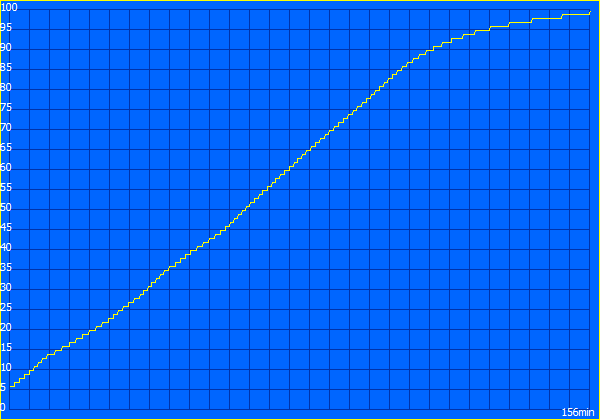
Battery life is clearly a strong point of the Lenovo ThinkPad P16s Gen 4 AMD. Almost 14 hours in our Wi-Fi web-surfing test (150 cd/m² screen brightness) is a result no other 16-inch workstation laptop in our comparison can match. The ThinkPad laptop achieves this thanks to the large 86 Wh battery and low power consumption.
| Lenovo ThinkPad P16s Gen 4 21RX000YGE Ryzen AI 9 HX PRO 370, Radeon 890M, 86 Wh | Lenovo ThinkPad P16s G2 21K9000CGE R7 PRO 7840U, Radeon 780M, 84 Wh | HP ZBook X G1i 16 Ultra 7 265H, RTX PRO 2000 Blackwell Generation Laptop, 83 Wh | Lenovo ThinkPad P1 Gen 8 Ultra 7 255H, RTX PRO 2000 Blackwell Generation Laptop, 90 Wh | Dell Precision 5690 Ultra 9 185H, RTX 5000 Ada Generation Laptop, 98 Wh | Average of class Workstation | |
|---|---|---|---|---|---|---|
| Battery runtime | 6% | -10% | -60% | -34% | -7% | |
| WiFi v1.3 (h) | 13.9 | 10.6 -24% | 12.5 -10% | 5.5 -60% | 9.2 -34% | 8.91 ? -36% |
| Load (h) | 1.1 | 1.5 36% | 1.358 ? 23% | |||
| H.264 (h) | 13.3 | 10.1 ? |
Notebookcheck Rating
While the Lenovo ThinkPad P16s Gen 4 AMD has some notable weaknesses, especially when it comes to heat and noise output, it is a good workhorse with a bright screen, great CPU performance and very comfortable keyboard, as well as many upgradeability options.
Lenovo ThinkPad P16s Gen 4 21RX000YGE
- 12/17/2025 v8
Benjamin Herzig
 Total Sustainability Score:
 Potential Competitors in Comparison
Image | Model / Review | Price | Weight | Height | Display |
|---|---|---|---|---|---|
1. 82%  | Lenovo ThinkPad P16s Gen 4 21RX000YGE AMD Ryzen AI 9 HX PRO 370 ⎘ AMD Radeon 890M ⎘ 64 GB Memory, 1024 GB SSD | List Price: 2440 Euro | 2 kg | 23 mm | 16.00" 1920x1200 142 PPI IPS LED |
2. 88.6% v7 (old)  | Lenovo ThinkPad P16s G2 21K9000CGE AMD Ryzen 7 PRO 7840U ⎘ AMD Radeon 780M ⎘ 32 GB Memory, 1024 GB SSD | List Price: 2150€ | 1.8 kg | 24.4 mm | 16.00" 3840x2400 283 PPI OLED |
3. 87.4%  | HP ZBook X G1i 16 Intel Core Ultra 7 265H ⎘ NVIDIA RTX PRO 2000 Blackwell Generation Laptop ⎘ 64 GB Memory, 2048 GB SSD | List Price: 2700 USD | 2.2 kg | 23 mm | 16.00" 2560x1600 189 PPI IPS |
4. 91.6%  | Lenovo ThinkPad P1 Gen 8 Intel Core Ultra 7 255H ⎘ NVIDIA RTX PRO 2000 Blackwell Generation Laptop ⎘ 32 GB Memory, 1024 GB SSD | List Price: 2000 USD | 1.9 kg | 20.6 mm | 16.00" 3200x2000 236 PPI Tandem OLED |
5. 88.3% v7 (old)  | Dell Precision 5690 Intel Core Ultra 9 185H ⎘ NVIDIA RTX 5000 Ada Generation Laptop ⎘ 32 GB Memory, 2048 GB SSD | List Price: 5900 USD | 2.3 kg | 22.17 mm | 16.00" 3840x2400 283 PPI OLED |
Transparency
The selection of devices to be reviewed is made by our editorial team. The test sample was provided to the author as a loan by the manufacturer or retailer for the purpose of this review. The lender had no influence on this review, nor did the manufacturer receive a copy of this review before publication. There was no obligation to publish this review. As an independent media company, Notebookcheck is not subjected to the authority of manufacturers, retailers or publishers.
This is how Notebookcheck is testing
Every year, Notebookcheck independently reviews hundreds of laptops and smartphones using standardized procedures to ensure that all results are comparable. We have continuously developed our test methods for around 20 years and set industry standards in the process. In our test labs, high-quality measuring equipment is utilized by experienced technicians and editors. These tests involve a multi-stage validation process. Our complex rating system is based on hundreds of well-founded measurements and benchmarks, which maintains objectivity. Further information on our test methods can be found here.
 Add as a preferred source on Google


