




NASA shares image of a ghostly scene captured by Hubble

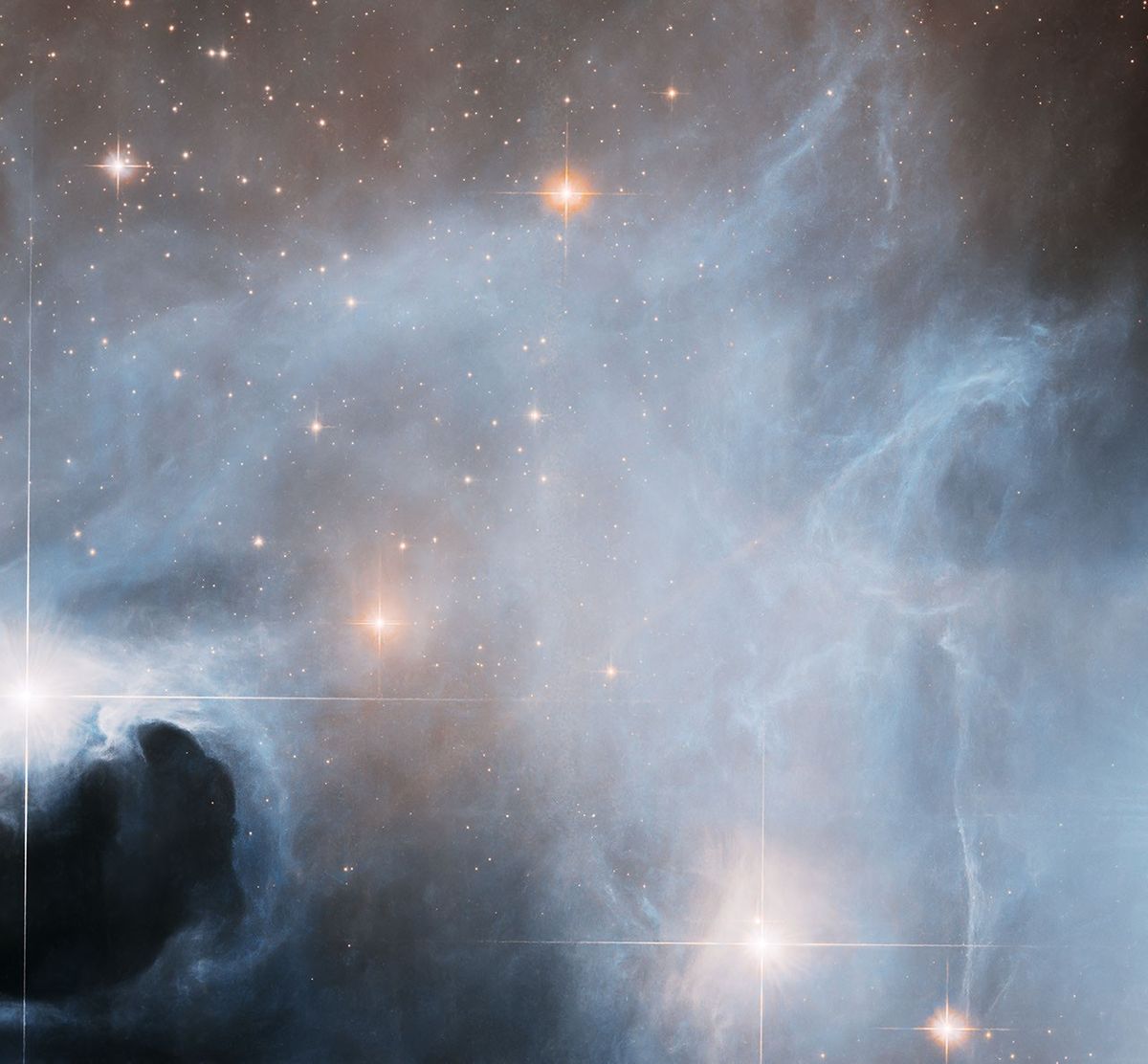
Hubble zoomed in on a star-forming region called Lupus 3. Lupus 3 is located about 500 light-years away in the constellation Scorpius. Interstellar gas illuminated by nearby stars forms the glowing mist seen in the image. Dark dust is also seen at the bottom left side of the image.
A group of stars stands out in the image — T Tauri stars. These are the bright stars seen at the left, bottom right, and upper center of the image. T Tauri stars are a type of very young star, less than 10 million years old. They have not yet settled into stable hydrogen fusion to become main-sequence stars.
The T Tauri stars are visible in this image because they are in a phase where radiation and stellar winds dissipate the enveloping gas and dust. Interestingly, they also show variable brightness. Their brightness varies both randomly and periodically.
The random variations in the stars' brightness may be due to instabilities in the disk of dust and gas surrounding the stars — what is called an accretion disk. Material from this disk falling onto the star and being consumed and flares on the star’s surface may also be reasons for the random variations. The periodic variations may be caused by giant sunspots rotating in and out of view.
This image and others like it present an opportunity for scientists to understand more about star formation.
Source(s)
Image source: NASA, ESA, and K. Stapelfeldt (Jet Propulsion Laboratory); Processing: Gladys Kober (NASA/Catholic University of America)
 Add as a preferred source on Google


