




Hubble spots a bright glow driven by a young massive star

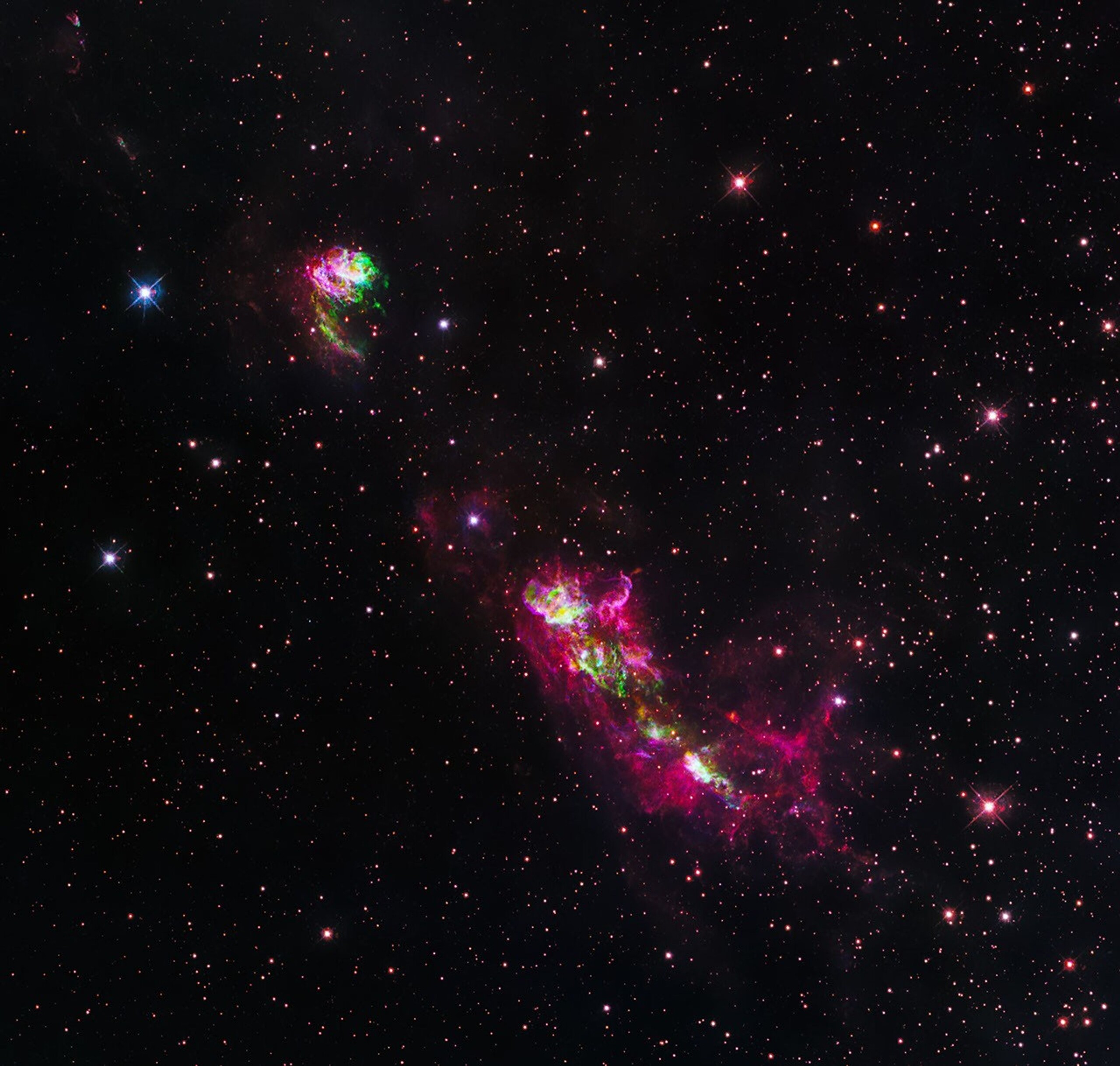
Using Hubble’s Wide Field Camera 3, astronomers were able to study an impressive sight at a distance of 5,500 light-years away from Earth and within the constellation Sagittarius. The image shows bright pink and green patches running diagonally. Those patches are a pair of Herbig-Haro (HH) objects called HH 80/81. The upper left patch in the image is part of HH 81, while the bottom streak is part of HH 80.
HH 80/81 are the brightest HH objects known to exist. Like other HH objects, they are formed when fast-moving jets of gas ejected from a newly forming star collide with slower gas that was ejected earlier. The collision produces shock waves. These shock waves heat the gas and cause it to glow.
The HH 80/81 stretches 32 light-years. This makes them the largest protostellar jets ever observed. They are also the only HH objects driven by a young massive star. The others that have been observed are driven by young low-mass stars. The young star powering the HH 80/81 pair is IRAS 18162-2048. It is about 20 times the mass of the Sun.
The speed of parts of HH 80/81 also set a record. Astronomers measured that parts of the jets moved at over 1,000 kilometers per second. This is the fastest recorded outflow in both radio and visual wavelengths from a young star.
Source(s)
Image source: NASA, ESA, B. Reipurth (Planetary Science Institute), Gladys Kober (NASA/Catholic University of America)
 Add as a preferred source on Google


