




Hubble captures a dreamy scene created by young stellar objects

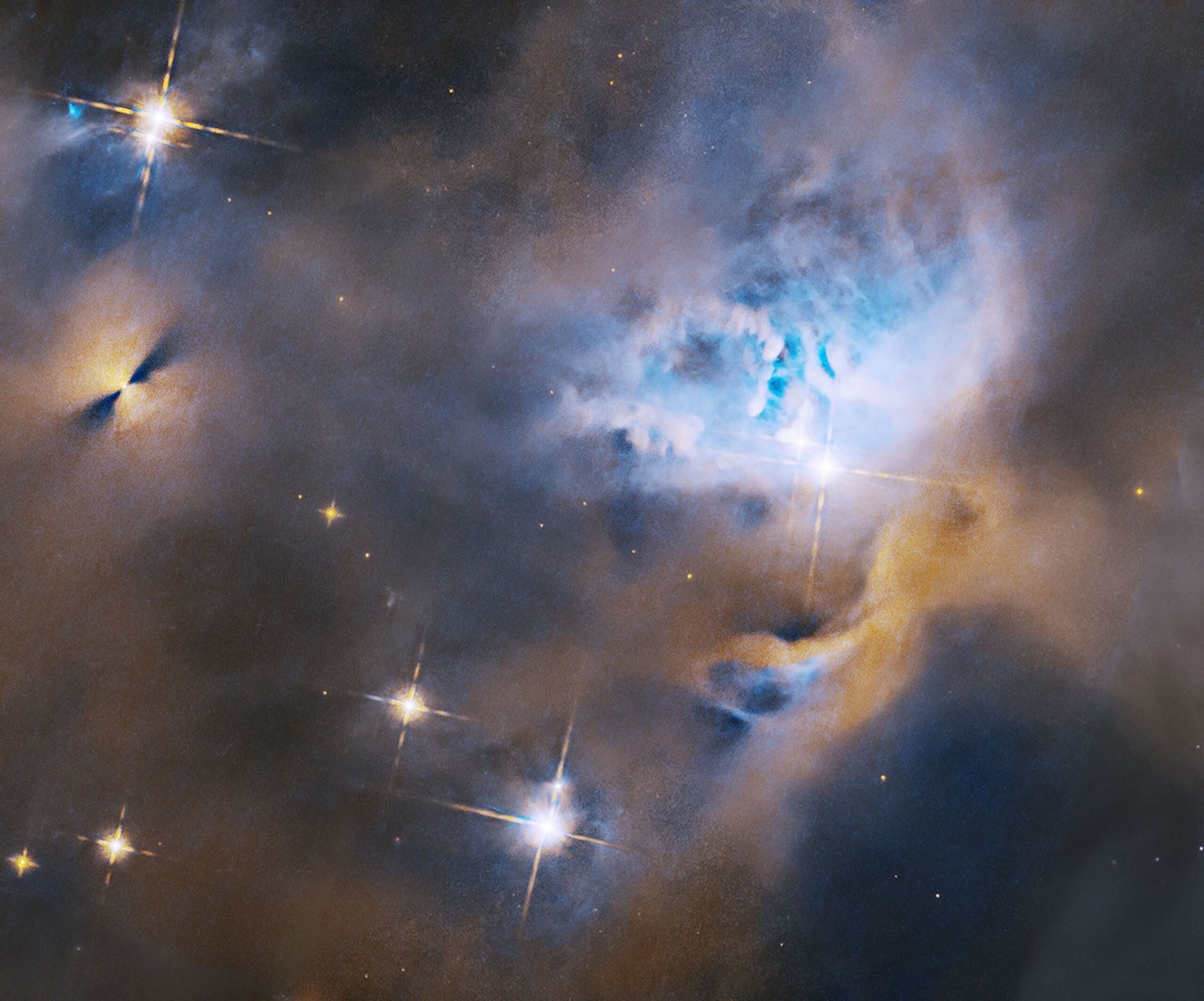
NGC 1333 is the star-forming region in this Hubble image. It is located about 950 light-years away in the Perseus molecular cloud. The image contains a bright reflection nebula, protostars, and a planet-forming disk.
To the left of the image are two dark stripes. In the center of the dark stripes is starlight. The starlight comes from a newly forming star. The dark stripes are the star’s protoplanetary disk and the disk’s shadow cast onto the surrounding cloud. The protoplanetary disk is a region where planets may eventually form.
A cavity lies slightly to the right of the image’s center. This cavity is called an outflow cavity. The cavity reveals a fan-shaped reflection nebula. As a reflection nebula, it does not produce light, it only scatters and reflects light from nearby stars.
The light in this reflection nebula comes from two Orion variable stars — HBC 340 and HBC 341. These stars change in brightness irregularly and unpredictably. The changes in the stars’ brightness cause fluctuations in the brightness of the nebula. HBC 340 is the brighter and more variable star. Hence, it is primarily responsible for the fluctuations observed in the reflection nebula.
There are other Orion variable stars in the image. Other young stellar objects are also present. Astronomers aim to use the image to understand more about young stellar objects and their properties.
Source(s)
 Add as a preferred source on Google


