




Mars Express captures powerful sandblasting on the Red Planet

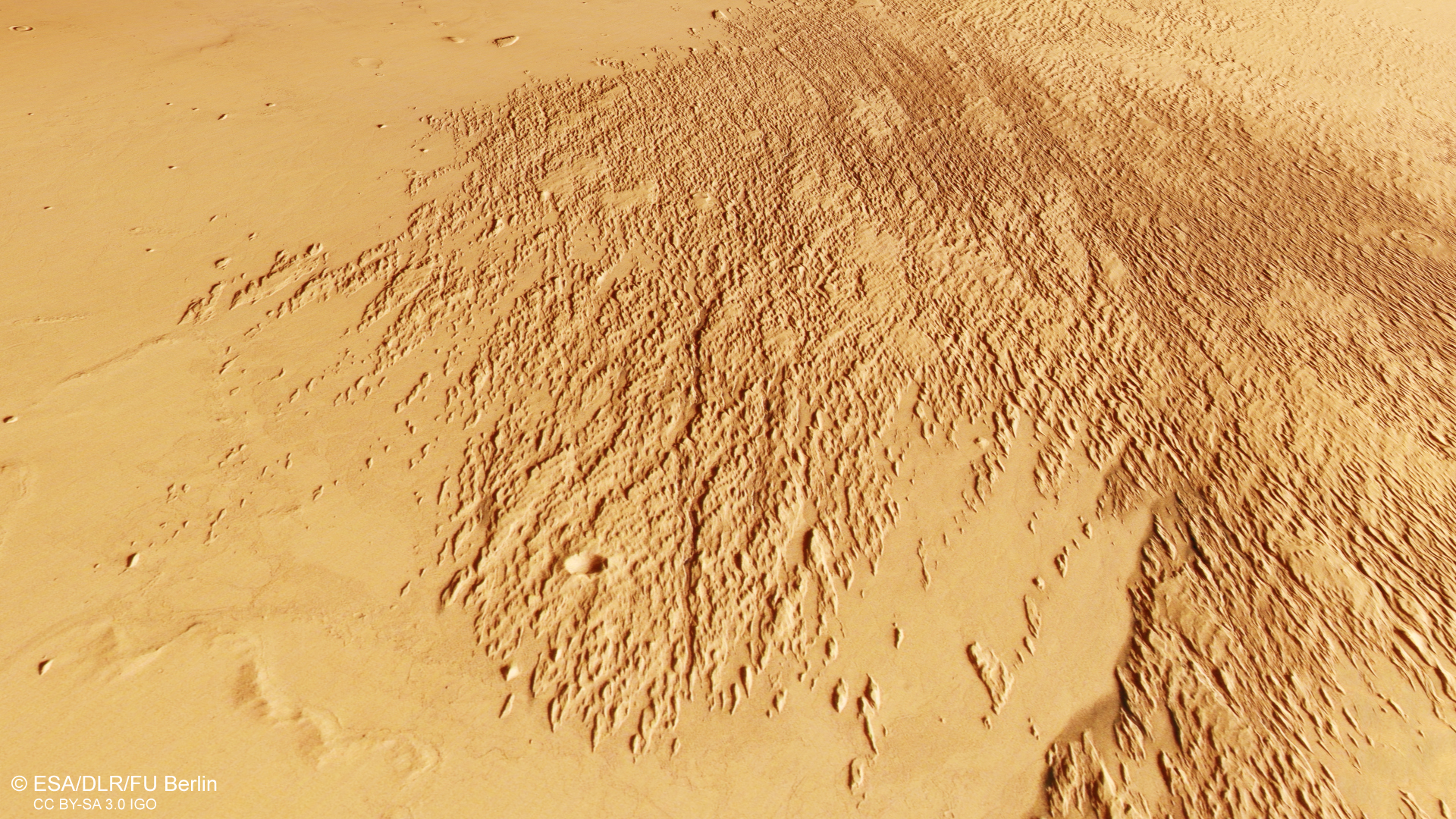
Mars Express has been exploring Martian landscapes since 2003. It has found many eye-catching formations. This new image captures powerful sandblasting on the Red Planet. It was captured by the High Resolution Stereo Camera (HRSC) aboard the orbiter.
The image shows ridges at the left side of a fresh-looking impact crater. The ridges were formed by strong Martian winds. Those strong winds whipped up sand particles and blasted them across sedimentary rock. This caused the wearing away of the softer layers of the rock. The harder layers remained, and this formed the sculptures that are seen in this image. They are called yardangs.
All the yardangs lean in the same direction. Because of this, scientists can tell which way the prevailing winds were blowing. But beyond that, the observation provides much more interesting data for scientists.
The image shows three different formation: the yardangs, an impact crater, and something called “platy flow.” The platy flow is much less visible. It formed when lava crusted over on top but kept flowing underneath. This continuous flow broke the surface into solid plates that shifted like the ice floes we see on Earth.
Interestingly, the platy flow lies beside and beneath the yardangs. Scientists believe the yardangs formed on top of it. This suggests that the yardangs likely formed more recently.
Images like this are helping scientists understand more about Mars. The data could be crucial in future missions that will see humans land on the Red Planet.
Source(s)
 Add as a preferred source on Google


