




NASA’s Hubble finds turbulence in the largest observed birthplace of planets
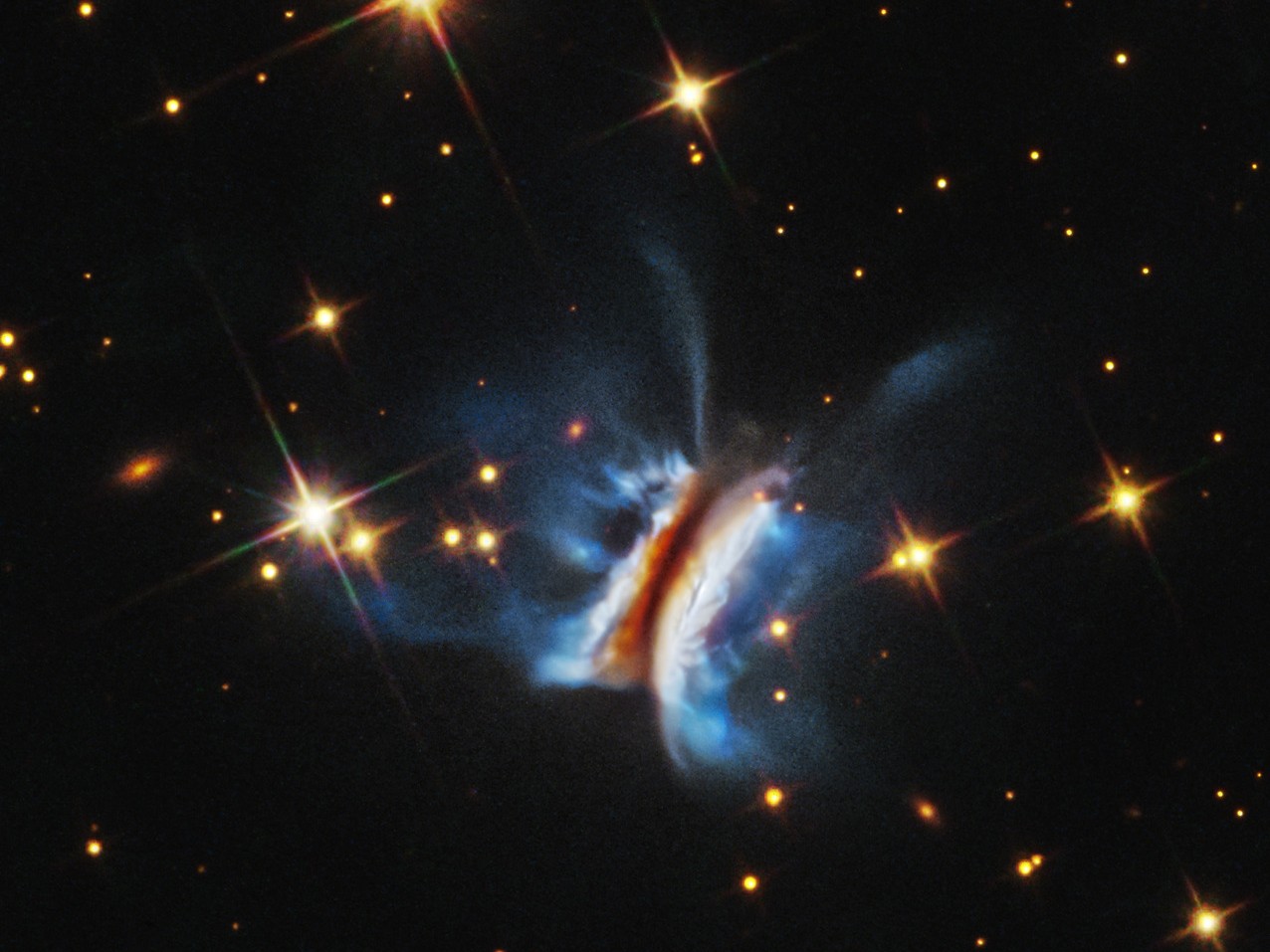
A protoplanetary disk is where planets form. The disk usually encircles a young star. The observed protoplanetary disk in this case is IRAS 23077+6707. It is viewed edge-on. It has the appearance of a hamburger. Owing to its shape, it is nicknamed “Dracula’s Chivito.” Chivito is the national dish of Uruguay. It is the country’s signature sandwich.
IRAS 23077+6707 is located about 1,000 light-years away from Earth. The disk spans a great distance — nearly 400 billion miles. This is 40 times the diameter of our solar system to the outer edge of the Kuiper belt. Astronomers estimate IRAS 23077+6707’s disk contains 10 to 30 times Jupiter’s mass. This suggests that there is enough material to form multiple gas giants.
But one strange thing astronomers observed in IRAS 23077+6707 is its asymmetry. One side of the disk has filament-like features, while the other side does not. This lopsidedness could be due to dust and gas falling into the disk, or due to the influence of the external environment. The disk also has wispy layers. The asymmetrical features and wispy layers suggest that this planetary nursery is much more active and chaotic than expected.
Astronomers have not seen anything like this in similar systems. This observation has left them with more questions than answers. But upon further studies, the data could provide more insights into understanding how planets form over time and how they do so in different environments. These findings were published in the Astrophysical Journal.
Source(s)
The Astrophysical Journal via NASA
Image: NASA, ESA, STScI, Kristina Monsch (CfA); Image Processing: Joseph DePasquale (STScI)
 Add as a preferred source on Google


