




NASA’s SPHEREx creates the most colorful map of the entire sky
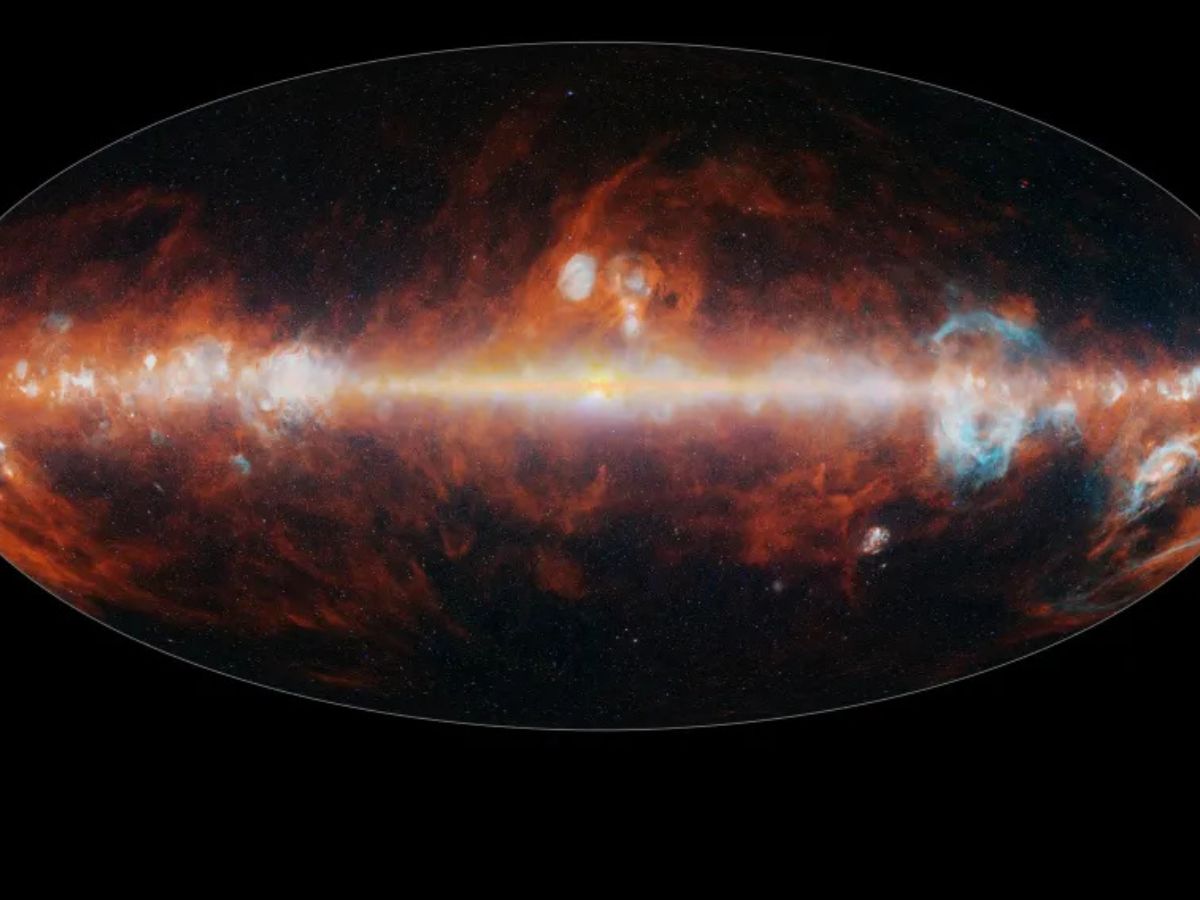
SPHEREx (Spectro-Photometer for the History of the Universe, Epoch of Reionization, and Ices Explorer) was launched in March this year. In just six months, it has mapped the entire sky in 102 different infrared wavelengths. The beauty of this is that each wavelength carries information about different aspects of the sky. Stars, hot hydrogen gas, cosmic dust — all these are accounted for in SPHEREx’s map.
With SPHEREx’s data, scientists will gain insight into one of the most significant moments in the universe’s history — inflation. This was a split second after the Big Bang, when the universe expanded very fast.
The different colors SPHEREx provides will help in measuring the distances to hundreds of millions of galaxies. This creates a 3D map. All of this information is useful in studying how the universe has evolved over its nearly 14 billion years of existence.
While several other observatories have mapped the entire sky, none have done it in nearly as many colors as SPHEREx. It’s all thanks to SPHEREx’s unique design. The telescope has six detectors. Each of them is paired with a specially designed filter that contains a gradient of 17 colors. So with every image, the telescope produces six times 17 colors — a total of 102.
SPHEREx orbits Earth about 14 and a half times in one day. Each day, it takes about 3,600 images covering one circular strip of the sky. It also has a wide field of view. A combination of these factors allowed it to observe the entire sky in six months. Given that SPHEREx has a two-year primary mission, it is expected to create three more maps of this sort.
 Add as a preferred source on Google


