




Hubble Space Telescope Picture of the Week
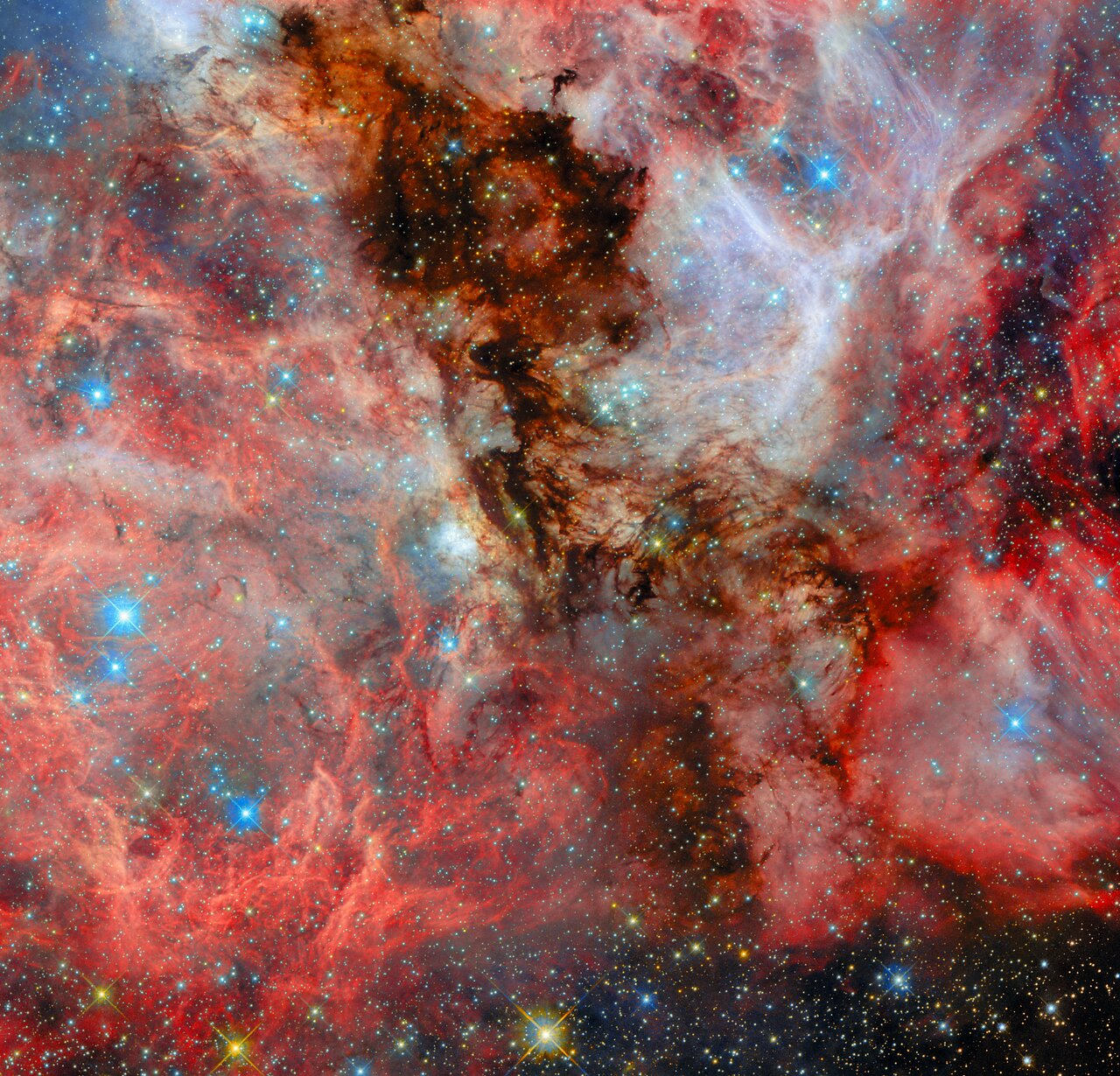
N159 is one of the most massive star-forming clouds in the Large Magellanic Cloud. It is located about 160,000 light-years away in the constellation Dorado. The Large Magellanic Cloud itself is a dwarf galaxy that orbits the Milky Way. This galaxy is the largest of the small galaxies orbiting our Milky Way.
A recent Hubble image showed a part of N159, highlighting the bubble-like structures baby stars create within gas clouds. This new image shows something similar. However, in this image, cold hydrogen gas dominates even more.
The hydrogen gas forms a complex network of ridges, cavities, and glowing filaments. The bubble-like structures are also visible in this image. The hot, massive young blue stars emit strong stellar winds and intense radiation. These emissions carve out holes in the surrounding gas. This is what creates the bubble-like structures. Intense radiation from the young stars also ionizes the surrounding hydrogen gas. This causes the gas to glow deep red, as seen in the image.
In the center of the image, thick dark dust is prominent. This dust blocks out light from stars in that region.
This Hubble image highlights the complex relationship between stars and their environment. It could help astronomers understand more about the cycle of creation and transformation of stars and their surroundings.
Source(s)
 Add as a preferred source on Google


