




Hubble captures a collection of protoplanetary disks
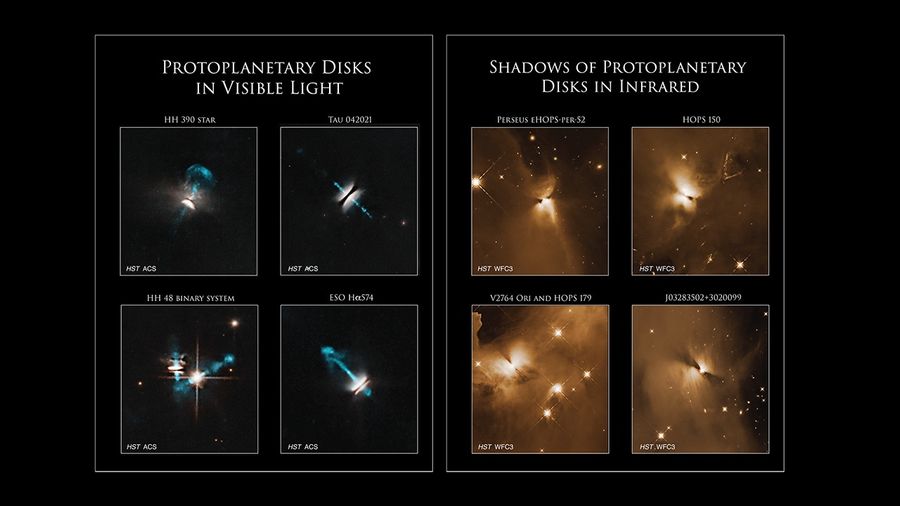
This Hubble collection captures eight protoplanetary disks — four in visible light and four in infrared. When stars are forming, they pull in gas and dust. Some of that matter forms a rotating disk — the protoplanetary disk. The gas and dust in the disk continue to feed the growing star. The remaining orbiting gas and dust may eventually form planets.
In the visible light image above, the protoplanetary disks are the dark dust disks between the bright light. HH 390, though, is not viewed edge-on, and that is why its disk seems to be at the edge of the bright light.
The bright light in question is a reflection nebula. Reflection nebulae are regions of gas and dust lit up by the light of a star. Jets of gas are also visible in the image. HH 390 and Tau 042021 are found about 450 light-years away in the Taurus Molecular Cloud. The bottom stars are located almost 500 light-years away in the Chameleon I star-forming region.
The stars in the infrared image appear to be in earlier stages of their evolution than those in the visible light image. In these earlier stages, there’s a thick dust envelope that covers the stars. Infrared light can pierce through that dust envelope. The envelope is evidently absent in the visible light images because visible light cannot see through that thick dust.
The dark areas that appear central to the bright light are the protoplanetary disks. The shadows of the disk cast onto the surrounding cloud make the disk seem larger. The top right and bottom left stars lie in the Orion Molecular Cloud about 1,300 light-years away. The top left and bottom right stars lie in the Perseus Molecular Cloud about 1,500 light-years away.
Source(s)
Image source — Left: NASA, ESA, and K. Stapelfeldt (Jet Propulsion Laboratory); Processing: Gladys Kober (NASA/Catholic University of America) Right: NASA, ESA, and T. Megeath (University of Toledo); Processing: Gladys Kober (NASA/Catholic University of America)
 Add as a preferred source on Google


