




NASA finds what possibly happens milliseconds before neutron star collisions
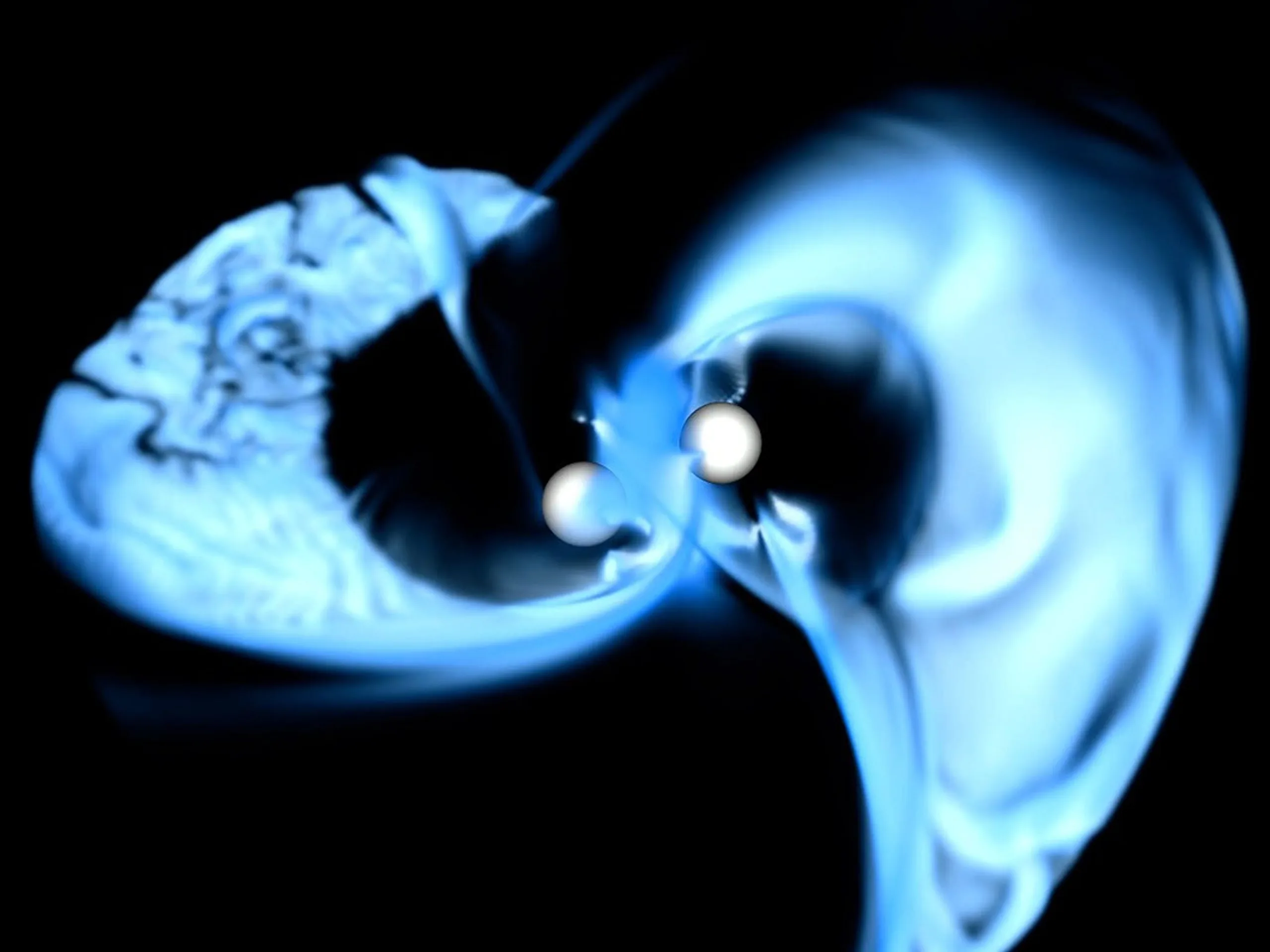
When a neutron star merger occurs, it produces one of the most powerful explosions in the universe — gamma-ray bursts. But before these mergers happen, the stars spin dozens of times, and a magnetic field is produced. This magnetic field is one of the strongest magnetic fields known. It is up to 10 trillion times stronger than a refrigerator magnet. The magnetic fields are strong enough to directly transform gamma-rays into electrons and positrons and rapidly accelerate them into incredibly high energies.
Using NASA’s Pleiades supercomputer, scientists ran more than 100 simulations to see how different magnetic field configurations affected how electromagnetic waves left a system of two orbiting 1.4 solar-mass neutron stars. Most of the simulations focused on the last 7.7 milliseconds before the merger. The simulations revealed that during this period, there is a dramatic interaction of magnetic field lines. The field lines connect, break, and reconnect. While the fields interact, particles are transformed into radiation and vice versa.
The simulation went further to show regions where the highest-energy gamma-rays are produced. These rays cannot escape the system as they are quickly converted to particles in the presence of strong magnetic fields. However, gamma-rays at lower energies can escape the merging system and may later produce X-rays. Future observatories can target these lower-energy radiations to give scientists a look at a neutron star merger just before it happens.
Source(s)
 Add as a preferred source on Google


