




NASA discovers a surprisingly massive galaxy cluster 2 billion years earlier than supposed

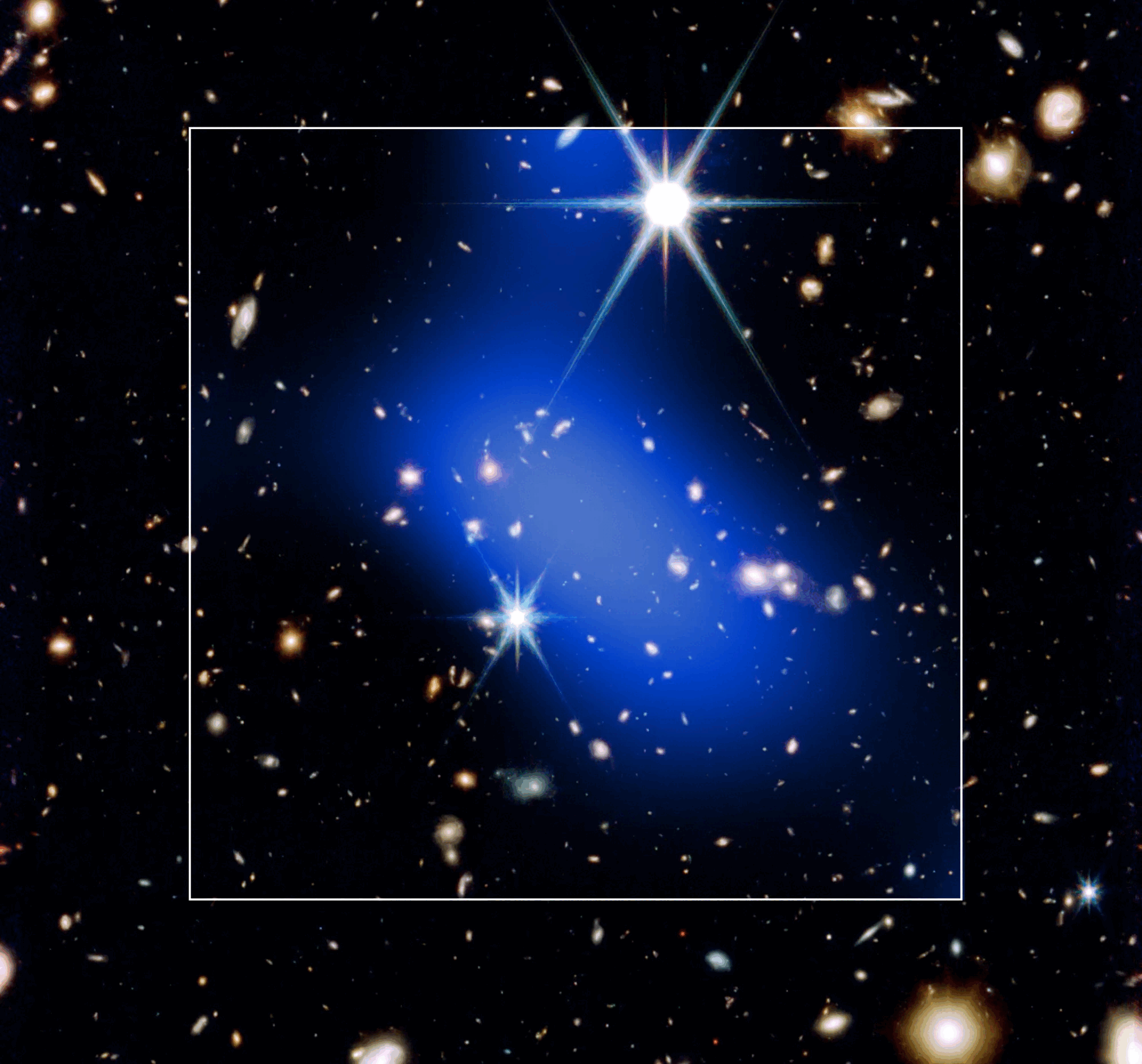
When a cosmic object is observed, its distance tells us how far back in time we are observing the object. For this new discovery, scientists found a galaxy cluster in its formative years, only about one billion years after the Big Bang. The galaxy cluster is called JADES-ID1. The cluster was found in the JWST Advanced Deep Extragalactic Survey (JADES), hence its name. The findings of the study were published in the journal Nature.
Given that JADES-ID1 is still forming, it is referred to as a protocluster. Before now, the earliest protocluster observed with X-ray emission was seen about three billion years after the Big Bang. So seeing JADES-ID1 about two billion years earlier is quite profound.
Interestingly, JADES-ID1 has a mass about 20 trillion times that of the Sun. Scientists are now wondering how something that massive formed so quickly.
The discovery was made thanks to observations from both the James Webb Space Telescope and the Chandra X-ray Observatory. When they observed JADES-ID1, two properties confirmed that it was indeed a protocluster. Firstly, Webb saw at least 66 potential galaxies held together by gravity. Secondly, Chandra observed that the galaxies were sitting in a huge cloud of hot gas.
Scientists expect JADES-ID1 to evolve from a protocluster into a massive galaxy cluster after billions of years — one as massive as the ones seen closer to Earth.
 Add as a preferred source on Google


