




Webb discovers the oldest galaxy ever observed in the universe

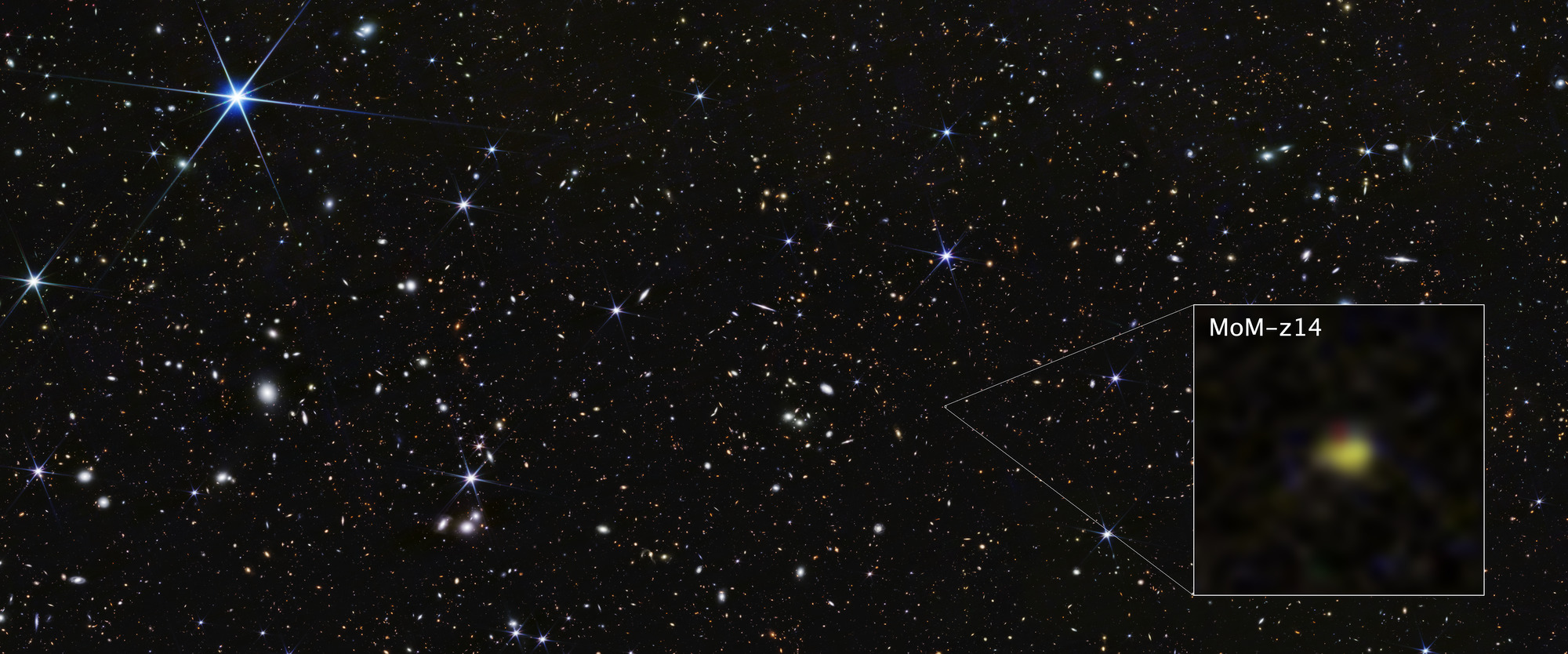
Since its launch, Webb has been taking science closer to observing the early universe. This time around, Webb looked as far back as 280 million years after the Big Bang. It found a bright galaxy called MoM-z14.
Astronomers are normally able to estimate the distance of galaxies from their images. But with Webb’s Near-Infrared Spectrograph (NIRSpec), they were able to confirm exactly how far back in time the MoM-z14 galaxy existed. Webb’s NIRSpec confirmed that the galaxy has a cosmological redshift of 14.44. What this means is that since the light from the galaxy has been traveling through space, the universe has expanded its wavelength 14.44 times.
MoM-z14’s brightness and high nitrogen content also drew attention. MoM-z14’s brightness is 100 times more than theoretical studies previously predicted. For its high nitrogen, astronomers suspect that it is due to supermassive stars in the galaxy. The theory holds that the dense environment of the universe resulted in these supermassive stars, which could produce high amounts of nitrogen.
Another interesting thing the astronomers discovered is that MoM-z14 shows signs of reionization. Reionization is a process that ionizes neutral hydrogen. This neutral hydrogen forms a thick fog that light cannot pass through. But when ionized, the fog clears. One of Webb’s missions is to define the timeline of this clearing period. And now, the MoM-z14 discovery has provided another clue to help Webb on that quest.
A paper containing details of this discovery was published in the Open Journal of Astrophysics.
Source(s)
The Open Journal of Astrophysics via NASA
Image: NASA, ESA, CSA, STScI, Rohan Naidu (MIT); Image Processing: Joseph DePasquale (STScI)
 Add as a preferred source on Google


