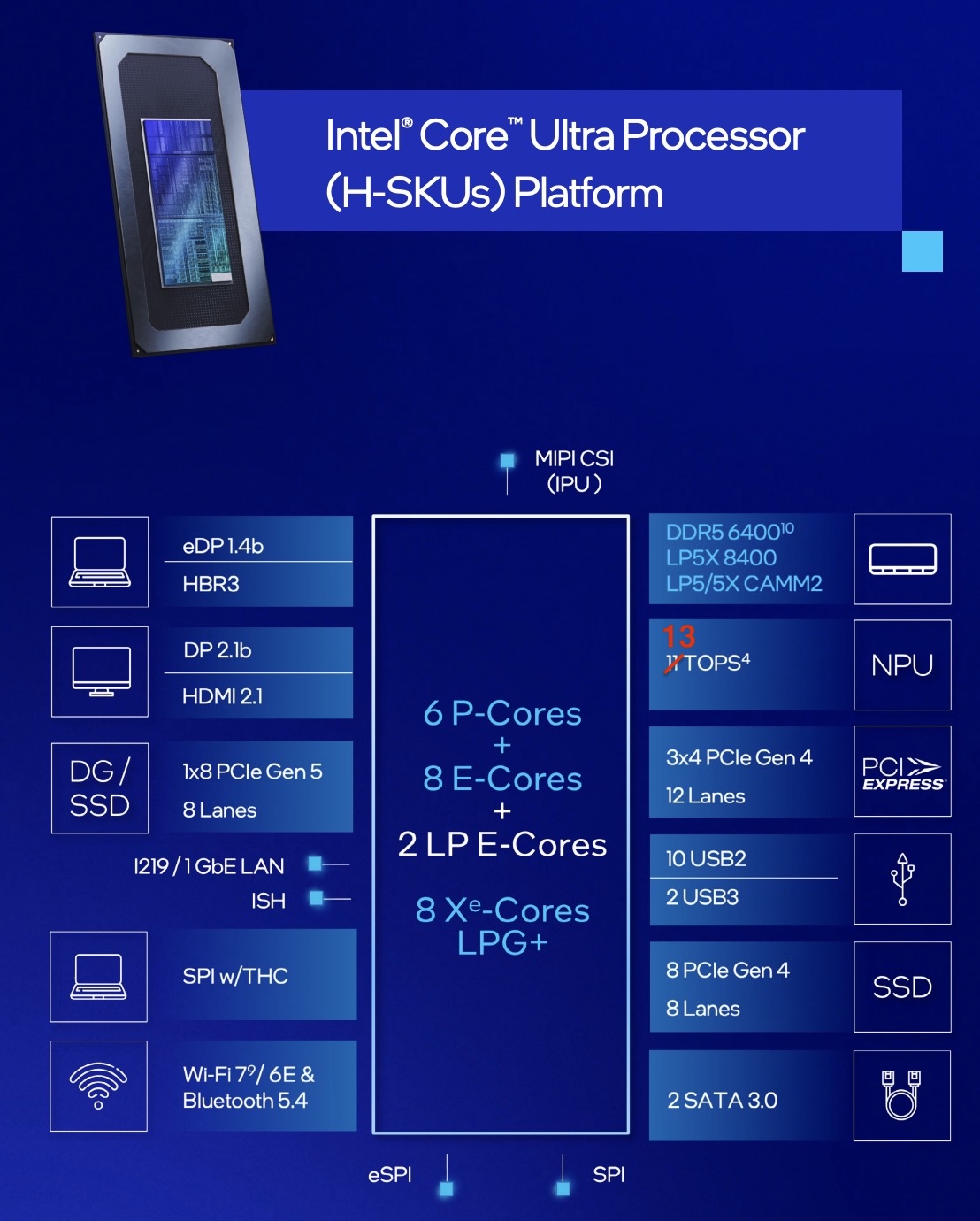
The Intel Core Ultra 9 285H is a mobile high-end CPU for larger notebooks based on the Arrow Lake architecture. It offers 16 cores consisting of 6 fast performance cores (Lion Cove) with up to 5.4 GHz and 8 smaller efficiency cores (Skymont) with up to 4.5 GHz clock speed and two additional low power cores with up to 2.5 GHz (Skymont). The CPU has access to 24 MB of cache and is specified with a TDP of 45 watts.
The SoC integrates a small dedicated NPU called AI Boost with 13 TOPS (Int8) and optionally supports vPro Enterprise. The integrated memory controller supports up to 192 GB LPDDR5/x-8400 or DDR5-6400 (dual channel). The integrated GPU (iGPU) is an Intel Arc 140T graphics card that offers eight Xe cores with up to 2.35 GHz.
Performance - High End
The top model offers all the cores that are built into the chip and clocks relatively high at up to 5.4 GHz. Thanks to the improved IPC of the cores (especially the efficiency cores), the CPU should reach the level of the old Raptor Lake Core Core 9 270H (6 + 8 cores, max 5.8 / 4.1 GHz). This makes the CPU ideal for very demanding tasks such as high-end gaming and content creation.
Chiplet Design
Like the desktop and HX chips, the Arrow Lake-H chips are based on individual chiplets that are placed on a 22nm base tile from Intel using Foveros 3D packaging. The CPU part comes from TSMC using the modern N3B (3nm) process. As with HX, the GPU also is produced at TSMC and is manufactured using the N5P process. SoC and I/O Tile are also from TSMC but in the older N6 process.
The Intel Core Ultra 7 288V is the fastest Lunar Lake family processor as of Nov 2024 thanks to its higher TDP power target and higher clock speeds. This is an SoC for use in tablets and laptops of the slimmer kind that was unveiled in Autumn 2024. It sports 4 new Skymont E-cores and 4 new Lion Cove P-cores running at up to 3.7 GHz and 5.1 GHz respectively, along with the promising new Arc 140V iGPU and 32 GB of on-package, non-replaceable LPDDR5x-8533 RAM. A new 48 TOPS neural engine, Thunderbolt 4 and PCIe 5 SSD support are included as well. A vPro-enabled version of the CPU became available in early 2025.
Architecture and Features
Lunar Lake is built using the Foveros technology (stacking several dies on top of each other and next to each other), just like Meteor Lake was. The new chips make use of the enormous BGA2833 socket interface. Of the 8 cores, not a single one is Hyper-Threading-enabled which is the opposite of what AMD currently does with its Zen 5/5c chips.
Intel claims Lion Cove cores bring a 14% IPC improvement over Redwood Cove. For Skymont and Crestmont, the difference is much higher at 68%. Several tweaks and improvements are present here, such as the Low Latency Fabric that is supposed to make small data transfers between cores/caches a lot faster. The 288V has a very healthy 12 MB of level 3 cache; elsewhere, it has 4 PCIe 5 and 4 PCIe 4 lanes for connecting various kinds of devices, including NVMe SSDs at up to 15.75 GB/s. Thunderbolt 4 support is onboard by default, as is support for CNVi WiFi 7 + BT 5.4 cards from Intel. The 48 TOPS "AI Boost" neural engine is present along with technologies such as Threat Detection to make AI-enabled applications such as the Windows Defender more powerful.
Intel is predicted to get short of on-package RAM in subsequent CPU generations.
Performance
The 288V should be just a couple of percentage points faster than the Core Ultra 7 165U and Core i7-1360P in multi-threaded tasks.
Generally speaking, the 256V, 258V, 266V, 268V, 288V are faster than the 226V, 228V, 236V and 228V due to the difference in their last-level cache size (8 MB vs 12 MB) as well as clock speeds. However, the difference in performance between the slowest Lunar Lake chip, the 226V, and the fastest chip, the 288V is fairly small at around 10% to 15%. It depends on the TDP figures of the laptops being pitted against each other more than on anything else.
Graphics
The Arc Graphics 140V is here to replace the Arc 8 iGPU. Its 8 Xe² architecture "cores" run at up to 2,050 MHz and it also has 8 ray tracing units at its disposal. The adapter is DirectX 12 Ultimate-enabled and able to HW-decode a long list of popular video codecs such as h.266 VVC, h.265 HEVC, h.264 AVC, AV1 and VP9. Three SUHD 4320p monitors can be used simultaneously with this iGPU.
All 2023 and 2024 games are playable at 1080p on low graphics settings or higher with this iGPU. We got well over 30 fps in Ghost of Tsushima and almost 40 fps in Baldur's Gate 3. This means the Radeon 780M gets left behind while the Radeon 890M reigns supreme.
Power consumption
Unlike the slower 268V, 266V, 258V, 256V, 238V, 236V, 228V and 226V, this 2nd generation Core Ultra processor is supposed to consume 30 W when under long-term workloads rather than 17 W. The Intel-recommended short-term power limit for all of them is identical: 37 W.
Average Benchmarks Intel Core Ultra 9 285H → 100%n=45
Average Benchmarks Intel Core Ultra 9 288V → 76%n=45
- Range of benchmark values for this graphics card - Average benchmark values for this graphics card * Smaller numbers mean a higher performance 1 This benchmark is not used for the average calculation
v1.35
log 20. 13:04:30
#0 ran 0s before starting gpusingle class +0s ... 0s
#1 checking url part for id 18542 +0s ... 0s
#2 checking url part for id 17915 +0s ... 0s
#3 redirected to Ajax server, took 1766232269s time from redirect:0 +0s ... 0s
#4 did not recreate cache, as it is less than 5 days old! Created at Fri, 19 Dec 2025 14:52:30 +0100 +0s ... 0s
#5 composed specs +0.004s ... 0.004s
#6 did output specs +0s ... 0.004s
#7 getting avg benchmarks for device 18542 +0.002s ... 0.006s
#8 got single benchmarks 18542 +0.003s ... 0.009s
#9 getting avg benchmarks for device 17915 +0.002s ... 0.011s
#10 got single benchmarks 17915 +0.001s ... 0.011s
#11 got avg benchmarks for devices +0s ... 0.011s
#12 min, max, avg, median took s +0.032s ... 0.044s








 - Average benchmark values for this graphics card


 Add as a preferred