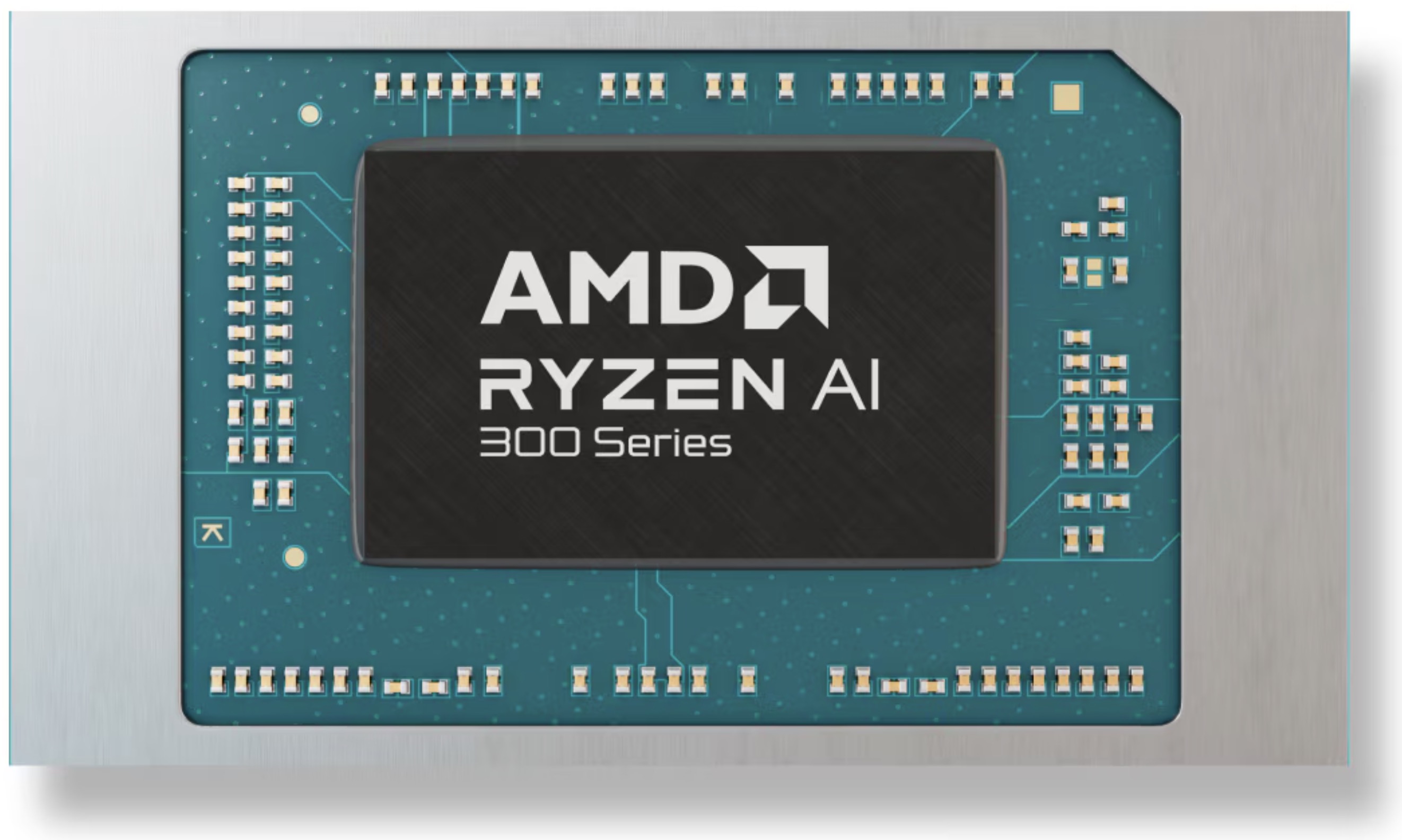
The AMD Ryzen AI 5 PRO 340 is a powerful mobile processor from the Krakan Point family that was announced at CES in early 2025. The APU integrates 6 CPU cores (3x Zen 5 with up to 4.8 GHz and 3x Zen 5c with less cache and a maximum of 3.4 GHz) and a big 16 MB L3-Cache. Compared to the nearly identical consumer chip, the Ryzen AI 5 340, the PRO variant supports additional management and security features.
Architecture and features
The Krackan Point family APUs are powered by Zen 5 and Zen 5c microarchitecture cores located in separate clusters, the latter being a slightly slower, smaller and more energy efficient version of the former. One of the differences between Zen 5 and Zen 5c is the size of the cache; the Zen 5 cores have larger caches available.
However, the mobile Zen 5 implementation is reportedly (ChipsAndCheese) is closer to desktop Zen 4 than desktop Zen 5 due to the different cache sizes, large differences in AVX-512 throughput, and other factors.
Elsewhere, the Ryzen AI 5 chip supports DDR5-5600 and LPDDR5x-8000 RAM, giving system designers a choice between lower latency and higher throughput. The chip is natively compatible with USB 4 (and therefore Thunderbolt). It has PCIe 4.0 support for a throughput of 1.9 GB/s per lane, just like its 8000 series predecessors. The integrated XDNA 2 NPU, which is much more complex than the first generation XDNA, delivers up to 50 INT8 TOPS for accelerating various AI workloads.
As usual with laptop CPUs, the Ryzen 5 AI chip cannot be replaced by the user as it is soldered.
Performance
Thanks to the Zen 5 architecture and the high clock rates, the CPU performance should be very good.
Graphics
The Radeon 840M is a downscaled Radeon 890M that offers only 4 cores (CUs = 256 shaders) and clocks at up to 2.9 GHz. It uses the new RDNA 3.5 architecture.
Power consumption
The AI PRO 340 is said to have a base TDP of 28 W, although laptop manufacturers are free to set the TDP between 15 and 54 W.
The 4 nm TSMC process with which these CPUs are manufactured ensures above-average energy efficiency.
The AMD Ryzen AI 7 350 is a powerful mobile processor from the Krackan Point family that was announced at CES in early 2025. The APU integrates 8 CPU cores (4x Zen 5 with up to 5 GHz and 4x Zen 5c with less cache and a maximum of 3.5 GHz) and a big 16 MB L3-Cache.
Architecture and features
The Krackan Point family APUs are powered by Zen 5 and Zen 5c microarchitecture cores located in separate clusters, the latter being a slightly slower, smaller and more energy efficient version of the former. One of the differences between Zen 5 and Zen 5c is the size of the cache; the Zen 5 cores have larger caches available.
However, the mobile Zen 5 implementation is reportedly (ChipsAndCheese) is closer to desktop Zen 4 than desktop Zen 5 due to the different cache sizes, large differences in AVX-512 throughput, and other factors.
Elsewhere, the Ryzen AI 7 chip supports DDR5-5600 and LPDDR5x-8000 RAM, giving system designers a choice between lower latency and higher throughput. The chip is natively compatible with USB 4 (and therefore Thunderbolt). It has PCIe 4.0 support for a throughput of 1.9 GB/s per lane, just like its 8000 series predecessors. The integrated XDNA 2 NPU, which is much more complex than the first generation XDNA, delivers up to 50 INT8 TOPS for accelerating various AI workloads.
As usual with laptop CPUs, the Ryzen 7 AI chip cannot be replaced by the user as it is soldered.
Performance
Thanks to the Zen 5 architecture and the high clock rates, the CPU performance should be very good.
Graphics
The Radeon 860M is the direct successor to the Radeon 760M and offers 8 cores (CUs = 512 shaders) and clocks at up to 3 GHz. It uses the new RDNA 3.5 architecture.
Power consumption
The AI 350 is said to have a base TDP of 28 W, although laptop manufacturers are free to set the TDP between 15 and 54 W.
The 4 nm TSMC process with which these CPUs are manufactured ensures above-average energy efficiency.
Average Benchmarks AMD Ryzen AI 5 PRO 340 → 100%n=2
Average Benchmarks AMD Ryzen AI 7 350 → 108%n=2
- Range of benchmark values for this graphics card - Average benchmark values for this graphics card * Smaller numbers mean a higher performance 1 This benchmark is not used for the average calculation
v1.35
log 07. 04:47:37
#0 ran 0s before starting gpusingle class +0s ... 0s
#1 checking url part for id 19318 +0s ... 0s
#2 checking url part for id 19172 +0s ... 0s
#3 redirected to Ajax server, took 1767757657s time from redirect:0 +0s ... 0s
#4 did not recreate cache, as it is less than 5 days old! Created at Tue, 06 Jan 2026 15:10:37 +0100 +0s ... 0s
#5 composed specs +0.004s ... 0.005s
#6 did output specs +0s ... 0.005s
#7 getting avg benchmarks for device 19318 +0.001s ... 0.005s
#8 got single benchmarks 19318 +0.004s ... 0.009s
#9 getting avg benchmarks for device 19172 +0.004s ... 0.013s
#10 got single benchmarks 19172 +0.022s ... 0.035s
#11 got avg benchmarks for devices +0s ... 0.035s
#12 min, max, avg, median took s +0.034s ... 0.069s








 - Average benchmark values for this graphics card


 Add as a preferred