




Resident Evil Requiem benchmark shows Linux hits 145 FPS vs 129 FPS on Windows 11 with Frame Generation

Resident Evil Requim has become a smashing hit. It recently broke a Steam sales record with 344,000 peak concurrent players. It also debuted PlayStation’s new upscaling technology on the PS5 Pro, resulting in improved gameplay performance.
And as Linux continues to grow as a gaming platform, one additional question remains: how does the latest Resident Evil game perform on Linux? Thankfully, we have an answer from the YouTube channel NJ Tech, which recently conducted an average FPS comparison of Resident Evil Requiem between Windows 11 and CachyOS.
The testing was carried out on a system built around AMD’s Ryzen 9 7900X processor, configured with Precision Boost Overdrive or PBO for short and Curve Optimizer enabled. The motherboard used was the MSI PRO X670-P WiFi running AGESA 1.2.0.3g firmware.
The system was equipped with 32GB of DDR5 memory (2x16GB) clocked at 6200MHz with CL30 timings, and cooled using a Deepcool LD360 AIO liquid cooler. Storage included a 1TB Samsung 980 Pro NVMe SSD along with two 2TB WD Blue SN570 drives. Power was supplied by a Corsair RM1000x PSU.
For software, the benchmarks were conducted on Windows 11 Pro 25H2 and Linux-based CachyOS, using CachyOS-Proton (20260207) for compatibility testing on Linux.
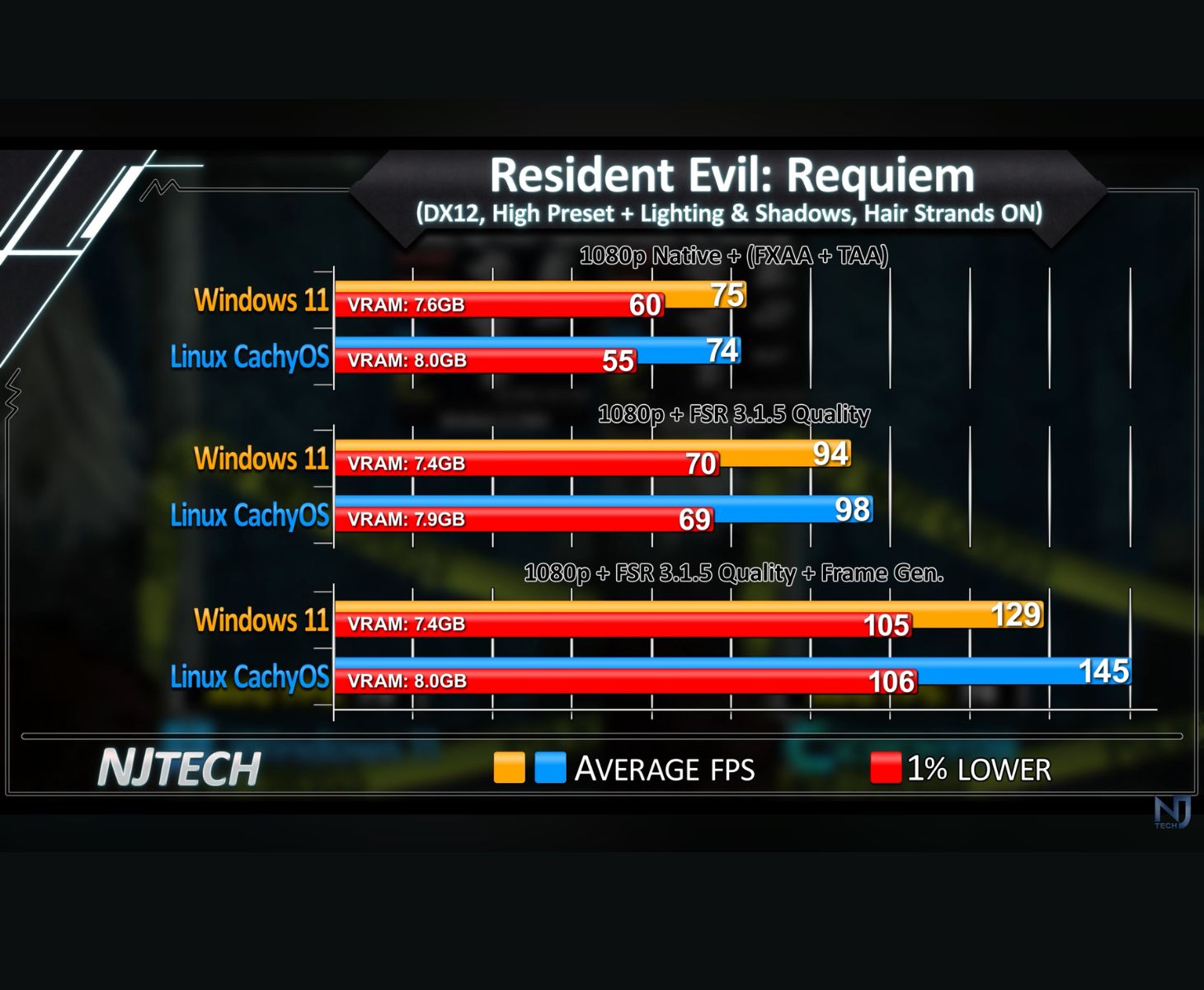
At 1080p native resolution with FXAA and TAA enabled, Windows 11 records an average of 75 FPS with 1% lows at 60 FPS. Linux running CachyOS delivers 74 FPS on average with 1% lows at 55 FPS. Average performance is nearly identical between the two platforms, although Windows maintains slightly stronger frame consistency. VRAM usage is marginally higher on Linux at 8.0 GB compared to 7.6 GB on Windows.
Enabling FSR 3.1.5 in Quality mode at 1080p shifts the balance slightly. Windows posts 94 FPS on average with 70 FPS 1% lows, while Linux reaches 98 FPS average and 69 FPS 1% lows. VRAM allocation again trends higher on the Linux side.
With FSR 3.1.5 Quality and Frame Generation enabled, the performance gap widens. Windows achieves 129 FPS on average with 105 FPS 1% lows. Linux increases to 145 FPS on average with 106 FPS 1% lows. While 1% lows remain closely matched, Linux demonstrates a clear advantage in average frame rate under this configuration.
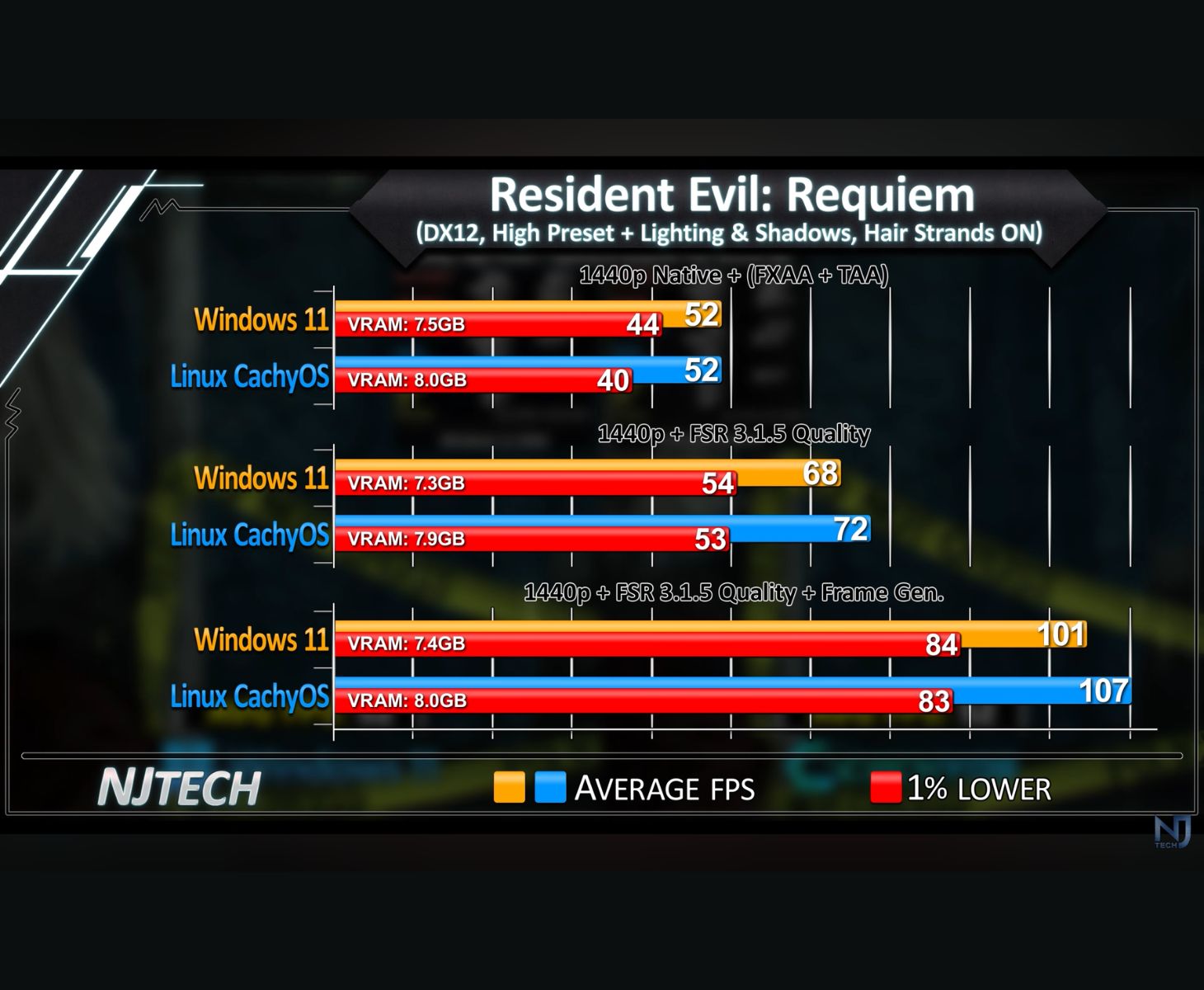
At 1440p native resolution with FXAA and TAA enabled, both operating systems deliver identical average frame rates of 52 FPS. However, Windows 11 records slightly stronger 1% lows at 44 FPS compared to 40 FPS on Linux CachyOS. This suggests marginally better frame consistency on Windows under native rendering at this resolution. VRAM usage remains somewhat higher on Linux at 8.0 GB versus 7.5 GB on Windows.
Switching to 1440p with FSR 3.1.5 set to Quality mode improves performance on both platforms. Windows posts 68 FPS on average with 54 FPS 1% lows, while Linux reaches 72 FPS average and 53 FPS 1% lows. Linux holds a small lead in average performance, though low frame results are nearly identical. VRAM allocation again trends slightly higher on Linux.
With FSR 3.1.5 Quality and Frame Generation enabled at 1440p, the performance uplift becomes more pronounced. Windows achieves 101 FPS average with 84 FPS 1% lows. Linux increases to 107 FPS average with 83 FPS 1% lows. Average performance favors Linux by a noticeable margin, while 1% lows remain effectively comparable between the two platforms.
At 1440p native, both Windows 11 and Linux CachyOS average 52 FPS, though Windows again maintains slightly stronger 1% lows at 44 FPS compared to 40 FPS on Linux.
With FSR 3.1.5 Quality enabled, Linux moves ahead at 72 FPS compared to 68 FPS on Windows. Adding Frame Generation increases Windows to 101 FPS average and Linux to 107 FPS, with 1% lows staying closely matched on both platforms.
You can watch the complete in-depth testing in the video linked below.
Source(s)
 Add as a preferred source on Google


