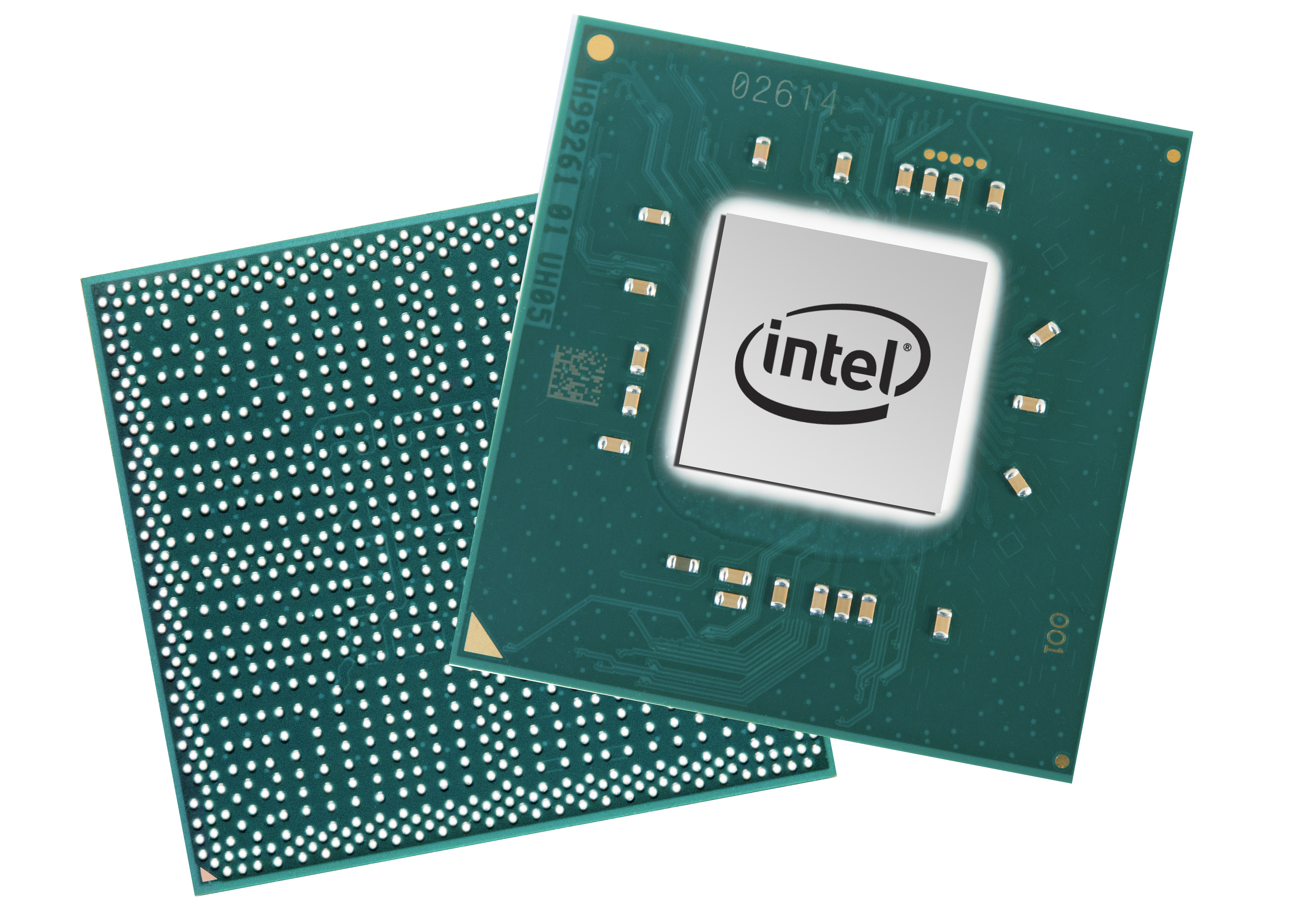
The Intel Celeron N4000 is a dual-core SoC designed for affordable laptops and mini-PCs and was announced late 2017. It runs at 1.1 GHz to 2.6 GHz (Single Core Burst, Multi Core Burst maxes out at 2.5 GHz) and is based on the Gemini Lake platform. Similar to the Apollo Lake predecessor, the chip is manufactured on a 14 nm process with FinFETs but offers slightly improved processor cores, double the amount of L2 cache, all in a smaller package. Partial Wi-Fi 5 support is baked into the chip. Besides two CPU cores, the chip also includes a DirectX 12 capable GPU as well as a DDR4/LPDDR4 memory controller (dual-channel, up to 2400 MHz). The SoC is not replaceable as it is directly soldered to the mainboard.
Architecture
The processor architecture was slightly reworked and is now called Goldmont Plus. It features a larger L2 cache (4 MB). That means the per-clock-performance should be a bit better, but not anywhere near the Core CPUs like Kaby Lake Y.
Performance
The average N4000 in our database only just matches the Core i5-4300Y, a fairly old dual-core processor of nearly the same energy efficiency, in multi-thread performance. In other words, the Celeron is a very slow processor that's good enough for the most basic of tasks only. Expect long load times no matter the app.
Graphics
The UHD Graphics 600 (Gemini Lake) is based on Intel's Generation 9 architecture, which supports DirectX 12 and is also used for the Kaby Lake / Skylake / Apollo Lake graphics adapters (like HD Graphics 520). Equipped with 12 EUs and a clock of up to 650 MHz, the performance should be roughly on par with the older HD Graphics 500 (Apollo Lake).
The chip also includes an advanced video engine with hardware support for the playback of VP9 and H.265 (8-bit color-depth).
Power consumption
Like most other N-class Intel chips, the Celeron N4000 has a 6 W TDP (also known as the long-term power limit). This is not much at all, allowing laptop makers to build passively cooled laptops, tablets, mini-PCs around the chip. The SoC can briefly consume up to 15 W, though, depending on how a system is configured.
Last but not the least, this Celeron is manufactured on one of the old 14 nm Intel processes leading to poor, as of early 2023, energy efficiency.
The Intel Processor N100 is an entry-level mobile CPU for thin and light laptops from the Alder Lake-N series. It was announced in early 2023 and offers no performance cores and 4 of the 8 efficient cores (E-cores, Gracemont architecture). The chip does not support HyperThreading and clocks with 1 to 3.4 GHz. The performance of the E-cores should be similar to old Skylake cores (compare to the Core i7-6700HQ). All cores can use up to 6 MB L3-cache.
Performance
The average N100 in our database delivers unimpressive multi-thread benchmark scores that are most similar to those of the Core i3-1115G4. The chip is fast enough for many day-to-day tasks, but not much more than that; the other thing to keep in mind is that of the two N100-toting systems tested by us as of October 2023, both have rather high CPU power limits. The chip will be noticeably slower if limited to just six or seven Watts.
Features
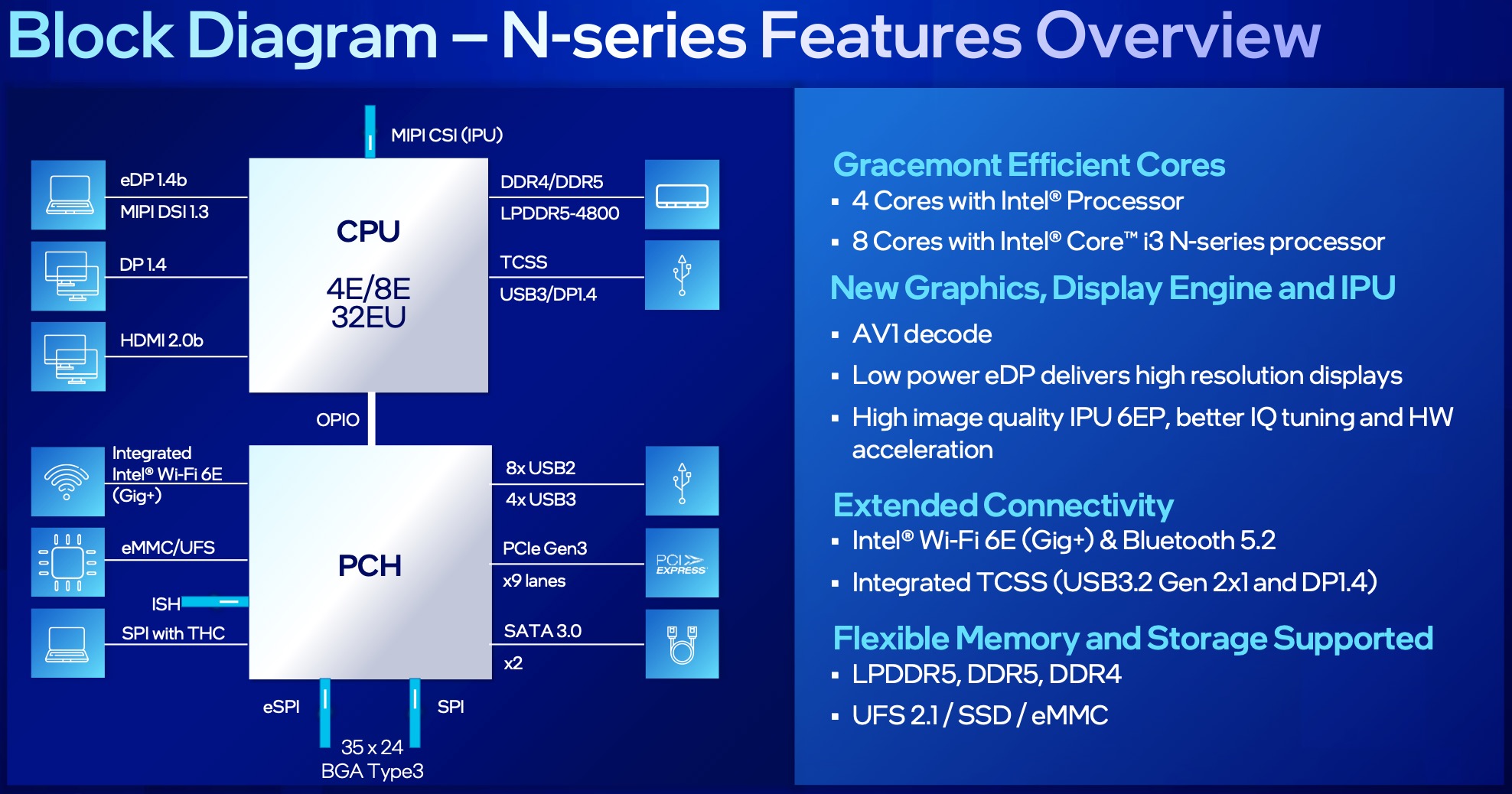
The Alder Lake-N chips only support single channel memory with up to DDR5-4800, DDR4-3200 or LPDDR5-4800. The chip also supports Quick Sync and AV1 decoding (most likely same engine as in Alder Lake). Furthermore, Wi-Fi 6E and Bluetooth 5.2 are partly integrated (but no Thunderbolt). External chips can be connected via PCIe Gen3 x9 (via the PCH).
The integrated graphics adapter is based on the Xe-architecture and offers only 24 of the 32 EUs (Execution Units) operating at only 450 - 750 MHz. Due to the single channel memory, low clock speeds, and low shader count, the gaming performance of the iGPU is very limited.
Power consumption
The N100 has a base power consumption of only 6 W and is therefore suited for fanless cooling. The CPU is built with a further improved 10nm SuperFin process at Intel (called Intel 7).
The Intel Core i3-N305 is an entry-level mobile CPU for thin and light laptops from the Alder Lake-N series. It was announced in early 2023 and offers no performance cores and 8 efficient cores (E-cores, Gracemont architecture). The chip does not support HyperThreading and clocks with up to 3.8 GHz (single core, 3 GHz all core Turbo). The performance of the E-cores should be similar to old Skylake cores (compare to the Core i7-6700HQ). All cores can use up to 6 MB L3-cache.
Performance
The performance depends on the cooling and TDP settings and should be somewhere similar to the old Alder Lake Pentium 8500 (1 performance core, 4 efficiency cores, max. 4.4 GHz and 8 MB L3-cache). The multi-threaded performance should be quite good with the 8 cores but will suffer due to the low TDP. Single thread performance will suffer due to the missing P-cores and relatively low boost clock speeds.
Features
The Alder Lake-N chips only support single channel memory with up to DDR5-4800, DDR4-3200 or LPDDR5-4800. The chip also supports Quick Sync and AV1 decoding (most likely same engine as in Alder Lake). Furthermore, Wi-Fi 6E and Bluetooth 5.2 are partly integrated (but no Thunderbolt). External chips can be connected via PCIe Gen3 x9 (via the PCH).
The integrated graphics adapter is based on the Xe-architecture and offersall 32 EUs (Execution Units) operating at up to 1.25 GHz. In addition to the single channel memory, the gaming performance is very limited of the iGPU.
Power consumption
The i3 has a base power consumption of 7 W and is therefore even suited for fanless cooling. The CPU is built with a further improved 10nm SuperFin process at Intel (called Intel 7).
Average Benchmarks Intel Processor N100 → 262%n=35
Average Benchmarks Intel Core i3-N300 → 227%n=35
- Range of benchmark values for this graphics card - Average benchmark values for this graphics card * Smaller numbers mean a higher performance 1 This benchmark is not used for the average calculation
v1.35
log 06. 15:41:42
#0 ran 0s before starting gpusingle class +0s ... 0s
#1 checking url part for id 9426 +0s ... 0s
#2 checking url part for id 14932 +0s ... 0s
#3 checking url part for id 14928 +0s ... 0s
#4 redirected to Ajax server, took 1767710502s time from redirect:0 +0s ... 0s
#5 did not recreate cache, as it is less than 5 days old! Created at Tue, 06 Jan 2026 15:10:37 +0100 +0s ... 0s
#6 composed specs +0.006s ... 0.006s
#7 did output specs +0s ... 0.006s
#8 getting avg benchmarks for device 9426 +0.003s ... 0.01s
#9 got single benchmarks 9426 +0.014s ... 0.024s
#10 getting avg benchmarks for device 14932 +0.003s ... 0.027s
#11 got single benchmarks 14932 +0.012s ... 0.039s
#12 getting avg benchmarks for device 14928 +0.004s ... 0.043s
#13 got single benchmarks 14928 +0.004s ... 0.047s
#14 got avg benchmarks for devices +0s ... 0.047s
#15 min, max, avg, median took s +0.065s ... 0.112s







 - Average benchmark values for this graphics card


 Add as a preferred