Notebookcheck Logo

Intel Celeron N4500 vs Intel Processor N50 vs Intel Celeron N5095

Intel Celeron N4500

► remove from comparison Intel Celeron N4500

The Intel Celeron N4500 is a dual-core SoC of the Jasper Lake series that is primarily intended for inexpensive notebooks and was announced in early 2021. The two Tremont CPU cores clock between 1.1 and 2.8 GHz (single core Burst) and offer no HyperThreading. The N4500 uses 1.5 MB L2 and 4 MB L3 cache. The chip is manufactured on the first-gen 10 nm Intel process.

Architecture

The processor architecture is called Tremont and a complete redesign compared to the old Golmont Plus cores in the predecessor. According to Intel, the single thread performance of a core could is up two 30% better on average (10 - 80% in all tests of SPECint and SPECfp).

Features

In addition to the dual-core CPU block, the SoC integrates a 16 EU Intel UHD Graphics GPU clocked from 350 - 750 MHz and a dual-channel DDR4 / quad-channel LPDDR4(x) memory controller (up to 16 GB, up to 2933 MHz). The chip now also partly integrates Wi-Fi 6 (Gig+), 8 PCIe 3.0 lanes, 14 USB 2.0/ 3.2 ports and two SATA 6.0 ports. The package got bigger and measures 35 x 24 mm (compared to 25 x 24 mm for the N5030 e.g.). The SoC is directly soldered to the mainboard (BGA) and can't be easily replaced.

Performance

The average N4500 in our database shapes up to be a fairly slow processor, its multi-thread benchmark scores only just matching those of the Core i3-4010U. (The latter saw the light of day in 2013 as a lower mid-range, dual-core CPU designed for use in ultraportable laptops.) In other words, expect the Celeron to be painfully slow in all but the most basic activities.

You mileage may vary depending on how high the CPU power limits are.

Power consumption

Like most N-class Intel chips, the Celeron has a default TDP (also known as the long-term power limit) of 6 W. This is not much at all and thus good enough for passively cooled tablets, laptops, mini-PCs.

The Celeron N4500 is built with Intel's 2nd generation 10 nm process (not 10 nm SuperFin or Intel 7) for low, as of mid 2023, energy efficiency.

Intel Processor N50

► remove from comparison Intel N50

The Intel Processor N50 is an entry-level mobile CPU for thin and light laptops from the Alder Lake-N series. It was announced in early 2023 and offers no performance cores and 2 of the 8 efficient cores (E-cores, Gracemont architecture). The chip does not support HyperThreading and clocks with up to 3.4 GHz. The performance of the E-cores should be similar to old Skylake cores (compare to the Core i7-6700HQ). All cores can use up to 6 MB L3-cache. 

Performance

The performance is clearly lower than the Processor N100 (4 cores, 3.4 GHz) due to the reduced core count. The single thread performance however, should be similar. Compared to older processors, the N50 should be comparable to dual core Skylake based CPUs like the Intel Core m3-8100Y (2x 3.4 GHz, 5W).Features

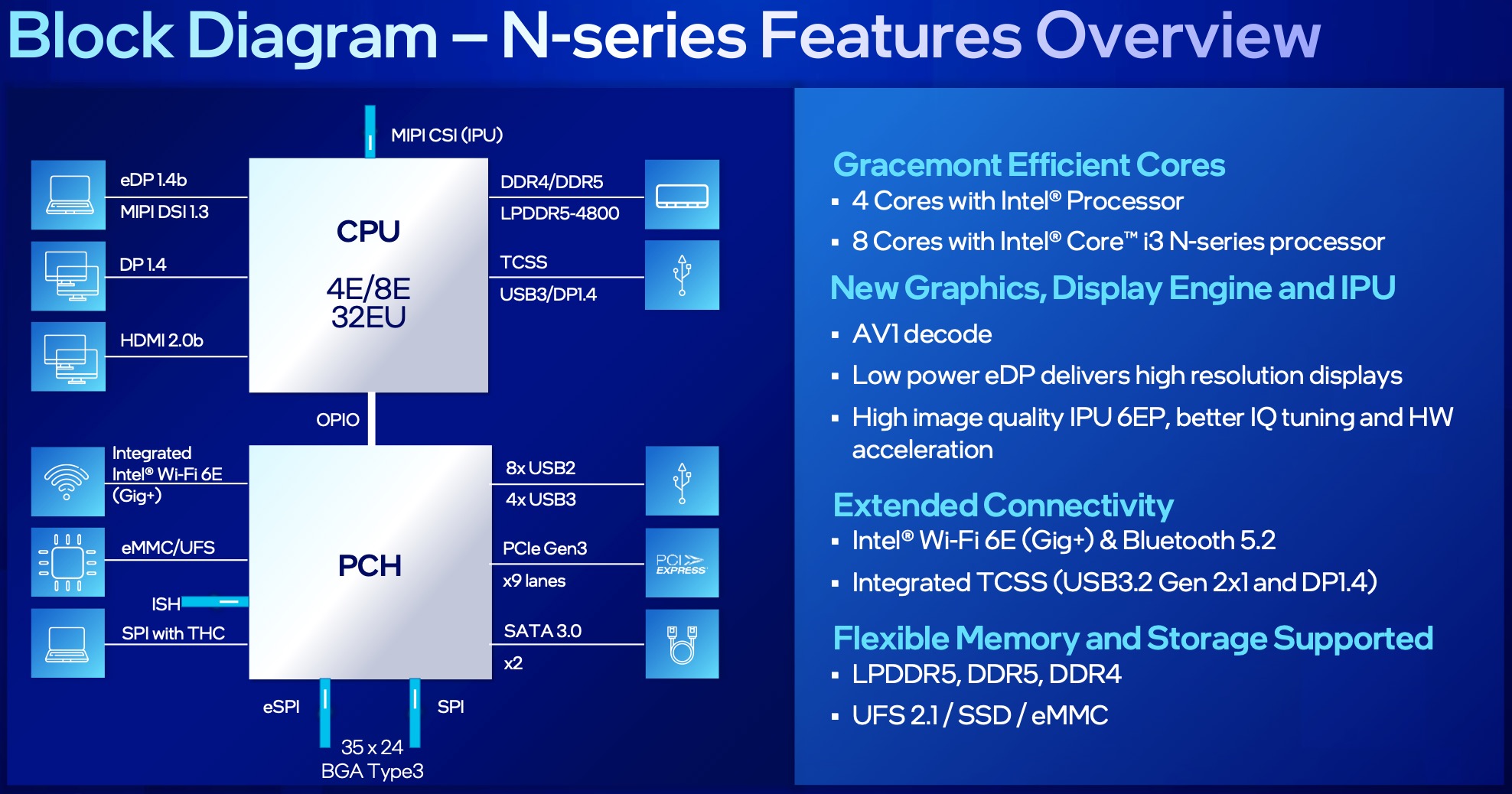
The Alder Lake-N chips only support single channel memory with up to DDR5-4800, DDR4-3200 or LPDDR5-4800. The chip also supports Quick Sync and AV1 decoding (most likely same engine as in Alder Lake). Furthermore, Wi-Fi 6E and Bluetooth 5.2 are partly integrated (but no Thunderbolt). External chips can be connected via PCIe Gen3 x9 (via the PCH).

The integrated graphics adapter is based on the Xe-architecture and offers only 16 of the 32 EUs (Execution Units) operating at only up to 750 MHz. Due to the single channel memory, low clock speeds, and low shader count, the gaming performance of the iGPU is very limited.

Power consumption

The N50 has a base power consumption of only 6 W and is therefore suited for fanless cooling. The CPU is built with a further improved 10nm SuperFin process at Intel (called Intel 7).

Intel Celeron N5095

► remove from comparison Intel Celeron N5095

The Celeron N5095 is an inexpensive quad-core SoC of the Jasper Lake product family designed for use in affordable SFF desktops and laptops. It features four Tremont CPU cores running at 2 GHz that Boost to up to 2.9 GHz with no thread-doubling Hyper-Threading technology in sight. A pretty basic iGPU is present as well.

The only difference between the N5095 and the N5095A is that the latter comes with support for more proprietary Intel technologies such as the Smart Sound DSP, Wake on Voice and HD Audio.

Architecture and Features

Tremont brings many improvements over Goldmont Plus, the architecture that we know from the N5030 and myriads of other N-class CPUs. An up to 30% boost in single-thread performance is to be expected thanks to smarter prefetchers, branch prediction improvements and other refinements, according to Intel. These new chips are physically larger than their immediate predecessors as a result. Either way, this is still a "small" core rather than a "big" one according to ChipsAndCheese.

The Celeron has 1.5 MB of L2 and 4 MB of L3 cache and is compatible with DDR4-2933 and LPDDR4x-2933 memory or slower. Support for Intel CNVi Wi-Fi 6 modules is baked into the chip, as are 8 PCIe 3.0 lanes for NVMe SSD speeds up to 3.9 GB/s. USB 4 or Thunderbolt aren't supported however.

Please also note that the Celeron gets soldered to the motherboard (BGA1338 socket interface) for good and is thus not user-replaceable.

Performance

The average N5095 in our database is about as fast as the Core i3-10110U, Core i3-1005G1, Celeron N5105 and also the Ryzen 3 3200U in multi-threaded workloads. Which is just enough for the most basic of tasks in late 2024.

Performance will get a significant hit if the power target is set to 10 W or 6 W instead of the Intel-recommended 15 W value.

Graphics

The DirectX 12.1-capable 16 EU UHD Graphics runs at up to 750 MHz and is in many respects similar to what Ice Lake CPUs come equipped with. This graphics adapter is capable of driving up to 3 SUHD displays simultaneously; HEVC, AVC, VP9, MPEG-2 and other popular video codecs can all be hardware-decoded. AV1 and VVC can't.

As far as gaming is concerned, it is reasonable to expect playable framerates in really old games (like Dota 2 Reborn) provided one sticks to lower resolutions such as HD 720p.

Power consumption

While most N-class chips have a 6 W long-term power target, the Celeron N5095 has a 15 W TDP to mimic much faster U-class Core processors. This isn't a great CPU for passively cooled designs.

The N5095 is built with the same 10 nm Intel process as Ice Lake-U processors for pretty unimpressive power efficiency, as of late 2024.

ModelIntel Celeron N4500Intel Processor N50Intel Celeron N5095
CodenameJasper LakeAlder Lake-NJasper Lake
SeriesIntel Jasper LakeIntel Alder Lake-NIntel Jasper Lake
Series: Jasper Lake Jasper Lake
Intel Pentium Silver N60052 - 3.3 GHz4 / 4 cores4 MB L3
Intel Pentium Silver N60001.1 - 3.3 GHz4 / 4 cores4 MB L3
Intel Celeron N5095A2 - 2.9 GHz4 / 4 cores4 MB L3
Intel Celeron N50952 - 2.9 GHz4 / 4 cores4 MB L3
Intel Celeron N51052 - 2.9 GHz4 / 4 cores4 MB L3
Intel Celeron N51001.1 - 2.8 GHz4 / 4 cores4 MB L3
Intel Celeron N45052 - 2.9 GHz2 / 2 cores4 MB L3
Intel Celeron N4500 « 1.1 - 2.8 GHz2 / 2 cores4 MB L3
Intel Core i3-N3051.8 - 3.8 GHz8 / 8 cores6 MB L3
Intel Core i3-N300 - 3.8 GHz8 / 8 cores6 MB L3
Intel Processor N2001 - 3.7 GHz4 / 4 cores6 MB L3
Intel Processor N97 - 3.6 GHz4 / 4 cores6 MB L3
Intel Processor N95 - 3.4 GHz4 / 4 cores6 MB L3
Intel Processor N1001 - 3.4 GHz4 / 4 cores6 MB L3
Intel Processor N50 « 1 - 3.4 GHz2 / 2 cores6 MB L3
Intel Pentium Silver N60052 - 3.3 GHz4 / 4 cores4 MB L3
Intel Pentium Silver N60001.1 - 3.3 GHz4 / 4 cores4 MB L3
Intel Celeron N5095A2 - 2.9 GHz4 / 4 cores4 MB L3
Intel Celeron N5095 « 2 - 2.9 GHz4 / 4 cores4 MB L3
Intel Celeron N51052 - 2.9 GHz4 / 4 cores4 MB L3
Intel Celeron N51001.1 - 2.8 GHz4 / 4 cores4 MB L3
Intel Celeron N45052 - 2.9 GHz2 / 2 cores4 MB L3
Intel Celeron N45001.1 - 2.8 GHz2 / 2 cores4 MB L3
Clock1100 - 2800 MHz1000 - 3400 MHz2000 - 2900 MHz
L2 Cache1.5 MB1.5 MB
L3 Cache4 MB6 MB4 MB
Cores / Threads2 / 22 / 2
2 x 3.4 GHz Intel Gracemont E-Core
4 / 4
4 x 2.9 GHz Intel Tremont
TDP6 Watt6 Watt15 Watt
Technology10 nm10 nm10 nm
max. Temp.105 °C105 °C105 °C
SocketBGA1338BGA1338
FeaturesDDR4-2933/LPDDR4x-2933 RAM, PCIe 3, GNA, MMX, SSE, SSE2, SSE3, SSSE3, SSE4.1, SSE4.2, SMEP, SMAP, EIST, TM1, TM2, Turbo, SST, AES-NI, RDRAND, RDSEED, SHADDR4-2933/LPDDR4x-2933 RAM, PCIe 3, GNA, MMX, SSE, SSE2, SSE3, SSSE3, SSE4.1, SSE4.2, VMX, SMEP, SMAP, EIST, TM1, TM2, Turbo, SST, AES-NI, RDRAND, RDSEED, SHA
iGPUIntel UHD Graphics (Jasper Lake 16 EU) (350 - 750 MHz)Intel UHD Graphics Xe 16EUs (Tiger Lake-H) ( - 750 MHz)Intel UHD Graphics (Jasper Lake 16 EU) (450 - 750 MHz)
Architecturex86x86x86
Announced
Manufacturerark.intel.comark.intel.comark.intel.com

Benchmarks

Performance Rating - CB R15 + R20 + 7-Zip + X265 + Blender + 3DM11 CPU - Celeron N4500
16.6 pt (28%)
Restrict / Search: Model: Max. age: years
Performance Rating - CB R15 + R20 + 7-Zip + X265 + Blender + 3DM11 CPU - Celeron N5095
20.6 pt (34%)
Restrict / Search: Model: Max. age: years
Cinebench R23 - Cinebench R23 Multi Core
709 Points (1%)
min: 2150     avg: 2174     median: 2164 (2%)     max: 2219 Points
Cinebench R23 - Cinebench R23 Single Core
452 Points (18%)
min: 587     avg: 608     median: 611 (25%)     max: 621 Points
Cinebench R20 - Cinebench R20 CPU (Single Core)
188 Points (20%)
min: 228     avg: 234     median: 234 (25%)     max: 239 Points
Cinebench R20 - Cinebench R20 CPU (Multi Core)
332 Points (1%)
min: 804     avg: 825     median: 827 (2%)     max: 844 Points
Cinebench R15 - Cinebench R15 CPU Multi 64 Bit
171 Points (1%)
min: 221     avg: 343     median: 364 (2%)     max: 379 Points
Cinebench R15 - Cinebench R15 CPU Single 64 Bit
82 Points (23%)
min: 95.4     avg: 103.9     median: 106 (29%)     max: 109 Points
Cinebench R11.5 - Cinebench R11.5 CPU Multi 64 Bit
2.1 Points (3%)
min: 4.65     avg: 4.7     median: 4.7 (6%)     max: 4.76 Points
Cinebench R11.5 - Cinebench R11.5 CPU Single 64 Bit
1 Points (25%)
min: 1.25     avg: 1.3     median: 1.3 (30%)     max: 1.29 Points
Cinebench R10 - Cinebench R10 Rend. Single (32bit)
min: 3527     avg: 3545     median: 3544.5 (21%)     max: 3562 Points
Cinebench R10 - Cinebench R10 Rend. Multi (32bit)
min: 12218     avg: 12283     median: 12283 (9%)     max: 12348 Points
Cinebench R10 - Cinebench R10 Rend. Multi (64bit)
6954 Points (4%)
min: 16442     avg: 16860     median: 16860 (11%)     max: 17278 Points
Cinebench R10 - Cinebench R10 Rend. Single (64bit)
5266 Points (6%)
min: 5224     avg: 5338     median: 5337.5 (7%)     max: 5451 Points
wPrime 2.10 - wPrime 2.0 1024m *
1270 s (15%)
min: 605.375     avg: 611     median: 611.4 (7%)     max: 617.326 s
wPrime 2.10 - wPrime 2.0 32m *
50.2 s (10%)
min: 19.202     avg: 19.5     median: 19.5 (4%)     max: 19.779 s
WinRAR - WinRAR 4.0
1076 Points (2%)
min: 1630     avg: 1706     median: 1705.5 (3%)     max: 1781 Points
7-Zip 18.03 - 7-Zip 18.03 Multi Thread 4 runs
5394 MIPS (3%)
min: 10924     avg: 11024     median: 11013 (6%)     max: 11168 MIPS
7-Zip 18.03 - 7-Zip 18.03 Single Thread 4 runs
2853 MIPS (34%)
min: 2935     avg: 3074     median: 3100 (37%)     max: 3124 MIPS
X264 HD Benchmark 4.0 - x264 Pass 2
12 fps (0%)
min: 24.75     avg: 25     median: 25 (1%)     max: 25.25 fps
X264 HD Benchmark 4.0 - x264 Pass 1
60.6 fps (2%)
min: 112.75     avg: 116.5     median: 116.5 (3%)     max: 120.25 fps
HWBOT x265 Benchmark v2.2 - HWBOT x265 4k Preset
0.7 fps (1%)
min: 1.9     avg: 2     median: 2 (4%)     max: 2.05 fps
TrueCrypt - TrueCrypt Serpent
0.1 GB/s (3%)
0.2 GB/s (6%)
TrueCrypt - TrueCrypt Twofish
0.2 GB/s (3%)
0.4 GB/s (6%)
TrueCrypt - TrueCrypt AES
1.1 GB/s (3%)
2.5 GB/s (7%)
Blender - Blender 3.3 Classroom CPU *
2936 Seconds (37%)
Blender - Blender 2.79 BMW27 CPU *
4249 Seconds (30%)
min: 1502     avg: 1548     median: 1547 (11%)     max: 1624 Seconds
R Benchmark 2.5 - R Benchmark 2.5 *
2.1 sec (46%)
min: 1.16     avg: 1.2     median: 1.2 (25%)     max: 1.2 sec
3DMark 06 - CPU - 3DMark 06 - CPU
2053 Points (4%)
min: 5266     avg: 5272     median: 5272 (11%)     max: 5278 Points
Super Pi mod 1.5 XS 1M - Super Pi mod 1.5 XS 1M *
22.8 s (5%)
20.5 s (4%)
Super Pi mod 1.5 XS 2M - Super Pi mod 1.5 XS 2M *
51.4 s (2%)
45.7 s (2%)
Super Pi Mod 1.5 XS 32M - Super Pi mod 1.5 XS 32M *
1132 s (5%)
1039 s (5%)
3DMark 11 - 3DM11 Performance Physics
1507 Points (4%)
min: 4224     avg: 4309     median: 4287 (11%)     max: 4439 Points
3DMark - 3DMark Ice Storm Physics
min: 41689     avg: 42092     median: 42091.5 (34%)     max: 42494 Points
3DMark - 3DMark Ice Storm Extreme Physics
min: 41654     avg: 42066     median: 42065.5 (34%)     max: 42477 Points
3DMark - 3DMark Ice Storm Unlimited Physics
min: 46730     avg: 47458     median: 47458 (38%)     max: 48186 Points
3DMark - 3DMark Cloud Gate Physics
1521 Points (4%)
min: 3720     avg: 3823     median: 3846 (10%)     max: 3888 Points
3DMark - 3DMark Fire Strike Standard Physics
2017 Points (4%)
min: 5400     avg: 5496     median: 5499 (10%)     max: 5572 Points
3DMark - 3DMark Time Spy CPU
504 Points (2%)
min: 1595     avg: 1649     median: 1656 (7%)     max: 1696 Points
Geekbench 6.5 - Geekbench 6.5 Single-Core
min: 457     avg: 459.5     median: 459.5 (11%)     max: 462 Points
258%
N50 +
1185 Points (27%)
520 Points (12%)
Geekbench 6.5 - Geekbench 6.5 Multi-Core
min: 662     avg: 710     median: 709.5 (3%)     max: 757 Points
285%
N50 +
2024 Points (8%)
1529 Points (6%)
Geekbench 5.5 - Geekbench 5.1 - 5.5 64 Bit Single-Core
min: 401     avg: 531     median: 594 (20%)     max: 598 Points
150%
N50 +
891 Points (30%)
min: 637     avg: 649     median: 650.5 (22%)     max: 659 Points
Geekbench 5.5 - Geekbench 5.1 - 5.5 64 Bit Multi-Core
min: 707     avg: 929     median: 1018 (2%)     max: 1063 Points
132%
N50 +
1339 Points (2%)
min: 1933     avg: 2010     median: 2028 (4%)     max: 2052 Points
Geekbench 5.0 - Geekbench 5.0 64 Bit Single-Core
min: 628     avg: 644     median: 646.5 (3%)     max: 655 Points
Geekbench 5.0 - Geekbench 5.0 64 Bit Multi-Core
min: 1985     avg: 2029     median: 2030.5 (6%)     max: 2070 Points
Geekbench 4.4 - Geekbench 4.1 - 4.4 64 Bit Single-Core
min: 2858     avg: 2896     median: 2900 (29%)     max: 2929 Points
Geekbench 4.4 - Geekbench 4.1 - 4.4 64 Bit Multi-Core
min: 7759     avg: 7856     median: 7842 (8%)     max: 7968 Points
Mozilla Kraken 1.1 - Kraken 1.1 Total Score *
min: 1665.2     avg: 2413     median: 2412.6 (3%)     max: 3160 ms
min: 1557     avg: 1578     median: 1571.5 (2%)     max: 1619 ms
Sunspider - Sunspider 1.0 Total Score *
197.1 ms (2%)
Octane V2 - Octane V2 Total Score
24838 Points (16%)
WebXPRT 4 - WebXPRT 4 Score
min: 91.2     avg: 99.6     median: 99.6 (26%)     max: 108 Points
min: 94.2     avg: 95.2     median: 95.2 (25%)     max: 96.2 Points
WebXPRT 3 - WebXPRT 3 Score
min: 48.2     avg: 94.8     median: 94.8 (17%)     max: 141.3 Points
min: 114.3     avg: 123.4     median: 125.3 (22%)     max: 127.2 Points
PCMark for Android - PCM f. Android Storage 2.0 random write internal
2.3 MB/s (1%)
PCMark for Android - PCM f. Android Storage 2.0 seq write internal
128.8 MB/s (4%)
PCMark for Android - PCM f. Android Storage 2.0 random read internal
91 MB/s (44%)
PCMark for Android - PCM f. Android Storage 2.0 seq read internal
2205 MB/s (55%)
PCMark for Android - PCM f. Android Storage 2.0 score
min: 6206     avg: 6520     median: 6519.5 (3%)     max: 6833 Points
PCMark for Android - PCM f. Android Work Score 3.0
min: 7404     avg: 7641     median: 7641 (27%)     max: 7878 Points
CrossMark - CrossMark Overall
381 Points (14%)
min: 473     avg: 486     median: 490 (18%)     max: 495 Points
CrXPRT 2 - CrXPRT2 Performance Score
81 Points (45%)
Power Consumption - Prime95 Power Consumption - external Monitor *
10.7 Watt (2%)
min: 24.1     avg: 24.4     median: 24.4 (4%)     max: 24.8 Watt
Power Consumption - Cinebench R15 Multi Power Consumption - external Monitor *
9.1 Watt (2%)
min: 20.7     avg: 22     median: 22.1 (4%)     max: 23 Watt
Power Consumption - Geekbench 5.5 Power Consumption 150cd *
10.6 Watt (5%)
Power Consumption - Idle Power Consumption - external Monitor *
4.9 Watt (3%)
Power Consumption - Idle Power Consumption 150cd 1min *
min: 4.06     avg: 4.8     median: 4.8 (3%)     max: 5.49 Watt
Power Consumption - Power Efficiency - Cinebench R15 Multi external Monitor
18.7 Points per Watt (14%)
min: 15.6     avg: 17     median: 17.2 (13%)     max: 18.3 Points per Watt

Average Benchmarks Intel Celeron N4500 → 100% n=4

Average Benchmarks Intel Processor N50 → 206% n=4

Average Benchmarks Intel Celeron N5095 → 159% n=4

- Range of benchmark values for this graphics card
red legend - Average benchmark values for this graphics card
* Smaller numbers mean a higher performance
1 This benchmark is not used for the average calculation

v1.35
log 10. 22:33:40

#0 ran 0s before starting gpusingle class +0s ... 0s

#1 checking url part for id 13079 +0s ... 0s

#2 checking url part for id 14971 +0s ... 0s

#3 checking url part for id 13189 +0s ... 0s

#4 redirected to Ajax server, took 1768080820s time from redirect:0 +0s ... 0s

#5 did not recreate cache, as it is less than 5 days old! Created at Sat, 10 Jan 2026 05:18:44 +0100 +0s ... 0s

#6 composed specs +0.009s ... 0.009s

#7 did output specs +0s ... 0.009s

#8 getting avg benchmarks for device 13079 +0.004s ... 0.013s

#9 got single benchmarks 13079 +0.009s ... 0.022s

#10 getting avg benchmarks for device 14971 +0.001s ... 0.023s

#11 got single benchmarks 14971 +0.004s ... 0.026s

#12 getting avg benchmarks for device 13189 +0.004s ... 0.03s

#13 got single benchmarks 13189 +0.007s ... 0.037s

#14 got avg benchmarks for devices +0s ... 0.037s

#15 min, max, avg, median took s +0.046s ... 0.083s

#16 return log +0s ... 0.083s

Please share our article, every link counts!
Mail Logo
Google Logo Add as a preferred
source on Google
> Expert Reviews and News on Laptops, Smartphones and Tech Innovations > Benchmarks / Tech > Processor Comparison - Head 2 Head
Redaktion, 2017-09- 8 (Update: 2023-07- 1)