The Apple M1 Pro 8-Core is a System on a Chip (SoC) from Apple that is found in the late 2021 MacBook Pro 14 and 16-inch models. It offers 8 cores from the 10 available in the chip divided in six performance cores (P-cores with 600 - 3220 MHz) and four power-efficiency cores (E-cores with 600 - 2064 MHz). The cores are similar to the cores in the Apple M1.
The big cores (codename Firestorm) offer 192 KB instruction cache, 128 KB data cache, and 24 MB shared L2 cache (up from 12 MB in the M1). The four efficiency cores (codename Icestorm) are a lot smaller and offer only 128 KB instruction cache, 64 KB data cache, and 4 MB shared cache. Finally, the SoC includes 16 MB System Level Cache shared by the GPU. The efficiency cores (E cluster) clock with 600 - 2064 MHz, the performance cores (P cluster) with 600 - 3228 MHz.
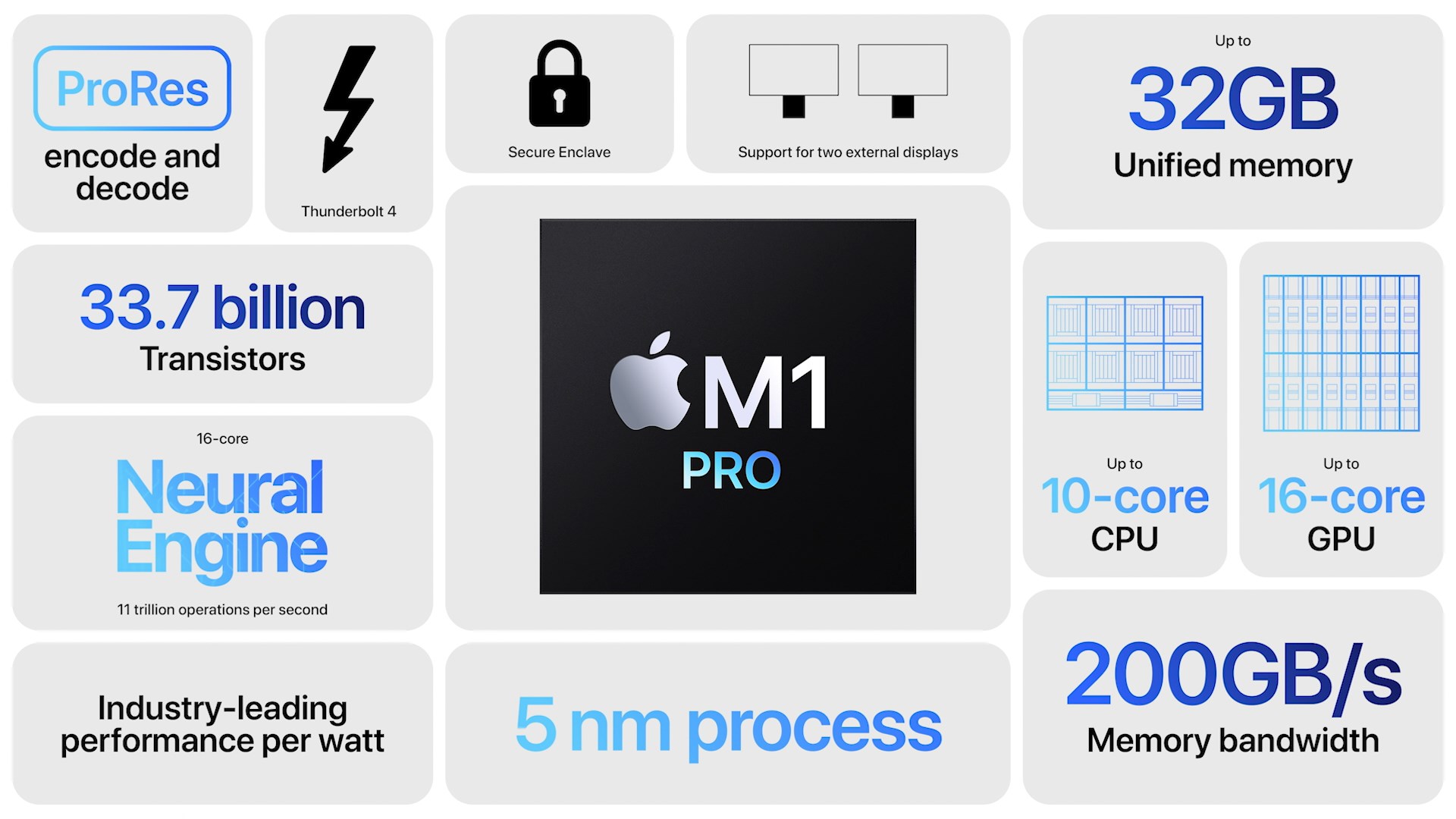
The unified memory (16 or 32 GB LPDDR5-6400) next to the chip is connected by a 256 bit memory controller and can be used by the GPU and CPU.
Furthermore, the SoC integrates a fast 16 core neural engine, a secure enclave (e.g., for encryption), a unified memory architecture, Thunderbolt 4 controller, an ISP, and media de- and encoders (including ProRes).
The M1 Pro is manufactured in 5 nm at TSMC and integrates 33.7 billion transistors. The peak power consumption of the chip was advertised around 30W for CPU intensive tasks.
The Ryzen 7 8845HS is a powerful Hawk Point family chip that we believe to be a Ryzen 7 7840HS in disguise but with higher clock speeds on the Ryzen AI NPU. The R7 8845HS was brought to life in H2 2023; it features 8 cores (16 threads thanks to SMT support) running at up to 5.1 GHz. Last but not the least, the Radeon 780M serves as the integrated GPU.
Architecture & Features
Hawk Point family chips are powered by the Zen 4 architecture, much like Phoenix and Dragon Range family chips are. That's not to say that there is no difference between the three. With Hawk Point, AMD uncorks its 2nd generation Ryzen AI technology meaning the new processors are expected to deliver an up to 40% increase in generative AI performance over 7040 series APUs. Dozens of popular apps such as DaVinci Resolve support this technology, as of late 2023.
Unlike Zen 3, Zen 4 features AVX512 support and, thanks to a plethora of other improvements including larger caches/registers/buffers across the board, is slated to bring a double-digit IPC improvement over the former.
Elsewhere, the 8845HS has 16 MB of L3 cache and a seriously fast RAM controller (up to LPDDR5x-7500 and up to DDR5-5600, ECC-enabled memory included). PCI-Express speeds are capped at 1.97 GB/s per lane which corresponds to the 4.0 spec.
This Ryzen 7 series chip is designed to run 64-bit Windows 11, 64-bit Windows 10 or Linux; please note that it isn't overclockable and neither is it user-replaceable. It gets soldered to the motherboard for good instead (FP7, FP7r2, FP8 socket interfaces).
Performance
Since the 8845HS is a 7840HS in disguise, it's safe to expect it to be just slightly faster than the Core i9-13900H and also the Ryzen 9 7940HS, as far as multi-thread performance is concerned. This is a very fast chip, as of Q3 2023.
Your mileage may vary depending on how high the CPU power limits are and how competent the cooling solution of your system is.
Graphics
The Radeon 780M (12 CUs / 768 shaders, up to 2,700 MHz) is capable of powering 4 monitors simultaneously with resolutions as high as SUHD 4320p. It will also have little issue hardware-encoding and hardware-decoding the most widely used video codecs (AV1, HEVC, AVC). As far as gaming is concerned, the thing will let you play most games at 1080p as long as you are fine with moderate quality settings. Long story short, this is the best iGPU money can buy, as of H2 2023.
Your mileage may vary depending on how high the CPU power limits are, how competent the cooling solution of your system is, how fast the RAM of your system is (there is no dedicated VRAM here).
Power consumption
This Ryzen 7 series chip has a long-term power limit (default TDP) of 35 W to 54 W, giving system makers a choice between improving battery life and making the system they're designing insanely fast. Either way, an active cooling solution is a must for a laptop or a mini-PC built around this APU.
The R7 8845HS is built with a 4 nm TSMC process for high, as of late 2023, energy efficiency.
The Apple M1 Pro is a System on a Chip (SoC) from Apple that is found in the late 2021 MacBook Pro 14 and 16-inch models. It offers all 10 cores available in the chip divided in eight performance cores (P-cores with 600 - 3220 MHz) and two power-efficiency cores (E-cores with 600 - 2064 MHz). There is no Turbo Boost for single cores or short burst periods. The cores are similar to the cores in the Apple M1. The entry level model offers only 8 cores.
The big cores (codename Firestorm) offer 192 KB instruction cache, 128 KB data cache, and 24 MB shared L2 cache (up from 12 MB in the M1). The four efficiency cores (codename Icestorm) are a lot smaller and offer only 128 KB instruction cache, 64 KB data cache, and 4 MB shared cache. CPU and GPU can both use the 24 MB SLC (System Level Cache). The efficiency cores (E cluster) clock with 600 - 2064 MHz, the performance cores (P cluster) with 600 - 3228 MHz.
The unified memory (16 or 32 GB LPDDR5-6400) next to the chip is connected by a 256 bit memory controller (200 GB/s bandwidth) and can be used by the GPU and CPU.
Furthermore, the SoC integrates a fast 16 core neural engine, a secure enclave (e.g., for encryption), a unified memory architecture, Thunderbolt 4 controller, an ISP, and media de- and encoders (including ProRes).
The M1 Pro is manufactured in 5 nm at TSMC and integrates 33.7 billion transistors. The peak power consumption of the chip was advertised around 30W for CPU intensive tasks. In the Prime95 benchmark the chip uses in our tests (with a MBP16) 33.6W package power and 31W for the CPU part. In idle the SoC only reports 1W package power.
- Range of benchmark values for this graphics card - Average benchmark values for this graphics card * Smaller numbers mean a higher performance 1 This benchmark is not used for the average calculation
v1.35
log 14. 16:55:45
#0 ran 0s before starting gpusingle class +0s ... 0s
#1 checking url part for id 13847 +0s ... 0s
#2 checking url part for id 16399 +0s ... 0s
#3 checking url part for id 13845 +0s ... 0s
#4 redirected to Ajax server, took 1765727744s time from redirect:1 +0s ... 0s
#5 did not recreate cache, as it is less than 5 days old! Created at Sun, 14 Dec 2025 14:22:43 +0100 +0s ... 0s
#6 composed specs +0.006s ... 0.006s
#7 did output specs +0s ... 0.006s
#8 getting avg benchmarks for device 13847 +0.001s ... 0.006s
#9 got single benchmarks 13847 +0.004s ... 0.01s
#10 getting avg benchmarks for device 16399 +0.002s ... 0.012s
#11 got single benchmarks 16399 +0.016s ... 0.028s
#12 getting avg benchmarks for device 13845 +0.001s ... 0.029s
#13 got single benchmarks 13845 +0.004s ... 0.032s
#14 got avg benchmarks for devices +0s ... 0.032s
#15 min, max, avg, median took s +0.038s ... 0.07s







 - Average benchmark values for this graphics card


