




Apple set to reshape the foldable market: Samsung faces drop to 32% market share
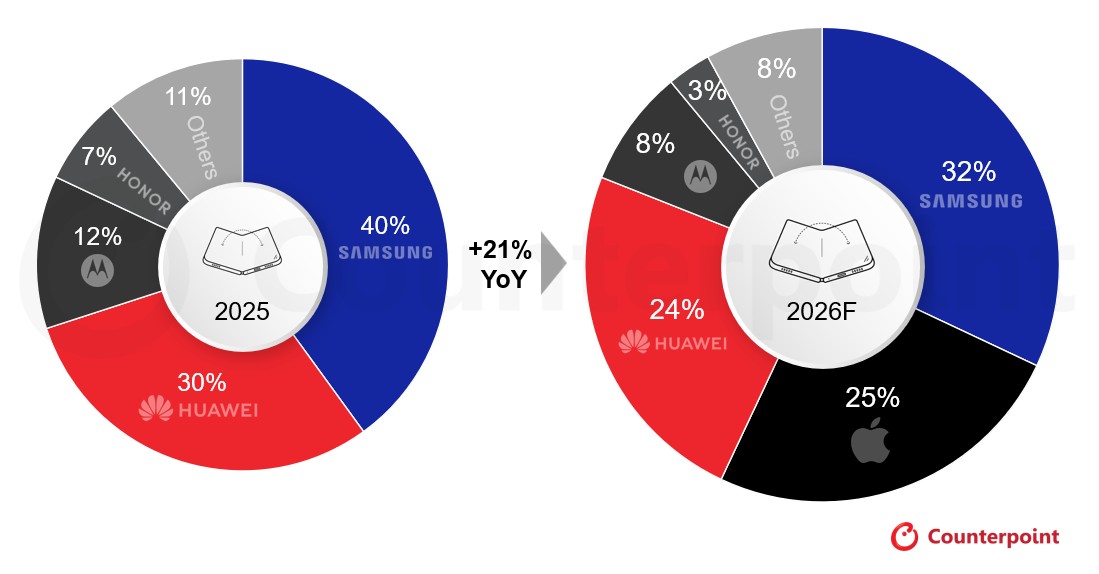
The foldable smartphone market is on the verge of its biggest shake-up yet. According to a new forecast from Counterpoint Research, global foldable smartphone shipments are expected to increase by 21% year over year in 2026. Market analysts attribute this strong growth primarily to Apple's planned entry into the premium foldable smartphone segment.
Although Apple has not yet officially unveiled its first foldable iPhone, industry observers already expect the company to capture a 25% market share during its first year on the market. According to analysts, this rapid debut would deal a significant blow to Samsung, the current leader in the foldable smartphone industry.
Counterpoint's analysts believe Apple's arrival will have not only noticeable but far-reaching consequences for Samsung. While the South Korean company is still expected to retain the top position with an estimated 32% market share, that would represent a sharp decline from the 40% it is projected to hold in 2025. Chinese rival Huawei is expected to follow closely with 24%, while Motorola is forecast to reach 8% and Honor 3%.
Against this backdrop, Samsung's upcoming Unpacked event takes on even greater importance. The market leader will need to deliver with its new Galaxy Z8 lineup. In addition to the Galaxy Z8 Flip and Galaxy Z8 Fold, Samsung is also expected to introduce a wider model.
Its larger display is expected to make everyday use easier while improving the experience of AI-powered features. Larger displays are becoming increasingly important for modern smartphones. Artificial intelligence is evolving from a simple voice assistant into an active productivity tool. Tasks such as summarizing documents, editing content, and navigating between multiple apps all benefit directly from additional screen space.
Apple's anticipated entry into the foldable market is expected to elevate consumer interest in foldable smartphones to a new level. For customers, the intensifying competition in the premium segment is likely to result in more innovation and a faster pace of technological development.
Source(s)
 Add as a preferred source on Google


