





Verdict - Lenovo ThinkTab X11 Gen 1
Few other tablets come with such a comprehensive feature set and offer as long battery life as the ThinkTab X11. Lenovo's first Android tablet in the Think family for quite some time offers virtually everything you desire for both business and personal use. However, anyone not benefitting from this wealth of features who is simply on the hunt for a tablet for chilling on the couch will likely be disappointed with the ThinkTab X11's weight.
The choice of chipset is somewhat disappointing in this price range, especially for a tablet. Lenovo has gone with the Snapdragon 7s Gen 3, which is a rather underpowered SoC that often struggles with its 1600p resolution. The brightness and color accuracy also fall short compared to the Poco Pad X1 or Xiaomi Pad 8.
However, users who appreciate the multitude of applications offered by this feature-packed powerhouse from Lenovo will surely be able to live with our criticisms. A comparable tablet experience in the Android realm is virtually nonexistent, and thanks to its rugged case, the ThinkTab X11 is also an attractive option for outdoor enthusiasts or construction site users.
Pros
Cons
Price and availability - Lenovo ThinkTab X11
The ThinkTab X11 is available from June 15th for a suggested retail price that starts at around $579. Our review sample configuration, which includes a 5G modem and accessories, costs an additional $170.
Table of Contents
- Verdict - Lenovo ThinkTab X11 Gen 1
- Specifications - Lenovo ThinkTab X11 Gen 1
- Case - A waterproof Android tablet with a replaceable battery
- Features - Lenovo's first Thinkpad tablet comes with NFC & a 3.5 mm headphone jack
- Software - ThinkTab X11 Gen 1 with Android 16 & long updates?
- Communication and GNSS - A rugged tablet with 5G, but without WiFi 7
- Cameras - An Android tablet with autofocus for university or school
- Accessories and warranty - The ThinkTab X11 comes with the Lenovo Tab Pen XE & Rugged Smart Case
- Input devices and operation - An 11-inch tablet with stylus support & a fingerprint sensor
- Display - A mid-range tablet, not with OLED, but excellent contrast
- Performance - The Snapdragon chipset inside the ThinkTab X11 comes with speed disadvantages
- Emissions - The cool Android tablet suffers no SoC throttling issues
- Battery life - The ThinkTab X11 delights heavy users with its large, replaceable battery
- Notebookcheck overall rating
- Possible alternatives compared
Specifications - Lenovo ThinkTab X11 Gen 1
Case - A waterproof Android tablet with a replaceable battery
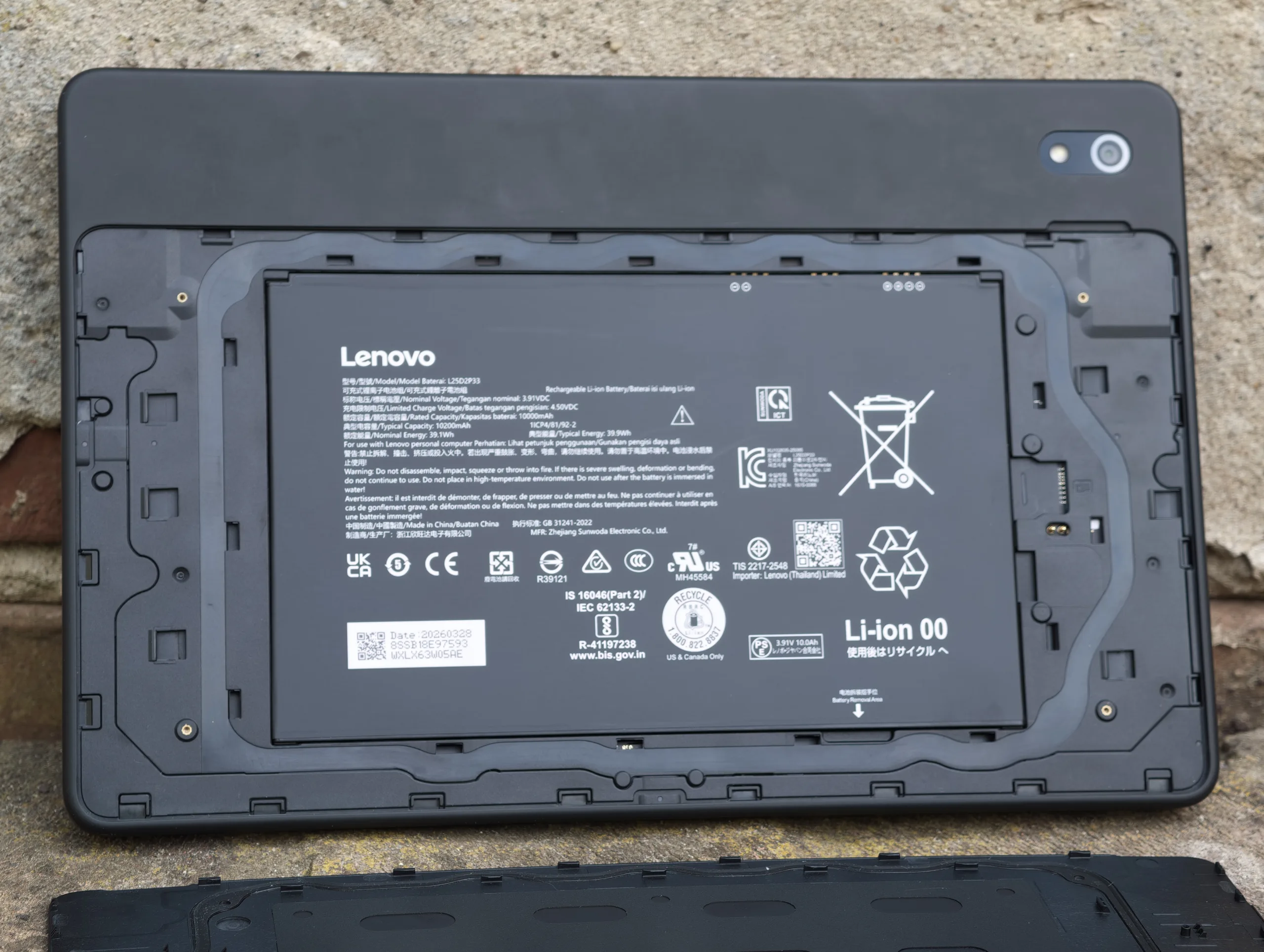
Anyone picking up the ThinkTab X11 for the first time is likely to be surprised by its weight for an 11-inch tablet. However, comparable durability-focused devices are similarly heavy. On the plus side, the battery housed inside Lenovo's mid-range tablet is easily replaceable. The 10,200 mAh battery capacity is also very generous for its size.
According to the manufacturer, in addition to IP68 certification, the ThinkTab X11 has passed various tests under MIL-STD-810H, a protection standard used by the US Air Force, Army, and Navy. Corning Gorilla Glass is implemented as the protective glass.
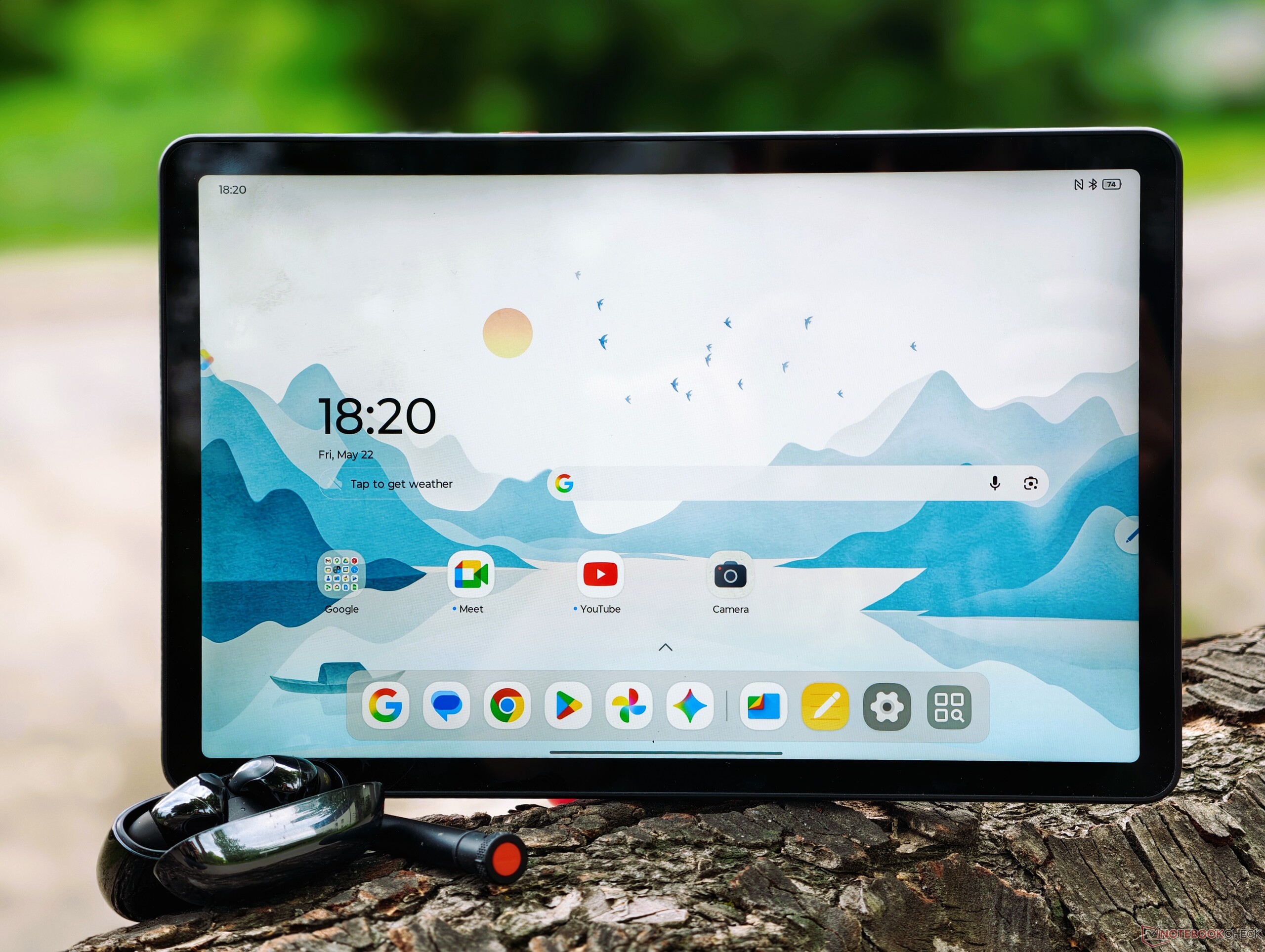
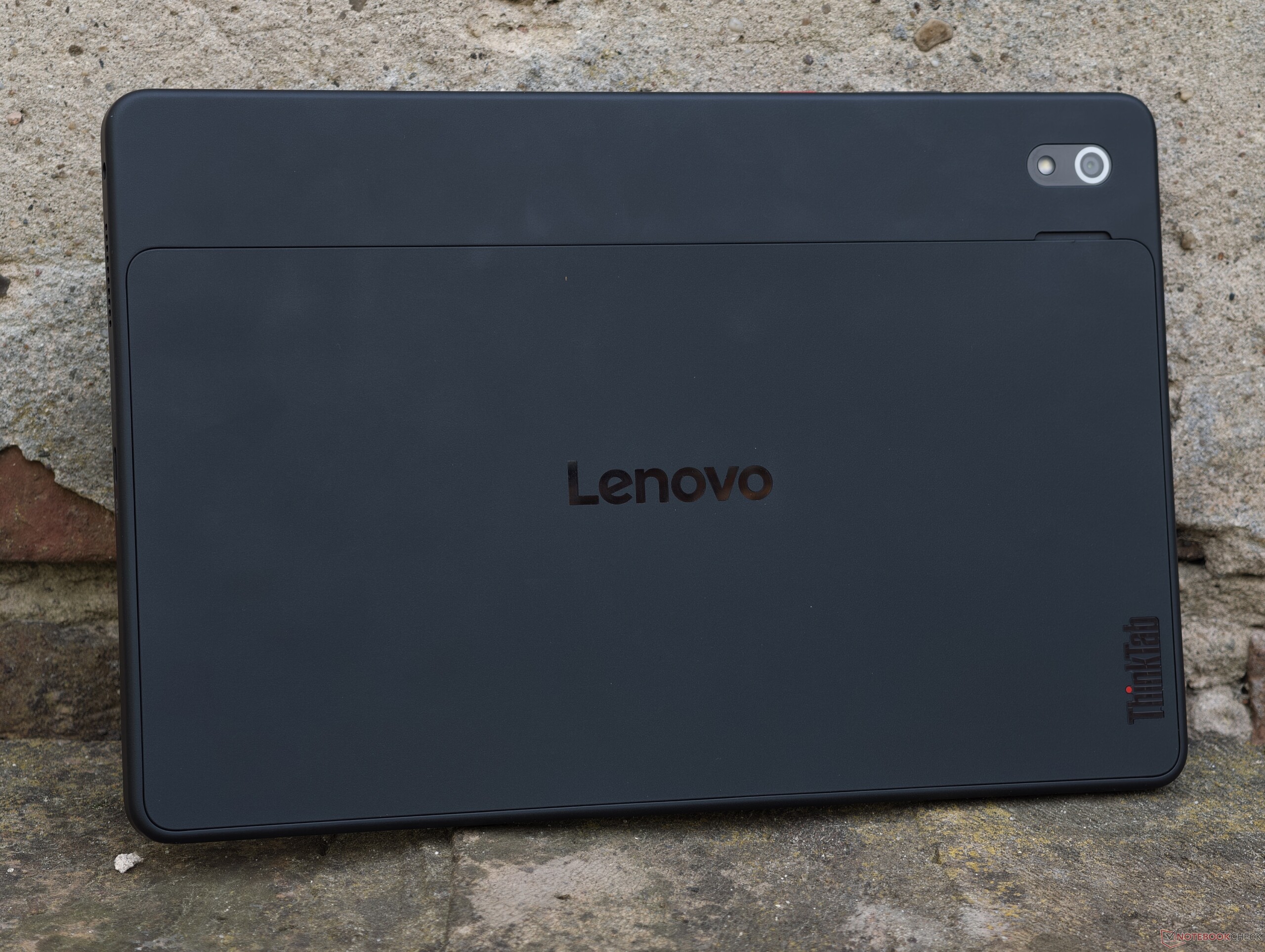
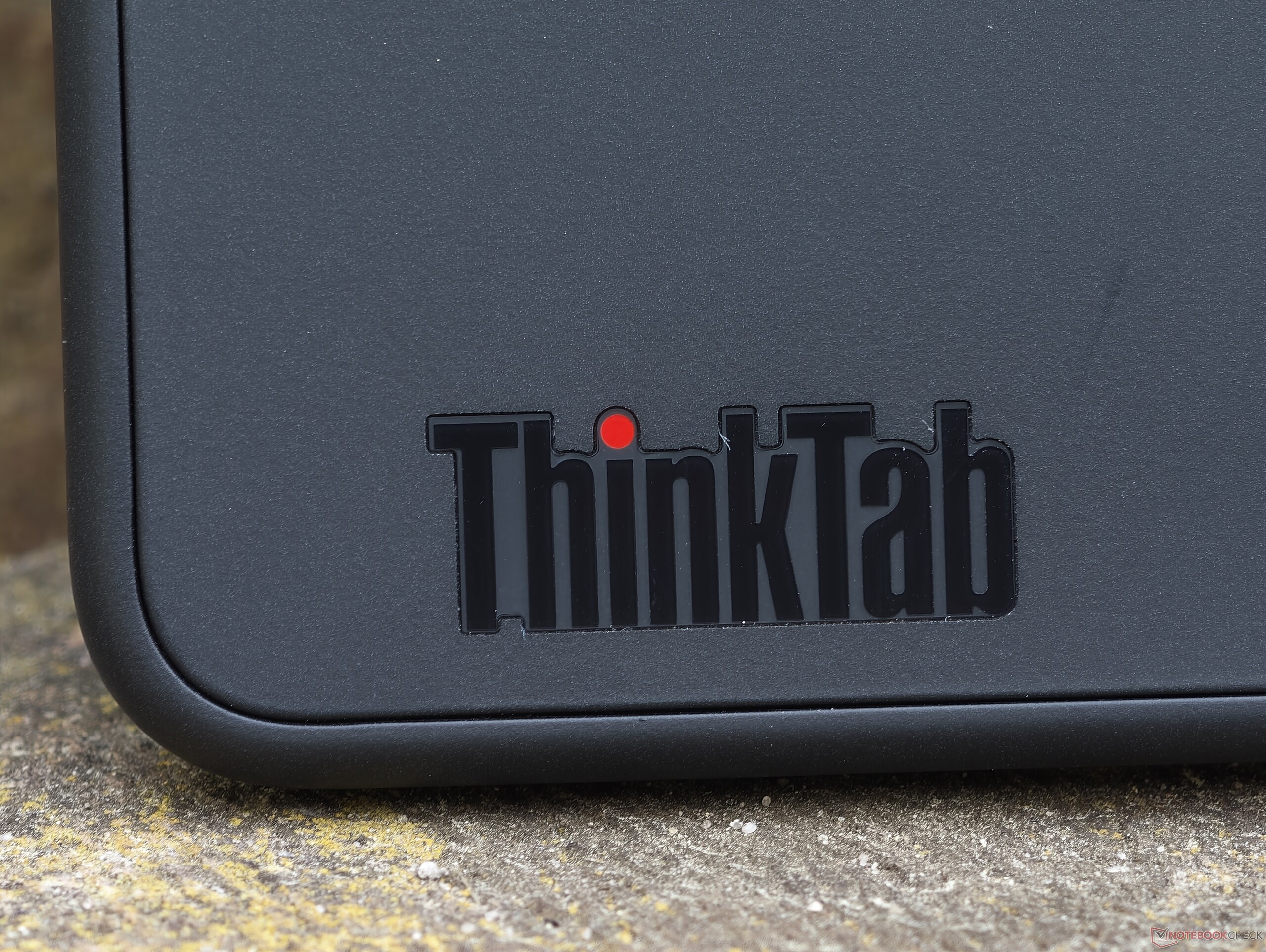
The build quality is appealing, but the plastic casing detracts somewhat from the overall premium feel. Despite this, the slightly rubberized surface on the back doesn't feel cheap. The bezels surrounding the IPS panel are also quite wide, resulting in a screen-to-body ratio of only 80 percent. For comparison, the Xiaomi Pad 8 achieves nearly 86 per cent in this area.
Features - Lenovo's first Thinkpad tablet comes with NFC & a 3.5 mm headphone jack
Lenovo has packed almost everything it possibly can into its mid-range tablet. The ThinkTab X11 really shines with its two USB-C ports. The primary port on the right-hand side of the device supports USB 3.2 with high data transfer speeds.
The second USB-C port on the bottom of the device is USB 2.0. This combination allows users to transfer data or use DisplayPort output while the tablet is plugged in. Headphones for listening to music can also be connected simultaneously via the included 3.5 mm jack.
But the list of features doesn't stop there. The ThinkTab X11 also includes an NFC chip, an e-compass, and a vibration motor. The internal UFS 3.1 storage can also be expanded via an SD card slot. The card slot accepts cards up to 2TB (exFAT) and, in our tests, it achieved a very fast transfer speed of almost 50 MB/s.
| SD Card Reader - average JPG Copy Test (av. of 3 runs) | |
| Lenovo ThinkTab X11 (Angelbird V60) | |
| Samsung Galaxy Tab Active5 Pro (Angelbird V60) | |
| Average of class Tablet (10.2 - 79.2, n=42, last 2 years) | |
Cross Platform Disk Test (CPDT)
Software - ThinkTab X11 Gen 1 with Android 16 & long updates?
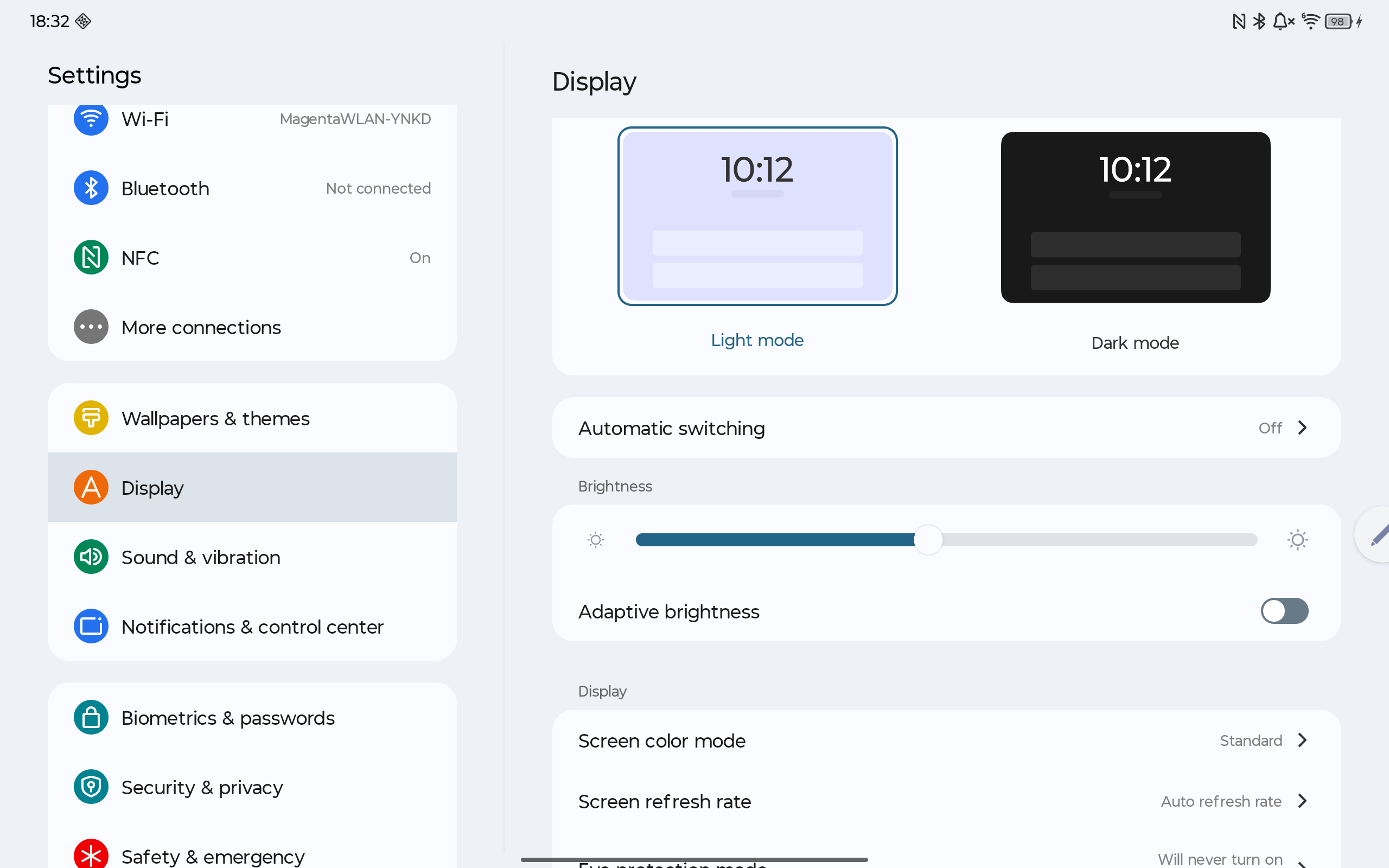
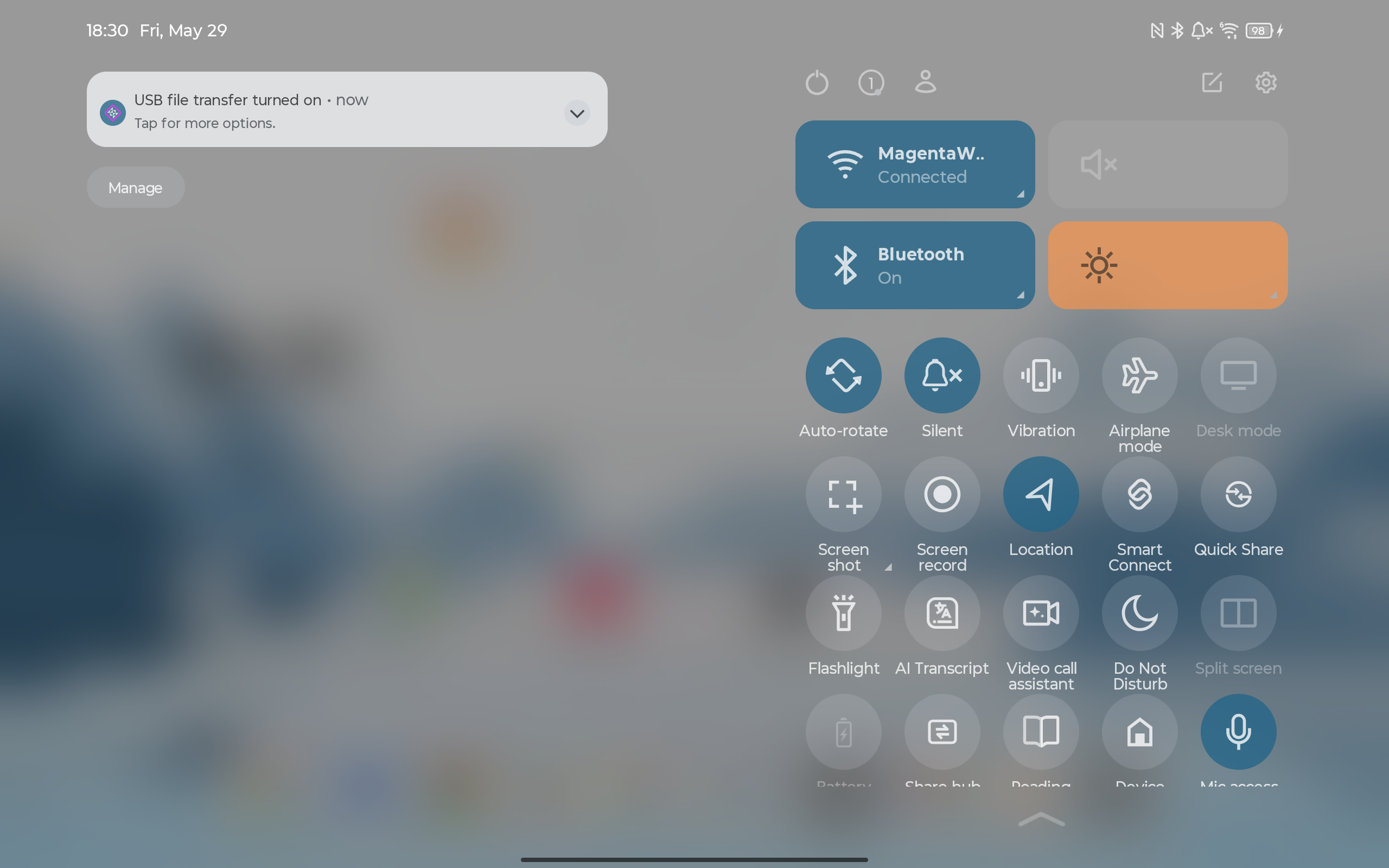
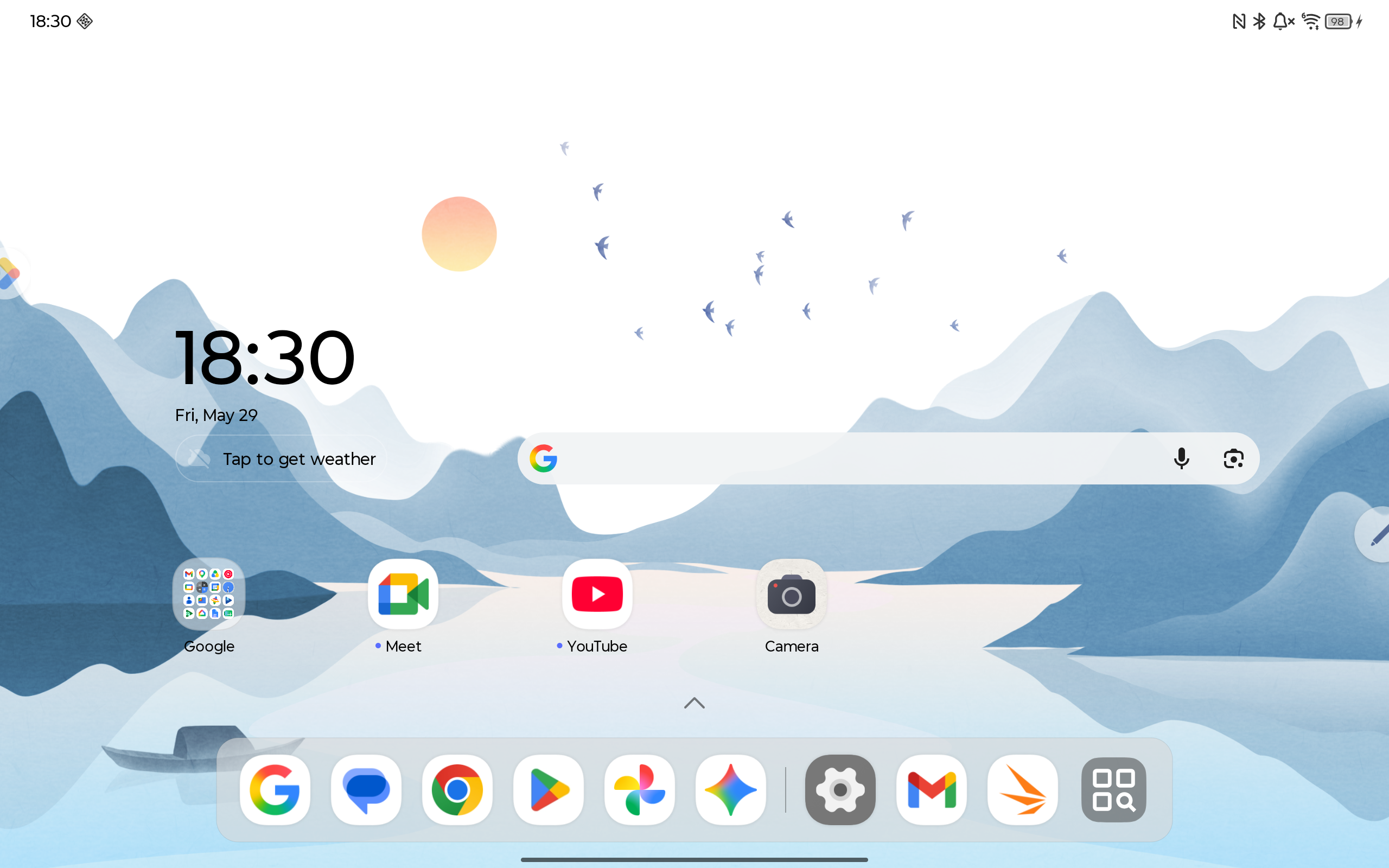
Lenovo has equipped its mid-range tablet with its in-house ZUI interface, version 18, based on Android 16. Similar to Samsung devices with DeX support, the ThinkTab X11 can also be used with a desktop-like interface.
The upgrade database lists the ThinkTab X11 as having three major Android versions and four years of security patches, while the EPREL database indicates seven years of support.
Sustainability
The Lenovo tablet comes in (presumably) plastic-free packaging. The manufacturer has provided no information regarding recycled materials, and its carbon footprint is 62 kg CO₂ equivalents. The ThinkTab X11 is listed in the EPREL database with the highest repairability rating of A.
Communication and GNSS - A rugged tablet with 5G, but without WiFi 7
The ThinkTab X11 uses the WiFi 6E standard, which also supports the 6 GHz band. In our tests with an Asus ROG Rapture GT-AXE11000, we achieved high and consistent data transfer speeds.
For mobile internet access, the ThinkTab X11 features an integrated cellular modem, which also enables location tracking via satellite and A-GPS. In addition to a nano-SIM slot, an eSIM is also supported.
Since we only received the WiFi model, we were unable to test the location tracking capabilities.
| Networking | |
| Lenovo ThinkTab X11 | |
| iperf3 transmit AXE11000 6GHz | |
| iperf3 receive AXE11000 6GHz | |
| Xiaomi Poco Pad X1 | |
| iperf3 transmit AXE11000 | |
| iperf3 receive AXE11000 | |
| iperf3 transmit AXE11000 6GHz | |
| iperf3 receive AXE11000 6GHz | |
| Xiaomi Pad 8 | |
| iperf3 transmit AXE11000 6GHz | |
| iperf3 receive AXE11000 6GHz | |
| Samsung Galaxy Tab Active5 Pro | |
| iperf3 transmit AXE11000 6GHz | |
| iperf3 receive AXE11000 6GHz | |
| Average Wi-Fi 6E | |
| iperf3 transmit AXE11000 | |
| iperf3 receive AXE11000 | |
| iperf3 transmit AXE11000 6GHz | |
| iperf3 receive AXE11000 6GHz | |
| Average of class Tablet | |
| iperf3 transmit AXE11000 | |
| iperf3 receive AXE11000 | |
| iperf3 transmit AXE11000 6GHz | |
| iperf3 receive AXE11000 6GHz | |
Cameras - An Android tablet with autofocus for university or school

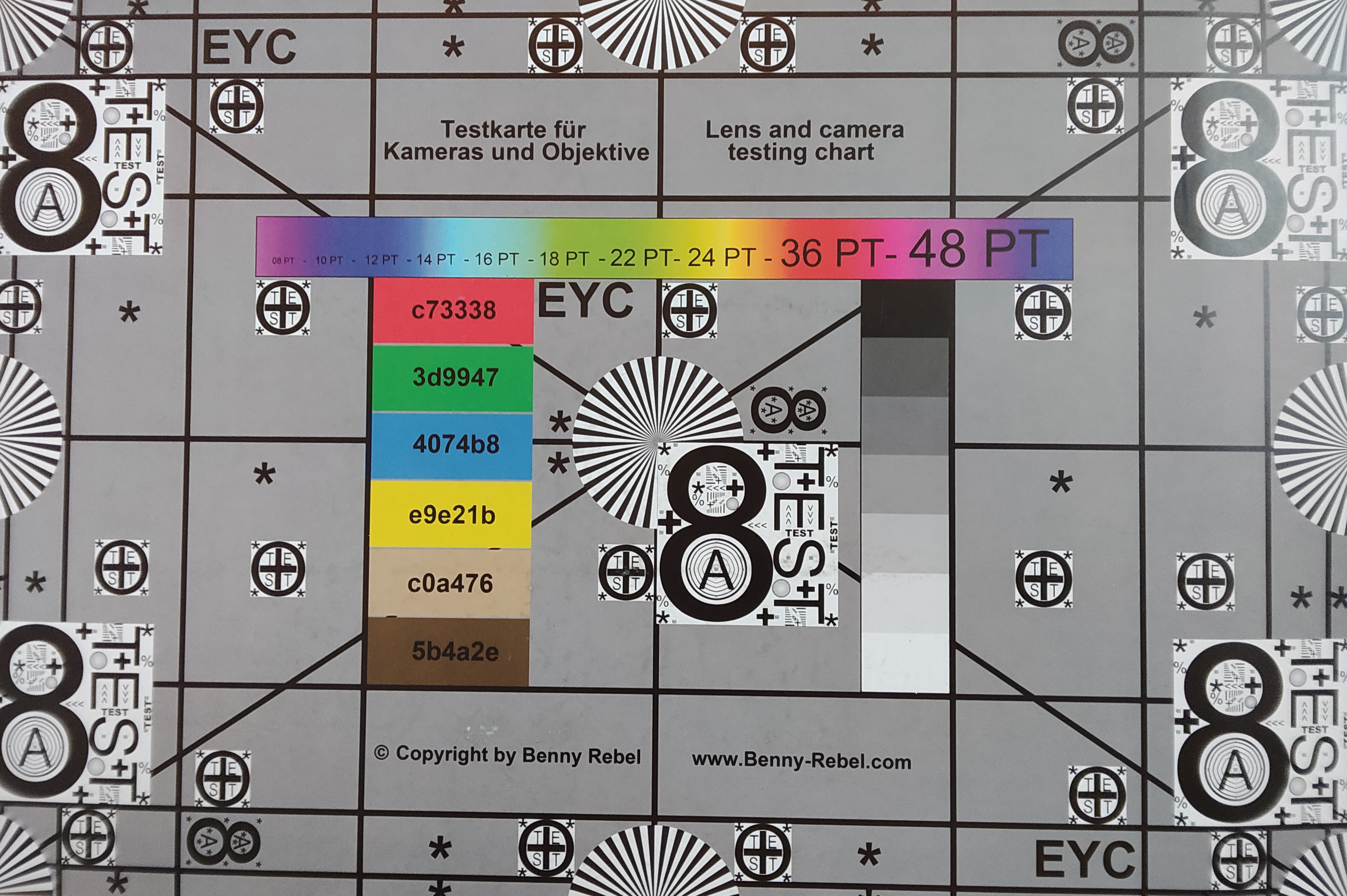
Unsurprisingly for a tablet, Lenovo hasn't placed a particular emphasis on photo quality with its ThinkTab X11. The main rear camera offers only 13 megapixels and sluggish autofocus. However, image quality is sufficient for snapshots on construction sites or for digitizing documents. Sharpness and color reproduction can be generally described as satisfactory.
The front camera features a fixed-focus 8-megapixel lens, ideal for HD video calls.
Image comparison
Choose a scene and navigate within the first image. One click changes the position on touchscreens. One click on the zoomed-in image opens the original in a new window. The first image shows the scaled photograph of the test device.
Plant motifCity motifLow light

















Accessories and warranty - The ThinkTab X11 comes with the Lenovo Tab Pen XE & Rugged Smart Case
The ThinkPad X11 comes with a USB-C cable and a quick start guide, and various bundles are also available. Our review unit included a charger, the Lenovo Tab Pen XE with batteries, and the Rugged Smart Case. Lenovo also offers the optional Stylus Tab Pen Plus for around $65, which has a USB-C port for charging.
Retailers typically offer a 24-month warranty, either with a "bring-in" service or via a courier service. According to the data sheet, warranty packages of one or three years are also available.
Input devices and operation - An 11-inch tablet with stylus support & a fingerprint sensor
We were impressed by the ThinkPad X11's precise inputs on its 10.95-inch LCD, whether using a finger or a stylus. For handwritten notes, other tablets offer slightly finer input; however, with the Tab Pen XE, we observed noticeable digitizer trailing during rapid movements.
For secure unlocking, an active fingerprint sensor is integrated into the power button found at the top of the device. It's easily accessible with your index finger and works reliably and quite quickly. Alternatively, a less secure 2D facial recognition via the front camera can be used.

Display - A mid-range tablet, not with OLED, but excellent contrast

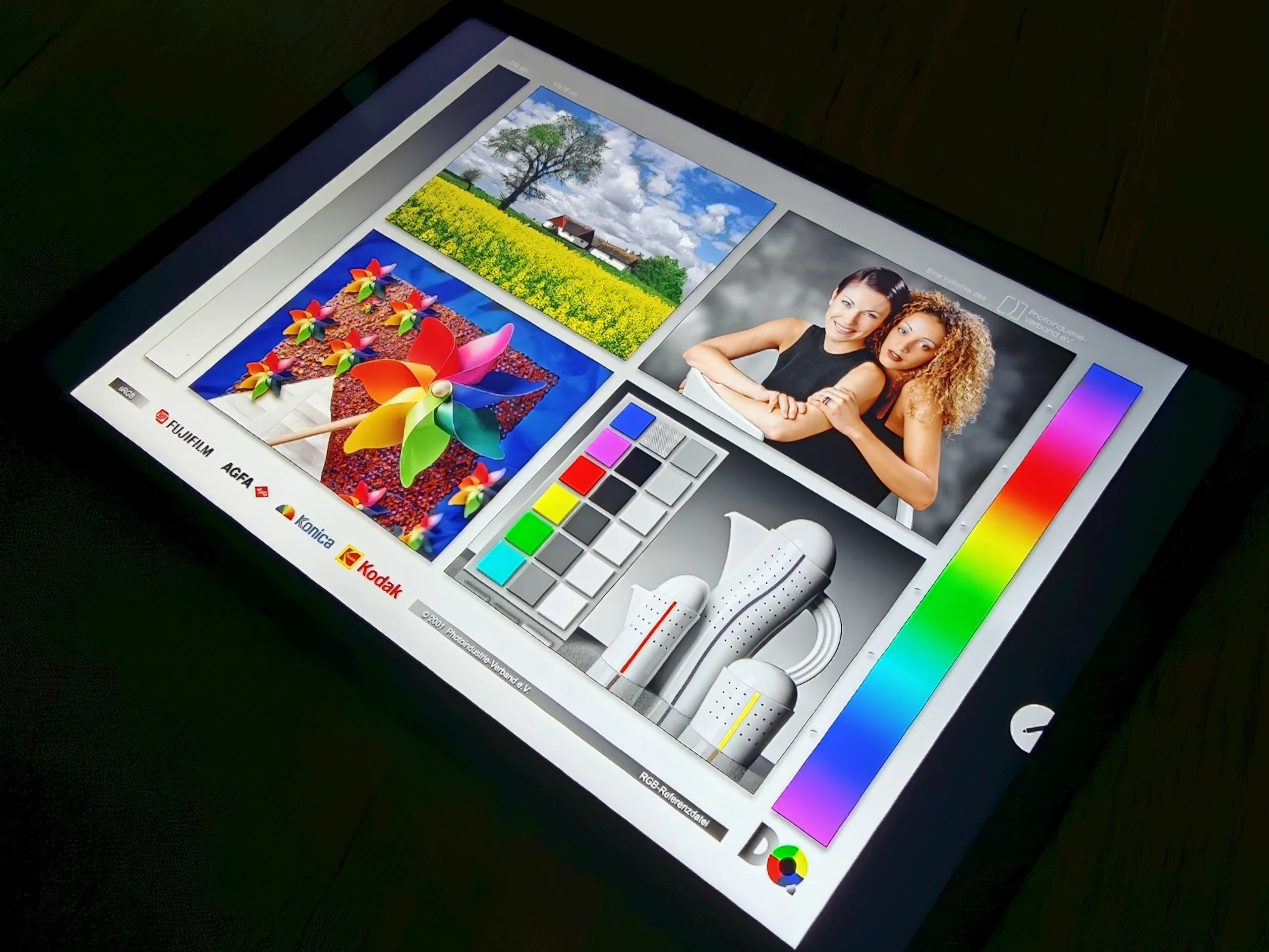
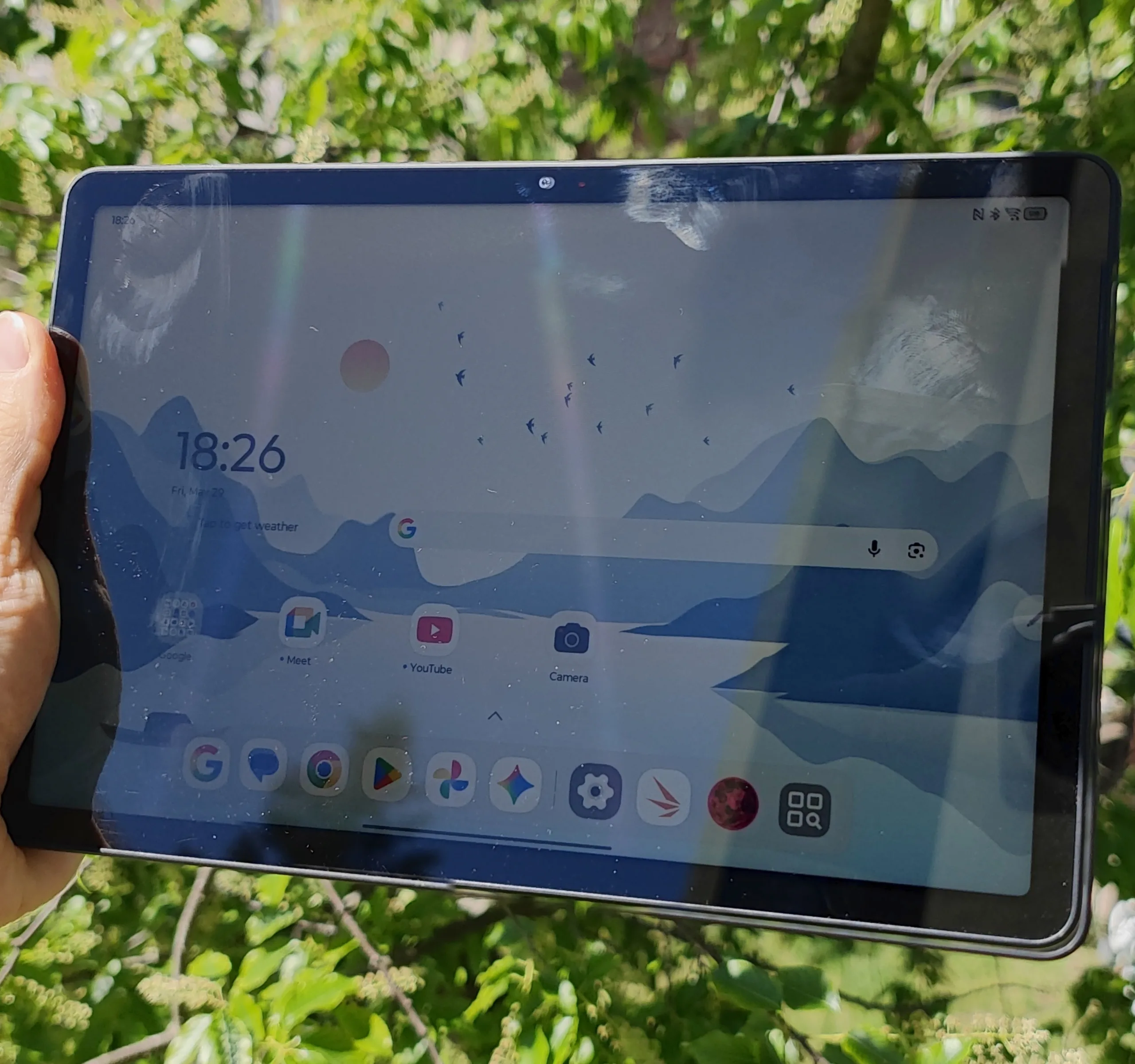
The 90Hz panel has a 16:10 aspect ratio and a 1600p resolution. It possesses a sufficiently high pixel density of 276 PPI, although some mid-range tablets offer sharper displays. Xiaomi's consumer tablets in this price range also feature brighter panels.
We achieved the highest brightness in our measurements with the APL18 test pattern, closely followed by an HDR video. Despite this, HDR effects are not optimally reproduced on the PWM-free panel, reaching only around 600 cd/m².
| |||||||||||||||||||||||||
Brightness Distribution: 91 %
Center on Battery: 529 cd/m²
Contrast: 3306:1 (Black: 0.16 cd/m²)
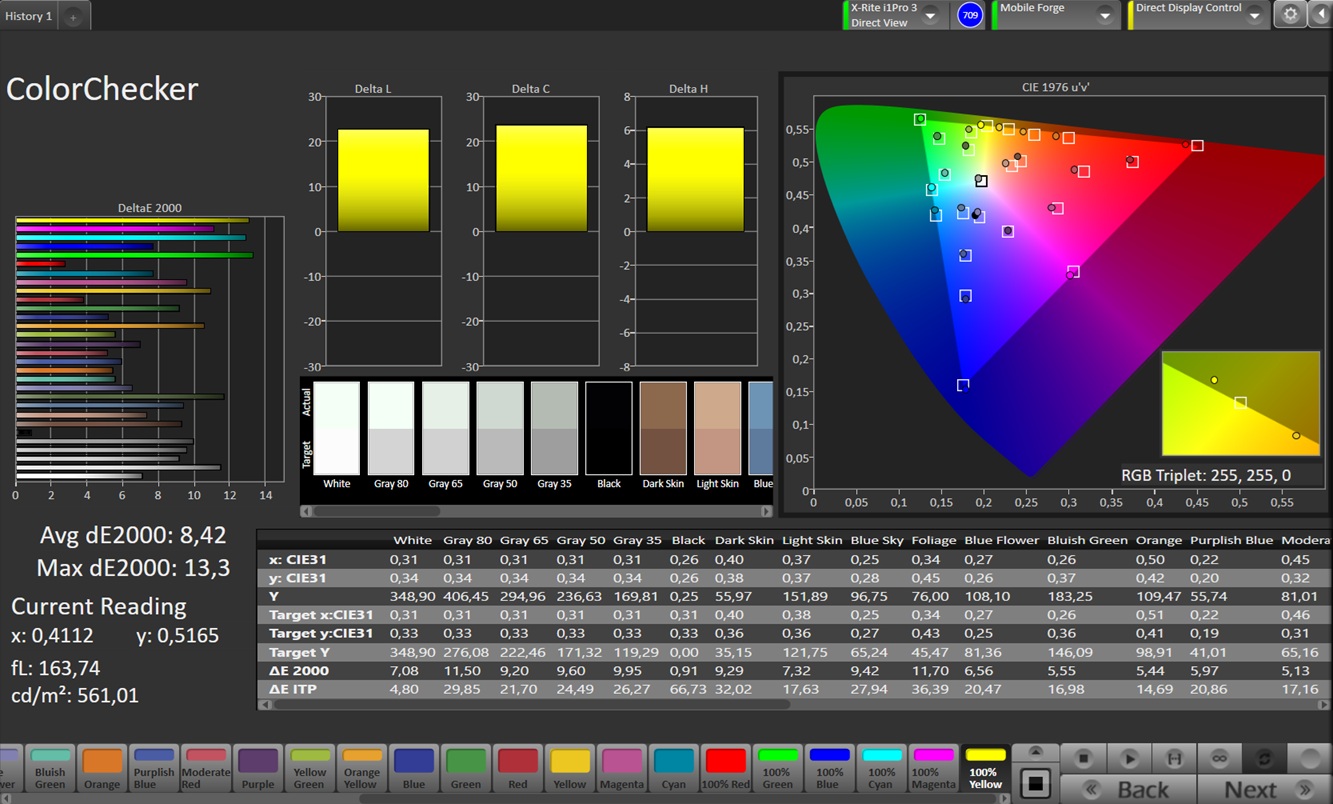
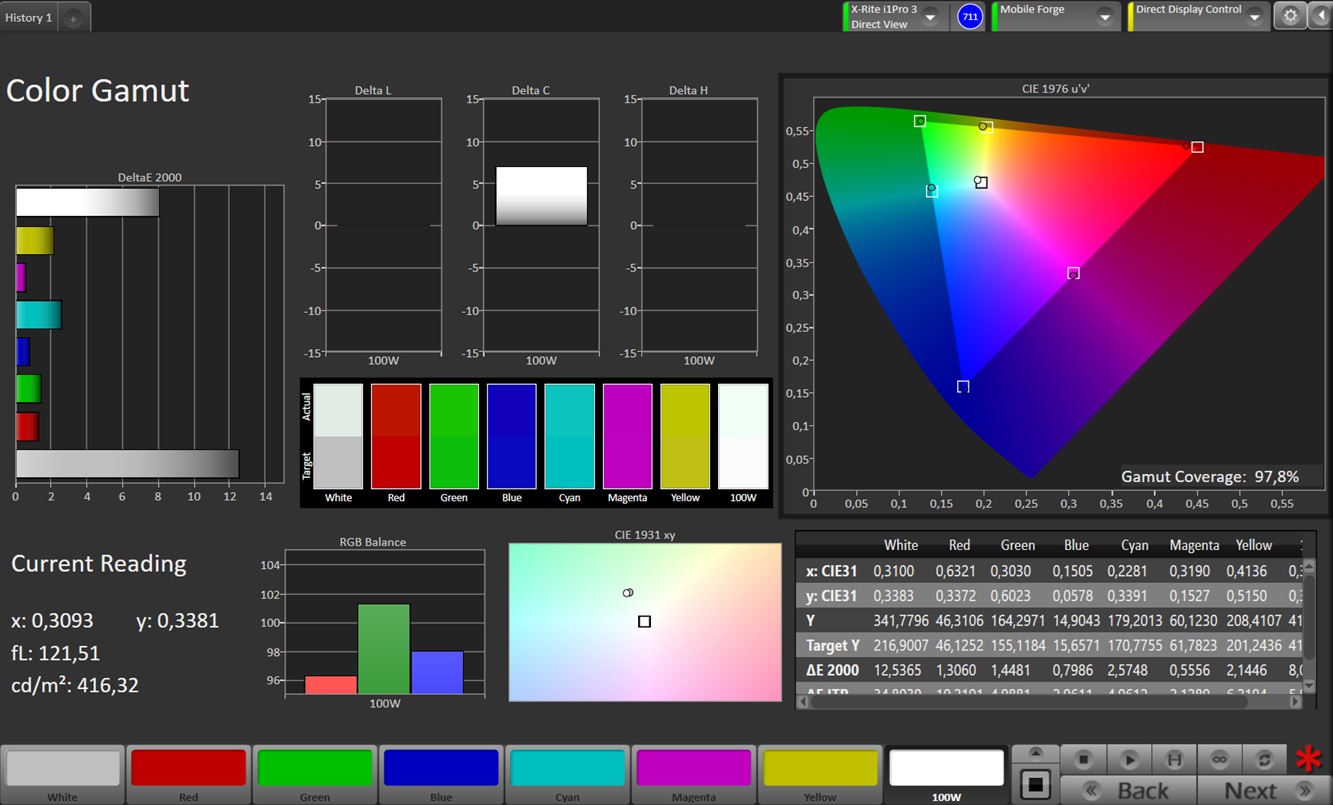
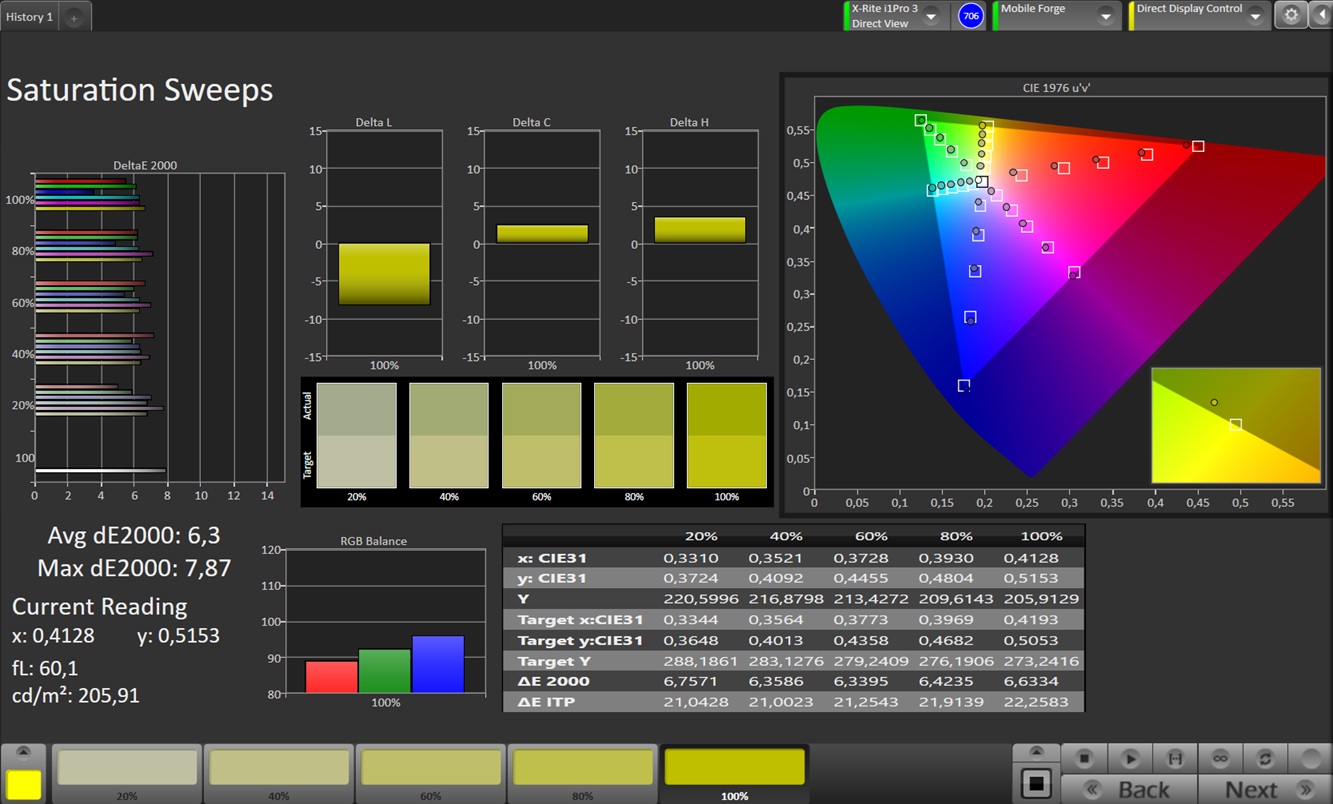
ΔE ColorChecker Calman: 8.42 | ∀{0.5-29.43 Ø4.7}
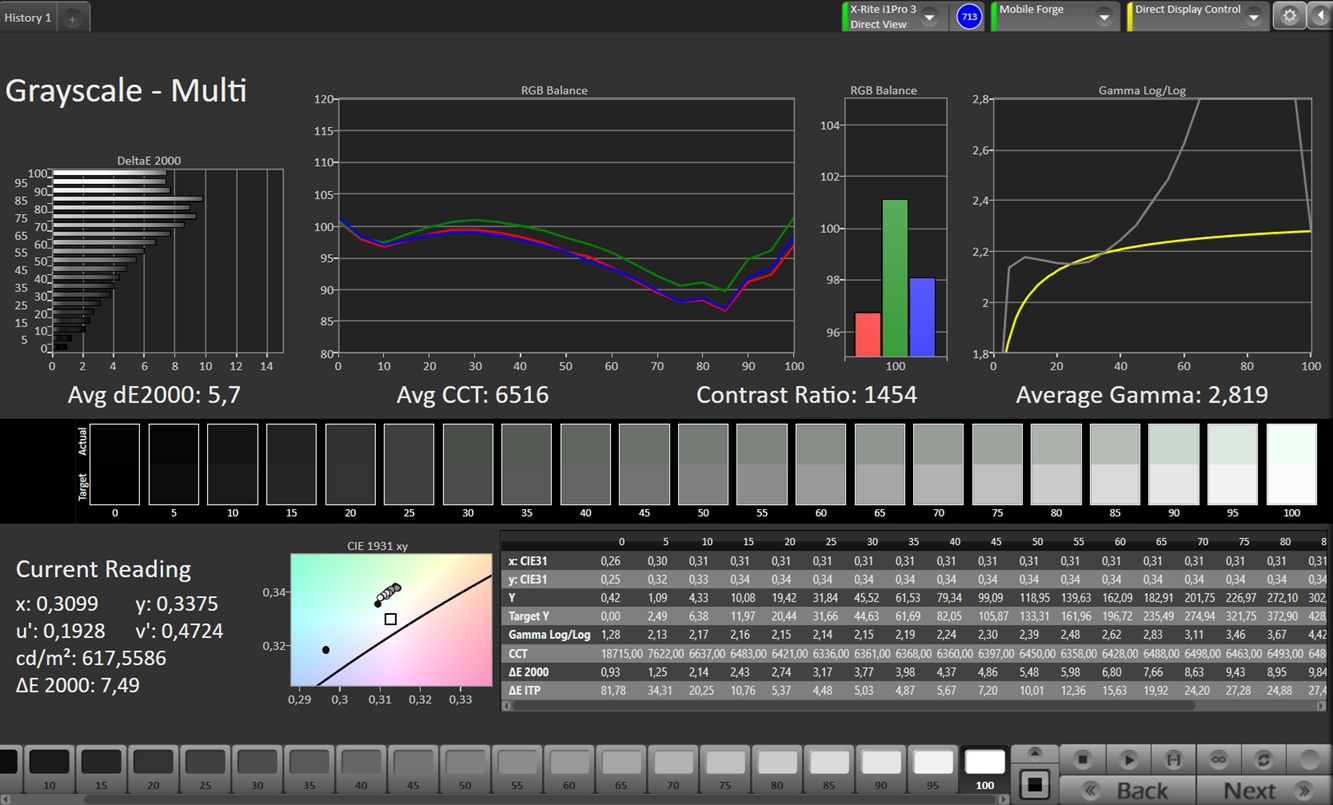
ΔE Greyscale Calman: 5.7 | ∀{0.09-98 Ø4.95}
97.8% sRGB (Calman 2D)
Gamma: 2.819
CCT: 6516 K
| Lenovo ThinkTab X11 IPS LCD, 2560x1600, 11" | Xiaomi Poco Pad X1 TFT-LCD, 3200x2136, 11.2" | Xiaomi Pad 8 IPS, 3200x2136, 11.2" | Samsung Galaxy Tab Active5 Pro IPS, 1920x1200, 10.1" | |
|---|---|---|---|---|
| Screen | 2% | 19% | -1% | |
| Brightness middle (cd/m²) | 529 | 794 50% | 627 19% | 757 43% |
| Brightness (cd/m²) | 507 | 727 43% | 613 21% | 730 44% |
| Brightness Distribution (%) | 91 | 89 -2% | 96 5% | 91 0% |
| Black Level * (cd/m²) | 0.16 | 0.47 -194% | 0.3 -88% | 0.47 -194% |
| Contrast (:1) | 3306 | 1689 -49% | 2090 -37% | 1611 -51% |
| Colorchecker dE 2000 * | 8.42 | 2.2 74% | 1.25 85% | 2.85 66% |
| Colorchecker dE 2000 max. * | 13.3 | 5.8 56% | 2.95 78% | 6.16 54% |
| Greyscale dE 2000 * | 5.7 | 3.7 35% | 1.8 68% | 4.1 28% |
| Gamma | 2.819 78% | 2.25 98% | 2.183 101% | 2.229 99% |
| CCT | 6516 100% | 6962 93% | 6898 94% | 7510 87% |
* ... smaller is better
| Display / APL18 Peak Brightness | |
| Xiaomi Poco Pad X1 | |
| Lenovo ThinkTab X11 | |
| Display / HDR Peak Brightness | |
| Lenovo ThinkTab X11 | |
| Xiaomi Poco Pad X1 | |
Screen Flickering / PWM (Pulse-Width Modulation)
| Screen flickering / PWM not detected | 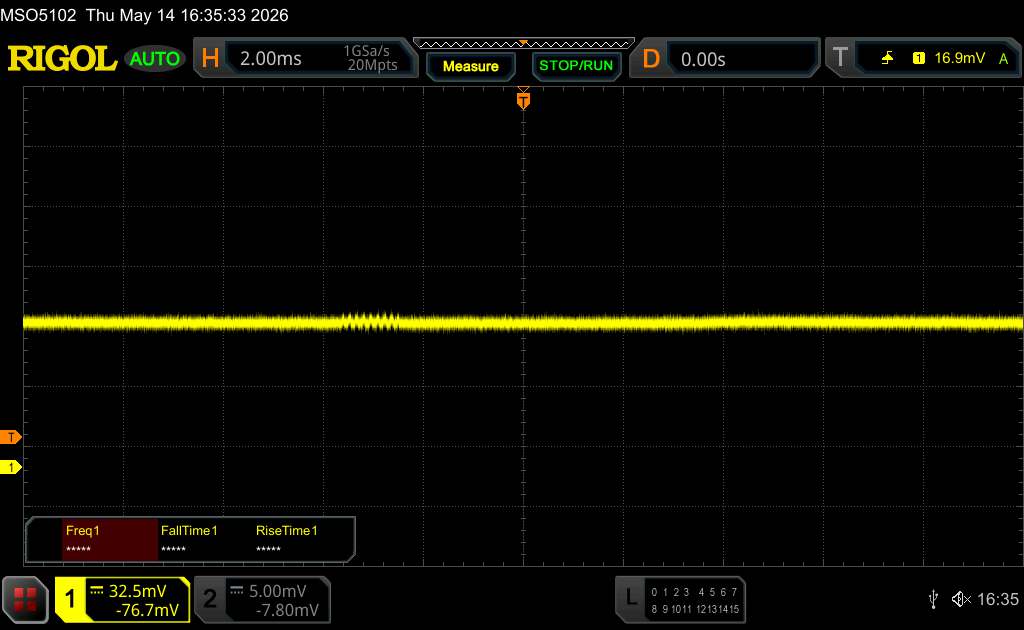 | ||
In comparison: 52 % of all tested devices do not use PWM to dim the display. If PWM was detected, an average of 7665 (minimum: 5 - maximum: 343500) Hz was measured. | |||
Our spectrophotometer measurement yielded a very low black level of 0.16 cd/m², which is a very good contrast level for this IPS panel. The ThinkPad X11 performs less well in terms of its color accuracy. We measured the smallest differences between individual colors using the standard profile.
Display Response Times
| ↔ Response Time Black to White | ||
|---|---|---|
| 19.4 ms ... rise ↗ and fall ↘ combined | ↗ 11.2 ms rise | 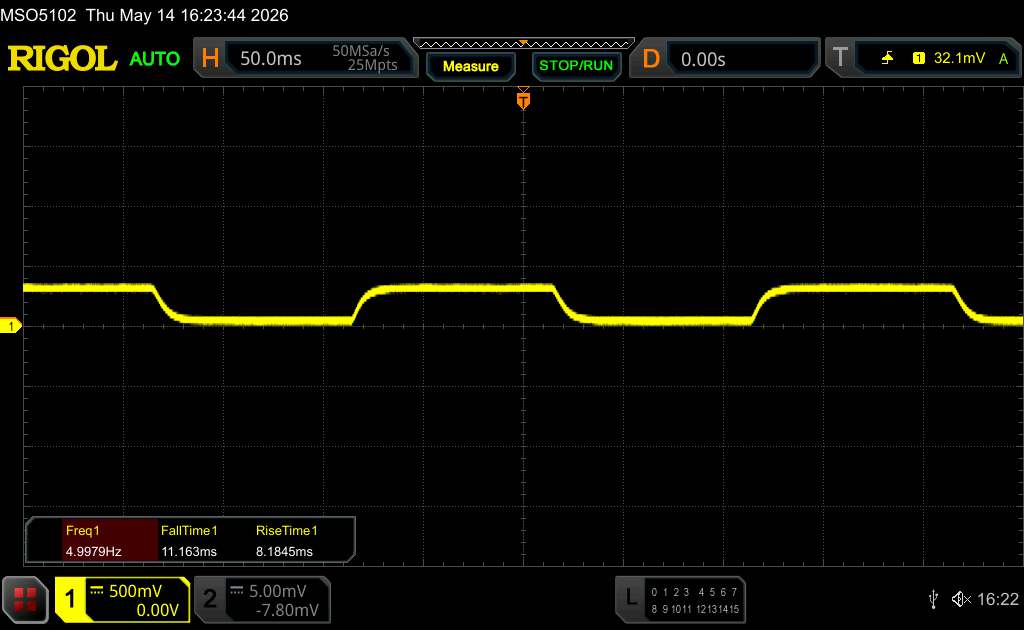 |
| ↘ 8.2 ms fall | ||
| The screen shows good response rates in our tests, but may be too slow for competitive gamers. In comparison, all tested devices range from 0.1 (minimum) to 240 (maximum) ms. » 43 % of all devices are better. This means that the measured response time is similar to the average of all tested devices (19.7 ms). | ||
| ↔ Response Time 50% Grey to 80% Grey | ||
| 29.3 ms ... rise ↗ and fall ↘ combined | ↗ 16.2 ms rise | 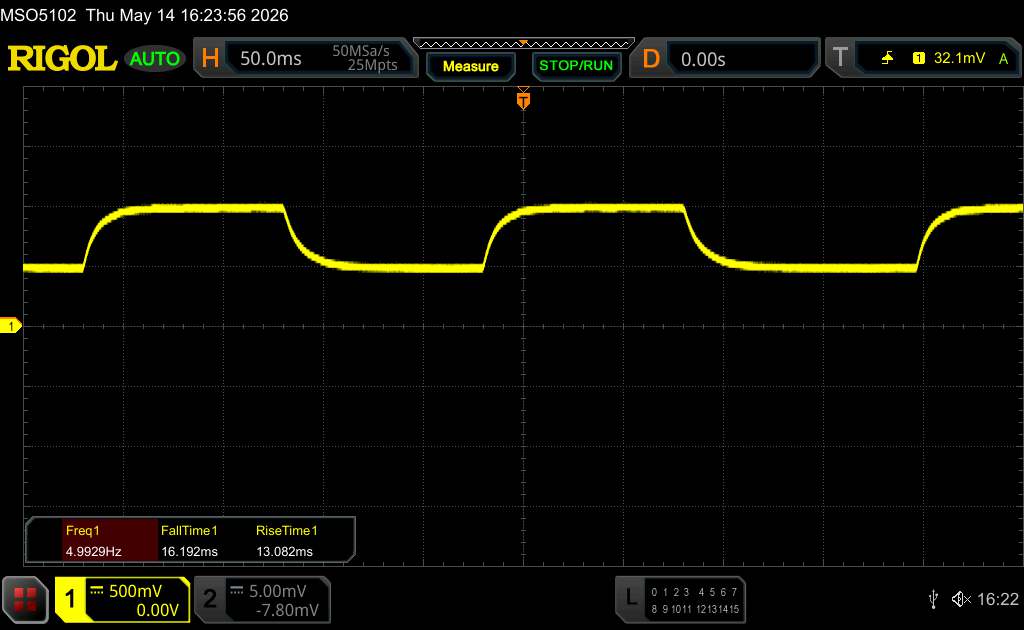 |
| ↘ 13.1 ms fall | ||
| The screen shows relatively slow response rates in our tests and may be too slow for gamers. In comparison, all tested devices range from 0.13 (minimum) to 636 (maximum) ms. » 40 % of all devices are better. This means that the measured response time is similar to the average of all tested devices (30.8 ms). | ||
Performance - The Snapdragon chipset inside the ThinkTab X11 comes with speed disadvantages
Lenovo has equipped its mid-range tablet with a Snapdragon 7s Gen 3 that packs 8 GB of LPDDR5 RAM. While the 4nm SoC delivers solid CPU performance, it clearly fell short of the Poco Pad X1 in the Geekbench test. However, the Galaxy Tab Active5 Pro performs at a similar level.
In everyday situations, the system generally runs smoothly, but the Snapdragon chipset sometimes struggles with the display's high resolution. Additionally, the ThinkTab X11 experiences occasional lag.
| CrossMark - Overall | |
| Average of class Tablet (319 - 2375, n=47, last 2 years) | |
| Lenovo ThinkTab X11 | |
| Average Qualcomm Snapdragon 7s Gen 3 (689 - 809, n=8) | |
| Samsung Galaxy Tab Active5 Pro | |
| UL Procyon AI Inference for Android - Overall Score NNAPI | |
| Average of class Tablet (3600 - 76852, n=52, last 2 years) | |
| Xiaomi Pad 8 | |
| Xiaomi Poco Pad X1 | |
| Lenovo ThinkTab X11 | |
| Average Qualcomm Snapdragon 7s Gen 3 (8460 - 9089, n=6) | |
| Samsung Galaxy Tab Active5 Pro | |
| AI Benchmark - Score V6 | |
| Xiaomi Pad 8 | |
| Xiaomi Poco Pad X1 | |
| Average of class Tablet (70.4 - 22476, n=36, last 2 years) | |
| Lenovo ThinkTab X11 | |
| Average Qualcomm Snapdragon 7s Gen 3 (1246 - 1573, n=4) | |
| Antutu v11 - Score | |
| Xiaomi Pad 8 | |
| Average of class Tablet (522205 - 4184631, n=11, last 2 years) | |
| Xiaomi Poco Pad X1 | |
| Lenovo ThinkTab X11 | |
| Average Qualcomm Snapdragon 7s Gen 3 (n=1) | |
The integrated Adreno 810 handles graphics processing, but in the GFXBench 4K test, it proved extremely slow at under 10 fps. The result is a device that offers little processing power for its price range. Despite its higher resolution, the Xiaomi Pad 8 achieved over 30fps in the same test.
GFXBench (DX / GLBenchmark) 2.7: T-Rex Onscreen | 1920x1080 T-Rex Offscreen
GFXBench 3.0: on screen Manhattan Onscreen OGL | 1920x1080 1080p Manhattan Offscreen
GFXBench 3.1: on screen Manhattan ES 3.1 Onscreen | 1920x1080 Manhattan ES 3.1 Offscreen
GFXBench: on screen Car Chase Onscreen | 1920x1080 Car Chase Offscreen | on screen Aztec Ruins High Tier Onscreen | 2560x1440 Aztec Ruins High Tier Offscreen | on screen Aztec Ruins Normal Tier Onscreen | 1920x1080 Aztec Ruins Normal Tier Offscreen | 3840x2160 4K Aztec Ruins High Tier Offscreen
| 3DMark / Wild Life Extreme Unlimited | |
| Xiaomi Pad 8 | |
| Xiaomi Poco Pad X1 | |
| Lenovo ThinkTab X11 | |
| Samsung Galaxy Tab Active5 Pro | |
| 3DMark / Wild Life Extreme | |
| Xiaomi Pad 8 | |
| Xiaomi Poco Pad X1 | |
| Lenovo ThinkTab X11 | |
| Samsung Galaxy Tab Active5 Pro | |
| 3DMark / Wild Life Unlimited Score | |
| Xiaomi Pad 8 | |
| Xiaomi Poco Pad X1 | |
| Lenovo ThinkTab X11 | |
| Samsung Galaxy Tab Active5 Pro | |
| 3DMark / Solar Bay Score | |
| Xiaomi Pad 8 | |
| 3DMark / Solar Bay Unlimited Score | |
| Xiaomi Pad 8 | |
| 3DMark / Steel Nomad Light Unlimited Score | |
| Xiaomi Pad 8 | |
| Xiaomi Poco Pad X1 | |
| Lenovo ThinkTab X11 | |
| 3DMark / Steel Nomad Light Score | |
| Xiaomi Pad 8 | |
| Xiaomi Poco Pad X1 | |
| Lenovo ThinkTab X11 | |
| GFXBench (DX / GLBenchmark) 2.7 / T-Rex Onscreen | |
| Xiaomi Pad 8 | |
| Xiaomi Poco Pad X1 | |
| Samsung Galaxy Tab Active5 Pro | |
| Lenovo ThinkTab X11 | |
| GFXBench (DX / GLBenchmark) 2.7 / T-Rex Offscreen | |
| Xiaomi Pad 8 | |
| Xiaomi Poco Pad X1 | |
| Samsung Galaxy Tab Active5 Pro | |
| Lenovo ThinkTab X11 | |
| GFXBench 3.0 / Manhattan Onscreen OGL | |
| Xiaomi Pad 8 | |
| Xiaomi Poco Pad X1 | |
| Samsung Galaxy Tab Active5 Pro | |
| Lenovo ThinkTab X11 | |
| GFXBench 3.0 / 1080p Manhattan Offscreen | |
| Xiaomi Pad 8 | |
| Xiaomi Poco Pad X1 | |
| Samsung Galaxy Tab Active5 Pro | |
| Lenovo ThinkTab X11 | |
| GFXBench 3.1 / Manhattan ES 3.1 Onscreen | |
| Xiaomi Pad 8 | |
| Samsung Galaxy Tab Active5 Pro | |
| Xiaomi Poco Pad X1 | |
| Lenovo ThinkTab X11 | |
| GFXBench 3.1 / Manhattan ES 3.1 Offscreen | |
| Xiaomi Pad 8 | |
| Xiaomi Poco Pad X1 | |
| Samsung Galaxy Tab Active5 Pro | |
| Lenovo ThinkTab X11 | |
| GFXBench / Car Chase Onscreen | |
| Xiaomi Pad 8 | |
| Samsung Galaxy Tab Active5 Pro | |
| Xiaomi Poco Pad X1 | |
| Lenovo ThinkTab X11 | |
| GFXBench / Car Chase Offscreen | |
| Xiaomi Pad 8 | |
| Xiaomi Poco Pad X1 | |
| Samsung Galaxy Tab Active5 Pro | |
| Lenovo ThinkTab X11 | |
| GFXBench / Aztec Ruins High Tier Onscreen | |
| Xiaomi Pad 8 | |
| Xiaomi Poco Pad X1 | |
| Samsung Galaxy Tab Active5 Pro | |
| Lenovo ThinkTab X11 | |
| GFXBench / Aztec Ruins High Tier Offscreen | |
| Xiaomi Pad 8 | |
| Xiaomi Poco Pad X1 | |
| Samsung Galaxy Tab Active5 Pro | |
| Lenovo ThinkTab X11 | |
| GFXBench / Aztec Ruins Normal Tier Onscreen | |
| Xiaomi Pad 8 | |
| Xiaomi Poco Pad X1 | |
| Samsung Galaxy Tab Active5 Pro | |
| Lenovo ThinkTab X11 | |
| GFXBench / Aztec Ruins Normal Tier Offscreen | |
| Xiaomi Pad 8 | |
| Xiaomi Poco Pad X1 | |
| Samsung Galaxy Tab Active5 Pro | |
| Lenovo ThinkTab X11 | |
| GFXBench / 4K Aztec Ruins High Tier Offscreen | |
| Xiaomi Pad 8 | |
| Xiaomi Poco Pad X1 | |
| Samsung Galaxy Tab Active5 Pro | |
| Lenovo ThinkTab X11 | |
| Octane V2 - Total Score | |
| Xiaomi Pad 8 (Chrome 142) | |
| Xiaomi Poco Pad X1 (Chrome 143) | |
| Average of class Tablet (2794 - 138481, n=69, last 2 years) | |
| Lenovo ThinkTab X11 (Chrome 148) | |
| Samsung Galaxy Tab Active5 Pro (Chrome 137) | |
| Average Qualcomm Snapdragon 7s Gen 3 (37338 - 45934, n=7) | |
| Mozilla Kraken 1.1 - Total | |
| Average of class Tablet (243 - 14670, n=64, last 2 years) | |
| Lenovo ThinkTab X11 (Chrome 148) | |
| Average Qualcomm Snapdragon 7s Gen 3 (862 - 1044, n=6) | |
| Samsung Galaxy Tab Active5 Pro (Chrome 137) | |
| Xiaomi Poco Pad X1 (Chrome 143) | |
| Xiaomi Pad 8 (Chrome 142) | |
| Jetstream 2 - 2.2 Total | |
| Xiaomi Poco Pad X1 (Chrome 143) | |
| Average of class Tablet (61.3 - 579, n=43, last 2 years) | |
| Samsung Galaxy Tab Active5 Pro (Chrome 137) | |
| Lenovo ThinkTab X11 (Chrome 148) | |
| Average Qualcomm Snapdragon 7s Gen 3 (160.6 - 170, n=4) | |
| WebXPRT 5 - Overall | |
| Average of class Tablet (37 - 102, n=6, last 2 years) | |
| Lenovo ThinkTab X11 (Chrome 148) | |
| Average Qualcomm Snapdragon 7s Gen 3 (n=1) | |
* ... smaller is better
| Lenovo ThinkTab X11 | Xiaomi Poco Pad X1 | Xiaomi Pad 8 | Samsung Galaxy Tab Active5 Pro | Average 256 GB UFS 3.1 Flash | Average of class Tablet | |
|---|---|---|---|---|---|---|
| AndroBench 3-5 | 43% | 60% | -58% | -2% | 10% | |
| Sequential Read 256KB (MB/s) | 2073.41 | 4068.41 96% | 3899.2 88% | 1009 -51% | 1770 ? -15% | 2120 ? 2% |
| Sequential Write 256KB (MB/s) | 1872.23 | 3751.24 100% | 3391.2 81% | 291 -84% | 1236 ? -34% | 1719 ? -8% |
| Random Read 4KB (MB/s) | 236.94 | 203.66 -14% | 325.1 37% | 193 -19% | 289 ? 22% | 280 ? 18% |
| Random Write 4KB (MB/s) | 264.1 | 237.72 -10% | 348.2 32% | 63 -76% | 319 ? 21% | 332 ? 26% |
Emissions - The cool Android tablet suffers no SoC throttling issues
Temperature
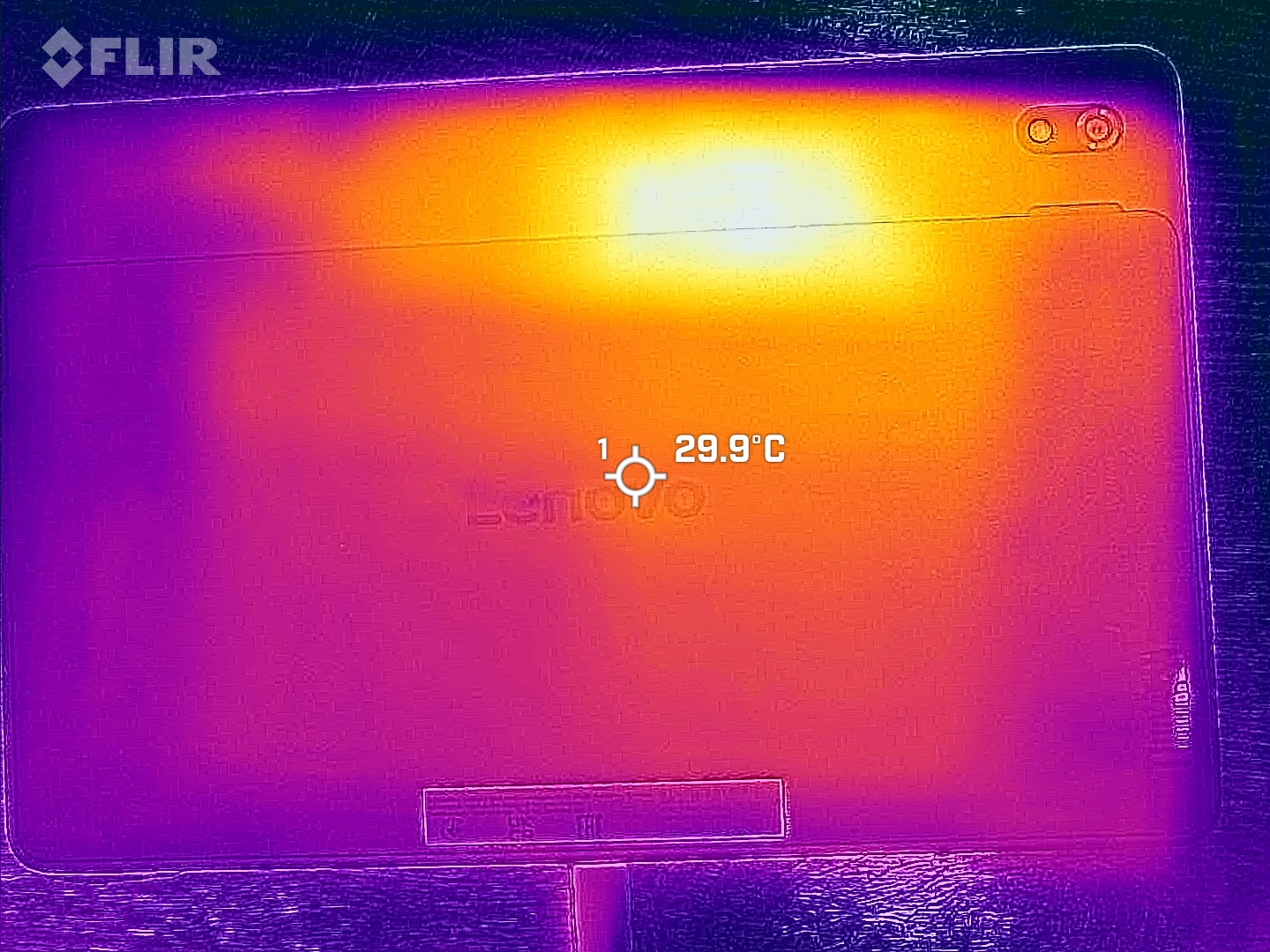
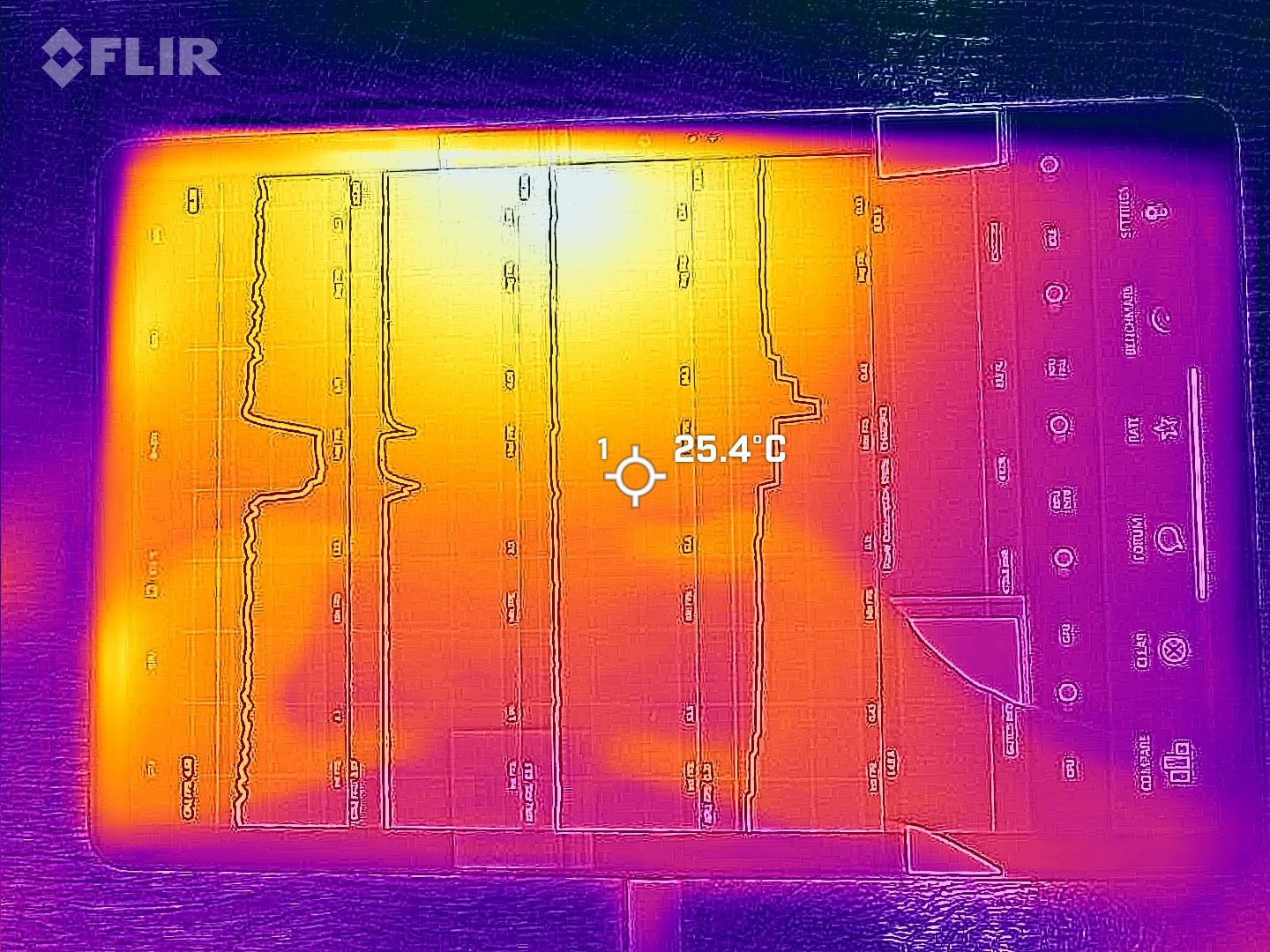
The ThinkPad X11's surface temperatures remain safe in every situation, even in the 3DMark stress tests. Moreover, we did not detect any significant throttling.
(+) The maximum temperature on the upper side is 34.1 °C / 93 F, compared to the average of 33.7 °C / 93 F, ranging from 20.7 to 53.2 °C for the class Tablet.
(+) The bottom heats up to a maximum of 37.3 °C / 99 F, compared to the average of 33.2 °C / 92 F
(+) In idle usage, the average temperature for the upper side is 24 °C / 75 F, compared to the device average of 30 °C / 86 F.
3DMark Stress Tests
| 3DMark | |
| Wild Life Stress Test Stability | |
| Samsung Galaxy Tab Active5 Pro | |
| Lenovo ThinkTab X11 | |
| Xiaomi Poco Pad X1 | |
| Xiaomi Pad 8 | |
| Wild Life Extreme Stress Test | |
| Samsung Galaxy Tab Active5 Pro | |
| Lenovo ThinkTab X11 | |
| Xiaomi Poco Pad X1 | |
| Xiaomi Pad 8 | |
| Steel Nomad Light Stress Test Stability | |
| Lenovo ThinkTab X11 | |
| Xiaomi Poco Pad X1 | |
| Xiaomi Pad 8 | |
Speakers
The two speakers support Dolby Atmos and deliver decent sound. However, the low frequencies could be more pronounced, and the very high frequencies get noticeably lost in the pink noise range.
Sound output can be enjoyed either via the 3.5 mm jack or wirelessly via Bluetooth 5.4. The latter offers broad codec support.
Lenovo ThinkTab X11 audio analysis
(+) | speakers can play relatively loud (83.8 dB)
Bass 100 - 315 Hz
(-) | nearly no bass - on average 16.4% lower than median
(±) | linearity of bass is average (13.9% delta to prev. frequency)
Mids 400 - 2000 Hz
(+) | balanced mids - only 4.6% away from median
(+) | mids are linear (5.6% delta to prev. frequency)
Highs 2 - 16 kHz
(+) | balanced highs - only 4.2% away from median
(±) | linearity of highs is average (7.1% delta to prev. frequency)
Overall 100 - 16.000 Hz
(±) | linearity of overall sound is average (15.5% difference to median)
Compared to same class
» 35% of all tested devices in this class were better, 3% similar, 62% worse
» The best had a delta of 7%, average was 21%, worst was 130%
Compared to all devices tested
» 23% of all tested devices were better, 4% similar, 72% worse
» The best had a delta of 4%, average was 23%, worst was 136%
Samsung Galaxy Tab Active5 Pro audio analysis
(+) | speakers can play relatively loud (91 dB)
Bass 100 - 315 Hz
(-) | nearly no bass - on average 19.7% lower than median
(±) | linearity of bass is average (10.9% delta to prev. frequency)
Mids 400 - 2000 Hz
(±) | higher mids - on average 5.5% higher than median
(+) | mids are linear (4.1% delta to prev. frequency)
Highs 2 - 16 kHz
(+) | balanced highs - only 3.2% away from median
(+) | highs are linear (4.1% delta to prev. frequency)
Overall 100 - 16.000 Hz
(±) | linearity of overall sound is average (16.1% difference to median)
Compared to same class
» 37% of all tested devices in this class were better, 6% similar, 58% worse
» The best had a delta of 7%, average was 21%, worst was 130%
Compared to all devices tested
» 26% of all tested devices were better, 5% similar, 69% worse
» The best had a delta of 4%, average was 23%, worst was 136%
Battery life - The ThinkTab X11 delights heavy users with its large, replaceable battery
Power consumption
Although the ThinkTab X11 has a 10,200 mAh battery that supports wired charging at a maximum of 45 watts, wireless charging is not supported.
Power consumption can be best described as efficient. At under 2 watts in idle mode, the Lenovo tablet's power consumption is low. Even under load, the ThinkTab X11 draws less energy than the Galaxy Tab Active5 Pro.
| Off / Standby |   0.1 / 0.2 Watt 0.1 / 0.2 Watt |
| Idle |  1.3 / 1.5 / 1.7 Watt 1.3 / 1.5 / 1.7 Watt |
| Load |
4.3 / 6.8 Watt |
    
| |
Key:
min: ,
med: ,
max: Metrahit Energy | |
| Lenovo ThinkTab X11 10200 mAh | Xiaomi Poco Pad X1 8850 mAh | Xiaomi Pad 8 9200 mAh | Samsung Galaxy Tab Active5 Pro 10100 mAh | Average Qualcomm Snapdragon 7s Gen 3 | Average of class Tablet | |
|---|---|---|---|---|---|---|
| Power Consumption | -35% | -43% | -124% | -6% | -124% | |
| Idle Minimum * (Watt) | 1.3 | 0.7 46% | 1.3 -0% | 3.5 -169% | 1.294 ? -0% | 2.21 ? -70% |
| Idle Average * (Watt) | 1.5 | 2.45 -63% | 2 -33% | 3.7 -147% | 1.667 ? -11% | 4.01 ? -167% |
| Idle Maximum * (Watt) | 1.7 | 2.58 -52% | 2.3 -35% | 4.1 -141% | 1.827 ? -7% | 4.4 ? -159% |
| Load Average * (Watt) | 4.3 | 7.31 -70% | 6.6 -53% | 7.5 -74% | 4.43 ? -3% | 8.97 ? -109% |
| Load Maximum * (Watt) | 6.8 | 9.17 -35% | 13.3 -96% | 12.7 -87% | 7.57 ? -11% | 14.5 ? -113% |
* ... smaller is better
Power consumption: Geekbench (150 cd/m²)
Power consumption: GFXbench (150 cd/m²)
Battery runtimes
In our practical battery test, the Lenovo tablet delivered extremely good battery life using an adjusted display brightness of 150 cd/m². In this area, the ThinkPad X11 kept going for almost 20 hours longer than the Apple iPad 10.
| Lenovo ThinkTab X11 10200 mAh | Xiaomi Poco Pad X1 8850 mAh | Xiaomi Pad 8 9200 mAh | Samsung Galaxy Tab Active5 Pro 10100 mAh | |
|---|---|---|---|---|
| Battery runtime | ||||
| WiFi v1.3 (h) | 29.9 | 13.9 -54% | 20.7 -31% | 22.6 -24% |
Notebookcheck overall rating
The ThinkTab X11 comes with a feature set that few other current Android tablets can offer. It took almost 15 years for Lenovo to bring a successor to the ThinkPad 18382DG tablet to market, but this one now exists in a standalone product category.

Lenovo ThinkTab X11
- 06/10/2026 v8
Marcus Herbrich
 Total Sustainability Score:
 Possible alternatives compared
Image | Model / Review | Price | Weight | Drive | Display |
|---|---|---|---|---|---|
1. 81.9%  | Lenovo ThinkTab X11 Qualcomm Snapdragon 7s Gen 3 ⎘ Qualcomm Adreno 810 ⎘ 8 GB Memory, 256 GB UFS 3.1 | Amazon: 1. $439.99 Lenovo ThinkTab X11 Gen 1 TB... 2. $548.62 Lenovo ThinkTab X11 Gen 1 TB... 3. $519.99 Lenovo ThinkTab X11 Gen 1 TB... List Price: 500€ | 650 g | 256 GB UFS 3.1 Flash | 10.95" 2560x1600 276 PPI IPS LCD |
2. 85.8%  | Xiaomi Poco Pad X1 Qualcomm Snapdragon 7+ Gen 3 ⎘ Qualcomm Adreno 732 ⎘ 8 GB Memory, 512 GB UFS 4.x | Amazon: List Price: 389€ | 500 g | 512 GB UFS 4.0 Flash | 11.20" 3200x2136 344 PPI TFT-LCD |
3. 87.1%  | Xiaomi Pad 8 Qualcomm Snapdragon 8s Gen 4 SM8735 ⎘ Qualcomm Adreno 825 ⎘ 12 GB Memory, 256 GB UFS 4.x | Amazon: 1. $382.50 XIAOMI Pad 8 Ai WiFi Version... 2. $406.13 XIAOMI Pad 8 Ai WiFi Version... 3. $379.50 XIAOMI Pad 8 Ai WiFi Version... List Price: 437€ | 485 g | 256 GB UFS 4.1 Flash | 11.20" 3200x2136 344 PPI IPS |
4. 80.1%  | Samsung Galaxy Tab Active5 Pro Qualcomm Snapdragon 7s Gen 3 ⎘ Qualcomm Adreno 810 ⎘ 6 GB Memory, 128 GB UFS 2.2 | Amazon: List Price: 799€ | 683 g | 128 GB UFS 2.2 Flash | 10.10" 1920x1200 224 PPI IPS |
Transparency
The selection of devices to be reviewed is made by our editorial team. The test sample was provided to the author as a loan by the manufacturer or retailer for the purpose of this review. The lender had no influence on this review, nor did the manufacturer receive a copy of this review before publication. There was no obligation to publish this review. As an independent media company, Notebookcheck is not subjected to the authority of manufacturers, retailers or publishers.
This is how Notebookcheck is testing
Every year, Notebookcheck independently reviews hundreds of laptops and smartphones using standardized procedures to ensure that all results are comparable. We have continuously developed our test methods for around 20 years and set industry standards in the process. In our test labs, high-quality measuring equipment is utilized by experienced technicians and editors. These tests involve a multi-stage validation process. Our complex rating system is based on hundreds of well-founded measurements and benchmarks, which maintains objectivity. Further information on our test methods can be found here.
 Add as a preferred source on Google


