Notebookcheck Logo
Oppo Reno16 Pro smartphone review
ⓘ Notebookcheck (Marcus Herbrich)

Compact premium smartphone: A megapixel monster with a huge battery — Oppo Reno 16 Pro review

Some gaps remain.

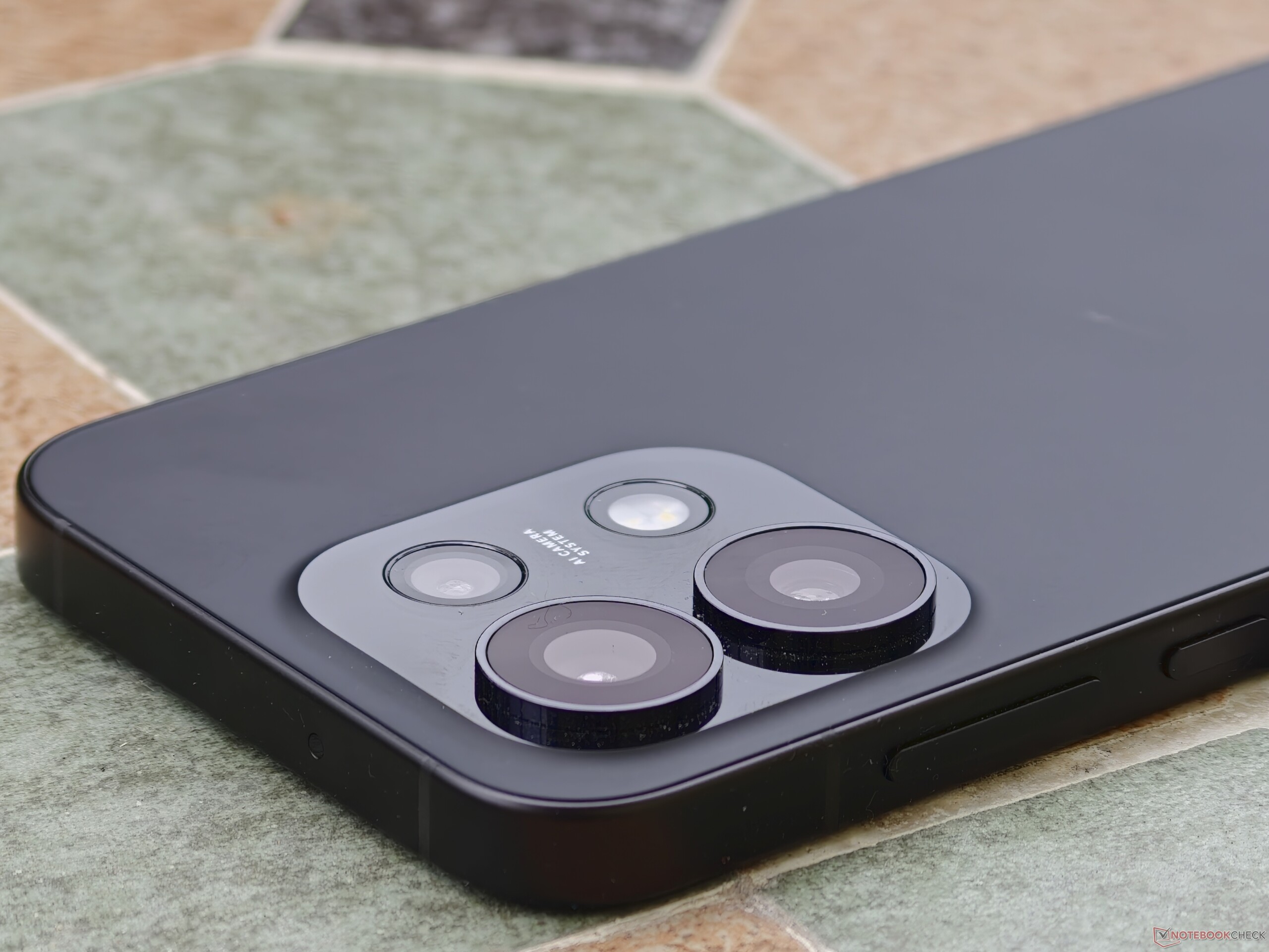
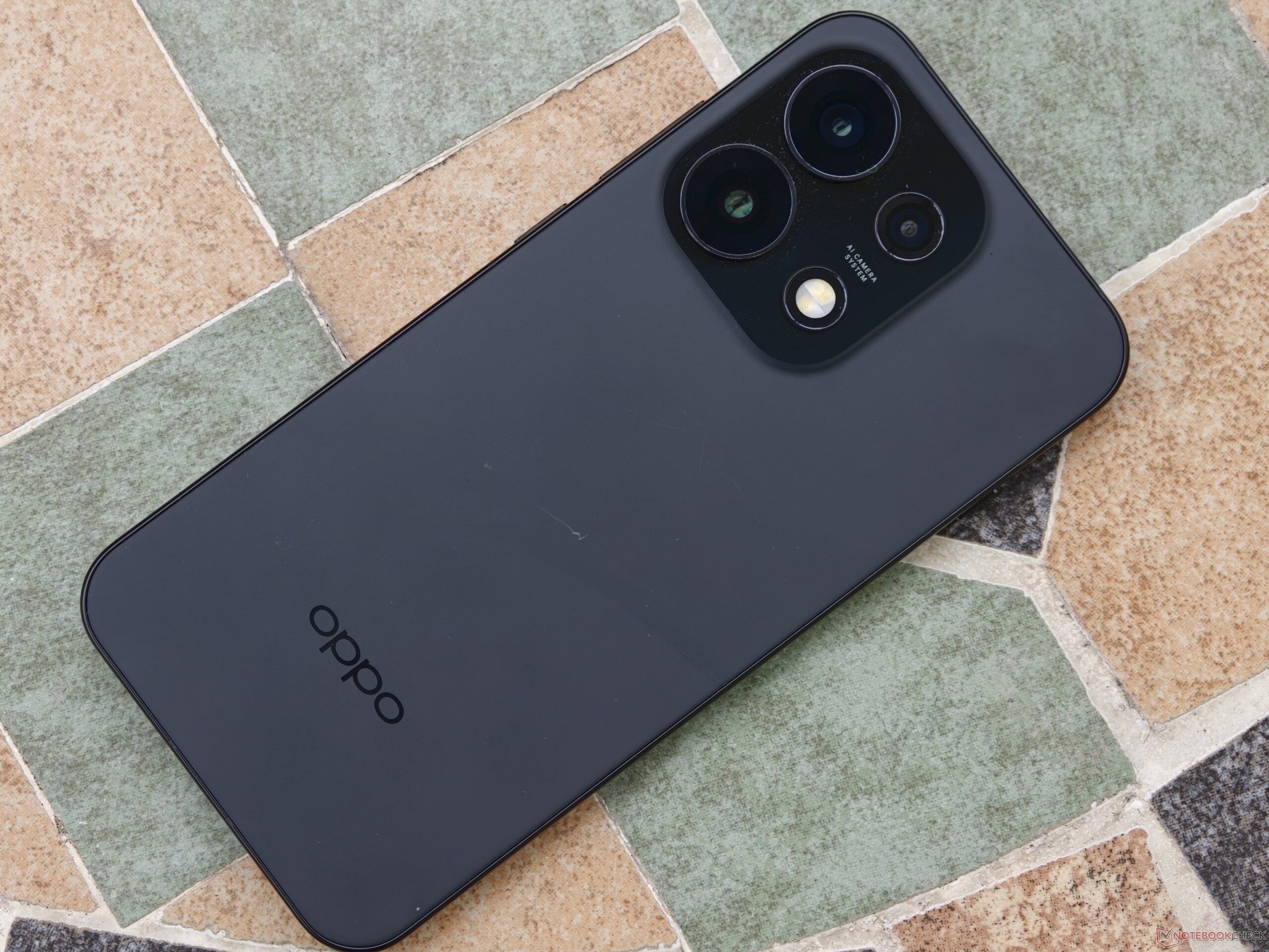
With the Reno 16 Pro, Oppo is entering the upper-midrange to premium segment with a compact Android smartphone. Despite its compact dimensions, this alternative to the iPhone 17 and Galaxy S26 packs an extra-large battery, a 200 MP camera, and a telephoto lens. Read our review to find out how well the new Dimensity 8550 performs in everyday use.
Marcus Herbrich, 👁 Daniel Schmidt, Ninh Duy (translated by DeepL / Ninh Duy) Published 🇩🇪
5G Android Touchscreen Smartphone

Verdict on the Oppo Reno16 Pro

The Oppo Reno 16 Pro delivers a pleasant everyday experience, thanks in particular to its excellent haptics, very good ultrasonic fingerprint sensor, and long battery life. Photo quality is good, and the OLED panel is bright. The Oppo phone also comes in a compact form factor, which is a clear advantage for fans of smaller smartphones. At the same time, however, there is little progress over the Reno 15 Pro. The display, in particular, has not improved at all, with the Galaxy S26 and Xiaomi 17 reaching significantly higher brightness levels.

The Dimensity 8550 is efficient and delivers solid everyday performance, with enough headroom for occasional gaming. Nevertheless, the new MediaTek chipset is clearly a midrange SoC, which is hardly surprising given that it is only a minor refresh of the Dimensity 8500. The Poco X8 Pro, equipped with last year's chipset, is sometimes even faster than Oppo's upper-tier model despite costing less than half as much. The Reno 16 Pro also makes do with midrange standards such as Bluetooth 5.4, Wi-Fi 6E, and UFS 3.1. More problematic for a smartphone priced at nearly 900 euros are the significant omissions from its feature set: it lacks USB 3.1 with video output as well as wireless charging.

A notable highlight is the new Snap Key, a dedicated action button making its debut in the Reno series that expands the Oppo phone's functionality. Also welcome are the promised five years of major OS updates and six years of security patches. Other useful features include O+ Connect, which provides a convenient way to transfer files between the Reno 16 Pro and iOS or macOS devices.

Overall, the Reno 16 Pro is a strong smartphone for everyday use, but it clearly falls behind its upper-tier rivals in terms of hardware and technical features. Those who do not value the compact form factor may find the Xiaomi 17T Pro a compelling alternative, offering similar strengths with fewer weaknesses.

Pros

+ high-quality housing rated IP69
+ beautiful OLED panel
+ good ultrasonic sensor
+ long battery life

Cons

- USB 2.0 only
- No wireless charging
- Weak SoC for a high-end device
- Significant SoC throttling
- No Wi-Fi 7 & only UFS 3.1

Price and availability of the Oppo Reno16 Pro

The Oppo Reno 16 Pro is launching in Europe with a starting MSRP of €899 for the base configuration with 8 GB of RAM and 512 GB of storage. It is available from Amazon Germany, directly from the manufacturer, and other retailers.

Translator's note: In the US, the smartphone is available on Amazon for around $1,505.

Amazon Logo
$1,505.00
OPPO Reno16 Pro Dual-SIM 512GB ROM + 12GB RAM (GSM Only | No CDMA) Factory Unlocked 5G Smartphone (Starlight Black) - International Version

Oppo Reno16 Pro Specifications

Oppo Reno16 Pro (Reno16 Series)
Processor
MediaTek Dimensity 8550 8c/8t, 1 x 3.4 GHz ARM Cortex-A725, 3 x 3.2 GHz ARM Cortex-A725, 4 x 2.2 GHz ARM Cortex-A725, Cortex-A725
Graphics adapter
ARM Mali-G720 MP8, Core: 1500 MHz
Memory
12 GB 
, LPDDR5
Display
6.32 inch 19.5:9, 2640 x 1216 pixel 460 PPI, Capacitive touchscreen, AMOLED, Crystal Guard, glossy: yes, HDR, 144 Hz
Storage
512 GB UFS 3.1 Flash, 512 GB 
, 456 GB free
Connections
1 USB 2.0, USB-C Power Delivery (PD), 1 Infrared, Audio Connections: USB-C, 1 Fingerprint Reader, NFC, Brightness Sensor, Sensors: accelerometer, gyro, proximity, compass, OTG, Miracast, IR-Blaster
Networking
Wi-Fi 6E (a/b/g/n = Wi-Fi 4/ac = Wi-Fi 5/ax = Wi-Fi 6/ Wi-Fi 6E 6 GHz), Bluetooth 5.4, 2G (850/​900/​1800/​1900), 3G (B1/​B2/​B4/​B5/​B6/​B8/​B19), 4G (B1/​B2/​B3/​B4/​B5/​B7/​B8/​B12/​B13/​B17/​B18/​B19/​B20/​B26/​B28/​B32/​B34/​B38/​B39/​B40/​B41/​B66/​B71), 5G (n1/​n2/​n3/​n5/​n7/​n8/​n12/​n20/​n26/​n28/​n38/​n40/​n41/​n48/​n66/​n71/​n77/​n78), Dual SIM, LTE, 5G, GPS
Size
height x width x depth (in mm): 8.2 x 151.21 x 72.42 ( = 0.32 x 5.95 x 2.85 in)
Battery
6000 mAh Lithium-Ion, 80W SUPERVOOC, Silicon-Carbon-Anode
Charging
fast charging / Quickcharge
Operating System
Android 16
Camera
Primary Camera: 200 MPix (f/1.8, 24 mm, OIS, 1/1.56", video 4K60) + 50 MPix (3.5x optical zoom, f/2.8, 80 mm, OIS, 1/2.75") + 50 MPix (f/2.0, 16 mm, ultrawide, 1/2.88")
Secondary Camera: 50 MPix (f/2.0, 18 mm, AF)
Additional features
Speakers: Stereo, USB cable, SIM tool, info material, ColorOS 16, 24 Months Warranty, widevine L1 | IP68, IP69 | aptX HD, LDAC, LHDC, AAC, SBC | Single-Band-GNSS: GPS, GLONASS, GALILEO, BDS, QZSS | HDR10, HDR10+, HLG | SAR Value 1.185W/kg Body, 0.921W/kg Head | eSIM, fanless, waterproof
Released
06/25/2026
Weight
185 g ( = 6.53 oz / 0.41 pounds)
Price
1099 Euro
Note: The manufacturer may use components from different suppliers including display panels, drives or memory sticks with similar specifications.


Design and features - Compact, slim smartphone with IP68/IP69, but only USB 2.0
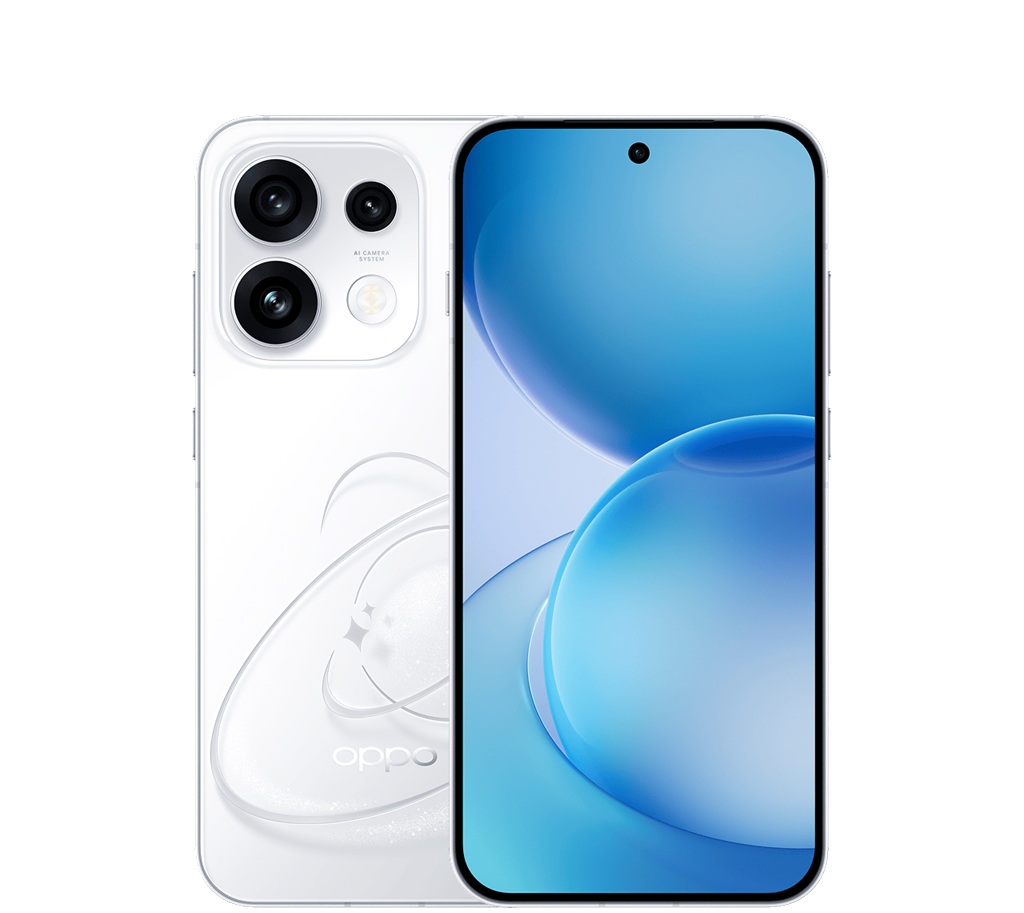
Oppo Reno 16 Pro with a “holographic” back
ⓘ Oppo
Oppo Reno 16 Pro with a “holographic” back

Oppo’s upper-tier smartphone weighs just 185 grams and is certified to IP68/IP69K. With a 6.32-inch display and a high screen-to-body ratio of nearly 90%, the phone has a relatively compact footprint. The white model is also available with a “holographic” back, which gets its distinctive look from microlenses beneath the glass cover.

Given the high MSRP, it is disappointing that Oppo equips its upper-tier phone with only an outdated USB 2.0 port.
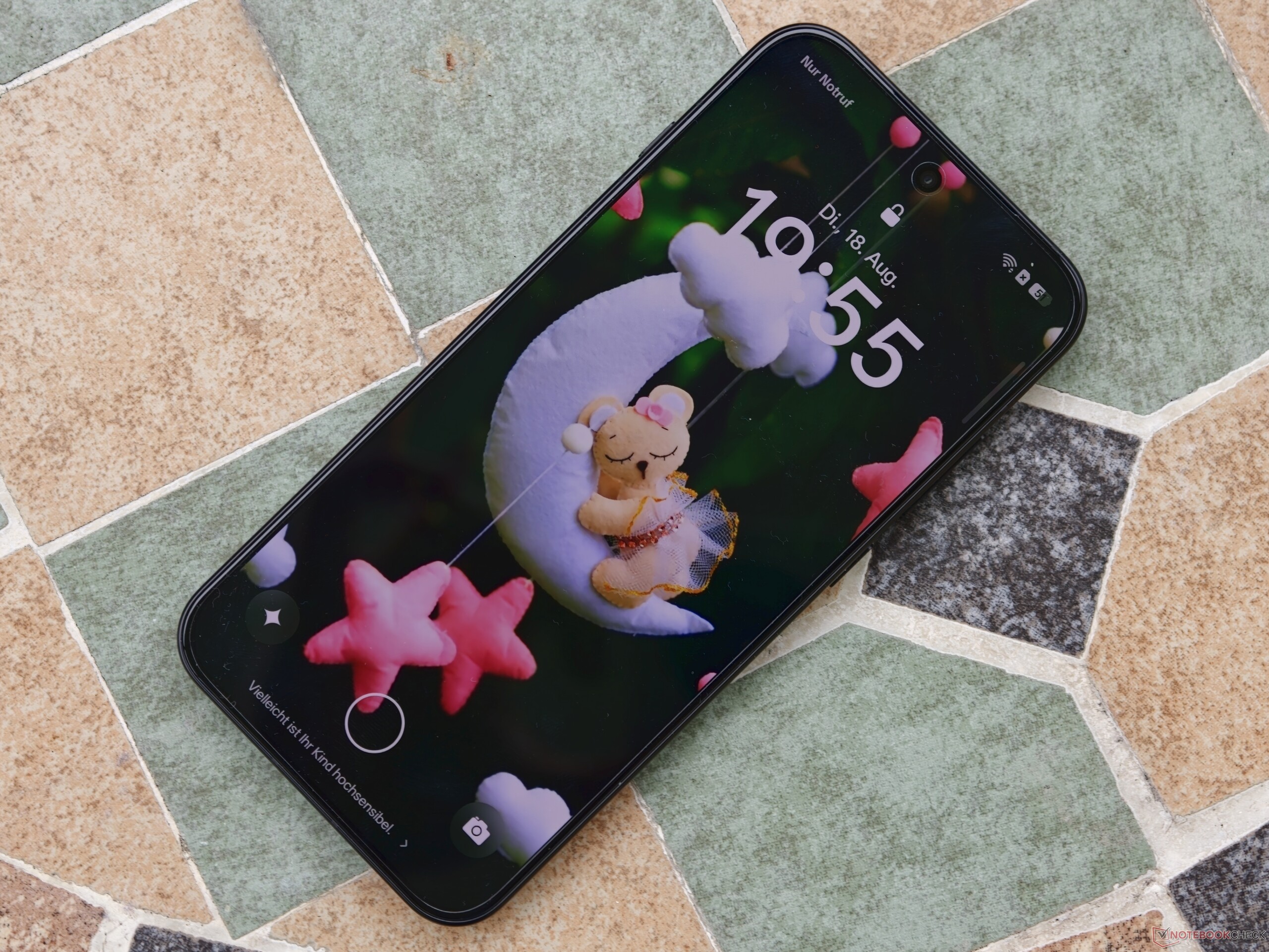
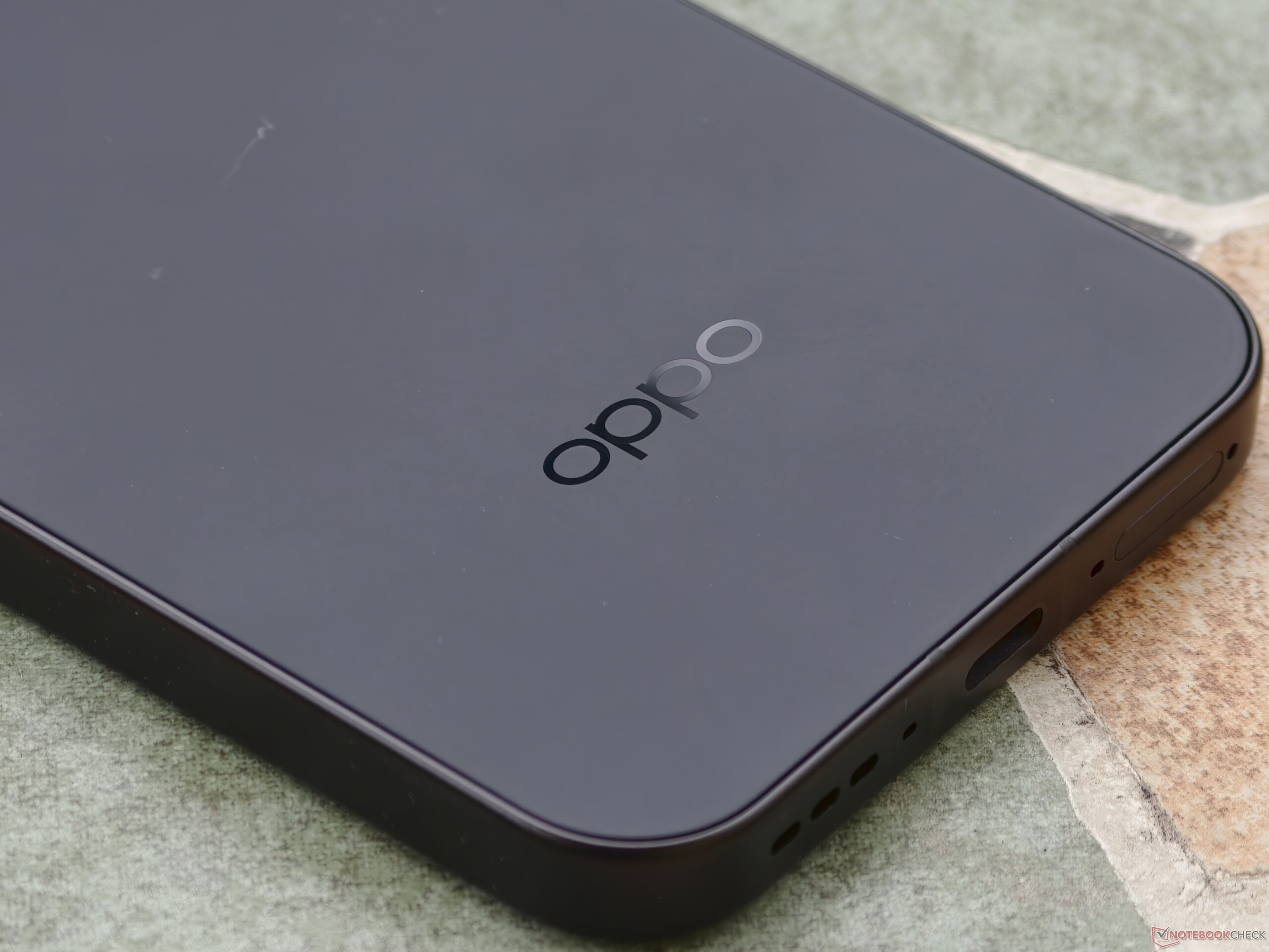
Size comparison

163.33 mm / 6.43 in 77.82 mm / 3.06 in 8.3 mm / 0.3268 in 220 g0.485 lbs162.2 mm / 6.39 in 77.5 mm / 3.05 in 8.25 mm / 0.3248 in 219 g0.4828 lbs158.4 mm / 6.24 in 75.8 mm / 2.98 in 7.3 mm / 0.2874 in 190 g0.4189 lbs151.21 mm / 5.95 in 72.42 mm / 2.85 in 8.2 mm / 0.3228 in 185 g0.4079 lbs151.1 mm / 5.95 in 71.8 mm / 2.83 in 8.1 mm / 0.3189 in 191 g0.4211 lbs149.6 mm / 5.89 in 71.7 mm / 2.82 in 7.2 mm / 0.2835 in 167 g0.3682 lbs148 mm / 5.83 in 105 mm / 4.13 in 1 mm / 0.03937 in 1.5 g0.00331 lbs

Communication and operation—Android phone without WiFi 7, but with an ultrasonic fingerprint sensor

In our testing, the Reno 16 Pro achieved high Wi-Fi speeds with Wi-Fi 6E, although the current Wi-Fi 7 standard would allow for significantly higher bandwidth.

When on the go, the phone supports 5G with very broad frequency coverage. Those who frequently use their smartphone for navigation may be somewhat disappointed by the single-band GNSS support.

The Oppo phone makes an excellent impression when it comes to haptics and fingerprint recognition. The X-axis linear motor provides crisp haptic feedback, while the ultrasonic fingerprint sensor unlocks the phone quickly and very reliably.

Networking
Oppo Reno16 Pro
Wi-Fi 6E
iperf3 transmit Wi-Fi6/7 RT-BE96U
1718 (min: 896) MBit/s ∼45%
iperf3 receive Wi-Fi6/7 RT-BE96U
1827 (min: 1616) MBit/s ∼42%
Xiaomi 17T Pro
802.11 a/​b/​g/​n/​ac/​ax/​be
iperf3 transmit Wi-Fi6/7 RT-BE96U
3845 (min: 3505) MBit/s ∼100%
iperf3 receive Wi-Fi6/7 RT-BE96U
4387 (min: 3333) MBit/s ∼100%
Samsung Galaxy S26+
802.11 a/​b/​g/​n/​ac/​ax/​be
iperf3 transmit AXE11000
887 (min: 479) MBit/s ∼90%
iperf3 receive AXE11000
914 (min: 876) MBit/s ∼97%
iperf3 transmit AXE11000 6GHz
1799 (min: 955) MBit/s ∼100%
iperf3 receive AXE11000 6GHz
1645 (min: 1513) MBit/s ∼100%
Xiaomi Poco F8 Ultra
802.11 a/​b/​g/​n/​ac/​ax/​be
iperf3 transmit AXE11000
989 (min: 488) MBit/s ∼100%
iperf3 receive AXE11000
946 (min: 814) MBit/s ∼100%
Average Wi-Fi 6E
 
iperf3 transmit AXE11000
954 (min: 227) MBit/s ∼96%
iperf3 receive AXE11000
940 (min: 442) MBit/s ∼99%
iperf3 transmit AXE11000 6GHz
1371 (min: 229) MBit/s ∼76%
iperf3 receive AXE11000 6GHz
1335 (min: 598) MBit/s ∼81%
iperf3 transmit Wi-Fi6/7 RT-BE96U
1302 (min: 853) MBit/s ∼34%
iperf3 receive Wi-Fi6/7 RT-BE96U
1342 (min: 743) MBit/s ∼31%
Average of class Smartphone
 
iperf3 transmit AXE11000
677 (min: 52.5) MBit/s ∼68%
iperf3 receive AXE11000
716 (min: 52.2) MBit/s ∼76%
iperf3 transmit AXE11000 6GHz
1271 (min: 287) MBit/s ∼71%
iperf3 receive AXE11000 6GHz
1400 (min: 339) MBit/s ∼85%
iperf3 transmit Wi-Fi6/7 RT-BE96U
1846 (min: 327) MBit/s ∼48%
iperf3 receive Wi-Fi6/7 RT-BE96U
2087 (min: 328) MBit/s ∼48%
0100200300400500600700800900100011001200130014001500160017001800190020002100220023002400250026002700280029003000310032003300340035003600370038003900400041004200430044004500Tooltip
Oppo Reno16 Pro Wi-Fi 6E; iperf3 transmit Wi-Fi6/7 RT-BE96U; iperf 3.21, 6 GHz: Ø1703 (896-1895) MBit/s
Xiaomi 17T Pro 802.11 a/​b/​g/​n/​ac/​ax/​be; iperf3 transmit Wi-Fi6/7 RT-BE96U; iperf 3.1.3: Ø3845 (3505-4039) MBit/s
Oppo Reno16 Pro Wi-Fi 6E; iperf3 receive Wi-Fi6/7 RT-BE96U; iperf 3.21, 6 GHz: Ø1827 (1616-1924) MBit/s
Xiaomi 17T Pro 802.11 a/​b/​g/​n/​ac/​ax/​be; iperf3 receive Wi-Fi6/7 RT-BE96U; iperf 3.1.3: Ø4386 (3333-4542) MBit/s

Cameras — Oppo uses a 200 MP sensor and optical image stabilization in its upper-tier smartphone

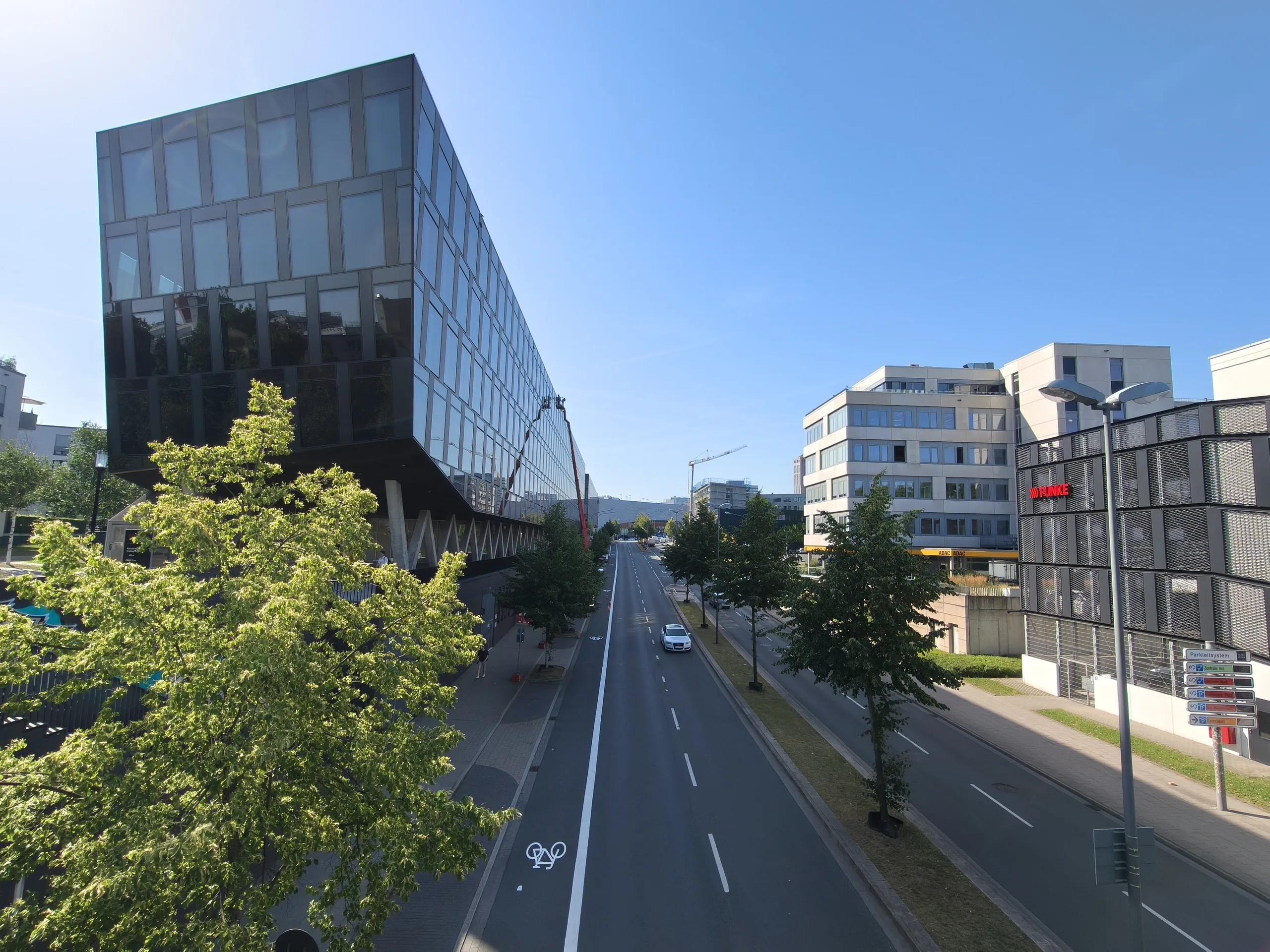
Not much has changed in terms of photo quality compared with the Reno15 Pro. The Reno 16 Pro uses the Samsung ISOCELL HP5 as its main camera, the same sensor used for the telephoto camera in the Find X9 Pro.

The 200 MP camera with OIS delivers good sharpness and plenty of detail in sufficient light. However, the dynamic range in our test photos is not optimal. Aside from one outlier in the blue tones, color reproduction is very good.

We also like the telephoto camera in this compact segment, which offers 3.5x optical zoom and optical image stabilization. In daylight, the Samsung JN5's sensor cropping enables good results at up to 7x zoom.

Low Light
Low Light
Ultra-wide angle
Ultra-wide angle
5x telephoto lens
5x telephoto lens

Image comparison

Choose a scene and navigate within the first image. One click changes the position on touchscreens. One click on the zoomed-in image opens the original in a new window. The first image shows the scaled photograph of the test device.


orginal image
click to load images
ColorChecker
3 ∆E
3.1 ∆E
4.1 ∆E
4.3 ∆E
4.8 ∆E
3.7 ∆E
2.2 ∆E
10.1 ∆E
5.1 ∆E
3.5 ∆E
2 ∆E
1.7 ∆E
16.2 ∆E
1 ∆E
4 ∆E
3.9 ∆E
5.2 ∆E
6.1 ∆E
6.3 ∆E
2.4 ∆E
2.9 ∆E
2.3 ∆E
3.4 ∆E
5.7 ∆E
ColorChecker Oppo Reno16 Pro: 4.46 ∆E min: 1.04 - max: 16.21 ∆E
ColorChecker
30.6 ∆E
54.7 ∆E
37.3 ∆E
36.1 ∆E
42.4 ∆E
61.3 ∆E
53.8 ∆E
31.6 ∆E
43.5 ∆E
27.7 ∆E
63.5 ∆E
63.9 ∆E
28.7 ∆E
48.3 ∆E
37.9 ∆E
74.7 ∆E
43 ∆E
43 ∆E
78.7 ∆E
69.8 ∆E
51.9 ∆E
37.3 ∆E
24.5 ∆E
14 ∆E
ColorChecker Oppo Reno16 Pro: 45.75 ∆E min: 14.02 - max: 78.71 ∆E

Display — Compact smartphone with an OLED screen and 144 Hz refresh rate

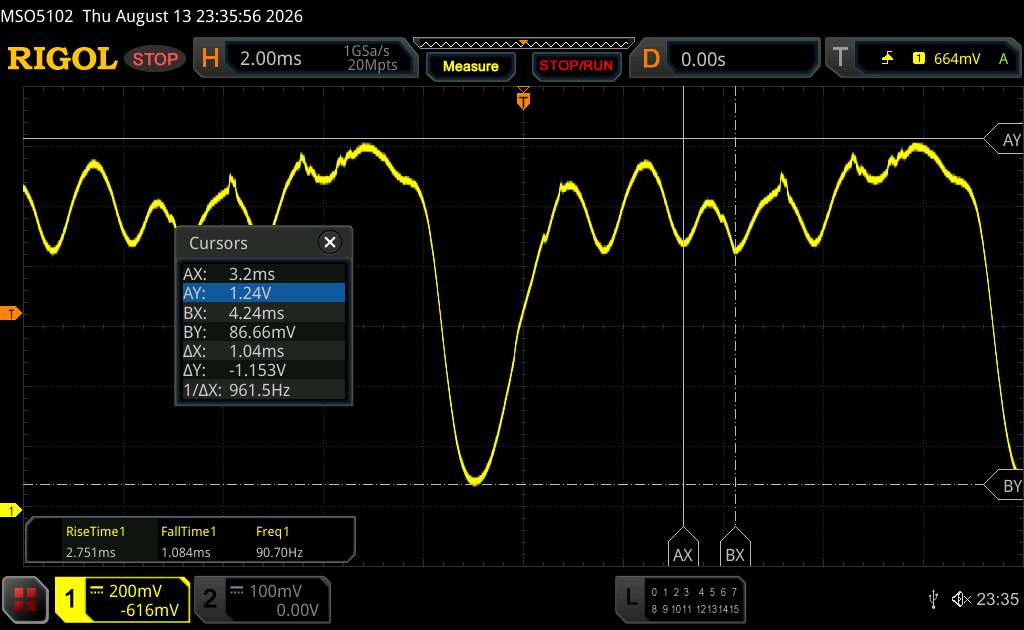
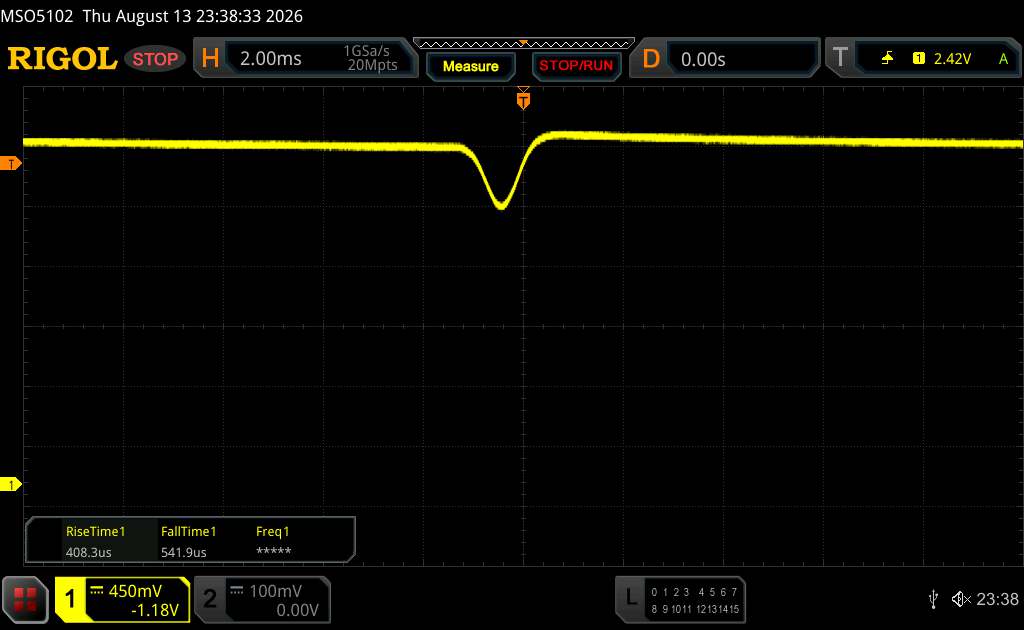
The display in the current generation is likely the same as the one used in the Reno 15 Pro. As is typical for OLED panels, it uses PWM for brightness control, resulting in screen flickering. The base frequency we measured is low, and the high-frequency PWM dimming rate of 960 Hz at low brightness is not particularly high either. As a result, discomfort for PWM-sensitive users cannot be ruled out. According to Oppo, the high-frequency PWM dimming should operate at 3,840 Hz. It is possible that the Reno 16 Pro uses a higher PWM frequency at higher brightness levels.

1210
cd/m²
Distribution of brightness
tested with X-Rite i1Pro 3
Maximum: 1210 cd/m² (Nits) Minimum: 2.88 cd/m²
Center on Battery: 1210 cd/m²
Contrast: ∞:1 (Black: 0 cd/m²)
ΔE ColorChecker Calman: 1.6 | ∀{0.5-29.43 Ø4.7}
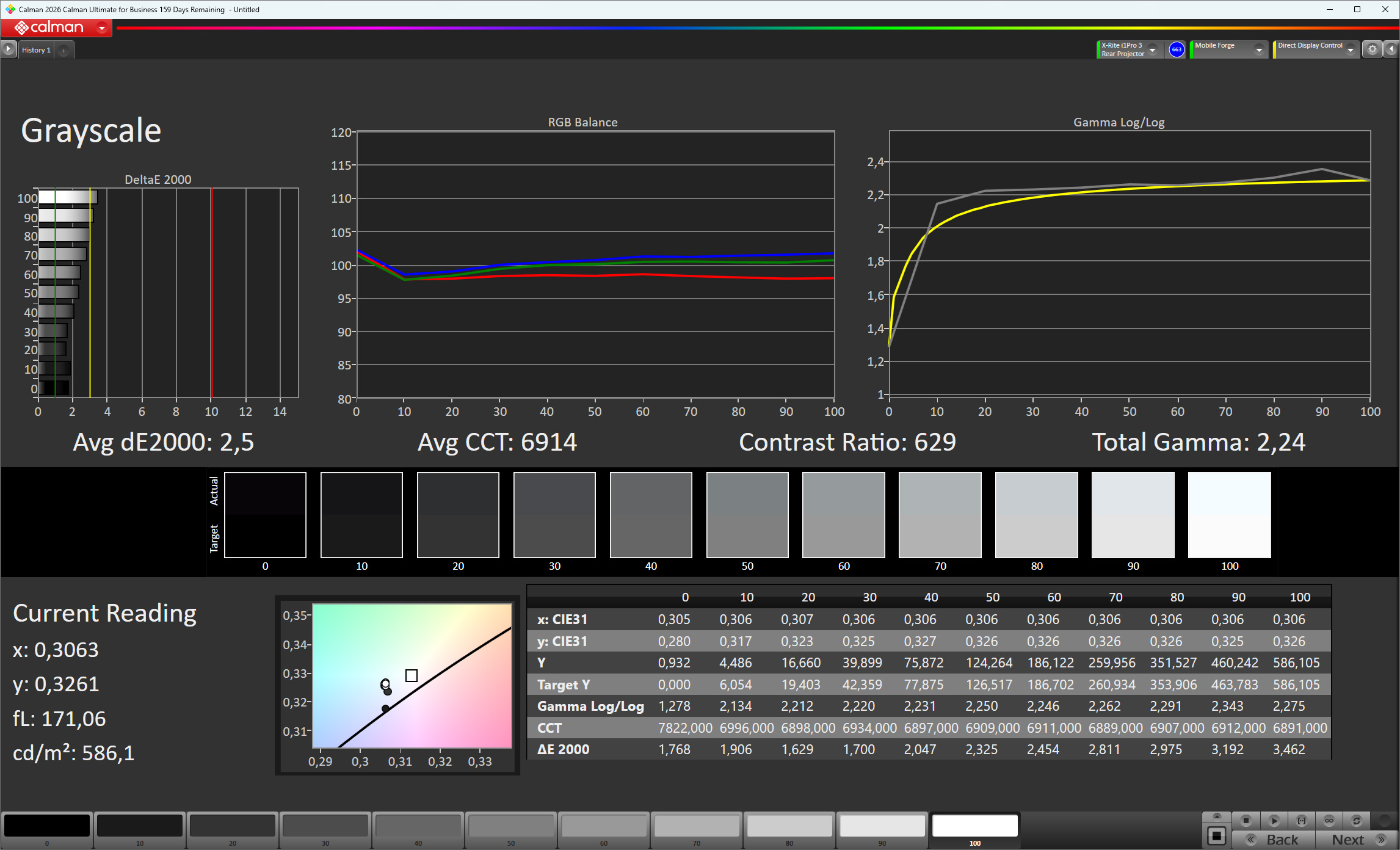
ΔE Greyscale Calman: 2.5 | ∀{0.09-98 Ø4.95}
99.6% sRGB (Calman 2D)
Gamma: 2.24
CCT: 6914 K
Oppo Reno16 Pro
AMOLED, 2640x1216, 6.3"
Xiaomi 17T Pro
AMOLED, 2772x1280, 6.8"
Samsung Galaxy S26+
LTPO-AMOLED, 3120x1440, 6.7"
Xiaomi Poco F8 Ultra
AMOLED, 2608x1200, 6.9"
Display
132%
89%
137%
APL18 Peak Brightness (cd/m²)
1221
3507
187%
2751
125%
3519
188%
HDR Peak Brightness (cd/m²)
1873
3295
76%
2875
53%
3458
85%
Response Times
5%
-92%
20%
Response Time Grey 50% / Grey 80% * (ms)
0.96 ?(0.465, 0.4975)
1.13 ?(0.547, 0.5865)
-18%
3.79 ?(2.137, 1.648)
-295%
0.86 ?(0.433, 0.427)
10%
Response Time Black / White * (ms)
1.29 ?(0.609, 0.684)
1.01 ?(0.4925, 0.5165)
22%
1.18 ?(0.6195, 0.561)
9%
0.87 ?(0.4395, 0.433)
33%
PWM Frequency (Hz)
90
120
240
120
PWM Amplitude * (%)
17.14
15.46
10%
15.27
11%
14.02
18%
Screen
12%
-20%
25%
Brightness middle (cd/m²)
1210
1068
-12%
1384
14%
1771
46%
Black Level * (cd/m²)
Colorchecker dE 2000 *
1.6
1.3
19%
2.8
-75%
1.3
19%
Colorchecker dE 2000 max. *
3.5
2.5
29%
4.5
-29%
2.8
20%
Greyscale dE 2000 *
2.5
2.2
12%
2.2
12%
2.1
16%
Gamma
2.24 98%
2.26 97%
2.05 107%
2.25 98%
CCT
6914 94%
6875 95%
6514 100%
6452 101%
Brightness (cd/m²)
1060
1379
1773
Brightness Distribution (%)
97
95
99
Total Average (Program / Settings)
50% / 36%
-8% / -19%
61% / 48%

* ... smaller is better

Screen Flickering / PWM (Pulse-Width Modulation)

To dim the screen, some notebooks will simply cycle the backlight on and off in rapid succession - a method called Pulse Width Modulation (PWM) . This cycling frequency should ideally be undetectable to the human eye. If said frequency is too low, users with sensitive eyes may experience strain or headaches or even notice the flickering altogether.
Screen flickering / PWM detected 90 Hz
Amplitude: 17.14 %
Secondary Frequency: 960 Hz

The display backlight flickers at 90 Hz (worst case, e.g., utilizing PWM) .

The frequency of 90 Hz is very low, so the flickering may cause eyestrain and headaches after extended use.

In comparison: 52 % of all tested devices do not use PWM to dim the display. If PWM was detected, an average of 7680 (minimum: 5 - maximum: 343500) Hz was measured.

minimum display brightness
min.
25% display brightness
25%
50% display brightness
50%
75% screen brightness
75%
maximum manual display brightness
100%

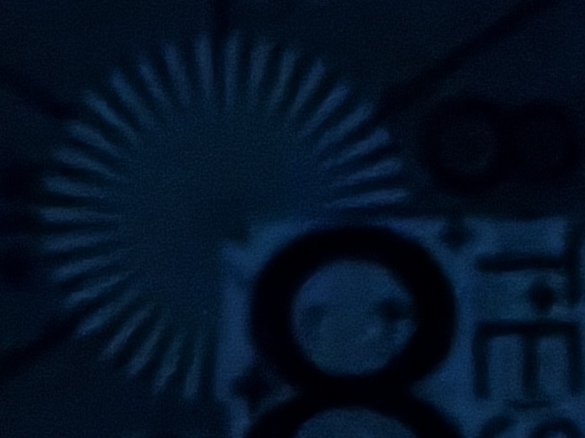
Series of measurements with a fixed zoom level and varying brightness settings (Although the amplitude curve appears flat at minimum brightness, this is due to the scaling. The info box shows a magnified version of the amplitude at minimum brightness.) 

Color Accuracy (Color Profile: Standard, Target Color Space: sRGB)
Color Space (Color Profile: Standard, Target Color Space: sRGB)
Grayscale (Color Profile: Standard, Target Color Space: sRGB)

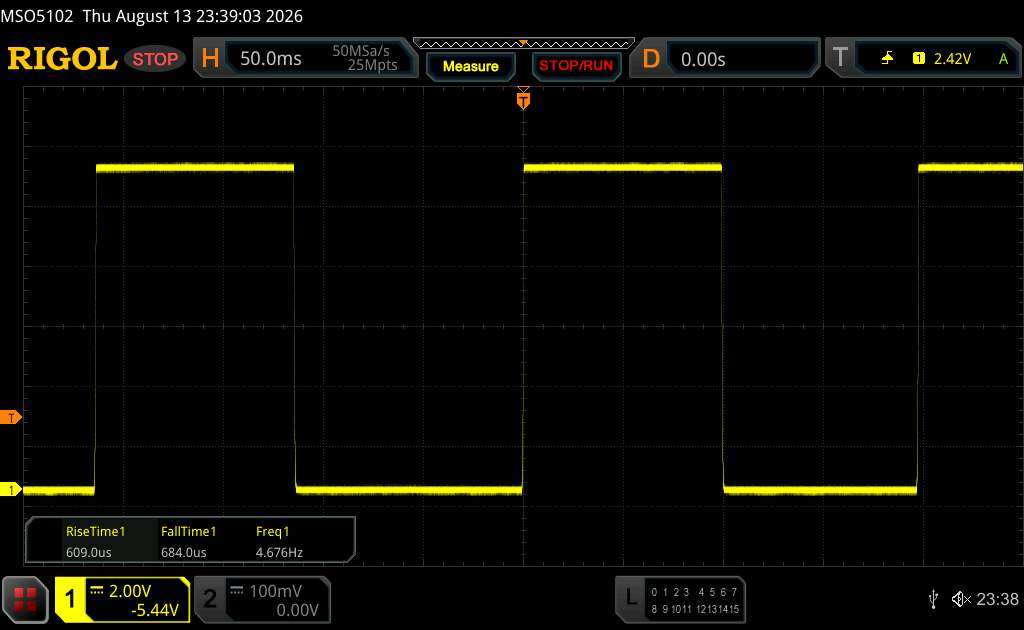
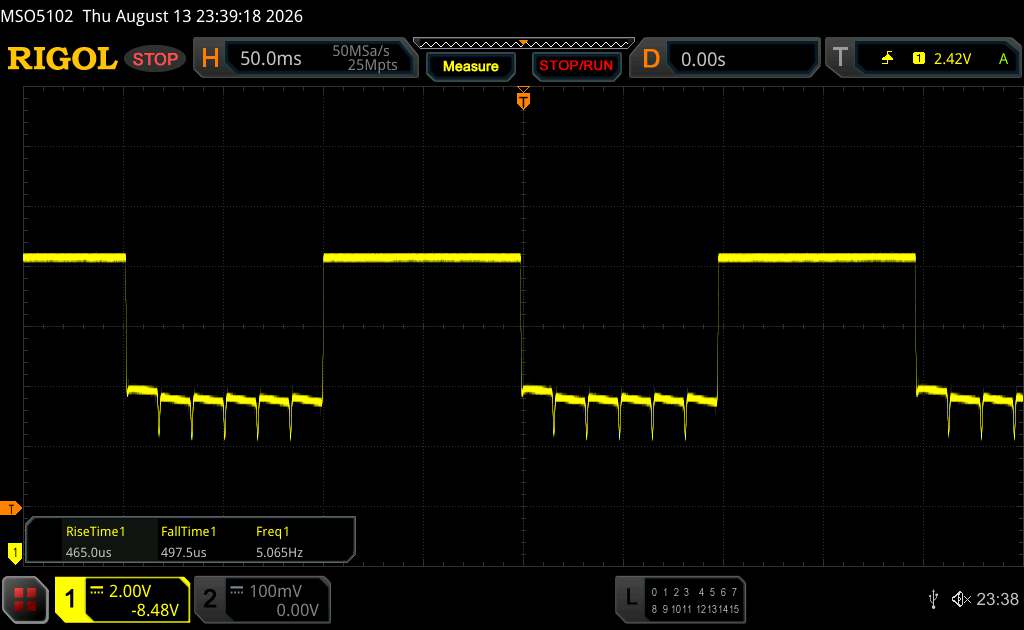
Display Response Times

Display response times show how fast the screen is able to change from one color to the next. Slow response times can lead to afterimages and can cause moving objects to appear blurry (ghosting). Gamers of fast-paced 3D titles should pay special attention to fast response times.
       Response Time Black to White
1.29 ms ... rise ↗ and fall ↘ combined↗ 0.609 ms rise
↘ 0.684 ms fall
The screen shows very fast response rates in our tests and should be very well suited for fast-paced gaming.
In comparison, all tested devices range from 0.1 (minimum) to 240 (maximum) ms. » 8 % of all devices are better.
This means that the measured response time is better than the average of all tested devices (19.7 ms).
       Response Time 50% Grey to 80% Grey
0.96 ms ... rise ↗ and fall ↘ combined↗ 0.465 ms rise
↘ 0.4975 ms fall
The screen shows very fast response rates in our tests and should be very well suited for fast-paced gaming.
In comparison, all tested devices range from 0.13 (minimum) to 636 (maximum) ms. » 4 % of all devices are better.
This means that the measured response time is better than the average of all tested devices (30.8 ms).

Performance, emissions, and battery life — Android phone with a new MediaTek chipset

The Dimensity 8550 is a solid midrange SoC, but in benchmarks, competitors in this price range can sometimes be more than twice as fast as the Reno 16 Pro. Storage performance is also significantly lower than on the Poco F8 Ultra

In our stress tests, the MediaTek chipset loses around half of its performance, and some unlimited stress tests even terminate prematurely.

Geekbench 6.7
Single-Core
Xiaomi Poco F8 Ultra
Qualcomm Snapdragon 8 Elite Gen 5, Adreno 840, 16384
3676 Points +136%
Xiaomi 17T Pro
MediaTek Dimensity 9500, Mali-G1 Ultra MC12, 12288
3269 Points +110%
Samsung Galaxy S26+
Samsung Exynos 2600, Xclipse 960, 12288
3209 Points +106%
Average of class Smartphone
  (196 - 3759, n=188, last 2 years)
1868 Points +20%
Oppo Reno16 Pro
MediaTek Dimensity 8550, Mali-G720 MP8, 12288
1559 Points
Average MediaTek Dimensity 8550
  (n=1)
1559 Points 0%
Multi-Core
Samsung Galaxy S26+
Samsung Exynos 2600, Xclipse 960, 12288
11034 Points +79%
Xiaomi Poco F8 Ultra
Qualcomm Snapdragon 8 Elite Gen 5, Adreno 840, 16384
11004 Points +78%
Xiaomi 17T Pro
MediaTek Dimensity 9500, Mali-G1 Ultra MC12, 12288
10042 Points +63%
Oppo Reno16 Pro
MediaTek Dimensity 8550, Mali-G720 MP8, 12288
6166 Points
Average MediaTek Dimensity 8550
  (n=1)
6166 Points 0%
Average of class Smartphone
  (830 - 11811, n=188, last 2 years)
5607 Points -9%
3DMark
Wild Life Unlimited Score
Xiaomi Poco F8 Ultra
Qualcomm Snapdragon 8 Elite Gen 5, Adreno 840, 16384
30621 Points +104%
Samsung Galaxy S26+
Samsung Exynos 2600, Xclipse 960, 12288
26896 Points +79%
Xiaomi 17T Pro
MediaTek Dimensity 9500, Mali-G1 Ultra MC12, 12288
21283 Points +42%
Oppo Reno16 Pro
MediaTek Dimensity 8550, Mali-G720 MP8, 12288
14987 Points
Average MediaTek Dimensity 8550
  (n=1)
14987 Points 0%
Average of class Smartphone
  (271 - 30892, n=173, last 2 years)
12758 Points -15%
Wild Life Extreme
Samsung Galaxy S26+
Samsung Exynos 2600, Xclipse 960, 12288
7206 Points +63%
Xiaomi Poco F8 Ultra
Qualcomm Snapdragon 8 Elite Gen 5, Adreno 840, 16384
7021 Points +59%
Xiaomi 17T Pro
MediaTek Dimensity 9500, Mali-G1 Ultra MC12, 12288
6932 Points +57%
Oppo Reno16 Pro
MediaTek Dimensity 8550, Mali-G720 MP8, 12288
4411 Points
Average MediaTek Dimensity 8550
  (n=1)
4411 Points 0%
Average of class Smartphone
  (61 - 8263, n=173, last 2 years)
3346 Points -24%
Wild Life Extreme Unlimited
Samsung Galaxy S26+
Samsung Exynos 2600, Xclipse 960, 12288
7232 Points +63%
Xiaomi 17T Pro
MediaTek Dimensity 9500, Mali-G1 Ultra MC12, 12288
7005 Points +58%
Xiaomi Poco F8 Ultra
Qualcomm Snapdragon 8 Elite Gen 5, Adreno 840, 16384
6959 Points +57%
Oppo Reno16 Pro
MediaTek Dimensity 8550, Mali-G720 MP8, 12288
4434 Points
Average MediaTek Dimensity 8550
  (n=1)
4434 Points 0%
Average of class Smartphone
  (62 - 8271, n=172, last 2 years)
3340 Points -25%
GFXBench
on screen Aztec Ruins Normal Tier Onscreen
Samsung Galaxy S26+
Samsung Exynos 2600, Xclipse 960, 12288
120 fps +64%
Xiaomi Poco F8 Ultra
Qualcomm Snapdragon 8 Elite Gen 5, Adreno 840, 16384
120 fps +64%
Xiaomi 17T Pro
MediaTek Dimensity 9500, Mali-G1 Ultra MC12, 12288
120 fps +64%
Oppo Reno16 Pro
MediaTek Dimensity 8550, Mali-G720 MP8, 12288
73 fps
Average MediaTek Dimensity 8550
  (n=1)
73 fps 0%
Average of class Smartphone
  (6.2 - 166, n=184, last 2 years)
62.4 fps -15%
1920x1080 Aztec Ruins Normal Tier Offscreen
Xiaomi 17T Pro
MediaTek Dimensity 9500, Mali-G1 Ultra MC12, 12288
344 fps +94%
Samsung Galaxy S26+
Samsung Exynos 2600, Xclipse 960, 12288
313 fps +77%
Xiaomi Poco F8 Ultra
Qualcomm Snapdragon 8 Elite Gen 5, Adreno 840, 16384
296 fps +67%
Oppo Reno16 Pro
MediaTek Dimensity 8550, Mali-G720 MP8, 12288
177 fps
Average MediaTek Dimensity 8550
  (n=1)
177 fps 0%
Average of class Smartphone
  (3.4 - 378, n=183, last 2 years)
131.5 fps -26%
on screen Aztec Ruins High Tier Onscreen
Xiaomi Poco F8 Ultra
Qualcomm Snapdragon 8 Elite Gen 5, Adreno 840, 16384
120 fps +71%
Xiaomi 17T Pro
MediaTek Dimensity 9500, Mali-G1 Ultra MC12, 12288
120 fps +71%
Samsung Galaxy S26+
Samsung Exynos 2600, Xclipse 960, 12288
106 fps +51%
Oppo Reno16 Pro
MediaTek Dimensity 8550, Mali-G720 MP8, 12288
70 fps
Average MediaTek Dimensity 8550
  (n=1)
70 fps 0%
Average of class Smartphone
  (3.7 - 144, n=185, last 2 years)
50.9 fps -27%
2560x1440 Aztec Ruins High Tier Offscreen
Xiaomi 17T Pro
MediaTek Dimensity 9500, Mali-G1 Ultra MC12, 12288
125 fps +76%
Samsung Galaxy S26+
Samsung Exynos 2600, Xclipse 960, 12288
119 fps +68%
Xiaomi Poco F8 Ultra
Qualcomm Snapdragon 8 Elite Gen 5, Adreno 840, 16384
114 fps +61%
Oppo Reno16 Pro
MediaTek Dimensity 8550, Mali-G720 MP8, 12288
71 fps
Average MediaTek Dimensity 8550
  (n=1)
71 fps 0%
Average of class Smartphone
  (1.2 - 151, n=183, last 2 years)
51.4 fps -28%
3840x2160 4K Aztec Ruins High Tier Offscreen
Xiaomi 17T Pro
MediaTek Dimensity 9500, Mali-G1 Ultra MC12, 12288
60 fps +94%
Samsung Galaxy S26+
Samsung Exynos 2600, Xclipse 960, 12288
56 fps +81%
Xiaomi Poco F8 Ultra
Qualcomm Snapdragon 8 Elite Gen 5, Adreno 840, 16384
50 fps +61%
Oppo Reno16 Pro
MediaTek Dimensity 8550, Mali-G720 MP8, 12288
31 fps
Average MediaTek Dimensity 8550
  (n=1)
31 fps 0%
Average of class Smartphone
  (0.54 - 63, n=183, last 2 years)
23.6 fps -24%
Geekbench AI
Single Precision NPU 1.7
Oppo Reno16 Pro
MediaTek Dimensity 8550, Mali-G720 MP8, 12288
1185 Points
Average MediaTek Dimensity 8550
  (n=1)
1185 Points 0%
Samsung Galaxy S26+
Samsung Exynos 2600, Xclipse 960, 12288
756 Points -36%
Xiaomi Poco F8 Ultra
Qualcomm Snapdragon 8 Elite Gen 5, Adreno 840, 16384
559 Points -53%
Average of class Smartphone
  (80 - 4471, n=123, last 2 years)
517 Points -56%
Xiaomi 17T Pro
MediaTek Dimensity 9500, Mali-G1 Ultra MC12, 12288
293 Points -75%
Half Precision NPU 1.7
Oppo Reno16 Pro
MediaTek Dimensity 8550, Mali-G720 MP8, 12288
8366 Points
Average MediaTek Dimensity 8550
  (n=1)
8366 Points 0%
Average of class Smartphone
  (80 - 35139, n=123, last 2 years)
1463 Points -83%
Samsung Galaxy S26+
Samsung Exynos 2600, Xclipse 960, 12288
767 Points -91%
Xiaomi Poco F8 Ultra
Qualcomm Snapdragon 8 Elite Gen 5, Adreno 840, 16384
561 Points -93%
Xiaomi 17T Pro
MediaTek Dimensity 9500, Mali-G1 Ultra MC12, 12288
317 Points -96%
Quantized NPU 1.7
Oppo Reno16 Pro
MediaTek Dimensity 8550, Mali-G720 MP8, 12288
10781 Points
Average MediaTek Dimensity 8550
  (n=1)
10781 Points 0%
Average of class Smartphone
  (124 - 48271, n=123, last 2 years)
2339 Points -78%
Samsung Galaxy S26+
Samsung Exynos 2600, Xclipse 960, 12288
1621 Points -85%
Xiaomi Poco F8 Ultra
Qualcomm Snapdragon 8 Elite Gen 5, Adreno 840, 16384
1285 Points -88%
Xiaomi 17T Pro
MediaTek Dimensity 9500, Mali-G1 Ultra MC12, 12288
820 Points -92%
CrossMark
Overall
Xiaomi Poco F8 Ultra
Qualcomm Snapdragon 8 Elite Gen 5, Adreno 840, 16384
2598 Points +186%
Samsung Galaxy S26+
Samsung Exynos 2600, Xclipse 960, 12288
2098 Points +131%
Average of class Smartphone
  (376 - 2856, n=111, last 2 years)
1274 Points +40%
Xiaomi 17T Pro
MediaTek Dimensity 9500, Mali-G1 Ultra MC12, 12288
1086 Points +20%
Oppo Reno16 Pro
MediaTek Dimensity 8550, Mali-G720 MP8, 12288
908 Points
Average MediaTek Dimensity 8550
  (n=1)
908 Points 0%
Productivity
Xiaomi Poco F8 Ultra
Qualcomm Snapdragon 8 Elite Gen 5, Adreno 840, 16384
2260 Points +256%
Samsung Galaxy S26+
Samsung Exynos 2600, Xclipse 960, 12288
1743 Points +175%
Average of class Smartphone
  (388 - 2366, n=111, last 2 years)
1145 Points +81%
Xiaomi 17T Pro
MediaTek Dimensity 9500, Mali-G1 Ultra MC12, 12288
934 Points +47%
Oppo Reno16 Pro
MediaTek Dimensity 8550, Mali-G720 MP8, 12288
634 Points
Average MediaTek Dimensity 8550
  (n=1)
634 Points 0%
Creativity
Samsung Galaxy S26+
Samsung Exynos 2600, Xclipse 960, 12288
1983 Points +202%
Xiaomi Poco F8 Ultra
Qualcomm Snapdragon 8 Elite Gen 5, Adreno 840, 16384
1829 Points +179%
Average of class Smartphone
  (310 - 2123, n=111, last 2 years)
1035 Points +58%
Xiaomi 17T Pro
MediaTek Dimensity 9500, Mali-G1 Ultra MC12, 12288
773 Points +18%
Oppo Reno16 Pro
MediaTek Dimensity 8550, Mali-G720 MP8, 12288
656 Points
Average MediaTek Dimensity 8550
  (n=1)
656 Points 0%
Responsiveness
Xiaomi Poco F8 Ultra
Qualcomm Snapdragon 8 Elite Gen 5, Adreno 840, 16384
11299 Points +69%
Oppo Reno16 Pro
MediaTek Dimensity 8550, Mali-G720 MP8, 12288
6699 Points
Average MediaTek Dimensity 8550
  (n=1)
6699 Points 0%
Xiaomi 17T Pro
MediaTek Dimensity 9500, Mali-G1 Ultra MC12, 12288
4710 Points -30%
Samsung Galaxy S26+
Samsung Exynos 2600, Xclipse 960, 12288
4701 Points -30%
Average of class Smartphone
  (466 - 13407, n=111, last 2 years)
4083 Points -39%
Jetstream 2
2.0 Total
Samsung Galaxy S26+
Samsung Exynos 2600, Xclipse 960, 12288
281.459 Points
Xiaomi Poco F8 Ultra
Qualcomm Snapdragon 8 Elite Gen 5, Adreno 840, 16384
165.891 Points
Average of class Smartphone
  (63.9 - 423, n=114, last 2 years)
159.5 Points
Xiaomi 17T Pro
MediaTek Dimensity 9500, Mali-G1 Ultra MC12, 12288
117.209 Points
Xiaomi 17T Pro
MediaTek Dimensity 9500, Mali-G1 Ultra MC12, 12288
115.56 Points
Xiaomi 17T Pro
MediaTek Dimensity 9500, Mali-G1 Ultra MC12, 12288
101.916 Points
Xiaomi 17T Pro
MediaTek Dimensity 9500, Mali-G1 Ultra MC12, 12288
97.56 Points
Xiaomi 17T Pro
MediaTek Dimensity 9500, Mali-G1 Ultra MC12, 12288
74.321 Points
2.2 Total
Samsung Galaxy S26+
Samsung Exynos 2600, Xclipse 960, 12288
354.246 Points +111%
Average of class Smartphone
  (2 - 480, n=94, last 2 years)
209 Points +25%
Oppo Reno16 Pro
MediaTek Dimensity 8550, Mali-G720 MP8, 12288
167.849 Points
Average MediaTek Dimensity 8550
  (n=1)
167.8 Points 0%
Xiaomi 17T Pro
MediaTek Dimensity 9500, Mali-G1 Ultra MC12, 12288
118.918 Points -29%
Xiaomi 17T Pro
MediaTek Dimensity 9500, Mali-G1 Ultra MC12, 12288
108.028 Points -36%
Oppo Reno16 ProXiaomi 17T ProSamsung Galaxy S26+Xiaomi Poco F8 UltraAverage 512 GB UFS 3.1 FlashAverage of class Smartphone
AndroBench 3-5
55%
65%
237%
78%
99%
Sequential Read 256KB (MB/s)
1709.54
3021.51
77%
3574.74
109%
4064.33
138%
Sequential Write 256KB (MB/s)
1699.21
2770.02
63%
2543.31
50%
3987.65
135%
1386 ?(575 - 2053, n=41)
-18%
Random Read 4KB (MB/s)
277.65
414.44
49%
419.84
51%
575.86
107%
Random Write 4KB (MB/s)
82.64
108.71
32%
122.63
48%
551.82
568%
Max. Load
47 °C
117 F
46.8 °C
116 F
45.7 °C
114 F
46.6 °C
116 F
46.7 °C
116 F
45.2 °C
113 F
46.2 °C
115 F
45.4 °C
114 F
43.4 °C
110 F
Maximum: 47 °C = 117 F
Average: 45.9 °C = 115 F
43.1 °C
110 F
45 °C
113 F
45 °C
113 F
43.2 °C
110 F
44.7 °C
112 F
44.9 °C
113 F
42 °C
108 F
44.5 °C
112 F
44.4 °C
112 F
Maximum: 45 °C = 113 F
Average: 44.1 °C = 111 F
Room Temperature 22 °C = 72 F | Fluke t3000FC (calibrated) & Voltcraft IR-260
(-) The average temperature for the upper side under maximal load is 45.9 °C / 115 F, compared to the average of 33 °C / 91 F for the devices in the class Smartphone.
(-) The maximum temperature on the upper side is 47 °C / 117 F, compared to the average of 35.3 °C / 96 F, ranging from 21.9 to 247 °C for the class Smartphone.
(±) The bottom heats up to a maximum of 45 °C / 113 F, compared to the average of 34.1 °C / 93 F

3DMark Stress Tests

3DMark
Wild Life Stress Test Stability
Xiaomi 17T Pro
Mali-G1 Ultra MC12, Dimensity 9500, 512 GB UFS 4.1 Flash
61.9 % +33%
Samsung Galaxy S26+
Xclipse 960, Exynos 2600, 256 GB UFS 4.0 Flash
60.7 % +30%
Oppo Reno16 Pro
Mali-G720 MP8, Dimensity 8550, 512 GB UFS 3.1 Flash
46.6 %
Wild Life Extreme Stress Test
Xiaomi 17T Pro
Mali-G1 Ultra MC12, Dimensity 9500, 512 GB UFS 4.1 Flash
64.8 % +13%
Samsung Galaxy S26+
Xclipse 960, Exynos 2600, 256 GB UFS 4.0 Flash
59.6 % +3%
Oppo Reno16 Pro
Mali-G720 MP8, Dimensity 8550, 512 GB UFS 3.1 Flash
57.6 %
Solar Bay Stress Test Stability
Xiaomi 17T Pro
Mali-G1 Ultra MC12, Dimensity 9500, 512 GB UFS 4.1 Flash
65.9 % +86%
Samsung Galaxy S26+
Xclipse 960, Exynos 2600, 256 GB UFS 4.0 Flash
60.6 % +71%
Oppo Reno16 Pro
Mali-G720 MP8, Dimensity 8550, 512 GB UFS 3.1 Flash
35.5 %
Solar Bay Extreme Stress Test Stability
Xiaomi Poco F8 Ultra
Adreno 840, SD 8 Elite Gen 5, 512 GB UFS 4.1 Flash
81.4 % +107%
Samsung Galaxy S26+
Xclipse 960, Exynos 2600, 256 GB UFS 4.0 Flash
61.9 % +57%
Oppo Reno16 Pro
Mali-G720 MP8, Dimensity 8550, 512 GB UFS 3.1 Flash
39.4 %
Steel Nomad Light Stress Test Stability
Samsung Galaxy S26+
Xclipse 960, Exynos 2600, 256 GB UFS 4.0 Flash
63.6 % +32%
Xiaomi 17T Pro
Mali-G1 Ultra MC12, Dimensity 9500, 512 GB UFS 4.1 Flash
59.5 % +24%
Oppo Reno16 Pro
Mali-G720 MP8, Dimensity 8550, 512 GB UFS 3.1 Flash
48.1 %
05101520253035404550556065707580859095100105110115120Tooltip
Oppo Reno16 Pro Mali-G720 MP8, Dimensity 8550, 512 GB UFS 3.1 Flash; Wild Life Extreme Stress Test; 1.1.14.3: Ø19.6 (15-26) %
Xiaomi 17T Pro Mali-G1 Ultra MC12, Dimensity 9500, 512 GB UFS 4.1 Flash; Wild Life Extreme Stress Test; 1.1.14.3: Ø32.2 (26-40.1) %
Oppo Reno16 Pro Mali-G720 MP8, Dimensity 8550, 512 GB UFS 3.1 Flash; Wild Life Stress Test Stability; 0.0.0.0: Ø58.5 (30.4-65.2) %
Xiaomi 17T Pro Mali-G1 Ultra MC12, Dimensity 9500, 512 GB UFS 4.1 Flash; Wild Life Stress Test Stability: Ø96.7 (75.7-122.2) %
Oppo Reno16 Pro Mali-G720 MP8, Dimensity 8550, 512 GB UFS 3.1 Flash; Solar Bay Stress Test Stability; 1.0.17.4: Ø18.5 (8.4-23.7) %
Xiaomi 17T Pro Mali-G1 Ultra MC12, Dimensity 9500, 512 GB UFS 4.1 Flash; Solar Bay Stress Test Stability; 1.0.17.4: Ø38.8 (29-44.1) %
Oppo Reno16 Pro Mali-G720 MP8, Dimensity 8550, 512 GB UFS 3.1 Flash; Solar Bay Extreme Stress Test Stability; 1.0.5.1: Ø3.88 (1.931-4.9) %
Oppo Reno16 Pro Mali-G720 MP8, Dimensity 8550, 512 GB UFS 3.1 Flash; Steel Nomad Light Stress Test Stability; 1.0.6.2: Ø9.91 (5.47-11.4) %
Xiaomi 17T Pro Mali-G1 Ultra MC12, Dimensity 9500, 512 GB UFS 4.1 Flash; Steel Nomad Light Stress Test Stability; 1.0.6.2: Ø17.5 (14-23.5) %
dB(A) 0102030405060708090Deep BassMiddle BassHigh BassLower RangeMidsHigher MidsLower HighsMid HighsUpper HighsSuper Highs2028.5392525.128.43120.923.24031.831.4503737.36321.732.18019.33410017.638.412514.744.416015.45320015.95525015.258.831514.562.740011.659.35001163.263011.87080011.176.9100011.974125011.379160012.277.7200011.482.4250011.978.631501377.4400013.476.9500013.475.3630013.376.6800013.476.31000013.875.41250013.368.21600013.759.6SPL24.889.4N0.678.9median 13.3median 75.3Delta1.48.736.341.230.335.52732.739.843.742.347.72434.723.635.521.240.820.448.422.653.719.854.317.859.714.962.916.260.314.567.212.974.512.877.411.276.712.180.211.979.211.481.31282.112.178.813.373.713.173.112.975.31377.112.875.412.86914.261.425.390.10.781.9median 13median 74.51.98.8hearing rangehide median Pink NoiseOppo Reno16 ProSamsung Galaxy S26+
Frequency diagram (checkboxes can be checked and unchecked to compare devices)
Oppo Reno16 Pro audio analysis

(+) | speakers can play relatively loud (89.4 dB)
Bass 100 - 315 Hz
(-) | nearly no bass - on average 23.3% lower than median
(±) | linearity of bass is average (7.7% delta to prev. frequency)
Mids 400 - 2000 Hz
(±) | reduced mids - on average 6.2% lower than median
(±) | linearity of mids is average (7% delta to prev. frequency)
Highs 2 - 16 kHz
(+) | balanced highs - only 1.3% away from median
(+) | highs are linear (2.2% delta to prev. frequency)
Overall 100 - 16.000 Hz
(±) | linearity of overall sound is average (15.4% difference to median)
Compared to same class
» 4% of all tested devices in this class were better, 3% similar, 93% worse
» The best had a delta of 11%, average was 34%, worst was 136%
Compared to all devices tested
» 23% of all tested devices were better, 4% similar, 73% worse
» The best had a delta of 4%, average was 23%, worst was 136%

Samsung Galaxy S26+ audio analysis

(+) | speakers can play relatively loud (90.1 dB)
Bass 100 - 315 Hz
(-) | nearly no bass - on average 21.2% lower than median
(±) | linearity of bass is average (7.4% delta to prev. frequency)
Mids 400 - 2000 Hz
(±) | higher mids - on average 5.5% higher than median
(+) | mids are linear (5.5% delta to prev. frequency)
Highs 2 - 16 kHz
(+) | balanced highs - only 2.6% away from median
(+) | highs are linear (3.6% delta to prev. frequency)
Overall 100 - 16.000 Hz
(±) | linearity of overall sound is average (15% difference to median)
Compared to same class
» 2% of all tested devices in this class were better, 3% similar, 95% worse
» The best had a delta of 11%, average was 34%, worst was 136%
Compared to all devices tested
» 21% of all tested devices were better, 4% similar, 75% worse
» The best had a delta of 4%, average was 23%, worst was 136%

Power Consumption
Off / Standbydarklight 0.07 / 0.25 Watt
Idledarkmidlight 0.87 / 1.36 / 1.41 Watt
 color bar
Key: min: dark, med: mid, max: light        Metrahit Energy
Oppo Reno16 Pro
6000 mAh
Xiaomi 17T Pro
7000 mAh
Samsung Galaxy S26+
4900 mAh
Xiaomi Poco F8 Ultra
6500 mAh
Average MediaTek Dimensity 8550
 
Average of class Smartphone
 
Power Consumption
-16%
16%
4%
0%
-8%
Idle Minimum * (Watt)
0.87
0.89
-2%
0.56
36%
0.87
-0%
0.87 ?(n=1)
-0%
Idle Average * (Watt)
1.36
1.67
-23%
1.28
6%
1.29
5%
1.36 ?(n=1)
-0%
Idle Maximum * (Watt)
1.41
1.73
-23%
1.31
7%
1.33
6%
1.41 ?(n=1)
-0%
Load Average * (Watt)
6.27
12.38
8.84
Load Maximum * (Watt)
8.63
16.9
9.15

* ... smaller is better

Battery Runtime
WiFi Websurfing (Chrome 151)
23h 15min
Battery runtime - WiFi v1.3
Oppo Reno16 Pro
6000 mAh
23.3 h
Xiaomi 17T Pro
7000 mAh
26 h
Samsung Galaxy S26+
4900 mAh
17.8 h
Xiaomi Poco F8 Ultra
6500 mAh
21.9 h
Samsung Galaxy S26
4300 mAh
17.7 h
Xiaomi 17
7000 mAh
30.9 h

Notebookcheck Overall Rating

With the Reno 16 Pro, Oppo is targeting the premium compact segment, although it has some notable feature omissions compared with the Galaxy S26 and Xiaomi 17. Those who do not mind importing a device should take a look at our review of its sister model, the Find X9s Pro.

Oppo Reno16 Pro - 08/28/2026 v8
Marcus Herbrich

Chassis
90%
Keyboard
70 / 75 → 93%
Pointing Device
94%
Connectivity
53 / 69 → 77%
Weight
90%
Battery
93%
Display
91%
Games Performance
28 / 55 → 51%
Application Performance
70 / 85 → 82%
AI Performance
77%
Temperature
84%
Noise
100%
Audio
78 / 90 → 86%
Camera
75%
Average
70%
83%
Smartphone - Weighted Average
CO2 Emissions
No Data
Materials
25%
Packaging
75%
Power Use
94.9%
Repairability
40%
Software Updates
94.5%
Recycle Logo Total Sustainability Score: 54.9%

Comparison of Possible Alternatives

Image
Model / Review
Price
Weight
Drive
Display
1.
82.9%
Oppo Reno16 Pro
Oppo Reno16 Pro
MediaTek Dimensity 8550 ⎘
ARM Mali-G720 MP8 ⎘
12 GB Memory, 512 GB UFS 3.1
Amazon: List Price: 1099€185 g512 GB UFS 3.1 Flash6.32"
2640x1216
460 PPI
AMOLED
2.
85.7%
Xiaomi 17T Pro
Xiaomi 17T Pro
MediaTek Dimensity 9500 ⎘
Arm Mali G1- Ultra MC12 ⎘
12 GB Memory, 512 GB UFS 4.x
Amazon: $812.00
List Price: 1000€
219 g512 GB UFS 4.1 Flash6.83"
2772x1280
447 PPI
AMOLED
3.
89%
Samsung Galaxy S26+
Samsung Galaxy S26+
Samsung Exynos 2600 ⎘
Samsung Xclipse 960 ⎘
12 GB Memory, 256 GB UFS 4.x
Amazon: List Price: 1249€190 g256 GB UFS 4.0 Flash6.70"
3120x1440
513 PPI
LTPO-AMOLED
4.
88.2%
Xiaomi Poco F8 Ultra
Qualcomm Snapdragon 8 Elite Gen 5 ⎘
Qualcomm Adreno 840 ⎘
16 GB Memory, 512 GB UFS 4.x
Amazon: List Price: 900€220 g512 GB UFS 4.1 Flash6.90"
2608x1200
416 PPI
AMOLED

Transparency

The selection of devices to be reviewed is made by our editorial team. The test sample was provided to the author as a loan by the manufacturer or retailer for the purpose of this review. The lender had no influence on this review, nor did the manufacturer receive a copy of this review before publication. There was no obligation to publish this review. As an independent media company, Notebookcheck is not subjected to the authority of manufacturers, retailers or publishers.

This is how Notebookcheck is testing

Every year, Notebookcheck independently reviews hundreds of laptops and smartphones using standardized procedures to ensure that all results are comparable. We have continuously developed our test methods for around 20 years and set industry standards in the process. In our test labs, high-quality measuring equipment is utilized by experienced technicians and editors. These tests involve a multi-stage validation process. Our complex rating system is based on hundreds of well-founded measurements and benchmarks, which maintains objectivity. Further information on our test methods can be found here.

Google LogoAdd as a preferred source on Google
Mail Logo

No comments for this article

Got questions or something to add to our article? Even without registering you can post in the comments!
No comments for this article / reply

static version load dynamic
Loading Comments
> Expert Reviews and News on Laptops, Smartphones and Tech Innovations > Reviews > Oppo Reno 16 Pro review: Compact premium smartphone with 200 MP camera and huge battery
Marcus Herbrich, 2026-08-30 (Update: 2026-08-30)