




Astronomers have observed a wandering black hole shredding a star
While supermassive black holes are generally found at the centers of galaxies, some are located elsewhere. And recently, astronomers have detected a bright flare at the edge of a galaxy, caused by a star that came too close to a black hole.
This celestial object was first discovered in November 2025 by the ZTF (Zwicky Transient Facility). According to astronomers, this black hole has a mass one million times that of the Sun and is located about 750 million light-years from Earth, in the galaxy WISEA J014656.04-152214.7.
During this event, the emitted light was brighter than that of the host galaxy and was 10 billion times more powerful than sunlight. And according to Robert Stein, a research fellow at the University of Maryland, College Park and NASA’s Goddard Space Flight Center in Greenbelt, Maryland, this was caused by a star being torn apart by the black hole:
"Out of the half million flashes ZTF detects each night, our new artificial intelligence algorithm automatically recognized a flare that looked a lot like a tidal disruption event, despite its unusual location in the outskirts of a galaxy."
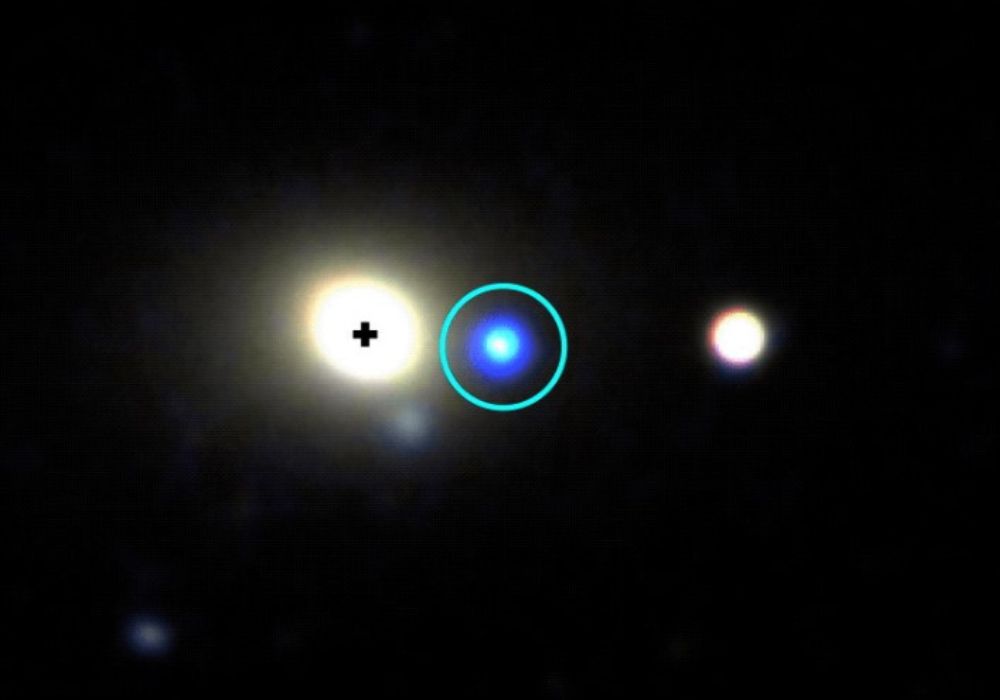
However, while the cause of this event is known, several mysteries surround this celestial object. Indeed, it is located at the edge of this galaxy, and according to some astronomers, it may have originated from a smaller galaxy that later merged with the larger one. But these are only hypotheses, and further studies will be needed to learn more about this celestial object.
Source(s)
The Astrophysical Journal Letters
Image source: NASA Hubble Space Telescope - Unsplash / Lowell Discovery Telescope/Legacy Survey/Robert Stein
 Add as a preferred source on Google


