




Astronomers have observed the earliest moments of a supernova 500 million light-years away
Supernovae are among the most spectacular events in the universe. And recently, astronomers have unveiled a study revealing the presence of a supernova in a galaxy located about 500 million light-years from Earth.
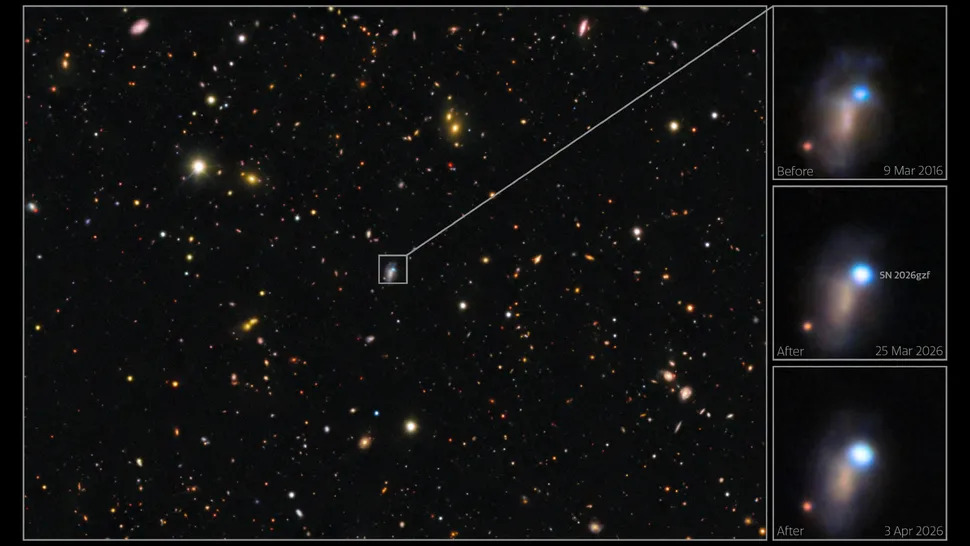
Indeed, in March 2026, the Einstein Probe detected an X-ray burst emitted in this galaxy. Although this may seem insignificant, numerous observations were made shortly after this discovery, notably using instruments at the NSF NoirLab.
Thanks to these observations, they were able to detect the earliest moments of the explosion, when the shock wave reached the star's surface, producing the first light from the supernova. Furthermore, according to their estimates, this is a broad-lined Type Ic (Ic-BL) supernova named SN 2026gzf, capable of triggering gamma-ray bursts.
However, this event is unique because, according to researchers, the initial shock wave is one of the weakest ever observed for this type of supernova. In addition, no evidence of a gamma-ray burst has been detected, as Brendan O’Connor explained in a statement:
"SN 2026gzf looks remarkably similar to other energetic supernovae that have been previously linked to gamma-ray bursts. Yet multi-wavelength follow-up observations using the most sensitive facilities found no evidence for a relativistic jet or an afterglow, which are typically seen in those events. One possibility is that the jet was ‘choked,’ either by the surface of the star or by circumstellar material surrounding the star."
Thus, while they now know that the explosion was caused by a star 20 times more massive than the Sun, several questions about its behavior remain unanswered. And for this, researchers will have to conduct further studies in the future.
Source(s)
The Astrophysical Journal Letters
Image source: CTIO/NOIRLab/DOE/NSF/AURA Image Processing: D. de Martin & M. Zamani (NSF NOIRLab) / NASA Hubble Space Telescope - Unsplash
 Add as a preferred source on Google


