




SpaceX crowding out competitors with tenfold AI satellite constellation increase
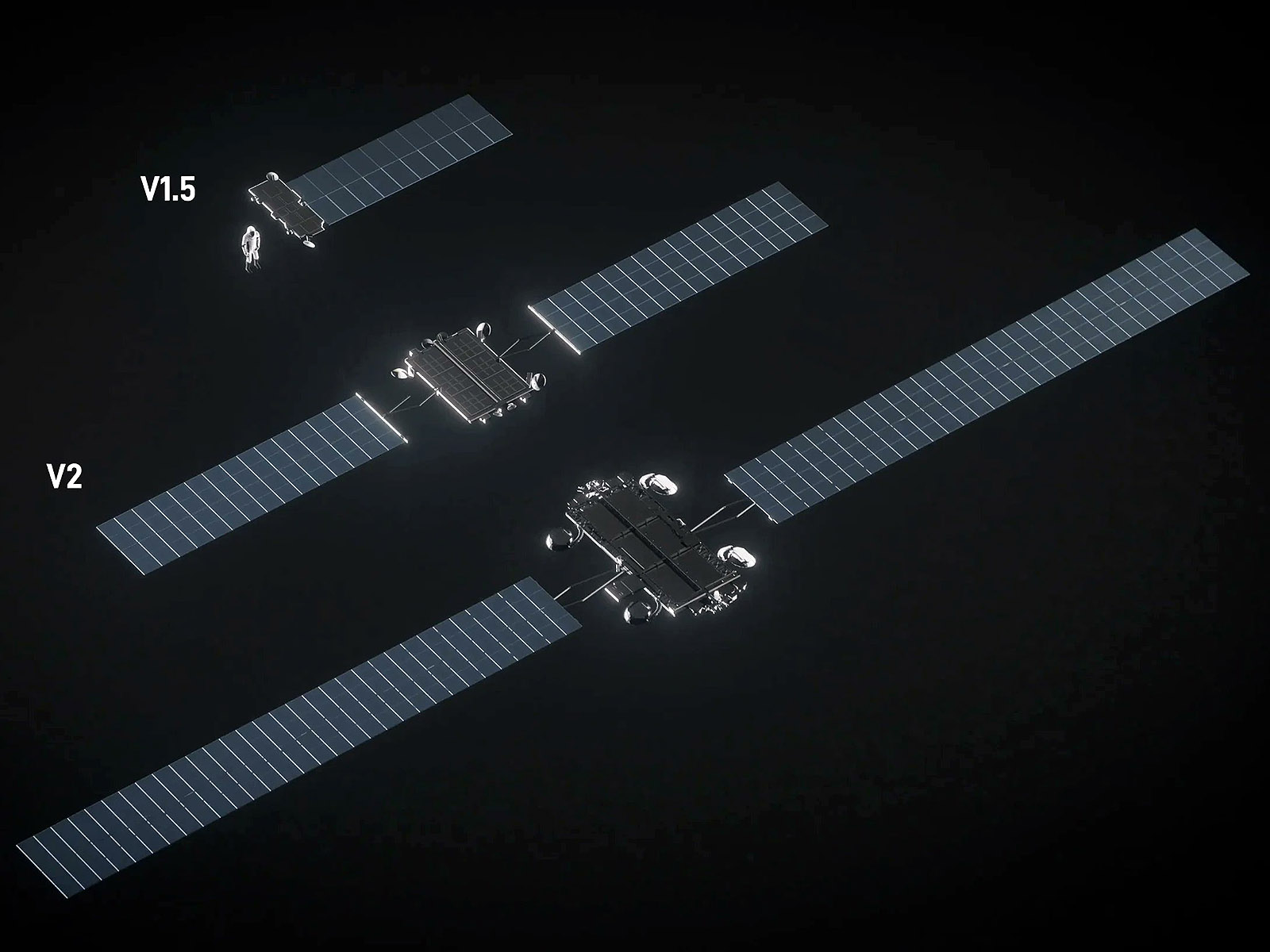
SpaceX has filed a new application with the U.S. Federal Communications Commission asking for permission to launch and operate a V3 (Gen3) satellite constellation numbering up to 100,000 units.
The filing seeks authority for a third-generation non-geostationary orbit system spread across two closely stacked orbital shells at roughly 323–327.5 km and 473–477.5 km altitudes and asks for inclination freedom ranging from 26 to 96.9 degrees.
Each SpaceX Gen3 satellite is expected to weigh as much as two tons, nearly three times the mass of a current Gen2 unit, and will require SpaceX's upcoming Starship rocket to reach orbit.
That is a serious leap in capability and seemingly not even the first batch of those “up to a million” AI data center satellites that SpaceX filed for previously. SpaceX is promising roughly a tenfold increase in download throughput to about 1 Tbps and a 22x jump in uplink capacity, with combined RF and laser backhaul reaching around 4 Tbps per satellite.
SpaceX argues that all that capacity will be needed so that the US remains competitive in the AI era:
The Gen3 system will include 100,000 satellites operating in very-low-Earth-orbit to deliver extremely low-latency and multi-gigabit symmetrical throughput for consumers, enterprises, and government users and billions of AI-powered devices around the world. To achieve this ambitious goal, the Gen3 system will put new spectrum and sharing frameworks to work for American consumers. AI requires massive uplink capacity to support high-definition 2 spatial and auditory data necessary for real-time decision-making and industrial automation. Without it, the United States cannot compete in the AI revolution.
The desired scale raises some eyebrows and indicates that SpaceX is in a hurry to crowd out any potential competitor now that it has become a publicly traded company. Currently, there are about 10,700 Starlink satellites in orbit, out of a Gen 2 permit that allows 15,000. An FCC authorization for 100,000 V3 satellites would be nearly ten times the current fleet of active satellites in orbit across every operator.
Astronomers and orbital-safety trackers already flag Starlink as the dominant source of collision-avoidance maneuvers in LEO, and tens of thousands more satellites would multiply the number of active objects requiring collision avoidance screening every single day. So far, SpaceX has been getting its way with regulators, but this AI satellite connectivity pitch will result in a way messier LEO environment, so the filing may not go down without a fight, including by potential SpaceX competitors.
Source(s)
SpaceX (FCC)
 Add as a preferred source on Google


