




A rare X-ray flash from a supernova was detected by the Einstein Probe

When a star reaches the final stages of its life after exhausting all its fuel, it may explode as a supernova. This phenomenon is one of the most powerful explosions observed in the universe. But beyond its devastating effects, this explosion can produce X-ray flashes, which can be detected by the Einstein Probe.
This probe is particularly valuable to astronomers. Indeed, it is capable of detecting these transient events, while other space telescopes were designed to detect gamma-ray bursts. As for X-rays, they are divided into several subcategories, such as X-ray flashes, which are extremely rare.
To understand the origin of this signal, a team of astronomers led by Gokul P. Srinivasaragavan of the University of Maryland has studied an X-ray flash named EP250827b. However, due to the low intensity of this signal, astronomers used the Zwicky Transient Facility and detected a supernova at the same location.
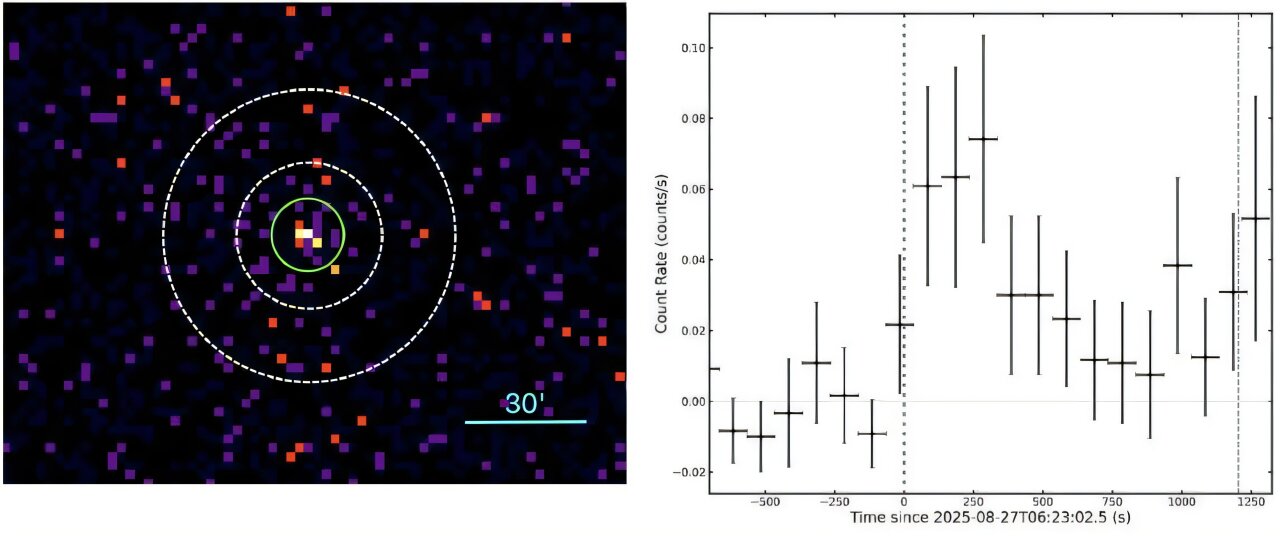
By studying this celestial object, known as SN 2025wkm, over several weeks, researchers have discovered that it is a Type Ic-BL supernova. In addition, during this event, the ejecta were traveling at a speed of about 25,000 miles per second.
But unlike other supernovae, its bolometric luminosity remained stable for about 20 days, which is a first for an X-ray flash supernova. Thus, to explain this behavior, some astronomers believe that an ultra-dense magnetar with an extremely powerful magnetic field may have formed following this event.
Source(s)
 Add as a preferred source on Google


