




This star was supposed to explode as a supernova, but astronomers found another explanation
In recent years, astronomers have closely studied a star because they believed that it would soon explode as a supernova. Known as AT 2016blu, this star is located about 29 million light-years from Earth and has some surprising characteristics.
Indeed, its mass is estimated to be at least 33 times that of the Sun, and it is classified as a luminous blue variable star. Since its discovery in 2012, researchers have observed 27 outbursts, occurring at different times, that displayed supernova-like characteristics.
As a result, they suspected that it could explode as a supernova. However, some researchers have put forward another hypothesis, highlighting the presence of a companion orbiting this celestial object:
"AT 2016blu exhibited 27 detected quasiperiodic (~113-day) outbursts between 2012 and June 2026, presumably triggered by periastron passages in an eccentric binary system in which the primary is a ≳33 M luminous blue variable (LBV)."
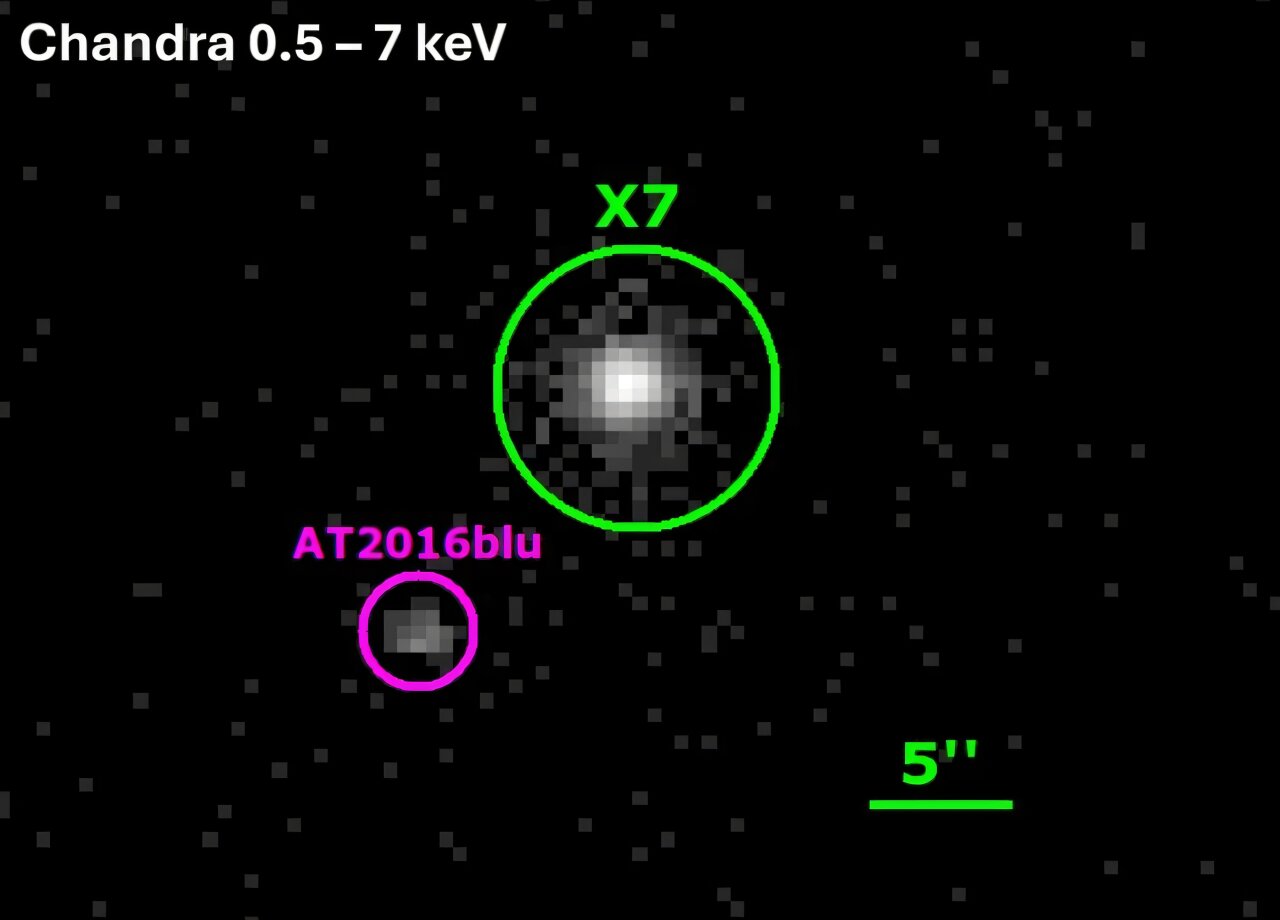
In a new study, astronomers observed AT 2016blu in X-rays, and by combining these observations with previous ones, they found evidence that this star is part of a binary system. Indeed, when an object accretes matter from its companion, heat is generated and X-rays are produced.
However, although they know that the companion is a compact object, its nature remains a mystery. It could be a black hole or a neutron star that is accreting matter from its host star.
Source(s)
Image source: NASA Hubble Space Telescope - Unsplash
 Add as a preferred source on Google


No comments for this article
