




After years of silence, a pulsar suddenly changes its spin three times

Although they remain largely mysterious, pulsars are neutron stars that rotate at different speeds. However, their rotation can sometimes suddenly accelerate, a phenomenon known as a glitch. According to astronomers, younger pulsars are more likely to exhibit this behavior, as is the case with PSR J1637−4642.
Only 41,000 years old, this pulsar completes a rotation in 154 milliseconds. However, despite its youth and high energy, it has remained quiet for about 10 years after its discovery. But a team of astronomers led by Zhaoyi Wang of Xiamen University has examined 15.5 years of data collected by the Murriyang radio telescope between February 2009 and October 2024.
During their observations, they discovered three glitches, the first one dating back to 2018. At that time, the rotation frequency of this celestial object increased by about 17.54 microhertz. Three years later, it increased by 14 nanohertz, followed by another increase of 179 nanohertz in 2024.
These results could help scientists to better understand pulsars, as the team explains in the study:
"Our results demonstrate that even “quiet” pulsars can harbor significant glitch activity."
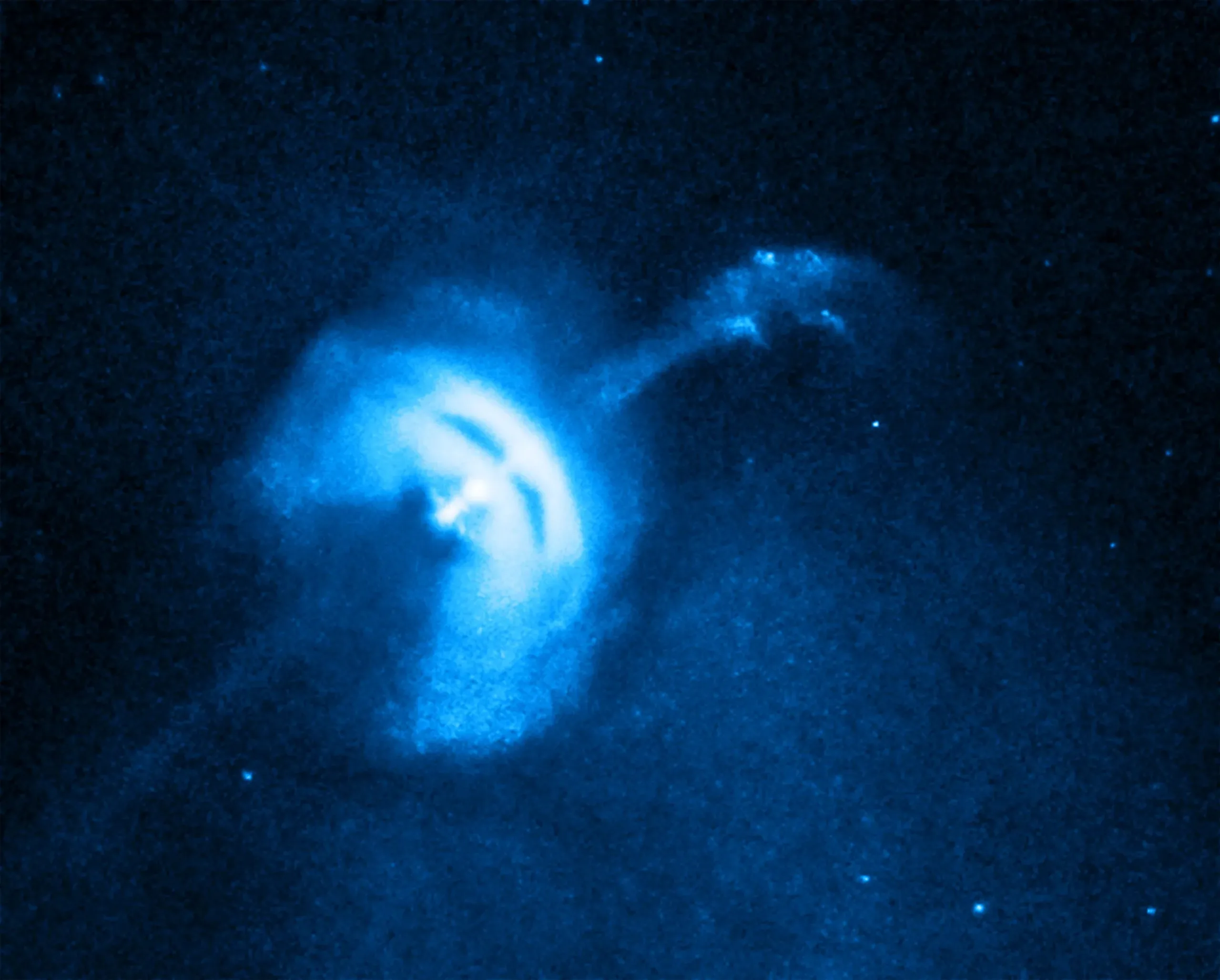
Indeed, these observations support a hypothesis put forward by scientists, which states that the glitches are caused by the transfer of angular momentum from the interior of neutron stars to their crusts. This causes the rotation rate to suddenly increase, followed by a slowdown over the next few months.
Source(s)
Image source: NASA Hubble Space Telescope - Unsplash / NASA/CXC/Univ. of Toronto/M. Durant, et al.
 Add as a preferred source on Google


