




James Webb discovers a “black hole star” the size of the Solar System
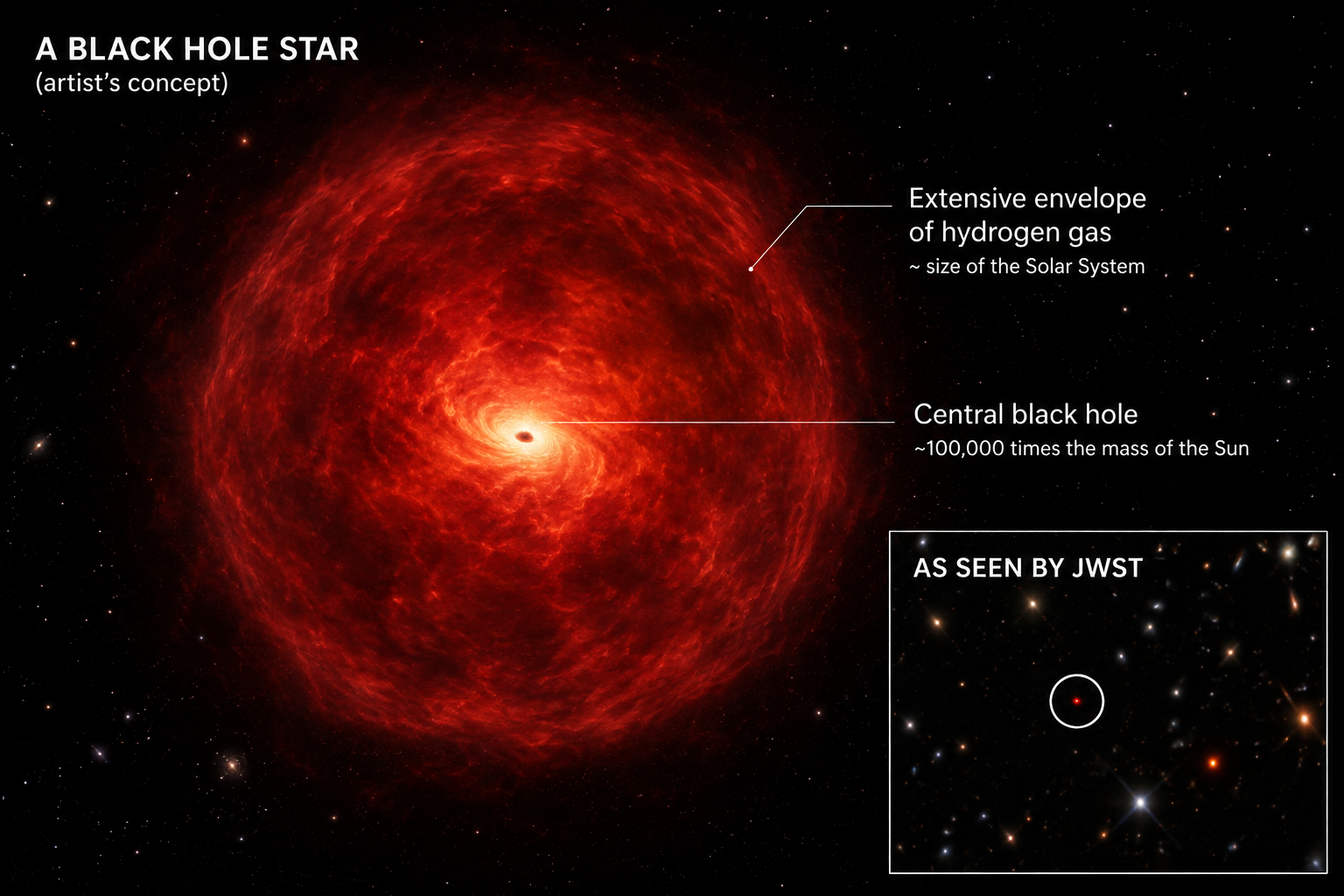
Astronomers have discovered what could be an entirely new type of astrophysical object: a “black hole star” that combines a massive black hole with an enormous envelope of gas similar to a star. The object, named MoM-BH*-1, was spotted by NASA’s James Webb Space Telescope (JWST) in the very early universe, just a few hundred million years after the Big Bang.
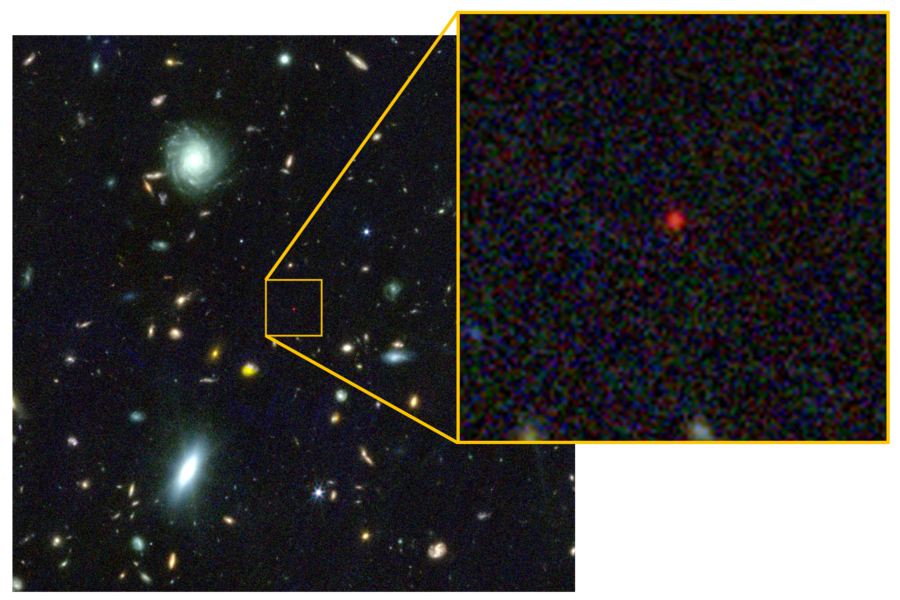
The object appears as an extremely bright red dot, roughly the size of our Solar System. Yet its energy output is estimated to be 100 billion times greater than that of any ordinary star, making conventional nuclear fusion impossible as its power source. Instead, the researchers believe the object is powered by a central black hole surrounded by an enormous, dense cloud of hydrogen gas.
“We think there is a central black hole that is 100,000 times as massive as the sun,” said lead author Rohan Naidu, a NASA Hubble Fellow and Pappalardo Fellow at MIT’s Kavli Institute for Astrophysics and Space Research. The black hole would be surrounded by an extended envelope of gas roughly the size of the Solar System, giving the object its star-like appearance.
The discovery was made as part of the Mirage or Miracle (MoM) survey, which was searching JWST observations for some of the earliest galaxies in the universe. The researchers noticed that one particularly bright source looked unusual because of its intense red color.
Red objects in deep-space images are often thought to be surrounded by dust, which can alter the apparent color of their light. However, MoM-BH*-1 showed a number of other unusual characteristics. Its light showed an exceptionally deep Balmer break, a spectral feature associated with dense gas absorbing photons in stellar atmospheres. The object also showed almost no signatures of elements heavier than hydrogen and helium.
The researchers then ran simulations of different possible configurations to figure out what could produce the object's distinctive spectrum and brightness. They found that an extremely dense envelope of hydrogen could explain the unusual spectral features, but not the extraordinary amount of energy being emitted.
A black hole turned out to be the missing piece. By adding an actively accreting black hole to their models and varying its mass and other parameters, the researchers found a configuration that closely matched JWST’s observations. Their simulations suggest that MoM-BH*-1 contains a black hole roughly 100,000 times more massive than the Sun, surrounded by a dense hydrogen envelope about the size of the Solar System.
The proposed object is fundamentally different from both an ordinary star and a conventional black hole. In a normal star, nuclear fusion provides the energy while the surrounding gas forms the stellar body. In a black hole star, the accreting black hole acts as the power source, while the surrounding dense gas creates a star-like outer envelope. The accompanying illustration in the MIT material contrasts the three structures, showing the black hole star’s envelope extending to roughly Solar-System scale.
The discovery could also help explain one of the biggest mysteries raised by JWST: the numerous “little red dots” appearing throughout observations of the early universe. These objects are extremely common in JWST images but appear to have largely disappeared from the modern universe.
The researchers suspect that many of these little red dots could actually be black hole stars embedded within early galaxies. MoM-BH*-1 appears unusual because it is so bright that it effectively outshines its host galaxy, allowing astronomers to observe what the team describes as almost pure black hole-star light.
The study, titled “A Gas Enshrouded and Gas Reddened Black Hole at Cosmic Dawn,” was published in Nature. If the interpretation is confirmed by further observations, black hole stars could provide a new explanation for how massive black holes formed and evolved in the early universe.
 Add as a preferred source on Google


