




Leaked Starlink Mini 2 details show built-in battery but slower uploads

Just days after SpaceX quietly unveiled the new Starlink V5 dish, another interesting development has surfaced. This time, it’s the Starlink Mini 2. According to fresh information shared by well-known Starlink hardware leaker Oleg Kutkov, SpaceX is actively developing a new Mini terminal under the hardware revision mini2_prod1.
The leaked hardware details show that the Starlink Mini 2 is becoming slightly more compact than its predecessor. The internal antenna panel has shrunk from 236 × 276 mm on the original Mini to 225 × 273 mm on the new model. The antenna itself has also been redesigned.
Compared to the original Starlink Mini, which packs 571 antenna elements, the Mini 2 uses 549 elements, suggesting SpaceX has optimized the phased-array layout rather than simply shrinking existing hardware. The leak also shows that the device retains GPS support and is explicitly configured for in-motion use, meaning it should continue serving travellers, campers, boats and vehicles just like today’s Starlink Mini.
Interestingly, the terminal still uses the same Catapult SoC found in the original model.
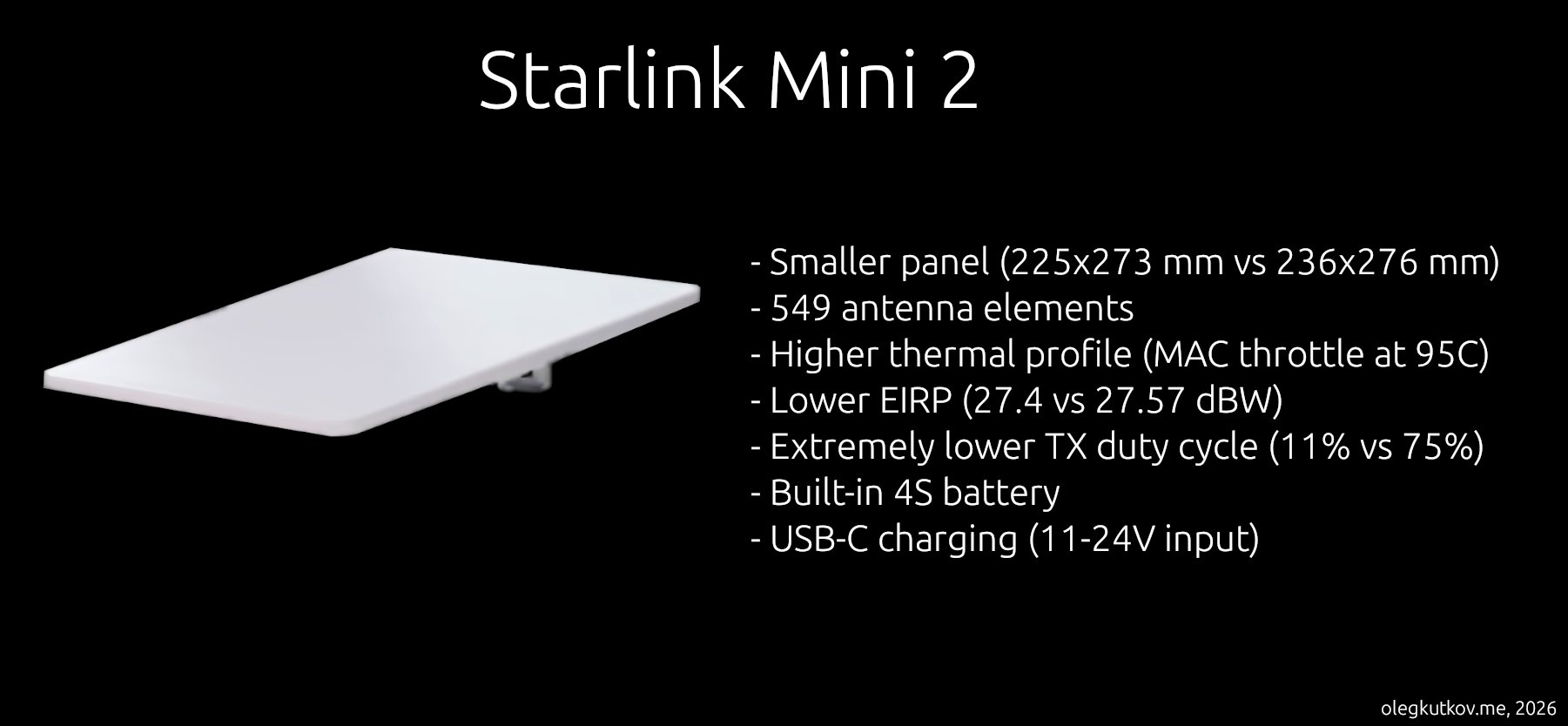
But perhaps the biggest upgrade is that the Mini 2 will reportedly have a built-in battery. The leak reveals that the Starlink Mini 2 includes a built-in 4-cell (4S) lithium battery managed by a BQ40Z-series battery management system (BMS). Battery capacity hasn’t been revealed yet, but charging will happen through USB-C Power Delivery, supporting an input voltage between 11V and 24V.
That’s a huge departure from the current Mini, but the battery doesn’t come without trade-offs. According to the leak, the new terminal operates with a lower average EIRP (Equivalent Isotropically Radiated Power) of 27.4 dBW, down slightly from 27.57 dBW on the original Mini. More significantly, its transmit duty cycle has reportedly dropped from 75% to just 11%. That reduction will likely translate into lower uplink performance, particularly during sustained uploads.
The leaker believes this is probably a consequence of SpaceX trying to stay within the device’s new power budget. In other words, if you’re running the dish from an internal battery, conserving energy becomes far more important than squeezing out every last megabit of upload speed.
SpaceX also appears to have increased several thermal limits. The Starlink Mini 2 reportedly raises the MAC thermal throttling thresholds to 95°C and 99°C, compared to 79°C and 83°C on the first-generation Mini. Meanwhile, battery thermal shutdown is configured at 80°C. These changes suggest the company expects the terminal to operate under more demanding conditions while still maintaining stable performance.
Source(s)
 Add as a preferred source on Google


