




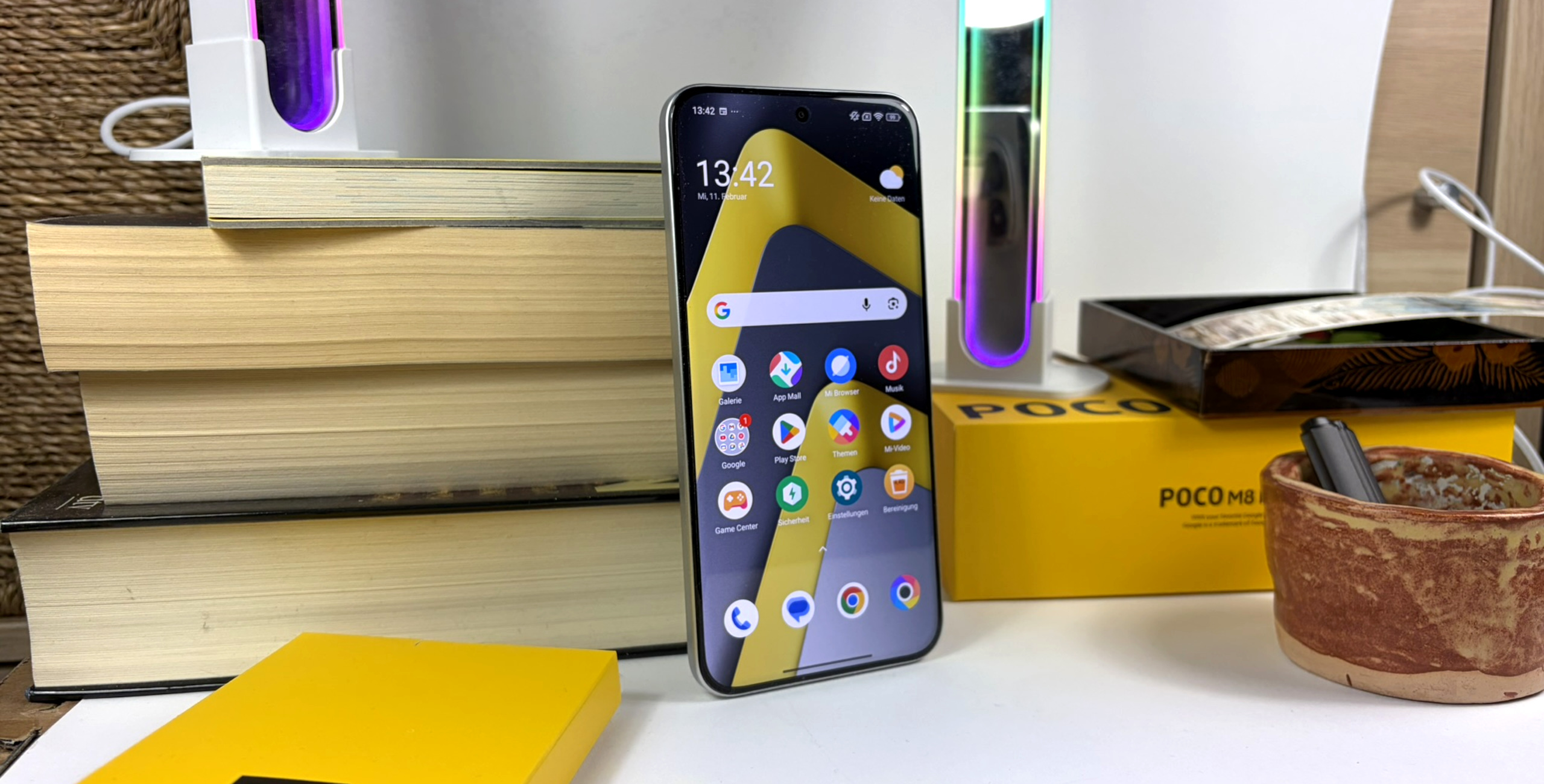
Verdict on the Xiaomi Poco M8 Pro 5G
The Xiaomi Poco M8 Pro offers a number of good reasons to buy. Its 6500 mAh battery guarantees extra-long runtimes without compromising on weight, the true-color AMOLED screen is extremely bright for this price range and the Snapdragon 7s Gen 4 ensures very solid everyday performance. The camera also takes good photos, the update supply is guaranteed until 2031 and the "radio" mode can be particularly helpful in an emergency.
What the Poco M8 Pro does not offer is eSIM support, a telephoto camera and the option to expand the memory using a microSD card. The advertising in HyperOS 2.0 is also annoying, but at least you can get rid of it with relatively little effort.
Pros
Cons
Price and availability

- $345.00XIAOMI Poco M8 PRO 5G Ai (Compatible with Tmobile Mint Tello & Global) (512GB + 12GB) 50MP Dual Camera NFC 6.83" 144Hz Octa Core Unlocked Dual Sim Model 2510EPC8BG Liberado (Silver)
- $385.97XIAOMI Poco M8 PRO 5G Ai (Compatible with Tmobile Mint Tello & Global) (512GB + 12GB) 50MP Dual Camera NFC 6.83" 144Hz Octa Core Unlocked Dual Sim Model 2510EPC8BG Liberado (Black)
- $315.87XIAOMI Poco M8 PRO 5G Ai (Compatible with Tmobile Mint Tello & Global) (256GB + 8GB) 50MP Dual Camera NFC 6.83" 144Hz Octa Core Unlocked Dual Sim Model 2510EPC8BG Liberado (Green)
Table of Contents
- Verdict on the Xiaomi Poco M8 Pro 5G
- Specifications
- Case - High-quality mix of Gorilla Glass, plastic and aluminum
- Features - Poco M8 Pro 5G with up to 512 GB memory
- Software - HyperOS 2.0 and updates until 2031
- Communication and GNSS - WiFi 6E, Bluetooth 5.4 and radio mode
- Phone functions and voice quality
- Cameras - 50 MP main camera with Light Fusion 800
- Accessories and warranty - 100-watt power supply costs extra
- Input devices and operation - More than fast enough for everyday use
- Display - 3000 nits brightness and high-frequency PWM dimming
- Performance - Poco M8 Pro 5G with Snapdragon 7s Gen 4
- Emissions - Cool Poco smartphone with stereo sound
- Battery life - silicon-carbon battery as a trump card
- Notebookcheck overall rating
- Possible alternatives in comparison
Poco smartphones usually offer a lot of performance and features at a moderate price. The new Poco M8 Pro 5G is just such a case. For just under 300 Euros (~$356), you get a 6.83-inch smartphone with Snapdragon 7s Gen 4, AMOLED display and a huge battery with 6500 mAh. Our test shows whether the overall package is convincing. We also take a look at how it compares to the very similar Xiaomi Redmi Note 15 Pro 5G in terms of price and features.
Specifications
Case - High-quality mix of Gorilla Glass, plastic and aluminum
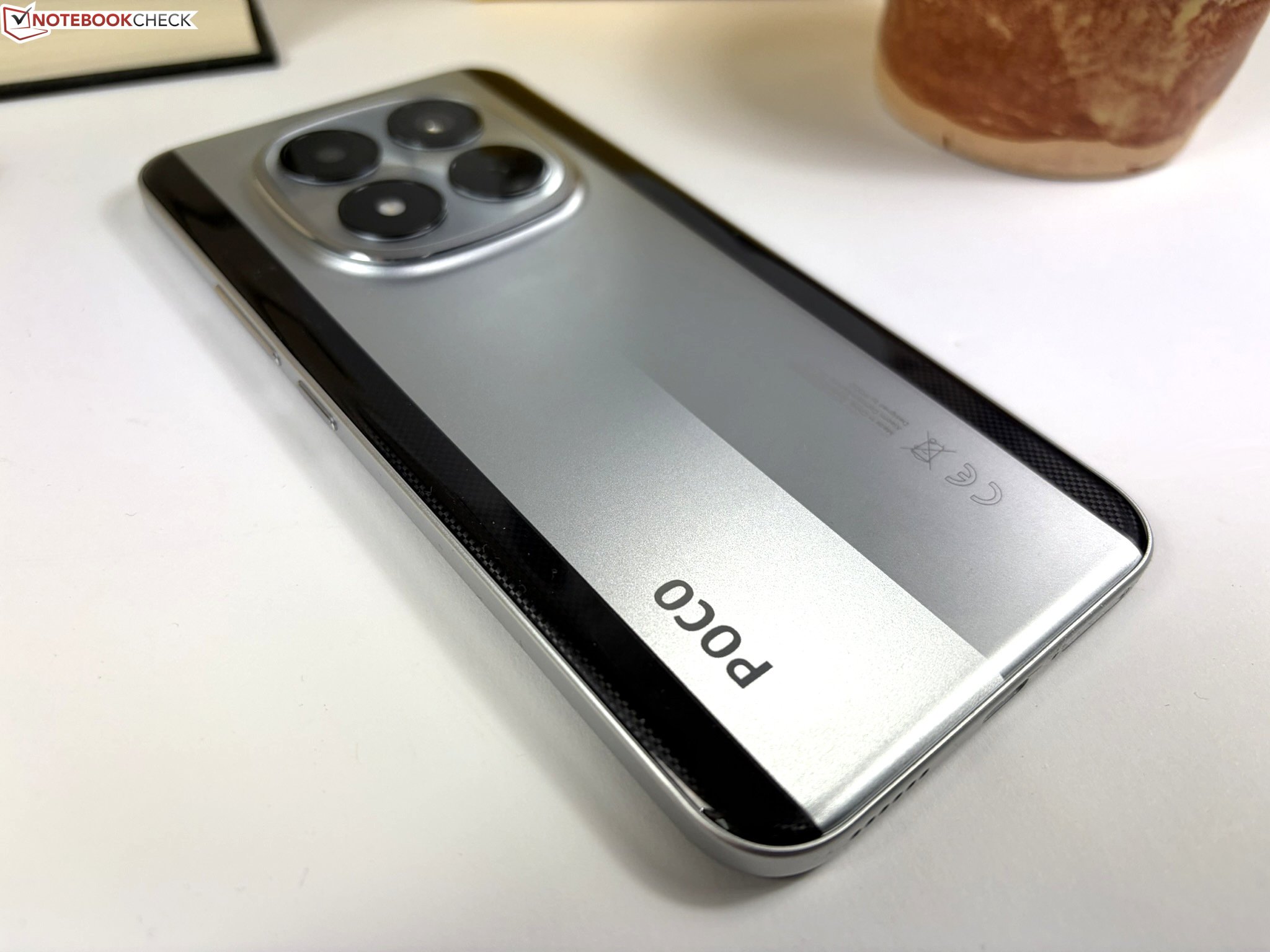
Despite its impressive dimensions, the Poco M8 Pro 5G weighs just 206 grams (~7.3 oz) and is therefore relatively light in the hand. The look and finish are also successful, even though there is only plastic on the back.
The back cover has a symmetrical design that also incorporates the camera module. Thanks to a central seam, the matte back reflects incident light slightly differently. On our test device in the silver color variant, black edge strips in a carbon checkerboard pattern look are added on the long sides. Other colors are black and green.
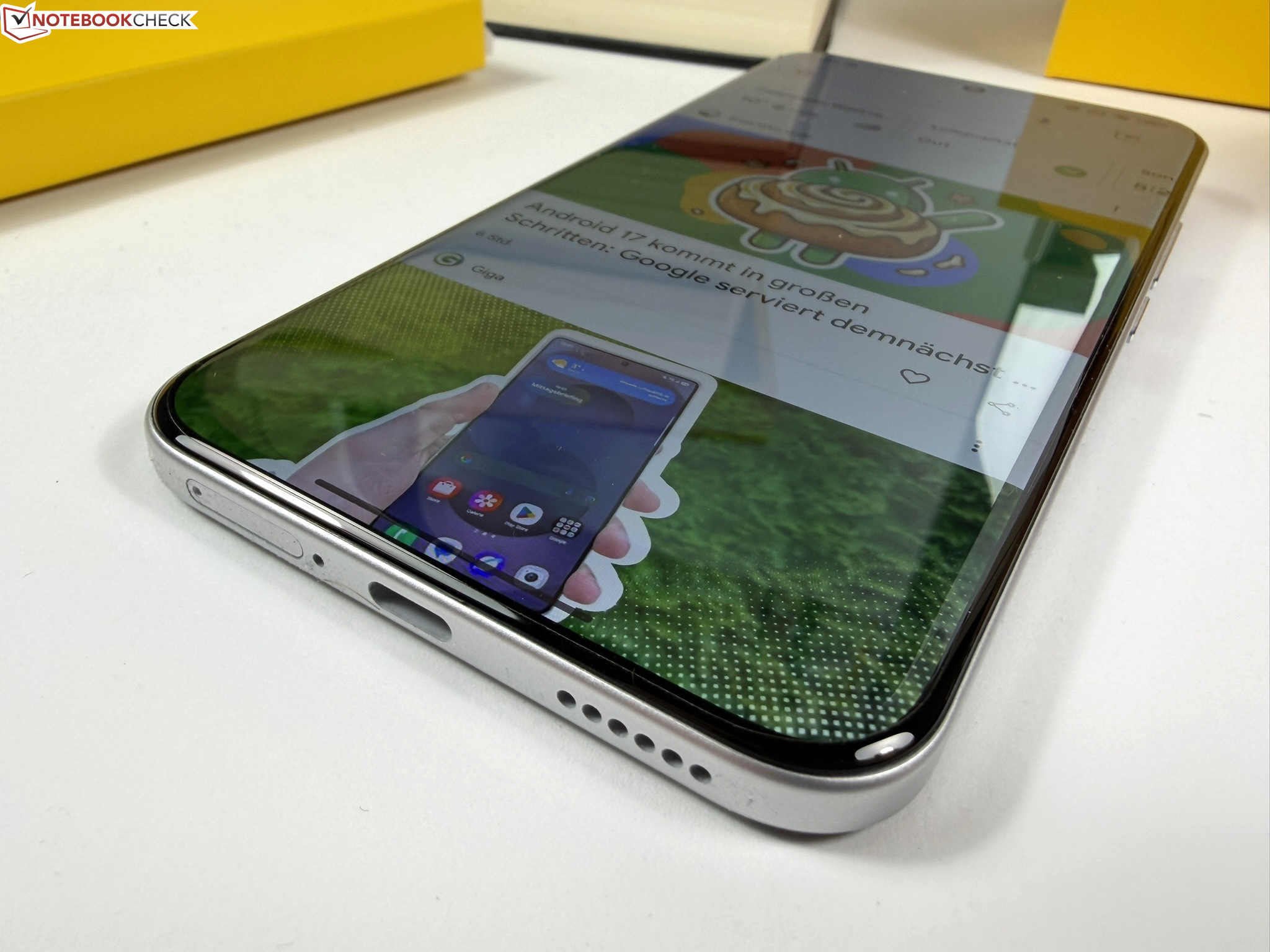
The display glass, which has an additional protective film, is made of Gorilla Glass Victus 2 and is slightly rounded at the corners and edges. Together with the very narrow display edges on all sides, this gives the Xiaomi phone a very high-quality look. An aluminum frame connects the front and back and the Poco M8 Pro 5G is also dust and waterproof thanks to its IP68 certification.



Features - Poco M8 Pro 5G with up to 512 GB memory
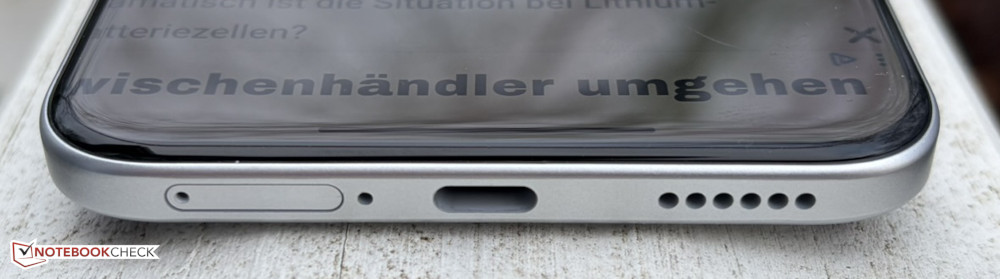
The Poco M8 Pro 5G is available with 8/256 or 12/512 GB memory. With USB-C 2.0, NFC, WiFi 6E, Bluetooth 5.4 and dual SIM, it offers almost everything you need. Only eSIMs and microSD cards are not supported. Despite AMOLED, there is also no always-on display; the display only remains visible for 10 seconds after tapping.


Software - HyperOS 2.0 and updates until 2031
The Poco phone runs HyperOS 2.0, which is based on Android 15. Xiaomi plans to provide four Android updates for the Poco M8 Pro 5G and supply it with security updates for 6 years (until January 2031).


Sustainability
Xiaomi wraps the packaging of the Poco M8 Pro 5G, which is made from recycled paper, in a plastic film. The manufacturer does not say which recycled materials are used in the smartphone.
Xiaomi offers tools for self-repairing cell phones and official spare parts are available. If you want to get rid of your old device, you can trade it in at Xiaomi's trade-in program as payment.
Communication and GNSS - WiFi 6E, Bluetooth 5.4 and radio mode
On our reference router Asus ROG Rapture GT-AXE11000, the Poco M8 Pro 5G achieves very stable transfer rates with a maximum of around 950 Mbps. Overall, the Poco phone achieves a higher Wi-Fi speed than many of its competitors.
Offline communication is a truly unique selling point. Two compatible Xiaomi smartphones can use it to establish a voice connection even without a mobile network. To do this, Bluetooth must be activated, a SIM card inserted and each participant must be logged into their Xiaomi account. According to Xiaomi, offline communication works over a distance of up to 1.9 kilometers (~1.2 miles).
| Networking | |
| Xiaomi Poco M8 Pro 5G | |
| iperf3 transmit AXE11000 | |
| iperf3 receive AXE11000 | |
| iperf3 transmit AXE11000 6GHz | |
| iperf3 receive AXE11000 6GHz | |
| Nothing Phone (3a) Pro | |
| iperf3 transmit AXE11000 | |
| iperf3 receive AXE11000 | |
| OnePlus Nord CE 5 | |
| iperf3 transmit AXE11000 | |
| iperf3 receive AXE11000 | |
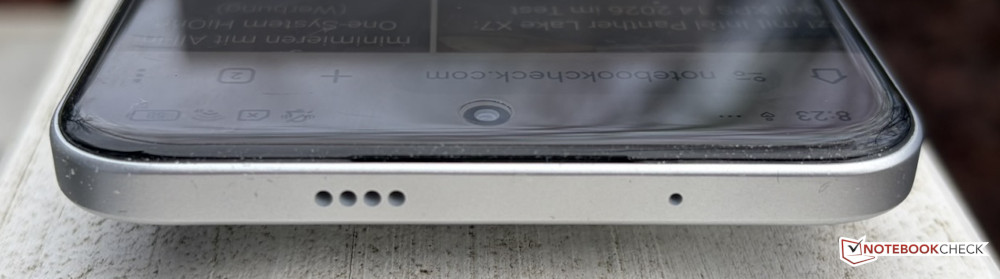
| Samsung Galaxy A36 5G | |
| iperf3 transmit AXE11000 | |
| iperf3 receive AXE11000 | |
| Xiaomi Poco M7 Pro 5G | |
| iperf3 transmit AXE11000 | |
| iperf3 receive AXE11000 | |
| Xiaomi Redmi Note 15 Pro 5G | |
| iperf3 transmit AXE11000 | |
| iperf3 receive AXE11000 | |
| Average Wi-Fi 6E | |
| iperf3 transmit AXE11000 | |
| iperf3 receive AXE11000 | |
| iperf3 transmit AXE11000 6GHz | |
| iperf3 receive AXE11000 6GHz | |
| Average of class Smartphone | |
| iperf3 transmit AXE11000 | |
| iperf3 receive AXE11000 | |
| iperf3 transmit AXE11000 6GHz | |
| iperf3 receive AXE11000 6GHz | |


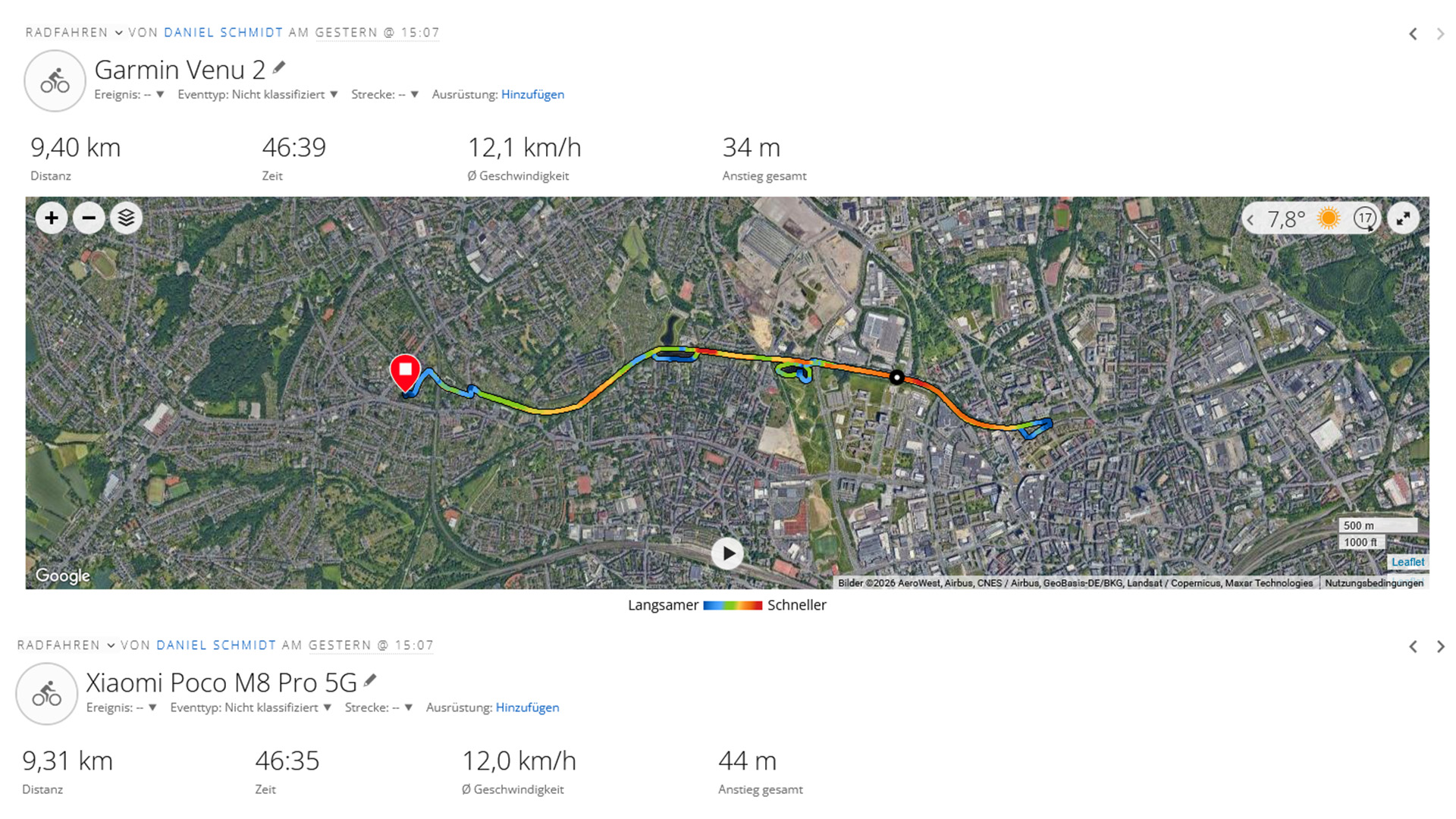
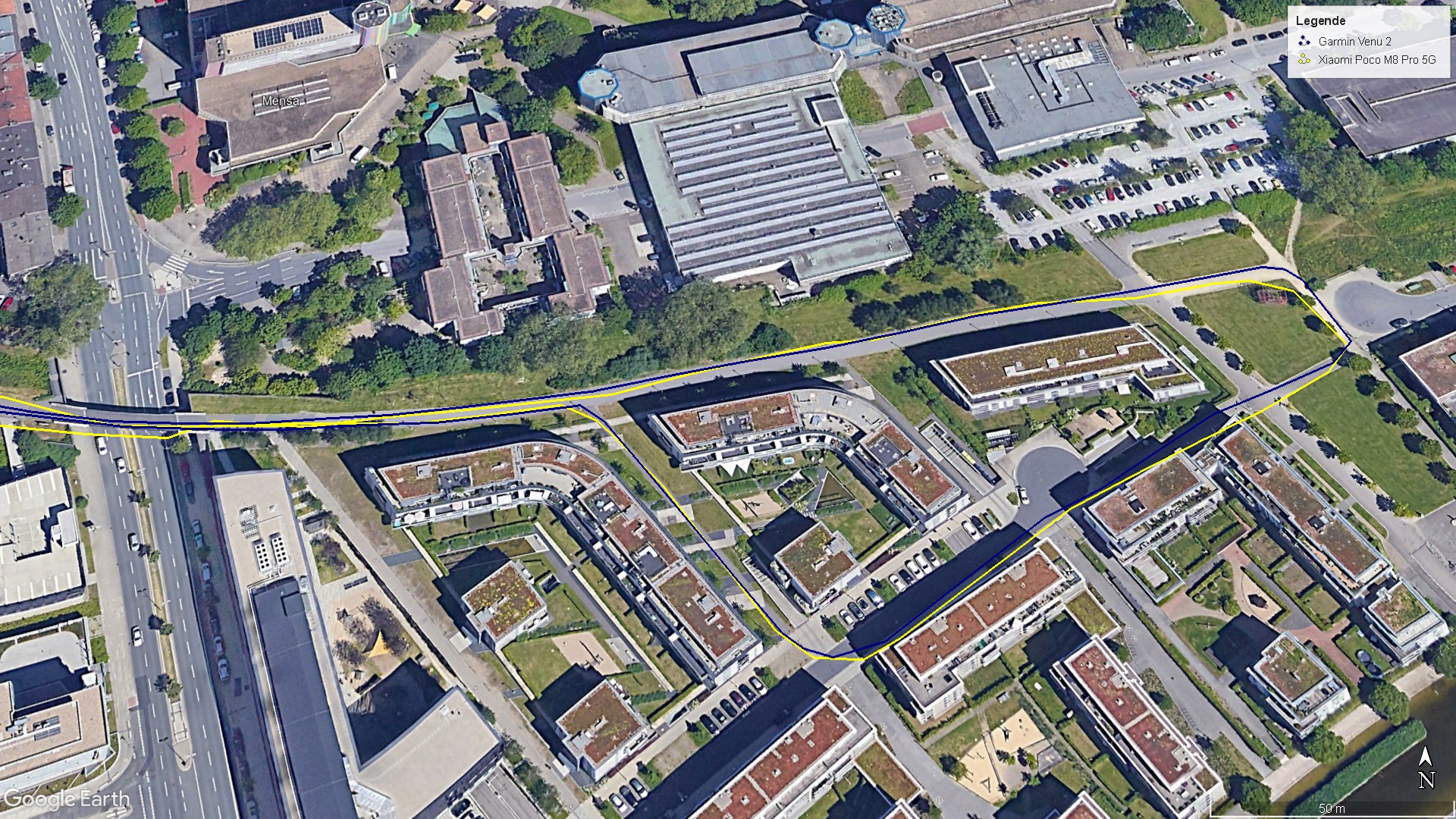
The Poco M8 Pro 5G is very suitable as a navigation device. It supports all common satellite navigation services and, apart from minor inaccuracies, guided us to our destination as accurately as the reference device, the Garmin Venu 2 fitness smartwatch.

Phone functions and voice quality
The Poco M8 Pro 5G is capable of VoLTE and Wi-Fi calls and can be used with 2 physical SIMs. During our test calls, the smartphone transmits voices clearly and reliably masks background noise.
Cameras - 50 MP main camera with Light Fusion 800

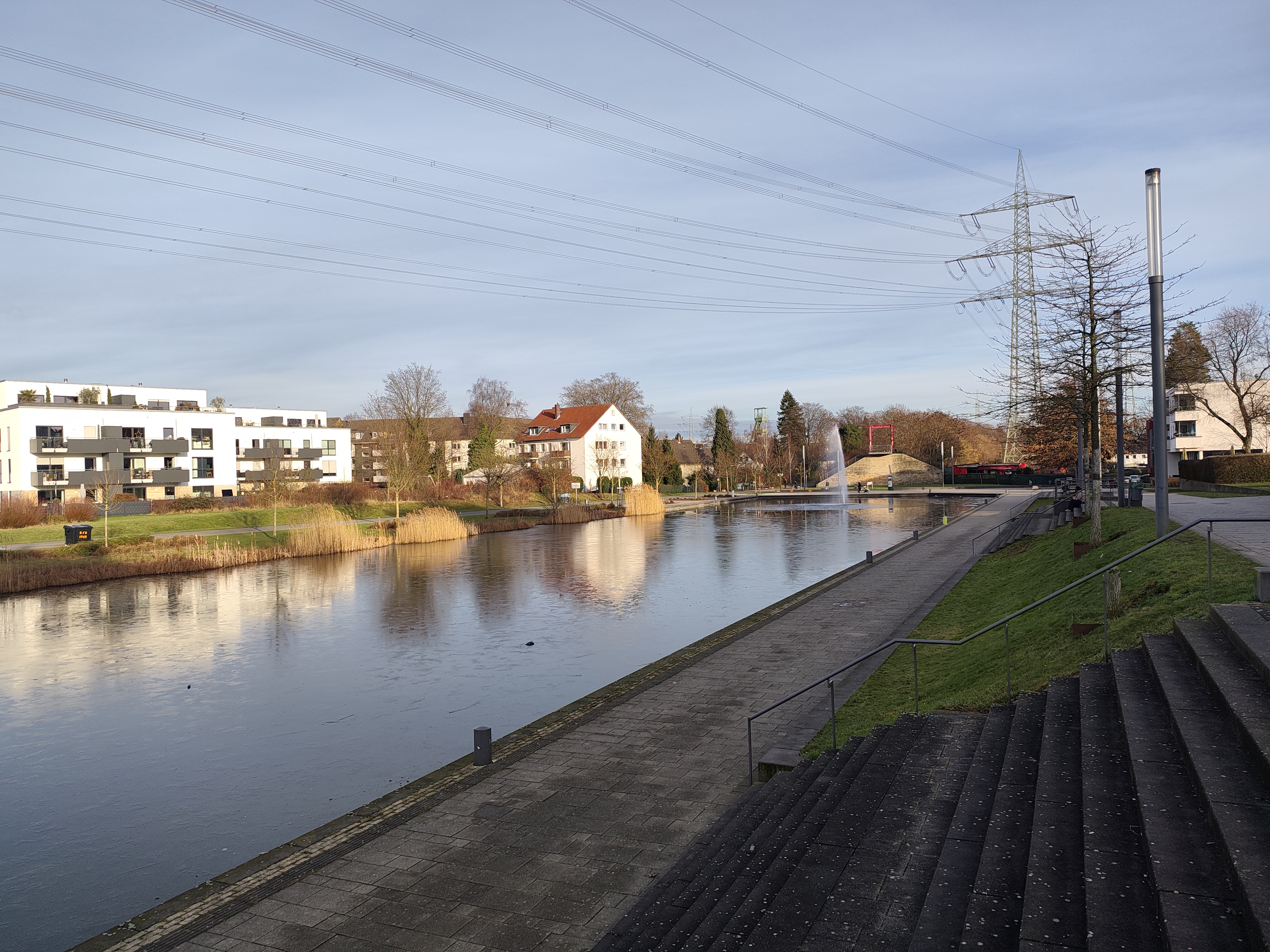
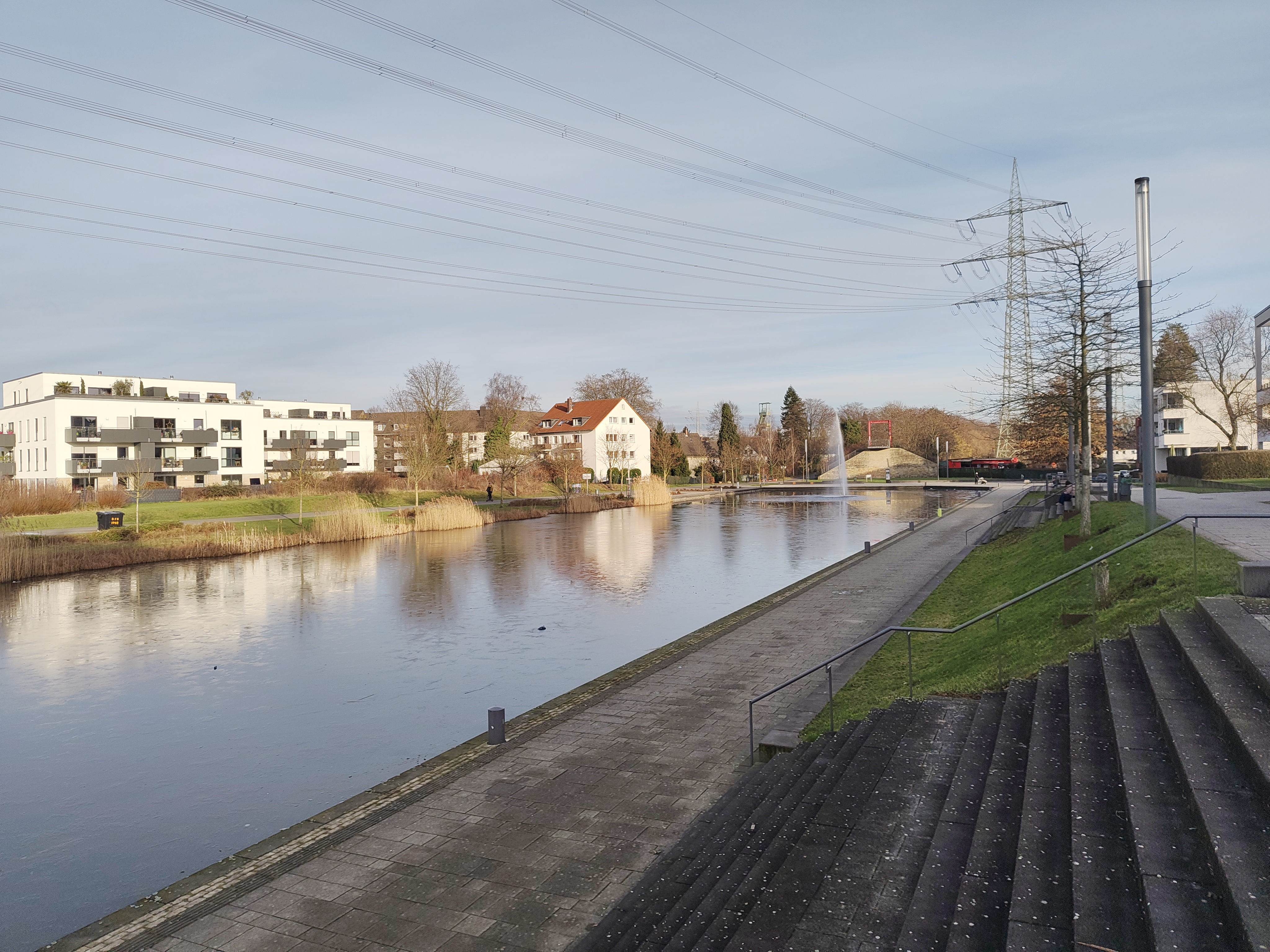
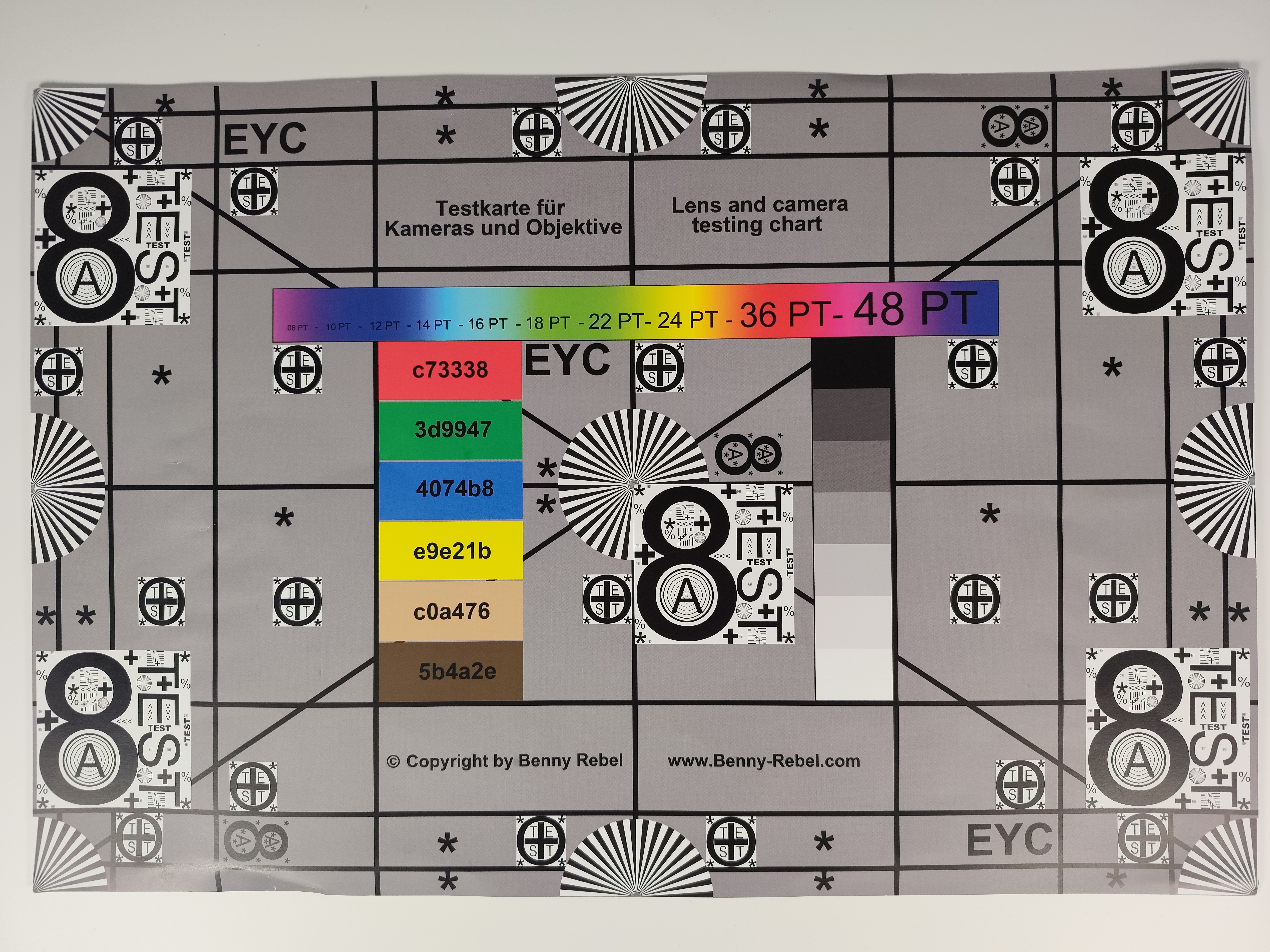
The Poco M8 Pro 5G uses a 50 MP camera that relies on Xiaomi's Light Fusion 800 image sensor. Its images appear sharp and vivid and it is only on closer inspection that it becomes apparent that the level of detail is not that high. However, good results can still be achieved even in low light. Video recordings can be made in good quality with up to 4K at 30 frames per second.
The ultra-wide-angle camera makes a typical appearance for this price range. It only has a resolution of 8 MP and is nowhere near the quality of the main camera. However, it has the image noise well under control and also takes usable snapshots overall.
There is a 32 MP camera for selfies and portraits, which, like the main camera, achieves good image quality. It records videos at up to 1080p at 30 frames per second.


Image comparison
Choose a scene and navigate within the first image. One click changes the position on touchscreens. One click on the zoomed-in image opens the original in a new window. The first image shows the scaled photograph of the test device.
DaylightDaylightUltra wide angle5x ZoomLow light























Accessories and warranty - 100-watt power supply costs extra
The accessories for the Poco M8 Pro 5G include a USB-C cable, a SIM tool and a protective cover.
Xiaomi offers a 12-month warranty on its Poco smartphones in the EU. Irrespective of this, the Dealer warranty and additional insurance cover is available at Xiaomi Care.
Input devices and operation - More than fast enough for everyday use
The Snapdragon 7s Gen 4, up to 12 GB of RAM and the 120 Hz display give the Poco M8 Pro 5G a system performance that is easily sufficient for everyday use. Even more complex apps and games in higher graphics settings do not pose any insurmountable problems for the smartphone.
The Poco M8 Pro 5G is biometrically unlocked using a fingerprint sensor or alternatively using 2D facial recognition. Both worked smoothly in the test.


Display - 3000 nits brightness and high-frequency PWM dimming
The AMOLED panel is slightly above the manufacturer's specification (3000 nits) with HDR content at 3117 cd/m². With SDR, an average of 1795 cd/m² and a maximum of 2841 cd/m² are achieved.
The peak luminance falls below 1000 cd/m² again after a short time. Nevertheless, the Poco M8 Pro 5G has one of the brightest displays in its class overall. It works with high-frequency PWM dimming for eye-friendly operation.
| |||||||||||||||||||||||||
Brightness Distribution: 99 %
Center on Battery: 1791 cd/m²
Contrast: ∞:1 (Black: 0 cd/m²)
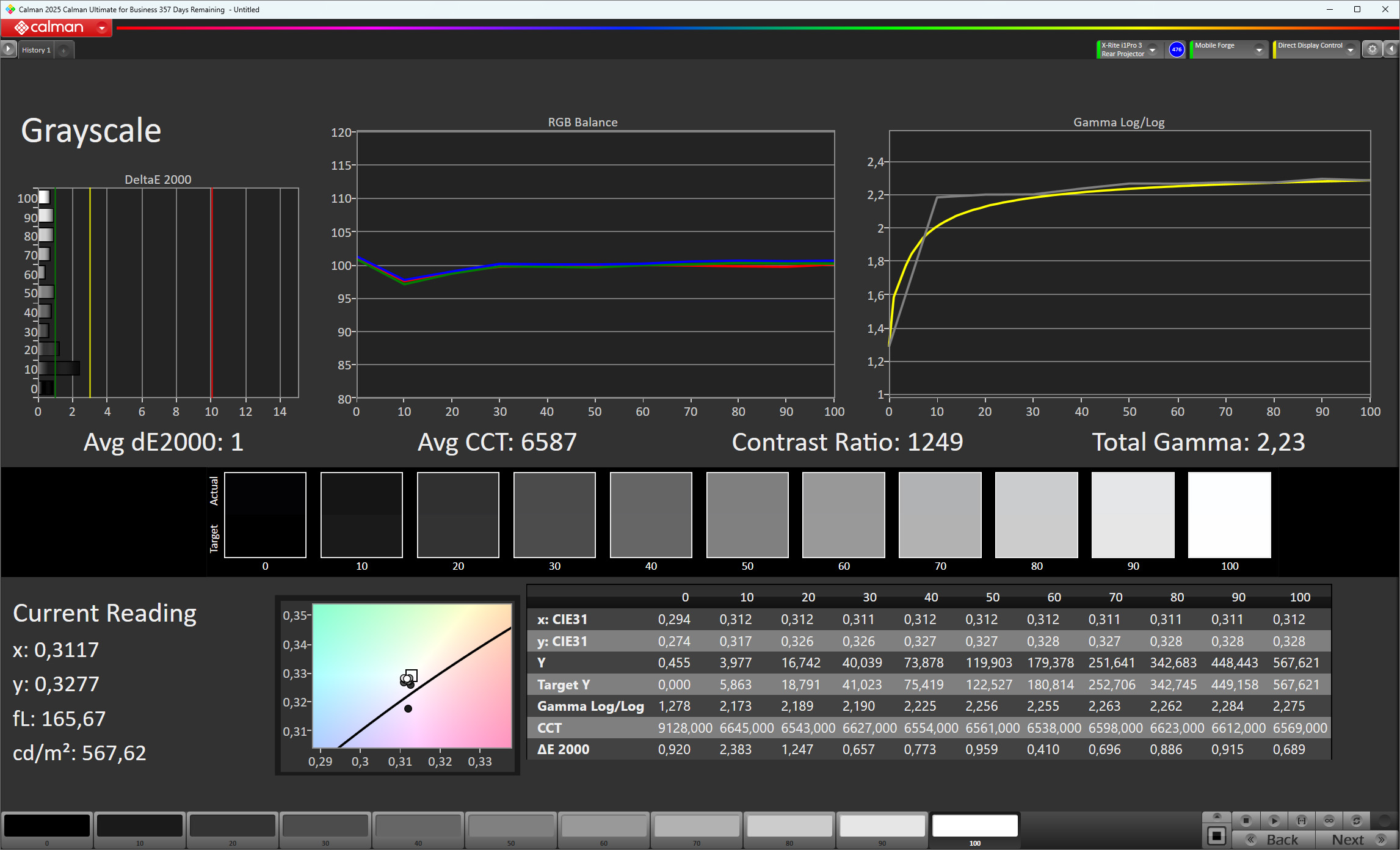
ΔE ColorChecker Calman: 1.5 | ∀{0.5-29.43 Ø4.69}
ΔE Greyscale Calman: 1 | ∀{0.09-98 Ø4.94}
99.7% sRGB (Calman 2D)
Gamma: 2.23
CCT: 6587 K
| Xiaomi Poco M8 Pro 5G AMOLED, 2772x1280, 6.8" | Nothing Phone (3a) Pro AMOLED, 2392x1080, 6.8" | OnePlus Nord CE 5 AMOLED, 2392x1080, 6.8" | Samsung Galaxy A36 5G Super AMOLED, 2340x1080, 6.7" | Xiaomi Poco M7 Pro 5G AMOLED, 2400x1080, 6.7" | Xiaomi Redmi Note 15 Pro 5G AMOLED, 2772x1280, 6.8" | |
|---|---|---|---|---|---|---|
| Screen | -28% | -20% | -31% | -13% | -79% | |
| Brightness middle (cd/m²) | 1791 | 1318 -26% | 1315 -27% | 1127 -37% | 1157 -35% | 1155 -36% |
| Brightness (cd/m²) | 1795 | 1306 -27% | 1300 -28% | 1137 -37% | 1151 -36% | 1136 -37% |
| Brightness Distribution (%) | 99 | 98 -1% | 97 -2% | 98 -1% | 97 -2% | 97 -2% |
| Black Level * (cd/m²) | ||||||
| Colorchecker dE 2000 * | 1.5 | 1.5 -0% | 1.22 19% | 1.8 -20% | 1.1 27% | 2.42 -61% |
| Colorchecker dE 2000 max. * | 3.4 | 2.9 15% | 2.7 21% | 2.8 18% | 2.4 29% | 5.63 -66% |
| Greyscale dE 2000 * | 1 | 2.3 -130% | 2 -100% | 2.1 -110% | 1.6 -60% | 3.7 -270% |
| Gamma | 2.23 99% | 2.26 97% | 2.258 97% | 2.11 104% | 2.21 100% | 2.246 98% |
| CCT | 6587 99% | 6819 95% | 6503 100% | 6466 101% | 6622 98% | 7263 89% |
* ... smaller is better
| Display / APL18 Peak Brightness | |
| Xiaomi Poco M8 Pro 5G | |
| Xiaomi Redmi Note 15 Pro 5G | |
| Samsung Galaxy A36 5G | |
| Nothing Phone (3a) Pro | |
| Xiaomi Poco M7 Pro 5G | |
| Display / HDR Peak Brightness | |
| Xiaomi Poco M8 Pro 5G | |
| Xiaomi Redmi Note 15 Pro 5G | |
| Xiaomi Poco M7 Pro 5G | |
| Samsung Galaxy A36 5G | |
| Nothing Phone (3a) Pro | |
Screen Flickering / PWM (Pulse-Width Modulation)
| Screen flickering / PWM detected | 120 Hz Amplitude: 14.64 % Secondary Frequency: 3333 Hz | 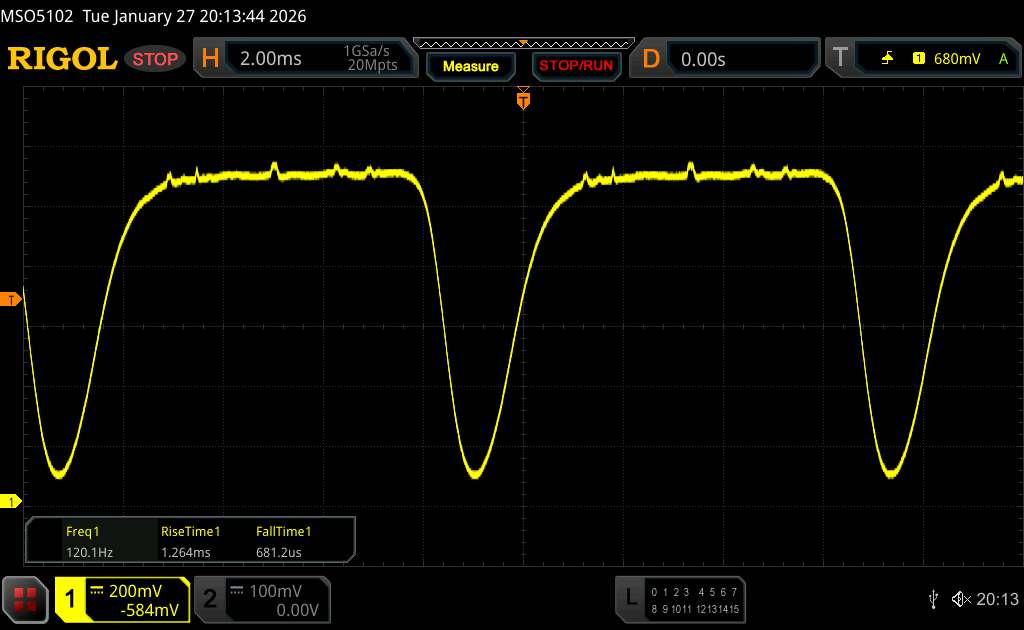 | |
The display backlight flickers at 120 Hz (worst case, e.g., utilizing PWM) . The frequency of 120 Hz is very low, so the flickering may cause eyestrain and headaches after extended use. In comparison: 52 % of all tested devices do not use PWM to dim the display. If PWM was detected, an average of 7622 (minimum: 5 - maximum: 343500) Hz was measured. | |||
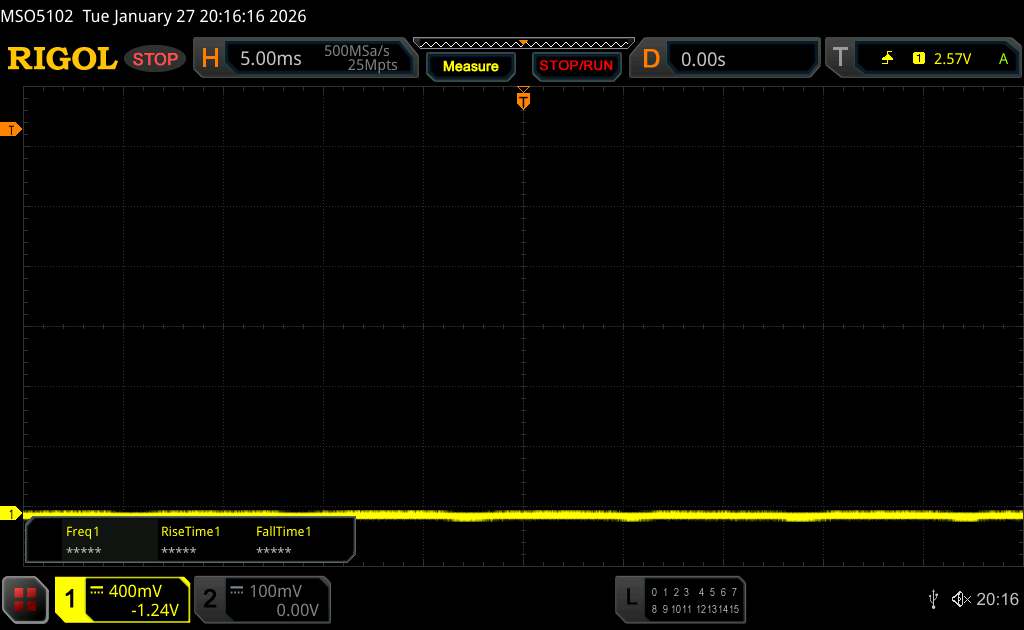
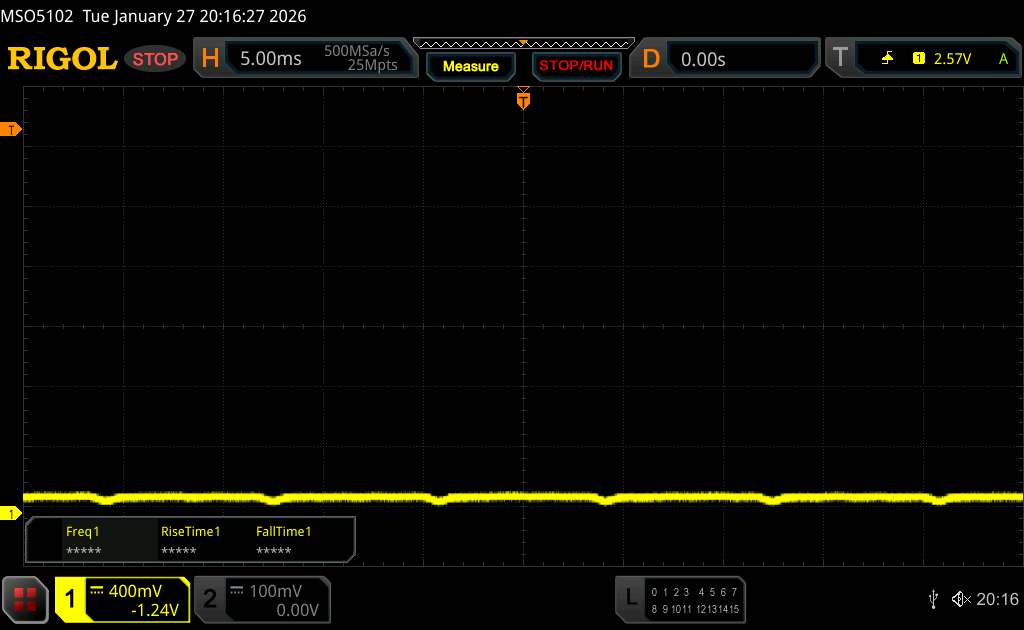
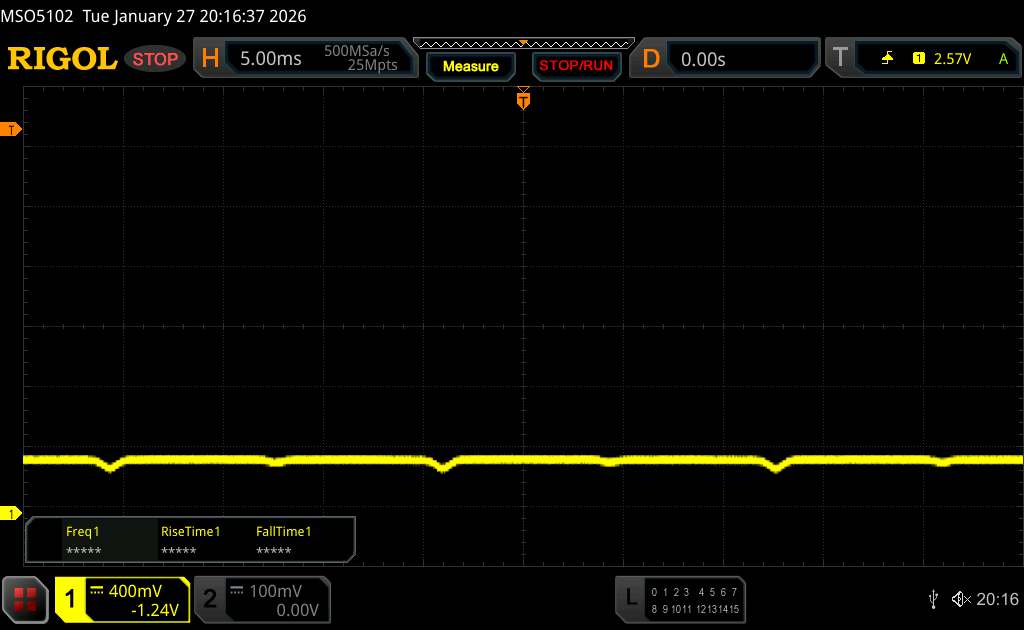
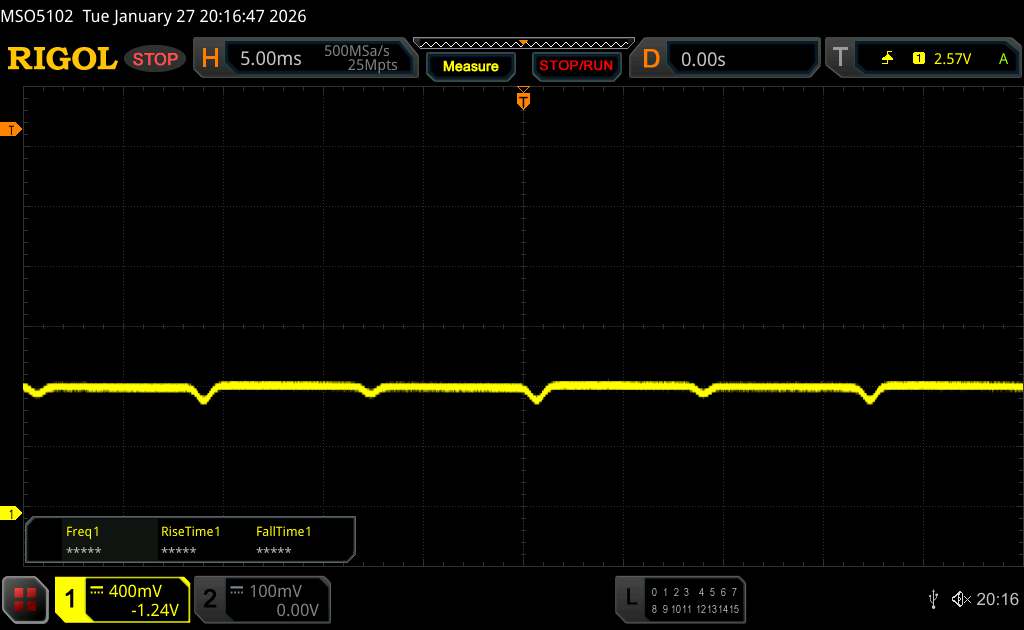
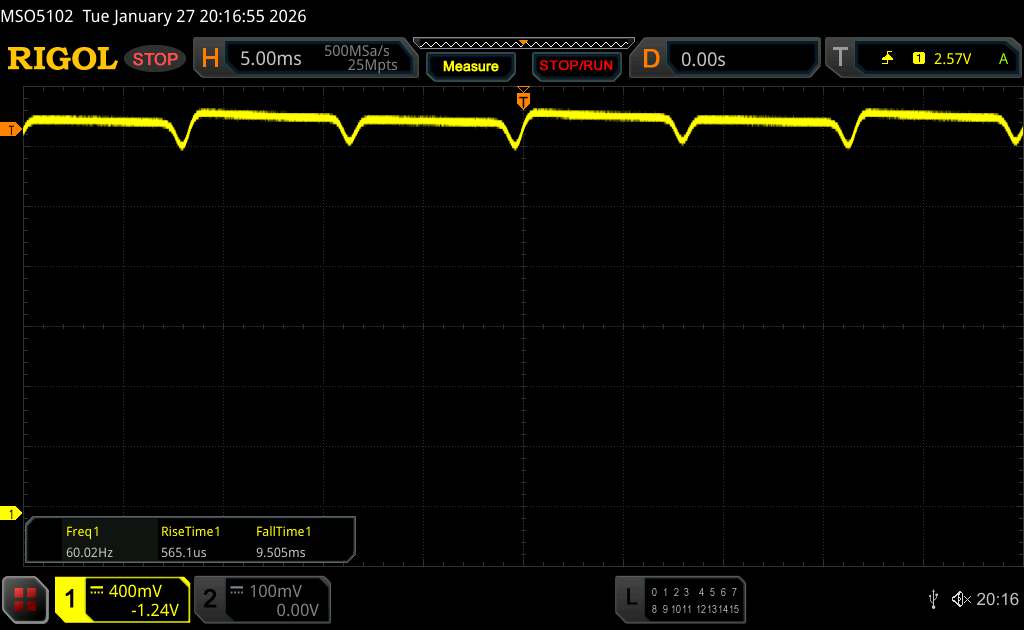
Measurement series with fixed zoom level and different brightness settings (The amplitude curve at minimum brightness looks flat, but this is due to the scaling. The info box shows the enlarged version of the amplitude at minimum brightness)
In the standard color mode Vivid, the AMOLED panel already provides a very precise color reproduction. If you want to adjust the image parameters, you can choose from two additional color modes with Saturated and Original Color Pro and adjust the color temperature.


Display Response Times
| ↔ Response Time Black to White | ||
|---|---|---|
| 1.13 ms ... rise ↗ and fall ↘ combined | ↗ 0.5545 ms rise | 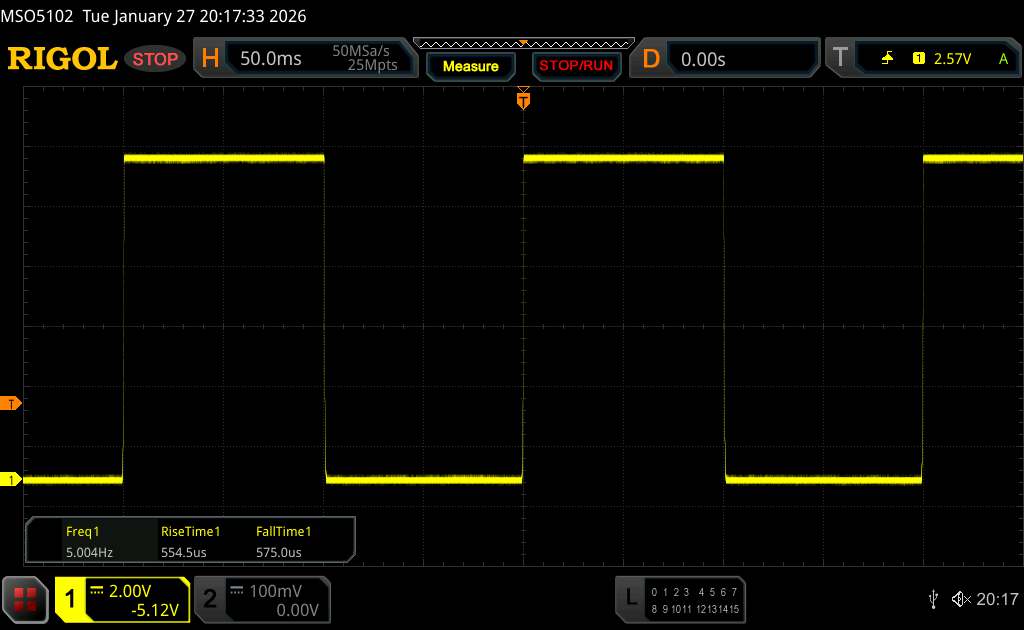 |
| ↘ 0.575 ms fall | ||
| The screen shows very fast response rates in our tests and should be very well suited for fast-paced gaming. In comparison, all tested devices range from 0.1 (minimum) to 240 (maximum) ms. » 6 % of all devices are better. This means that the measured response time is better than the average of all tested devices (19.7 ms). | ||
| ↔ Response Time 50% Grey to 80% Grey | ||
| 1.09 ms ... rise ↗ and fall ↘ combined | ↗ 0.5235 ms rise | 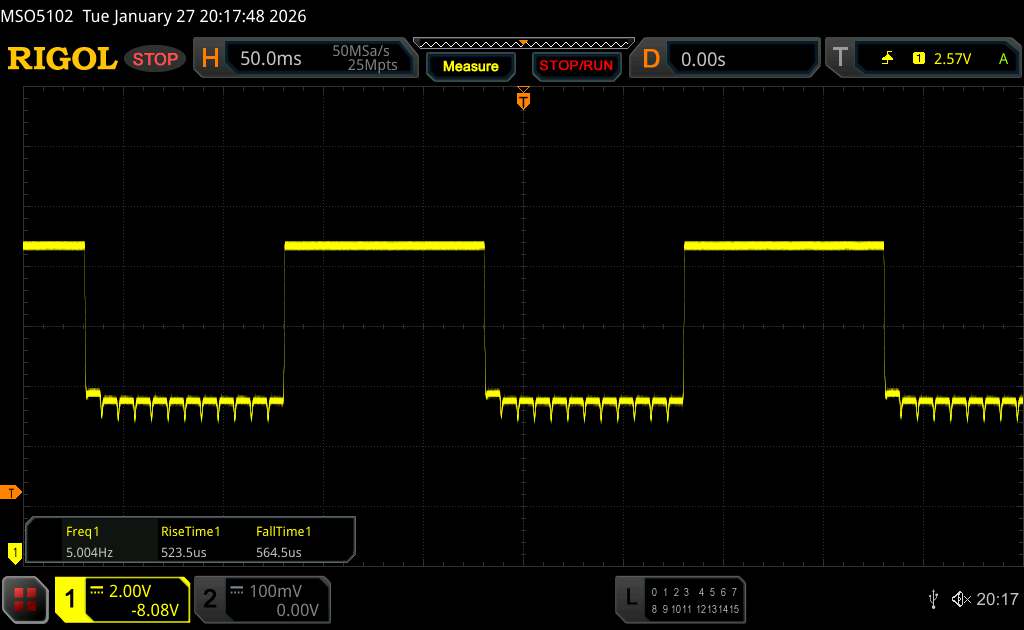 |
| ↘ 0.5645 ms fall | ||
| The screen shows very fast response rates in our tests and should be very well suited for fast-paced gaming. In comparison, all tested devices range from 0.13 (minimum) to 636 (maximum) ms. » 5 % of all devices are better. This means that the measured response time is better than the average of all tested devices (30.7 ms). | ||
The Poco smartphone performs very well outdoors. Its bright and viewing-angle stable display can also compensate for direct sunlight quite well and there are no problems at all with readability in the shade.


Performance - Poco M8 Pro 5G with Snapdragon 7s Gen 4
With the Snapdragon 7s Gen 4 the Poco M8 Pro 5G is pretty fast for a mid-range smartphone. It even cracks the million-point mark in AnTuTu v11. However, the MediaTek Dimensity 8350, which is found in the OnePlus Nord CE 5 for example, is sometimes slightly faster.
| Antutu v11 - Score | |
| Average of class Smartphone (519159 - 4450644, n=44, last 2 years) | |
| Xiaomi Poco M8 Pro 5G | |
| Average Qualcomm Snapdragon 7s Gen 4 (1019553 - 1057813, n=2) | |
| UL Procyon AI Inference for Android - Overall Score NNAPI | |
| Average of class Smartphone (2895 - 66164, n=99, last 2 years) | |
| Nothing Phone (3a) Pro | |
| Xiaomi Poco M8 Pro 5G | |
| Average Qualcomm Snapdragon 7s Gen 4 (8216 - 8756, n=3) | |
| Xiaomi Redmi Note 15 Pro 5G | |
| Samsung Galaxy A36 5G | |
| Xiaomi Poco M7 Pro 5G | |
| AImark - Score v3.x | |
| Average of class Smartphone (293 - 307528, n=66, last 2 years) | |
| Xiaomi Poco M7 Pro 5G | |
| Average Qualcomm Snapdragon 7s Gen 4 (n=1) | |
| Samsung Galaxy A36 5G | |
In the GPU tests, the Poco phone only lands in the midfield. The Adreno 810 graphics chip of the Snapdragon 7s Gen 4 is clearly inferior to the Mali-G615 MP6 GPU of the MediaTek Dimensity 8350. Nevertheless, the performance is easily sufficient to run current games smoothly in medium graphics settings.
GFXBench (DX / GLBenchmark) 2.7: T-Rex Onscreen | 1920x1080 T-Rex Offscreen
GFXBench 3.0: on screen Manhattan Onscreen OGL | 1920x1080 1080p Manhattan Offscreen
GFXBench 3.1: on screen Manhattan ES 3.1 Onscreen | 1920x1080 Manhattan ES 3.1 Offscreen
GFXBench: on screen Car Chase Onscreen | 1920x1080 Car Chase Offscreen | on screen Aztec Ruins High Tier Onscreen | 2560x1440 Aztec Ruins High Tier Offscreen | on screen Aztec Ruins Normal Tier Onscreen | 1920x1080 Aztec Ruins Normal Tier Offscreen | 3840x2160 4K Aztec Ruins High Tier Offscreen
| 3DMark / Wild Life Extreme Unlimited | |
| OnePlus Nord CE 5 | |
| Xiaomi Poco M8 Pro 5G | |
| Nothing Phone (3a) Pro | |
| Xiaomi Redmi Note 15 Pro 5G | |
| Samsung Galaxy A36 5G | |
| 3DMark / Wild Life Extreme | |
| OnePlus Nord CE 5 | |
| Xiaomi Poco M8 Pro 5G | |
| Nothing Phone (3a) Pro | |
| Xiaomi Redmi Note 15 Pro 5G | |
| Samsung Galaxy A36 5G | |
| 3DMark / Wild Life Unlimited Score | |
| OnePlus Nord CE 5 | |
| Xiaomi Poco M8 Pro 5G | |
| Nothing Phone (3a) Pro | |
| Samsung Galaxy A36 5G | |
| 3DMark / Steel Nomad Light Unlimited Score | |
| Xiaomi Redmi Note 15 Pro 5G | |
| Xiaomi Poco M8 Pro 5G | |
| Nothing Phone (3a) Pro | |
| 3DMark / Steel Nomad Light Score | |
| Xiaomi Redmi Note 15 Pro 5G | |
| Xiaomi Poco M8 Pro 5G | |
| Nothing Phone (3a) Pro | |
| GFXBench (DX / GLBenchmark) 2.7 / T-Rex Onscreen | |
| Samsung Galaxy A36 5G | |
| Xiaomi Poco M8 Pro 5G | |
| Xiaomi Redmi Note 15 Pro 5G | |
| Nothing Phone (3a) Pro | |
| Xiaomi Poco M7 Pro 5G | |
| GFXBench (DX / GLBenchmark) 2.7 / T-Rex Offscreen | |
| Xiaomi Poco M8 Pro 5G | |
| Nothing Phone (3a) Pro | |
| Samsung Galaxy A36 5G | |
| Xiaomi Redmi Note 15 Pro 5G | |
| Xiaomi Poco M7 Pro 5G | |
| GFXBench 3.0 / Manhattan Onscreen OGL | |
| Samsung Galaxy A36 5G | |
| Xiaomi Redmi Note 15 Pro 5G | |
| Nothing Phone (3a) Pro | |
| Xiaomi Poco M8 Pro 5G | |
| Xiaomi Poco M7 Pro 5G | |
| GFXBench 3.0 / 1080p Manhattan Offscreen | |
| Xiaomi Redmi Note 15 Pro 5G | |
| Xiaomi Poco M8 Pro 5G | |
| Nothing Phone (3a) Pro | |
| Samsung Galaxy A36 5G | |
| Xiaomi Poco M7 Pro 5G | |
| GFXBench 3.1 / Manhattan ES 3.1 Onscreen | |
| Nothing Phone (3a) Pro | |
| Samsung Galaxy A36 5G | |
| Xiaomi Redmi Note 15 Pro 5G | |
| Xiaomi Poco M8 Pro 5G | |
| Xiaomi Poco M7 Pro 5G | |
| GFXBench 3.1 / Manhattan ES 3.1 Offscreen | |
| Xiaomi Poco M8 Pro 5G | |
| Nothing Phone (3a) Pro | |
| Xiaomi Redmi Note 15 Pro 5G | |
| Samsung Galaxy A36 5G | |
| Xiaomi Poco M7 Pro 5G | |
| GFXBench / Car Chase Onscreen | |
| Nothing Phone (3a) Pro | |
| Samsung Galaxy A36 5G | |
| Xiaomi Redmi Note 15 Pro 5G | |
| Xiaomi Poco M8 Pro 5G | |
| Xiaomi Poco M7 Pro 5G | |
| GFXBench / Car Chase Offscreen | |
| Xiaomi Redmi Note 15 Pro 5G | |
| Xiaomi Poco M8 Pro 5G | |
| Nothing Phone (3a) Pro | |
| Samsung Galaxy A36 5G | |
| Xiaomi Poco M7 Pro 5G | |
| GFXBench / Aztec Ruins High Tier Onscreen | |
| OnePlus Nord CE 5 | |
| Nothing Phone (3a) Pro | |
| Samsung Galaxy A36 5G | |
| Xiaomi Poco M8 Pro 5G | |
| Xiaomi Redmi Note 15 Pro 5G | |
| Xiaomi Poco M7 Pro 5G | |
| GFXBench / Aztec Ruins High Tier Offscreen | |
| OnePlus Nord CE 5 | |
| Xiaomi Poco M8 Pro 5G | |
| Nothing Phone (3a) Pro | |
| Xiaomi Redmi Note 15 Pro 5G | |
| Samsung Galaxy A36 5G | |
| Xiaomi Poco M7 Pro 5G | |
| GFXBench / Aztec Ruins Normal Tier Onscreen | |
| OnePlus Nord CE 5 | |
| Nothing Phone (3a) Pro | |
| Samsung Galaxy A36 5G | |
| Xiaomi Poco M8 Pro 5G | |
| Xiaomi Redmi Note 15 Pro 5G | |
| Xiaomi Poco M7 Pro 5G | |
| GFXBench / Aztec Ruins Normal Tier Offscreen | |
| OnePlus Nord CE 5 | |
| Xiaomi Poco M8 Pro 5G | |
| Nothing Phone (3a) Pro | |
| Samsung Galaxy A36 5G | |
| Xiaomi Redmi Note 15 Pro 5G | |
| Xiaomi Poco M7 Pro 5G | |
| GFXBench / 4K Aztec Ruins High Tier Offscreen | |
| OnePlus Nord CE 5 | |
| Xiaomi Poco M8 Pro 5G | |
| Nothing Phone (3a) Pro | |
| Xiaomi Redmi Note 15 Pro 5G | |
| Samsung Galaxy A36 5G | |
| Xiaomi Poco M7 Pro 5G | |
| Jetstream 2 - 2.0 Total | |
| Xiaomi Poco M8 Pro 5G (Chrome 144.0.7559.109) | |
| Average Qualcomm Snapdragon 7s Gen 4 (143.9 - 180.2, n=2) | |
| Average of class Smartphone (63.9 - 423, n=115, last 2 years) | |
| Nothing Phone (3a) Pro (chrome 134) | |
| Samsung Galaxy A36 5G (Chrome 135) | |
| OnePlus Nord CE 5 (Chrome 141) | |
| Xiaomi Redmi Note 15 Pro 5G (Chrome 144) | |
| Xiaomi Poco M7 Pro 5G (Chrome 135) | |
| Speedometer 2.0 - Result 2.0 | |
| Average of class Smartphone (49.3 - 733, n=72, last 2 years) | |
| Xiaomi Poco M8 Pro 5G (Chrome 144.0.7559.109) | |
| Average Qualcomm Snapdragon 7s Gen 4 (171 - 191, n=3) | |
| Nothing Phone (3a) Pro (chrome 135) | |
| Xiaomi Redmi Note 15 Pro 5G (Chrome 144) | |
| Xiaomi Poco M7 Pro 5G (Chrome 135) | |
| Samsung Galaxy A36 5G (Chrome 135) | |
| Speedometer 3 - Score 3.0 | |
| Average of class Smartphone (3.06 - 45.5, n=81, last 2 years) | |
| Average Qualcomm Snapdragon 7s Gen 4 (10.8 - 11.6, n=3) | |
| Xiaomi Poco M8 Pro 5G (Chrome 144.0.7559.109) | |
| Nothing Phone (3a) Pro (chrome 135) | |
| Xiaomi Redmi Note 15 Pro 5G (Chrome 144) | |
| Xiaomi Poco M7 Pro 5G (Chrome 135) | |
| Samsung Galaxy A36 5G (Chrome 135) | |
| WebXPRT 4 - Overall | |
| Xiaomi Poco M8 Pro 5G (Chrome 144.0.7559.109) | |
| Average Qualcomm Snapdragon 7s Gen 4 (125 - 147, n=3) | |
| Average of class Smartphone (56 - 278, n=89, last 2 years) | |
| Samsung Galaxy A36 5G (Chrome 135) | |
| Nothing Phone (3a) Pro (chrome 134) | |
| Xiaomi Redmi Note 15 Pro 5G (Chrome 144) | |
| Xiaomi Poco M7 Pro 5G (Chrome 135) | |
| Octane V2 - Total Score | |
| Average of class Smartphone (6015 - 126661, n=135, last 2 years) | |
| Average Qualcomm Snapdragon 7s Gen 4 (48731 - 49622, n=3) | |
| Xiaomi Poco M8 Pro 5G (Chrome 144.0.7559.109) | |
| Nothing Phone (3a) Pro (chrome 134) | |
| Xiaomi Redmi Note 15 Pro 5G (Chrome 144) | |
| Samsung Galaxy A36 5G (Chrome 135) | |
| Xiaomi Poco M7 Pro 5G (Chrome 135) | |
| Mozilla Kraken 1.1 - Total | |
| Xiaomi Poco M7 Pro 5G (Chrome 135) | |
| Xiaomi Redmi Note 15 Pro 5G (Chrome 144) | |
| Samsung Galaxy A36 5G (Chrome 135) | |
| Nothing Phone (3a) Pro (chrome 134) | |
| Average of class Smartphone (281 - 2718, n=119, last 2 years) | |
| Average Qualcomm Snapdragon 7s Gen 4 (812 - 819, n=3) | |
| Xiaomi Poco M8 Pro 5G (Chrome 144.0.7559.109) | |
* ... smaller is better
| Xiaomi Poco M8 Pro 5G | Nothing Phone (3a) Pro | OnePlus Nord CE 5 | Samsung Galaxy A36 5G | Xiaomi Poco M7 Pro 5G | Xiaomi Redmi Note 15 Pro 5G | Average 512 GB UFS 2.2 Flash | Average of class Smartphone | |
|---|---|---|---|---|---|---|---|---|
| AndroBench 3-5 | 25% | 21% | -32% | 17% | 13% | 13% | 98% | |
| Sequential Read 256KB (MB/s) | 1009.1 | 996.23 -1% | 1235 22% | 968.34 -4% | 987.81 -2% | 945 -6% | 1026 ? 2% | 2280 ? 126% |
| Sequential Write 256KB (MB/s) | 993.91 | 970.63 -2% | 795 -20% | 166.77 -83% | 943.43 -5% | 837.4 -16% | 936 ? -6% | 1972 ? 98% |
| Random Read 4KB (MB/s) | 183.57 | 255.89 39% | 222 21% | 233.98 27% | 243.98 33% | 184 0% | 218 ? 19% | 317 ? 73% |
| Random Write 4KB (MB/s) | 187.74 | 304.95 62% | 302 61% | 62.58 -67% | 265.26 41% | 326.1 74% | 255 ? 36% | 362 ? 93% |
Emissions - Cool Poco smartphone with stereo sound
Temperature
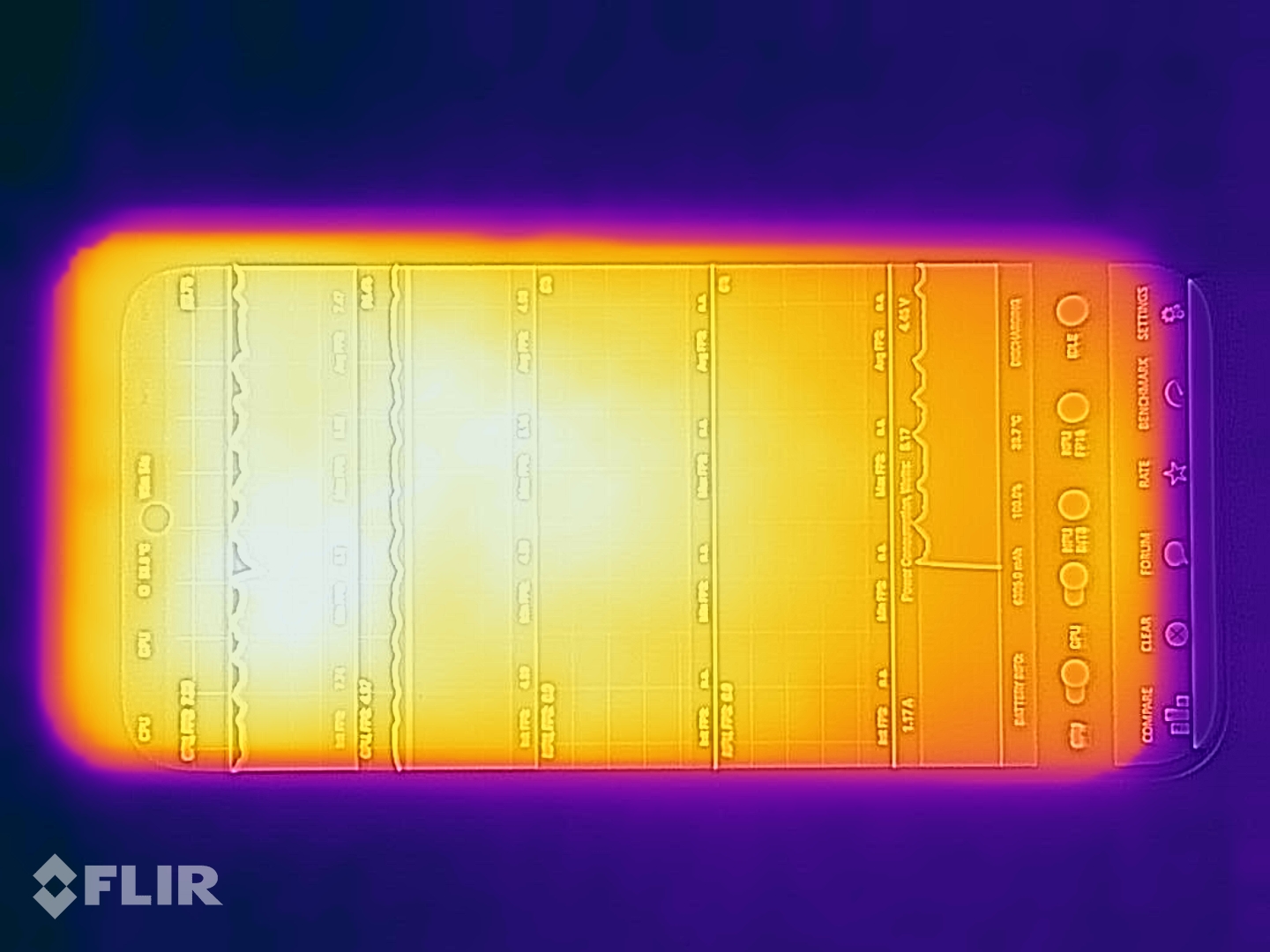
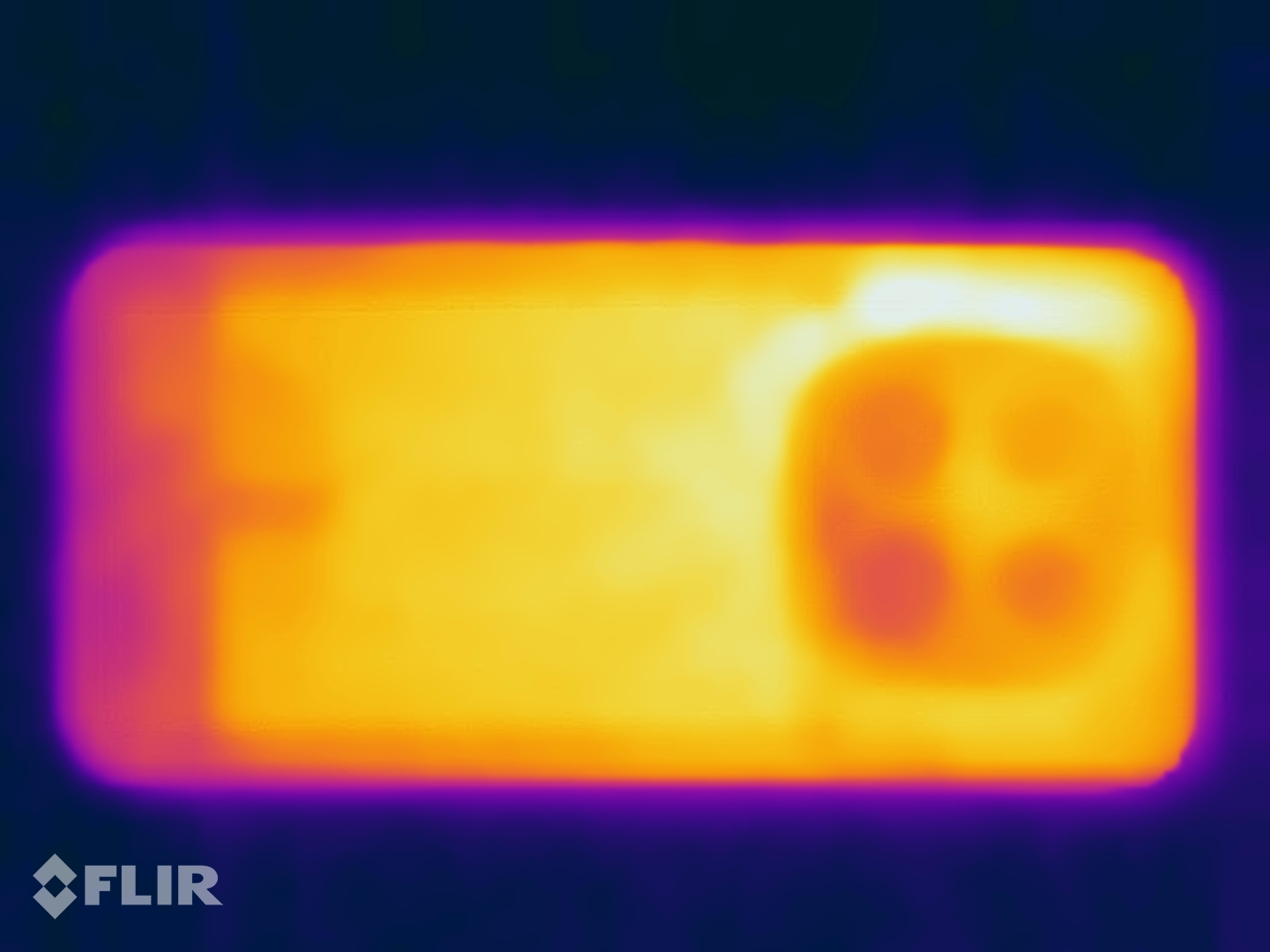
The Poco M8 Pro 5G does not get more than lukewarm even under continuous load and has its internal temperature very well under control. The 3DMark stress tests show that the smartphone can call up its full SoC performance at practically any time.
(+) The maximum temperature on the upper side is 39.4 °C / 103 F, compared to the average of 35.4 °C / 96 F, ranging from 21.9 to 247 °C for the class Smartphone.
(+) The bottom heats up to a maximum of 38.3 °C / 101 F, compared to the average of 34.1 °C / 93 F
(+) In idle usage, the average temperature for the upper side is 25.4 °C / 78 F, compared to the device average of 33 °C / 91 F.
3DMark Stress Tests
| 3DMark | |
| Wild Life Stress Test Stability | |
| Nothing Phone (3a) Pro | |
| Samsung Galaxy A36 5G | |
| Xiaomi Poco M8 Pro 5G | |
| Wild Life Extreme Stress Test | |
| Xiaomi Redmi Note 15 Pro 5G | |
| Xiaomi Poco M8 Pro 5G | |
| Nothing Phone (3a) Pro | |
| Samsung Galaxy A36 5G | |
| OnePlus Nord CE 5 | |
| Steel Nomad Light Stress Test Stability | |
| Nothing Phone (3a) Pro | |
| Xiaomi Redmi Note 15 Pro 5G | |
| Xiaomi Poco M8 Pro 5G | |
Speaker
In addition to Dolby Atmos, the stereo speakers also support Hi-Res Audio and produce a good sound in which the mids and highs dominate.
External audio devices can be connected via USB-C and Bluetooth 5.4. The Poco M8 Pro 5G supports many of the latest Bluetooth codecs.
Xiaomi Poco M8 Pro 5G audio analysis
(+) | speakers can play relatively loud (94.3 dB)
Bass 100 - 315 Hz
(-) | nearly no bass - on average 17% lower than median
(+) | bass is linear (3.6% delta to prev. frequency)
Mids 400 - 2000 Hz
(±) | reduced mids - on average 7.5% lower than median
(+) | mids are linear (5% delta to prev. frequency)
Highs 2 - 16 kHz
(±) | higher highs - on average 8.6% higher than median
(+) | highs are linear (5% delta to prev. frequency)
Overall 100 - 16.000 Hz
(±) | linearity of overall sound is average (18.9% difference to median)
Compared to same class
» 24% of all tested devices in this class were better, 10% similar, 66% worse
» The best had a delta of 11%, average was 34%, worst was 136%
Compared to all devices tested
» 44% of all tested devices were better, 8% similar, 48% worse
» The best had a delta of 4%, average was 23%, worst was 136%
Samsung Galaxy A36 5G audio analysis
(+) | speakers can play relatively loud (90.5 dB)
Bass 100 - 315 Hz
(-) | nearly no bass - on average 26.4% lower than median
(±) | linearity of bass is average (7.3% delta to prev. frequency)
Mids 400 - 2000 Hz
(±) | reduced mids - on average 6.1% lower than median
(+) | mids are linear (4.3% delta to prev. frequency)
Highs 2 - 16 kHz
(+) | balanced highs - only 3% away from median
(+) | highs are linear (1.8% delta to prev. frequency)
Overall 100 - 16.000 Hz
(±) | linearity of overall sound is average (17.9% difference to median)
Compared to same class
» 16% of all tested devices in this class were better, 8% similar, 75% worse
» The best had a delta of 11%, average was 34%, worst was 136%
Compared to all devices tested
» 37% of all tested devices were better, 8% similar, 55% worse
» The best had a delta of 4%, average was 23%, worst was 136%
Battery life - silicon-carbon battery as a trump card
Energy consumption
The Poco M8 Pro 5G runs quite energy-efficiently. In contrast, it does not hold back when charging, as this works with up to 100 watts. With Xiaomi's 100-watt power supply, which was available to us for testing, a complete charging cycle takes just under 50 minutes. The Xiaomi phone supports wired reverse charging with up to 22.5 watts.
| Off / Standby |   0.04 / 0.17 Watt 0.04 / 0.17 Watt |
| Idle |  1.11 / 1.23 / 1.34 Watt 1.11 / 1.23 / 1.34 Watt |
| Load |
3.8 / 7.79 Watt |
    
| |
Key:
min: ,
med: ,
max: Metrahit Energy | |
| Xiaomi Poco M8 Pro 5G 6500 mAh | Nothing Phone (3a) Pro 5000 mAh | Samsung Galaxy A36 5G 5000 mAh | Xiaomi Poco M7 Pro 5G 5110 mAh | Xiaomi Redmi Note 15 Pro 5G 6580 mAh | Average Qualcomm Snapdragon 7s Gen 4 | Average of class Smartphone | |
|---|---|---|---|---|---|---|---|
| Power Consumption | 13% | -27% | 2% | -14% | -89% | -28% | |
| Idle Minimum * (Watt) | 1.11 | 0.89 20% | 0.86 23% | 1.14 -3% | 1.2 -8% | 1.136 ? -2% | 0.898 ? 19% |
| Idle Average * (Watt) | 1.23 | 1.3 -6% | 1.75 -42% | 1.3 -6% | 1.5 -22% | 3.77 ? -207% | 1.482 ? -20% |
| Idle Maximum * (Watt) | 1.34 | 1.33 1% | 1.82 -36% | 1.34 -0% | 1.9 -42% | 3.85 ? -187% | 1.673 ? -25% |
| Load Average * (Watt) | 3.8 | 3.29 13% | 5.31 -40% | 2.96 22% | 4 -5% | 5.5 ? -45% | 6.79 ? -79% |
| Load Maximum * (Watt) | 7.79 | 4.76 39% | 10.95 -41% | 8.18 -5% | 7.4 5% | 8.08 ? -4% | 10.7 ? -37% |
* ... smaller is better
Power consumption: Geekbench (150 cd/m²)
Power consumption: GFXbench (150 cd/m²)
Battery life
With its 6500 mAh lithium battery with silicon-carbon anode, the Poco M8 Pro 5G ensures long runtimes. With moderate use, the smartphone can easily be used for two or even three days at a time before it needs to be recharged. In the Wi-Fi test, the Poco M8 Pro 5G managed a very good 23.5 hours, beating almost all comparable devices. Only the Xiaomi Redmi Note 15 Pro 5G lasts noticeably longer at 30.5 hours.
Notebookcheck overall rating
The Xiaomi Poco M8 Pro 5G stands out from other mid-range smartphones thanks to its strong overall package. The combination of display brightness, battery life and solid everyday performance sets the bar pretty high for the competition. However, there is no eSIM support and the ads in the system are also a negative feature.
Xiaomi Poco M8 Pro 5G
- 02/14/2026 v8
Manuel Masiero
 Total Sustainability Score:
 Possible alternatives in comparison
Image | Model / Review | Price | Weight | Drive | Display |
|---|---|---|---|---|---|
1. 79.1%  | Xiaomi Poco M8 Pro 5G Qualcomm Snapdragon 7s Gen 4 ⎘ Qualcomm Adreno 810 ⎘ 12 GB Memory, 512 GB UFS 2.2 | Amazon: $315.87 List Price: 400 Euro | 206 g | 512 GB UFS 2.2 Flash | 6.83" 2772x1280 447 PPI AMOLED |
2. 79.6%  | Nothing Phone (3a) Pro Qualcomm Snapdragon 7s Gen 3 ⎘ Qualcomm Adreno 810 ⎘ 12 GB Memory | Amazon: | 211 g | 6.77" 2392x1080 388 PPI AMOLED | |
3. 80.8%  | OnePlus Nord CE 5 MediaTek Dimensity 8350 ⎘ ARM Mali-G615 MP6 ⎘ 8 GB Memory, 128 GB UFS 3.1 | List Price: 349€ | 199 g | 128 GB UFS 3.1 Flash | 6.77" 2392x1080 388 PPI AMOLED |
4. 78%  | Samsung Galaxy A36 5G Qualcomm Snapdragon 6 Gen 3 ⎘ Qualcomm Adreno 710 ⎘ 6 GB Memory, 256 GB UFS 3.1 | List Price: 379€ | 195 g | 256 GB UFS 3.1 Flash | 6.70" 2340x1080 385 PPI Super AMOLED |
5. 76.1%  | Xiaomi Poco M7 Pro 5G MediaTek Dimensity 7025 ⎘ IMG BXM-8-256 ⎘ 12 GB Memory, 256 GB UFS 2.2 | List Price: 240€ | 190 g | 256 GB UFS 2.2 Flash | 6.67" 2400x1080 395 PPI AMOLED |
6. 77.6%  | Xiaomi Redmi Note 15 Pro 5G MediaTek Dimensity 7400-Ultra ⎘ ARM Mali-G615 MP2 ⎘ 8 GB Memory, 256 GB UFS 2.2 | List Price: 400€ | 210 g | 256 GB UFS 2.2 Flash | 6.83" 2772x1280 447 PPI AMOLED |
Transparency
The selection of devices to be reviewed is made by our editorial team. The test sample was provided to the author as a loan by the manufacturer or retailer for the purpose of this review. The lender had no influence on this review, nor did the manufacturer receive a copy of this review before publication. There was no obligation to publish this review. As an independent media company, Notebookcheck is not subjected to the authority of manufacturers, retailers or publishers.
This is how Notebookcheck is testing
Every year, Notebookcheck independently reviews hundreds of laptops and smartphones using standardized procedures to ensure that all results are comparable. We have continuously developed our test methods for around 20 years and set industry standards in the process. In our test labs, high-quality measuring equipment is utilized by experienced technicians and editors. These tests involve a multi-stage validation process. Our complex rating system is based on hundreds of well-founded measurements and benchmarks, which maintains objectivity. Further information on our test methods can be found here.
 Add as a preferred source on Google


