




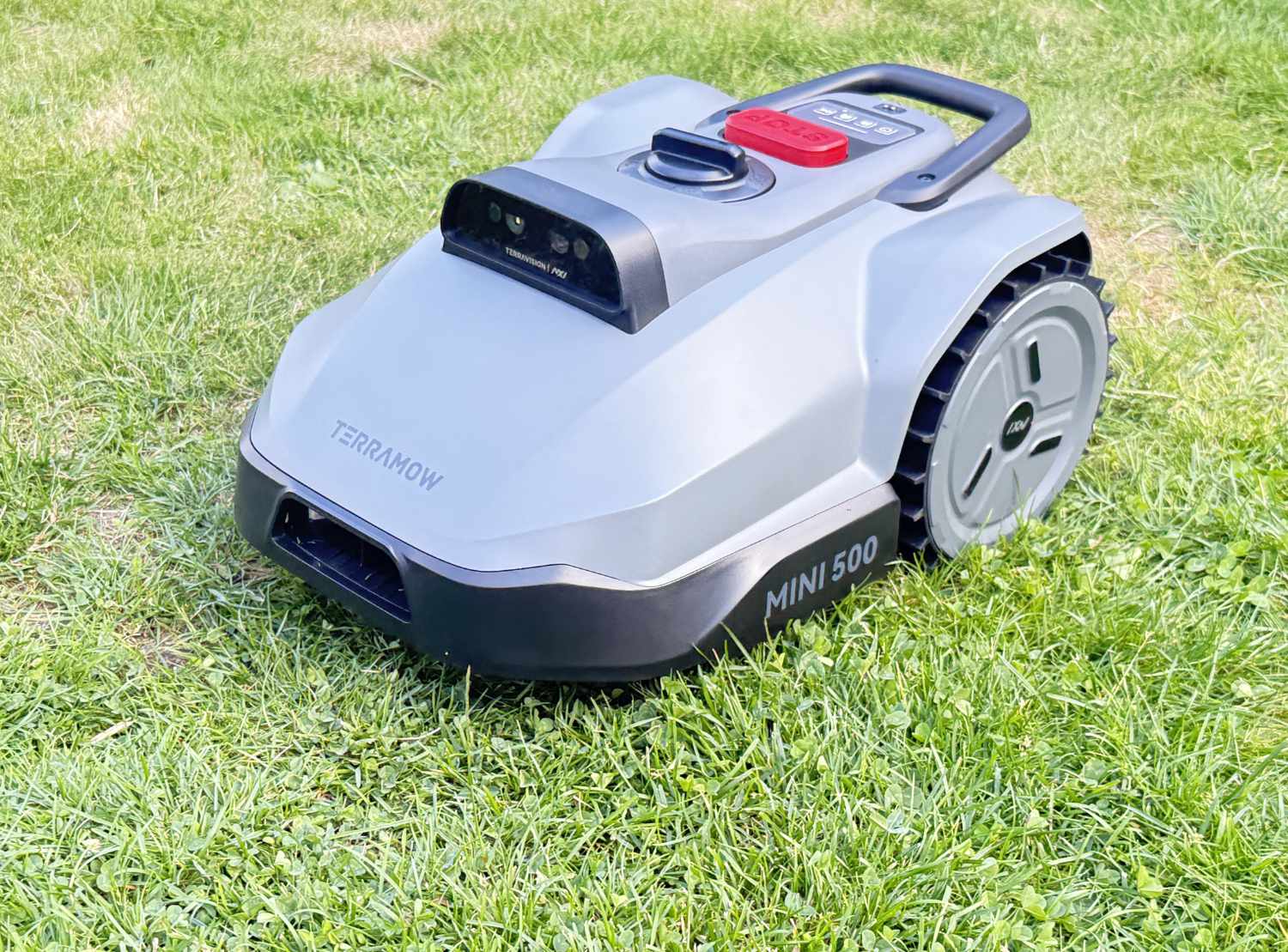
Small robotic lawn mower for urban gardens: TerraMow Mini 500 review
TerraVision instead of RTK or wire.
With the Mini 500, TerraMow offers a compact robotic lawn mower equipped with AI cameras instead of a boundary wire or RTK, designed for small gardens of up to 500 square meters. Our test reveals how well it performs in such gardens.Marcus Schwarten (translated by Marcus Schwarten (translations supported by DeepL)) Published 🇩🇪 🇳🇱 ...
TerraMow Mini 500 review verdict: Perfect for small gardens
If you have a smaller garden of up to 500 square meters, the TerraMow Mini 500 is a suitable smart replacement for a traditional lawn mower. The robotic mower made a very good impression in our test.

Based on our findings, navigation and obstacle detection work reliably. The cutting deck is compact and the operating speed is moderate, though this is not a major issue for gardens of up to 500 square meters. As expected in this price range, there is no electrically adjustable cutting height.
Overall, the TerraMow Mini 500 impresses with its simple setup and operation, as well as its trouble-free performance. The Eufy C15 and the Natural Expressions Performance 7 are in a similar league. Ultimately, our advice is to check the current prices, although Eufy’s robotic mower has the advantage of providing access to a larger ecosystem through a single app.
Pros
Cons
Price and availability
In Europe, the suggested retail price for the TerraMow Mini 500 is 749 euros. The robotic lawn mower is available directly from the manufacturer as well as on Amazon, optionally as part of a bundle with a garage.

Table of Contents
- TerraMow Mini 500 review verdict: Perfect for small gardens
- Features & package contents: With or without a Garage
- Setup & maintenance: Maps autonomously using his cameras
- App & operation: Clear layout and live video
- Navigation & obstacle detection: Reliably good as usual
- Area & edge mowing: Robotic lawn mower for small gardens
- Runtime & noise level: Economical and quiet
Not everyone can call a garden measuring 1,000 square meters or more their own. Especially in cities, many gardens are significantly smaller. But even here, it is usually worth using a robotic lawn mower so that you do not constantly have to push a conventional lawn mower across the lawn yourself.
With the Mini 500, TerraMow recently launched a brand-new robotic lawn mower without a boundary wire for more compact gardens. It bears a strong resemblance to the likewise fairly new Eufy C15 from Anker and the Natural Expressions Performance 7, which recently impressed in testing. Our review reveals whether the TerraMow Mini 500 can do the same.
TerraMow Mini 500 specifications
| Area | 500 m² |
|---|---|
| Navigation and obstacle detection | TerraVision 2.0 Triple-Camera AI Vision |
| Mowing unit | Mowing disc |
| Number of blades | 3 |
| Cutting width | 18 cm |
| Cutting height | 2–6 cm |
| Cutting height adjustment | manual |
| Gradient | 32.5% / 18° |
| Display | yes |
| Battery capacity | 3.96 Ah/88.7 Wh |
| Weight | 10.1 kg |
| Dimensions | 55.5 × 37.1 × 26.7 cm |
| Water resistance | IPX6 |
| Garage included | No |
| Replacement blades included | 9 pieces |
| Color | Gray |
| MSRP | 749 euros |
Features & package contents: With or without a Garage
The TerraMow Mini 500 is designed for lawns of up to 500 square meters, making it adequately sized for most urban gardens. This positions it below the TerraMow V Series (starting at about 850 euros on Amazon), which had already impressed us in our test last year. With the new Mini 500, the manufacturer is once again relying on AI vision as an alternative to a traditional boundary wire, an RTK antenna, or LiDAR.
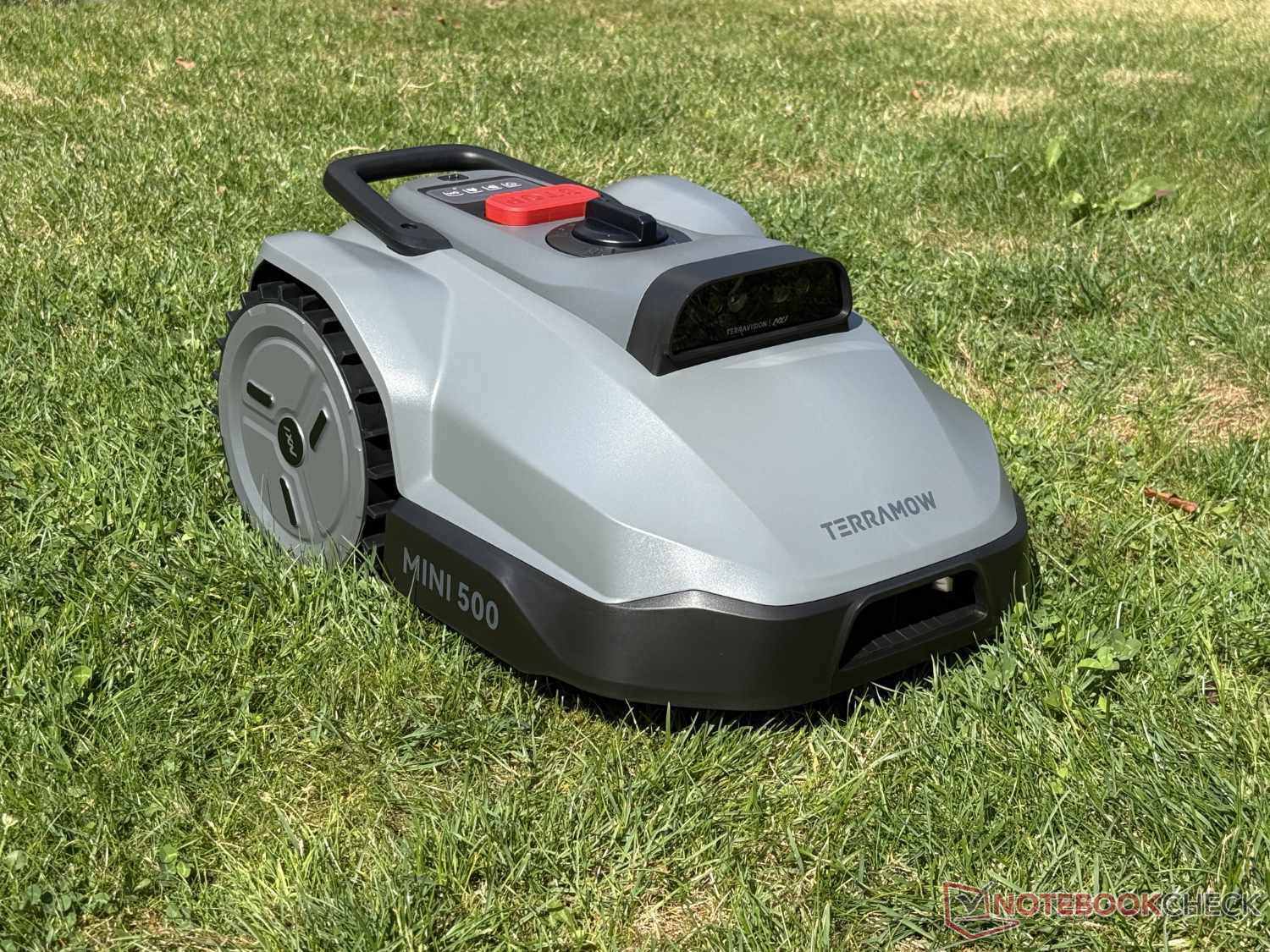
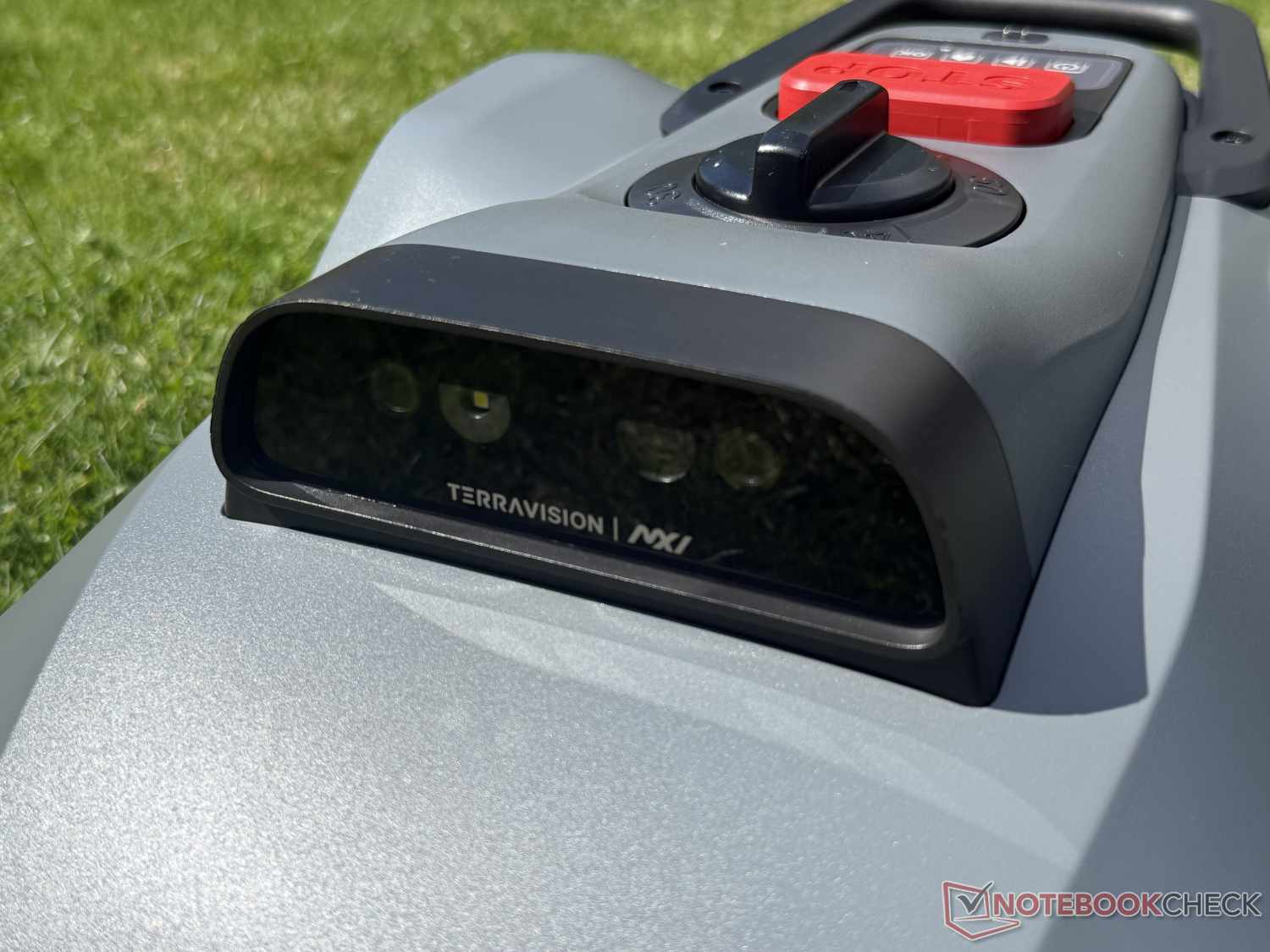
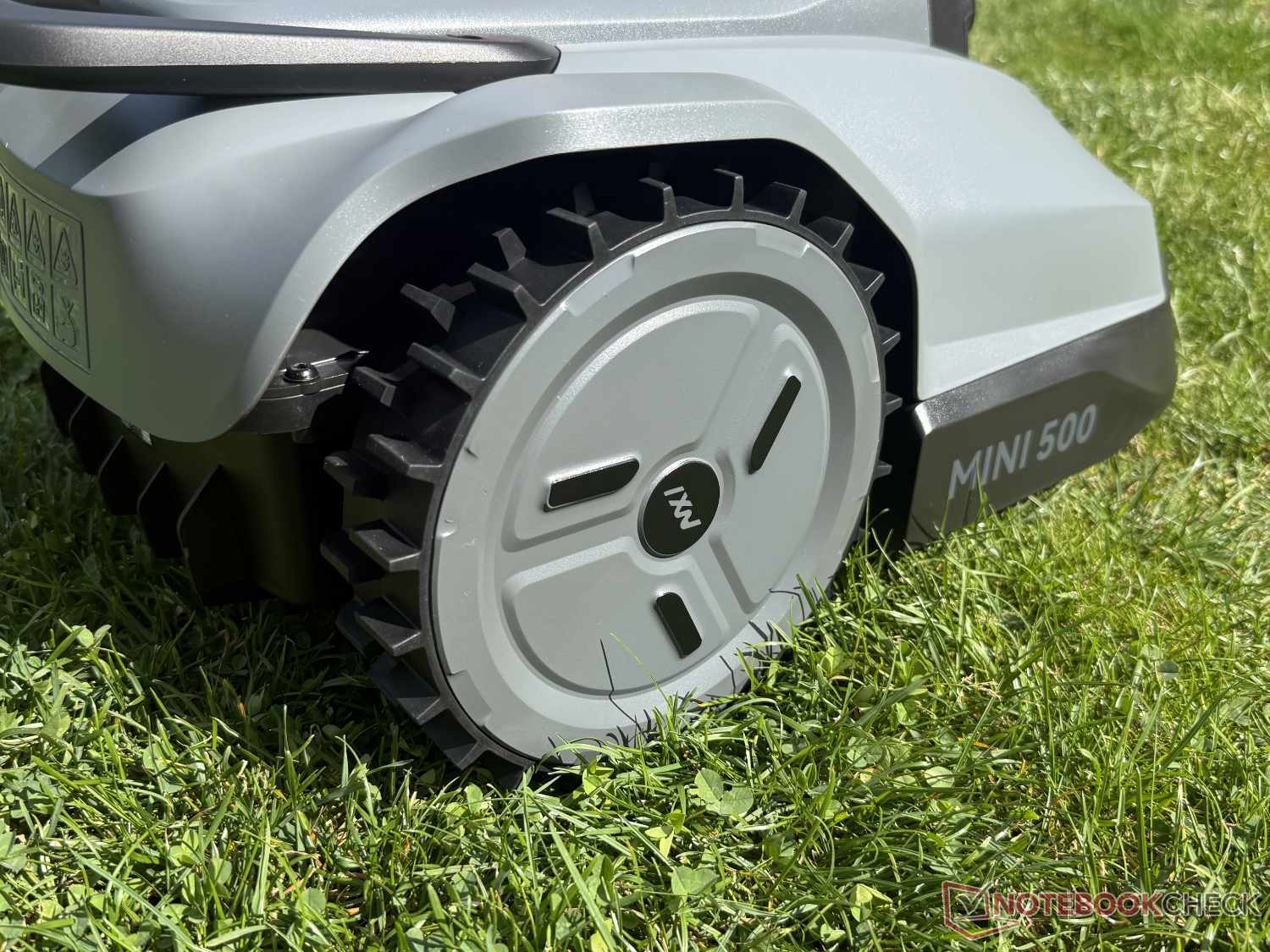
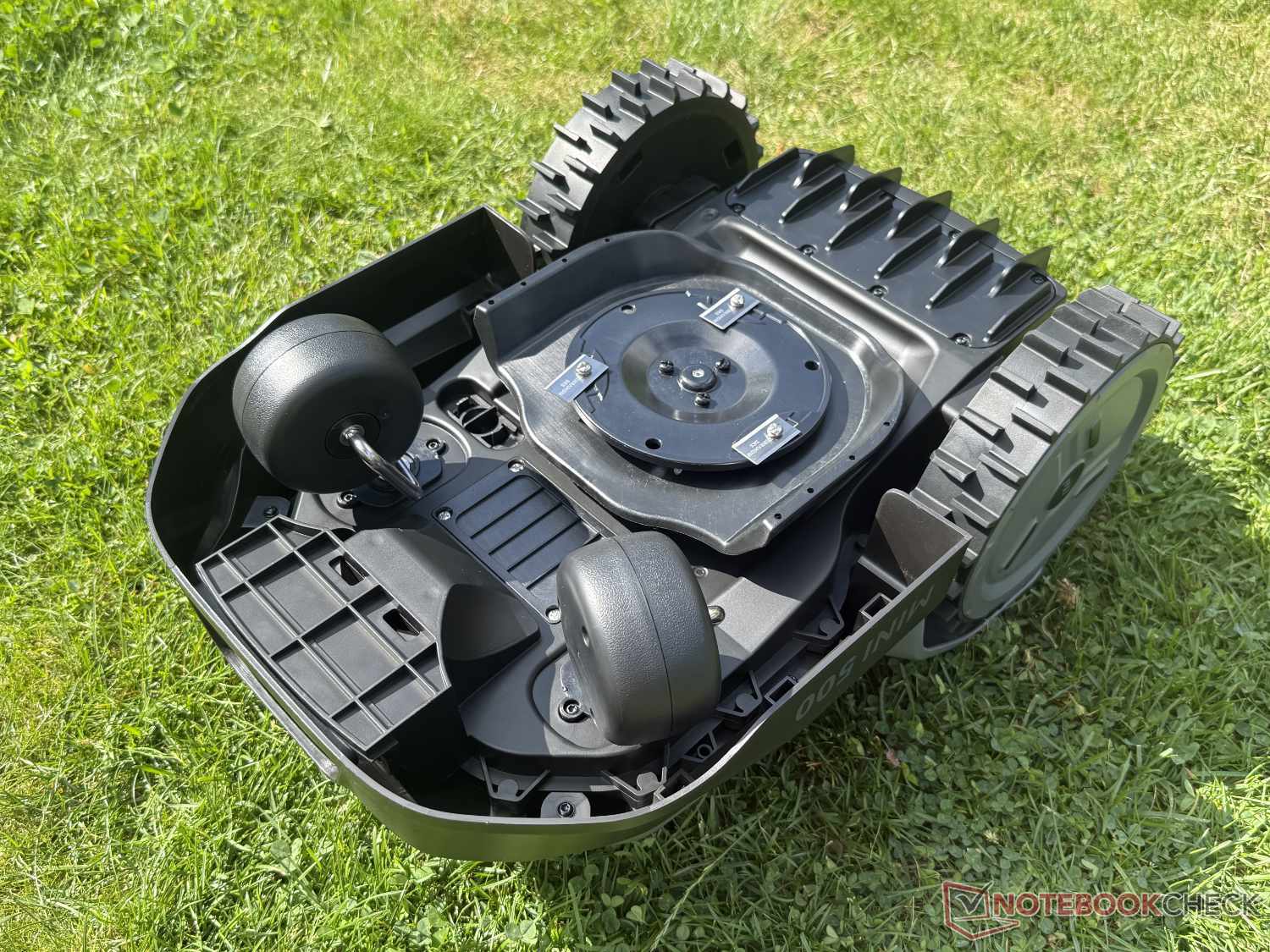
The TerraVision 2.0 navigation system uses three front-facing cameras and AI to recognize the lawn autonomously. We will reveal how well this works later in our TerraMow Mini 500 review. First, a few words about the equipment.
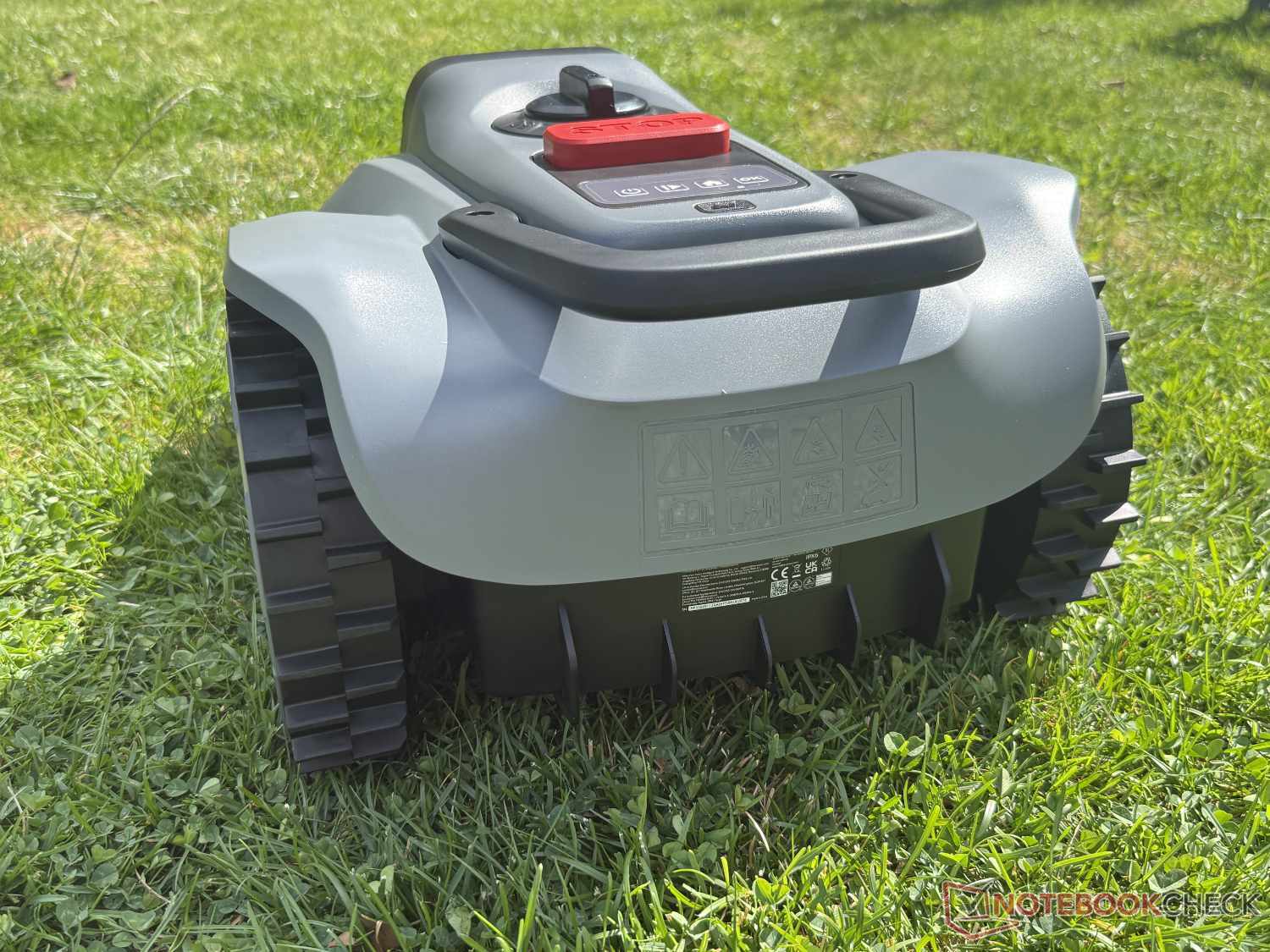
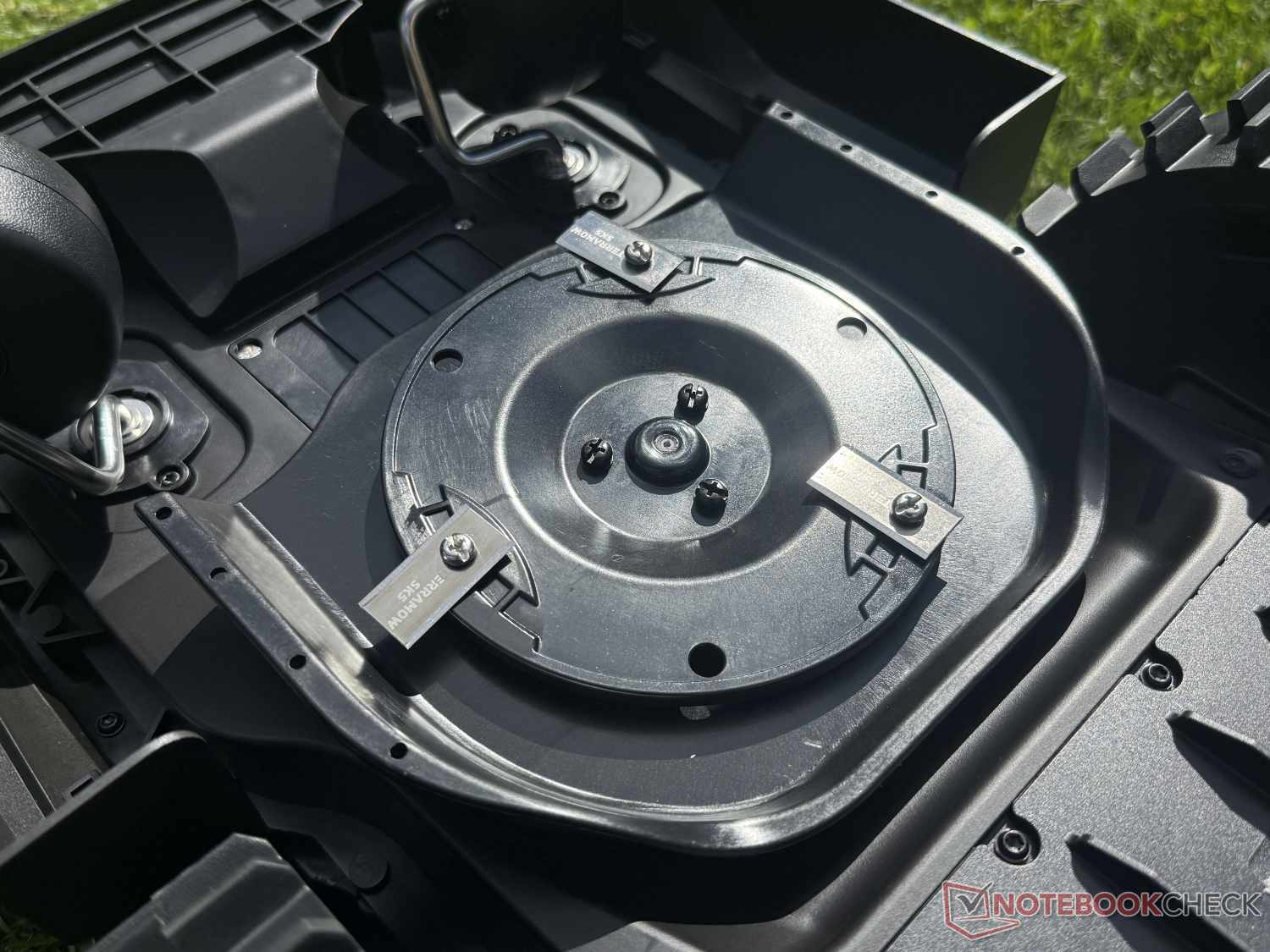
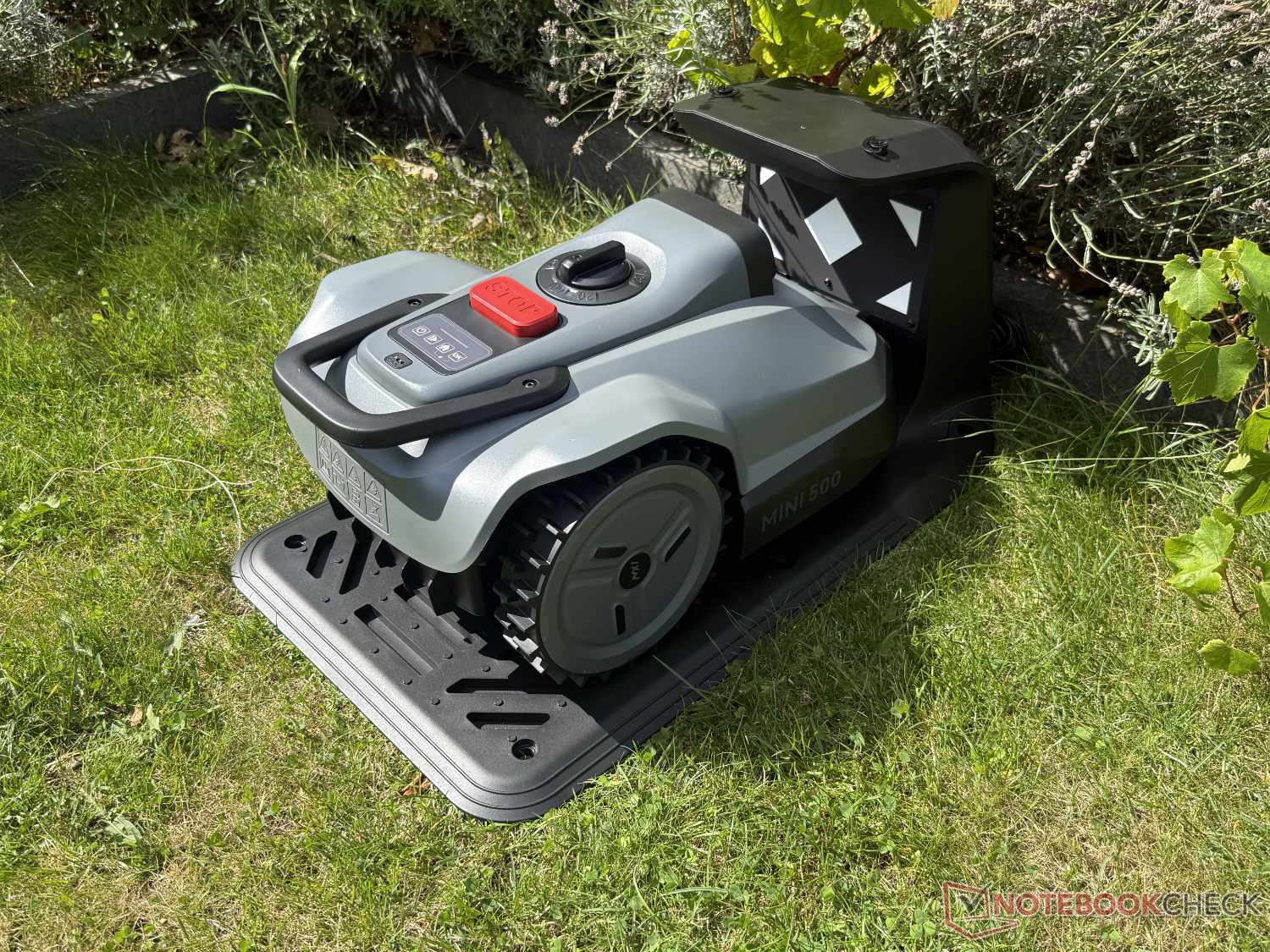
The robotic mower cuts with a compact 18 cm cutting disc equipped with three blades, and its cutting height can be manually adjusted from 20 to 60 mm. Electric adjustment is particularly useful when different cutting heights are required in different zones, but it is rarely available in this price range. With a maximum incline of 18 degrees (32.5 percent), the robotic mower is not particularly capable on challenging terrain and is therefore aimed at relatively flat properties. On the other hand, it is relatively compact, measuring approximately 55 x 37 x 27 cm in length, width, and height. At just over 10 kg, it is also pleasantly light and can easily be carried by its handle.
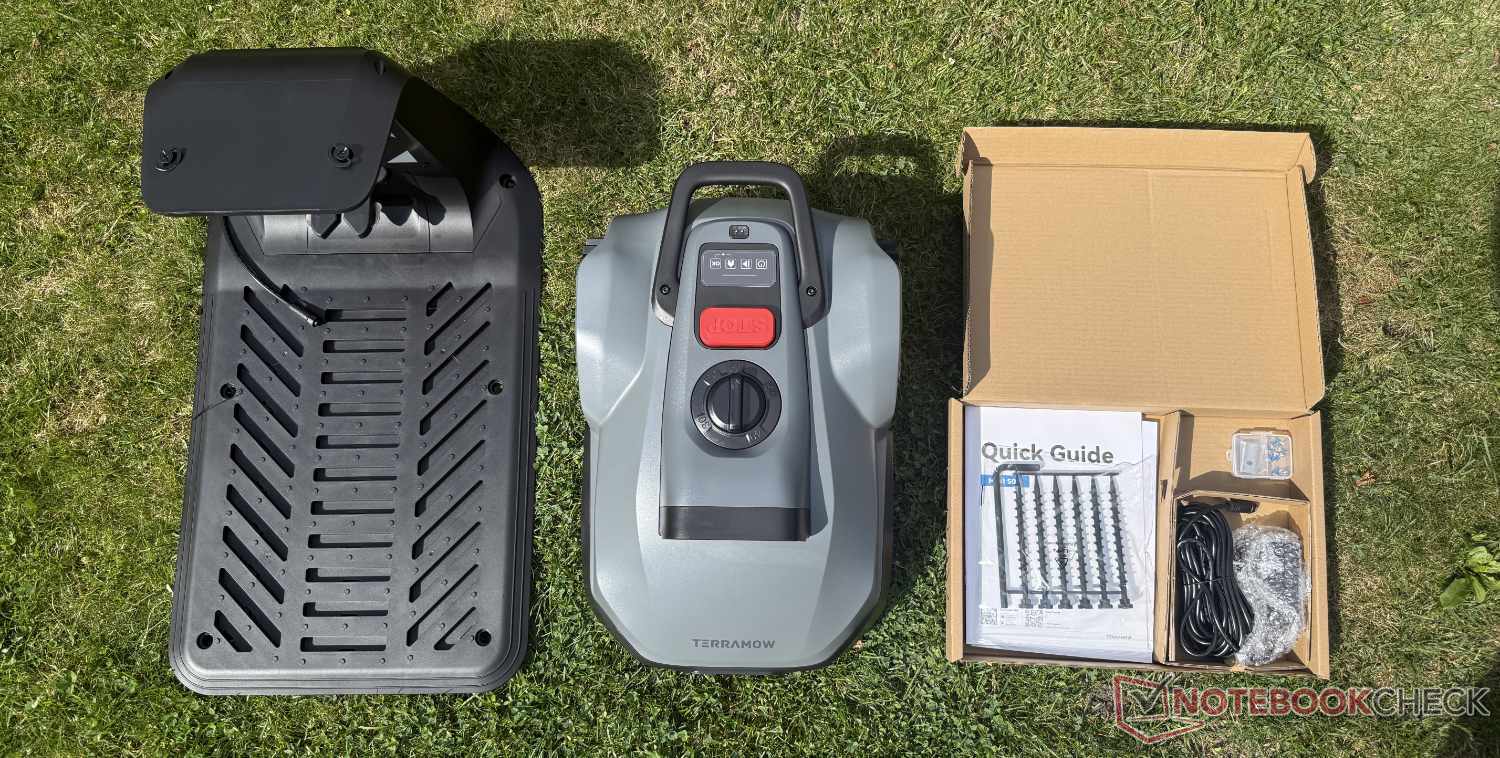
Its low weight also makes it easier to lift out of the box. The box also contains the standard base station with mounting hardware, a power cord, nine replacement blades, and an instruction manual. The garage roof familiar from the earlier TerraMow S and V model series is not included as standard with the new budget model. However, it can be ordered separately for an additional charge and screwed onto the charging station.
Setup & maintenance: Maps autonomously using his cameras
We encountered the first surprise as soon as we started. Accustomed to the process from previous tests, we opened the TerraMow app and tried to add the Mini 500. However, when we tapped the device entry, a message appeared stating that the new TerraMow Pro app was required. Anyone who uses one of the older robotic mowers alongside the Mini 500 will therefore have to juggle two apps, as the V and S Series cannot be added to the TerraMow Pro app.
Once the robotic mower had been connected to the app and Wi-Fi after this minor detour, mapping proceeded in the usual manner. However, the process differs from that of many RTK- and LiDAR-based robotic mowers. Instead, TerraMow stays true to its established approach and once again maps the area completely autonomously. It is not entirely automatic, however, as the mowing direction relative to the station must at least be specified before mapping begins.
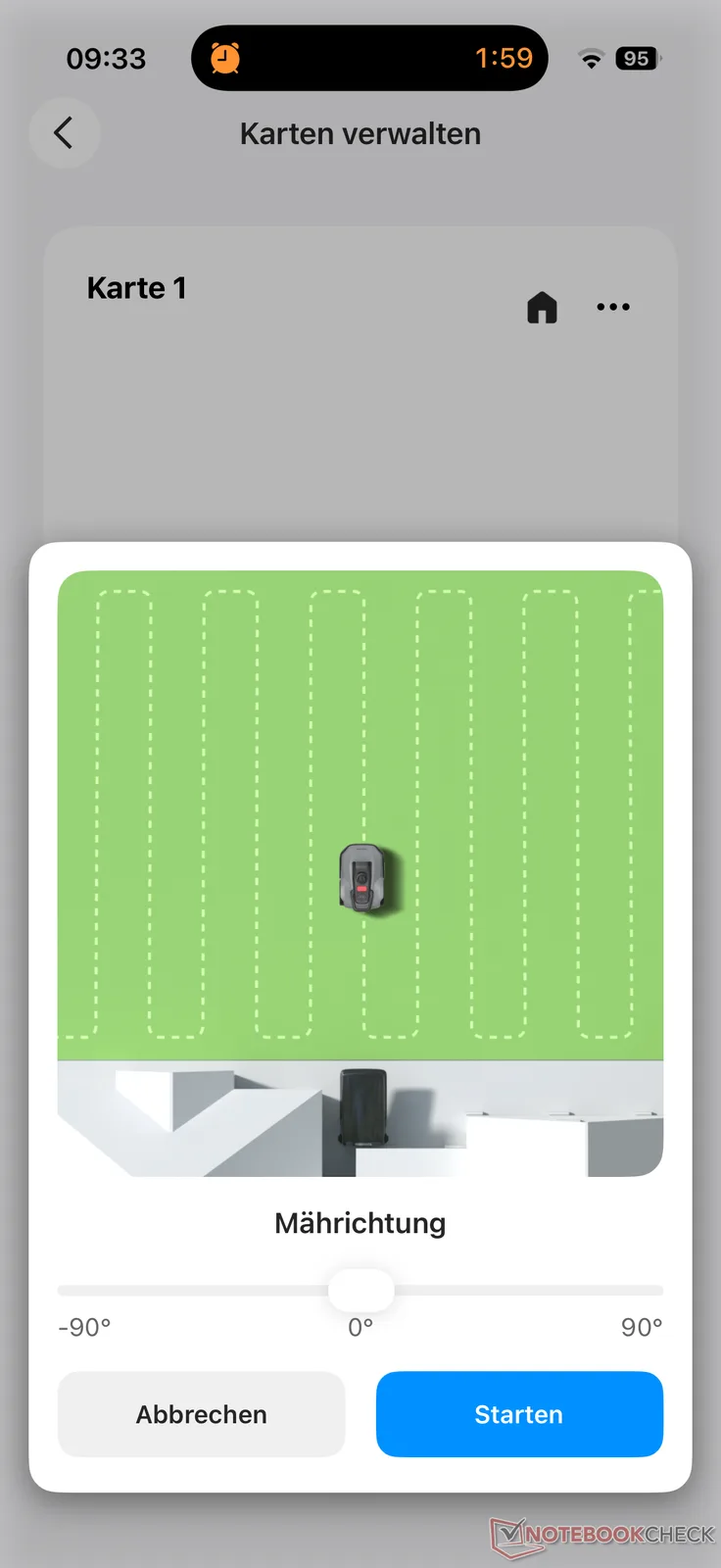
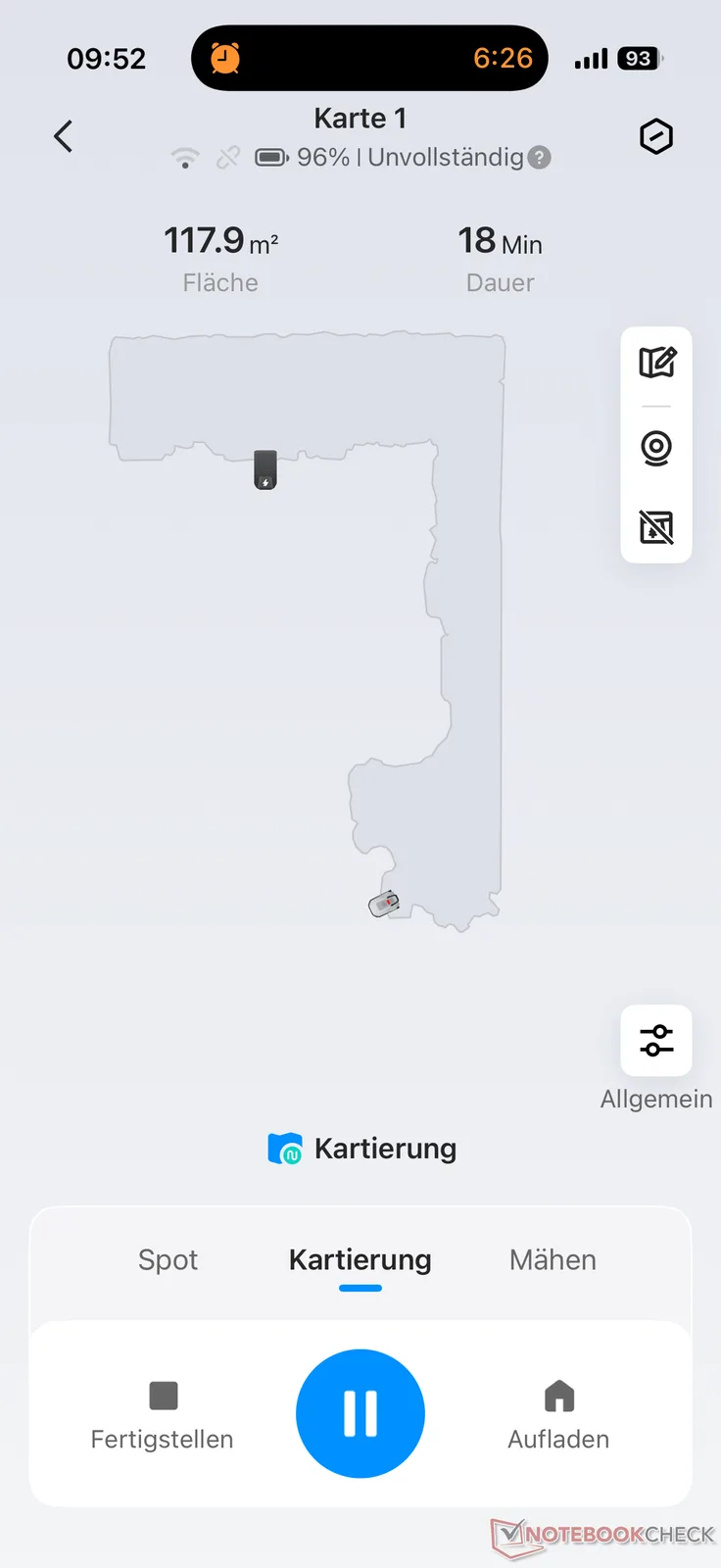
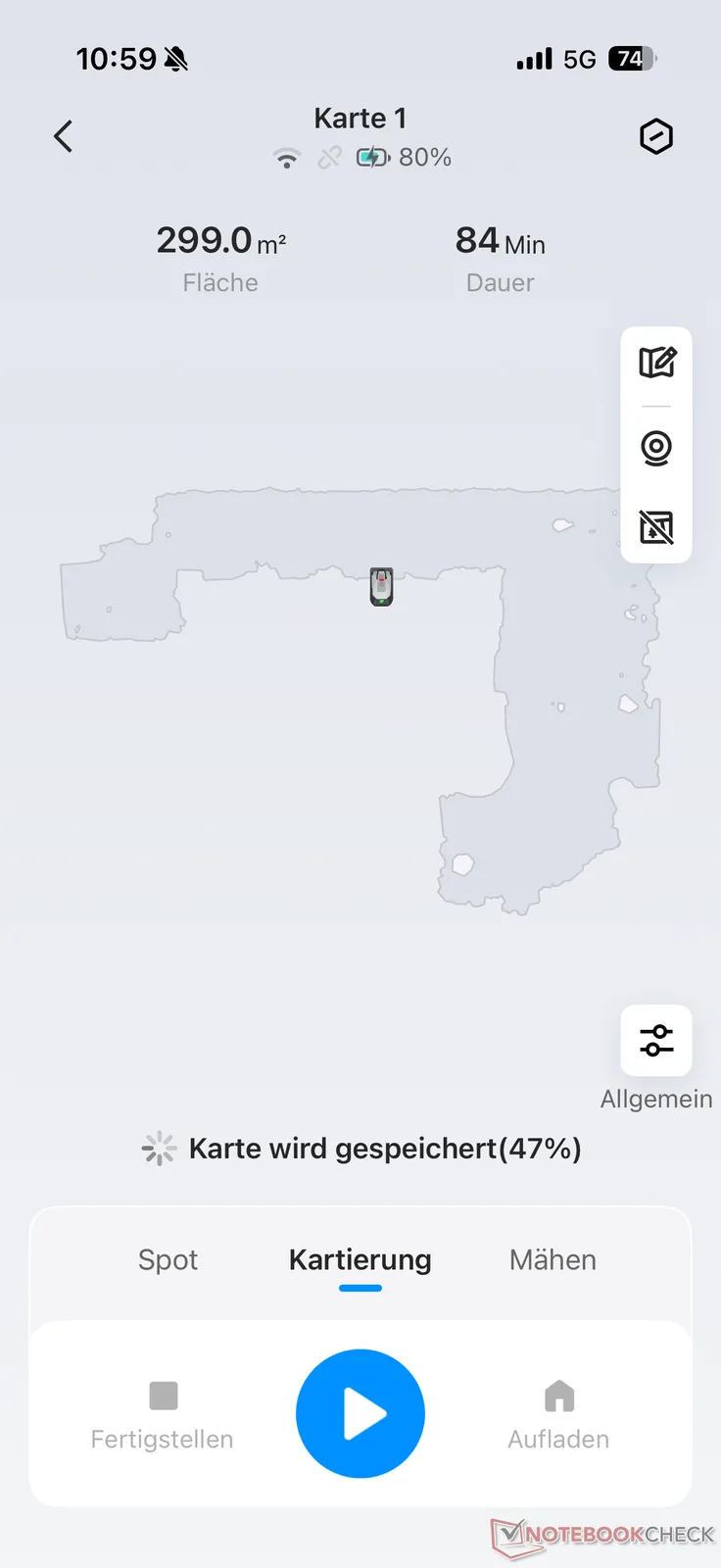
As we have already seen with previous product lines and Eufy’s robotic mowers, the robotic mower then explores its new territory completely autonomously. It first traverses the lawn in lanes and then revisits individual areas, using its cameras to detect the lawn’s edges. This worked very reliably and accurately in our test, as usual, although mapping our nearly 300-square-meter test area took just under an hour and a half.
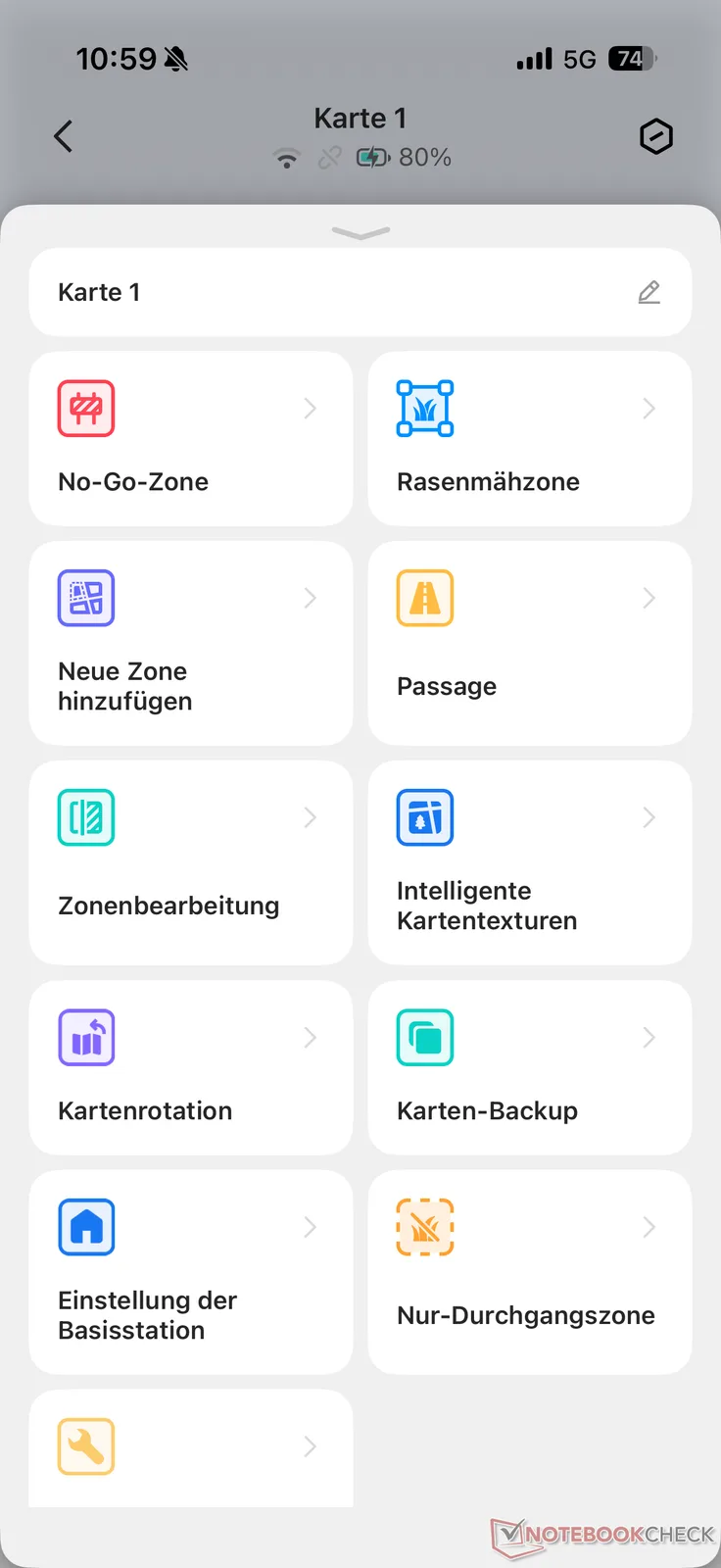
This form of mapping is problematic only for lawns that are not enclosed, such as those open to a neighboring property, or for areas that should not be mowed. In these cases, the mapping process can be paused and corresponding exclusion zones positioned on the map as it is being created. Once the lawn has been mapped, the virtual map is saved. Various editing options are then available, including the creation of different zones and exclusion zones in various shapes (rectangle, polygon, ellipse, boundary), among other options.
In terms of maintenance, the TerraMow Mini 500 is conventional. The three blades can be replaced using a screwdriver, which is not included. Thanks to its IPX6 rating, the mower can be cleaned with a garden hose.
App & operation: Clear layout and live video
The TerraMow Pro app is largely similar to the old app. The device entry displays the created map, on which live progress is shown while the mower is working. At the bottom, users can select the various modes (Auto, Spot, Zone, Box, and Edge) and start, pause, or stop mowing.
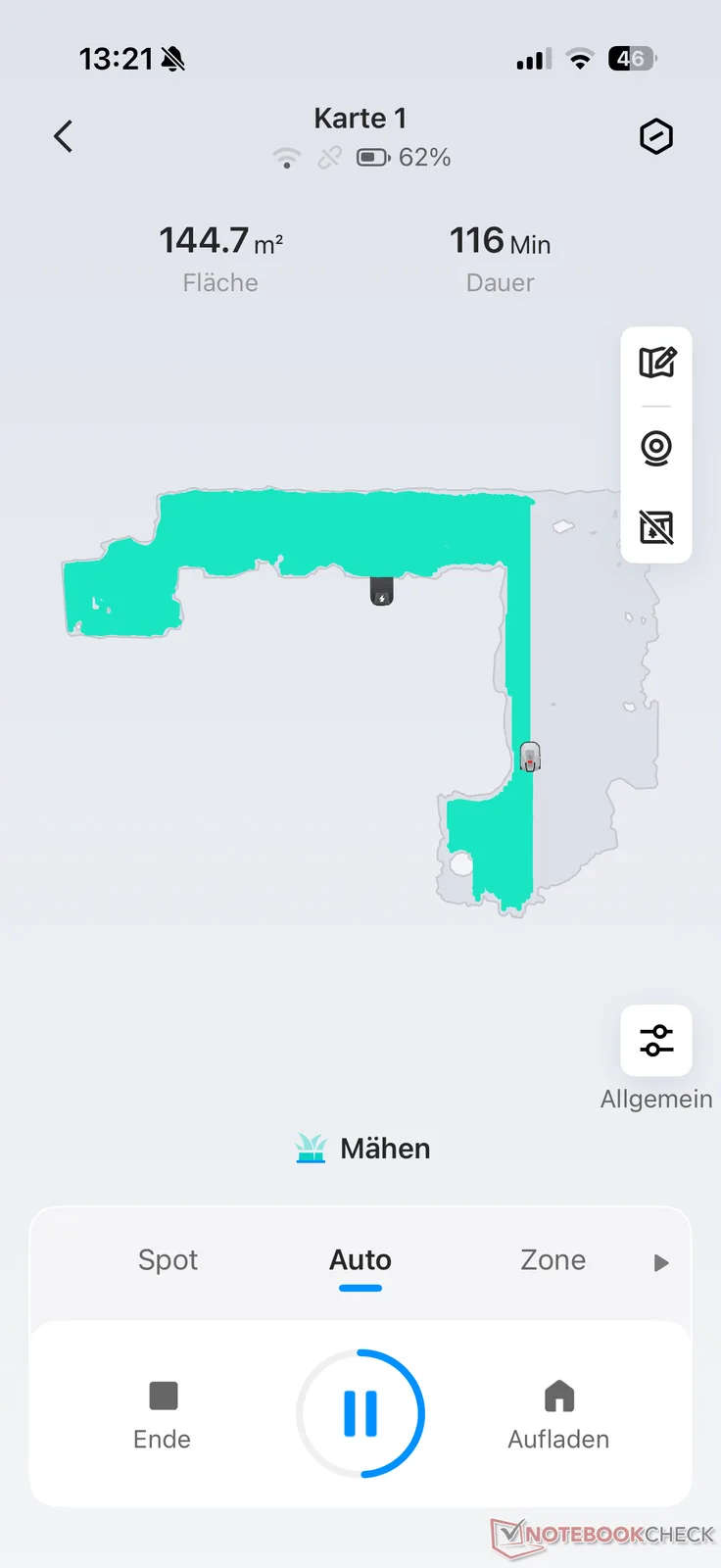
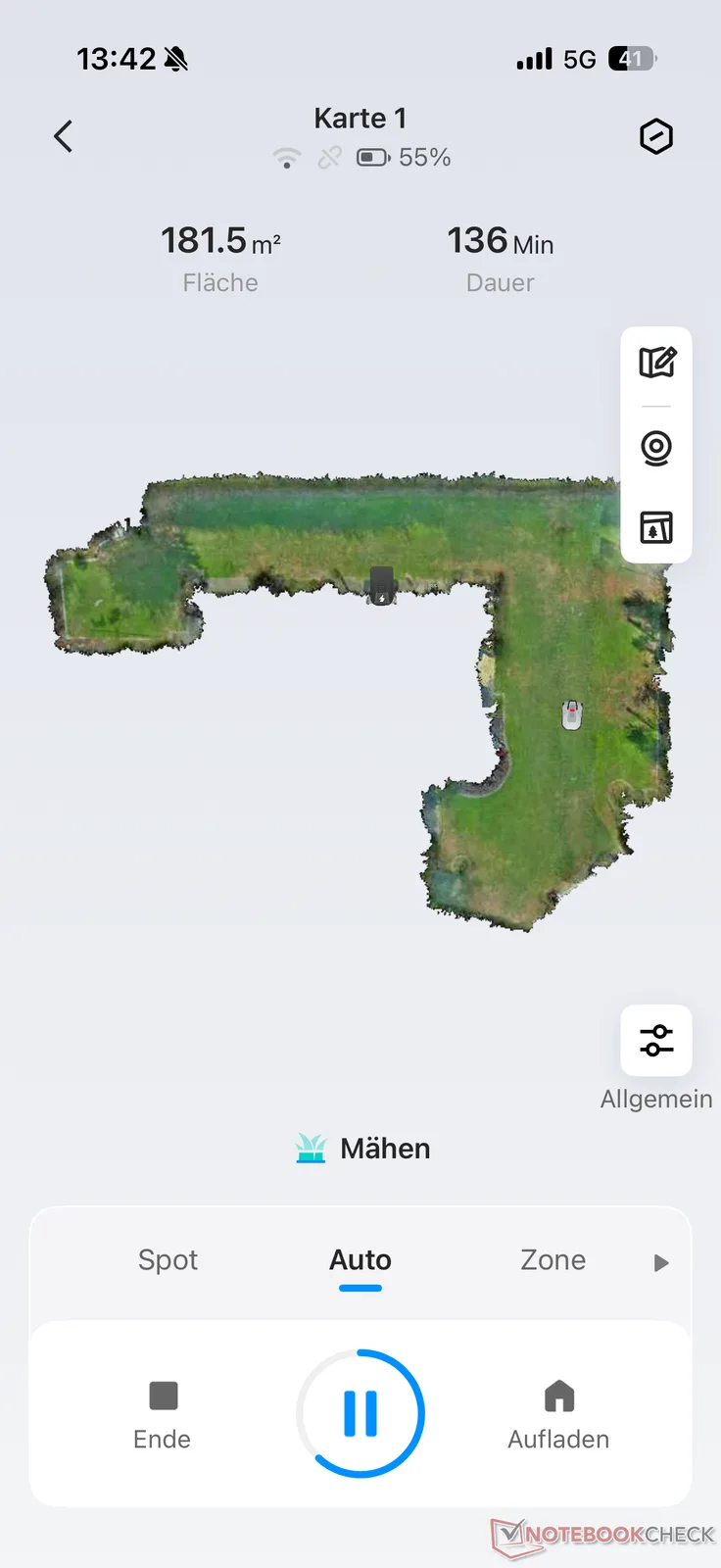
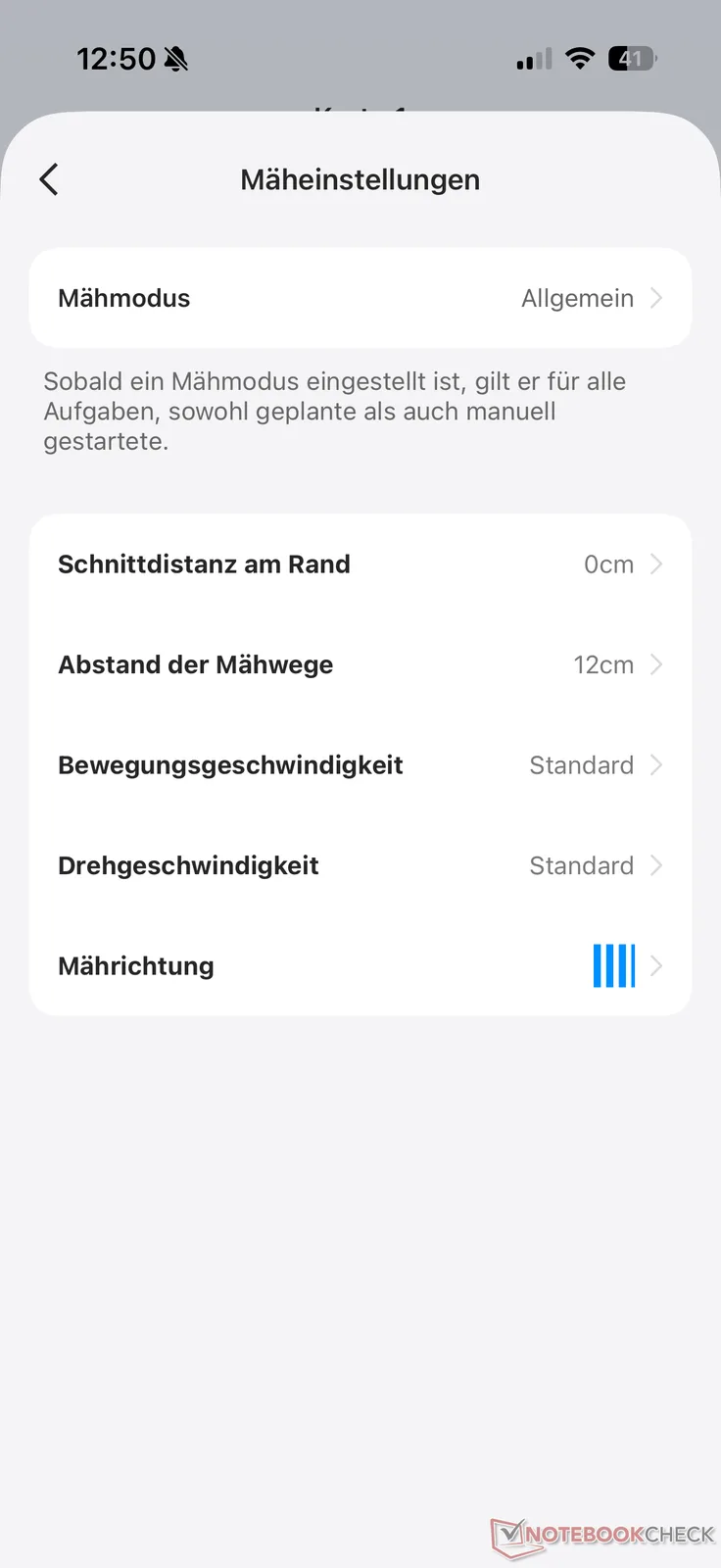
On the right-hand side, alongside map management, live video (once activated), and the map view (terrain on/off), there is also an icon for opening the mowing settings. Here, users can set the mowing mode (General or Customized, with different settings for each zone), the cutting distance from the edge (-15 to 15 cm, unfortunately only for the entire map rather than individually as with Anthbot), the spacing between mowing paths (6, 9, 12, or 15 cm), the travel speed (four levels), and the mowing direction.
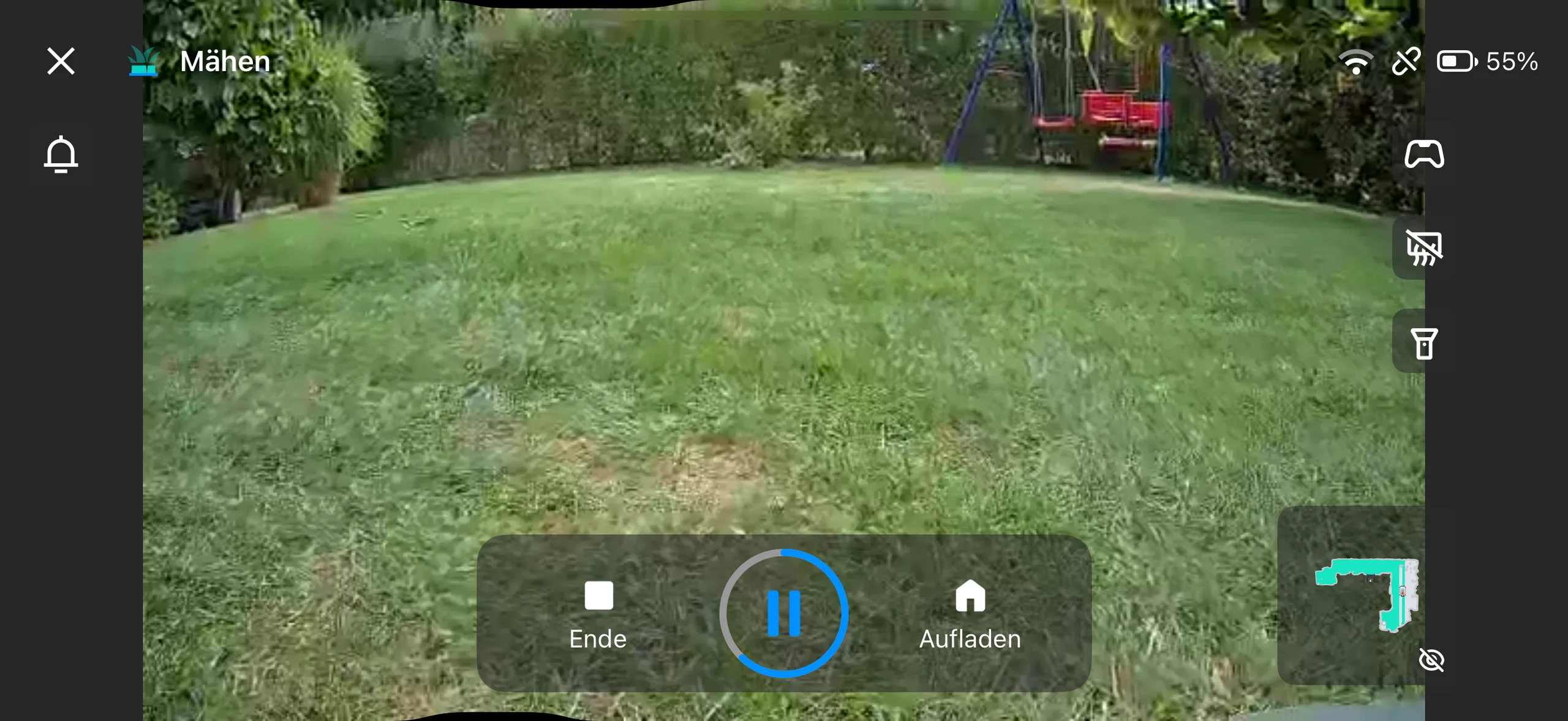
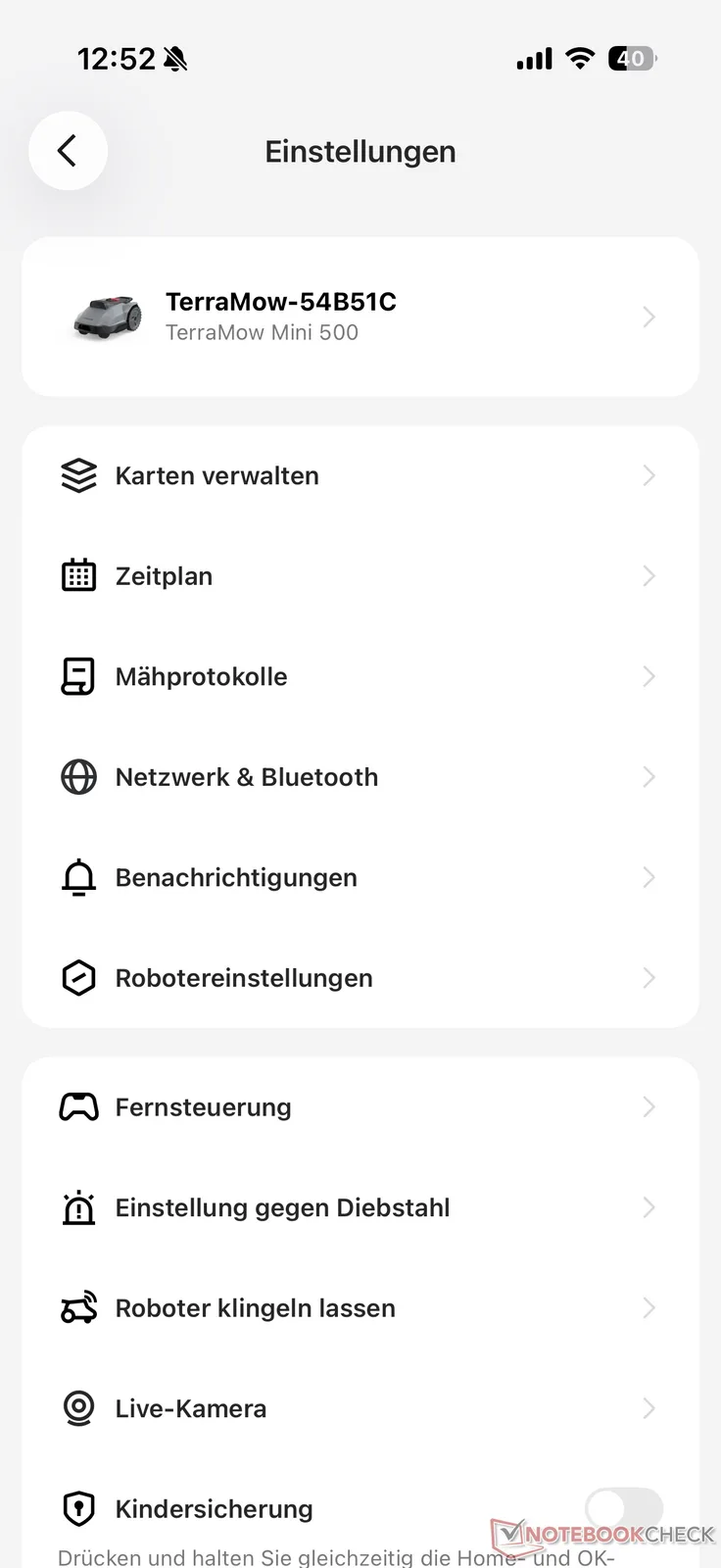
There is also a button in the upper-right corner for opening the menu. Here, users will find the usual functions, including schedules, logs, and various settings relating to the robot and its behavior, such as its response to rain. Anti-theft protection, remote control, and the usual firmware updates are also included.
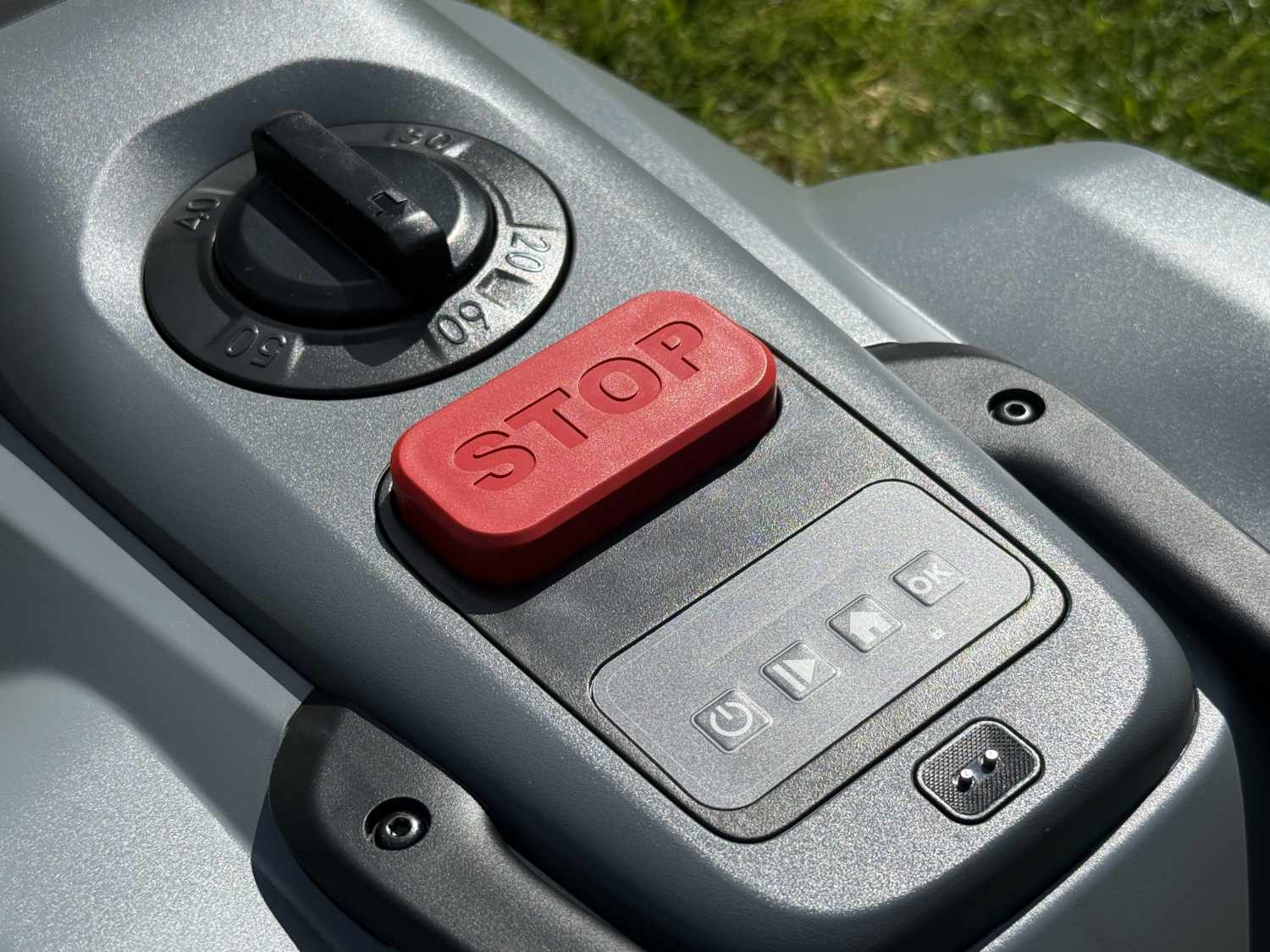
As an alternative to the app, the TerraMow Mini 500 can also be controlled using the control panel on the robotic mower. Alongside the standard Stop button and buttons for the most important functions, there is a large rotary dial for manually adjusting the cutting height.
There is no built-in display, which is hardly surprising in this price range. The battery level is indicated by an LED bar.
Navigation & obstacle detection: Reliably good as usual
As previously mentioned, the TerraMow Mini 500 does not use conventional technologies such as a boundary wire, an RTK reference station, or LiDAR. Instead, it navigates across the lawn entirely by means of its camera-based TerraVision 2.0 triple-camera AI vision system. This had already worked well in our tests of TerraMow’s previous two robotic mower series, and it works well here too.
The TerraMow Mini 500 reliably followed its paths and covered the entire area. Even narrow passages of around 60 cm pose no problem for the compact robotic mower.
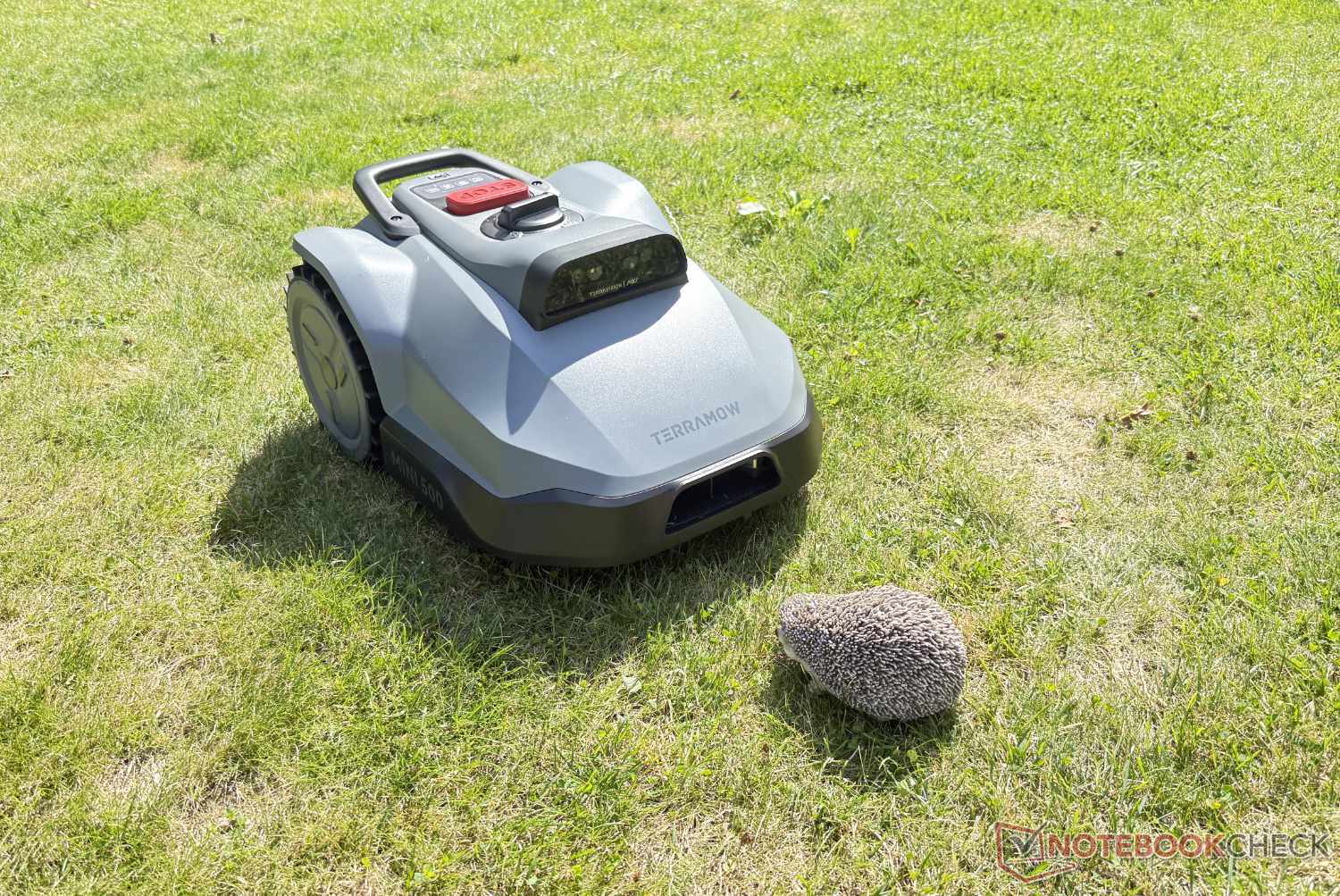
We recently tested the very similar Eufy C15 and Natural Expressions Performance 7. Both had already made a good impression with their obstacle avoidance, and the TerraMow Mini 500 does the same.
With its three cameras and AI assistance, it reliably detected all our test obstacles, including a model hedgehog, a tennis ball, and a piece of garden hose, and passed relatively close to them while navigating around them. Many other competitors, some of them significantly more expensive, have struggled at least to some extent with some of these obstacles. In this respect, the TerraMow Mini 500 performed flawlessly in our test.
Area & edge mowing: Robotic lawn mower for small gardens
The TerraMow Mini 500 is designed for small gardens of up to 500 square meters. Its cutting system is correspondingly compact, with an 18 cm cutting width and three blades. It therefore mows in fairly narrow paths, whose spacing can also be adjusted via the app. Based on our hands-on experience, however, it still mowed quite neatly and cleanly, although it proceeds at a leisurely pace at the standard speed setting.
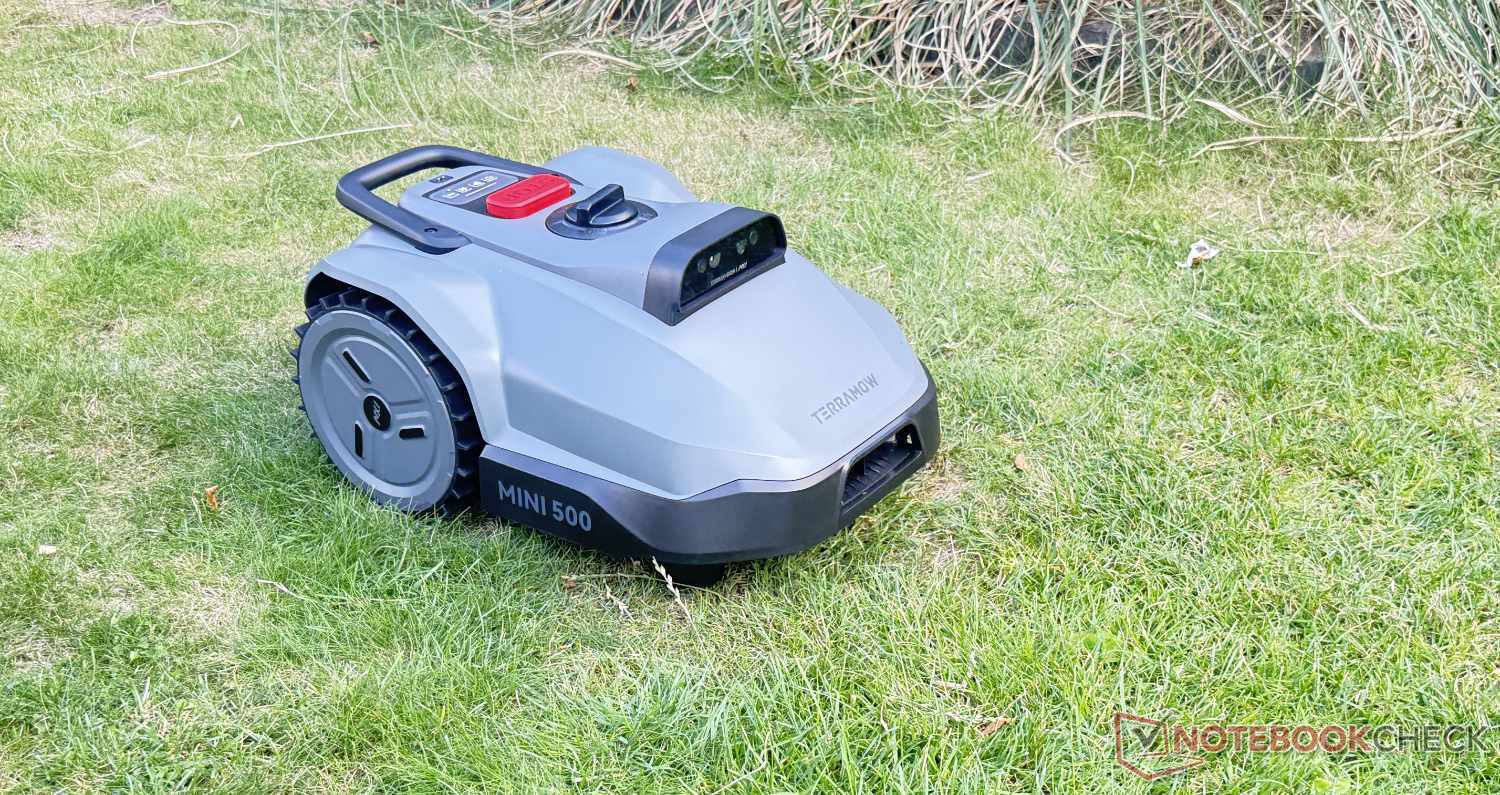
When mowing along edges, the Mini 500, as an affordable model without a separate edge-cutting solution, has the usual problem. The 18 cm-wide cutting disc is centered within the roughly 37 cm-wide robotic mower. In other words, there is a gap of around 10 cm between the cutting disc and the edge of the housing on both the left and right sides.
This strip will inevitably remain at non-level transitions that the robotic mower can be configured to drive over. In addition, there is some deviation caused by the navigation, although it remains quite precise even along the edge.
Runtime & noise level: Economical and quiet
TerraMow installs an 88.7 Wh battery, giving the mower slightly less capacity than the Eufy C15. This should allow the robotic mower to mow up to 250 square meters per battery charge. In our test, the TerraMow Mini 500 actually exceeded this figure on our test area before returning to the charging station with 20 percent charge remaining. It then spent a little over 1.5 hours there recharging approximately 90 Wh at up to 65 W.
To compare the energy efficiency of the robotic mowers we test, we always assume a 500-square-meter area that is to be mowed three times a week. Based on our measurements, including standby power consumption of less than 2 W, this results in monthly electricity consumption of just over 3 kWh. The TerraMow Mini 500 is therefore not only affordable to buy but also economical to operate.
The TerraMow Mini 500 itself is pleasantly quiet at just over 50 dB. Depending on the mowing activity, it naturally becomes louder; according to our measurements from a distance of around 1 m, it averages between 55 and 60 dB.

Based on our test, is the TerraMow Mini 500 not the right boundary-wire-free robotic lawn mower for your garden?
Then discover many more models in our Best Robotic Lawn Mowers of 2026!
Transparency
The selection of devices to be reviewed is made by our editorial team. The test sample was provided to the author as a loan by the manufacturer or retailer for the purpose of this review. The lender had no influence on this review, nor did the manufacturer receive a copy of this review before publication. There was no obligation to publish this review. As an independent media company, Notebookcheck is not subjected to the authority of manufacturers, retailers or publishers.
 Add as a preferred source on Google


