




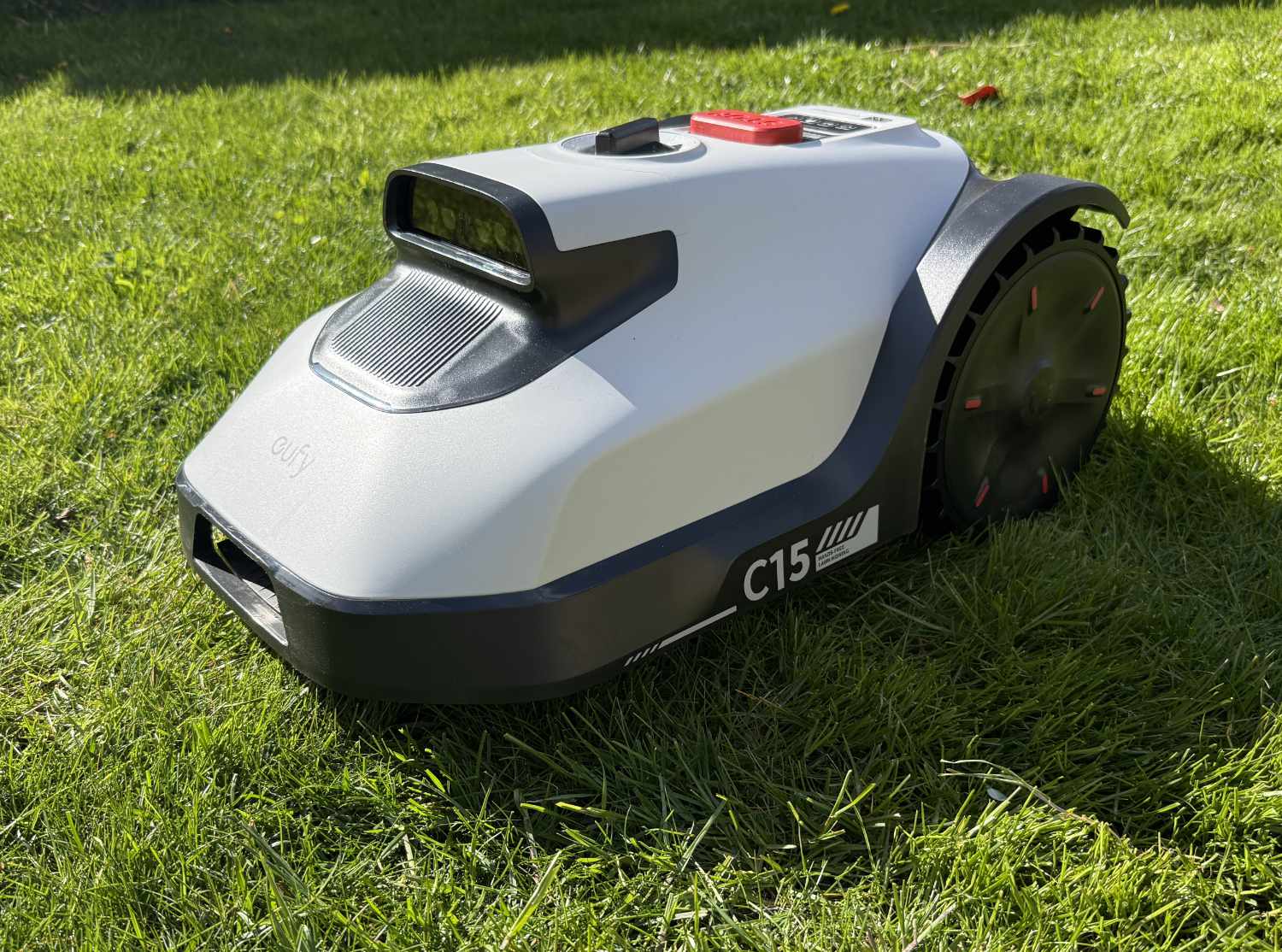
Anker's new entry-level robotic lawn mower for small gardens: Eufy C15 review
Affordable.
Can Anker's entry-level Eufy C15 robotic lawn mower upset the more expensive models? Our review of the brand-new garden helper for under 1,000 euros reveals for whom the Eufy C15 is the perfect choice - and for whom not...Marcus Schwarten (translated by DeepL / Marcus Schwarten) Published 🇩🇪
Eufy C15 test conclusion: Good entry-level robotic lawn mower for small gardens
If you are looking for a robotic lawn mower for small gardens that is easy to set up and does its job reliably, you will find it here. The Eufy C15 made a very good impression in the test - especially considering its low price.

Positive features that stood out in the test included the simple setup without RTK or boundary wire, the (mostly) reliable operation and the very good obstacle detection. The biggest weakness (as with many other robotic lawn mowers) is the edge cut.
However, the garden must meet a few requirements - in addition to the maximum dimensions of 500 square meters. Ideally, the lawn should be closed on all sides and have no more than a slight incline. This is because the Eufy C15 does not allow manual mapping and is anything but a mountain goat.
For less than €1,000 with the garage included, Anker's Eufy C15 is an affordable robotic lawn mower for anyone looking for a simple solution for automatically mowing smaller lawns. However, the competition in the three-digit price range is getting bigger and bigger, such as the Ecovacs Goat O1200 LiDAR Pro with side trimmer or the even cheaper Anthbot M9 or M5 show.
Pros
Cons
Price & availability
The Eufy C15 is not currently available in the USA. In Europe, it is available for a recommended retail price of 899 euros, e.g. from Amazon. The manufacturer also offers an optional version with a garage for an additional 100 euros.
Table of Contents
- Eufy C15 test conclusion: Good entry-level robotic lawn mower for small gardens
- Equipment & scope of delivery: With garage on request
- Setup & maintenance: Ready to go immediately - but with a waiting time
- App & operation: With live video and real view
- Navigation & obstacle detection: reliable as usual
- Mowing performance & edge cutting: Without edge cutting highlight
- Runtime & noise level: Affordable not only in terms of purchase price
Last year, Anker made an impressive debut in the robotic lawn mower market with the Eufy E15 and E18. The Eufy C15, the third robot lawn mower, follows in 2026, positioning itself as the new entry-level class below the two existing models.
For less than 1,000 euros, the manufacturer nevertheless promises a fully-fledged robotic lawn mower that is aimed at smaller lawns of up to 500 square meters. Our review reveals how well the Eufy C15 has done its job in practice and what buyers have to do without with this entry-level model.
Eufy C15 data sheet (comparison with E15/E18)
| Property/model | Eufy C15 | Eufy E15 | Eufy E18 |
|---|---|---|---|
| Area | 500 m² | 800 m² | 1,200 m² |
| Navigation and obstacle detection | TrueVision | TrueVision | TrueVision |
| Mower | Mowing disk | Mowing disk | Mowing disk |
| Number of blades | 3 | 3 | 3 |
| Cutting width | 18 cm | 20.3 cm | 20.3 cm |
| Cutting height | 20 - 60 mm | 25 - 75 mm | 25 - 75 mm |
| Adjust cutting height | manual | electric | electric |
| Slope | 32% / 18° | 32% / 18° | 32% / 18° |
| Connectivity | WiFi, Bluetooth | WiFi, Bluetooth, 4G | WiFi, Bluetooth, 4G |
| Display | no | no | no |
| Battery capacity | 93 Wh | 93 Wh | 93 Wh |
| Weight | n/a | 12.5 kg | 12.5 kg |
| Dimensions | 60 x 38.5 x 29 cm | 60.3 x 39.4 x 31.8 cm | 60.3 x 39.4 x 31.8 cm |
| Water resistance | IPX6 | IPX6 | IPX6 |
| Garage included | optional | yes | yes |
| Number of blades supplied | 3 + 9 | 3 + 9 | 3 + 9 |
| Color | White | White | Silver |
| MSRP | from 899 Euro | 1,499 Euro | 1,799 Euro |
Equipment & scope of delivery: With garage on request
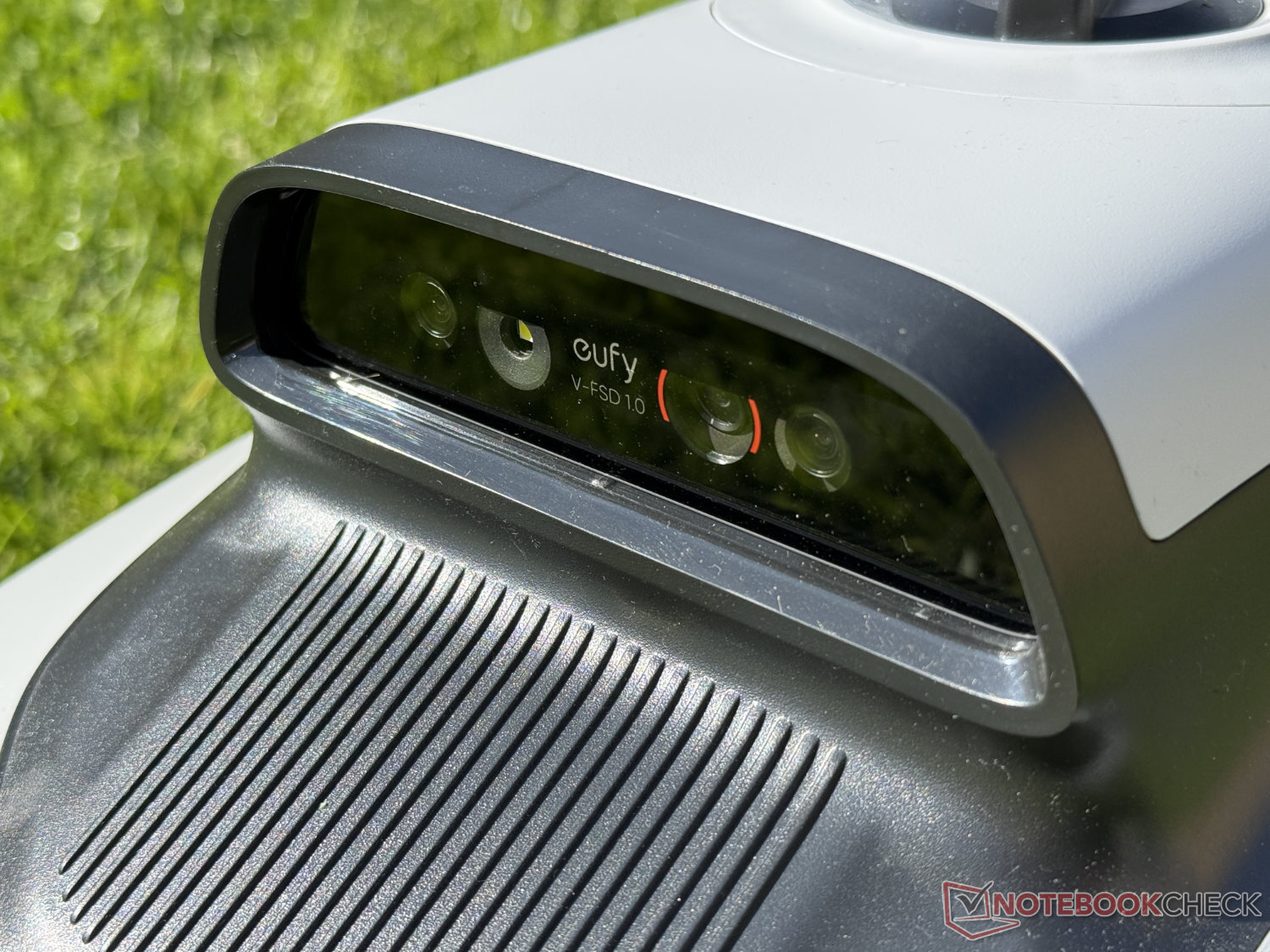
Despite being an entry-level model, the Eufy C15 is identical to the more expensive E15 and E18 models in many respects. This applies above all to the navigation solution. The C15 also relies on TrueVision technology, meaning it uses purely camera-based navigation. It does not require a perimeter wire or RTK antenna in the garden and does not rely on LiDAR, as many other wireless robotic lawnmowers of the 2026 generation do.
Two cameras together with other sensors and AI detect the lawn and obstacles, enabling it to be "ready to go in just 5 minutes" according to the manufacturer's promise. In our Eufy C15 test below, we explain whether this is actually the case in practice.
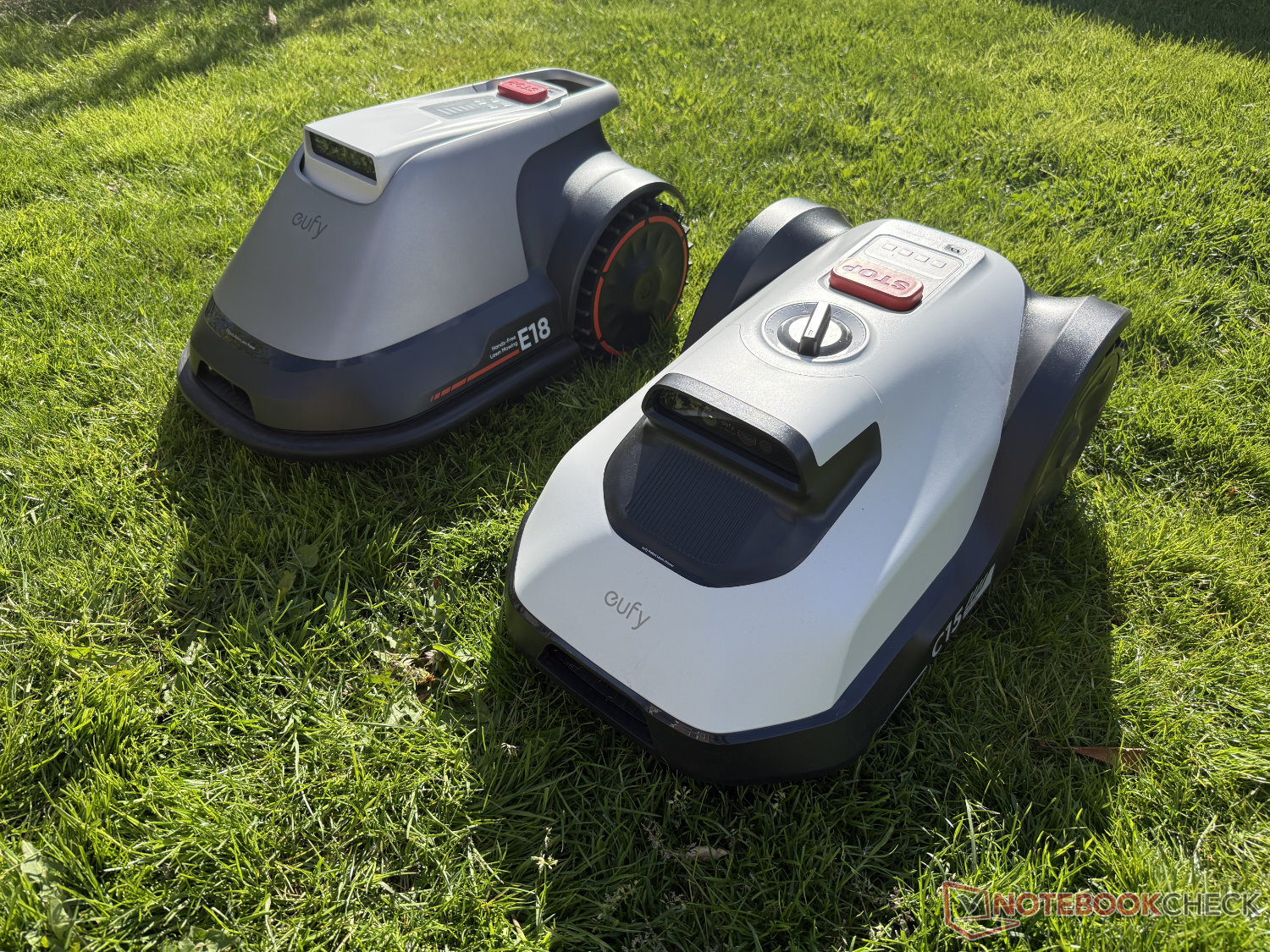
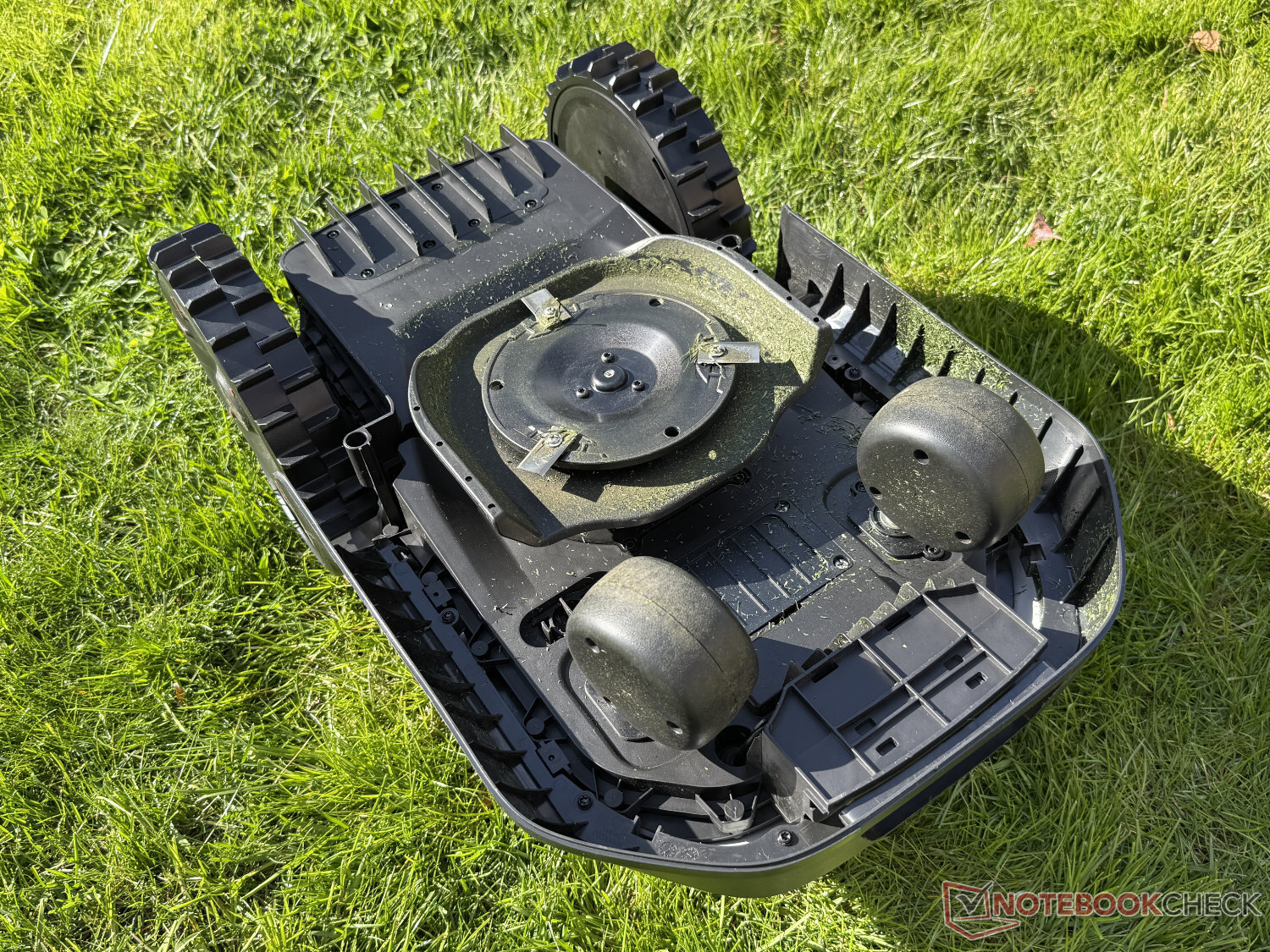
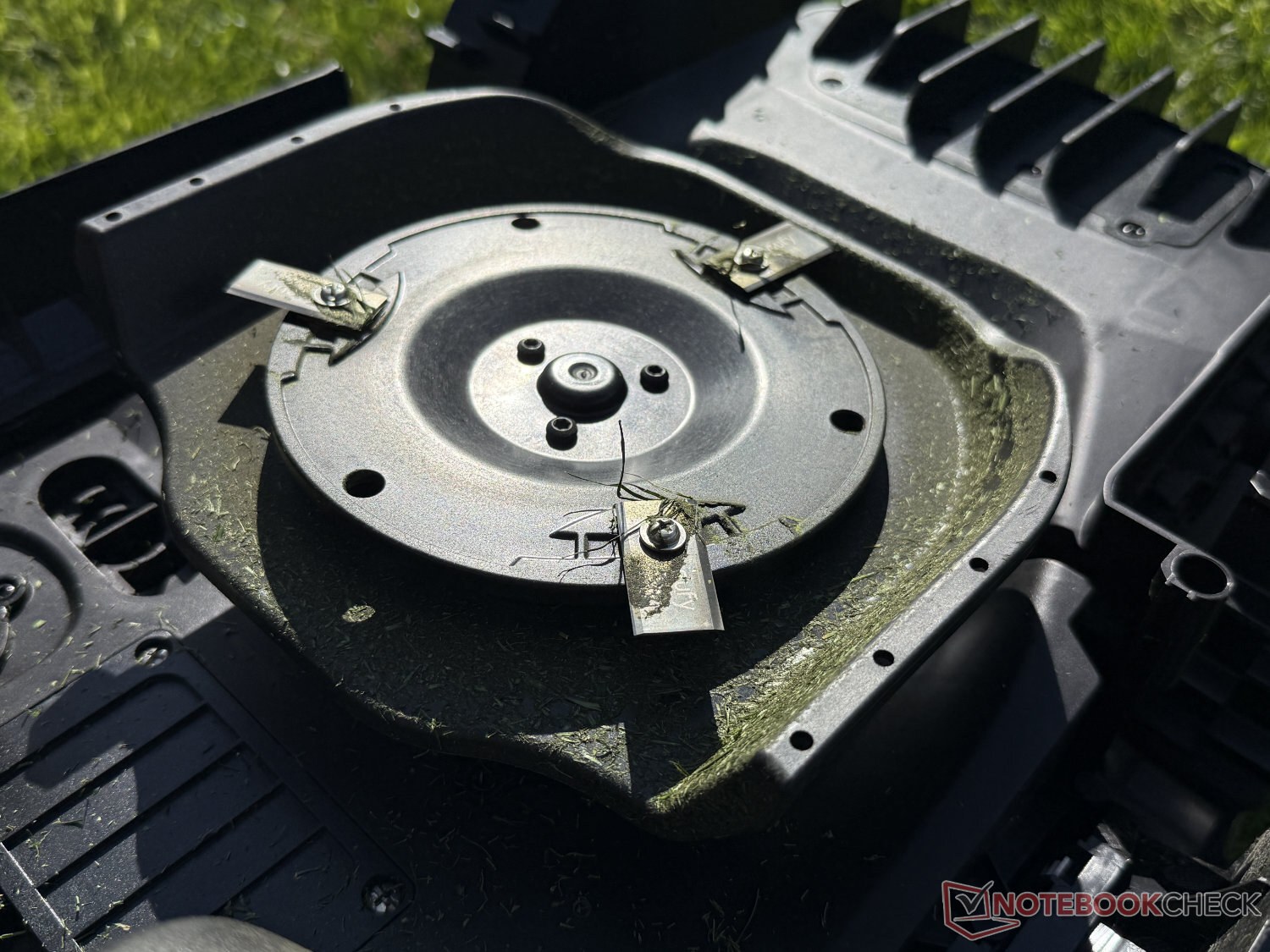
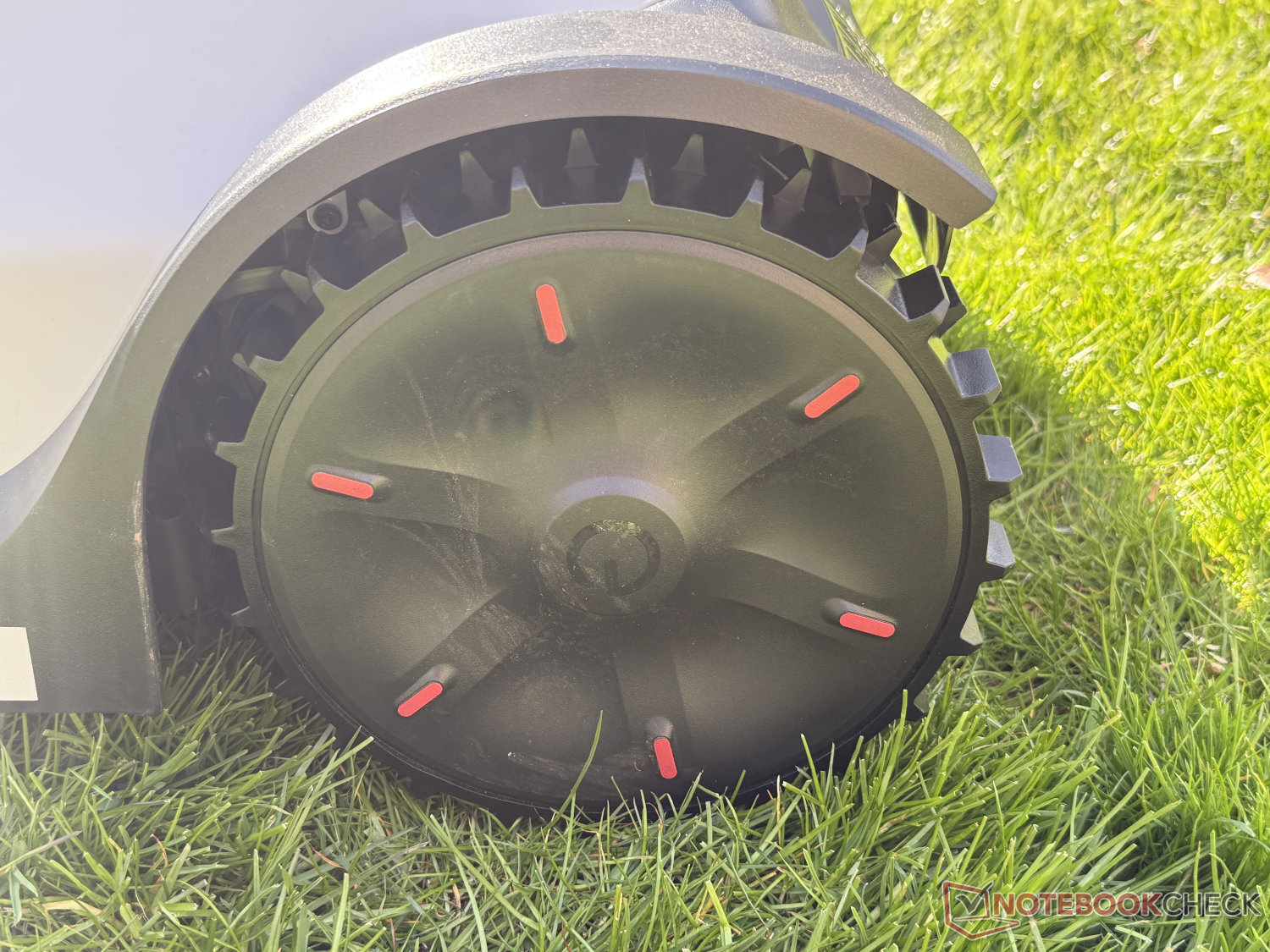
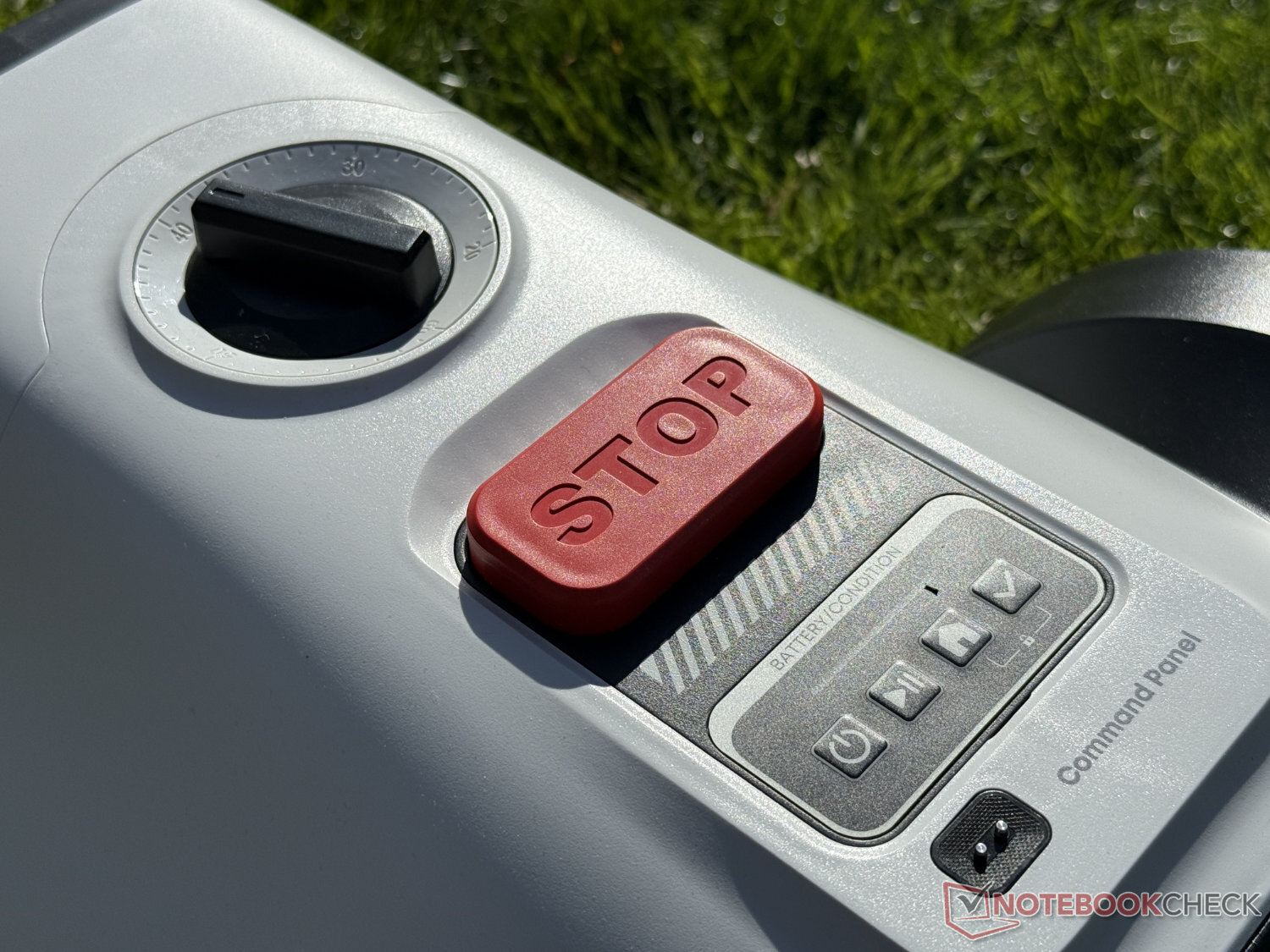
First, let's work through the remaining features. Mowing is carried out with an 18 cm and therefore around 2 cm narrower mowing disk with three freely oscillating blades. The cutting height can be adjusted from 20 to 60 mm, but only manually. These are some of the few differences to the E-series, which offer electric adjustment of the cutting height.
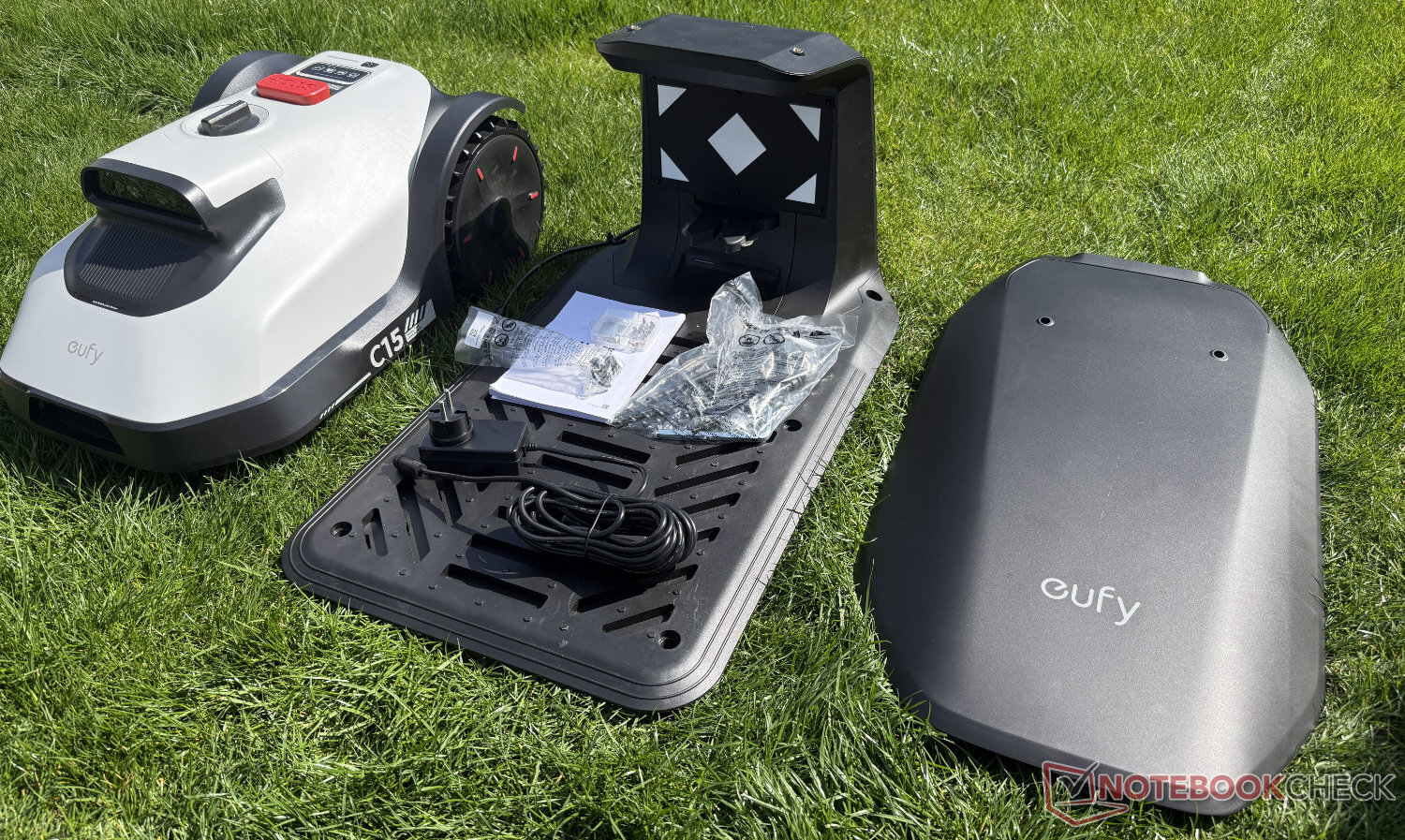
There are two different versions of the scope of delivery. The cheaper version, with an MSRP of €899, includes only the charging station with ground screws and nine spare blades. Alternatively, Eufy offers the C15 with a garage for an additional 100 euros MSRP - i.e. a plastic roof that attaches to the charging station with four tool-free screws and protects the robotic lawn mower from the elements.
Setup & maintenance: Ready to go immediately - but with a waiting time
As already mentioned, Anker promises that the Eufy C15 will be ready to go within five minutes. That's not quite true. The robotic lawn mower is not ready to start mowing that quickly, but it is at least ready for mapping. The version without the garage is really quick to set up: Unpack the robotic lawn mower and accessories from the box, lock the charging station in a suitable place in the ground, connect the power cable to the charging station and socket, switch on the Eufy C15 and place it in the station - done.
But that's only half the job done. Now comes the app connection and subsequent mapping. If you already have an account in the Eufy app, you can connect the C15 directly via "Add device". Otherwise, a short registration process is required. In the test, establishing a connection between the robot, Wi-Fi and app did not cause any problems. There is no 4G option.
Now comes the mapping process. This is quite different from many other robots. Because, as with the more expensive models Eufy E15 and E18 models, the more affordable entry-level C15 model does not require a manual mapping run. Instead, the robot mower takes care of mapping the lawn and creating the virtual map on its own. To do this, it explores the surrounding area with its cameras, automatically recognizes the lawn and scans it metre by metre until a completely closed map is available.
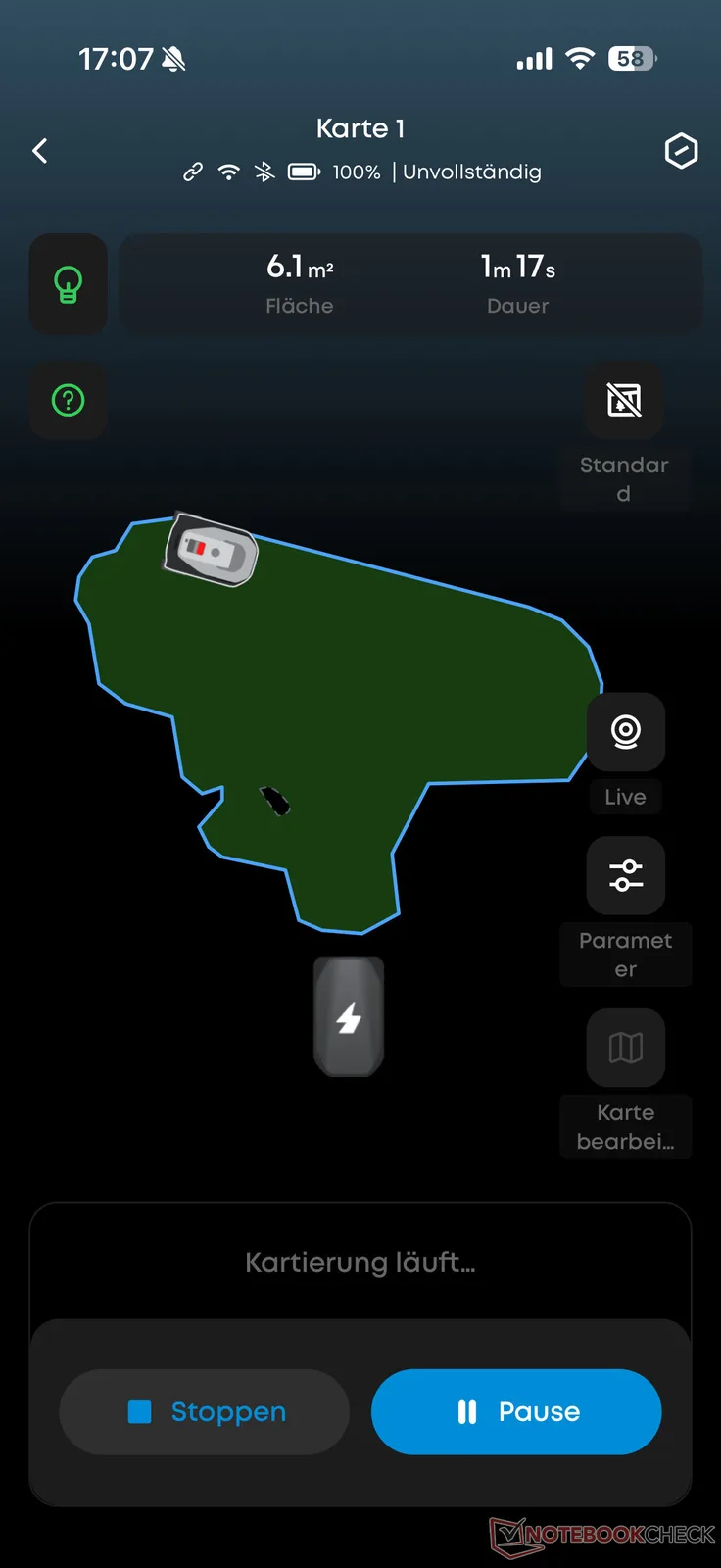
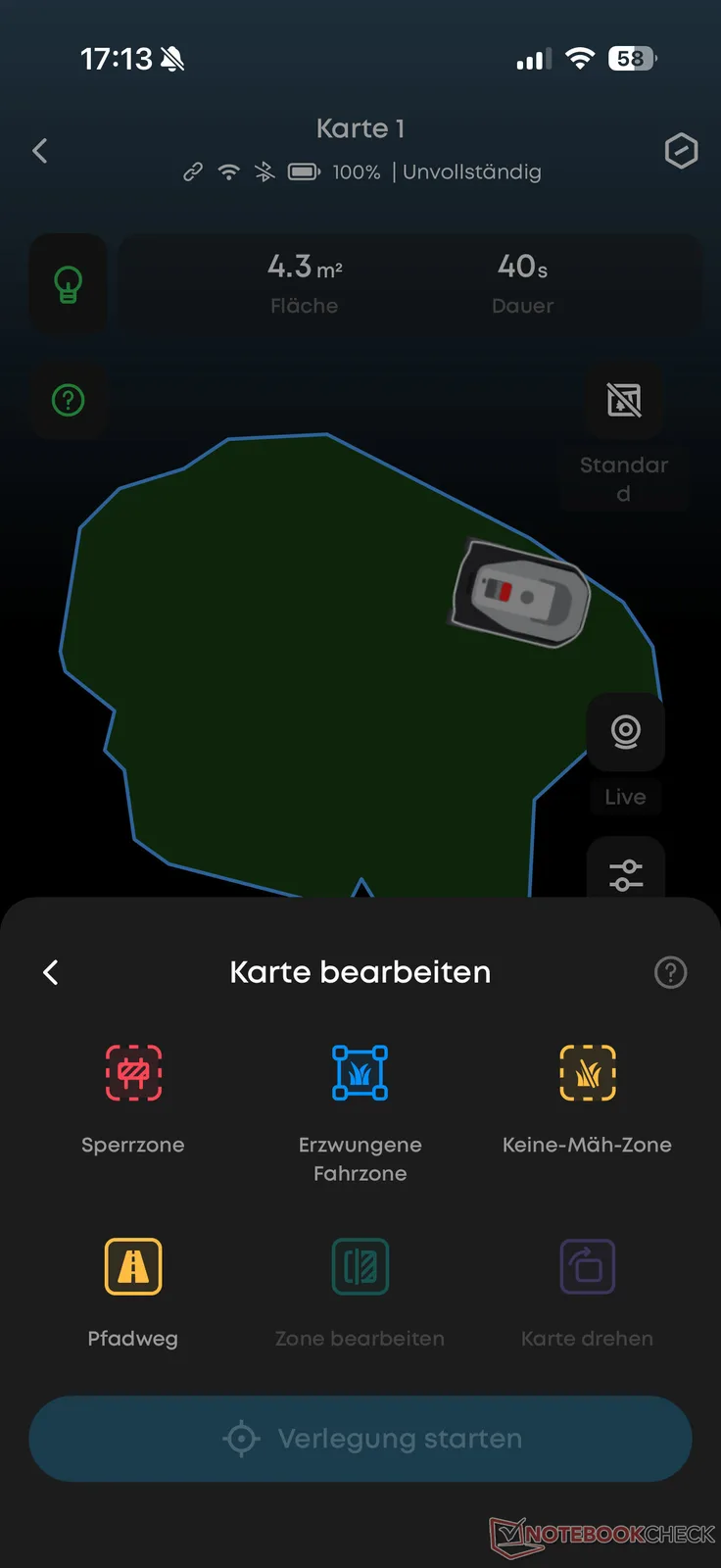
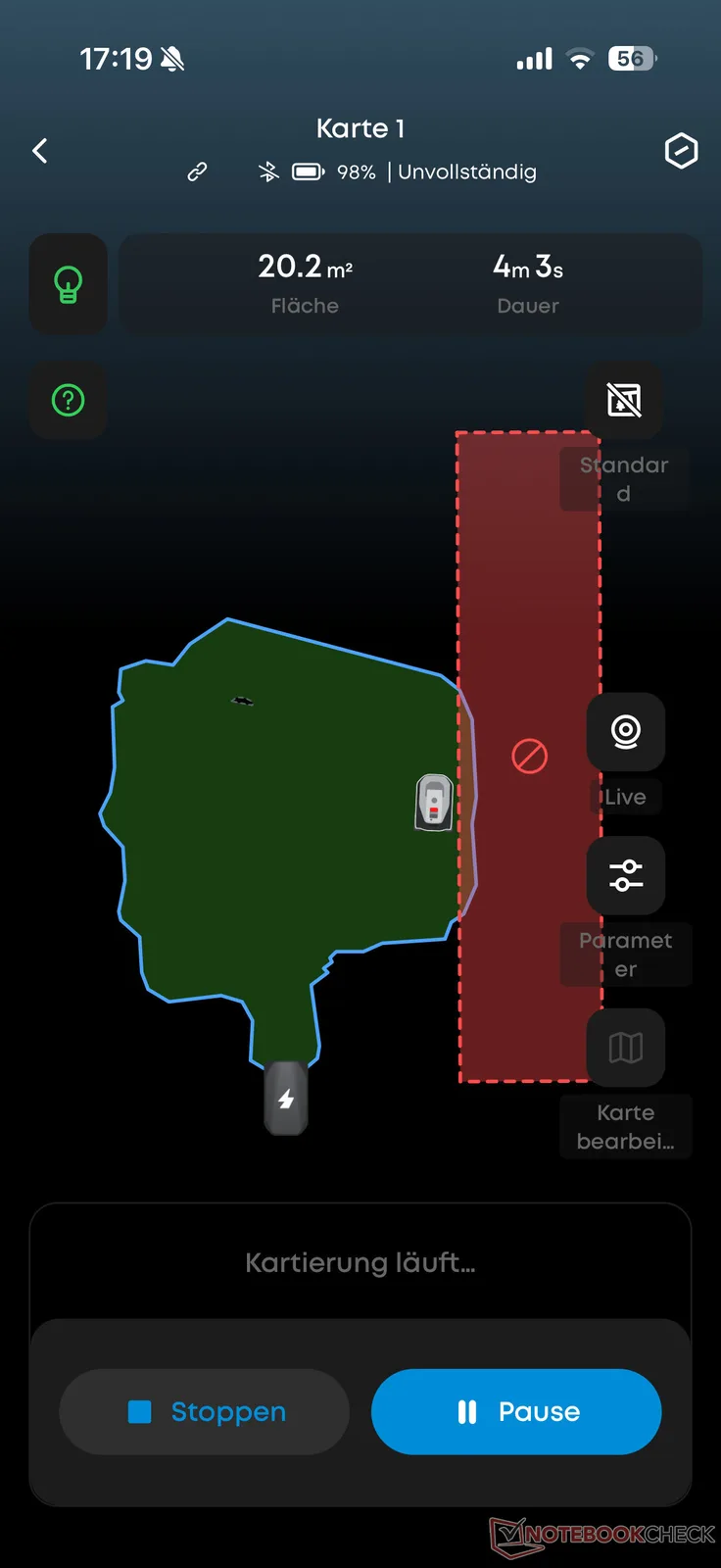
Which indirectly brings us to a problem which had already been noticed in the two sister models the previous year. If the lawn is enclosed on all sides, the Eufy C15 has no problems at all according to our test impressions. The situation is different if, for example, there is no separate transition to the neighbors' gardens or if lawn areas are to be left out for other reasons (e.g. flowering island in the lawn).
If only a certain part of a large lawn area is to be mapped and a no-go zone is not to be created afterwards, a little trick is required. Once the robotic lawn mower has reached the boundary, the mapping process can be paused. A restricted zone or virtual boundary can then be drawn by editing the partial map created up to that point. Without the final map, however, positioning is sometimes not so easy. If necessary, the restricted area can also be adjusted later in the map management. If mapping could be handled manually in sections when needed, such scenarios would be easier to handle.
In our slightly irregularly shaped test garden of around 250 square meters in size, mapping took a good 50 minutes - roughly the same amount of time as with E15 and E18. Depending on the size of the plot, you may have to wait a while after unpacking before the Eufy C15 can mow for the first time. That is certainly not a record-breaking start, but thanks to the absence of RTK and perimeter wire, it is definitely extremely beginner-friendly - especially for closed and simply designed lawns, for which the Eufy C15 is primarily made.
App & operation: With live video and real view
The Eufy app already made a good impression last year. If you have several of the manufacturer's devices, you can manage them all via one app - including the C15. As usual, the current map is displayed on the overview, on which the live progress is visible during mowing. Various mowing parameters can be set via a small icon on the right-hand side of the screen.
In addition to driving and blade speed, direction of travel on the map and the path distance, the distance for edge mowing can also be set here. Here you can select between -15 and +15 cm how far the robot may cross the edge of the lawn. This is practical for ground-level transitions, for example to patios and paths. Unfortunately, the value can only be set for the entire zone, but not for individual edge areas. Some other manufacturers solve this even better, for example the Anthbot M9.
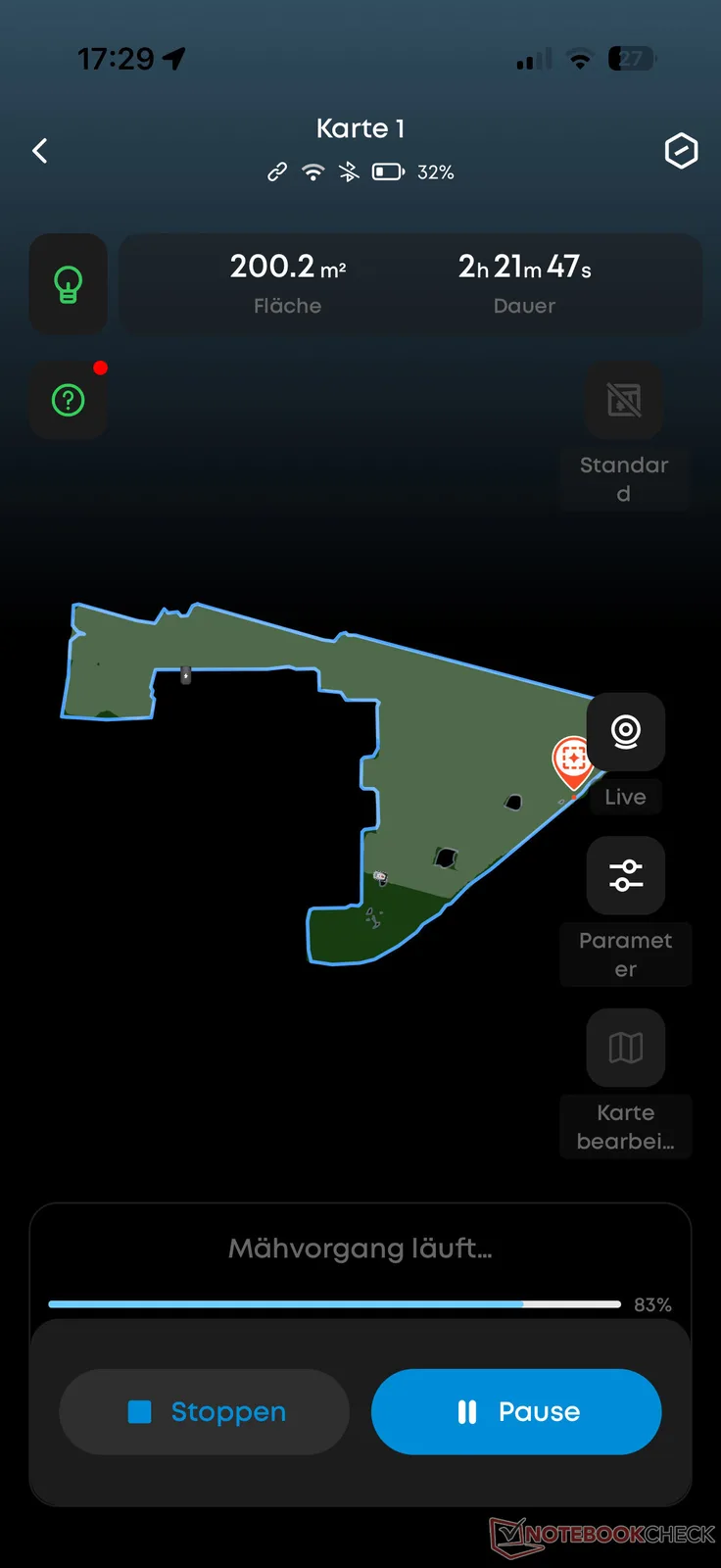
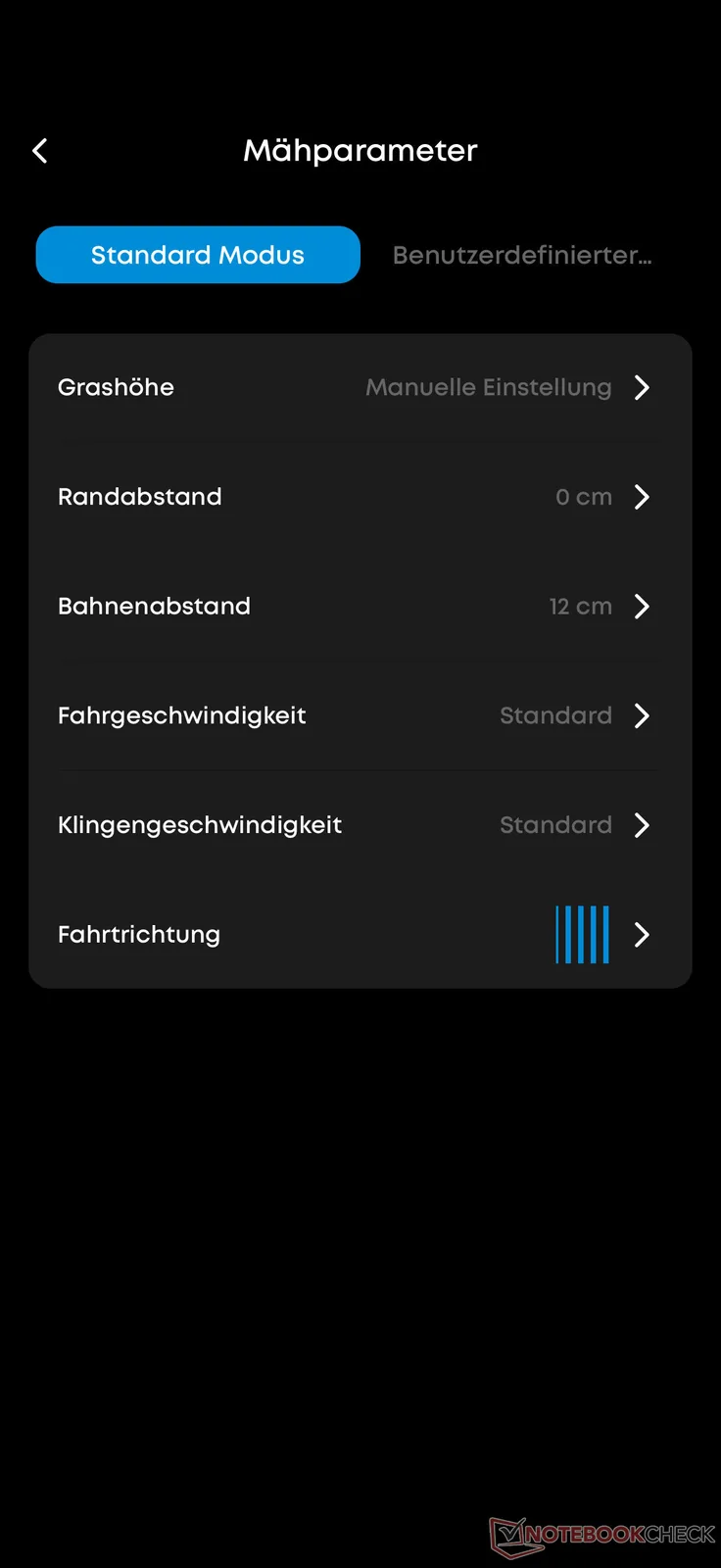
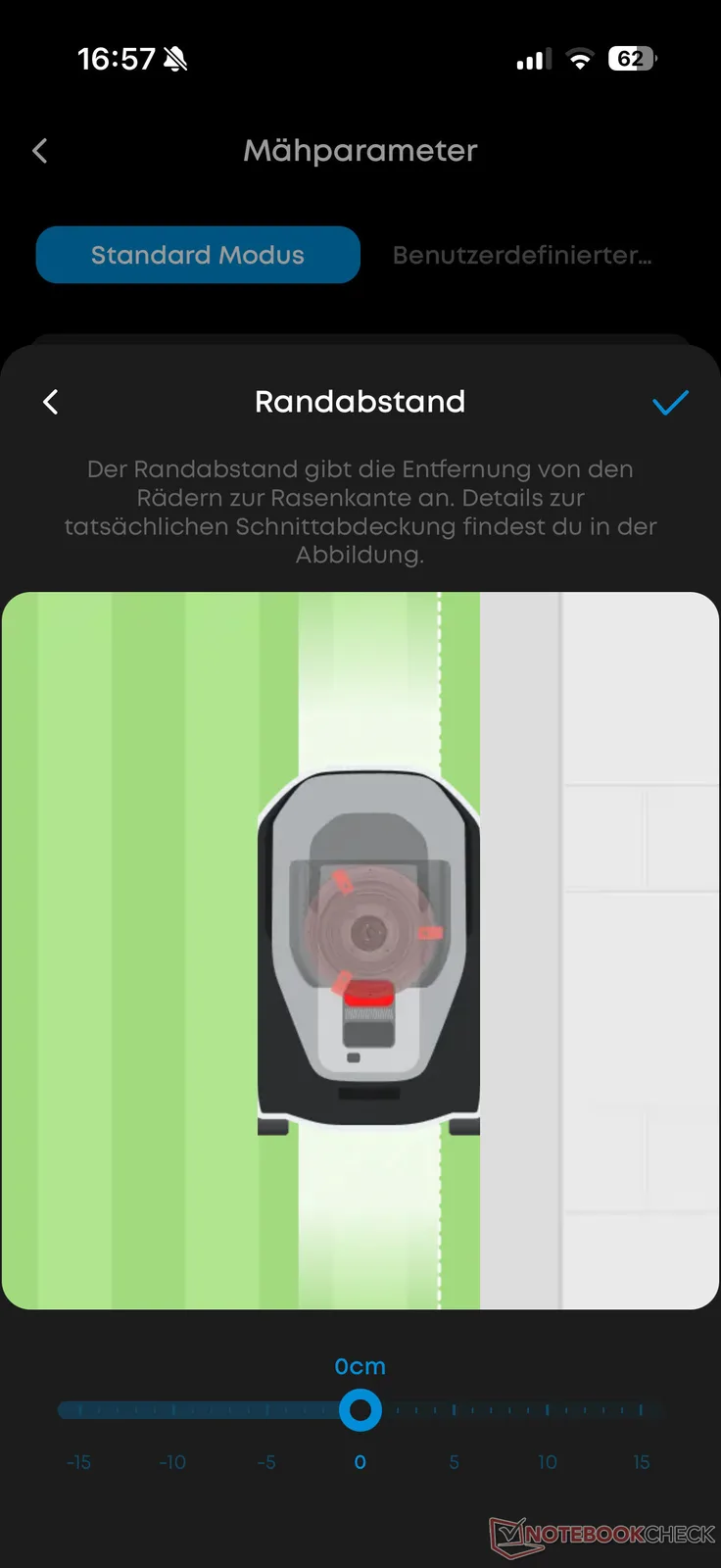
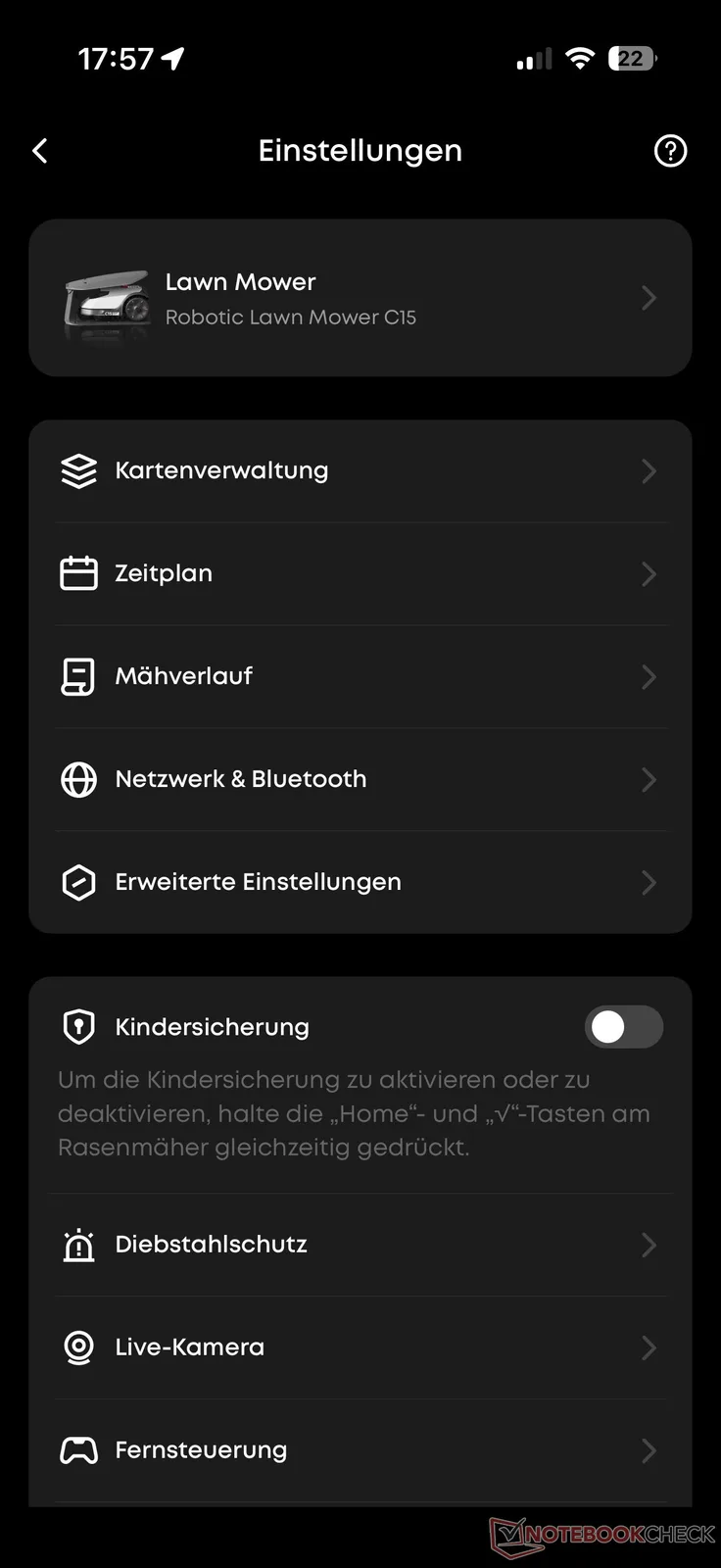
“In the top-right corner, the usual icon opens the settings menu. In addition to map management, schedule for automated mowing and mowing history, there are various options to customize here. These include the volume of the voice message (also available in German), activation and deactivation of rain detection and various laboratory functions that have not yet made it to series production.
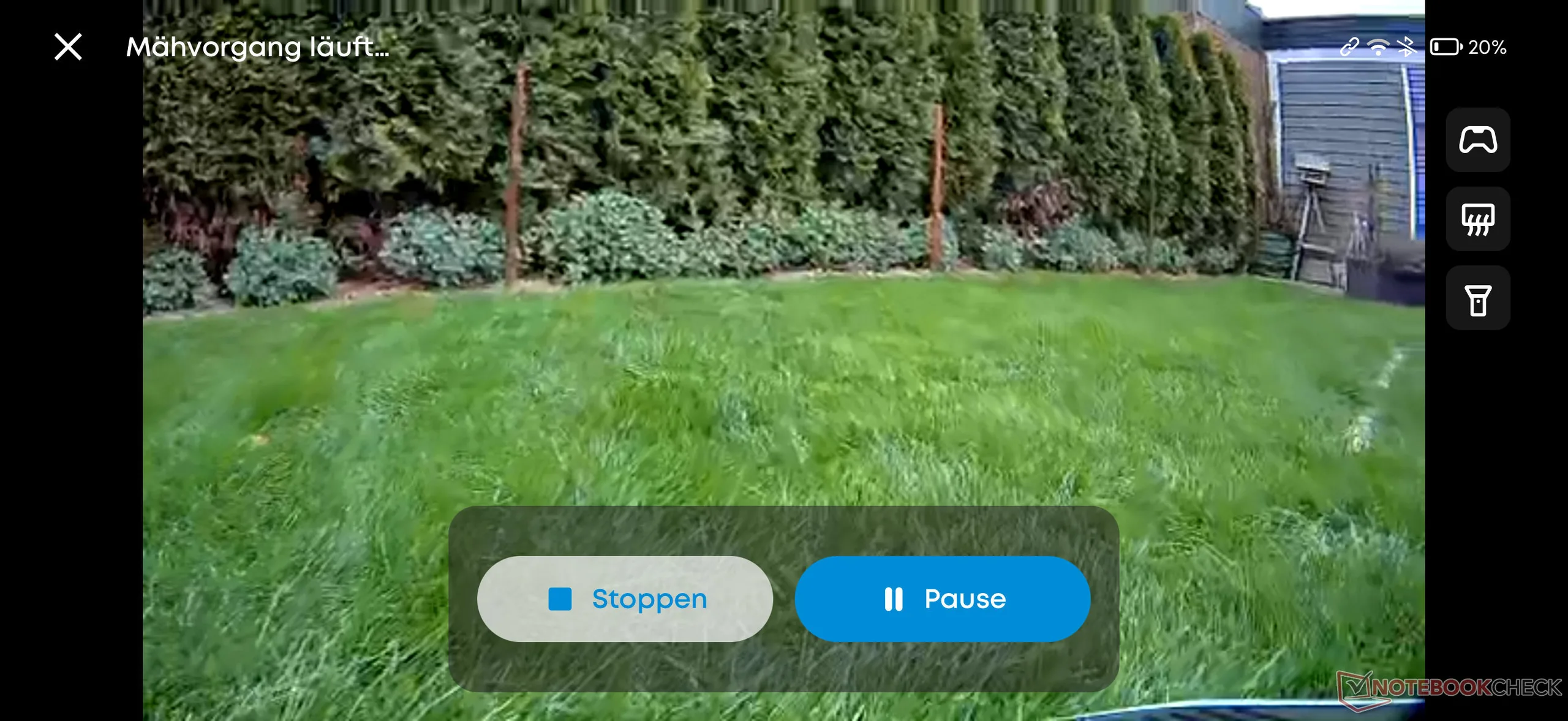
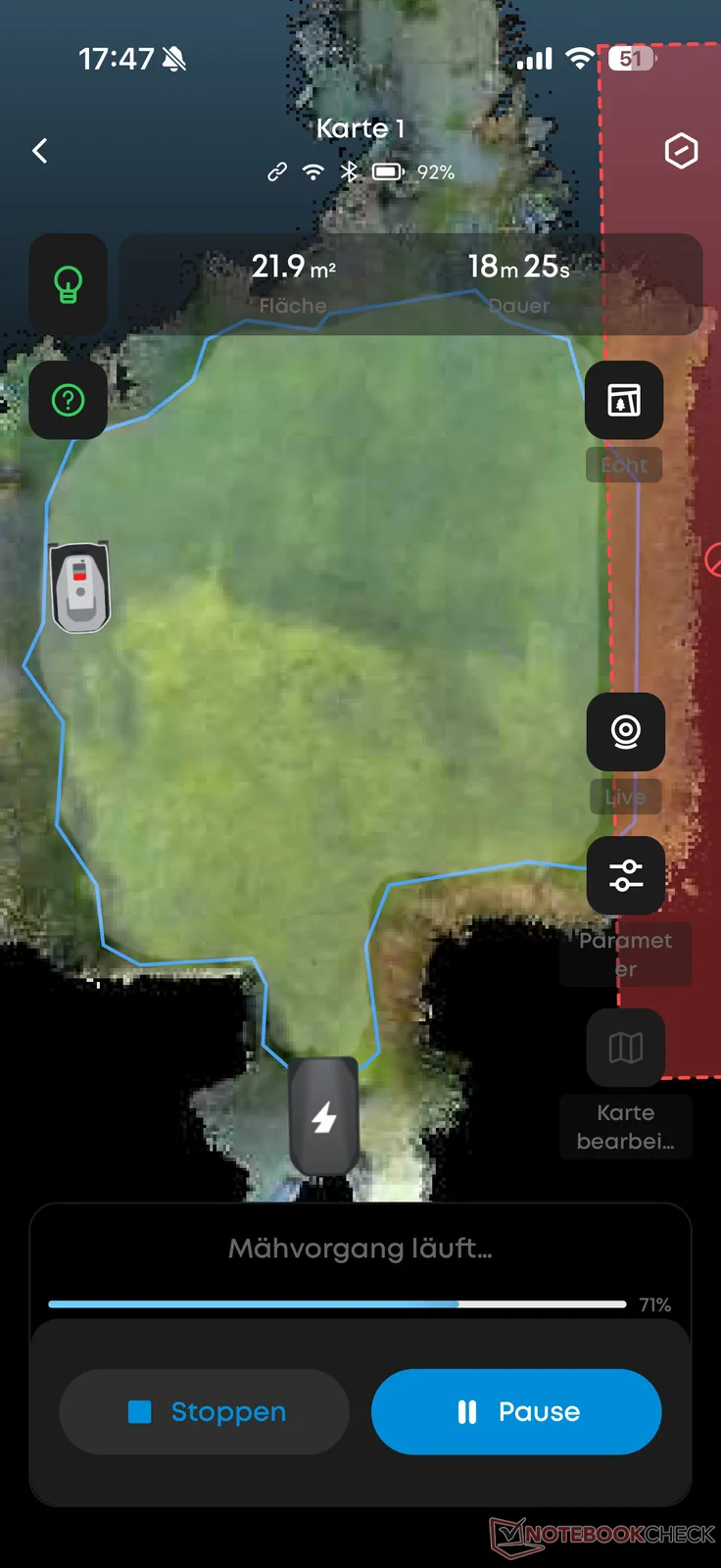
Only one map can be created with the Eufy C15. However, this can contain several zones including connecting paths. Restricted zones, no-mow zones and forced driving zones can also be created. Overall, the map management is kept quite simple, which is appropriate for an entry-level model. In addition to the possibility of live video while driving (after activation), the option of displaying a "real" view of the garden in addition to the standard view is exciting, although this is also rather rudimentary.
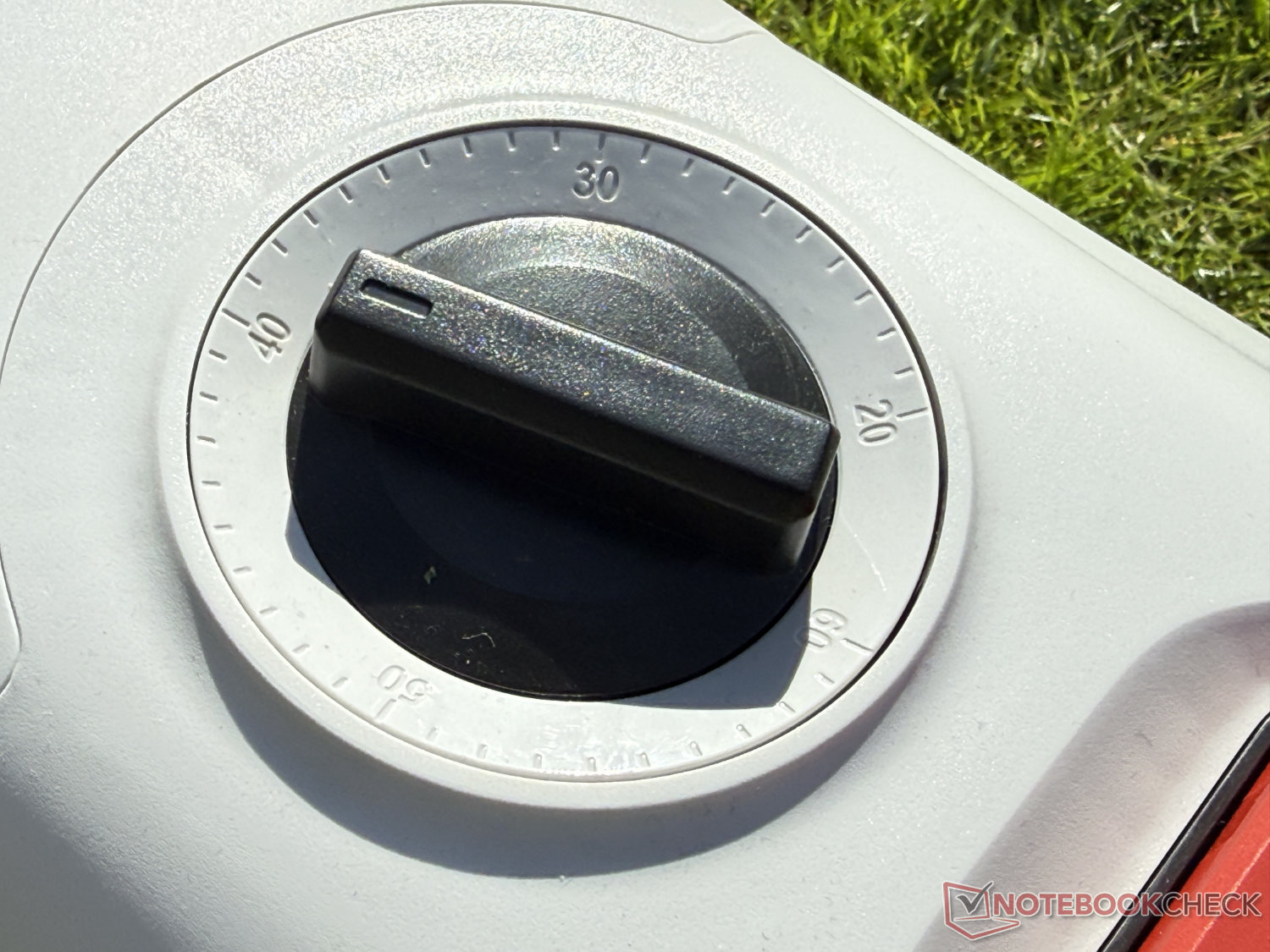
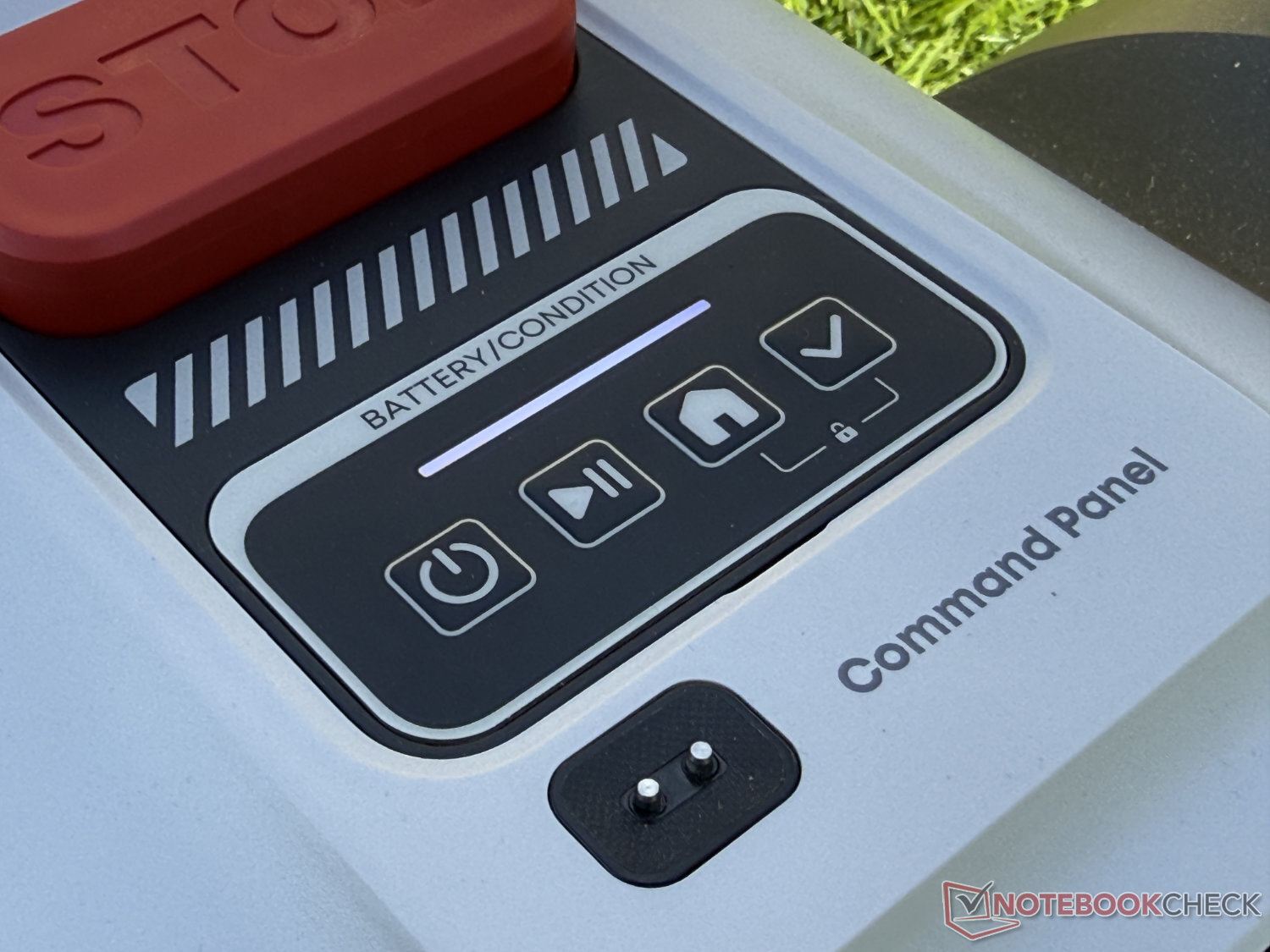
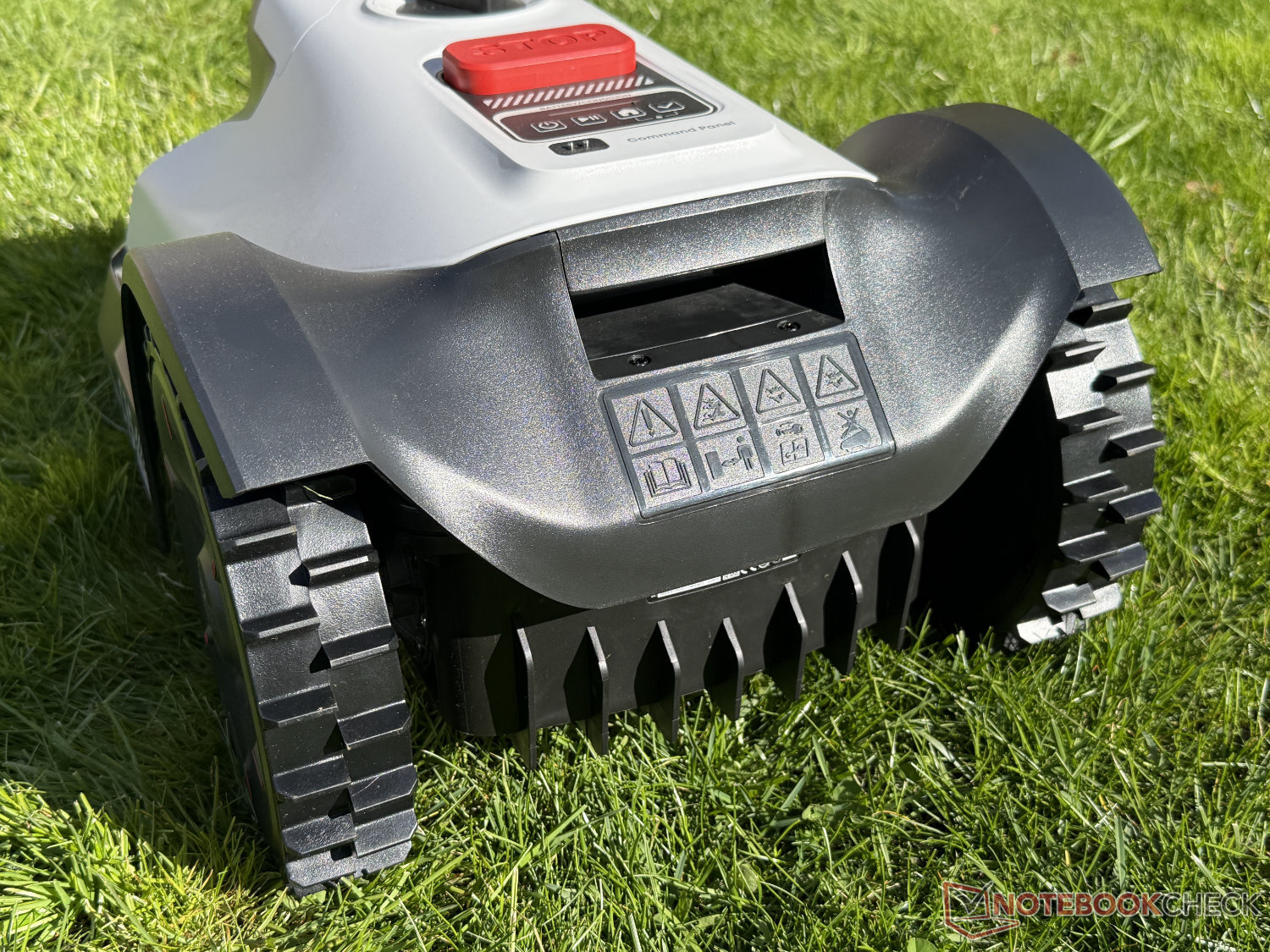
As an alternative to the app, the Eufy C15 can also be operated using the five buttons (Stop, Power, Start/Pause, Home, OK) on the robotic lawn mower itself. In any case, the cutting height must be set here using the large rotary dial on the top. There is no display. The battery status is shown via a small LED strip.
Navigation & obstacle detection: reliable as usual
Eufy now relies on the TrueVision system, which is primarily based on two AI cameras, for its three robotic lawn mowers. This already made a good impression last year in the E15 and E18. The new entry-level model C15 also worked reliably for the most part in the test. The robotic lawn mower covered our two test areas as systematically and comprehensively as possible. The climbing ability is limited. However, its compact dimensions make many narrow passages easy to handle.
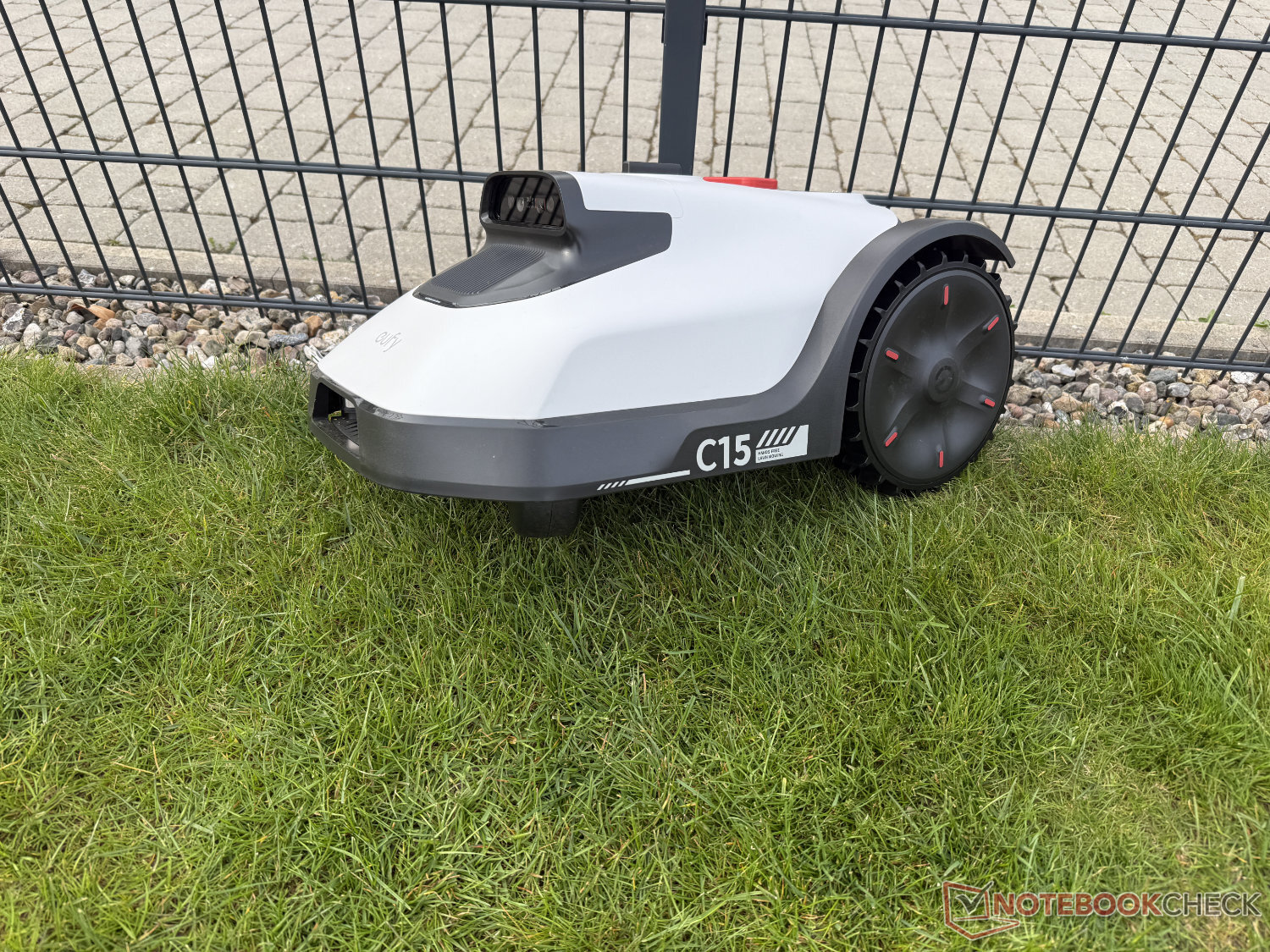
However, our practical experience was not entirely free of problems. On one occasion, the robot lawn mower "crashed" on the other side of the lawn at a small stone edge with a subsequent 10 cm drop, meaning it left the mapped area by a few centimetres. Even the activated laboratory function "Detection and avoidance of dangerous areas" in the settings did not prevent this. Otherwise, however, the Eufy C15 reliably followed its path and carried out its operation without any further incidents.
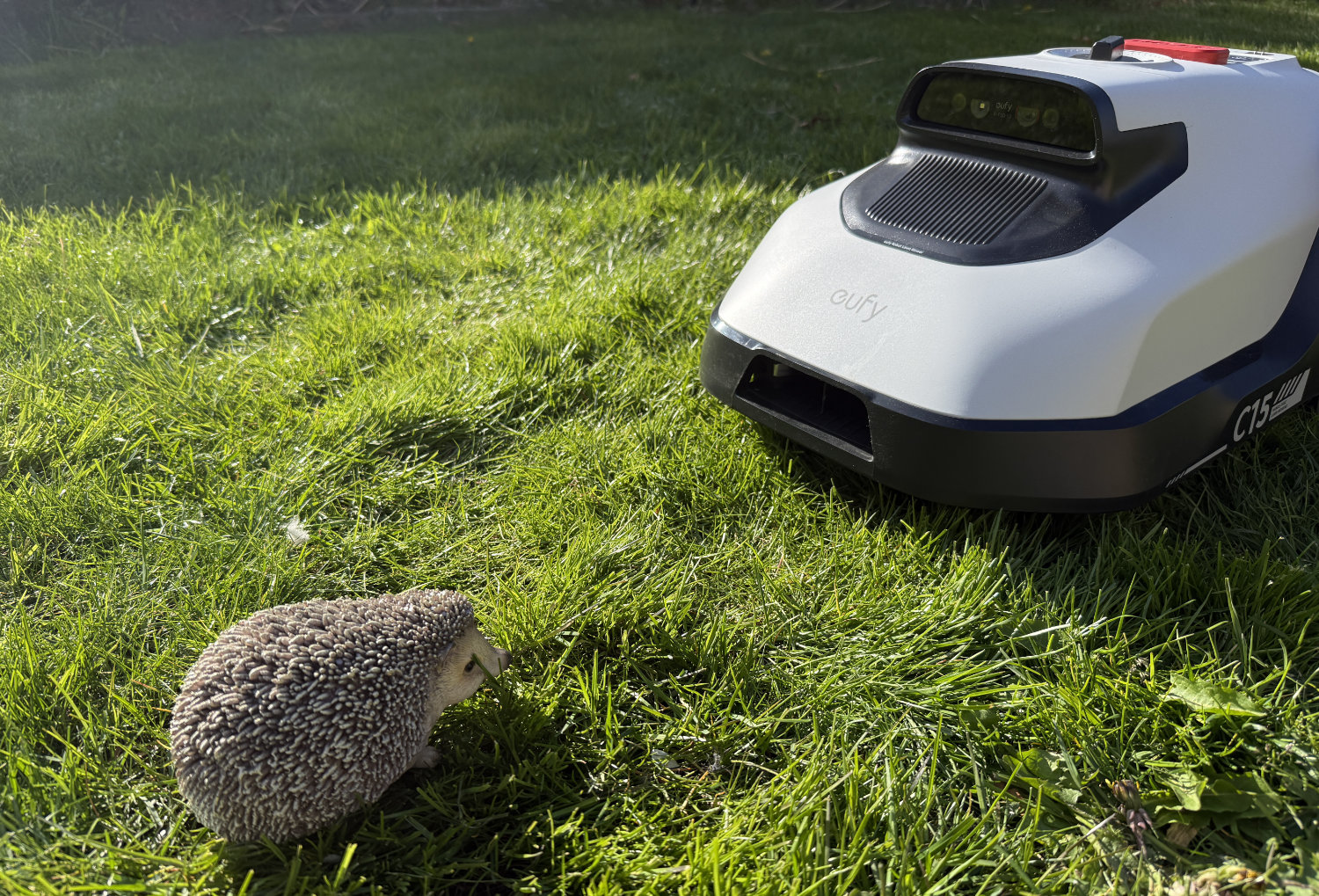
The obstacle detection of the Eufy C15 worked completely reliably in the test - just as it did in the two E-series models last year. In addition to all natural obstacles on the test areas (apart from the one faux pas on the "abyss"), our test objects were also always detected - including a hedgehog dummy, a piece of garden hose and a tennis ball. The latter two in particular have caused many other and much more expensive robotic lawn mowers to fail.
Mowing performance & edge cutting: Without edge cutting highlight
There is also not much to criticize about the mowing performance of the Eufy C15. At 18 cm, the mowing deck is very small, which is of course to the detriment of the area per hour. In the end, however, the grass on our test areas was cut to the required length. In this respect, the inexpensive robotic mower does not differ greatly from more expensive models, even if some of them are more powerful.
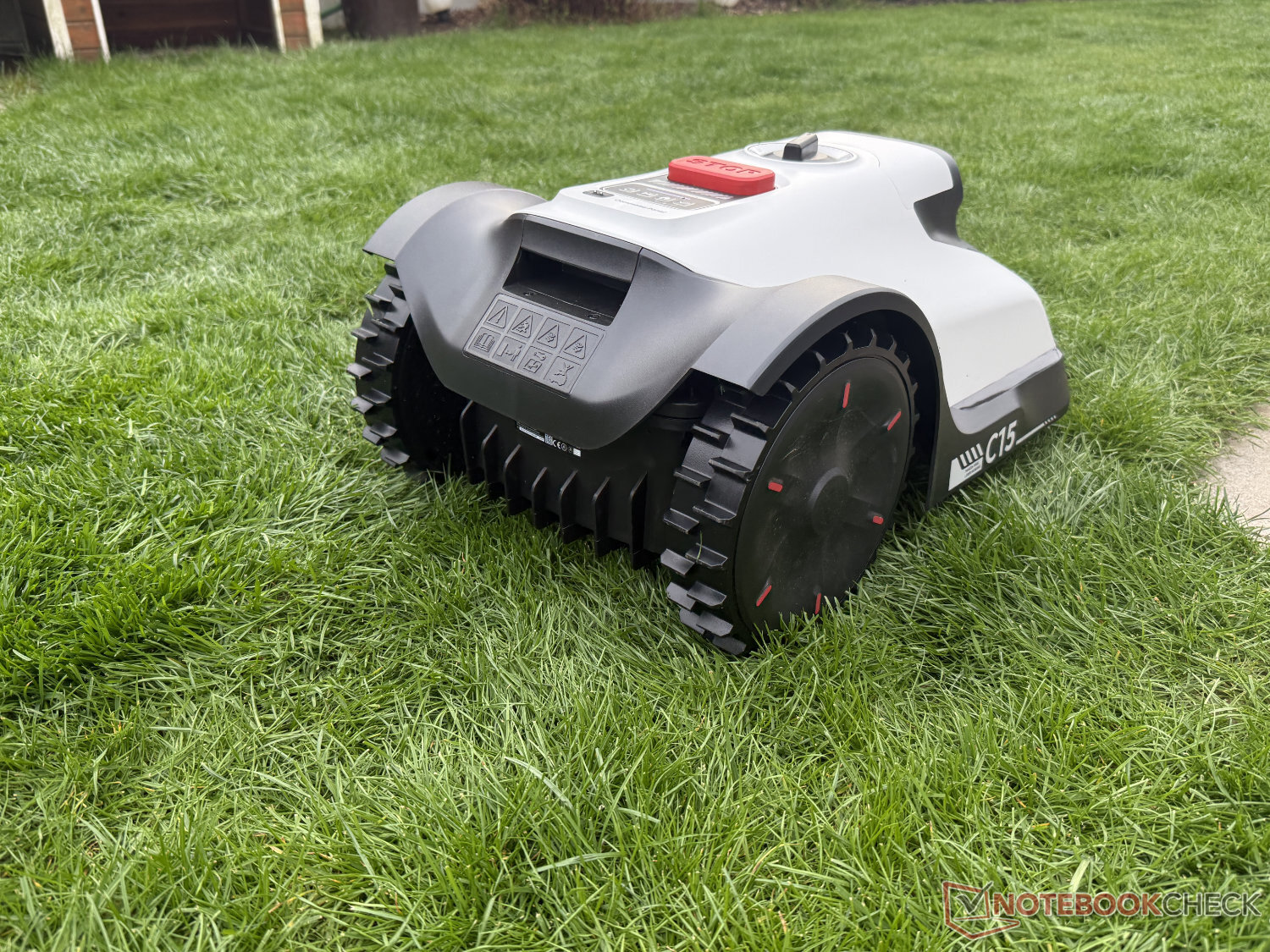
The wheat will be separated from the chaff in 2026 when it comes to edging. This year, some (usually more expensive) robotic lawn mowers offer special solutions for lawn edges with a side mower or trimmer. Apart from the setting options in the Eufy app (see above), there is nothing comparable in the C15.
The mowing disc sits around 10 cm from the edge in the middle under the robot. Added to this are the inaccuracies in navigation, which cannot be influenced by manual mapping. The result is an unmown edge of a good 10 to 20 cm if the lawn is surrounded by transitions that are not at ground level.
Runtime & noise level: Affordable not only in terms of purchase price
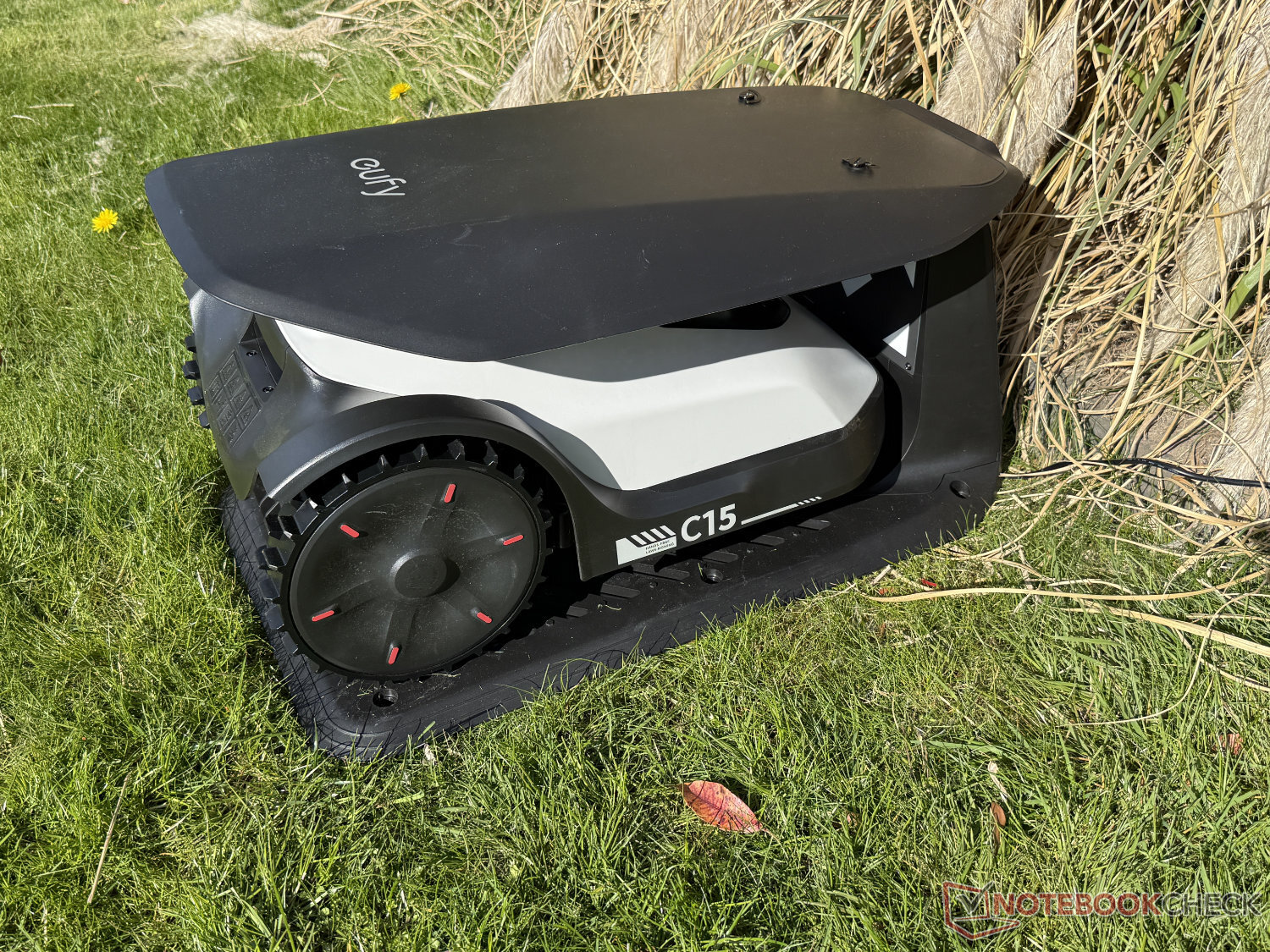
Anker claims 200 square meters per battery charge. The Eufy C15 was even able to surpass this figure in the test. With standard settings, it mowed around 250 square meters in just over three hours until it made its way to the charging station with 10 percent charge remaining. There it "refueled" in just under two hours, with around 100 Wh flowing through our measuring device.
Together with a manageable power consumption of approx. 2 W in standby mode at the charging station, this results in a power consumption of only around 3.5 kWh per month in our comparison. This is based on mowing 500 square meters three times a week. The Eufy C15 is therefore not only affordable to buy, but also to maintain. Another positive aspect: at around 57 dB (measured from a distance of 1 m,, also depending on the mowing intensity), the Eufy C15 is also relatively quiet thanks to its small mowing disc.

Based on our test, is the wire-free Eufy C15 not the right robotic lawn mower for your garden?
Then discover many more models in our 2026 robotic lawn mower ranking!
Transparency
The selection of devices to be reviewed is made by our editorial team. The test sample was given to the author by the manufacturer free of charge for the purposes of review. There was no third-party influence on this review, nor did the manufacturer receive a copy of this review before publication. There was no obligation to publish this review. As an independent media company, Notebookcheck is not subjected to the authority of manufacturers, retailers or publishers.
 Add as a preferred source on Google


