




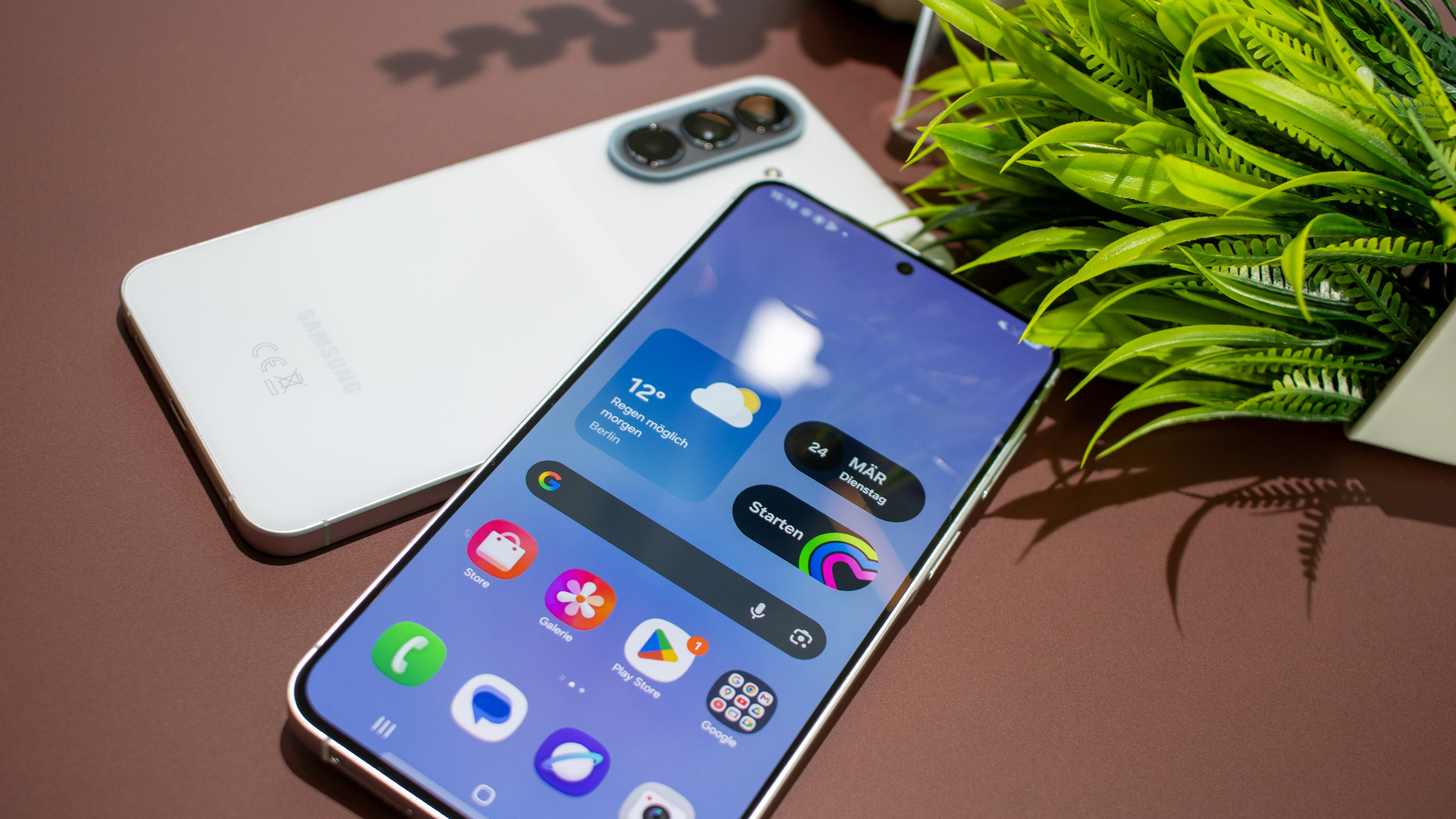
Verdict on the Samsung Galaxy A57 5G
The Samsung Galaxy A57 5G is a thoroughly successful update to the A Series, but it remains surprisingly conservative compared to its predecessor. The slimmer and lighter body, high-quality build, upgraded IP68 rating, and faster Exynos 1680 chip combine to create a well-rounded package. Add to that a long update guarantee, solid everyday performance, and a bright AMOLED display that performs well in everyday use—even if the competition now offers even higher peak brightness levels.
However, there are a few drawbacks: the camera delivers solid results but nothing outstanding for this price range; USB 2.0 seems outdated in 2026, and Samsung is also holding back on Bluetooth codecs. The most serious issue, however, is the disappointing battery life, which—despite an unchanged battery capacity—actually falls short of that of the Galaxy A56. If Samsung doesn’t fix this problem via a software update, the smartphone will be wasting a lot of its potential.
The Galaxy A57 5G is thus a high-quality mid-range smartphone with few genuine innovations. Those who own an older Galaxy A model will get a modern, reliable device with long-term software support. Owners of a Galaxy A56, on the other hand, will find few reasons to switch, especially since the significantly higher MSRP further diminishes the added value.
Pros
Cons
Price and Availability
The Galaxy A57 is available in all color and storage options directly from Samsung. However, it can be found at significantly lower prices at Notebooksbilliger and Amazon, among other retailers.

- $389.00Samsung Galaxy A57 5G 2026 | 256GB, 8GB, Dual SIM | 6.7" 120 Hz, Super AMOLED Plus, IP68 Water Resistant, Android 16 | International Model Factory Unlocked for Global
- $387.48Samsung Galaxy A57 5G (2026), Unlocked Android Smartphone, 128GB, AMOLED Display, Triple Camera, IP68, 5000mAh Battery, US Version, US 1 Yr Warranty, Awesome Gray
- $419.50Samsung Galaxy A57 5G 2026 | 256GB, 8GB, Dual SIM | 6.7" 120 Hz, Super AMOLED Plus, IP68 Water Resistant, Android 16 | International Model Factory Unlocked for Global
Table of Contents
- Verdict on the Samsung Galaxy A57 5G
- Specifications: Samsung Galaxy A57 5G
- Case - Galaxy A57 with a higher IP rating and a slimmer design
- Features - Hardly any changes from the previous model
- Software - Galaxy A Series with Six Years of Updates
- Communications and GNSS - The Galaxy A57 Supports 6 GHz Wi-Fi
- Phone Features and Call Quality - A57 with Dual eSIM
- Camera - Solid Main Camera on the Galaxy A57
- Accessories and Warranty - Galaxy A57 with a Minimal Package Contents
- Input and Operation - Optical Fingerprint Sensor on board
- Display - Samsung Continues to Rely on PWM at Low Frequency
- Performance - The Galaxy A57 is powered by the Exynos 1680
- Games - Not for Enthusiasts
- Emissions - Exynos 1680 Barely Reduces Them
- Battery Life - 5,000 mAh in the Galaxy A57
- Notebookcheck Overall Rating
- Possible Alternatives Comparison
The Samsung Galaxy A57 5G is the successor to the Galaxy A56 5G and stands out primarily for its slimmer design and lighter weight. Samsung has also included the standard SoC upgrade and improved the IP rating. Slight improvements can also be seen in Wi-Fi and Bluetooth performance.
In Germany, storage options include 128 GB or 256 GB, each with 8 GB of RAM; the MSRP has risen significantly and now stands at 529 and 589 euros, respectively. The 12/512 GB model is not officially available in Germany, but can be purchased as an EU import through various retailers.
Specifications: Samsung Galaxy A57 5G
Case - Galaxy A57 with a higher IP rating and a slimmer design
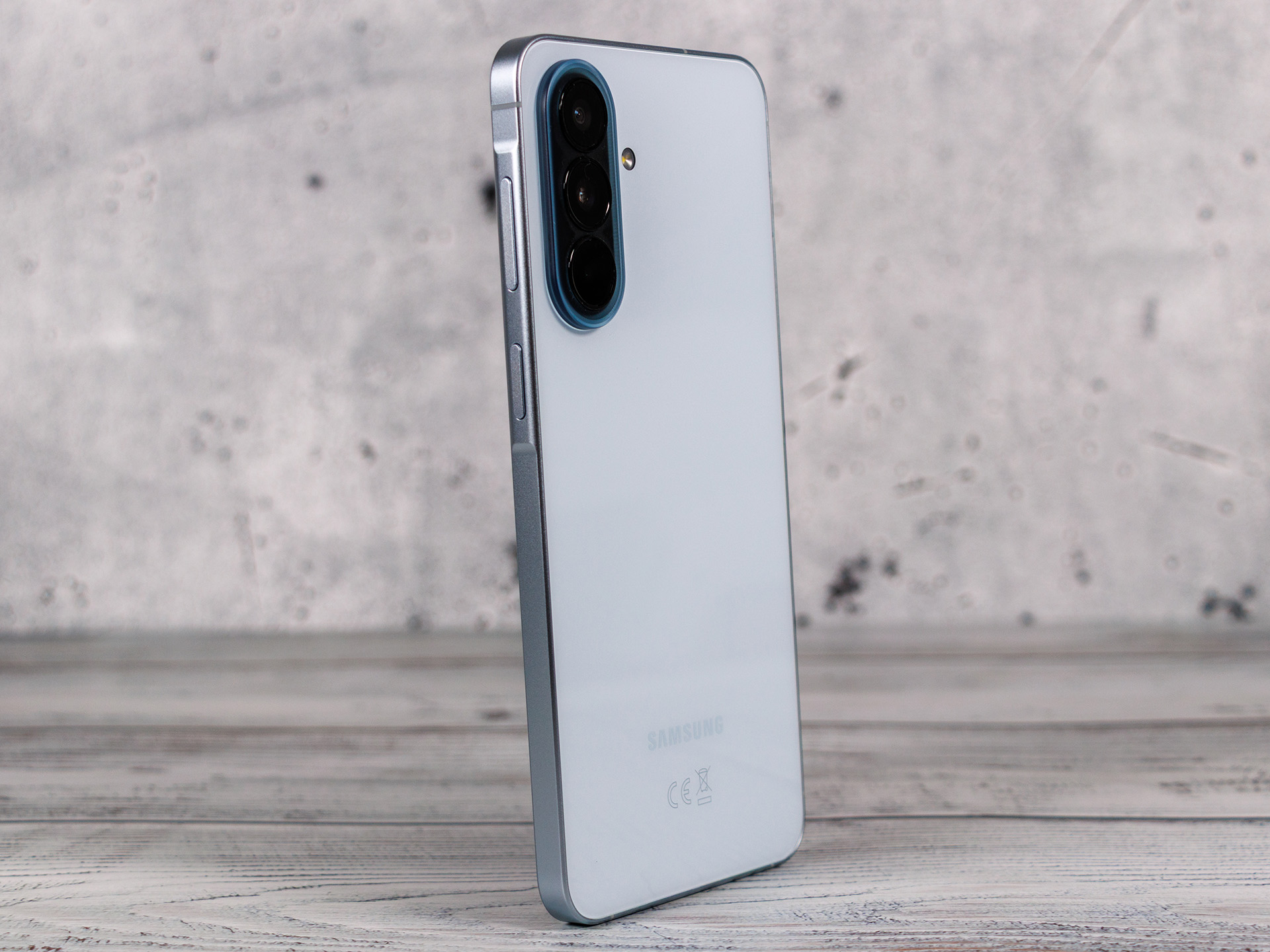
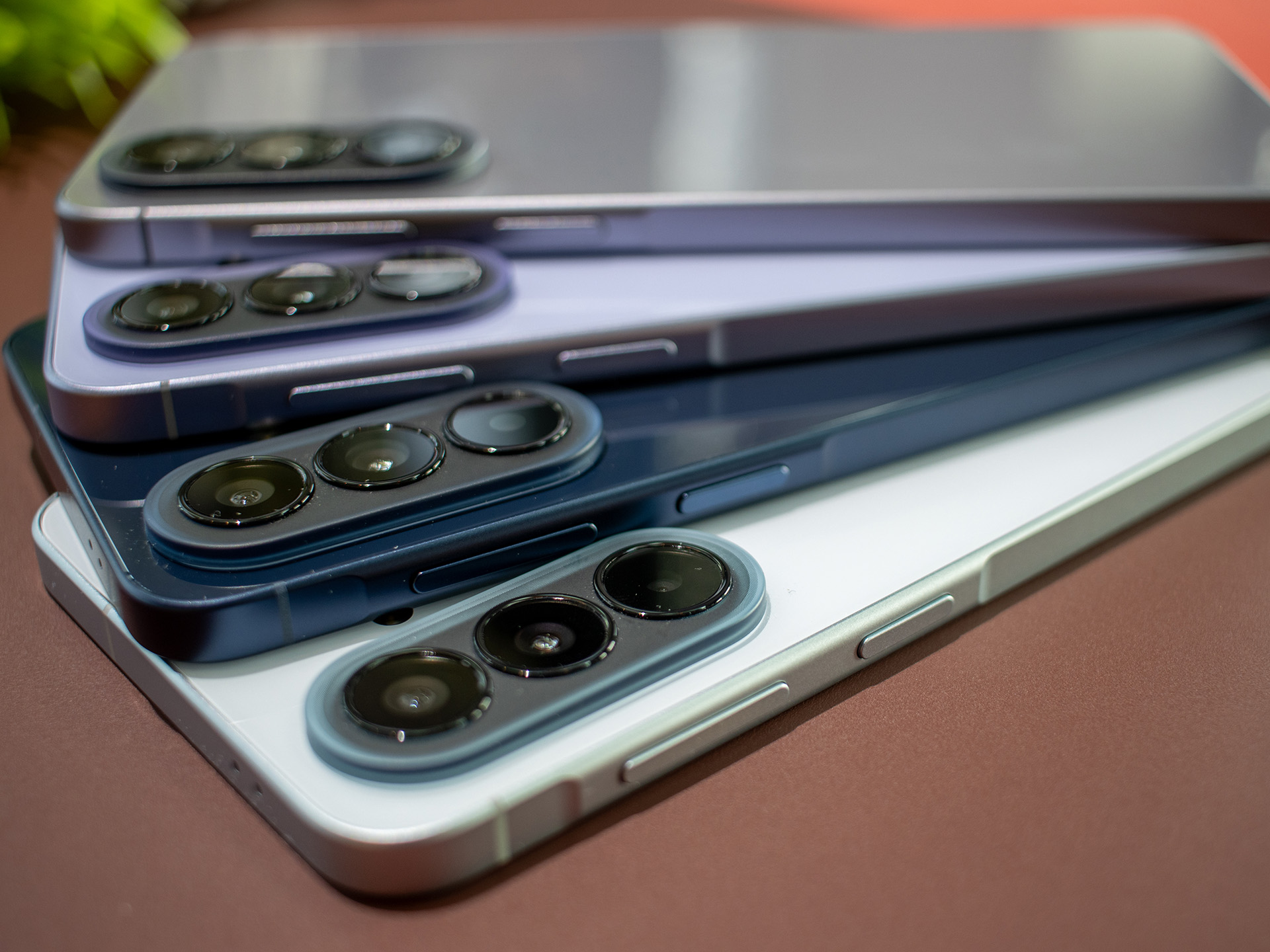
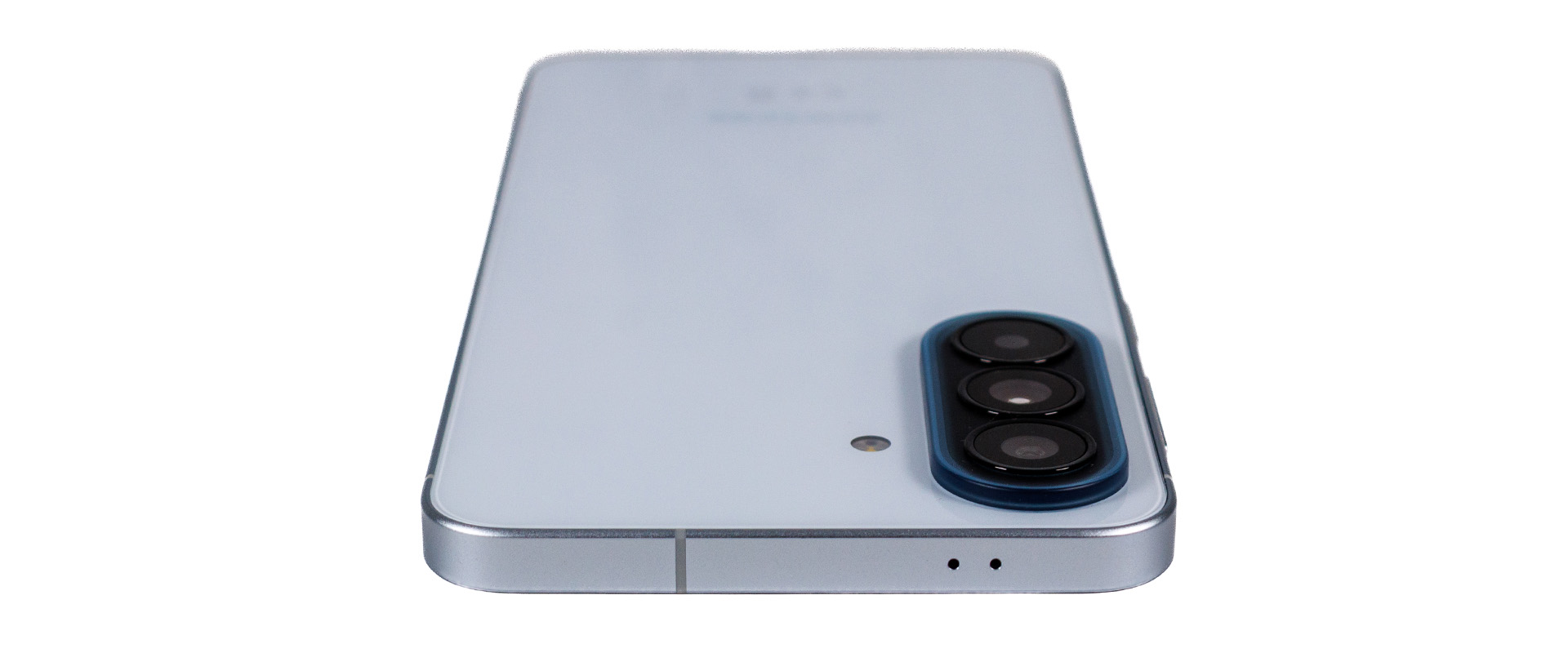
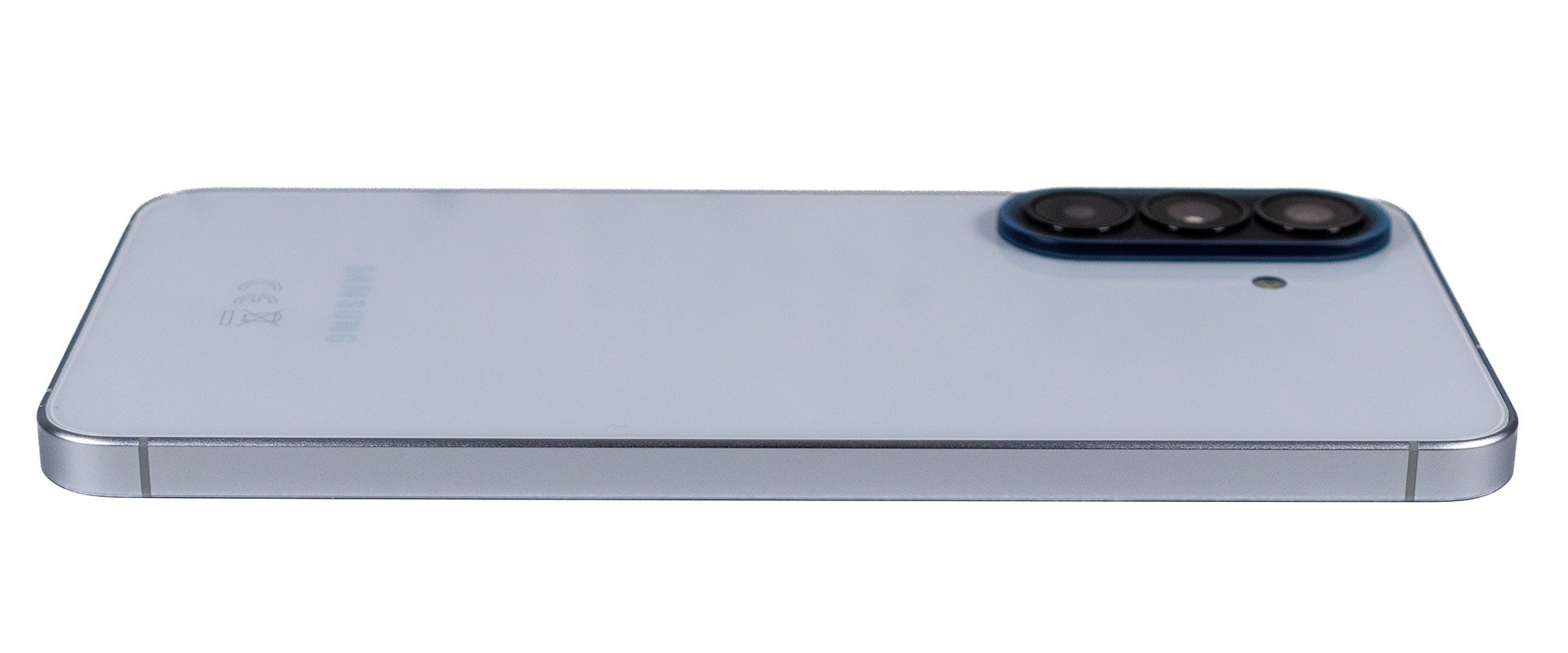
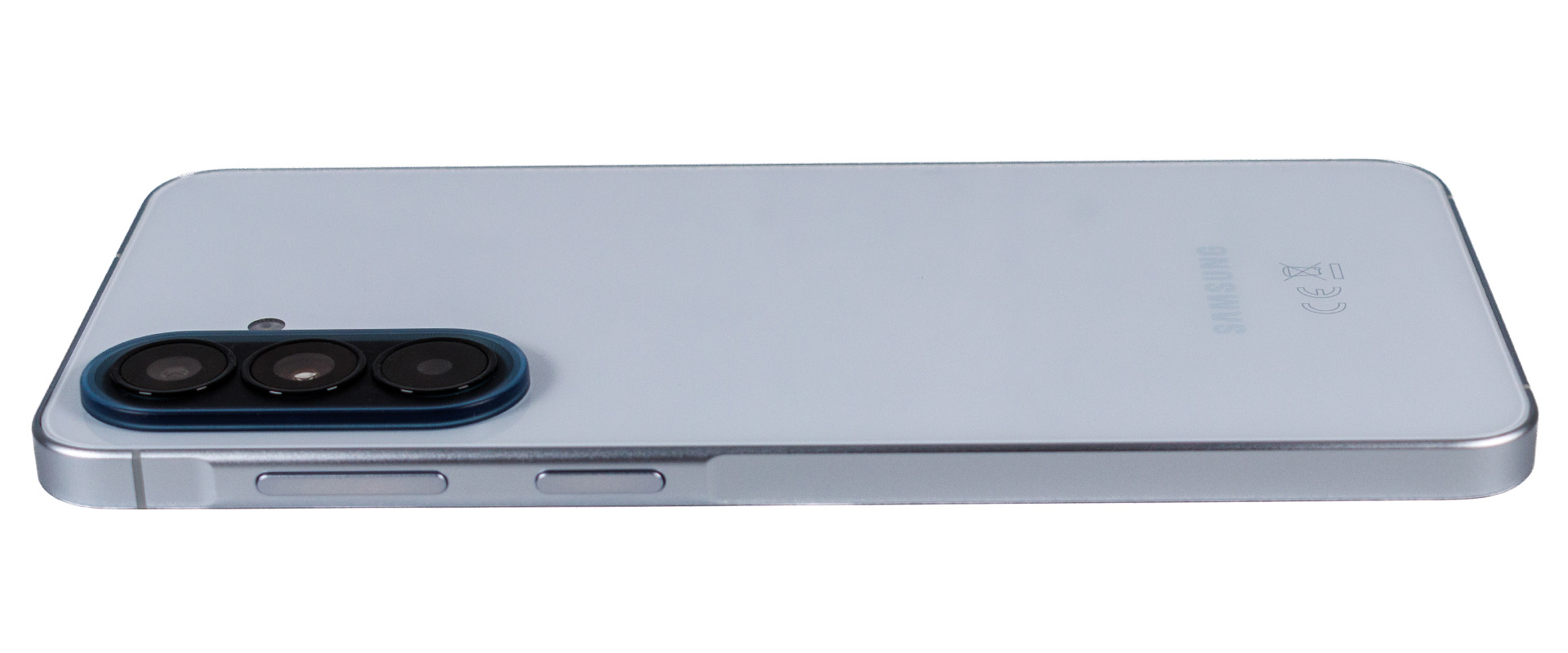
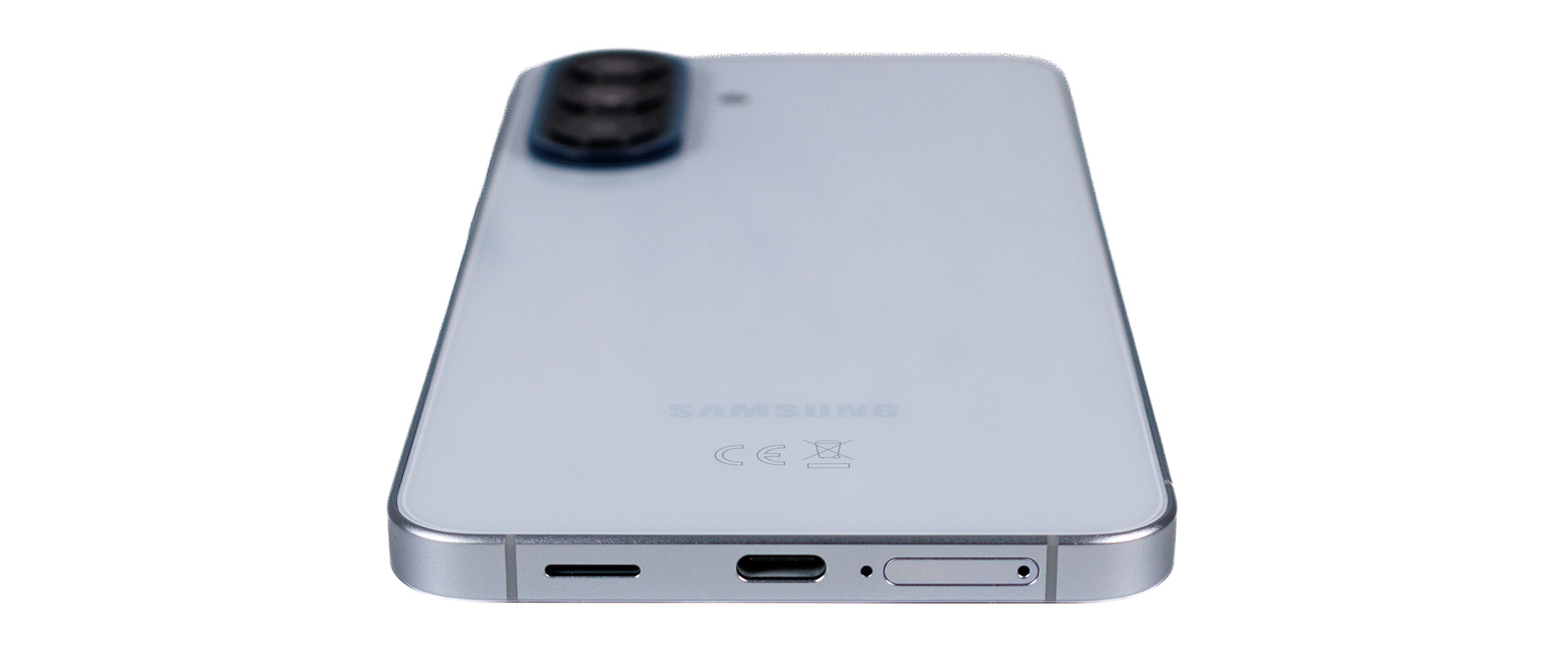
When you hold the Samsung Galaxy A57 5G for the first time, you immediately notice how slim and light it is. Samsung lists the thickness as 6.9 mm; we measured it at just 6.8 mm, though it’s up to 9.85 mm with the camera protruding. The matte aluminum frame also gives it a very high-quality look, though the glass back is a classic fingerprint magnet. The glass, just like on the front, is durable Corning Gorilla Glass Victus+.
The build quality conveys a genuine premium feel; only the gaps between the glass on the back and the surrounding frame are, upon close inspection, not quite uniform in the corners. The Galaxy A57 withstands attempts to bend it without so much as a sound and puts up considerable resistance.
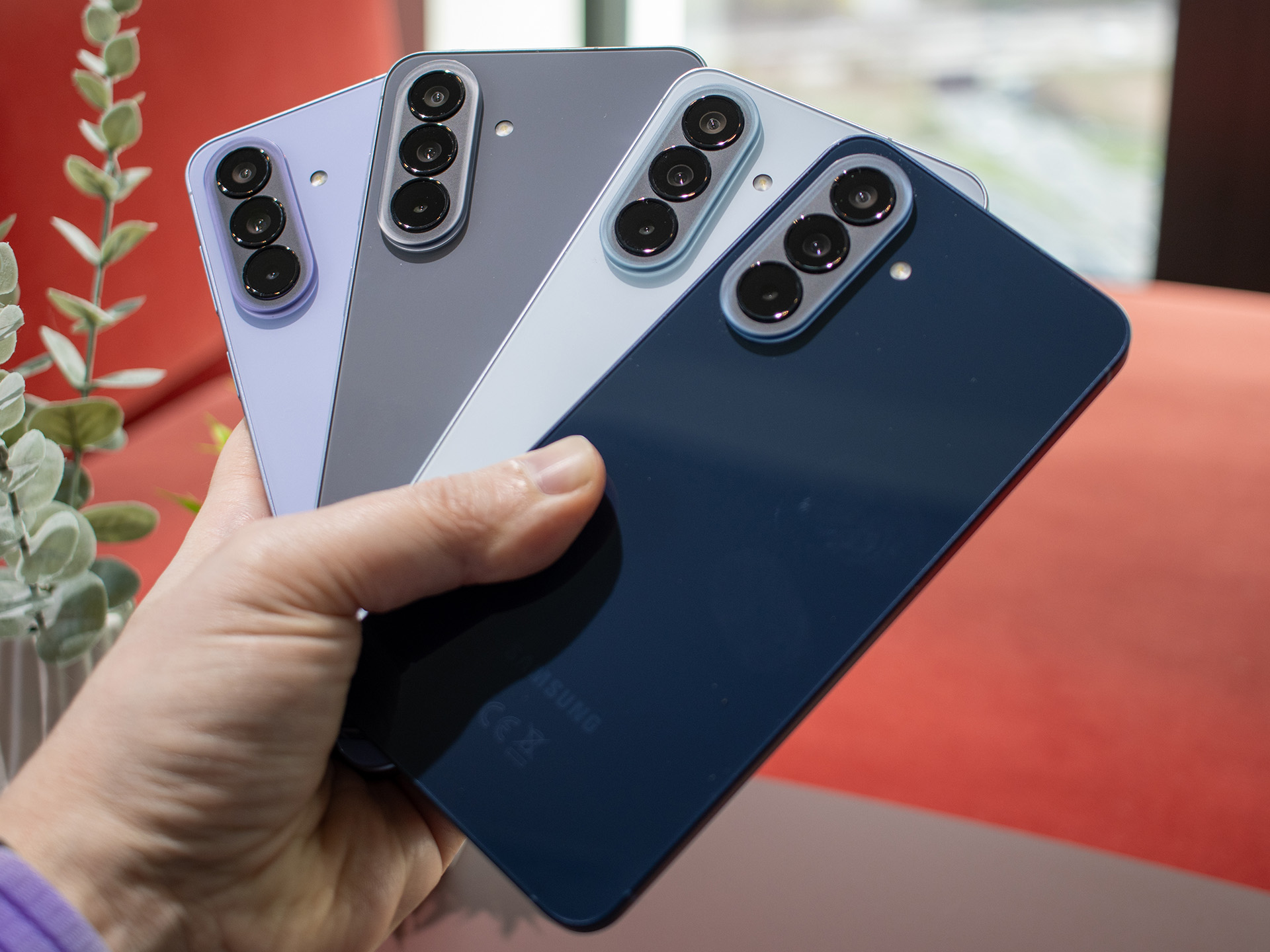
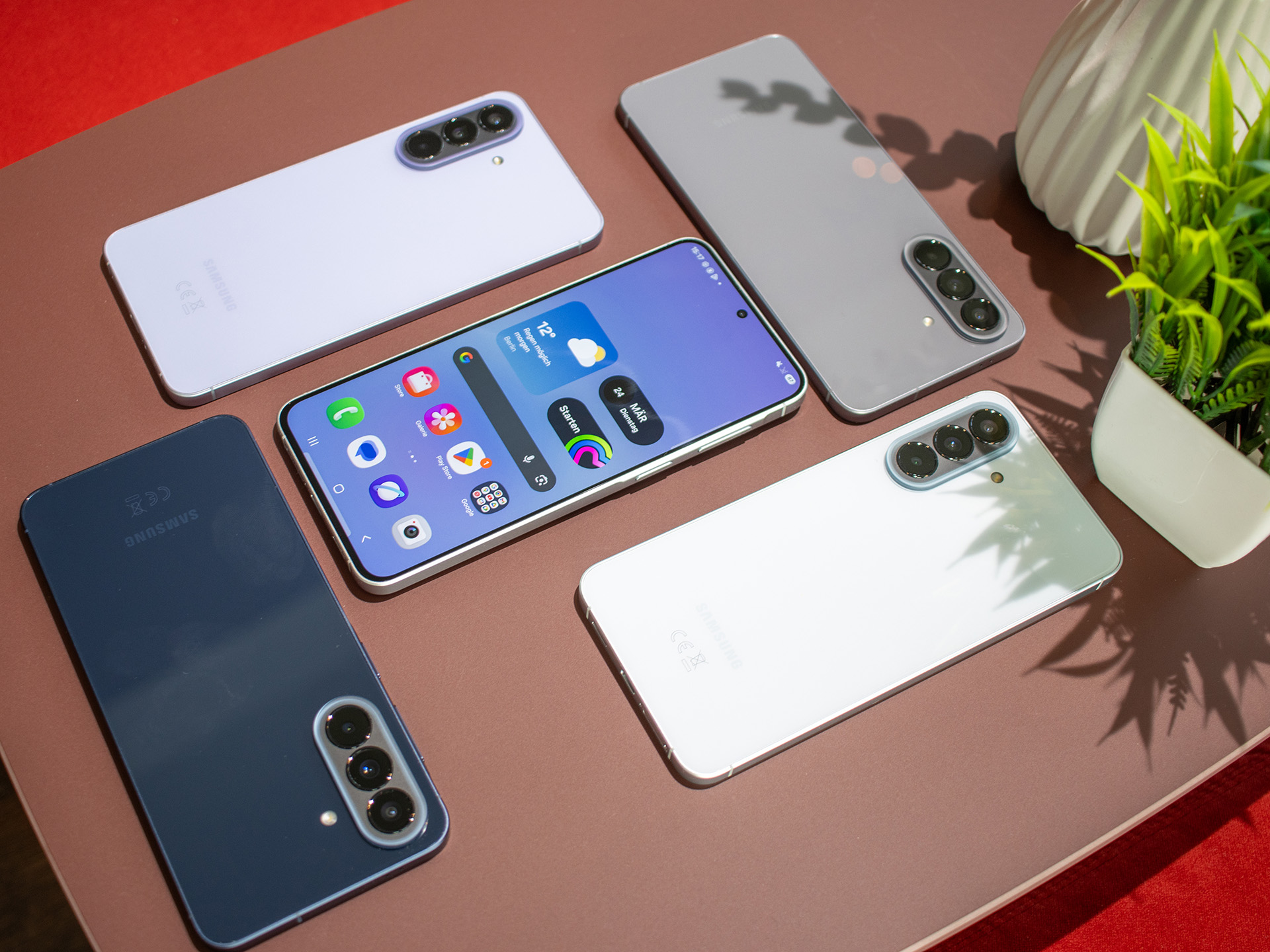
Samsung has upgraded the IP rating of its smartphone and now certifies it as IP68, meaning it’s not only dustproof but also remains waterproof when submerged for extended periods (in clear water, up to a depth of 1.5 m, for at least 30 minutes). It is available in Awesome Gray, Icy Blue, Lilac, and Navy.


Features - Hardly any changes from the previous model
The specs are nominally identical to those of the Galaxy A56; the A57 features a new SoC and a more modern communications module and now supports Bluetooth 6.0 and Wi-Fi 6E.
The Galaxy phone still relies on USB 2.0, which supports neither wired display output nor DeX. In this regard, the Pixel 10a, among others, offers more.
Software - Galaxy A Series with Six Years of Updates
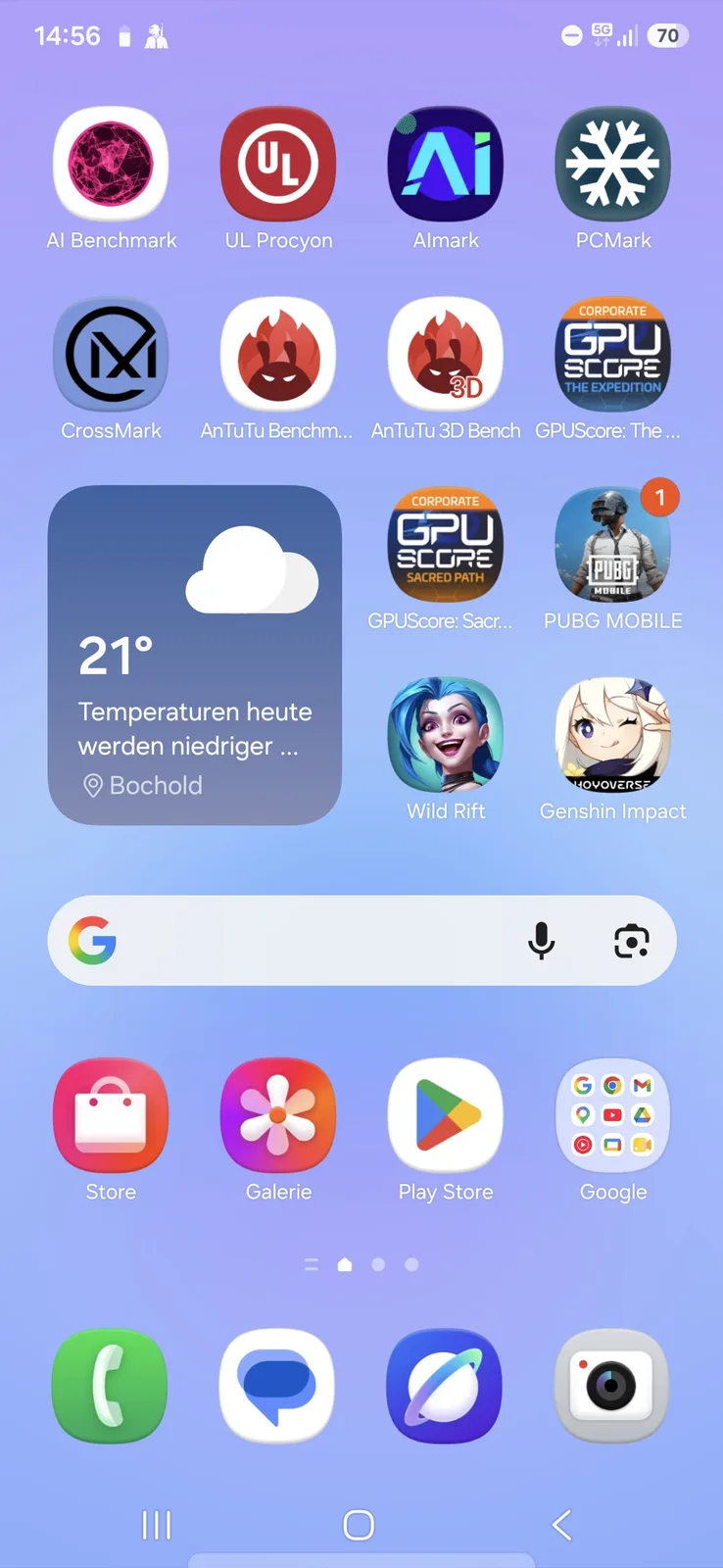
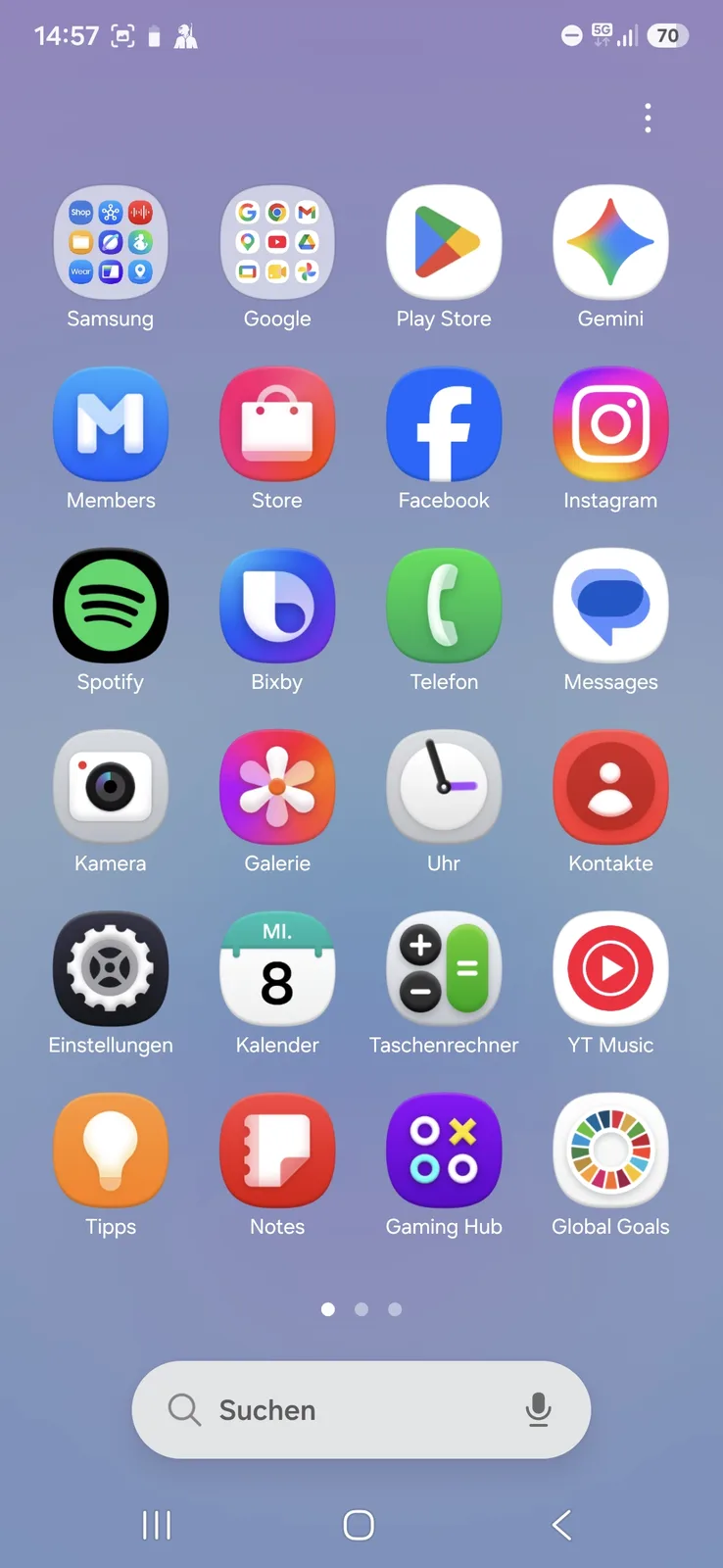
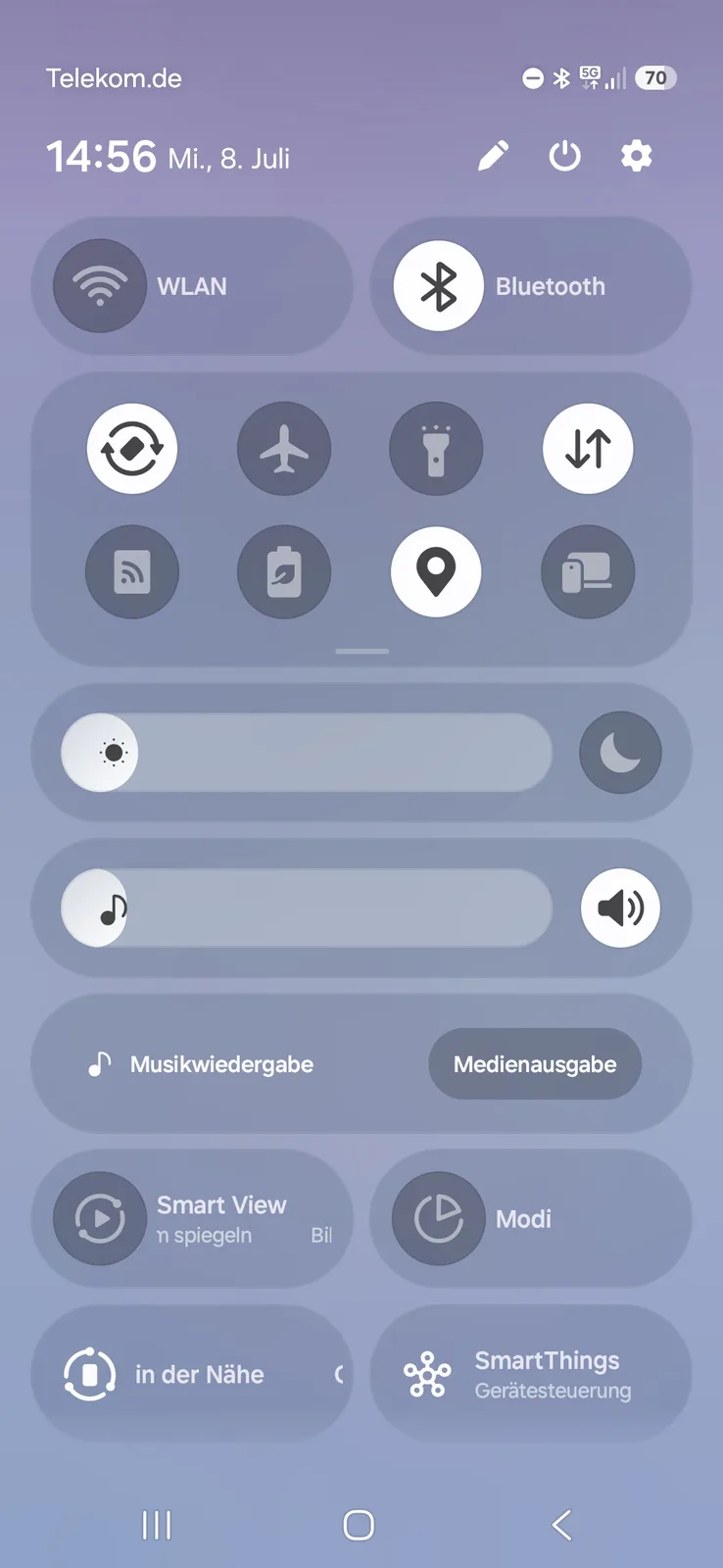
The Galaxy A57 5G ships with Android 16 and Samsung's One UI 8.5 user interface. It is expected to receive both security patches and feature updates for six years.
In terms of AI features, the A57 has been significantly scaled back compared to the S series and its predecessor. Unfortunately, Samsung preinstalls even more third-party apps, which now include Netto, TikTok, and Temu, among others. However, this is merely an annoyance, as they can be completely uninstalled.

Sustainability
The Galaxy A57 comes in slim, plastic-free packaging. The sustainability information isn't as comprehensive as that for the Galaxy S series, but it's more extensive than that of competitors in this price range. Information can be found in the EPREL database, on the product website (Specifications / Ecodesign) and in a consolidated sustainability report.
The Galaxy A57 5G is part of the Self-Repair Program, allowing users to replace many components on their own—with step-by-step instructions included.
Communications and GNSS - The Galaxy A57 Supports 6 GHz Wi-Fi
With the Samsung Galaxy A57 5G, mobile data connectivity works best on the 5G network. The range of supported frequency bands is decent, but those who travel internationally frequently won’t be ideally served in this regard. Reception is excellent in urban areas and gives no cause for criticism.
When it comes to Wi-Fi, Samsung has finally added support for the 6 GHz band but still doesn’t include Wi-Fi 7. Our testing also shows that the transfer speeds aren’t top-notch.
| Networking | |
| Samsung Galaxy A57 | |
| iperf3 transmit AXE11000 6GHz | |
| iperf3 receive AXE11000 6GHz | |
| Xiaomi Poco X8 Pro Max | |
| iperf3 transmit AXE11000 | |
| iperf3 receive AXE11000 | |
| Honor 600 | |
| iperf3 transmit AXE11000 | |
| iperf3 receive AXE11000 | |
| Google Pixel 10a | |
| iperf3 receive Wi-Fi6/7 RT-BE96U | |
| iperf3 transmit Wi-Fi6/7 RT-BE96U | |
| Nothing Phone (4a) | |
| iperf3 transmit AXE11000 | |
| iperf3 receive AXE11000 | |
| Motorola Edge 70 Fusion | |
| iperf3 transmit AXE11000 | |
| iperf3 receive AXE11000 | |
| Average Wi-Fi 6E | |
| iperf3 transmit AXE11000 | |
| iperf3 receive AXE11000 | |
| iperf3 transmit AXE11000 6GHz | |
| iperf3 receive AXE11000 6GHz | |
| iperf3 receive Wi-Fi6/7 RT-BE96U | |
| iperf3 transmit Wi-Fi6/7 RT-BE96U | |
| Average of class Smartphone | |
| iperf3 transmit AXE11000 | |
| iperf3 receive AXE11000 | |
| iperf3 transmit AXE11000 6GHz | |
| iperf3 receive AXE11000 6GHz | |
| iperf3 receive Wi-Fi6/7 RT-BE96U | |
| iperf3 transmit Wi-Fi6/7 RT-BE96U | |
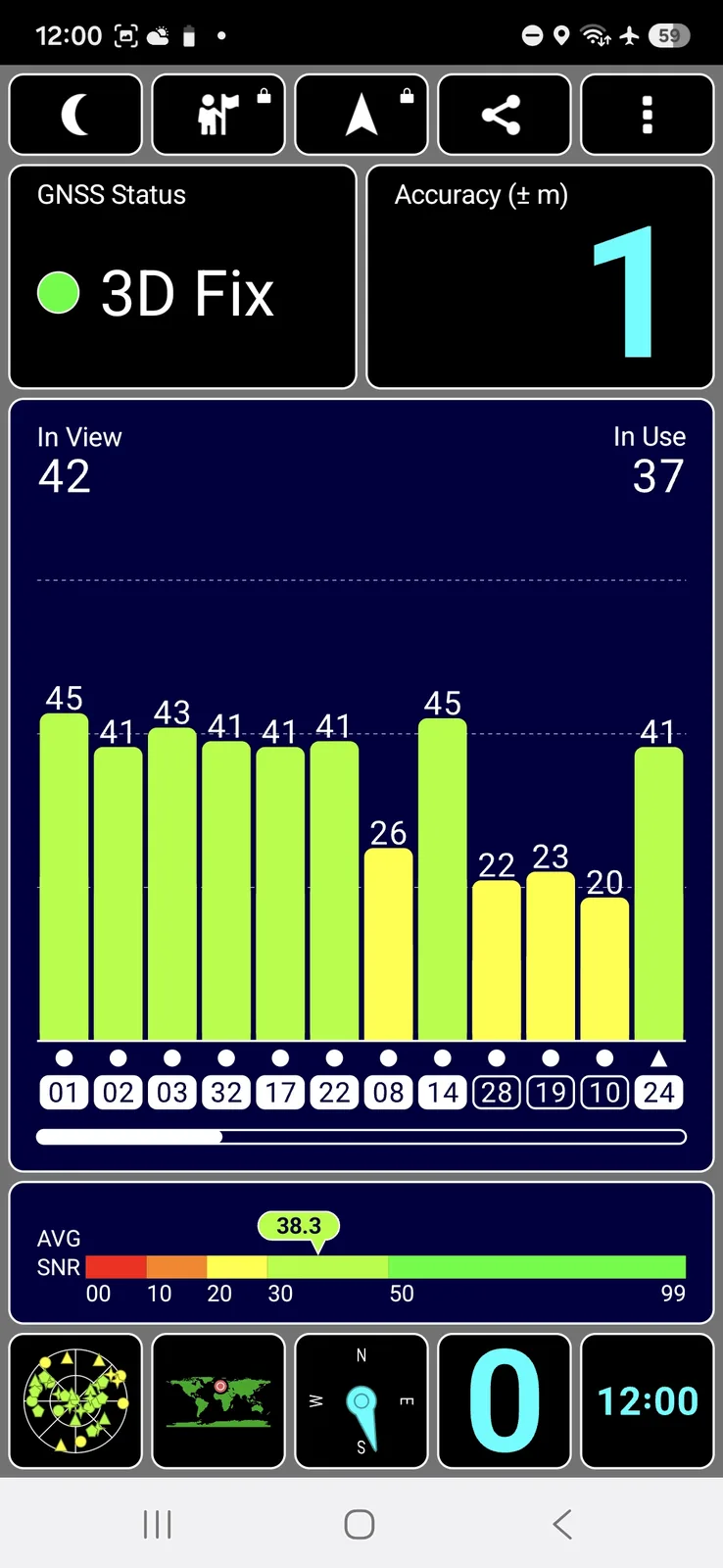
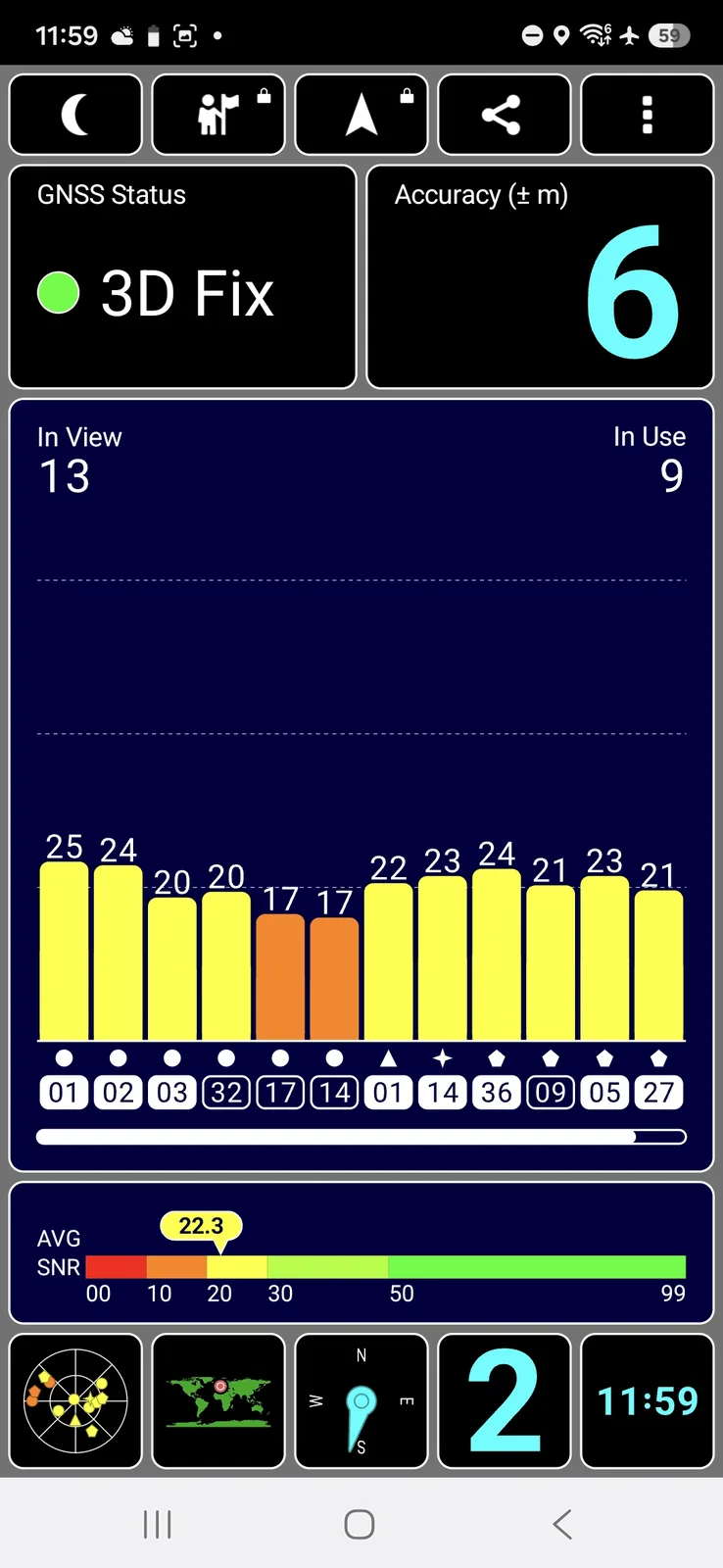
Inside a building, the satfix takes quite a while, but then locks onto a fairly accurate position. Outdoors, this happens much faster and accuracy is around 1 meter.
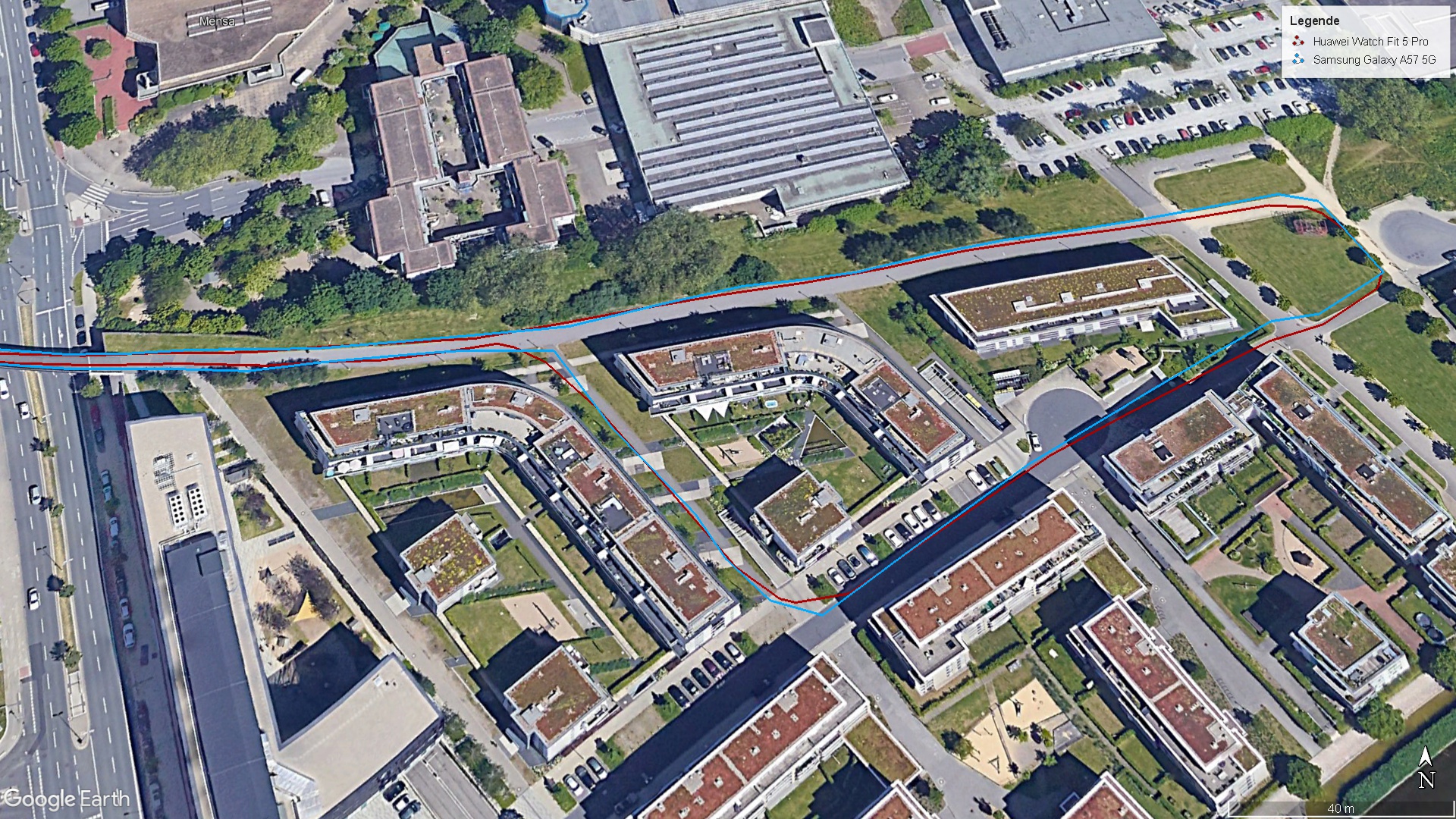
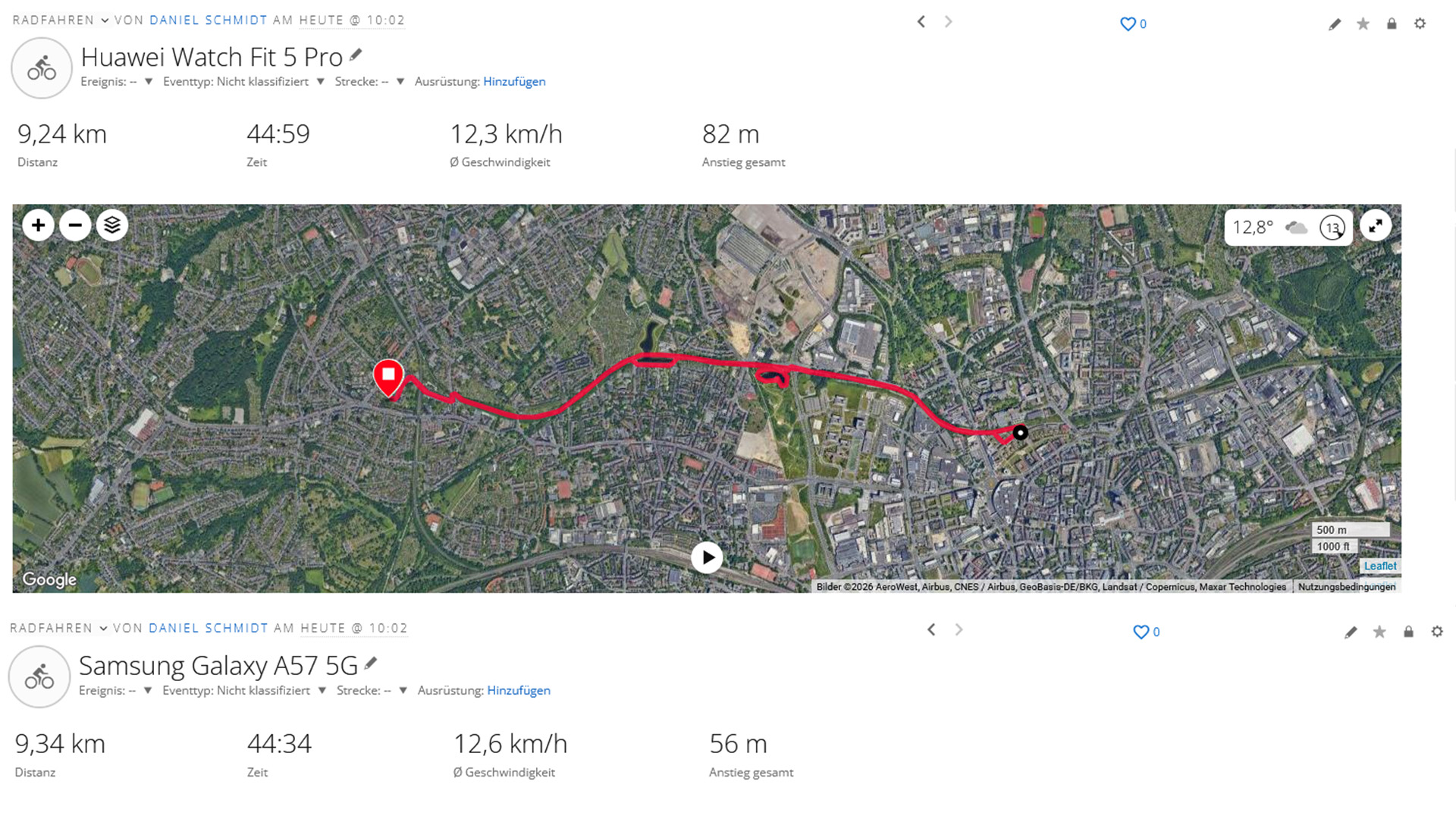
On a bike ride, we compare the Samsung Galaxy A57 with the Huawei Watch Fit 5 Pro. We noticed that the smartphone checks its position less frequently but is still quite accurate, despite using single-band GNSS. The A57 is therefore well-suited for navigation tasks.

Phone Features and Call Quality - A57 with Dual eSIM
The Samsung Galaxy A57 5G supports either two nano-SIM cards or two eSIMs; mixed use is also possible. When held to the ear, voice quality is natural and low-noise. Noise cancellation works well and filters out a lot of background noise; however, in loud environments, the user’s voice sounds a bit muffled.
In speakerphone mode, the person on the other end of the call sounds a little muffled but is always easy to understand. The microphone range is decent, but the distance from the smartphone shouldn’t exceed two meters.
Camera - Solid Main Camera on the Galaxy A57

Samsung has made some minor tweaks to the cameras compared to the previous model, but hasn’t made any major changes. The front camera takes good photos, though they’re sharpened a bit too much. Videos can be recorded in Ultra HD at 30 FPS; if you want to use 60 FPS, you’ll have to switch to Full HD.
The main camera delivers solid image quality, but given the price range in which Samsung has positioned the Galaxy A57 5G, that’s not quite enough. In our test shots, we noticed that bright areas of the image sometimes get blown out, and the depth of field could be better. We do like the color calibration, though. Zooming is only possible digitally and remains usable up to 4x magnification; beyond that, however, the quality drops sharply, and at 10x zoom, it’s already at its limit.
The additional ultra-wide-angle lens has 12 MPix, but it lacks detail and produces pixelated images at the edges. The third lens is a weak macro lens that delivers only mediocre results.
The Galaxy A57 records videos in Ultra HD at 30 FPS or Full HD at up to 60 FPS. Higher frame rates (240 FPS) are possible with the slow-motion feature, though this is limited to 720p. Optical image stabilization effectively reduces camera shake, and the microphones capture fairly clear audio.
Image comparison
Choose a scene and navigate within the first image. One click changes the position on touchscreens. One click on the zoomed-in image opens the original in a new window. The first image shows the scaled photograph of the test device.
Main cameraMain cameraUltra wide-angle5x ZoomLow-Light




















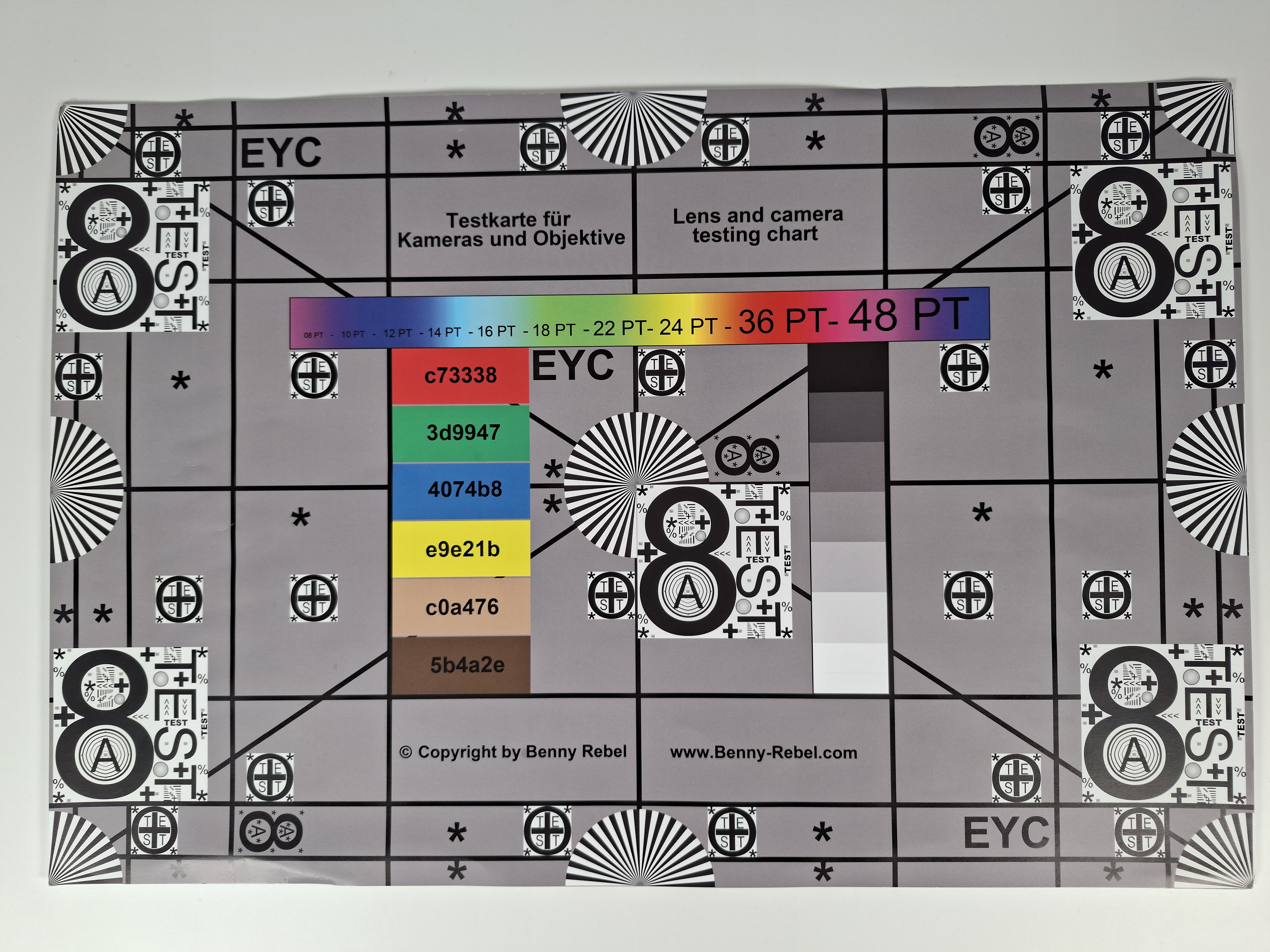
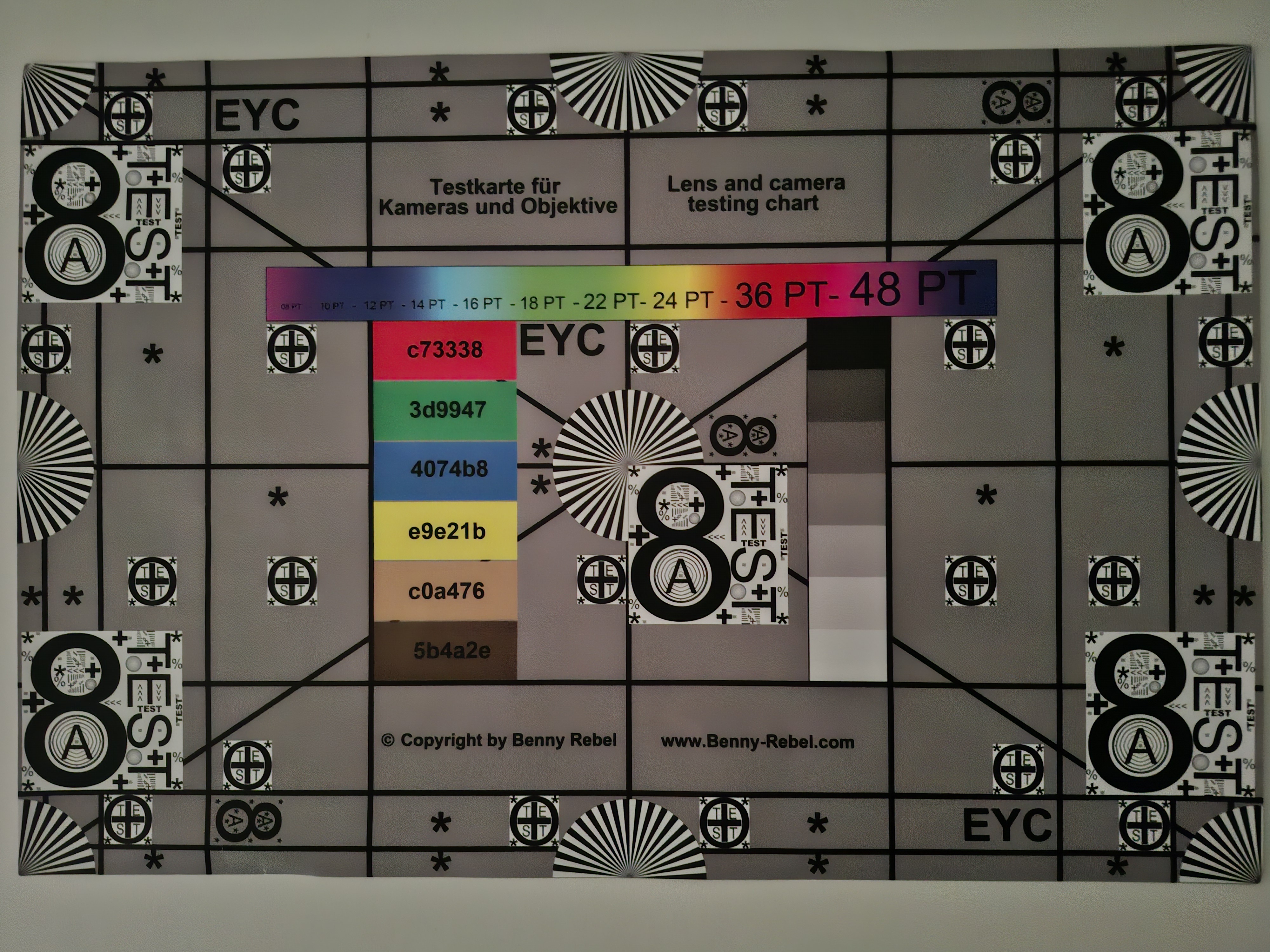
Under controlled lighting conditions, the Samsung Galaxy A57 5G displays colors naturally, with no anomalies.
Our test chart is rendered pleasantly sharp in the center—without being overly sharp—but becomes blurrier toward the edges.




Accessories and Warranty - Galaxy A57 with a Minimal Package Contents
The Samsung Galaxy A57 comes with only a USB cable (Type-C on both ends) and a SIM ejector pin. Samsung offers optional cases and power adapters in its own online store, and compatible accessories are also available from third-party vendors.
The warranty in Germany is valid for 24 months and can be extended with the Care+ insurance package, which costs 99 or 119 euros for two years, depending on the coverage; the latter also covers theft and loss. Alternatively, monthly payments of 5 or 6 euros are available.
Input and Operation - Optical Fingerprint Sensor on board
The Galaxy A57's capacitive touchscreen offers excellent glide performance and accurately registers input across the entire screen. The optical fingerprint sensor is integrated into the display and positioned quite close to the bottom edge. Recognition rates are decent as long as your finger stays on the sensor long enough, so the response speed could be a bit faster. Additionally, a less secure unlocking method via the front-facing camera is available.
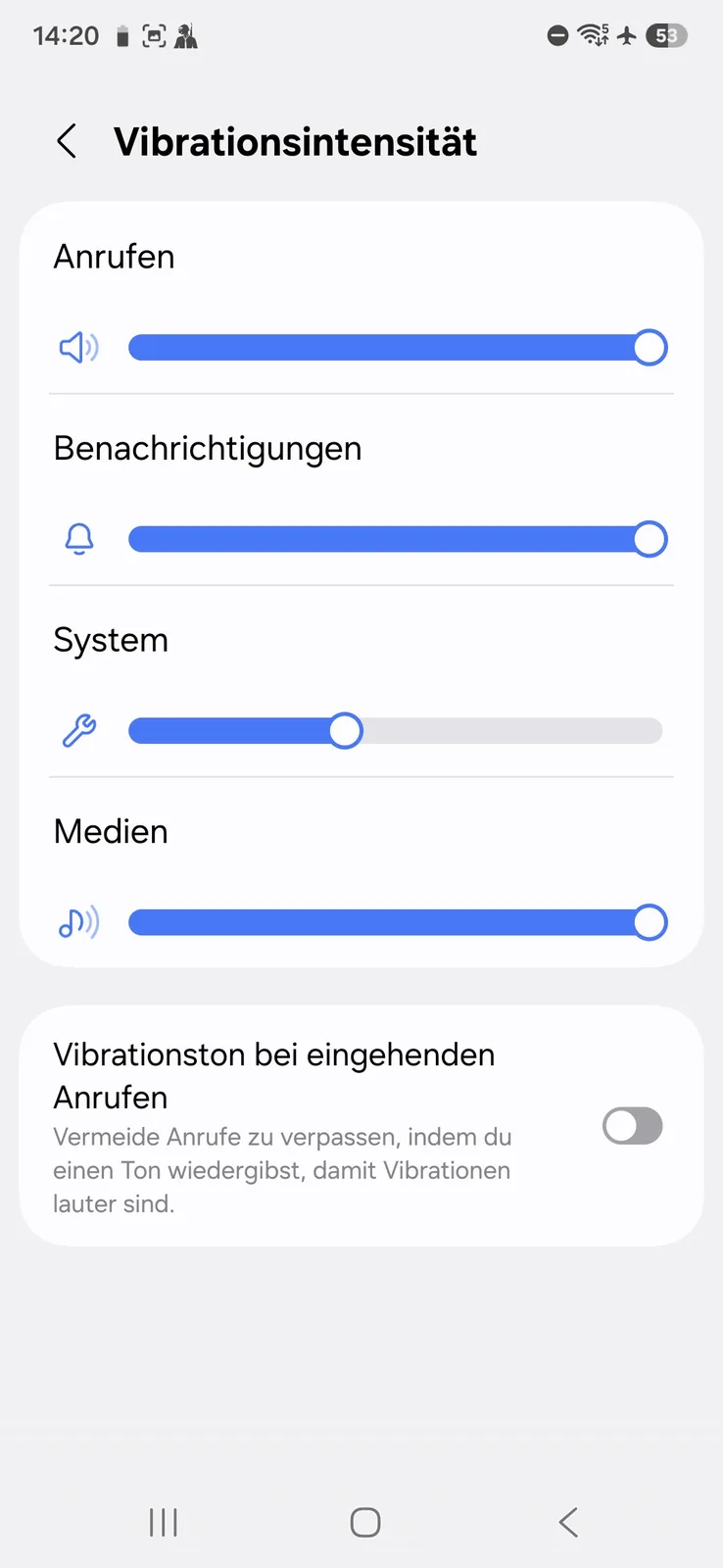
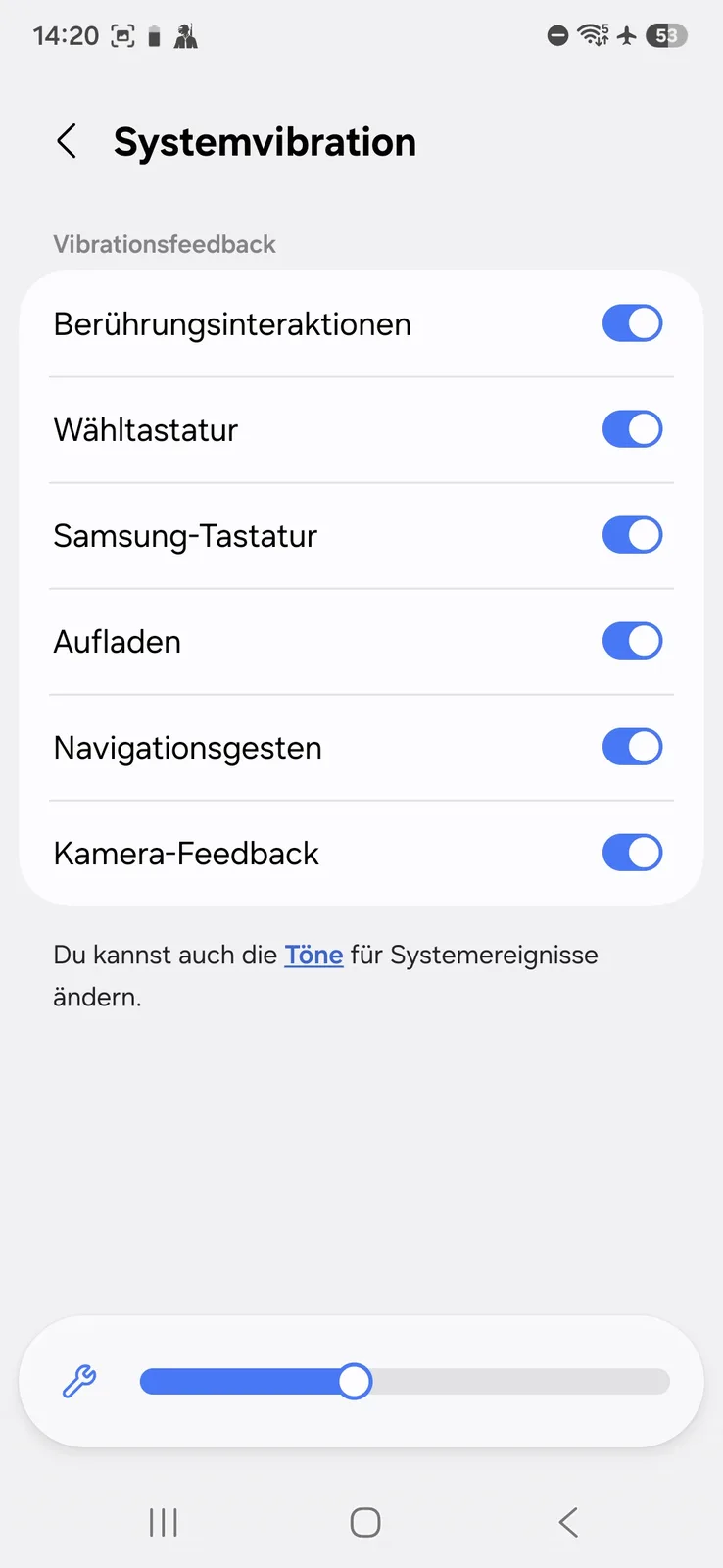
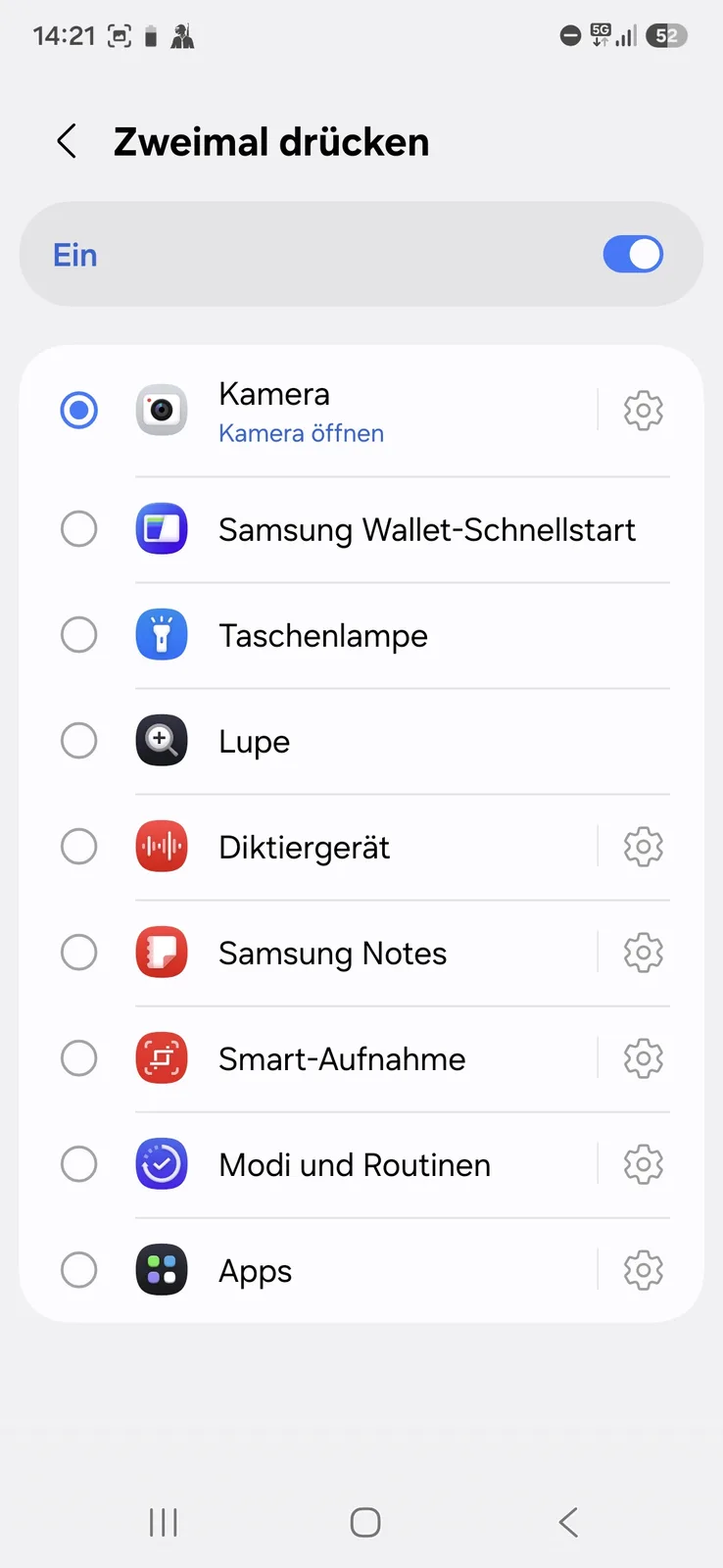
The linear vibration motor provides crisp feedback and can be customized in a wide range of ways in the settings. The function key can also be optimized to suit your needs and can be used as a traditional power button.



Display - Samsung Continues to Rely on PWM at Low Frequency

The display of the Samsung Galaxy A57 is nominally identical to that of the A56 , and our measurements confirm this. The backlighting is excellent, and the brightness can reach quite high levels; we measured a peak of 1,980 cd/m². While this is good, the displays of competing models are significantly brighter.
The Galaxy A57’s Super AMOLED panel uses pulse-width modulation (PWM) for brightness control. While the amplitude remains flat at minimum brightness, the frequency is low at 240 Hz, so sensitive users may experience discomfort during prolonged use.
| |||||||||||||||||||||||||
Brightness Distribution: 99 %
Center on Battery: 1135 cd/m²
Contrast: ∞:1 (Black: 0 cd/m²)
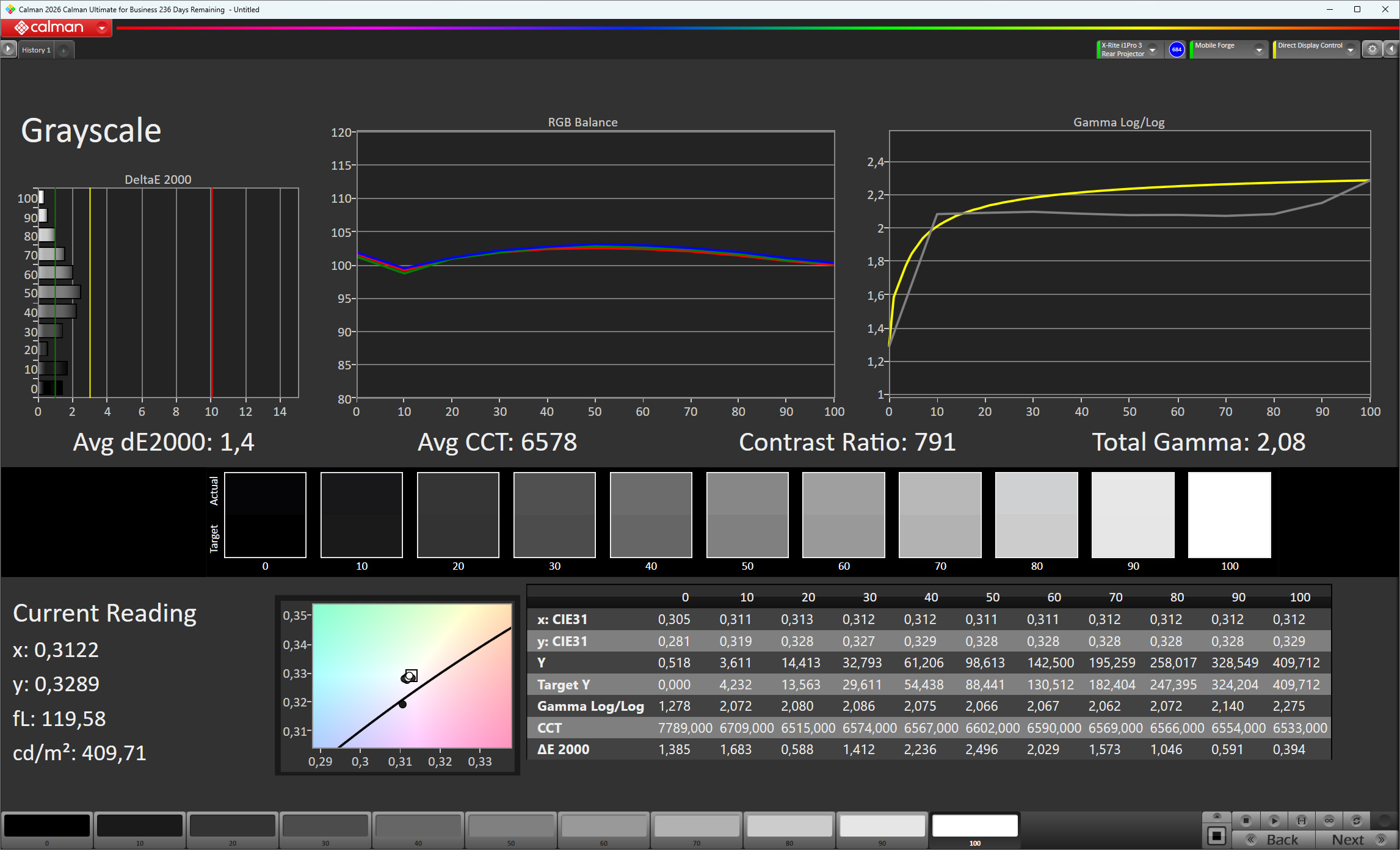
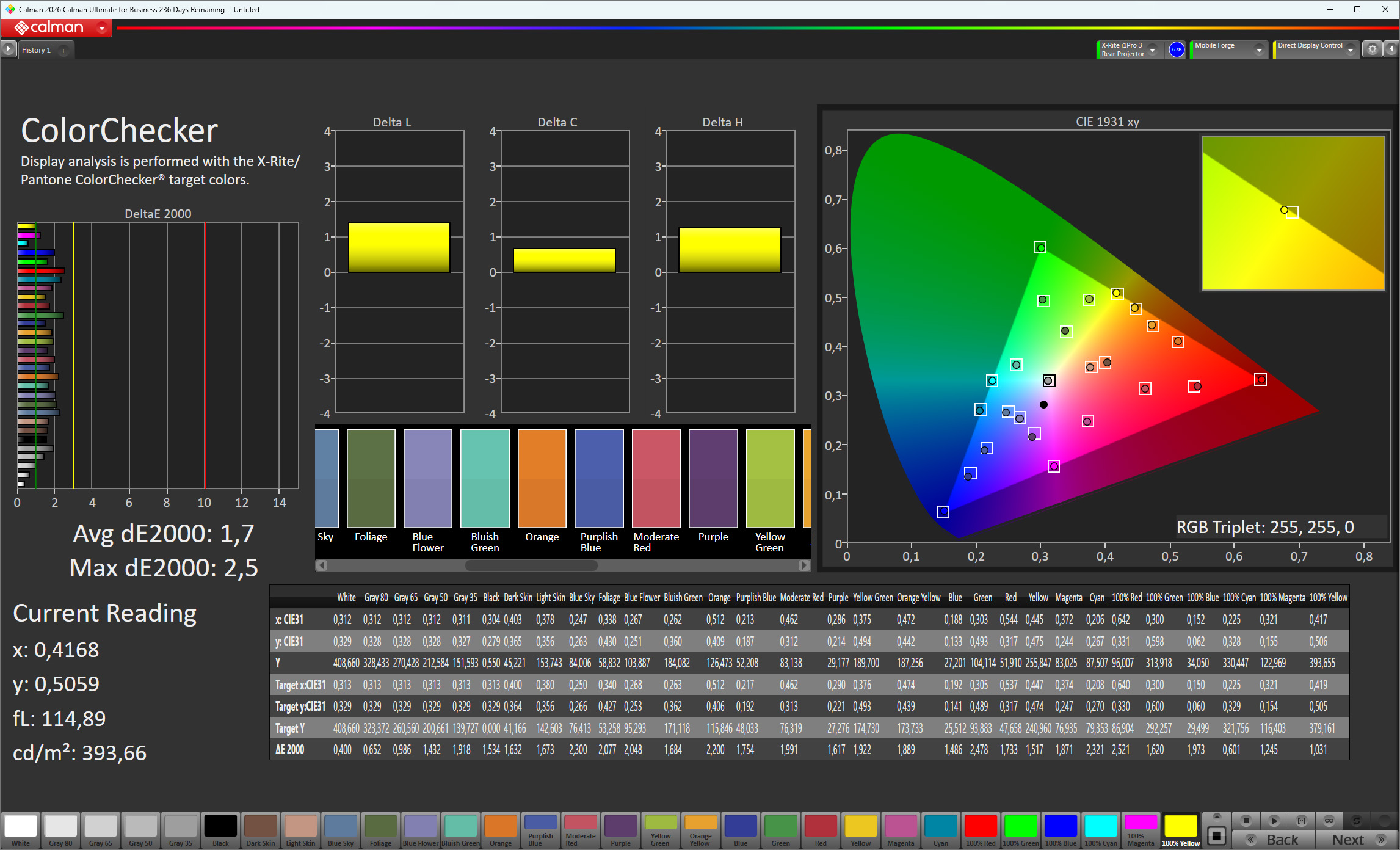
ΔE ColorChecker Calman: 1.7 | ∀{0.5-29.43 Ø4.69}
ΔE Greyscale Calman: 1.4 | ∀{0.09-98 Ø4.94}
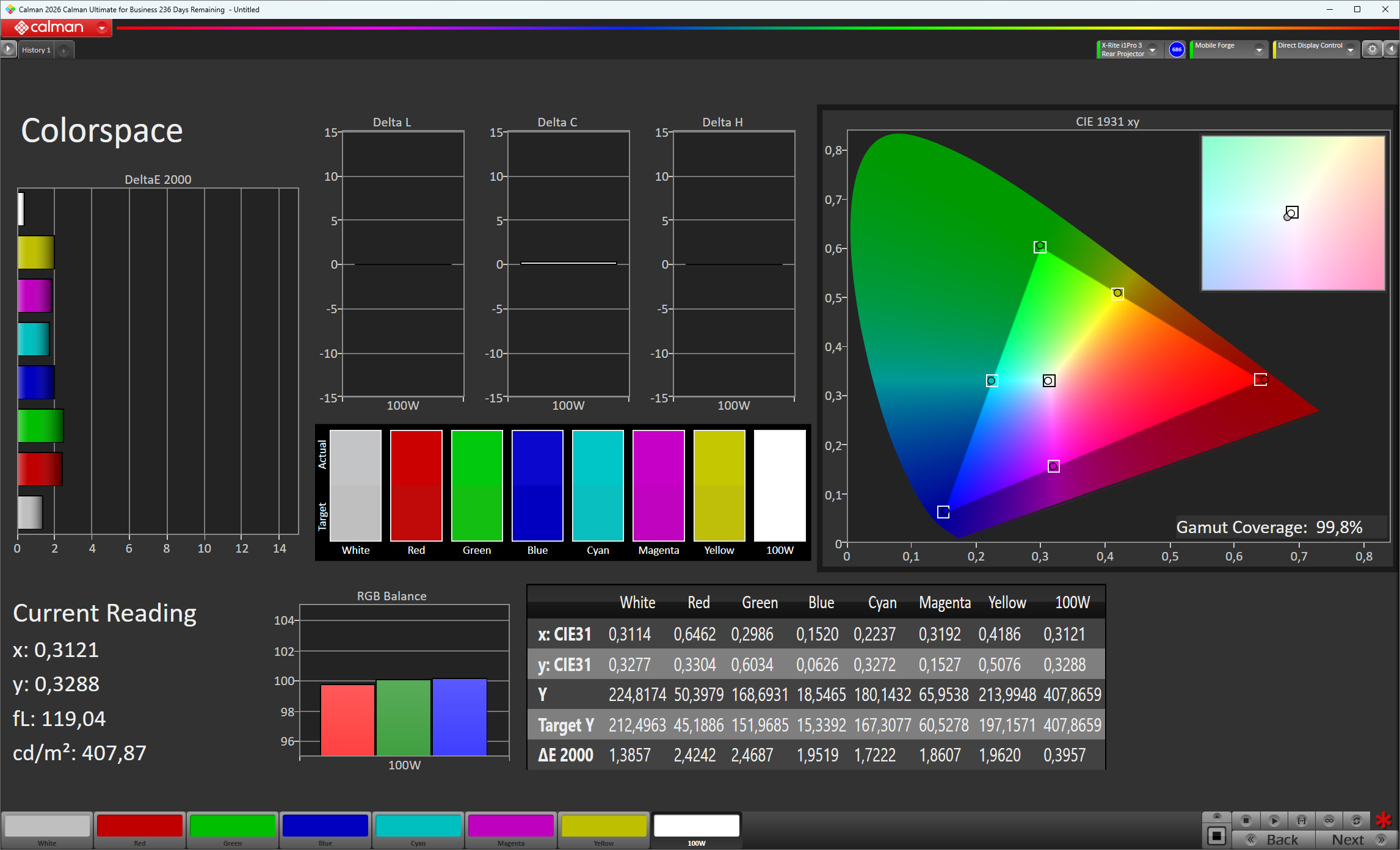
99.8% sRGB (Calman 2D)
Gamma: 2.08
CCT: 6578 K
| Samsung Galaxy A57 Super AMOLED, 2340x1080, 6.7" | Xiaomi Poco X8 Pro Max AMOLED, 2772x1280, 6.8" | Honor 600 AMOLED, 2728x1264, 6.6" | Google Pixel 10a pOLED, 2424x1080, 6.3" | Nothing Phone (4a) AMOLED, 2720x1224, 6.8" | Motorola Edge 70 Fusion AMOLED, 2772x1272, 6.8" | |
|---|---|---|---|---|---|---|
| Display | 83% | 188% | 54% | -27% | 92% | |
| APL18 Peak Brightness (cd/m²) | 1920 | 3582 87% | 3102 62% | 3050 59% | 1455 -24% | 3775 97% |
| HDR Peak Brightness (cd/m²) | 1980 | 3538 79% | 8192 314% | 2925 48% | 1403 -29% | 3685 86% |
| Response Times | 22% | 13% | -1% | -190% | -7% | |
| Response Time Grey 50% / Grey 80% * (ms) | 1.21 ? | 0.8 ? 34% | 1.06 ? 12% | 1.42 ? -17% | 8.18 ? -576% | 1.4 ? -16% |
| Response Time Black / White * (ms) | 1.1 ? | 0.952 ? 13% | 1 ? 9% | 1.07 ? 3% | 0.99 ? 10% | 1.2 ? -9% |
| PWM Frequency (Hz) | 240 | 120 | 60 | 240 | 90 | 120 |
| PWM Amplitude * (%) | 16.72 | 13.45 20% | 13.86 17% | 14.71 12% | 17.49 -5% | 16 4% |
| Screen | 1% | -53% | 27% | -26% | -9% | |
| Brightness middle (cd/m²) | 1135 | 1107 -2% | 1787 57% | 2205 94% | 1536 35% | 1501 32% |
| Brightness (cd/m²) | 1134 | 1110 -2% | 1538 36% | 1476 30% | ||
| Brightness Distribution (%) | 99 | 97 -2% | 97 -2% | 96 -3% | ||
| Black Level * (cd/m²) | ||||||
| Colorchecker dE 2000 * | 1.7 | 1 41% | 1.9 -12% | 1.4 18% | 2.6 -53% | 1.52 11% |
| Colorchecker dE 2000 max. * | 2.5 | 2.7 -8% | 5.3 -112% | 2.3 8% | 5.7 -128% | 3.47 -39% |
| Greyscale dE 2000 * | 1.4 | 1.7 -21% | 3.4 -143% | 1.6 -14% | 2 -43% | 2.6 -86% |
| Gamma | 2.08 106% | 2.25 98% | 2.25 98% | 2.23 99% | 2.24 98% | 2.184 101% |
| CCT | 6578 99% | 6498 100% | 6874 95% | 6715 97% | 6878 95% | 6444 101% |
| Total Average (Program / Settings) | 35% /
22% | 49% /
23% | 27% /
23% | -81% /
-71% | 25% /
10% |
* ... smaller is better
Screen Flickering / PWM (Pulse-Width Modulation)
| Screen flickering / PWM detected | 240 Hz Amplitude: 16.72 % | 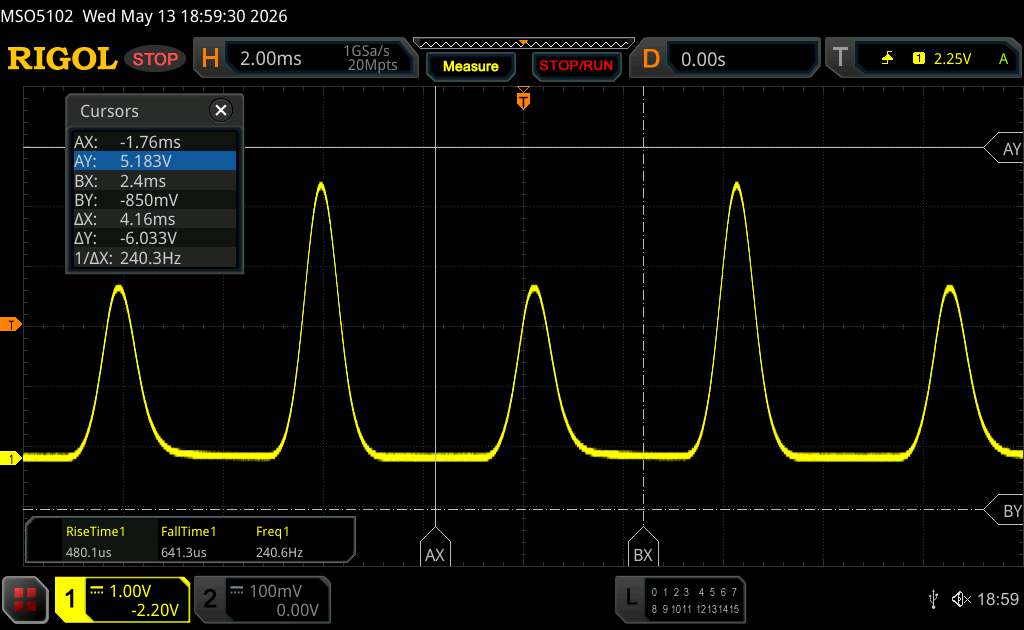 | |
The display backlight flickers at 240 Hz (worst case, e.g., utilizing PWM) . The frequency of 240 Hz is relatively low, so sensitive users will likely notice flickering and experience eyestrain at the stated brightness setting and below. In comparison: 52 % of all tested devices do not use PWM to dim the display. If PWM was detected, an average of 7611 (minimum: 5 - maximum: 343500) Hz was measured. | |||
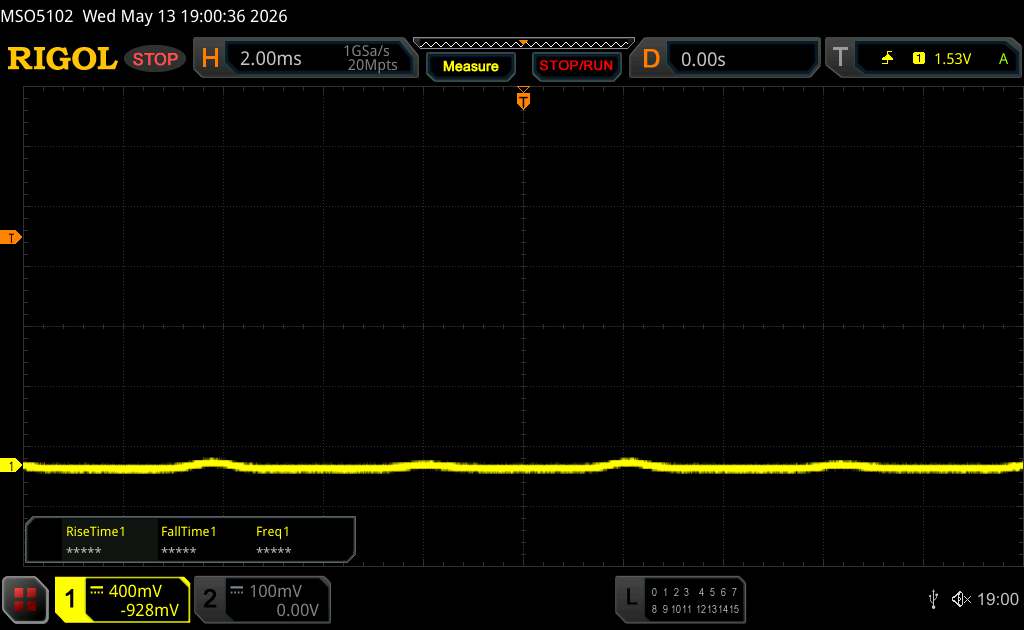
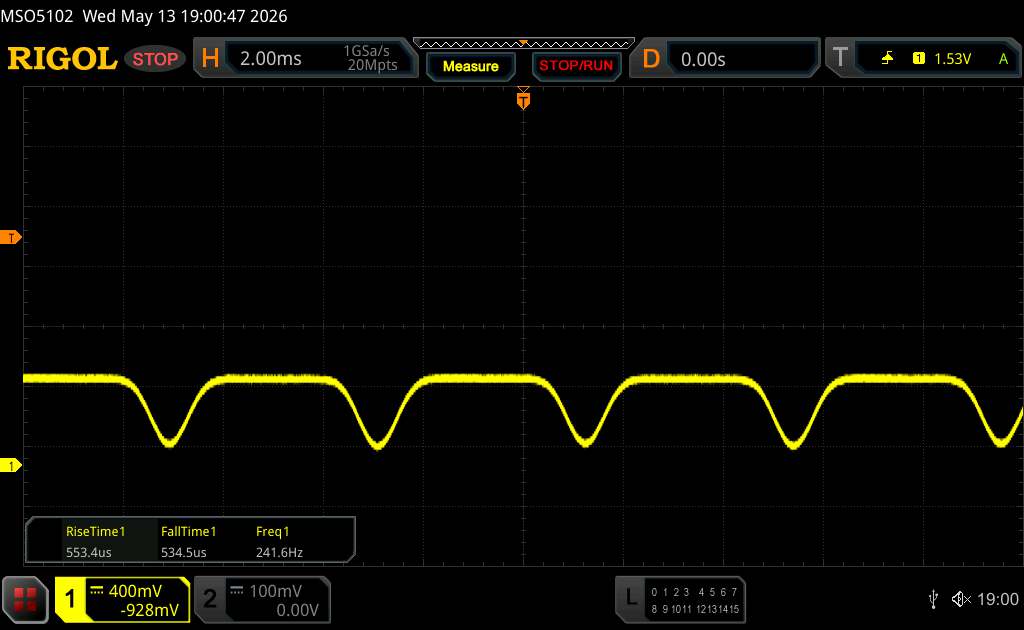
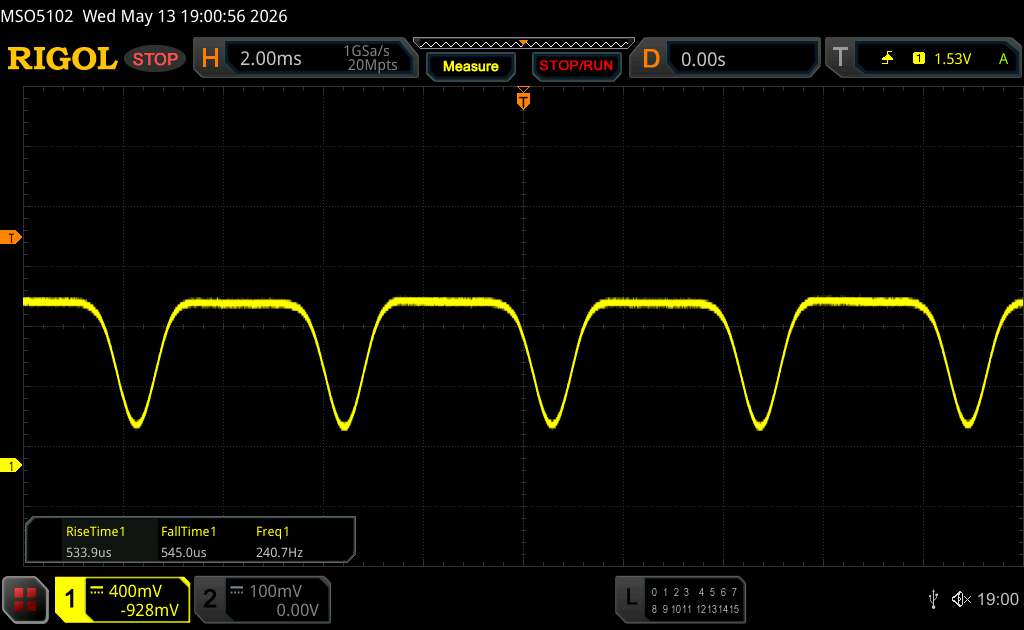
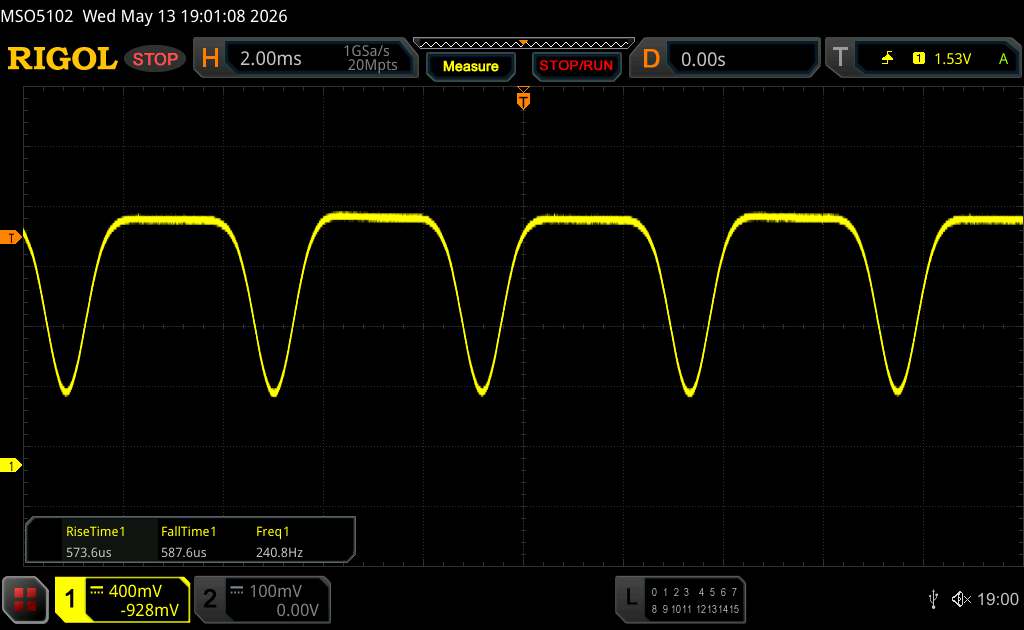
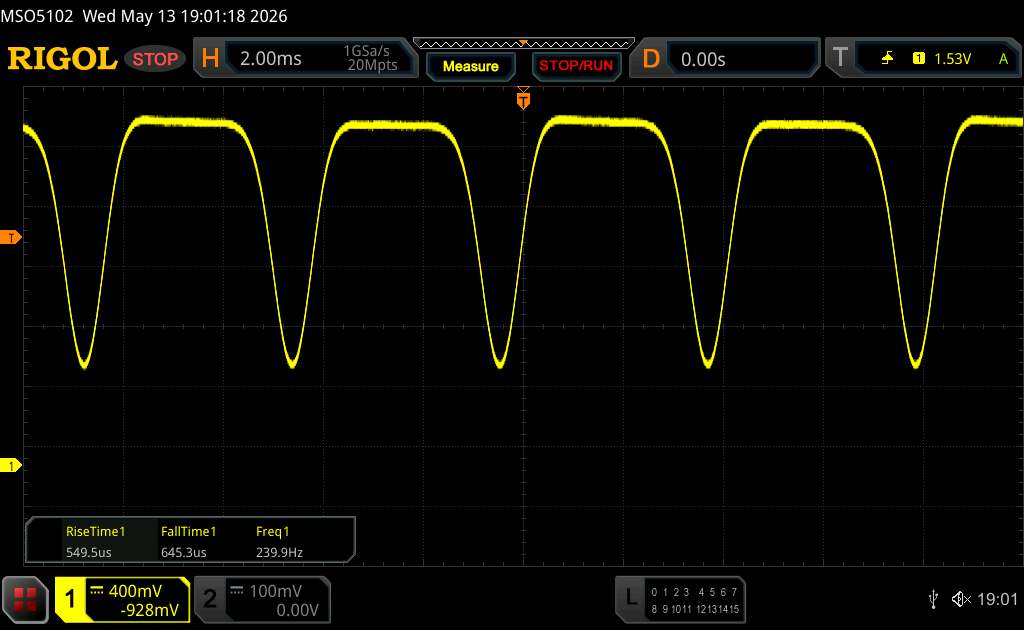
Series of measurements with a fixed zoom level and different brightness settings (Although the amplitude curve at minimum brightness appears flat, this is due to the scaling. The info box shows a magnified version of the amplitude at minimum brightness.)
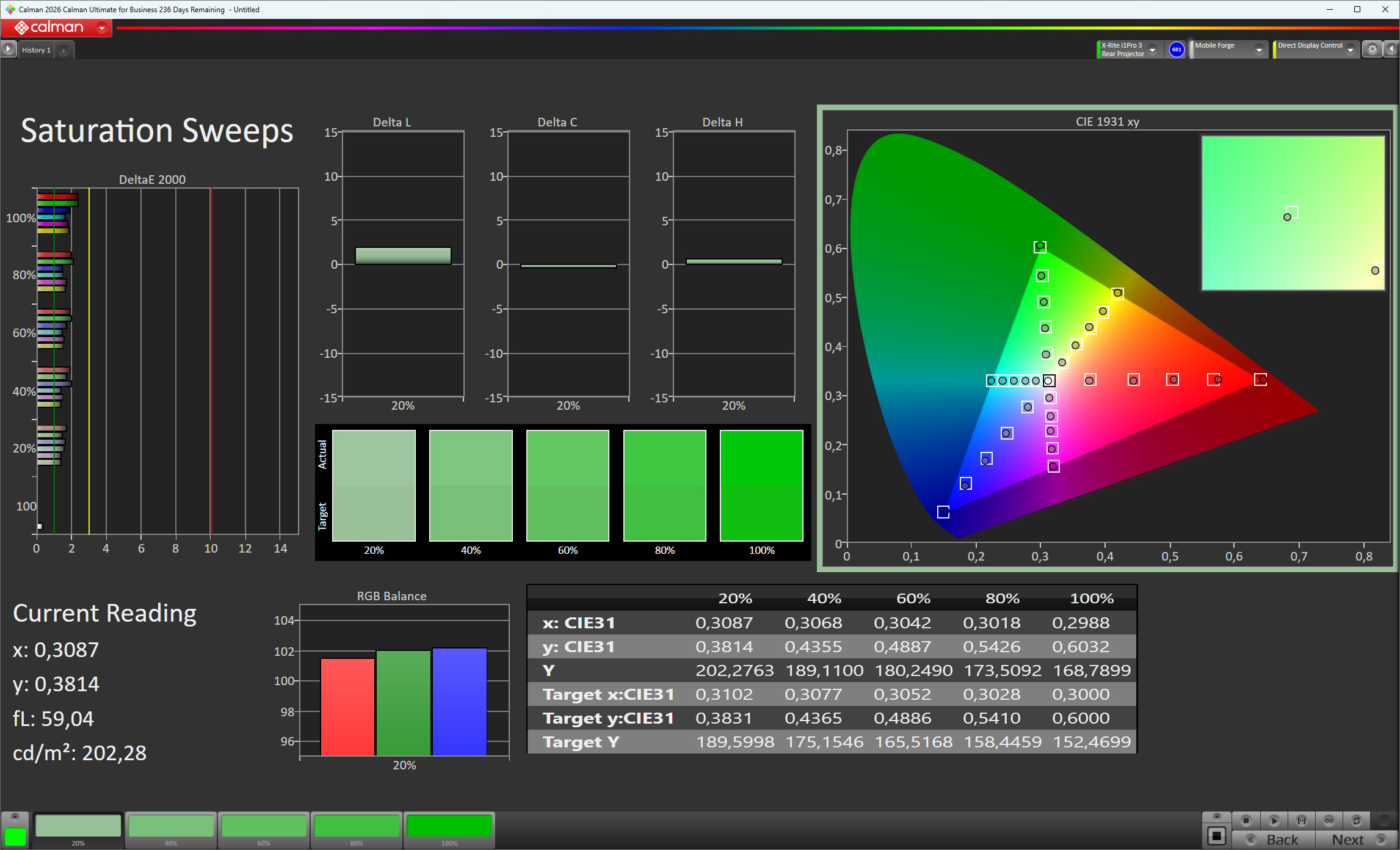
When the "Natural" display mode is selected in the Galaxy A57's settings, Calman certifies that the Samsung smartphone delivers accurate color reproduction. In the default " Vivid " mode, the display appears noticeably cooler.
Display Response Times
| ↔ Response Time Black to White | ||
|---|---|---|
| 1.1 ms ... rise ↗ and fall ↘ combined | ↗ 0.543 ms rise | 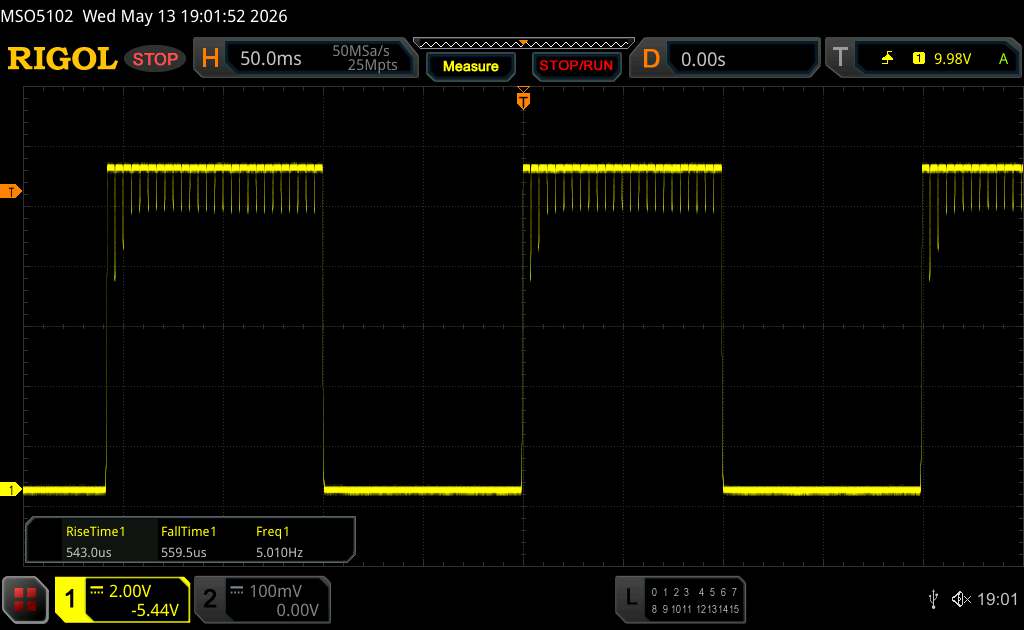 |
| ↘ 0.5595 ms fall | ||
| The screen shows very fast response rates in our tests and should be very well suited for fast-paced gaming. In comparison, all tested devices range from 0.1 (minimum) to 240 (maximum) ms. » 5 % of all devices are better. This means that the measured response time is better than the average of all tested devices (19.7 ms). | ||
| ↔ Response Time 50% Grey to 80% Grey | ||
| 1.21 ms ... rise ↗ and fall ↘ combined | ↗ 0.59 ms rise | 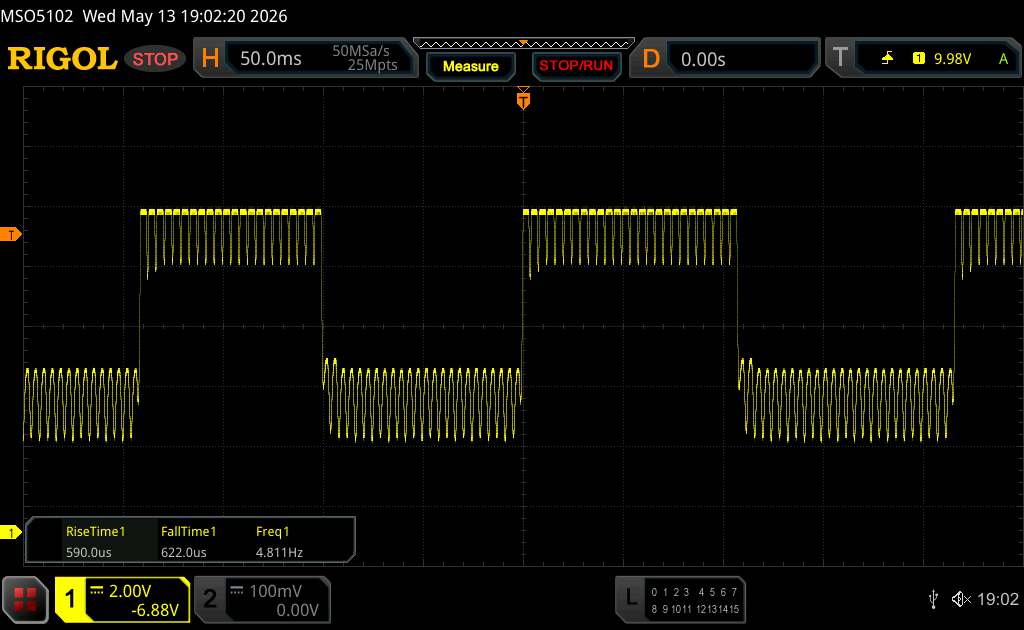 |
| ↘ 0.622 ms fall | ||
| The screen shows very fast response rates in our tests and should be very well suited for fast-paced gaming. In comparison, all tested devices range from 0.13 (minimum) to 636 (maximum) ms. » 6 % of all devices are better. This means that the measured response time is better than the average of all tested devices (30.7 ms). | ||
Outdoors, the Galaxy A57 performs well. It remains easy to read in most lighting conditions, though on sunny days it could be a bit brighter.

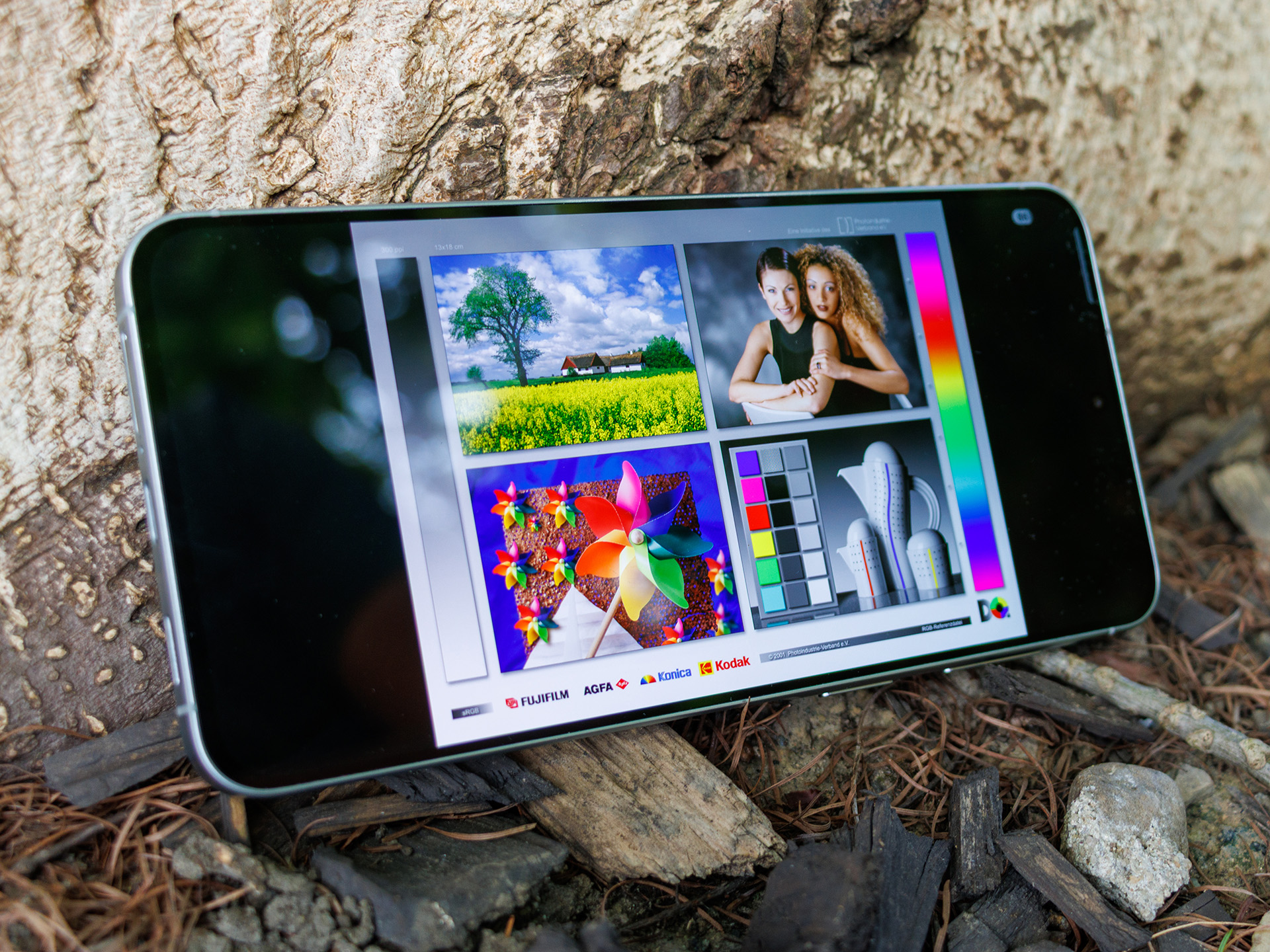
The panel's viewing angle stability is good, but even a slight change in viewing angle can result in a noticeable decrease in brightness, and a bluish color cast also becomes visible.

Performance - The Galaxy A57 is powered by the Exynos 1680
The Galaxy A57 5G features a Samsung-developed SoC, the Exynos 1680. It can access up to 8 GB of LPDDR5x RAM—and the 512 GB version even comes with 12 GB of RAM. This gives the smartphone solid everyday performance.
The CPU excels with high multi-core performance, a further 16% higher than that of the Exynos 1580, which powers the previous model. In terms of AI acceleration, the 1680 falls into the mid-range category.
| Antutu v11 - Score | |
| Xiaomi Poco X8 Pro Max | |
| Average of class Smartphone (519159 - 4450644, n=45, last 2 years) | |
| Samsung Galaxy A57 | |
| Average Samsung Exynos 1680 (n=1) | |
| PCMark for Android - Work 3.x | |
| Xiaomi Poco X8 Pro Max | |
| Samsung Galaxy A57 | |
| Average Samsung Exynos 1680 (n=1) | |
| Average of class Smartphone (4507 - 28557, n=133, last 2 years) | |
| UL Procyon AI Inference for Android - Overall Score NNAPI | |
| Xiaomi Poco X8 Pro Max | |
| Average of class Smartphone (2895 - 66164, n=99, last 2 years) | |
| Samsung Galaxy A57 | |
| Average Samsung Exynos 1680 (n=1) | |
| AImark - Score v3.x | |
| Xiaomi Poco X8 Pro Max | |
| Average of class Smartphone (293 - 307528, n=67, last 2 years) | |
| Samsung Galaxy A57 | |
| Average Samsung Exynos 1680 (n=1) | |
| AI Benchmark - Score V5 | |
| Average of class Smartphone (46.4 - 3334, n=18, last 2 years) | |
| Samsung Galaxy A57 | |
| Average Samsung Exynos 1680 (n=1) | |
The graphics calculations are performed by the integrated Xclipse 550. Although it is significantly ahead of an Adreno 810, it is still noticeably slower than an Adreno 722.
GFXBench (DX / GLBenchmark) 2.7: T-Rex Onscreen | 1920x1080 T-Rex Offscreen
GFXBench 3.0: on screen Manhattan Onscreen OGL | 1920x1080 1080p Manhattan Offscreen
GFXBench 3.1: on screen Manhattan ES 3.1 Onscreen | 1920x1080 Manhattan ES 3.1 Offscreen
GFXBench: on screen Car Chase Onscreen | 1920x1080 Car Chase Offscreen | on screen Aztec Ruins High Tier Onscreen | 2560x1440 Aztec Ruins High Tier Offscreen | on screen Aztec Ruins Normal Tier Onscreen | 1920x1080 Aztec Ruins Normal Tier Offscreen | 3840x2160 4K Aztec Ruins High Tier Offscreen
| 3DMark / Wild Life Extreme Unlimited | |
| Xiaomi Poco X8 Pro Max | |
| Google Pixel 10a | |
| Honor 600 | |
| Samsung Galaxy A57 | |
| Nothing Phone (4a) | |
| Motorola Edge 70 Fusion | |
| 3DMark / Wild Life Extreme | |
| Xiaomi Poco X8 Pro Max | |
| Google Pixel 10a | |
| Honor 600 | |
| Samsung Galaxy A57 | |
| Motorola Edge 70 Fusion | |
| Nothing Phone (4a) | |
| 3DMark / Wild Life Unlimited Score | |
| Xiaomi Poco X8 Pro Max | |
| Google Pixel 10a | |
| Honor 600 | |
| Samsung Galaxy A57 | |
| Nothing Phone (4a) | |
| Motorola Edge 70 Fusion | |
| 3DMark / Steel Nomad Light Unlimited Score | |
| Xiaomi Poco X8 Pro Max | |
| Google Pixel 10a | |
| Samsung Galaxy A57 | |
| Honor 600 | |
| Nothing Phone (4a) | |
| 3DMark / Steel Nomad Light Score | |
| Xiaomi Poco X8 Pro Max | |
| Google Pixel 10a | |
| Samsung Galaxy A57 | |
| Honor 600 | |
| Nothing Phone (4a) | |
| GFXBench (DX / GLBenchmark) 2.7 / T-Rex Onscreen | |
| Xiaomi Poco X8 Pro Max | |
| Samsung Galaxy A57 | |
| GFXBench (DX / GLBenchmark) 2.7 / T-Rex Offscreen | |
| Xiaomi Poco X8 Pro Max | |
| Samsung Galaxy A57 | |
| GFXBench 3.0 / Manhattan Onscreen OGL | |
| Xiaomi Poco X8 Pro Max | |
| Samsung Galaxy A57 | |
| GFXBench 3.0 / 1080p Manhattan Offscreen | |
| Xiaomi Poco X8 Pro Max | |
| Samsung Galaxy A57 | |
| GFXBench 3.1 / Manhattan ES 3.1 Onscreen | |
| Xiaomi Poco X8 Pro Max | |
| Samsung Galaxy A57 | |
| GFXBench 3.1 / Manhattan ES 3.1 Offscreen | |
| Xiaomi Poco X8 Pro Max | |
| Samsung Galaxy A57 | |
| GFXBench / Car Chase Onscreen | |
| Xiaomi Poco X8 Pro Max | |
| Google Pixel 10a | |
| Samsung Galaxy A57 | |
| GFXBench / Car Chase Offscreen | |
| Xiaomi Poco X8 Pro Max | |
| Google Pixel 10a | |
| Samsung Galaxy A57 | |
| GFXBench / Aztec Ruins High Tier Onscreen | |
| Xiaomi Poco X8 Pro Max | |
| Google Pixel 10a | |
| Samsung Galaxy A57 | |
| Honor 600 | |
| Nothing Phone (4a) | |
| Motorola Edge 70 Fusion | |
| GFXBench / Aztec Ruins High Tier Offscreen | |
| Xiaomi Poco X8 Pro Max | |
| Google Pixel 10a | |
| Honor 600 | |
| Samsung Galaxy A57 | |
| Nothing Phone (4a) | |
| Motorola Edge 70 Fusion | |
| GFXBench / Aztec Ruins Normal Tier Onscreen | |
| Xiaomi Poco X8 Pro Max | |
| Google Pixel 10a | |
| Honor 600 | |
| Samsung Galaxy A57 | |
| Motorola Edge 70 Fusion | |
| Nothing Phone (4a) | |
| GFXBench / Aztec Ruins Normal Tier Offscreen | |
| Xiaomi Poco X8 Pro Max | |
| Google Pixel 10a | |
| Honor 600 | |
| Samsung Galaxy A57 | |
| Nothing Phone (4a) | |
| Motorola Edge 70 Fusion | |
| GFXBench / 4K Aztec Ruins High Tier Offscreen | |
| Xiaomi Poco X8 Pro Max | |
| Google Pixel 10a | |
| Honor 600 | |
| Samsung Galaxy A57 | |
| Nothing Phone (4a) | |
| Motorola Edge 70 Fusion | |
The Galaxy A57's browser performance is good, and browsing the web is a breeze.
| Jetstream 2 | |
| 2.0 Total | |
| Xiaomi Poco X8 Pro Max (Chrome 147) | |
| Samsung Galaxy A57 (Chrome 149) | |
| Average Samsung Exynos 1680 (n=1) | |
| Average of class Smartphone (63.9 - 423, n=117, last 2 years) | |
| Motorola Edge 70 Fusion (Chrome 146) | |
| 2.2 Total | |
| Google Pixel 10a (Chrome 149) | |
| Xiaomi Poco X8 Pro Max (Chrome 147) | |
| Average Samsung Exynos 1680 (n=1) | |
| Average of class Smartphone (2 - 480, n=104, last 2 years) | |
| Samsung Galaxy A57 (Chrome 149) | |
| Nothing Phone (4a) (Chrome 147) | |
| Honor 600 (Chrome 149) | |
| Speedometer 2.0 - Result 2.0 | |
| Xiaomi Poco X8 Pro Max (Chrome 147) | |
| Samsung Galaxy A57 (Chrome 149) | |
| Average Samsung Exynos 1680 (n=1) | |
| Average of class Smartphone (49.3 - 733, n=73, last 2 years) | |
| Speedometer 3 - Score 3.0 | |
| Xiaomi Poco X8 Pro Max (Chrome 147) | |
| Samsung Galaxy A57 (Chrome 149) | |
| Average Samsung Exynos 1680 (n=1) | |
| Average of class Smartphone (3.06 - 45.5, n=81, last 2 years) | |
| WebXPRT 4 - Overall | |
| Xiaomi Poco X8 Pro Max (Chrome 147) | |
| Samsung Galaxy A57 (Chrome 149) | |
| Average Samsung Exynos 1680 (n=1) | |
| Average of class Smartphone (56 - 278, n=90, last 2 years) | |
| WebXPRT 5 - Overall | |
| Average of class Smartphone (19 - 104, n=26, last 2 years) | |
| Samsung Galaxy A57 (Chrome 149) | |
| Average Samsung Exynos 1680 (n=1) | |
| Xiaomi Poco X8 Pro Max (Chrome 147) | |
| Octane V2 - Total Score | |
| Samsung Galaxy A57 (Chrome 149) | |
| Average Samsung Exynos 1680 (n=1) | |
| Xiaomi Poco X8 Pro Max (Chrome 147) | |
| Average of class Smartphone (6015 - 126661, n=135, last 2 years) | |
| Mozilla Kraken 1.1 - Total | |
| Average of class Smartphone (281 - 2718, n=120, last 2 years) | |
| Average Samsung Exynos 1680 (n=1) | |
| Samsung Galaxy A57 (Chrome 149) | |
| Xiaomi Poco X8 Pro Max (Chrome 147) | |
* ... smaller is better
The Samsung smartphone's fast UFS 3.1 storage offers high speeds, but it is slightly slower than the average smartphone with this type of storage, especially when writing small data blocks. In everyday use, however, this isn't noticeably problematic.
| Samsung Galaxy A57 | Xiaomi Poco X8 Pro Max | Honor 600 | Google Pixel 10a | Nothing Phone (4a) | Motorola Edge 70 Fusion | Average 256 GB UFS 3.1 Flash | Average of class Smartphone | |
|---|---|---|---|---|---|---|---|---|
| AndroBench 3-5 | 29% | 81% | 49% | 47% | 82% | 37% | 70% | |
| Sequential Read 256KB (MB/s) | 1683.07 | 2067.34 23% | 1986.99 18% | 1689.27 0% | 2003.93 19% | 2049.4 22% | 1775 ? 5% | 2278 ? 35% |
| Sequential Write 256KB (MB/s) | 1119.11 | 1942.35 74% | 1807.77 62% | 826.38 -26% | 1596.2 43% | 1825.9 63% | 1247 ? 11% | 1971 ? 76% |
| Random Read 4KB (MB/s) | 249.83 | 366.17 47% | 353.95 42% | 326.53 31% | 263.22 5% | 351.2 41% | 290 ? 16% | 317 ? 27% |
| Random Write 4KB (MB/s) | 149.04 | 108.21 -27% | 451 203% | 430.37 189% | 325.75 119% | 452.1 203% | 319 ? 114% | 362 ? 143% |
Games - Not for Enthusiasts
Using GameBench, we tested a few select games on the Samsung Galaxy A57 5G, which isn’t exactly a gaming powerhouse. While the frame rates achieved are consistently good, it’s always necessary to lower the detail level, or higher display quality isn’t even available. For example, the Ultra HD setting isn’t available in PUBG, Genshin Impact suffers from stuttering, and the smartphone gets very warm at high frame rates.
Casual games are no problem for the A57, but anyone who enjoys playing FPS games or graphically intensive titles won’t be entirely satisfied with this Samsung phone.


Emissions - Exynos 1680 Barely Reduces Them
Temperature
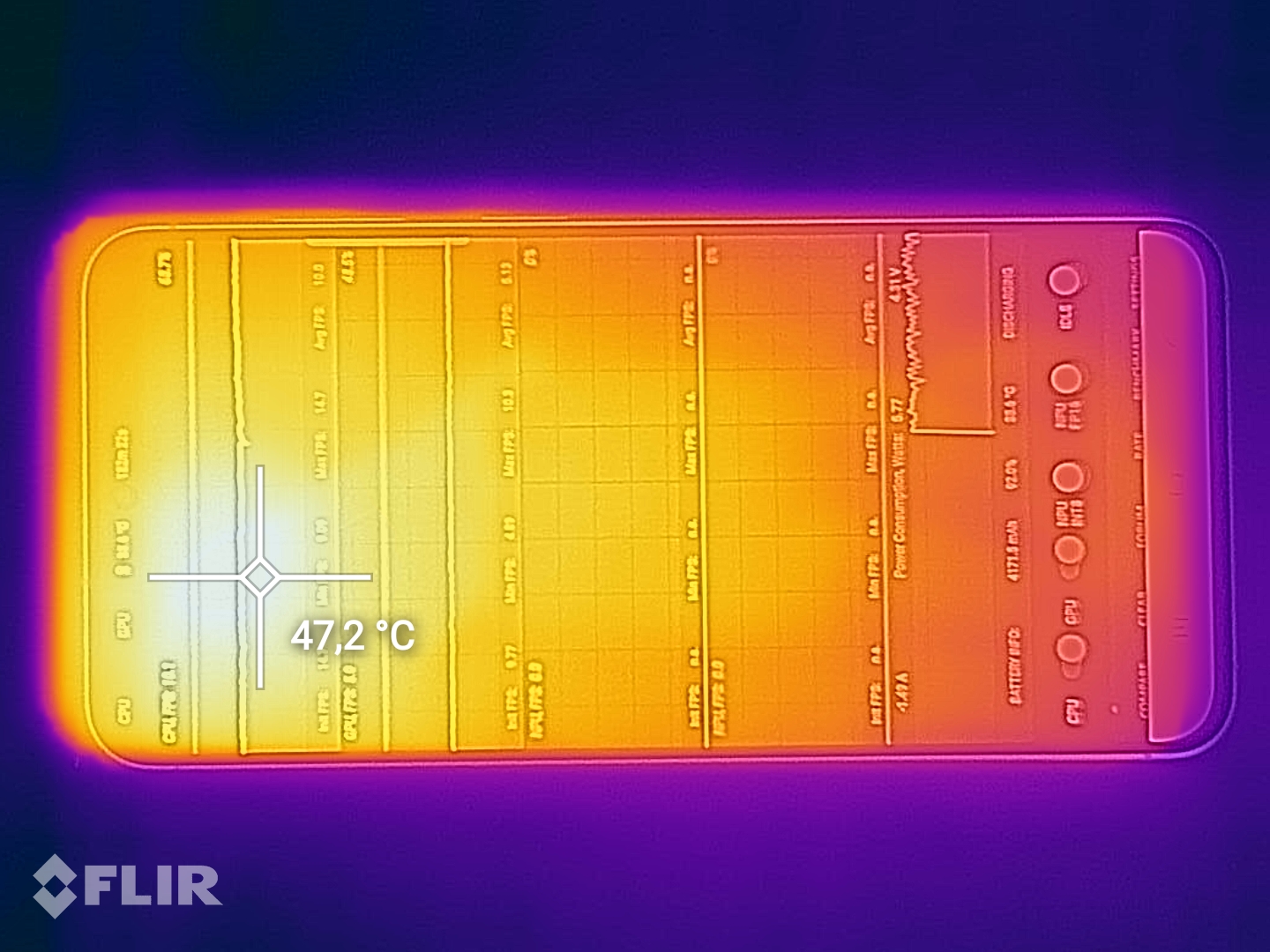
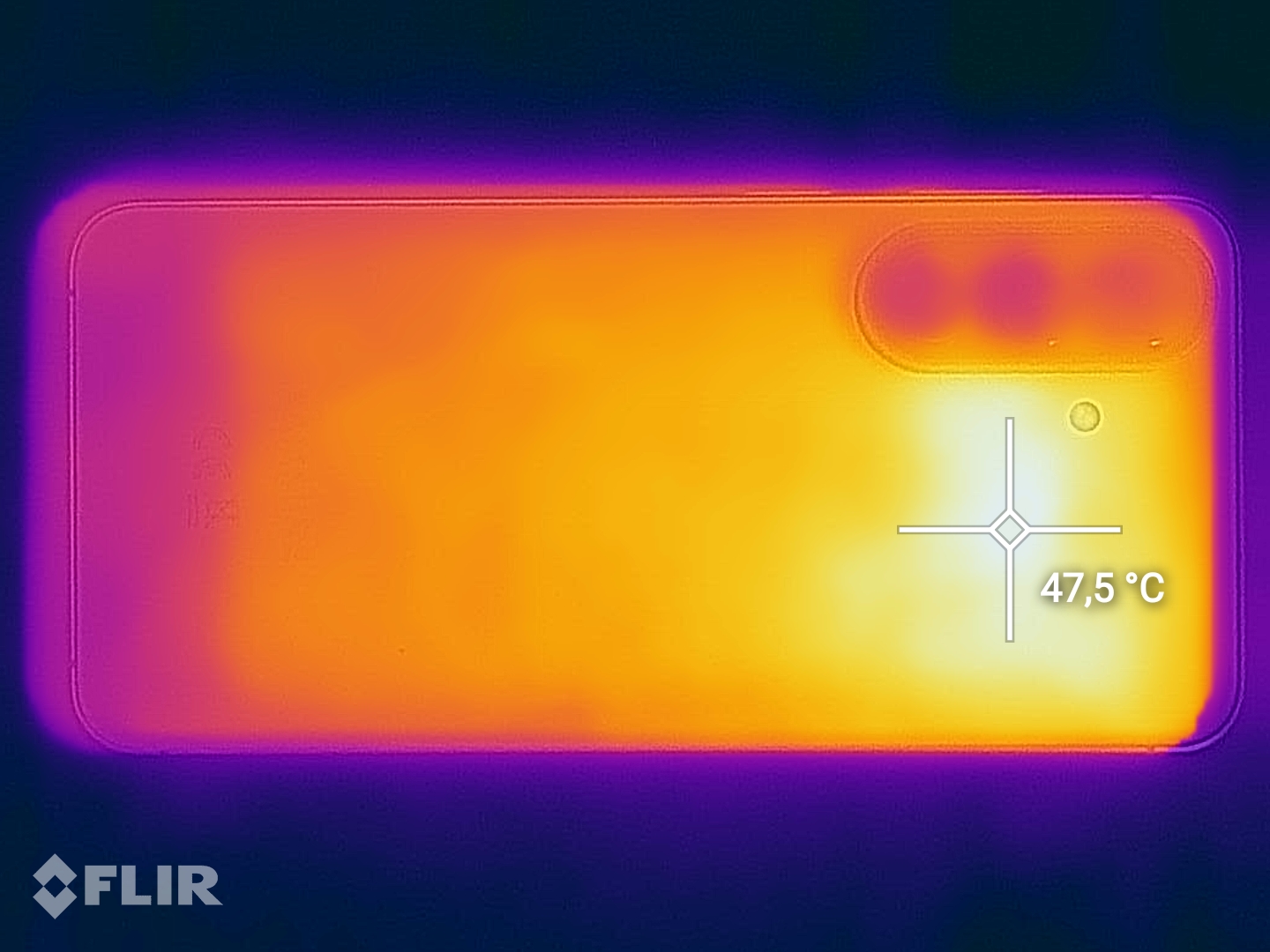
The Galaxy A57's surface temperatures can rise significantly under sustained load, causing large areas of the device to heat up to over 40 °C; however, this is never uncomfortable or a cause for concern.
In 3DMark stress tests, it remains largely stable and experiences only a slight drop in performance; in the latest Steel Nomad Light test, performance is even consistent.
(-) The maximum temperature on the upper side is 47 °C / 117 F, compared to the average of 35.4 °C / 96 F, ranging from 21.9 to 247 °C for the class Smartphone.
(-) The bottom heats up to a maximum of 47.8 °C / 118 F, compared to the average of 34.1 °C / 93 F
(+) In idle usage, the average temperature for the upper side is 30.6 °C / 87 F, compared to the device average of 33 °C / 91 F.
3DMark Stress Tests
| 3DMark | |
| Wild Life Stress Test Stability | |
| Nothing Phone (4a) | |
| Motorola Edge 70 Fusion | |
| Honor 600 | |
| Samsung Galaxy A57 | |
| Google Pixel 10a | |
| Xiaomi Poco X8 Pro Max | |
| Wild Life Extreme Stress Test | |
| Nothing Phone (4a) | |
| Honor 600 | |
| Samsung Galaxy A57 | |
| Motorola Edge 70 Fusion | |
| Google Pixel 10a | |
| Xiaomi Poco X8 Pro Max | |
| Steel Nomad Light Stress Test Stability | |
| Honor 600 | |
| Samsung Galaxy A57 | |
| Nothing Phone (4a) | |
| Google Pixel 10a | |
| Xiaomi Poco X8 Pro Max | |
Speaker
Despite the smartphone's slim profile, the two speakers on the Samsung Galaxy A57 deliver decent sound quality. However, the bass is rather weak, and at maximum volume, the sound becomes quite tinny.
As usual, Samsung is a bit stingy with Bluetooth codecs, but it does support SSC. With Dual Audio, you can connect two pairs of headphones or speakers at the same time, though only the SBC codec is used in this case. Wired headphones can be connected via USB.
Samsung Galaxy A57 audio analysis
(+) | speakers can play relatively loud (89.1 dB)
Bass 100 - 315 Hz
(-) | nearly no bass - on average 19.1% lower than median
(±) | linearity of bass is average (9.8% delta to prev. frequency)
Mids 400 - 2000 Hz
(±) | higher mids - on average 6.5% higher than median
(+) | mids are linear (6.4% delta to prev. frequency)
Highs 2 - 16 kHz
(+) | balanced highs - only 4.2% away from median
(+) | highs are linear (4.4% delta to prev. frequency)
Overall 100 - 16.000 Hz
(±) | linearity of overall sound is average (16.1% difference to median)
Compared to same class
» 6% of all tested devices in this class were better, 5% similar, 90% worse
» The best had a delta of 11%, average was 34%, worst was 136%
Compared to all devices tested
» 26% of all tested devices were better, 5% similar, 69% worse
» The best had a delta of 4%, average was 23%, worst was 136%
Google Pixel 10a audio analysis
(+) | speakers can play relatively loud (84.9 dB)
Bass 100 - 315 Hz
(-) | nearly no bass - on average 16.6% lower than median
(±) | linearity of bass is average (9.5% delta to prev. frequency)
Mids 400 - 2000 Hz
(+) | balanced mids - only 4.4% away from median
(+) | mids are linear (5.1% delta to prev. frequency)
Highs 2 - 16 kHz
(+) | balanced highs - only 4.1% away from median
(+) | highs are linear (4.8% delta to prev. frequency)
Overall 100 - 16.000 Hz
(+) | overall sound is linear (14.6% difference to median)
Compared to same class
» 2% of all tested devices in this class were better, 2% similar, 96% worse
» The best had a delta of 11%, average was 34%, worst was 136%
Compared to all devices tested
» 19% of all tested devices were better, 4% similar, 77% worse
» The best had a delta of 4%, average was 23%, worst was 136%
Battery Life - 5,000 mAh in the Galaxy A57
Power consumption
The Galaxy A57's power consumption is at a reasonable level under load and at minimum display brightness, but it increases slightly at full brightness.
The Samsung smartphone can only be charged via a cable at up to 45 watts. In our test, it took 71 minutes to fully charge the battery.
| Off / Standby |   0.07 / 0.56 Watt 0.07 / 0.56 Watt |
| Idle |  0.71 / 1.94 / 2.04 Watt 0.71 / 1.94 / 2.04 Watt |
| Load |
6.19 / 13.67 Watt |
    
| |
Key:
min: ,
med: ,
max: Metrahit Energy | |
| Samsung Galaxy A57 5000 mAh | Xiaomi Poco X8 Pro Max 8500 mAh | Honor 600 6400 mAh | Google Pixel 10a 5100 mAh | Nothing Phone (4a) 5080 mAh | Average Samsung Exynos 1680 | Average of class Smartphone | |
|---|---|---|---|---|---|---|---|
| Power Consumption | 1% | -35% | 34% | -16% | 0% | 5% | |
| Idle Minimum * (Watt) | 0.71 | 1.19 -68% | 1.24 -75% | 0.7 1% | 0.97 -37% | 0.71 ? -0% | 0.901 ? -27% |
| Idle Average * (Watt) | 1.94 | 1.23 37% | 2.28 -18% | 0.94 52% | 2.07 -7% | 1.94 ? -0% | 1.483 ? 24% |
| Idle Maximum * (Watt) | 2.04 | 1.43 30% | 2.3 -13% | 1.03 50% | 2.13 -4% | 2.04 ? -0% | 1.677 ? 18% |
| Load Average * (Watt) | 6.19 | 6.8 -10% | 6.19 ? -0% | 6.82 ? -10% | |||
| Load Maximum * (Watt) | 13.67 | 11.45 16% | 13.7 ? -0% | 10.8 ? 21% |
* ... smaller is better
Power consumption: Geekbench (150 cd/m²)
Power consumption: GFXbench (150 cd/m²)
Battery life
The Samsung Galaxy A57's battery life is surprisingly short, especially since it's significantly shorter than that of its predecessor, which had a battery of the same size.
In this comparison, the A57 comes in last. Hopefully, Samsung will address this issue with a future update.
| Samsung Galaxy A57 5000 mAh | Xiaomi Poco X8 Pro Max 8500 mAh | Honor 600 6400 mAh | Google Pixel 10a 5100 mAh | Nothing Phone (4a) 5080 mAh | Motorola Edge 70 Fusion 7000 mAh | Samsung Galaxy A56 5G 5000 mAh | |
|---|---|---|---|---|---|---|---|
| Battery runtime | 20% | 52% | 34% | 21% | 38% | 31% | |
| Reader / Idle (h) | 39.8 | 35.2 -12% | 39.3 -1% | 52.9 33% | |||
| H.264 (h) | 26.8 | 32 19% | 41.8 56% | ||||
| WiFi v1.3 (h) | 14.9 | 23.2 56% | 22.6 52% | 20 34% | 18 21% | 24.5 64% | 20 34% |
| Load (h) | 3.6 | 4.2 17% | 5.4 50% | 3.6 0% |
Notebookcheck Overall Rating
The Samsung Galaxy A57 5G impresses with its high-quality build, solid everyday performance, and long-term software support, but it fails to live up to its potential due to its poor battery life, limited improvements over its predecessor, and high MSRP.
Samsung Galaxy A57
- 07/09/2026 v8
Daniel Schmidt
 Total Sustainability Score:
 Possible Alternatives Comparison
Image | Model / Review | Price | Weight | Drive | Display |
|---|---|---|---|---|---|
1. 81.5%  | Samsung Galaxy A57 Samsung Exynos 1680 ⎘ Samsung Xclipse 550 ⎘ 8 GB Memory, 256 GB UFS 3.1 | List Price: 589€ | 179 g | 256 GB UFS 3.1 Flash | 6.70" 2340x1080 385 PPI Super AMOLED |
2. 85.6%  | Xiaomi Poco X8 Pro Max Mediatek Dimensity 9500s ⎘ ARM Immortalis-G925 MC11 ⎘ 12 GB Memory, 512 GB UFS 4.x | Amazon: List Price: 470€ | 218 g | 512 GB UFS 4.1 Flash | 6.83" 2772x1280 447 PPI AMOLED |
3. 82.8%  | Honor 600 Qualcomm Snapdragon 7 Gen 4 SM7750-AB ⎘ Qualcomm Adreno 722 ⎘ 8 GB Memory, 512 GB UFS 3.1 | Amazon: $729.00 List Price: 650€ | 185 g | 512 GB UFS 3.1 Flash | 6.57" 2728x1264 458 PPI AMOLED |
4. 85.3%  | Google Pixel 10a Google Tensor G4 ⎘ ARM Mali-G715 MP7 ⎘ 8 GB Memory, 128 GB UFS 3.1 | List Price: 549€ | 183 g | 128 GB UFS 3.1 Flash | 6.30" 2424x1080 421 PPI pOLED |
5. 78.6%  | Nothing Phone (4a) Qualcomm Snapdragon 7s Gen 4 ⎘ Qualcomm Adreno 810 ⎘ 12 GB Memory, 256 GB UFS 3.1 | List Price: 429€ | 204.5 g | 256 GB UFS 3.1 Flash | 6.78" 2720x1224 440 PPI AMOLED |
6. 77.4%  | Motorola Edge 70 Fusion Qualcomm Snapdragon 7s Gen 3 ⎘ Qualcomm Adreno 810 ⎘ 8 GB Memory, 256 GB UFS 3.1 | List Price: 420€ | 193 g | 256 GB UFS 3.1 Flash | 6.78" 2772x1272 450 PPI AMOLED |
Transparency
The selection of devices to be reviewed is made by our editorial team. The test sample was provided to the author as a loan by the manufacturer or retailer for the purpose of this review. The lender had no influence on this review, nor did the manufacturer receive a copy of this review before publication. There was no obligation to publish this review. As an independent media company, Notebookcheck is not subjected to the authority of manufacturers, retailers or publishers.
This is how Notebookcheck is testing
Every year, Notebookcheck independently reviews hundreds of laptops and smartphones using standardized procedures to ensure that all results are comparable. We have continuously developed our test methods for around 20 years and set industry standards in the process. In our test labs, high-quality measuring equipment is utilized by experienced technicians and editors. These tests involve a multi-stage validation process. Our complex rating system is based on hundreds of well-founded measurements and benchmarks, which maintains objectivity. Further information on our test methods can be found here.
 Add as a preferred source on Google


