




Nvidia's DLSS 5 hands-on tests reveal "AI slop" backlash might have been overblown
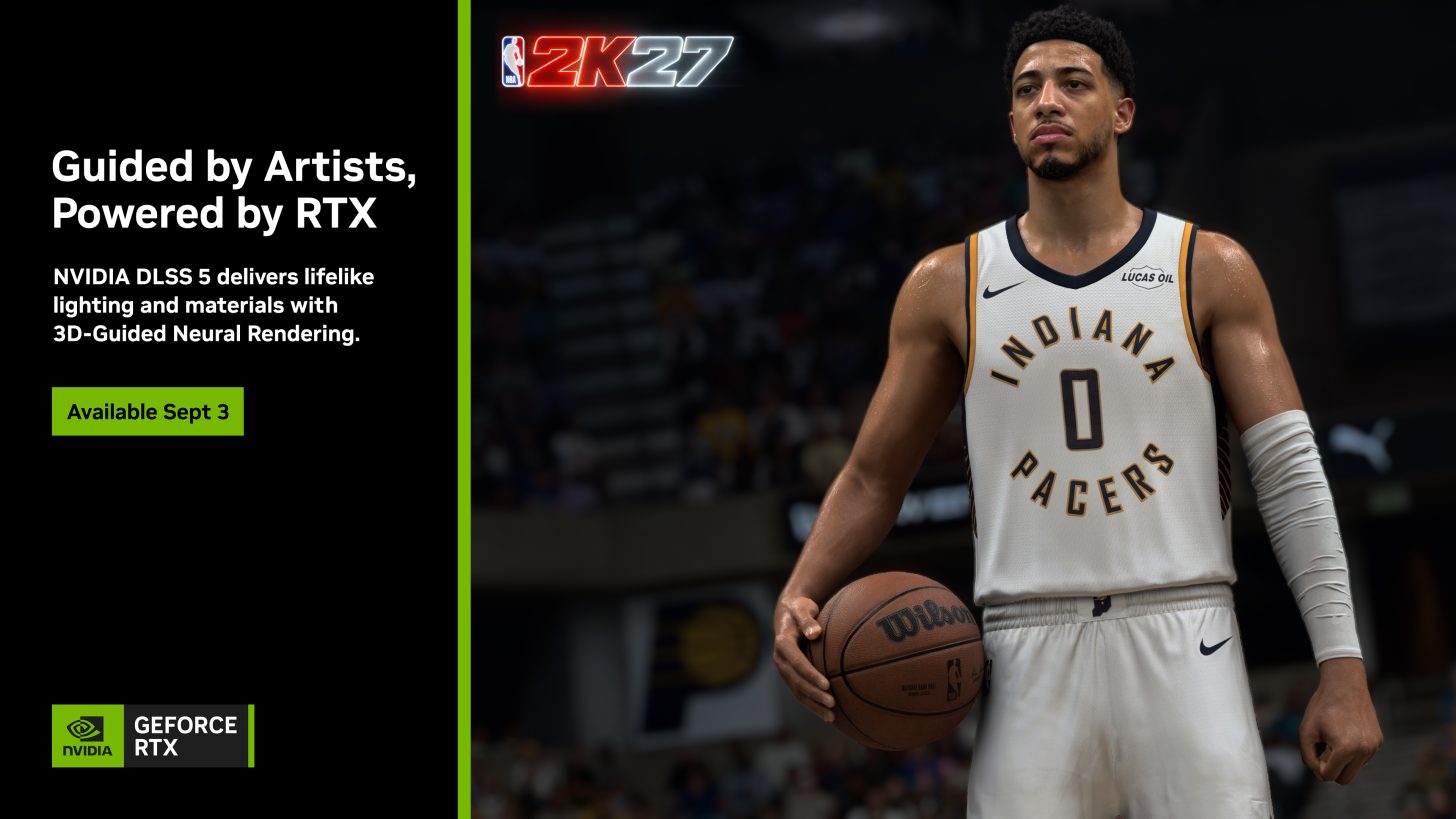
Nvidia's DLSS 5 launches September 3 alongside NBA 2K27, and hands-on previews of the finished version at Gamescom 2026 suggest it looks much cleaner than the demo that sparked a wave of backlash when the technology was first revealed in March.
An "AI slop" story that seems considerably exaggerated
Critics instantly branded the March reveal as generative "AI slop" for visibly altering character models in early tech demos, with Resident Evil Requiem's Leon S. Kennedy and Starfield becoming particular flashpoints. Journalists who saw the technology running NBA 2K27 at Gamescom came away with a similar reaction: cautious skepticism turning into genuine surprise. Nvidia says the technology is trained to "preserve artistic intent," and it looked far more restrained than the original reveal. “The level of detail in character faces in terms of lighting and shadows is truly next-level,” according to TechRadar, while Alessio Palumbo at Wccftech described it as “a generational leap the likes of which hasn't been seen in a long time”.
An overdone, untuned demo is being fingered as the culprit
Nvidia representatives reportedly explained that the March demo had every one of DLSS 5's intensity sliders set to maximum, exaggerating the effect well beyond anything a developer would realistically ship, and that the NBA 2K27 build was tuned directly by developer Visual Concepts rather than Nvidia itself. The technology works through three separate models covering structure intensity, tone intensity, and masking, affecting elements like ambient occlusion, contact shadows, reflections, and broader lighting. The Masking model lets developers manually or automatically control where each effect applies, giving studios more direct control over the final rendered image rather than leaving the look entirely to Nvidia's defaults.
DLSS 5 is launching exclusively to GeForce RTX 50 series GPUs and GeForce NOW, though Nvidia says it's exploring ways to eventually bring the feature to older cards. The original March demo required two RTX 5090 GPUs just to run, while the finished version now works on any single RTX 5000 series card, including laptops. Nvidia's own NBA 2K27 benchmarks show an RTX 5060 reaching 258 fps at 1080p on High settings, and an RTX 5090 hitting 370 fps at 4K Ultra using Performance mode, both with ray tracing and Multi Frame Generation enabled alongside DLSS 5.
Detractors exist even as optimization remains a key concern
Not every hands-on account was fully won over. Some outlets that saw the tech in action still described the improvements as subtle rather than transformative, and Nvidia itself has been candid about the remaining gap, with the company's Edward Liu, director of applied deep learning research, telling reporters the goal of true photorealism remains "a chasm" away from where the technology currently stands (via Engadget).
The bigger lingering worry isn't really about Nvidia's own implementation, but about what happens once other studios get their hands on the tool. There's a real risk some developers treat DLSS 5 as a shortcut for impressive visuals rather than a finishing touch on already well-built graphics, echoing similar concerns raised previously about Nvidia's Multi Frame Generation being used to paper over poor optimization. It remains an optional setting either way, meaning players who don't like the results can simply turn it off.
 Add as a preferred source on Google


