




Huawei Watch D3: ECG technology in detail—limitations, benefits, and background
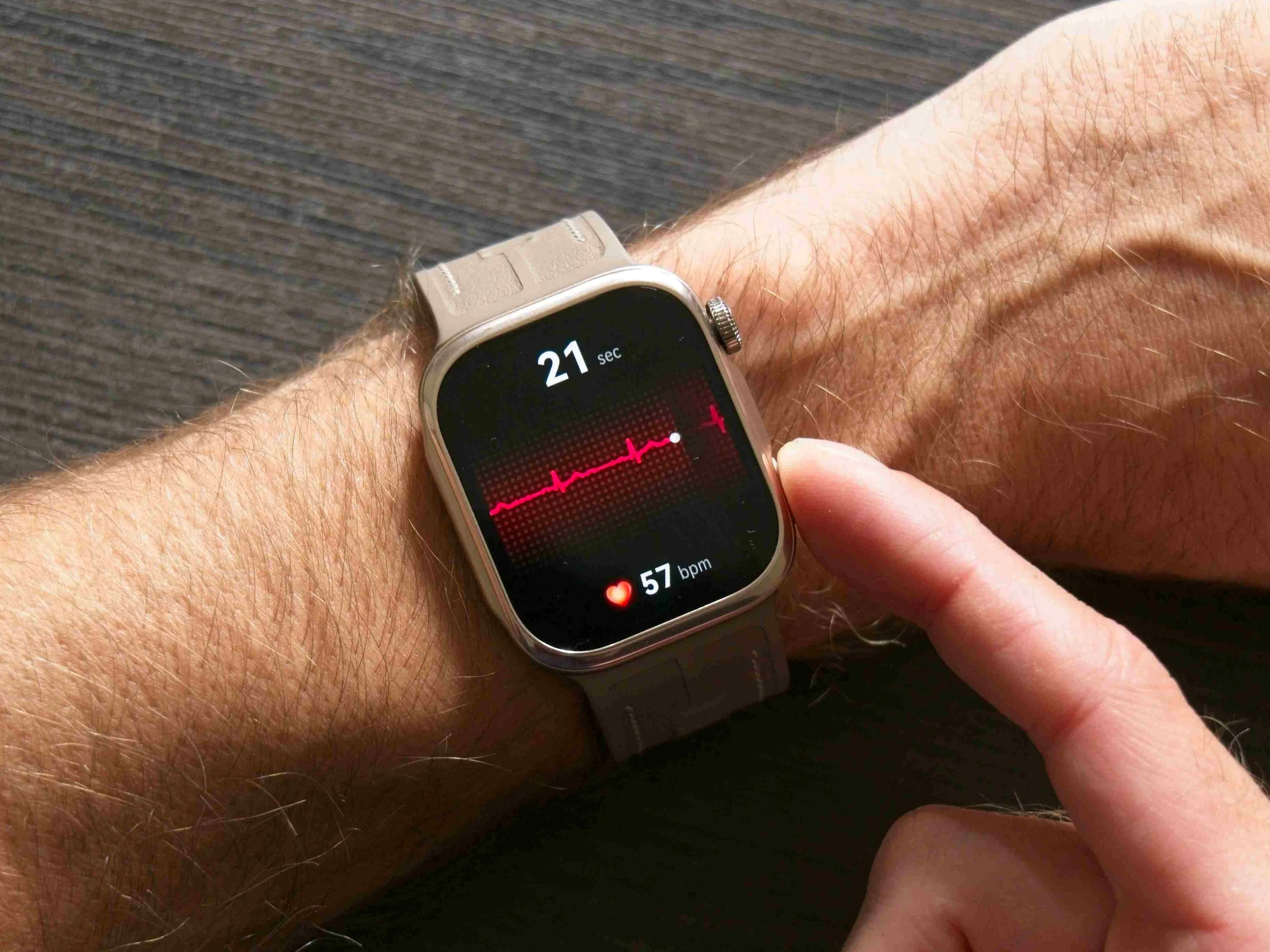
The Huawei Watch D3 also comes with an ECG feature
Disclosure: This article is based on a German original that was reviewed by a practicing physician with a Dr. med. for technical accuracy and fact-checked regarding medical content. To protect privacy, the author’s real name is not disclosed; contact information remains on file with the editorial team.
With the Watch D3, Huawei offers a new smartwatch that places a strong focus on health features, and we have already had the opportunity to put it through its paces. A feature increasingly integrated into modern wearables is the ability to record and automatically analyze an electrocardiogram (ECG). While even affordable smartwatches can produce fairly accurate ECG recordings, the analysis remains the critical sticking point: unless you are a medical professional, you must be able to trust the software's evaluation. We strongly advise relying solely on certified medical devices—such as the Huawei Watch D3—for this purpose.
Technical Background
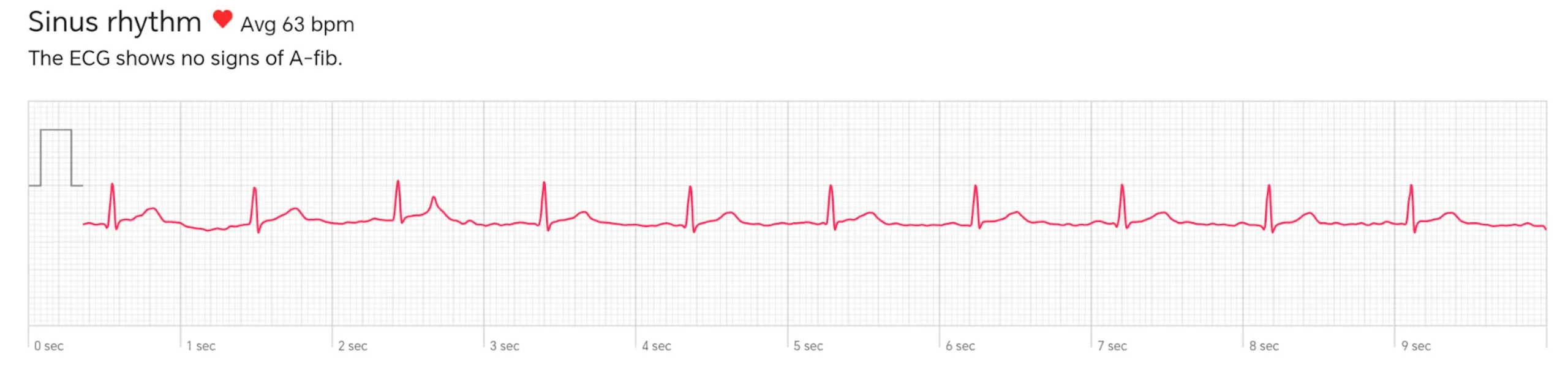
Technically, an ECG relies on a straightforward, direct measurement mechanism: contact with two electrically isolated electrodes closes a passive circuit through the body. With every beat, the heart generates minute electrical potential changes in the cardiac muscle cells, which are detected by the sensors. The device then processes this signal internally, specifically filtering out the DC offset. This settling process can often be observed on the display right at the start of a reading: the signal visibly stabilizes within seconds as the system automatically optimizes gain and filter levels.

Wearables vs. Medical Technology
Anyone who has ever had a medical ECG will likely remember that clinics and ambulances use far more than two electrodes. The clinical gold standard is a 12-lead ECG, which requires 10 distinct electrodes to measure heart activity across 12 different visual angles, or "leads."
While tracking 12 leads might seem redundant at first, detailed medical diagnostics require analyzing distinct regions of the heart muscle rather than just overall activity. A smartwatch, by contrast, records only Einthoven’s Lead I—measuring the potential difference from the right arm to the left arm—which isolates the lateral wall of the heart. By comparison, Einthoven’s Lead II measures from the right arm to the left leg, visualizing the inferior/posterior wall.
This technical limitation has major practical consequences: even a flawless smartwatch ECG evaluated by a cardiologist cannot detect a posterior wall infarction or localized muscle damage. To their credit, wearable manufacturers—including Huawei—explicitly state these diagnostic boundaries in their documentation.
An ECG smartwatch is not a cure-all
Like any other ECG-capable smartwatch, the Huawei Watch D3 cannot deliver a comprehensive cardiac diagnosis. What it can do, however, is reliably identify arrhythmias—a major risk factor for adverse cardiovascular events. The Watch D3’s key advantage over a clinical ECG is its constant presence: it allows users to capture potential rhythm disturbances on demand in everyday situations, whether waiting for a bus or mid-workout. Even a standard 24-hour Holter monitor can easily miss paroxysmal arrhythmias if they fail to manifest during that specific recording window. That said, individual spot measurements on the Huawei Watch D3 remain capped at 30 seconds each.
Ultimately, catching transient arrhythmias is largely a matter of statistical probability. It is difficult to declare whether daily smartwatch wear inherently beats a standard 24-hour ECG, as both approaches carry distinct trade-offs. However, because a smartwatch is always accessible, it significantly increases the odds of capturing an event right as symptoms occur.
In this regard, the Huawei Watch D3 leaves room for critique. It would have been impressive to see Huawei push boundaries in ECG technology as well—perhaps by enabling additional leads via a clip-on accessory or supporting overnight recording. Delivering such features would have solidified a truly pioneering role in the wearable space, mirroring its achievement with cuff-based blood pressure measurement.
Self-Test and Assessment of ECG Quality
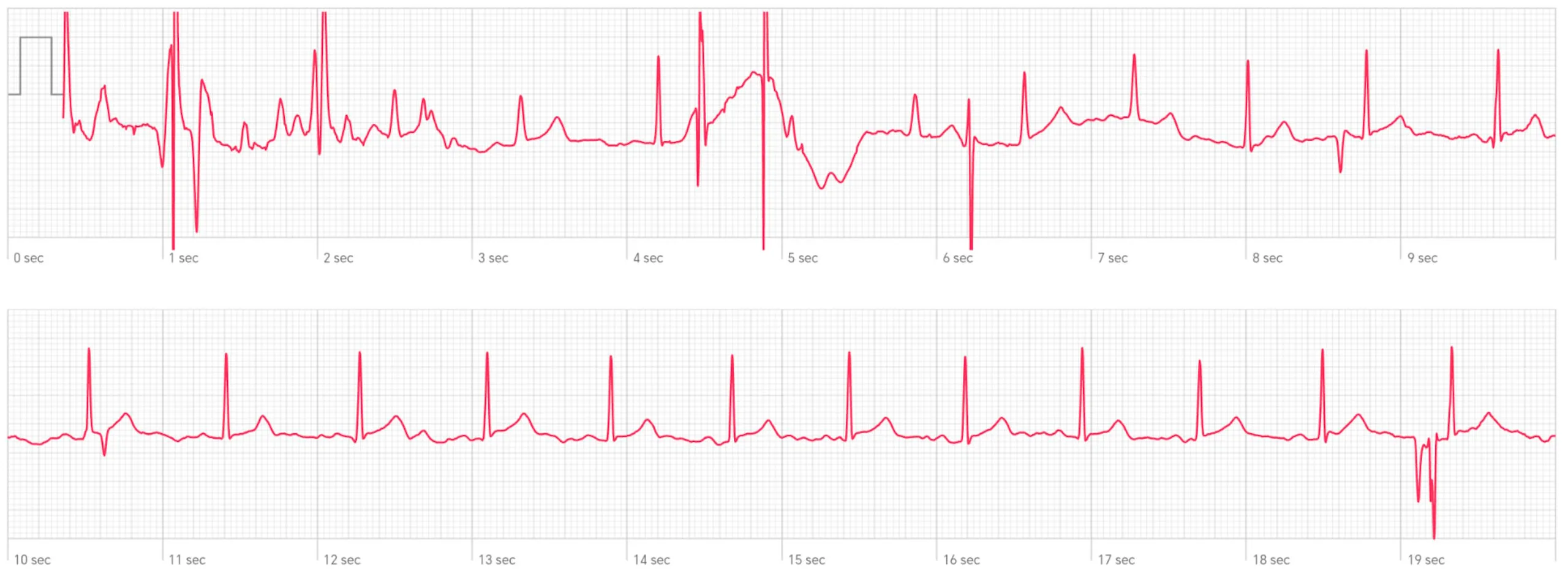
To evaluate the iHeal 6—a smartwatch we strongly advise against (sales were halted after our review was published)—we previously tested ECG functionality beyond its intended use. At the time, this served to prove that the device was taking actual measurements rather than generating fabricated, normal-range values—a issue we frequently observe with uncertified blood glucose trackers. We applied a similar approach to the Huawei Watch D3, not to uncover flaws, but as a technical-medical experiment. In theory, supplementary leads can be recorded using standard smartwatches. In practice, placing the watch chassis against a shaved lower leg while touching the electrode with a finger generates a functional secondary lead. The watch exports these readings directly as PDF files.
Our medical consultation yielded a positive assessment: clinicians can evaluate these alternative leads for critical indicators like ST-segment elevation, even though the primary algorithm focuses on rhythm analysis. However, reviewing multiple leads recorded this way is far from seamless. Standard clinical equipment displays concurrent leads stacked on a single readout; the Watch D3 generates a standalone PDF for each individual 30-second trace. Furthermore, true precordial (chest) leads remain impractical without structural modifications, limiting off-label tracking to limb-to-limb derivations. Rather than pointing out a defect, this test highlights both the physiological potential and the practical limits of single-channel wearable ECG sensors.
Conclusion
Providing blanket advice on health topics is always challenging—especially for an IT publication. Nevertheless, readers should actively monitor their cardiovascular health: events like heart attacks or strokes are far too common and often lead to severe suffering and permanent impairments. ECG-capable smartwatches like the Huawei Watch D3 serve as valuable tools for everyday awareness, but they must never foster a false sense of security.
Anyone with a family history of heart disease or noticeable symptoms should seek a medical evaluation. When specific concerns arise, physicians generally order clinical ECGs without hesitation given their modest cost—even though a standard resting ECG is, unfortunately, no longer routinely included in general health checkups for adults over 35.
 Add as a preferred source on Google


No comments for this article
